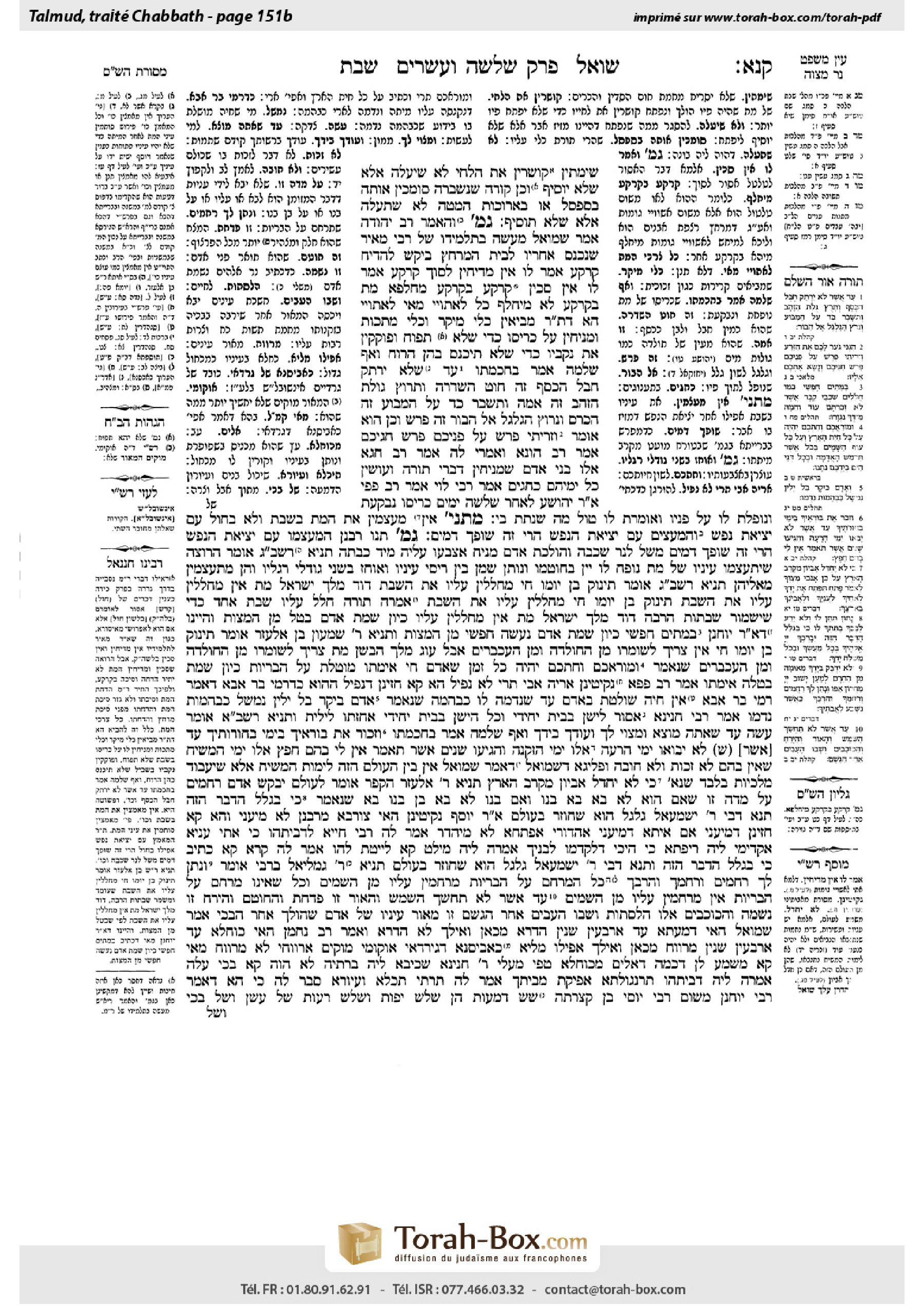
Shabbat 151b: Talmud study for Daf Yomi
Daf Yomi is the daily study of one Talmud folio. Explore 37 tractates with scans, Hebrew text, Sefaria English and AI-generated French translations where annotated.
Passage selection and English or AI-generated French translation are available where the scan has annotations. Daf Study is independent of Torah-Box and Sefaria.
Browse Shabbat · שבת · All tractatesShabbat 151b text and translations
This page of Shabbat includes the Aramaic text, an English translation and an AI-generated French translation, alongside the scan above.
שבת קנ״א ב · Aramaic and Hebrew text
שֶׁיַּמְתִּין. קוֹשְׁרִין אֶת הַלֶּחִי, לֹא שֶׁיַּעֲלֶה, אֶלָּא שֶׁלֹּא יוֹסִיף. וְכֵן קוֹרָה שֶׁנִּשְׁבְּרָה — סוֹמְכִין אוֹתָהּ בְּסַפְסָל אוֹ בַּאֲרוּכּוֹת הַמִּטָּה, לֹא שֶׁתַּעֲלֶה, אֶלָּא שֶׁלֹּא תּוֹסִיף.
גְּמָ׳ וְהָאָמַר רַב יְהוּדָה אָמַר שְׁמוּאֵל: מַעֲשֶׂה בְּתַלְמִידוֹ שֶׁל רַבִּי מֵאִיר שֶׁנִּכְנַס אַחֲרָיו לְבֵית הַמֶּרְחָץ, בִּיקֵּשׁ לְהָדִיחַ קַרְקַע, אָמַר לוֹ: אֵין מְדִיחִין. לָסוּךְ קַרְקַע, אָמַר לוֹ: אֵין סָכִין. קַרְקַע בְּקַרְקַע — מִחַלְּפָא, מֵת בְּקַרְקַע — לָא מִיחַלַּף.
״כֹּל״ לְאֵתוֹיֵי מַאי? לְאֵתוֹיֵי הָא דְּתָנוּ רַבָּנַן: מְבִיאִין כְּלִי מֵיקַר וּכְלֵי מַתָּכוֹת, וּמַנִּיחִין עַל כְּרֵיסוֹ כְּדֵי שֶׁלֹּא תָּפוּחַ. וּפוֹקְקִין אֶת נְקָבָיו כְּדֵי שֶׁלֹּא תִּיכָּנֵס בָּהֶן הָרוּחַ.
וְאַף שְׁלֹמֹה אָמַר בְּחׇכְמָתוֹ: ״עַד שֶׁלֹּא יֵרָתֵק חֶבֶל הַכֶּסֶף״ — זֶה חוּט הַשִּׁדְרָה. ״וְתָרוּץ גּוּלַּת הַזָּהָב״ — זֶה אַמָּה. ״וְתִשָּׁבֶר כַּד עַל הַמַּבּוּעַ״ — זֶה הַכָּרֵס. ״וְנָרוֹץ הַגַּלְגַּל אֶל הַבּוֹר״ — זֶה פֶּרֶשׁ.
וְכֵן הוּא אוֹמֵר: ״וְזֵרִיתִי פֶרֶשׁ עַל פְּנֵיכֶם פֶּרֶשׁ חַגֵּיכֶם״. אָמַר רַב הוּנָא וְאָמְרִי לַהּ אָמַר רַב חַגָּא: אֵלּוּ בְּנֵי אָדָם שֶׁמַּנִּיחִין דִּבְרֵי תוֹרָה, וְעוֹשִׂין כׇּל יְמֵיהֶם כְּחַגִּים. אָמַר רַבִּי לֵוִי אָמַר רַב פַּפֵּי אָמַר רַבִּי יְהוֹשֻׁעַ: לְאַחַר שְׁלֹשָׁה יָמִים כְּרֵיסוֹ נִבְקַעַת וְנוֹפֶלֶת לוֹ עַל פָּנָיו, וְאוֹמֶרֶת לוֹ: ״טוֹל מַה שֶּׁנָּתַתָּ בִּי״.
מַתְנִי׳ אֵין מְעַצְּמִין אֶת הַמֵּת בַּשַּׁבָּת, וְלֹא בַּחוֹל עִם יְצִיאַת נֶפֶשׁ. וְהַמְעַצֵּים עִם יְצִיאַת הַנֶּפֶשׁ — הֲרֵי זֶה שׁוֹפֵךְ דָּמִים.
גְּמָ׳ תָּנוּ רַבָּנַן: הַמְעַצְּמוֹ עִם יְצִיאַת הַנֶּפֶשׁ — הֲרֵי זֶה שׁוֹפֵךְ דָּמִים. מָשָׁל לְנֵר שֶׁכָּבָה וְהוֹלֶכֶת, אָדָם מַנִּיחַ אֶצְבָּעוֹ עָלֶיהָ — מִיָּד כָּבְתָה. תַּנְיָא, רַבָּן שִׁמְעוֹן בֶּן גַּמְלִיאֵל אוֹמֵר: הָרוֹצֶה שֶׁיִּתְעַצְּמוּ עֵינָיו שֶׁל מֵת — נוֹפֵחַ לוֹ יַיִן בְּחוֹטְמוֹ, וְנוֹתֵן שֶׁמֶן בֵּין רִיסֵי עֵינָיו, וְאוֹחֵז בִּשְׁנֵי גּוּדְלֵי רַגְלָיו, וְהֵן מִתְעַצְּמִין מֵאֲלֵיהֶן.
תַּנְיָא, רַבָּן שִׁמְעוֹן בֶּן גַּמְלִיאֵל אוֹמֵר: תִּינוֹק בֶּן יוֹמוֹ חַי — מְחַלְּלִין עָלָיו אֶת הַשַּׁבָּת, דָּוִד מֶלֶךְ יִשְׂרָאֵל מֵת — אֵין מְחַלְּלִין עָלָיו אֶת הַשַּׁבָּת. תִּינוֹק בֶּן יוֹמוֹ חַי מְחַלְּלִין עָלָיו אֶת הַשַּׁבָּת, אָמְרָה תּוֹרָה: חַלֵּל עָלָיו שַׁבָּת אַחַת, כְּדֵי שֶׁיִּשְׁמוֹר שַׁבָּתוֹת הַרְבֵּה. דָּוִד מֶלֶךְ יִשְׂרָאֵל מֵת אֵין מְחַלְּלִין עָלָיו, כֵּיוָן שֶׁמֵּת אָדָם בָּטֵל מִן הַמִּצְוֹת. וְהַיְינוּ דְּאָמַר רַבִּי יוֹחָנָן: ״בַּמֵּתִים חׇפְשִׁי״ — כֵּיוָן שֶׁמֵּת אָדָם, נַעֲשָׂה חׇפְשִׁי מִן הַמִּצְוֹת.
תַּנְיָא, רַבִּי שִׁמְעוֹן בֶּן אֶלְעָזָר אוֹמֵר: תִּינוֹק בֶּן יוֹמוֹ חַי — אֵין צָרִיךְ לְשׁוֹמְרוֹ מִן הַחוּלְדָּה וּמִן הָעַכְבָּרִים. אֲבָל עוֹג מֶלֶךְ הַבָּשָׁן מֵת — צָרִיךְ לְשׁוֹמְרוֹ מִן הַחוּלְדָּה וּמִן הָעַכְבָּרִים, שֶׁנֶּאֱמַר: ״וּמוֹרַאֲכֶם וְחִתְּכֶם יִהְיֶה״, כׇּל זְמַן שֶׁאָדָם חַי — אֵימָתוֹ מוּטֶּלֶת עַל הַבְּרִיּוֹת, כֵּיוָן שֶׁמֵּת — בָּטְלָה אֵימָתוֹ.
אָמַר רַב פָּפָּא, נְקִיטִינַן: אַרְיֵה אַבֵּי תְּרֵי — לָא נָפֵיל. הָא קָא חָזֵינַן דְּנָפֵיל? הָהוּא כִּדְרָמֵי בַּר אַבָּא. דְּאָמַר רָמֵי בַּר אַבָּא: אֵין חַיָּה שׁוֹלֶטֶת בָּאָדָם עַד שֶׁנִּדְמָה לוֹ כִּבְהֵמָה, שֶׁנֶּאֱמַר: ״אָדָם בִּיקָר בַּל יָלִין נִמְשַׁל כַּבְּהֵמוֹת נִדְמוּ״. אָמַר רַבִּי חֲנִינָא: אָסוּר לִישַׁן בַּבַּיִת יְחִידִי, וְכׇל הַיָּשֵׁן בַּבַּיִת יְחִידִי — אֹחַזְתּוֹ לִילִית.
תַּנְיָא, רַבִּי שִׁמְעוֹן בֶּן אֶלְעָזָר אוֹמֵר: עֲשֵׂה עַד שֶׁאַתָּה מוֹצֵא, וּמָצוּי לְךָ, וְעוֹדְךָ בְּיָדֶךָ. וְאַף שְׁלֹמֹה אָמַר בְּחׇכְמָתוֹ: ״וּזְכוֹר אֶת בּוֹרְאֶיךָ בִּימֵי בְּחוּרוֹתֶיךָ עַד [אֲשֶׁר] (שֶׁ)לֹא יָבֹאוּ יְמֵי הָרָעָה״ — אֵלּוּ יְמֵי הַזִּקְנָה, ״וְהִגִּיעוּ שָׁנִים אֲשֶׁר תֹּאמַר אֵין לִי בָהֶם חֵפֶץ״ — אֵלּוּ יְמֵי הַמָּשִׁיחַ, שֶׁאֵין בָּהֶם לֹא זְכוּת וְלֹא חוֹבָה.
וּפְלִיגָא דִּשְׁמוּאֵל, דְּאָמַר שְׁמוּאֵל: אֵין בֵּין הָעוֹלָם הַזֶּה לִימוֹת הַמָּשִׁיחַ אֶלָּא שִׁיעְבּוּד מַלְכִיּוֹת בִּלְבַד, שֶׁנֶּאֱמַר: כִּי ״לֹא יֶחְדַּל אֶבְיוֹן מִקֶּרֶב הָאָרֶץ״.
תַּנְיָא, רַבִּי אֶלְעָזָר הַקַּפָּר אוֹמֵר: לְעוֹלָם יְבַקֵּשׁ אָדָם רַחֲמִים עַל מִדָּה זוֹ, שֶׁאִם הוּא לֹא בָּא — בָּא בְּנוֹ, וְאִם בְּנוֹ לֹא בָּא — בֶּן בְּנוֹ בָּא, שֶׁנֶּאֱמַר: ״כִּי בִּגְלַל הַדָּבָר הַזֶּה״. תָּנָא דְּבֵי רַבִּי יִשְׁמָעֵאל: גַּלְגַּל הוּא שֶׁחוֹזֵר בָּעוֹלָם. אָמַר רַב יוֹסֵף, נְקִיטִינַן: הַאי צוּרְבָּא מֵרַבָּנַן לָא מִיעֲנֵי. וְהָא קָא חָזֵינַן דְּמִיעֲנֵי! אִם אִיתָא דְּמִיעֲנֵי, אַהְדּוֹרֵי אַפִּתְחָא לָא מַהְדַּר.
אֲמַר לַהּ רַבִּי חִיָּיא לִדְבֵיתְהוּ: כִּי אָתֵי עַנְיָא — אַקְדִּימִי לֵיהּ רִיפְתָּא, כִּי הֵיכִי דְּלַקְדְּמוּ לִבְנַיִךְ. אֲמַרָה לֵיהּ: מֵילָט קָא לָיְיטַתְּ לְהוּ?! אֲמַר לַהּ, קְרָא קָא כְּתִיב: ״כִּי בִּגְלַל הַדָּבָר הַזֶּה״, וְתָנָא דְּבֵי רַבִּי יִשְׁמָעֵאל — גַּלְגַּל הוּא שֶׁחוֹזֵר בָּעוֹלָם. תַּנְיָא, רַבִּי גַּמְלִיאֵל בְּרַבִּי אוֹמֵר: ״וְנָתַן לְךָ רַחֲמִים וְרִחַמְךָ וְהִרְבֶּךָ״, כׇּל הַמְרַחֵם עַל הַבְּרִיּוֹת — מְרַחֲמִין עָלָיו מִן הַשָּׁמַיִם, וְכֹל שֶׁאֵינוֹ מְרַחֵם עַל הַבְּרִיּוֹת — אֵין מְרַחֲמִין עָלָיו מִן הַשָּׁמַיִם.
״עַד אֲשֶׁר לֹא תֶחְשַׁךְ הַשֶּׁמֶשׁ וְהָאוֹר״ — זוֹ פַּדַּחַת וְהַחוֹטֶם, ״וְהַיָּרֵחַ״ — זוֹ נְשָׁמָה, ״וְהַכּוֹכָבִים״ — אֵלּוּ הַלְּסָתוֹת, ״וְשָׁבוּ הֶעָבִים אַחַר הַגָּשֶׁם״ — זוֹ מְאוֹר עֵינָיו שֶׁל אָדָם, שֶׁהוֹלֵךְ אַחַר הַבֶּכִי. אָמַר שְׁמוּאֵל: הַאי דִּמְעֲתָא — עַד אַרְבְּעִין שְׁנִין הָדְרָא, מִכָּאן וְאֵילָךְ לָא הָדְרָא.
וְאָמַר רַב נַחְמָן: הַאי כּוּחְלָא עַד אַרְבְּעִין שְׁנִין — מַרְוַוח, מִכָּאן וְאֵילָךְ — אֲפִילּוּ מְלֵי כְּאַכְסְנָא דְגַרְדָאֵי — אוֹקוֹמֵי מוֹקֵים, אַרְווֹחֵי לָא מַרְוַוח. מַאי קָא מַשְׁמַע לַן? דְּכַמָּה דְּאַלִּים מִכּוּחְלָא — טְפֵי מְעַלֵּי.
רַבִּי חֲנִינָא שְׁכִיבָא לֵיהּ בַּרְתֵּיהּ, לָא הֲוָה קָא בָכֵי עֲלַהּ. אֲמַרָה לֵיהּ דְּבֵיתְהוּ: תַּרְנְגוֹלְתָּא אַפֵּיקְתְּ מִבֵּיתָךְ?! אֲמַר לַהּ: תַּרְתֵּי — תְּכָלָא וְעִיוְרָא. סָבַר לַהּ כִּי הָא דַּאֲמַר רַבִּי יוֹחָנָן מִשּׁוּם רַבִּי יוֹסֵי בֶּן קַצַּרְתָּה: שֵׁשׁ דְּמָעוֹת הֵן — שָׁלֹשׁ יָפוֹת, וְשָׁלֹשׁ רָעוֹת. שֶׁל עָשָׁן וְשֶׁל בְּכִי
Shabbat 151b · English translation
to delay its decomposition. Similarly, one may tie the jaw of a corpse that is in the process of opening. One may not move it directly so that it will rise back to its original position, but so that it will not continue to open. And similarly, if one has a roof beam that has broken on Shabbat, one may support it with a bench or with long poles from a bed. One may not move it so that the beam will rise back to its original place, but so that it will not continue to fall.
GEMARA: The Gemara questions the mishna’s lenient ruling with regard to smearing oil on a corpse: But didn’t Rav Yehuda say that Shmuel said: There was an incident with a student of Rabbi Meir who followed him into the bathhouse on Shabbat. The student wanted to rinse the ground. Rabbi Meir said to him: One may not rinse on Shabbat. The student wanted to smear the ground with oil. Rabbi Meir said to him: One may not smear on Shabbat. This indicates that it is prohibited to rinse or smear anything that may not be moved on Shabbat. The Gemara responds: The ground in one place can be confused with the ground in another place, and the Sages therefore prohibited these activities even on a tiled floor, such as that of a bathhouse, due to a concern that one may come to do so on a dirt floor and smooth it out. However, a corpse cannot be confused with the ground, and it is therefore permitted to rinse a corpse and smear it with oil.
We learned in the mishna that one may attend to all the needs of the dead on Shabbat. The Gemara asks: What does the word all include in the mishna’s ruling that one may have thought is not included? The Gemara answers: It is meant to include that which the Sages taught: One may bring cold vessels and metal vessels and place them on the corpse’s stomach so that it does not swell. And one may seal up its orifices so that air will not enter them and cause swelling.
And King Solomon also said in his wisdom with regard to old age and death: “Before the silver cord is snapped asunder, and the golden bowl is shattered, and the pitcher is broken at the fountain, and the wheel falls, shattered, into the pit” (Ecclesiastes 12:6), which the Gemara explains as follows: “Before the silver cord is snapped asunder”; this is a reference to the spinal cord. “And the golden bowl [gullat] is shattered”; this is a reference to the member, which is like a spring of water [gulla]. “And the pitcher is broken at the fountain”; this is a reference to the stomach, which looks like a pitcher that swells and ruptures. “And the wheel [galgal] falls, shattered, into the pit”; this is a reference to excrement [gelalim].
And similarly, it says in the verse: “And I will spread dung upon your faces, even the dung of your Festival offerings” (Malachi 2:3). Rav Huna said, and some say that it was Rav Ḥagga who said: This verse is referring to those people who neglect the words of the Torah and turn all of their days into Festivals. Rabbi Levi said that Rav Pappi said that Rabbi Yehoshua said: Three days after death, the stomach of the dead bursts and falls onto his face and says to him: Take what you have put inside me.
MISHNA: One may not shut the eyes of the dead on Shabbat because the body is set-aside. And one may not shut the eyes even on a weekday while the soul departs. One must wait until the person has died. And one who shuts the eyes while the soul departs is a murderer because he has hastened the person’s death.
GEMARA: The Sages taught: One who shuts a person’s eyes while the soul departs is a murderer. This is analogous to a lamp that is gradually becoming extinguished but could continue to burn a little longer. If a person places his finger on it, it is immediately extinguished. It was taught in a baraita that Rabban Shimon ben Gamliel says: One who wants the eyes of a corpse to close should blow wine up its nose, and place oil between its eyelids, and grab hold of its two big toes, and its eyes will shut by themselves.
Incidental to the Gemara’s discussion of corpses, it cites that which was taught in a baraita: Rabban Shimon ben Gamliel says: For a living day-old baby, one desecrates Shabbat to save his life. Yet for the deceased David, king of Israel, one does not desecrate Shabbat. For a day-old baby we desecrate Shabbat because the Torah says: Desecrate one Shabbat for him so that he can observe many Shabbatot. But for the deceased David, king of Israel, one does not desecrate Shabbat, as once a person dies he is idle from mitzvot. And this is what Rabbi Yoḥanan said with regard to the verse: “Set apart among the dead [bametim ḥofshi], like the slain that lie in the grave, whom You remember no more” (Psalms 88:6). Once a person dies, he becomes free [ḥofshi] from the mitzvot.
And it was also taught in a baraita that Rabbi Shimon ben Elazar said: It is not necessary to protect a live day-old baby from a weasel or from mice, for they run away from the baby. But if Og, the king of Bashan, is dead, it is necessary to protect even him from a weasel or from mice, as it is stated: “And the fear of you and the dread of you [ḥittekhem] shall be upon every beast of the earth, and upon every bird of the heavens” (Genesis 9:2). The Gemara explains: As long as a person is alive [ḥai], he is feared by the animals. Once he dies, he is no longer feared.
Rav Pappa said: We hold that a lion does not pounce upon two people. The Gemara challenges this: But how can that be? We see that it does pounce upon two people. The Gemara answers: That statement of Rav Pappa must be in accordance with that which Rami bar Abba said: An animal does not overpower a person until he appears to it as an animal, as it is stated: “But man does not abide in honor, he is like the beasts that perish” (Psalms 49:13). However, animals do not attack people who are human in their spiritual character. In a similar vein, Rabbi Ḥanina said: It is prohibited to sleep alone in a house, and anyone who sleeps alone in a house will be seized by the evil spirit Lilith.
It was also taught in a baraita with regard to the appreciation of life: Rabbi Shimon ben Elazar says: Perform mitzvot while you still find opportunities, and you have the financial means, and you are still under your own control. And King Solomon also said, in his wisdom: “And remember your Creator in the days of your youth, before the evil days come and the years arrive when you will say: I have no desire for them” (Ecclesiastes 12:1). Rabbi Shimon ben Elazar explains: “The evil days”; these are the days of old age. “And the years arrive when you will say: I have no desire for them”; these are the days of Messiah, in which there is neither merit nor liability.
The Gemara comments that this explanation disagrees with the view of Shmuel, for Shmuel said: There is no difference between this world and the days of Messiah except for subjugation to foreign kingdoms alone, from which we will be released in the Messianic era, as it is stated: “For the poor will never cease from the land, therefore I command you, saying: You shall surely open your hand to your brother, to your poor and your needy in your land.” (Deuteronomy 15:11). This indicates that the ways of the world, including the existence of wealthy and poor socioeconomic strata, will continue forever.
It was taught in a baraita that Rabbi Elazar HaKappar says: A person should always request divine mercy with regard to this condition of poverty, for if he does not come to a state of poverty, his son will, and if his son does not come to such a state his grandson will, as it is stated: “You shall surely give him and your heart shall not be grieved when you give to him, for due to this thing [biglal hadavar hazeh] the Lord your God will bless you in all your work and in all that you put your hand toward” (Deuteronomy 15:10). With regard to this verse, the tanna from the school of Rabbi Yishmael taught: Due to [biglal] this thing means that it is a wheel [galgal] that turns in the world, upon which people continuously rise and fall. Rav Yosef said: We hold that a Torah scholar will not become poor. The Gemara challenges this statement: But we see that they do become poor. The Gemara answers: Even so, if there is a Torah scholar who becomes poor, he will still never have to go around asking for charity at people’s doors.
In a similar vein, the Gemara relates that Rabbi Ḥiyya said to his wife: When a poor person comes to the house, be quick to give him bread so that they will be quick to give bread to your children. She said to him: Are you cursing them, your children? He said to her: It is a verse that is written, as it says: “Due to this thing,” and the school of Rabbi Yishmael taught that it is a wheel that continuously turns in the world. Similarly, it was taught in a baraita that Rabbi Gamliel, son of Rabbi Yehuda HaNasi, says: The verse that states: “And He will show you mercy and have compassion on you and multiply you” (Deuteronomy 13:18) teaches us that anyone who has compassion for God’s creatures will receive compassion from Heaven, and anyone who does not have compassion for God’s creatures will not receive compassion from Heaven.
The Gemara returns to verses from Ecclesiastes that relate to death and old age. It is written: “Before the sun and the light and the moon and the stars are darkened, and the clouds return after the rain” (Ecclesiastes 12:2). The Sages taught: “The sun and the light”; this is referring to the forehead and the nose which stick out from a person’s face. “And the moon”; this is referring to the soul, which shines within a person. “And the stars”; these are the cheeks. “And the clouds return after the rain”; this is the light of a person’s eyes, which goes and dwindles after one cries as if it were covered by clouds. Shmuel said: With regard to the tear that a person cries, until one reaches the age of forty years, one’s vision returns and is not harmed. From here on, once a person reaches the age of forty, it does not return, and every time a person cries his vision is weakened.
And similarly, Rav Naḥman said: With regard to medicinal eye shadow, until one reaches the age of forty years, it enhances his eyesight. From here and on, even if one fills it as thick as a weaver’s pin [avisana degirda’ei], it will maintain his eyesight but it will not enhance it. The Gemara asks about this: What is he teaching us with the example of a weaver’s pin? The Gemara answers: Generally speaking, the more eye shadow one applies, the more beneficial it is.
The Gemara relates a story: When Rabbi Ḥanina’s daughter died, he did not cry over her. His wife said to him: Have you merely let a chicken out of your house, that you do not show any signs of sorrow? He said to her: If I cry, I will suffer twice, from bereavement and from blindness. The Gemara explains: He held in accordance with the statement that Rabbi Yoḥanan said in the name of Rabbi Yosei ben Ketzarta: There are six types of tears, three of which are good for the eyes and three of which are bad. Tears that come from smoke, and from crying out of sorrow,
Shabbat 151b · Traduction française (IA)
pour retarder sa décomposition. De même, on peut attacher la mâchoire d’un mort qui s’ouvre. On ne peut pas la déplacer directement pour la ramener à sa position initiale, mais on peut le faire pour l’empêcher de continuer à s’ouvrir. De même, si une poutre du toit s’est brisée pendant Chabbat, on peut la soutenir avec un banc ou avec de longues perches provenant d’un lit. On ne peut pas la déplacer pour ramener la poutre à sa place initiale, mais on peut le faire pour l’empêcher de continuer à tomber.
GUEMARA : La Guemara met en question la décision indulgente de la Michna concernant l’application d’huile sur un mort : Rav Yehouda n’a-t-il pas dit au nom de Chmouel qu’un élève de Rabbi Meïr l’avait suivi dans les bains pendant Chabbat ? L’élève voulut rincer le sol. Rabbi Meïr lui dit : « Il est interdit de rincer pendant Chabbat. » L’élève voulut enduire le sol d’huile. Rabbi Meïr lui dit : « Il est interdit d’enduire pendant Chabbat. » Cela indique qu’il est interdit de rincer ou d’enduire quoi que ce soit qu’il est interdit de déplacer pendant Chabbat. La Guemara répond : On peut confondre le sol d’un endroit avec celui d’un autre ; les Sages ont donc interdit ces activités même sur un sol carrelé, comme celui d’un bain, de peur qu’on ne les accomplisse sur un sol en terre et qu’on ne l’aplanisse. En revanche, on ne peut pas confondre un mort avec le sol ; il est donc permis de rincer un mort et de l’enduire d’huile.
Nous avons appris dans la Michna qu’on peut s’occuper de tous les besoins des morts pendant Chabbat. La Guemara demande : Qu’inclut le mot « tous » dans cette décision de la Michna, alors qu’on aurait pu penser que ces actes n’étaient pas permis ? La Guemara répond : Il s’agit notamment de ce que les Sages ont enseigné : On peut apporter des récipients froids et des récipients en métal et les poser sur le ventre du mort afin qu’il ne gonfle pas. On peut aussi obturer ses orifices afin que l’air n’y pénètre pas et ne le fasse pas gonfler.
Le roi Salomon dit également, dans sa sagesse, à propos de la vieillesse et de la mort : « Avant que le cordon d’argent ne se rompe, que la coupe d’or ne se brise, que la cruche ne se casse à la source et que la roue ne tombe, brisée, dans la fosse » (Ecclésiaste 12,6). La Guemara explique ainsi ce verset : « Avant que le cordon d’argent ne se rompe » : cela fait référence à la moelle épinière. « Et que la coupe d’or [gullat] ne se brise » : cela fait référence au membre, qui ressemble à une source d’eau [gulla]. « Que la cruche ne se casse à la source » : cela fait référence à l’estomac, qui ressemble à une cruche qui gonfle et se rompt. « Et que la roue [galgal] ne tombe, brisée, dans la fosse » : cela fait référence aux excréments [gelalim].
De même, il est dit dans le verset : « Je vous couvrirai le visage de fumier, le fumier de vos fêtes » (Malachie 2,3). Rav Houna dit — certains disent que c’est Rav Ḥagga qui l’a dit : ce verset parle de ceux qui négligent les paroles de la Torah et font de tous leurs jours des fêtes. Rabbi Lévi dit que Rav Pappi a rapporté les propos de Rabbi Yehochoua : Trois jours après la mort, le ventre du défunt éclate, tombe sur son visage et lui dit : « Prends ce que tu as mis en moi. »
MICHNA : On ne peut pas fermer les yeux d’un mort pendant Chabbat, car son corps est mouktsé. On ne peut pas non plus lui fermer les yeux un jour de semaine pendant que son âme le quitte. Il faut attendre que la personne soit morte. Celui qui ferme les yeux pendant que son âme le quitte est un meurtrier, car il a hâté sa mort.
GUEMARA : Les Sages ont enseigné : Celui qui ferme les yeux d’une personne pendant que son âme la quitte est un meurtrier. Cela ressemble à une lampe qui s’éteint progressivement, mais pourrait encore brûler un peu plus longtemps. Si quelqu’un pose le doigt dessus, elle s’éteint aussitôt. Il a été enseigné dans une baraïta que Rabban Chimon ben Gamliel dit : Celui qui veut que les yeux d’un mort se ferment doit lui souffler du vin dans le nez, mettre de l’huile entre ses paupières et lui saisir les deux gros orteils ; ses yeux se fermeront alors d’eux-mêmes.
À propos des morts, la Guemara cite incidemment ce qui a été enseigné dans une baraïta : Rabban Chimon ben Gamliel dit : Pour sauver la vie d’un bébé vivant âgé d’un jour, on profane Chabbat. Mais pour le défunt David, roi d’Israël, on ne profane pas Chabbat. Pour un bébé âgé d’un jour, on profane Chabbat parce que la Torah dit : « Profane un Chabbat pour lui afin qu’il puisse en observer de nombreux autres. » Mais pour le défunt David, roi d’Israël, on ne profane pas Chabbat, car dès qu’une personne meurt, elle cesse d’accomplir des mitsvot. C’est ce que Rabbi Yoḥanan a dit à propos du verset : « Détaché parmi les morts [bametim ḥofshi], comme les victimes qui gisent dans la tombe, dont Tu ne te souviens plus » (Psaumes 88,6). Dès qu’une personne meurt, elle est libérée [ḥofshi] des mitsvot.
Il a également été enseigné dans une baraïta que Rabbi Chimon ben Elazar dit : Il n’est pas nécessaire de protéger un bébé vivant âgé d’un jour contre une belette ou des souris, car elles s’enfuient devant lui. Mais si Og, roi de Bachan, est mort, il faut le protéger, lui aussi, contre une belette ou des souris, comme il est dit : « Vous serez redoutés et craints [ḥittekhem] par toutes les bêtes de la terre et tous les oiseaux du ciel » (Genèse 9,2). La Guemara explique : Tant qu’une personne est vivante [ḥai], les animaux la craignent. Une fois qu’elle est morte, ils ne la craignent plus.
Rav Pappa dit : Nous tenons pour acquis qu’un lion ne se jette pas sur deux personnes. La Guemara objecte : Mais comment cela se peut-il ? Nous voyons bien qu’il se jette sur deux personnes. La Guemara répond : Cette affirmation de Rav Pappa doit être comprise conformément à ce que Rami bar Abba a dit : Un animal ne prend pas le dessus sur une personne tant que celle-ci ne lui apparaît pas comme un animal, comme il est dit : « Mais l’homme ne demeure pas dans l’honneur ; il est comme les bêtes qui périssent » (Psaumes 49,13). Cependant, les animaux n’attaquent pas les personnes qui sont humaines dans leur caractère spirituel. Dans le même esprit, Rabbi Ḥanina dit : Il est interdit de dormir seul dans une maison, et quiconque dort seul dans une maison sera saisi par l’esprit mauvais Lilith.
Il a également été enseigné dans une baraïta, à propos de l’importance de la vie : Rabbi Chimon ben Elazar dit : Accomplis des mitsvot tant que tu en as encore l’occasion, que tu en as les moyens financiers et que tu es encore maître de toi-même. Le roi Salomon dit également, dans sa sagesse : « Souviens-toi de ton Créateur aux jours de ta jeunesse, avant que viennent les mauvais jours et que surviennent les années où tu diras : Je n’y trouve aucun plaisir » (Ecclésiaste 12,1). Rabbi Chimon ben Elazar explique : « Les mauvais jours », ce sont les jours de la vieillesse. « Et que surviennent les années où tu diras : Je n’y trouve aucun plaisir », ce sont les jours du Messie, où il n’y aura ni mérite ni faute.
La Guemara fait remarquer que cette explication est contraire à l’avis de Chmouel, car Chmouel a dit : Il n’y a aucune différence entre ce monde et les jours du Messie, si ce n’est l’assujettissement aux royaumes étrangers, dont nous serons libérés à l’époque messianique, comme il est dit : « Car le pauvre ne disparaîtra jamais du pays ; c’est pourquoi je te donne cet ordre : tu ouvriras largement ta main à ton frère, au pauvre et au nécessiteux dans ton pays » (Deutéronome 15,11). Cela indique que les conditions du monde, y compris l’existence de classes socioéconomiques riches et pauvres, perdureront toujours.
Il a été enseigné dans une baraïta que Rabbi Elazar HaKappar dit : Une personne doit toujours demander la miséricorde divine à propos de la pauvreté ; car si elle ne tombe pas dans la pauvreté, son fils y tombera, et si son fils n’y tombe pas, son petit-fils y tombera, comme il est dit : « Tu lui donneras généreusement, et ton cœur ne se chagrinera pas lorsque tu lui donneras, car à cause de cela [biglal hadavar hazeh], l’Éternel, ton Dieu, te bénira dans tout ton travail et dans tout ce à quoi tu mettras la main » (Deutéronome 15,10). À propos de ce verset, le tanna de l’école de Rabbi Yichmaël enseignait : « À cause de cela » [biglal] signifie qu’il s’agit d’une roue [galgal] qui tourne dans le monde, faisant continuellement monter et descendre les gens. Rav Yossef dit : Nous tenons pour acquis qu’un érudit en Torah ne deviendra pas pauvre. La Guemara objecte : Mais nous voyons qu’ils deviennent pauvres. La Guemara répond : Même ainsi, si un érudit en Torah devient pauvre, il n’aura jamais à aller mendier aux portes des gens.
Dans le même esprit, la Guemara rapporte que Rabbi Ḥiyya dit à sa femme : « Lorsqu’un pauvre se présente à la maison, empresse-toi de lui donner du pain afin que l’on s’empresse de donner du pain à tes enfants. » Elle lui dit : « Est-ce que tu les maudis, tes enfants ? » Il lui répondit : « C’est écrit dans un verset, comme il est dit : “À cause de cela”, et l’école de Rabbi Yichmaël a enseigné qu’il s’agit d’une roue qui tourne continuellement dans le monde. » De même, il a été enseigné dans une baraïta que Rabbi Gamliel, fils de Rabbi Yehouda HaNassi, dit : Le verset « Il te fera miséricorde, aura compassion de toi et te multipliera » (Deutéronome 13,18) nous enseigne que quiconque a compassion des créatures de Dieu recevra la compassion du Ciel, et que quiconque n’a pas compassion des créatures de Dieu ne recevra pas la compassion du Ciel.
La Guemara revient aux versets de l’Ecclésiaste qui évoquent la mort et la vieillesse. Il est écrit : « Avant que le soleil, la lumière, la lune et les étoiles ne s’obscurcissent, et que les nuages ne reviennent après la pluie » (Ecclésiaste 12,2). Les Sages ont enseigné : « Le soleil et la lumière » désignent le front et le nez, qui ressortent du visage. « Et la lune » désigne l’âme, qui brille à l’intérieur de la personne. « Et les étoiles » désignent les joues. « Et que les nuages ne reviennent après la pluie » désigne la lumière des yeux, qui s’éloigne et faiblit après qu’on a pleuré, comme si elle était recouverte de nuages. Chmouel dit : Pour les larmes qu’une personne verse, jusqu’à l’âge de quarante ans, sa vue revient et n’est pas altérée. À partir de quarante ans, elle ne revient plus, et chaque fois que la personne pleure, sa vue s’affaiblit.
De même, Rav Naḥman dit : En ce qui concerne le fard médicinal pour les yeux, jusqu’à l’âge de quarante ans, il améliore la vue. À partir de cet âge, même si on en applique une épaisseur égale à celle d’une épingle de tisserand [avisana degirda’ei], il maintiendra la vue, mais ne l’améliorera pas. La Guemara demande à ce sujet : Que nous enseigne-t-il par l’exemple d’une épingle de tisserand ? La Guemara répond : En règle générale, plus on applique de fard pour les yeux, plus il est bénéfique.
La Guemara rapporte une histoire : Lorsque la fille de Rabbi Ḥanina mourut, il ne pleura pas sur elle. Sa femme lui dit : « As-tu simplement laissé sortir une poule de ta maison, pour ne montrer aucun signe de chagrin ? » Il lui répondit : « Si je pleure, je souffrirai deux fois, du deuil et de la cécité. » La Guemara explique : Il s’en tenait à ce que Rabbi Yoḥanan a dit au nom de Rabbi Yossei ben Ketzarta : Il existe six sortes de larmes, dont trois sont bonnes pour les yeux et trois sont mauvaises. Les larmes provoquées par la fumée et celles versées sous l’effet du chagrin,
Traduction française générée par IA à partir de l’édition anglaise de Sefaria. Vérifie toujours un passage avec le texte source.
Text from Sefaria: William Davidson Edition - Vocalized Aramaic (CC BY NC); William Davidson Edition - English (CC BY NC).