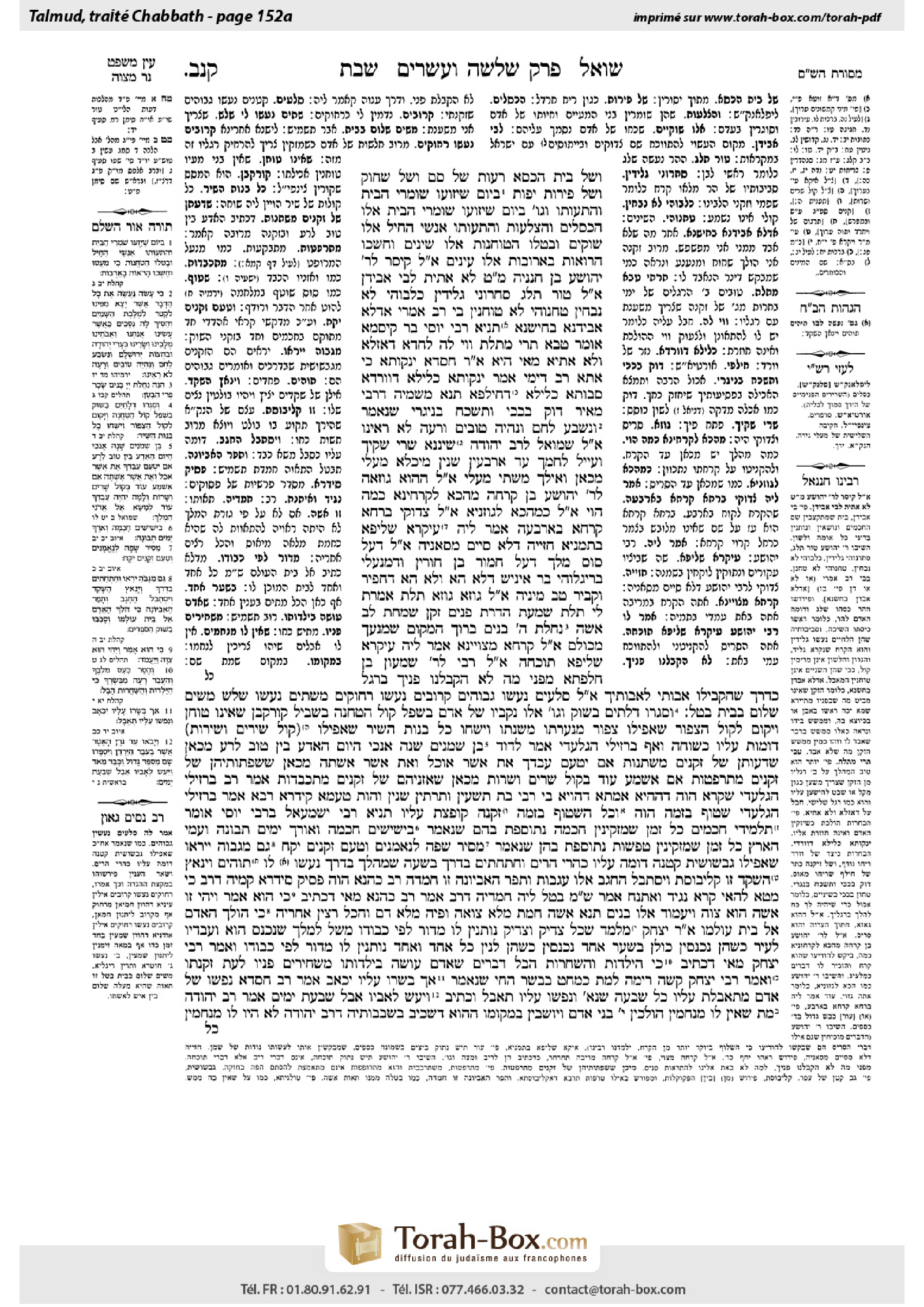
Shabbat 152a: Talmud study for Daf Yomi
Daf Yomi is the daily study of one Talmud folio. Explore 37 tractates with scans, Hebrew text, Sefaria English and AI-generated French translations where annotated.
Passage selection and English or AI-generated French translation are available where the scan has annotations. Daf Study is independent of Torah-Box and Sefaria.
Browse Shabbat · שבת · All tractatesShabbat 152a text and translations
This page of Shabbat includes the Aramaic text, an English translation and an AI-generated French translation, alongside the scan above.
שבת קנ״ב א · Aramaic and Hebrew text
וְשֶׁל בֵּית הַכִּסֵּא — רָעוֹת. שֶׁל סַם וְשֶׁל שְׂחוֹק וְשֶׁל פֵּירוֹת — יָפוֹת.
״בַּיּוֹם שֶׁיָּזוּעוּ שׁוֹמְרֵי הַבַּיִת וְהִתְעַוְּתוּ וְגוֹ׳״. ״בַּיּוֹם שֶׁיָּזוּעוּ שׁוֹמְרֵי הַבַּיִת״ — אֵלּוּ הַכְּסָלִים וְהַצְּלָעוֹת. ״וְהִתְעַוְּתוּ אַנְשֵׁי הֶחָיִל״ — אֵלּוּ שׁוֹקַיִם. ״וּבָטְלוּ הַטּוֹחֲנוֹת״ — אֵלּוּ שִׁינַּיִם. ״וְחָשְׁכוּ הָרוֹאוֹת בַּאֲרוּבּוֹת״ — אֵלּוּ עֵינַיִם.
אֲמַר לֵיהּ קֵיסָר לְרַבִּי יְהוֹשֻׁעַ בֶּן חֲנַנְיָה: מַאי טַעְמָא לָא אָתֵית לְבֵי אֲבִידָן? אֲמַר לֵיהּ: טוּר תְּלַג סַחְרָנוֹהִי גְּלִידִין. כַּלְבוֹהִי לָא נָבְחִין. טָחֲנוֹהִי לָא טָחֲנִין. בֵּי רַב אָמְרִי: אַדְּלָא אַבֵּידְנָא, בָּחֵישְׁנָא.
תַּנְיָא, רַבִּי יוֹסֵי בַּר קִיסְמָא אוֹמֵר: טָבָא תְּרֵי מִתְּלָת. וַוי לַהּ לַחֲדָא דְּאָזְלָא וְלָא אָתְיָא. מַאי הִיא? אָמַר רַב חִסְדָּא: יַנְקוּתָא. כִּי אֲתָא רַב דִּימִי אָמַר: יַנְקוּתָא — כְּלִילָא דְּוַורְדָּא, סָבוּתָא — כְּלִילָא דְחִילְפָא. תָּנָא מִשְּׁמֵיהּ דְּרַבִּי מֵאִיר: דּוֹק בְּכַכֵּי וְתַשְׁכַּח בְּנִיגְרֵי, שֶׁנֶּאֱמַר: ״וַנִּשְׂבַּע לֶחֶם וַנִּהְיֶה טוֹבִים וְרָעָה לֹא רָאִינוּ״. אֲמַר לֵיהּ שְׁמוּאֵל לְרַב יְהוּדָה: שִׁינָּנָא, שְׁרֵי שַׂקָּיךָ וְעַיֵּיל לַחְמָךְ. עַד אַרְבְּעִין שְׁנִין — מֵיכְלָא מְעַלֵּי, מִכָּאן וְאֵילָךְ — מִשְׁתְּיָא מְעַלֵּי.
אֲמַר לֵיהּ הָהוּא גּוֹזָאָה לְרַבִּי יְהוֹשֻׁעַ בֶּן קׇרְחָה: מֵהָכָא לְקַרְחִינָא כַּמָּה הָוֵי? אֲמַר לֵיהּ: כְּמֵהָכָא לְגוֹזַנְיָא. אֲמַר לֵיהּ: בַּרְחָא קַרְחָא בְּאַרְבְּעָה. אֲמַר לֵיהּ: עִיקְרָא שְׁלִיפָא בִּתְמָנְיָא.
חַזְיֵיהּ דְּלָא סָיֵים מְסָאנֵיהּ, אֲמַר לֵיהּ: דְּעַל סוּס — מֶלֶךְ, דְּעַל חֲמוֹר — בֶּן חוֹרִין, וּדְמַנְעָלֵי בְּרִיגְלוֹהִי — בַּר אִינִישׁ. דְּלָא הָא וְלָא הָא — דַּחֲפִיר וּקְבִיר טָב מִינֵּיהּ. אֲמַר לֵיהּ: גּוֹזָא גּוֹזָא, תְּלָת אֲמַרְתְּ לִי, תְּלָת שָׁמְעַתְּ: הַדְרַת פָּנִים — זָקָן, שִׂמְחַת לֵב — אִשָּׁה, ״נַחֲלַת ה׳ — בָּנִים״. בָּרוּךְ הַמָּקוֹם שֶׁמְּנָעֲךָ מִכּוּלָּם. אֲמַר לֵיהּ: קָרְחָא מְצַוֵּי?! אֲמַר לֵיהּ: עִיקְרָא שְׁלִיפָא תּוֹכֵחָה!
אֲמַר לֵיהּ רַבִּי לְרַבִּי שִׁמְעוֹן בֶּן חֲלַפְתָּא: מִפְּנֵי מָה לֹא הִקְבַּלְנוּ פָּנֶיךָ בָּרֶגֶל, כְּדֶרֶךְ שֶׁהִקְבִּילוּ אֲבוֹתַי לַאֲבוֹתֶיךָ? אֲמַר לֵיהּ: סְלָעִים נַעֲשׂוּ גְּבוֹהִים, קְרוֹבִים נַעֲשׂוּ רְחוֹקִים, מִשְׁתַּיִם נַעֲשׂוּ שָׁלֹשׁ, מֵשִׂים שָׁלוֹם בַּבַּיִת בָּטַל.
״וְסֻגְּרוּ דְלָתַיִם בַּשּׁוּק וְגוֹ׳״ — אֵלּוּ נְקָבָיו שֶׁל אָדָם. ״בִּשְׁפַל קוֹל הַטַּחֲנָה״ — בִּשְׁבִיל קוּרְקְבָן שֶׁאֵינוֹ טוֹחֵן. ״וְיָקוּם לְקוֹל הַצִּפּוֹר״ — שֶׁאֲפִילּוּ צִפּוֹר מְנַעַרְתּוֹ מִשְּׁנָתוֹ. ״וְיִשַּׁחוּ כׇּל בְּנוֹת הַשִּׁיר״ — שֶׁאֲפִילּוּ קוֹל שָׁרִים וְשָׁרוֹת דּוֹמוֹת עָלָיו כְּשִׂיחָה.
וְאַף בַּרְזִילַּי הַגִּלְעָדִי אָמַר לְדָוִד: ״בֶּן שְׁמֹנִים שָׁנָה אָנֹכִי הַיּוֹם הַאֵדַע בֵּין טוֹב לְרָע״ — מִכָּאן שֶׁדַּעְתָּן שֶׁל זְקֵנִים מִשְׁתַּנּוֹת. ״אִם יִטְעַם עַבְדְּךָ אֶת אֲשֶׁר אוֹכַל וְאֶת אֲשֶׁר אֶשְׁתֶּה״ — מִכָּאן שֶׁשִּׂפְתוֹתֵיהֶן שֶׁל זְקֵנִים מִתְרַפְּטוֹת. ״אִם אֶשְׁמַע עוֹד בְּקוֹל שָׁרִים וְשָׁרוֹת״ — מִכָּאן שֶׁאׇזְנֵיהֶם שֶׁל זְקֵנִים מִתְכַּבְּדוֹת.
אָמַר רַב: בַּרְזִילַּי הַגִּלְעָדִי שַׁקָּרָא הֲוָה. דְּהַהִיא אַמְּתָא דַּהֲוַאי בֵּי רַבִּי בַּת תִּשְׁעִין וְתַרְתֵּין שְׁנִין, וַהֲוָת טָעֲמָא קִידְרָא. רָבָא אָמַר: בַּרְזִילַּי הַגִּלְעָדִי שָׁטוּף בְּזִמָּה הֲוָה, וְכׇל הַשָּׁטוּף בְּזִמָּה — זִקְנָה קוֹפֶצֶת עָלָיו. תַּנְיָא, רַבִּי יִשְׁמָעֵאל בְּרַבִּי יוֹסֵי אוֹמֵר: תַּלְמִידֵי חֲכָמִים כׇּל זְמַן שֶׁמַּזְקִינִין — חָכְמָה נִתּוֹסֶפֶת בָּהֶם, שֶׁנֶּאֱמַר: ״בִּישִׁישִׁים חׇכְמָה וְאוֹרֶךְ יָמִים תְּבוּנָה״. וְעַמֵּי הָאָרֶץ כׇּל זְמַן שֶׁמַּזְקִינִין — טִפְּשׁוּת נִתּוֹסֶפֶת בָּהֶן, שֶׁנֶּאֱמַר: ״מֵסִיר שָׂפָה לְנֶאֱמָנִים וְטַעַם זְקֵנִים יִקָּח״.
״גַּם מִגָּבוֹהַּ יִירָאוּ״ — שֶׁאֲפִילּוּ גַּבְשׁוּשִׁית קְטַנָּה דּוֹמָה עָלָיו כְּהָרֵי הָרִים. ״וְחַתְחַתִּים בַּדֶּרֶךְ״ — בְּשָׁעָה שֶׁמְּהַלֵּךְ בַּדֶּרֶךְ נַעֲשׂוּ לוֹ תְּוָהִים. ״וְיָנֵאץ הַשָּׁקֵד״ — זוֹ קְלִיבוֹסֶת. ״וְיִסְתַּבֵּל הֶחָגָב״ — אֵלּוּ עֲגָבוֹת. ״וְתָפֵר הָאֲבִיּוֹנָה״ — זוֹ חֶמְדָּה.
רַב כָּהֲנָא הֲוָה פָּסֵיק סִידְרָא קַמֵּיהּ דְּרַב. כִּי מְטָא לְהַאי קְרָא, נְגֵיד וְאִתְּנַח. אֲמַר, שְׁמַע מִינַּהּ בְּטֵל לֵיהּ חֶמְדֵּיהּ דְּרַב. אָמַר רַב כָּהֲנָא, מַאי דִּכְתִיב: ״כִּי הוּא אָמַר וַיֶּהִי״ — זוֹ אִשָּׁה. ״הוּא צִוָּה וַיַּעֲמוֹד״ — אֵלּוּ בָּנִים. תָּנָא: אִשָּׁה חֵמֶת מָלֵא צוֹאָה, וּפִיהָ מָלֵא דָּם — וְהַכֹּל רָצִין אַחֲרֶיהָ.
״כִּי הוֹלֵךְ הָאָדָם אֶל בֵּית עוֹלָמוֹ״, אָמַר רַבִּי יִצְחָק: מְלַמֵּד שֶׁכׇּל צַדִּיק וְצַדִּיק נוֹתְנִין לוֹ מָדוֹר לְפִי כְּבוֹדוֹ. מָשָׁל לְמֶלֶךְ שֶׁנִּכְנָס הוּא וַעֲבָדָיו לָעִיר, כְּשֶׁהֵן נִכְנָסִין — כּוּלָּן בְּשַׁעַר אֶחָד נִכְנָסִין, כְּשֶׁהֵן לָנִין — כׇּל אֶחָד וְאֶחָד נוֹתְנִין לוֹ מָדוֹר לְפִי כְּבוֹדוֹ.
וְאָמַר רַבִּי יִצְחָק, מַאי דִּכְתִיב: ״כִּי הַיַּלְדוּת וְהַשַּׁחֲרוּת הָבֶל״ — דְּבָרִים שֶׁאָדָם עוֹשֶׂה בְּיַלְדוּתוֹ מַשְׁחִירִים פָּנָיו לְעֵת זִקְנָתוֹ.
וְאָמַר רַבִּי יִצְחָק: קָשָׁה רִימָּה לַמֵּת כְּמַחַט בַּבָּשָׂר הַחַי, שֶׁנֶּאֱמַר: ״אַךְ בְּשָׂרוֹ עָלָיו יִכְאָב״. אָמַר רַב חִסְדָּא: נַפְשׁוֹ שֶׁל אָדָם מִתְאַבֶּלֶת עָלָיו כׇּל שִׁבְעָה, שֶׁנֶּאֱמַר: ״וְנַפְשׁוֹ עָלָיו תֶּאֱבָל״, וּכְתִיב: ״וַיַּעַשׂ לְאָבִיו אֵבֶל שִׁבְעַת יָמִים״.
אָמַר רַב יְהוּדָה: מֵת שֶׁאֵין לוֹ מְנַחֲמִין — הוֹלְכִין עֲשָׂרָה בְּנֵי אָדָם וְיוֹשְׁבִין בִּמְקוֹמוֹ. הָהוּא דִּשְׁכֵיב בְּשִׁבָבוּתֵיהּ דְּרַב יְהוּדָה, לֹא הָיוּ לוֹ מְנַחֲמִין,
Shabbat 152a · English translation
and from pain in the bathroom are bad for the eyes. Tears that come from medicinal drugs, and from laughter, and from sharp produce are good for the eyes.
The Gemara continues to interpret verses from the Book of Ecclesiastes. The verse states: “On the day when the keepers of the house shall tremble, and the strong men shall bow themselves, and the grinders cease because they are few, and those that look out the windows shall be dimmed” (Ecclesiastes 12:3). “On the day when the keepers of the house shall tremble”; this is referring to the flanks and ribs that surround and protect a person’s internal organs. “And the strong men shall bow themselves”; these are the thighs, which support a person’s strength. “And the grinders cease”; these are the teeth, which decay and fall out. “And those that look out the windows shall be dimmed”; these are the eyes, which become dimmer.
The Gemara relates: The Roman emperor said to Rabbi Yehoshua ben Ḥananya: What is the reason you did not come to the House of Avidan? This was a place in which dialogues and debates were conducted. Rabbi Yehoshua ben Ḥananya said to him enigmatically: The snowy mountain is surrounded with ice, meaning that his hair had turned white; his dogs do not bark, meaning that his voice could no longer be heard; his grinders have ceased grinding, meaning that his teeth had fallen out. In the school of Rav they say that he added: I am searching for that which I have not lost, because an old man walks bent over and appears to be searching for something.
It was taught in a baraita that Rabbi Yosei bar Kisma says: The two feet of one’s youth are better than the three of old age, when one walks with a cane. Woe to the one who goes and does not come back. What is this referring to? Rav Ḥisda said: Youth. Similarly, when Rav Dimi came from Eretz Yisrael to Babylonia he said: Youth is a crown of roses; old age is a crown of thorns. The Sage taught in the name of Rabbi Meir: Grind food with your teeth and you will find in your feet the strength to carry your body, as it is stated: “For we were sated with our bread and were well, and saw no evil” (Jeremiah 44:17). Shmuel said to Rav Yehuda: Large-toothed one; untie your sack, that is, your mouth, and insert your food. Until the age of forty years, food is beneficial; from here and on, drinking is beneficial.
Having quoted some aphorisms of the Sages, the Gemara relates the following conversation: A certain eunuch who was an apostate said the following to Rabbi Yehoshua ben Korḥa as a provocation: How far is it from here to Karḥina? The provocateur’s intention was to hint to the fact that Rabbi Yehoshua ben Korḥa was bald [kere’aḥ]. He said to him: It is the same as the distance from here to the mountains of Gozen, hinting at the eunuch’s castration, which in Aramaic is goza (Rav Ya’akov Emden). The apostate said to him: A bald buck is sold for four dinar. He said to him: A castrated goat [ikkara shelifa] is sold for eight.
The apostate saw that Rabbi Yehoshua ben Korḥa was not wearing shoes. He said to him: One who rides on a horse is a king. One who rides on a donkey is a free man. And one who wears shoes is at least a human being. One who does neither this nor that, someone who is buried in the earth is better than him. He said to him: Eunuch, eunuch, you said to me three things, and now hear three things: The glory of a face is the beard, the joy of the heart is a wife, and “the portion of the Lord is children” (Psalms 127:3); blessed is the Omnipresent who has denied you all of them, for a eunuch does not have a beard, a wife or children. He said to him: Does a bald man quarrel? He said to him: Does a castrated male goat speak words of rebuke?
The Gemara again addresses old age: Rabbi Yehuda HaNasi said to Rabbi Shimon ben Ḥalafta: For what reason did we not greet you during the Festival the way that my fathers greeted your fathers? This was a polite way of asking Rabbi Shimon ben Ḥalafta why he had not come to visit Rabbi Yehuda HaNasi. He said to him: Because I have grown old, and the rocks on the road have become tall, and destinations that are near have become far away, and my two feet have been made into three with the addition of a cane, and that which brings peace to the house, namely, the sexual drive which motivates a couple to make peace, is no more.
The Gemara continues to expound the verses of the final chapter of Ecclesiastes. The verse states: “And the doors shall be shut in the marketplace when the sound of the grinding is low, and one shall start up at the voice of a bird, and all the daughters of music shall be brought low” (Ecclesiastes 12:4). The Sages expounded: “And the doors shall be shut in the marketplace”; these are a person’s orifices, which cease to function normally. The interpretation continues: “When the sound of the grinding is low”; because the stomach is not grinding and digesting one’s food. “And one shall start up at the voice of a bird”; because one is unable to sleep deeply such that even a bird will wake him from his sleep. “And all the daughters of music shall be brought low”; this means that even the voices of male and female singers will seem to him like mere conversation, and he will no longer derive pleasure from song.
And even Barzilai the Gileadite said to David: “Today I am eighty years old, can I discern between good and bad? Can your servant taste what I eat or what I drink? Can I hear any more the voice of singing men and singing women?” (II Samuel 19:36). The Gemara explains: “Can I discern between good and bad”; from here we derive that the minds of the elderly change and they no longer discern properly. “Can your servant taste what I eat or what I drink”; from here we derive that the lips of the elderly crack and wither. “Can I hear any more the voice of singing men and singing women”; from here we derive that the ears of the elderly become heavy.
Rav said: Barzilai the Gileadite was a liar and he merely wanted to avoid joining David upon his return to Jerusalem, for an eighty-year old man is not usually this debilitated. For there was a particular maidservant in the house of Rabbi Yehuda HaNasi who was ninety-two years old, and she would taste the food that was cooking in the pots. Rava said: Barzilai was speaking the truth, but Barzilai the Gileadite was steeped in promiscuity, and anyone who is steeped in promiscuity is overtaken by old age before his time. It was taught in a baraita that Rabbi Yishmael, son of Rabbi Yosei, says: As Torah scholars grow older, wisdom is increased in them, as it is stated: “With aged men is wisdom; and length of days brings understanding” (Job 12:12). And as ignoramuses grow older, foolishness is increased in them, as it is stated: “He removes the speech of men of trust and takes away the understanding of the aged” (Job 12:20).
The Gemara continues interpreting verses from Ecclesiastes. The verse states: “Also when they shall be afraid of that which is high and terrors shall be on the road, and the almond tree shall blossom, and the grasshopper shall drag itself along, and the caper berry shall fail, for a person goes to his eternal home, and the mourners circle the marketplace” (Ecclesiastes 12:5). The Gemara explains: “Also when they shall be afraid of that which is high”; this means that even a small knoll on the road seems to him, the elderly, like the highest of mountains. “And terrors shall be on the road”; this means that while he is walking on the road he will have terrors, i.e., he will fear falling or otherwise suffering injury. “And the almond tree shall blossom”; this is the hip bone that protrudes from the skin of an elderly person. “And the grasshopper [ḥagav] shall drag itself along [yistabbel]”; by replacing the letter ḥet of ḥagav with an ayin, this can be understood as referring to the buttocks [agavot] which become heavy [sevel]. “And the caper berry shall fail”; this is sexual desire that ceases.
The Gemara relates that Rav Kahana was reading biblical verses before Rav. When he got to this verse, Rav sighed. Rav Kahana said: We can derive from this that Rav’s desire has ceased. Rav Kahana also said: What is the meaning of that which is written: “For He spoke and it was, He commanded and it stood” (Psalms 33:9)? He understands this to mean that God created man with desires that push him to do things he would not do if he acted purely on the judgment of his intellect, and Rav Kahana therefore interprets the verse in the following manner: “For He spoke and it was”; this is a woman that a man marries. “He commanded and it stood”; these are the children who one works hard to raise. A tanna taught in a baraita: A woman is essentially a flask full of feces, a reference to the digestive system, and her mouth is full of blood, a euphemistic reference to menstruation, yet men are not deterred and they all run after her with desire.
The Gemara interprets the continuation of the verse cited above: “For a person goes to his eternal home” (Ecclesiastes 12:5). Rabbi Yitzḥak said: This teaches that each and every righteous person is given a dwelling place in the World-to-Come in accordance with his honor. The Gemara offers a parable in which a king enters a city along with his servants. When they enter, they all enter through a single gate; however, when they sleep, each one is given a dwelling place in accordance with his honor. So too, although everyone dies, not everyone receives the same reward in the World-to-Come.
And Rabbi Yitzḥak said: What is the meaning of that which is written: “For childhood and youth [shaḥarut] are vanity” (Ecclesiastes 11:10)? Sinful things that a person does in his youth darken [mashḥirim] his face with shame as he grows old (Rabbi Yoshiya Pinto).
And Rabbi Yitzḥak said: The maggots that eat the flesh of the deceased are as painful to the dead as a needle in the flesh of the living, as it says with regard to the dead: “But his flesh is in pain for him, and his soul mourns over him” (Job 14:22). Rav Ḥisda said: A person’s soul mourns for him during all seven days of mourning following his death, as it is stated: And his soul mourns over him,” and it is also written: “And he mourned his father seven days” (Genesis 50:10).
Rav Yehuda said: In the case of a deceased person who has no comforters, i.e., he has nobody to mourn for him, ten people should go and sit in his place and accept condolences. The Gemara relates the story of a certain person who died in Rav Yehuda’s neighborhood and who did not have any comforters, i.e., mourners;
Shabbat 152a · Traduction française (IA)
et celles qui proviennent de douleurs aux toilettes sont mauvaises pour les yeux. Les larmes provoquées par des remèdes, par le rire et par des aliments piquants sont bonnes pour les yeux.
La Guemara poursuit son interprétation des versets du livre de l’Ecclésiaste. Le verset dit : « Le jour où les gardiens de la maison trembleront, où les hommes forts se courberont, où les meules s’arrêteront parce qu’elles sont peu nombreuses, et où celles qui regardent par les fenêtres s’obscurciront » (Ecclésiaste 12,3). « Le jour où les gardiens de la maison trembleront » : cela désigne les flancs et les côtes qui entourent et protègent les organes internes d’une personne. « Où les hommes forts se courberont » : ce sont les cuisses, qui soutiennent la force d’une personne. « Où les meules s’arrêteront » : ce sont les dents, qui se déchaussent et tombent. « Et où celles qui regardent par les fenêtres s’obscurciront » : ce sont les yeux, dont la vue baisse.
La Guemara rapporte : l’empereur romain dit à Rabbi Yehoshua ben Ḥananya : « Pourquoi n’es-tu pas venu à la Maison d’Avidan ? » C’était un lieu où se tenaient des dialogues et des débats. Rabbi Yehoshua ben Ḥananya lui répondit de manière énigmatique : « La montagne enneigée est entourée de glace » — c’est-à-dire que ses cheveux avaient blanchi ; « ses chiens n’aboient pas » — c’est-à-dire que sa voix ne pouvait plus se faire entendre ; « ses meules ont cessé de moudre » — c’est-à-dire que ses dents étaient tombées. À l’école de Rav, on dit qu’il ajouta : « Je cherche ce que je n’ai pas perdu », car un vieillard marche courbé et semble chercher quelque chose.
Il a été enseigné dans une baraïta que Rabbi Yosei bar Kisma dit : « Les deux pieds de la jeunesse valent mieux que les trois de la vieillesse », lorsque l’on marche avec une canne. Malheur à celui qui part et ne revient pas. À quoi cela fait-il référence ? Rav Ḥisda dit : à la jeunesse. De même, lorsque Rav Dimi vint d’Eretz Israël en Babylonie, il dit : « La jeunesse est une couronne de roses ; la vieillesse, une couronne d’épines. » Un Sage enseigna au nom de Rabbi Meir : « Broyez la nourriture avec vos dents, et vous trouverez dans vos pieds la force de porter votre corps », comme il est dit : « Car nous étions rassasiés de notre pain et nous étions bien, et nous ne voyions aucun mal » (Jérémie 44,17). Shmuel dit à Rav Yehuda : « Toi qui as de grandes dents, ouvre ton sac », c’est-à-dire ta bouche, « et mets-y ta nourriture. Jusqu’à quarante ans, la nourriture est bénéfique ; à partir de là, c’est la boisson qui est bénéfique. »
Après avoir cité quelques aphorismes des Sages, la Guemara rapporte la conversation suivante : un eunuque apostat dit à Rabbi Yehoshua ben Korḥa, pour le provoquer : « Quelle distance y a-t-il d’ici à Karḥina ? » Le provocateur entendait faire allusion au fait que Rabbi Yehoshua ben Korḥa était chauve [kere’aḥ]. Il lui répondit : « C’est la même distance qu’entre ici et les montagnes de Gozen », faisant allusion à la castration de l’eunuque, qui se dit goza en araméen (Rav Ya’akov Emden). L’apostat lui dit : « Un bouc chauve se vend quatre dinars. » Il lui répondit : « Un bouc castré [ikkara shelifa] se vend huit dinars. »
L’apostat remarqua que Rabbi Yehoshua ben Korḥa ne portait pas de chaussures. Il lui dit : « Celui qui monte à cheval est un roi. Celui qui monte un âne est un homme libre. Celui qui porte des chaussures est au moins un être humain. Quant à celui qui ne fait ni l’un ni l’autre, mieux vaut pour lui être enterré sous terre. » Il lui répondit : « Eunuque, eunuque, tu m’as dit trois choses ; écoute maintenant trois choses : la gloire du visage, c’est la barbe ; la joie du cœur, c’est une épouse ; et “la part du Seigneur, ce sont les enfants” (Psaumes 127,3). Béni soit le Tout-Puissant, qui t’a privé de tout cela, car un eunuque n’a ni barbe, ni épouse, ni enfants. » L’autre lui dit : « Un chauve se querelle-t-il ? » Il lui répondit : « Un bouc castré prononce-t-il des paroles de réprimande ? »
La Guemara revient à la vieillesse : Rabbi Yehuda HaNasi dit à Rabbi Shimon ben Ḥalafta : « Pourquoi ne t’avons-nous pas salué pendant la fête, comme mes pères saluaient les tiens ? » C’était une manière courtoise de demander à Rabbi Shimon ben Ḥalafta pourquoi il n’était pas venu rendre visite à Rabbi Yehuda HaNasi. Il lui répondit : « Parce que j’ai vieilli, que les pierres du chemin sont devenues hautes, que les destinations proches sont devenues lointaines, que mes deux pieds sont devenus trois avec l’ajout d’une canne, et que ce qui apporte la paix dans la maison — à savoir le désir sexuel qui incite un couple à faire la paix — a disparu. »
La Guemara poursuit l’interprétation des versets du dernier chapitre de l’Ecclésiaste. Le verset dit : « Les portes se fermeront sur la place quand le bruit des meules faiblira, qu’on se réveillera au chant d’un oiseau et que toutes les filles du chant s’abaisseront » (Ecclésiaste 12,4). Les Sages expliquent : « Les portes se fermeront sur la place » : ce sont les orifices d’une personne, qui cessent de fonctionner normalement. L’interprétation se poursuit : « Quand le bruit des meules faiblira » : parce que l’estomac ne broie plus et ne digère plus la nourriture. « Qu’on se réveillera au chant d’un oiseau » : parce qu’on ne parvient plus à dormir profondément, si bien qu’un oiseau suffit à vous réveiller. « Et que toutes les filles du chant s’abaisseront » : cela signifie que même les voix des chanteurs et des chanteuses ne lui sembleront être qu’une simple conversation, et qu’il ne tirera plus aucun plaisir du chant.
Même Barzilaï le Galaadite dit à David : « Aujourd’hui, j’ai quatre-vingts ans ; puis-je distinguer le bien du mal ? Ton serviteur peut-il goûter ce qu’il mange ou ce qu’il boit ? Puis-je encore entendre la voix des chanteurs et des chanteuses ? » (II Samuel 19,36). La Guemara explique : « Puis-je distinguer le bien du mal ? » De là, nous apprenons que l’esprit des personnes âgées change et qu’elles ne discernent plus correctement. « Ton serviteur peut-il goûter ce qu’il mange ou ce qu’il boit ? » De là, nous apprenons que les lèvres des personnes âgées se gercent et se flétrissent. « Puis-je encore entendre la voix des chanteurs et des chanteuses ? » De là, nous apprenons que l’ouïe des personnes âgées s’affaiblit.
Rav dit : Barzilaï le Galaadite mentait ; il voulait simplement éviter de se joindre à David lors de son retour à Jérusalem, car un homme de quatre-vingts ans n’est généralement pas aussi affaibli. En effet, une servante de la maison de Rabbi Yehuda HaNasi avait quatre-vingt-douze ans et goûtait les aliments qui cuisaient dans les marmites. Rava dit : Barzilaï disait la vérité, mais Barzilaï le Galaadite s’était adonné à la débauche, et quiconque s’y adonne est frappé par la vieillesse avant l’heure. Il a été enseigné dans une baraïta que Rabbi Yishmael, fils de Rabbi Yosei, dit : à mesure que les érudits de la Torah vieillissent, leur sagesse augmente, comme il est dit : « Chez les vieillards se trouve la sagesse, et une longue vie donne l’intelligence » (Job 12,12). Et à mesure que les ignorants vieillissent, leur sottise augmente, comme il est dit : « Il prive de parole les hommes de confiance et ôte l’intelligence aux vieillards » (Job 12,20).
La Guemara poursuit l’interprétation des versets de l’Ecclésiaste. Le verset dit : « On craindra aussi ce qui est élevé, des terreurs seront sur le chemin, l’amandier fleurira, la sauterelle se traînera, la câpre n’aura plus d’effet, car l’homme s’en va vers sa demeure éternelle et les endeuillés parcourent la place » (Ecclésiaste 12,5). La Guemara explique : « On craindra aussi ce qui est élevé » signifie que même une petite butte sur le chemin lui semble, à lui, le vieillard, aussi haute que les plus grandes montagnes. « Des terreurs seront sur le chemin » signifie que, lorsqu’il marche, il est saisi de terreur, c’est-à-dire qu’il craint de tomber ou de se blesser d’une autre manière. « L’amandier fleurira » : c’est l’os de la hanche qui fait saillie sous la peau d’une personne âgée. « La sauterelle [ḥagav] se traînera [yistabbel] » : en remplaçant la lettre ḥet de ḥagav par un ayin, on peut comprendre qu’il s’agit des fesses [agavot], qui deviennent lourdes [sevel]. « La câpre n’aura plus d’effet » : cela désigne le désir sexuel qui s’éteint.
La Guemara rapporte que Rav Kahana lisait des versets bibliques devant Rav. Lorsqu’il arriva à ce verset, Rav soupira. Rav Kahana dit : nous pouvons en déduire que le désir de Rav s’est éteint. Rav Kahana dit aussi : quel est le sens de ce qui est écrit : « Car Il a parlé, et cela fut ; Il a ordonné, et cela tint » (Psaumes 33,9) ? Il comprend cela comme signifiant que Dieu a créé l’homme avec des désirs qui le poussent à faire des choses qu’il ne ferait pas s’il se fiait uniquement au jugement de son intellect. Rav Kahana interprète donc le verset ainsi : « Car Il a parlé, et cela fut » : cela désigne une femme qu’un homme épouse. « Il a ordonné, et cela tint » : cela désigne les enfants qu’on peine à élever. Un tanna enseigna dans une baraïta : une femme est, en substance, une gourde pleine d’excréments — allusion à son appareil digestif — et sa bouche est pleine de sang — allusion pudique aux menstruations —, mais les hommes ne se laissent pas décourager et courent tous après elle avec désir.
La Guemara interprète la suite du verset cité plus haut : « Car l’homme s’en va vers sa demeure éternelle » (Ecclésiaste 12,5). Rabbi Yitzḥak dit : cela enseigne que chaque juste reçoit dans le Monde à venir une demeure à la mesure de son rang. La Guemara propose une parabole : un roi entre dans une ville avec ses serviteurs. À leur arrivée, ils passent tous par la même porte ; mais, au moment de dormir, chacun reçoit une demeure à la mesure de son rang. De même, bien que tous meurent, tous ne reçoivent pas la même récompense dans le Monde à venir.
Rabbi Yitzḥak dit aussi : quel est le sens de ce qui est écrit : « Car l’enfance et la jeunesse [shaḥarut] sont vanité » (Ecclésiaste 11,10) ? Les actes pécheurs qu’une personne commet dans sa jeunesse assombrissent [mashḥirim] son visage de honte lorsqu’elle vieillit (Rabbi Yoshiya Pinto).
Rabbi Yitzḥak dit aussi : les vers qui dévorent la chair du défunt lui sont aussi douloureux qu’une aiguille dans la chair d’un vivant, comme il est dit au sujet du mort : « Sa chair souffre pour lui, et son âme se lamente sur lui » (Job 14,22). Rav Ḥisda dit : l’âme d’une personne se lamente sur elle pendant les sept jours de deuil qui suivent sa mort, comme il est dit : « Et son âme se lamente sur lui », et il est également écrit : « Il pleura son père pendant sept jours » (Genèse 50,10).
Rav Yehuda dit : lorsqu’un défunt n’a personne pour le réconforter, c’est-à-dire personne pour porter son deuil, dix personnes doivent aller s’asseoir à sa place et recevoir les condoléances. La Guemara rapporte l’histoire d’un homme qui mourut dans le voisinage de Rav Yehuda et qui n’avait personne pour le réconforter, c’est-à-dire aucun endeuillé ;
Traduction française générée par IA à partir de l’édition anglaise de Sefaria. Vérifie toujours un passage avec le texte source.
Text from Sefaria: William Davidson Edition - Vocalized Aramaic (CC BY NC); William Davidson Edition - English (CC BY NC).