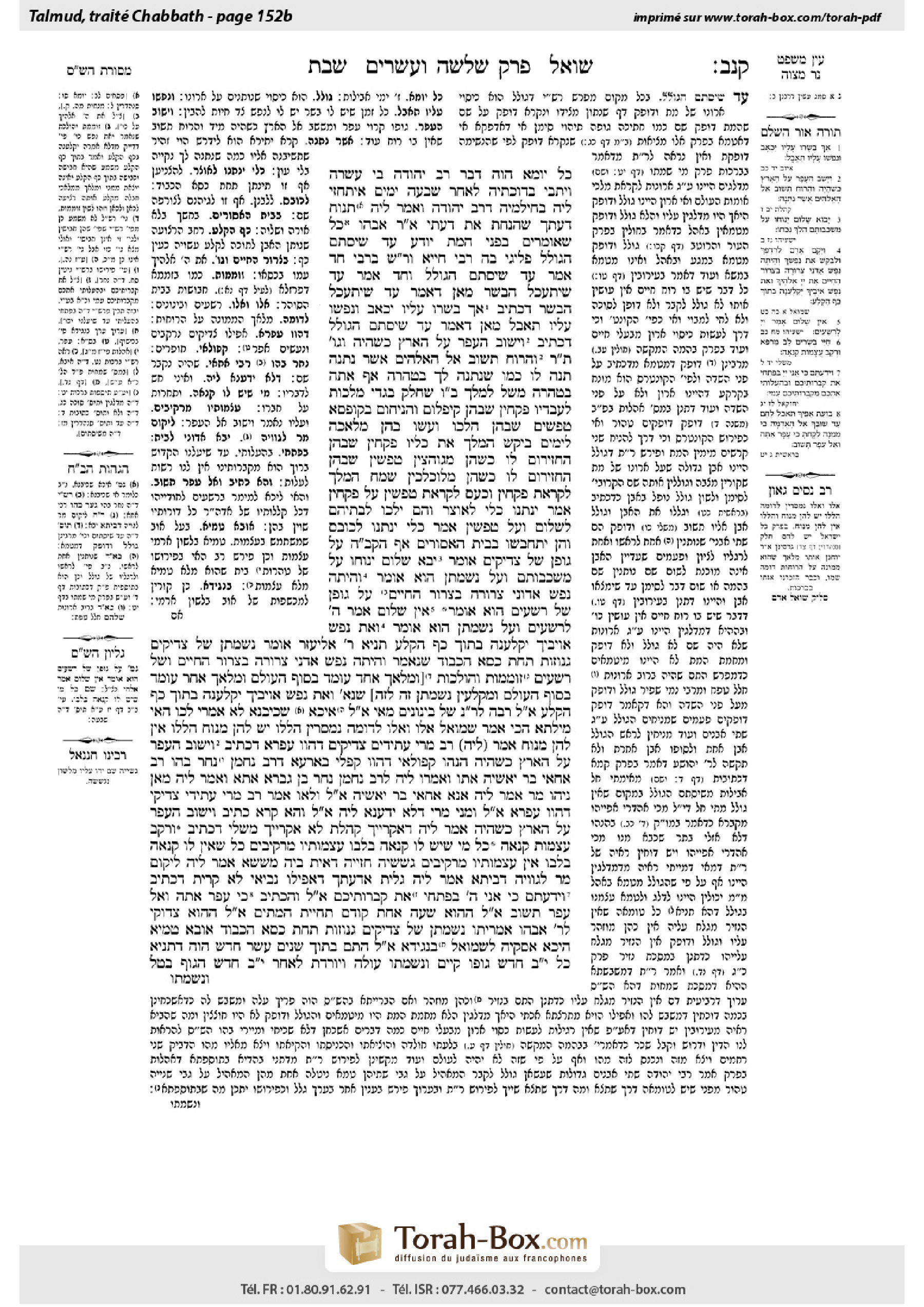
Shabbat 152b: Talmud study for Daf Yomi
Daf Yomi is the daily study of one Talmud folio. Explore 37 tractates with scans, Hebrew text, Sefaria English and AI-generated French translations where annotated.
Passage selection and English or AI-generated French translation are available where the scan has annotations. Daf Study is independent of Torah-Box and Sefaria.
Browse Shabbat · שבת · All tractatesShabbat 152b text and translations
This page of Shabbat includes the Aramaic text, an English translation and an AI-generated French translation, alongside the scan above.
שבת קנ״ב ב · Aramaic and Hebrew text
כׇּל יוֹמָא הֲוָה דָּבַר רַב יְהוּדָה בֵּי עַשְׂרָה, וְיָתְבִי בְּדוּכְתֵּיהּ. לְאַחַר שִׁבְעָה יָמִים אִיתְחֲזִי לֵיהּ בְּחֶילְמֵיהּ דְּרַב יְהוּדָה, וַאֲמַר לֵיהּ: תָּנוּחַ דַּעְתְּךָ שֶׁהִנַּחְתָּ אֶת דַּעְתִּי.
אָמַר רַבִּי אֲבָהוּ: כׇּל שֶׁאוֹמְרִים בִּפְנֵי הַמֵּת, יוֹדֵעַ, עַד שֶׁיִּסָּתֵם הַגּוֹלֵל. פְּלִיגִי בַּהּ רַבִּי חִיָּיא וְרַבִּי שִׁמְעוֹן בְּרַבִּי. חַד אָמַר: עַד שֶׁיִּסָּתֵם הַגּוֹלֵל, וְחַד אָמַר: עַד שֶׁיִּתְעַכֵּל הַבָּשָׂר.
מַאן דְּאָמַר עַד שֶׁיִּתְעַכֵּל הַבָּשָׂר, דִּכְתִיב: ״אַךְ בְּשָׂרוֹ עָלָיו יִכְאָב וְנַפְשׁוֹ עָלָיו תֶּאֱבָל״. מַאן דְּאָמַר עַד שֶׁיִּסָּתֵם הַגּוֹלֵל, דִּכְתִיב: ״וְיָשׁוֹב הֶעָפָר עַל הָאָרֶץ כְּשֶׁהָיָה וְגוֹ׳״.
תָּנוּ רַבָּנַן: ״וְהָרוּחַ תָּשׁוּב אֶל הָאֱלֹהִים אֲשֶׁר נְתָנָהּ״ — תְּנָהּ לוֹ כְּמוֹ שֶׁנְּתָנָהּ לְךָ, בְּטׇהֳרָה — אַף אַתָּה בְּטָהֳרָה. מָשָׁל לְמֶלֶךְ בָּשָׂר וָדָם שֶׁחָלַק בִּגְדֵי מַלְכוּת לַעֲבָדָיו. פִּקְחִין שֶׁבָּהֶן, קִיפְּלוּם וְהִנִּיחוּם בְּקוּפְסָא. טִפְּשִׁים שֶׁבָּהֶן, הָלְכוּ וְעָשׂוּ בָּהֶן מְלָאכָה. לְיָמִים בִּיקֵּשׁ הַמֶּלֶךְ אֶת כֵּלָיו, פִּקְחִין שֶׁבָּהֶן הֶחֱזִירוּם לוֹ כְּשֶׁהֵן מְגוֹהָצִין, טִפְּשִׁין שֶׁבָּהֶן הֶחֱזִירוּם לוֹ כְּשֶׁהֵן מְלוּכְלָכִין. שָׂמֵחַ הַמֶּלֶךְ לִקְרַאת פִּקְחִין, וְכָעַס לִקְרַאת טִפְּשִׁין.
עַל פִּקְחִין אָמַר: יִנָּתְנוּ כֵּלַי לָאוֹצָר, וְהֵם יֵלְכוּ לְבָתֵּיהֶם לְשָׁלוֹם. וְעַל טִפְּשִׁין אָמַר: כֵּלַי יִנָּתְנוּ לְכוֹבֵס, וְהֵן יֵחָבְשׁוּ בְּבֵית הָאֲסוּרִים.
אַף הַקָּדוֹשׁ בָּרוּךְ הוּא, עַל גּוּפָן שֶׁל צַדִּיקִים אוֹמֵר: ״יָבֹא שָׁלוֹם יָנוּחוּ עַל מִשְׁכְּבוֹתָם״, וְעַל נִשְׁמָתָן הוּא אוֹמֵר: ״וְהָיְתָה נֶפֶשׁ אֲדוֹנִי צְרוּרָה בִּצְרוֹר הַחַיִּים״. עַל גּוּפָן שֶׁל רְשָׁעִים הוּא אוֹמֵר: ״אֵין שָׁלוֹם אָמַר ה׳ לָרְשָׁעִים״, וְעַל נִשְׁמָתָן הוּא אוֹמֵר: ״וְאֵת נֶפֶשׁ אוֹיְבֶיךָ יְקַלְּעֶנָּה בְּתוֹךְ כַּף הַקָּלַע״.
תַּנְיָא, רַבִּי אֱלִיעֶזֶר אוֹמֵר: נִשְׁמָתָן שֶׁל צַדִּיקִים גְּנוּזוֹת תַּחַת כִּסֵּא הַכָּבוֹד, שֶׁנֶּאֱמַר: ״וְהָיְתָה נֶפֶשׁ אֲדֹנִי צְרוּרָה בִּצְרוֹר הַחַיִּים״. וְשֶׁל רְשָׁעִים זוֹמְמוֹת וְהוֹלְכוֹת, [וּמַלְאָךְ אֶחָד עוֹמֵד בְּסוֹף הָעוֹלָם, וּמַלְאָךְ אַחֵר עוֹמֵד בְּסוֹף הָעוֹלָם, וּמְקַלְּעִין נִשְׁמָתָן זֶה לָזֶה,] שֶׁנֶּאֱמַר: ״וְאֵת נֶפֶשׁ אוֹיְבֶיךָ יְקַלְּעֶנָּה בְּתוֹךְ כַּף הַקָּלַע״.
אֲמַר לֵיהּ רַבָּה לְרַב נַחְמָן: שֶׁל בֵּינוֹנִים מַאי? אֲמַר לֵיהּ: אִיכּוֹ שָׁכֵיבְנָא, לָא אֲמַרִי לְכוּ הַאי מִילְּתָא, הָכִי אָמַר שְׁמוּאֵל: אֵלּוּ וָאֵלּוּ לְדוּמָה נִמְסָרִין. הַלָּלוּ, יֵשׁ לָהֶן מָנוֹחַ. הַלָּלוּ, אֵין לָהֶן מָנוֹחַ. אָמַר (לֵיהּ) רַב מָרִי: עֲתִידִי צַדִּיקֵי דְּהָווּ עַפְרָא, דִּכְתִיב: ״וְיָשׁוֹב הֶעָפָר עַל הָאָרֶץ כְּשֶׁהָיָה״.
הָנְהוּ קָפוֹלָאֵי דַּהֲווֹ קָפְלִי בְּאַרְעָא דְּרַב נַחְמָן. נְחַר בְּהוּ רַב אַחַאי בַּר יֹאשִׁיָּה. אֲתוֹ וַאֲמַרוּ לֵיהּ לְרַב נַחְמָן: נְחַר בַּן גַּבְרָא. אֲתָא וַאֲמַר לֵיהּ: מַאן נִיהוּ מָר? אֲמַר לֵיהּ: אֲנָא אַחַאי בַּר יֹאשִׁיָּה. אֲמַר לֵיהּ: וְלָאו אָמַר רַב מָרִי: עֲתִידִי צַדִּיקֵי דְּהָווּ עַפְרָא? אֲמַר לֵיהּ: וּמַנִּי מָרִי דְּלָא יָדַעְנָא לֵיהּ? אֲמַר לֵיהּ: וְהָא קְרָא כְּתִיב: ״וְיָשׁוֹב הֶעָפָר עַל הָאָרֶץ כְּשֶׁהָיָה״!
אֲמַר לֵיהּ: דְּאַקְרְיָיךְ קֹהֶלֶת, לָא אַקְרְיָיךְ מִשְׁלֵי, דִּכְתִיב: ״וּרְקַב עֲצָמוֹת קִנְאָה״. כָּל מִי שֶׁיֵּשׁ לוֹ קִנְאָה בְּלִבּוֹ — עַצְמוֹתָיו מַרְקִיבִים, כֹּל שֶׁאֵין לוֹ קִנְאָה בְּלִבּוֹ — אֵין עַצְמוֹתָיו מַרְקִיבִים.
גַּשְּׁשֵׁיהּ, חַזְיֵיהּ דְּאִית בֵּיהּ מְשָׁשָׁא. אֲמַר לֵיהּ: לֵיקוּם מָר לְגַוֵּויהּ דְּבֵיתָא. אֲמַר לֵיהּ: גַּלֵּית אַדַּעְתָּךְ דַּאֲפִילּוּ נְבִיאֵי לָא קְרֵית, דִּכְתִיב: ״וִידַעְתֶּם כִּי אֲנִי ה׳ בְּפִתְחִי אֶת קִבְרוֹתֵיכֶם״.
אֲמַר לֵיהּ, וְהָכְתִיב: ״כִּי עָפָר אַתָּה וְאֶל עָפָר תָּשׁוּב״! אֲמַר לֵיהּ: הָהוּא שָׁעָה אַחַת קוֹדֶם תְּחִיַּית הַמֵּתִים.
אֲמַר לֵיהּ הָהוּא מִינָא לְרַבִּי אֲבָהוּ: אָמְרִיתוּ נִשְׁמָתָן שֶׁל צַדִּיקִים גְּנוּזוֹת תַּחַת כִּסֵּא הַכָּבוֹד. אוֹבָא טַמְיָא, הֵיכָא אַסְּקֵיהּ לִשְׁמוּאֵל בִּנְגִידָא? אֲמַר לֵיהּ: הָתָם בְּתוֹךְ שְׁנֵים עָשָׂר חֹדֶשׁ הֲוָה, דְּתַנְיָא: כׇּל שְׁנֵים עָשָׂר חֹדֶשׁ גּוּפוֹ קַיָּים, וְנִשְׁמָתוֹ עוֹלָה וְיוֹרֶדֶת. לְאַחַר שְׁנֵים עָשָׂר חֹדֶשׁ הַגּוּף בָּטֵל
Shabbat 152b · English translation
every day of the seven-day mourning period, Rav Yehuda would take ten people and they would sit in his place, in the house of the deceased. After seven days had passed the deceased appeared to Rav Yehuda in his dream and said to him: Put your mind to rest, for you have put my mind to rest.
Rabbi Abbahu said: Everything people say before the deceased, he knows, until the tomb is sealed with the top-stone. Rabbi Ḥiyya and Rabbi Shimon, son of Rabbi Yehuda HaNasi, disagreed with regard to the meaning of this statement. One of them said that the deceased is aware until the tomb is sealed with the top-stone, which is referring to the covering of the grave (Tosafot). And one of them said that it is until the flesh decomposes.
The one who said that it is until the flesh decomposes can support his position based on that which is written in the following verse: “But his flesh grieves for him, and his soul mourns over him” (Job 14:22). This indicates that the deceased is aware of the pain of his flesh in the grave. The one who said that the deceased is aware only until the tomb is sealed with the top-stone can support his view based on that which is written in a different verse: “And the dust returns to the earth as it was, and the spirit returns to God who gave it” (Ecclesiastes 12:7). This indicates that when the body returns to the earth, the spirit also returns to its place and is no longer aware of what is happening to the body.
The Sages taught with regard to the verse: “And the spirit returns to God who gave it” (Ecclesiastes 12:7) that the words: Who gave it, mean: As it was given. In other words, give it to Him as He gave it to you; just as He gave it to you in purity, you too should return it to God in purity. The Gemara cites a parable of a king of flesh and blood who distributed royal garments to his servants. The wise ones folded them and placed them in a box [kufsa] to protect them, whereas the foolish ones went and worked in them. After a period of time the king requested that his garments be returned to him. The wise ones returned them to him pressed, as they were when the servants received them, and the foolish ones returned them dirty. The king was happy to greet the wise ones and angry to greet the foolish ones.
With regard to the wise ones he said: My garments shall be given back to the storehouse, and let them go to their homes in peace. And with regard to the foolish ones he said: My garments shall be given to the launderer, and they, the fools, will be locked up in prison as a punishment for degrading the king’s garments for their own purposes.
The Holy One, Blessed be He, also acts in this way. With regard to the bodies of the righteous, which are likened to the royal garments that are well kept, it states: “He enters into peace, they rest on their beds each one that walks in his uprightness” (Isaiah 57:2). And with regard to their souls, it states: “And the soul of my lord shall be bound in the bundle of life with the Lord your God” (I Samuel 25:29). And conversely, with regard to the bodies of the wicked, it states: “There is no peace, says the Lord, for the wicked” (Isaiah 57:21), and with regard to their souls, it states: “And the souls of your enemies He shall sling out in the hollow of a sling” (I Samuel 25:29).
It was taught in a baraita that Rabbi Eliezer says: The souls of the righteous are stored beneath the Throne of Glory, as it is stated: “And the soul of my lord shall be bound in the bundle of life” (I Samuel 25:29). And the souls of the wicked are continuously tied up, and one angel stands at one end of the world and another angel stands at the other end of the world and they sling the souls of the wicked back and forth to one another, as it is stated: “And the souls of your enemies He shall sling out in the hollow of a sling” (I Samuel 25:29).
Rabba said to Rav Naḥman: What happens to the souls of middling people, who are neither righteous nor wicked? Rav Naḥman said to him: It is good that you asked me this question, for even if I were dead I would not have been able to tell you that. As Shmuel said as follows: These and those, the souls of the wicked and of the middling people, are handed over to Duma, the angel in charge of spirits. But these, the souls of the middling people, have rest, and these, the souls of the wicked, do not have rest. Rav Mari said: Even the bodies of the righteous will not be preserved and will become dust, as it is written: “And the dust returns to the earth as it was” (Ecclesiastes 12:7).
The Gemara cites a related story: The diggers who were digging in Rav Naḥman’s land came upon a grave, and Rav Aḥai bar Yoshiya, who was buried there, rebuked them. They came and said to Rav Naḥman: A deceased person just rebuked us. Rav Naḥman came and said to the person buried there: Who is the Master, i.e., who are you? He said to him: I am Aḥai bar Yoshiya. Rav Naḥman said to him: How has your body been preserved? Didn’t Rav Mari say that the righteous will turn to dust? Rav Aḥai said to him: And who is Mari, whom I do not know? Why should I be concerned about what he says? Rav Naḥman said to him: Even without Rav Mari’s statement, there is an explicit verse which is written: “And the dust will return to the earth as it was” (Ecclesiastes 12:7).
Rav Aḥai said to him: Whoever taught you the book of Ecclesiastes did not teach you the book of Proverbs, for it is written in Proverbs: “A tranquil heart is the life of the flesh, but envy is the rotting of the bones” (Proverbs 14:30). This means that anyone who has envy in his heart during his lifetime, his bones rot in the grave, and anyone who does not have envy in his heart, his bones do not rot.
Rav Naḥman touched him and saw that he had substance. Rav Naḥman said to him: Let the Master arise and come into my house. Rav Aḥai said to him: You have revealed that you have not even studied Prophets, and it is not just the Writings of which you are ignorant, for it is written: “And you shall know that I am the Lord when I open up your graves and lift you up from your graves, My nation” (Ezekiel 37:13). As long as the dead have not been instructed to leave their graves, leaving of their own accord is prohibited.
Rav Naḥman once again asked Rav Aḥai about the preservation of the flesh, and he said: But it is written: “For you are dust and you shall return to dust” (Genesis 3:19), so why has your body not turned into dust? He said to him: That verse applies to the righteous only one hour before the resurrection of the dead, so that they, too, may be created anew (Maharsha).
A certain apostate once said to Rabbi Abbahu: You say that the souls of the righteous are stored beneath the Throne of Glory, but if so, how did the oracle woman raise up Samuel using necromancy if his soul was no longer in this world? Rabbi Abbahu said to him: There, it was within twelve months of his death, as it was taught in a baraita: For a full twelve months a deceased person’s body remains and his soul ascends and descends, such that it is sometimes in this world with its body. After twelve months, the body ceases to exist
Shabbat 152b · Traduction française (IA)
Chaque jour de la période de deuil de sept jours, Rav Yehouda prenait dix hommes, qui s’asseyaient à sa place, dans la maison du défunt. Au bout de sept jours, le défunt apparut en rêve à Rav Yehouda et lui dit : « Rassure-toi, car tu m’as apaisé. »
Rabbi Abbahou dit : Tout ce que les gens disent en présence du défunt, celui-ci le sait, jusqu’à ce que la tombe soit scellée par la pierre supérieure. Rabbi Ḥiyya et Rabbi Shimon, fils de Rabbi Yehouda HaNasi, étaient en désaccord sur le sens de cette déclaration. L’un disait que le défunt en est conscient jusqu’à ce que la tombe soit scellée par la pierre supérieure, c’est-à-dire jusqu’à ce que la fosse soit recouverte (Tosafot). L’autre disait que c’est jusqu’à ce que la chair se décompose.
Celui qui dit que cela dure jusqu’à la décomposition de la chair peut appuyer sa position sur le verset suivant : « Mais sa chair souffre pour lui, et son âme est en deuil à son sujet » (Job 14:22). Cela indique que le défunt ressent la douleur de sa chair dans la tombe. Celui qui dit que le défunt n’en est conscient que jusqu’à ce que la tombe soit scellée par la pierre supérieure peut appuyer sa position sur un autre verset : « La poussière retourne à la terre comme elle était, et l’esprit retourne à Dieu qui l’a donné » (Ecclésiaste 12:7). Cela indique que lorsque le corps retourne à la terre, l’esprit retourne lui aussi à sa place et n’a plus conscience de ce qui arrive au corps.
Les Sages ont enseigné au sujet du verset : « L’esprit retourne à Dieu qui l’a donné » (Ecclésiaste 12:7), que les mots « qui l’a donné » signifient : comme Il l’a donné. Autrement dit, rends-le-Lui comme Il te l’a donné ; de même qu’Il te l’a donné dans la pureté, toi aussi, tu dois le rendre à Dieu dans la pureté. La Guemara rapporte la parabole d’un roi de chair et de sang qui distribuait des vêtements royaux à ses serviteurs. Les sages les pliaient et les rangeaient dans un coffret [kufsa] pour les protéger, tandis que les sots allaient travailler en les portant. Au bout d’un certain temps, le roi demanda que ses vêtements lui soient rendus. Les sages les lui rendirent repassés, tels qu’ils les avaient reçus, tandis que les sots les lui rendirent sales. Le roi fut heureux d’accueillir les sages et mécontent d’accueillir les sots.
Au sujet des sages, il dit : « Que mes vêtements soient remis au dépôt, et qu’ils rentrent en paix chez eux. » Et au sujet des sots, il dit : « Que mes vêtements soient remis au blanchisseur, et que ceux-ci, les sots, soient enfermés en prison, en punition d’avoir dégradé les vêtements du roi à leur propre usage. »
Le Saint, béni soit-Il, agit lui aussi ainsi. Au sujet des corps des justes, qui sont comparés aux vêtements royaux bien conservés, il est dit : « Il entre dans la paix ; ils reposent sur leurs lits, chacun de ceux qui marchent dans la droiture » (Isaïe 57:2). Et au sujet de leurs âmes, il est dit : « Que l’âme de mon seigneur soit liée dans le faisceau des vivants auprès du Seigneur ton Dieu » (I Samuel 25:29). À l’inverse, au sujet des corps des méchants, il est dit : « Il n’y a pas de paix, dit le Seigneur, pour les méchants » (Isaïe 57:21), et au sujet de leurs âmes, il est dit : « Il lancera les âmes de tes ennemis comme avec une fronde » (I Samuel 25:29).
Il a été enseigné dans une baraïta que Rabbi Eliezer dit : Les âmes des justes sont conservées sous le Trône de Gloire, comme il est dit : « Que l’âme de mon seigneur soit liée dans le faisceau des vivants » (I Samuel 25:29). Quant aux âmes des méchants, elles sont continuellement ligotées ; un ange se tient à une extrémité du monde et un autre ange à l’autre extrémité, et ils se lancent les âmes des méchants de l’un à l’autre, comme il est dit : « Il lancera les âmes de tes ennemis comme avec une fronde » (I Samuel 25:29).
Rabba dit à Rav Naḥman : « Qu’advient-il des âmes des personnes intermédiaires, qui ne sont ni justes ni méchantes ? » Rav Naḥman lui dit : « Tu as bien fait de me poser cette question, car même si j’étais mort, je n’aurais pas pu te répondre. » Car Shmuel a dit ceci : Les unes et les autres, les âmes des méchants et celles des personnes intermédiaires, sont remises à Duma, l’ange chargé des esprits. Mais celles-ci, les âmes des personnes intermédiaires, ont du repos, tandis que celles-là, les âmes des méchants, n’en ont pas. Rav Mari dit : Même les corps des justes ne seront pas préservés et deviendront poussière, comme il est écrit : « La poussière retourne à la terre comme elle était » (Ecclésiaste 12:7).
La Guemara rapporte une histoire liée à ce sujet : des ouvriers qui creusaient dans le domaine de Rav Naḥman tombèrent sur une tombe, et Rav Aḥai bar Yoshiya, qui y était enterré, les réprimanda. Ils vinrent dire à Rav Naḥman : « Un défunt vient de nous réprimander. » Rav Naḥman vint et dit à l’homme qui était enterré là : « Qui est le maître, c’est-à-dire qui es-tu ? » Il lui répondit : « Je suis Aḥai bar Yoshiya. » Rav Naḥman lui dit : « Comment ton corps a-t-il été préservé ? Rav Mari n’a-t-il pas dit que les justes retourneront à la poussière ? » Rav Aḥai lui répondit : « Et qui est ce Mari, que je ne connais pas ? Pourquoi devrais-je me soucier de ce qu’il dit ? » Rav Naḥman lui dit : « Même sans la déclaration de Rav Mari, il y a un verset explicite : “La poussière retournera à la terre comme elle était” (Ecclésiaste 12:7). »
Rav Aḥai lui dit : « Celui qui t’a enseigné le livre de l’Ecclésiaste ne t’a pas enseigné le livre des Proverbes, car il est écrit dans les Proverbes : “Un cœur tranquille est la vie du corps, mais l’envie est la pourriture des os” (Proverbes 14:30). » Cela signifie que quiconque éprouve de l’envie dans son cœur de son vivant voit ses os pourrir dans la tombe, tandis que celui qui n’éprouve pas d’envie dans son cœur ne voit pas ses os pourrir.
Rav Naḥman le toucha et constata qu’il avait de la substance. Rav Naḥman lui dit : « Que le maître se lève et vienne chez moi. » Rav Aḥai lui dit : « Tu as révélé que tu n’as même pas étudié les Prophètes ; et ce ne sont pas seulement les Écrits que tu ignores, car il est écrit : “Vous saurez que je suis le Seigneur lorsque j’ouvrirai vos tombes et que je vous ferai remonter de vos tombes, mon peuple” (Ézéchiel 37:13). Tant que les morts n’ont pas reçu l’ordre de quitter leurs tombes, il leur est interdit de les quitter de leur propre initiative. »
Rav Naḥman demanda de nouveau à Rav Aḥai comment sa chair avait été préservée et lui dit : « Mais il est écrit : “Car tu es poussière et tu retourneras à la poussière” (Genèse 3:19). Pourquoi donc ton corps n’est-il pas devenu poussière ? » Il lui répondit : « Ce verset ne s’applique aux justes qu’une heure avant la résurrection des morts, afin qu’eux aussi puissent être créés à nouveau » (Maharsha).
Un certain apostat dit un jour à Rabbi Abbahou : « Vous dites que les âmes des justes sont conservées sous le Trône de Gloire ; mais dans ce cas, comment la femme qui évoquait les morts a-t-elle pu faire remonter Samuel par nécromancie, si son âme n’était plus dans ce monde ? » Rabbi Abbahou lui répondit : « Dans ce cas, moins de douze mois s’étaient écoulés depuis sa mort, car il a été enseigné dans une baraïta : Pendant douze mois complets, le corps d’un défunt subsiste et son âme monte et descend, de sorte qu’elle se trouve parfois dans ce monde avec son corps. Après douze mois, le corps cesse d’exister
Traduction française générée par IA à partir de l’édition anglaise de Sefaria. Vérifie toujours un passage avec le texte source.
Text from Sefaria: William Davidson Edition - Vocalized Aramaic (CC BY NC); William Davidson Edition - English (CC BY NC).