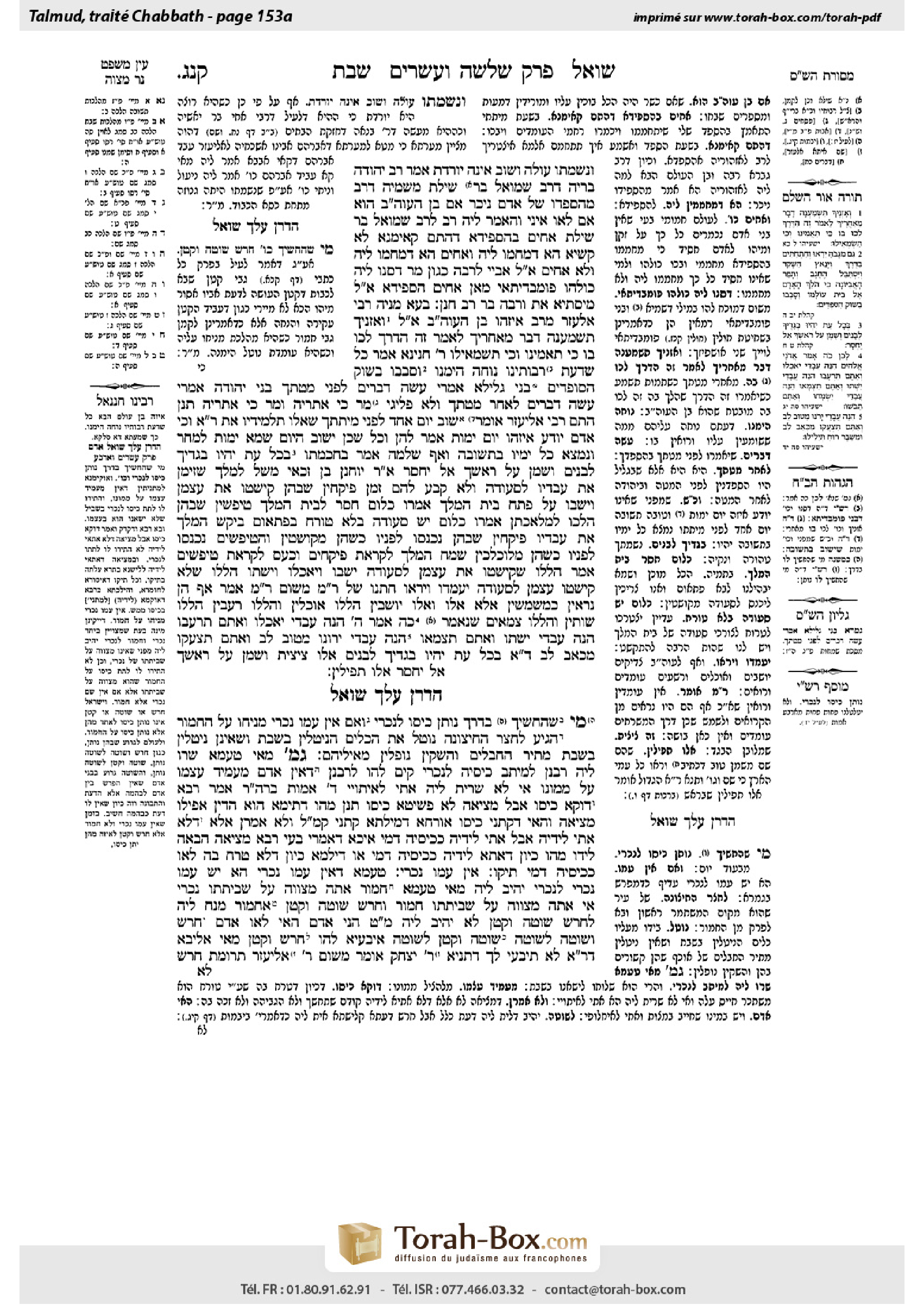
Shabbat 153a: Talmud study for Daf Yomi
Daf Yomi is the daily study of one Talmud folio. Explore 37 tractates with scans, Hebrew text, Sefaria English and AI-generated French translations where annotated.
Passage selection and English or AI-generated French translation are available where the scan has annotations. Daf Study is independent of Torah-Box and Sefaria.
Browse Shabbat · שבת · All tractatesShabbat 153a text and translations
This page of Shabbat includes the Aramaic text, an English translation and an AI-generated French translation, alongside the scan above.
שבת קנ״ג א · Aramaic and Hebrew text
וְנִשְׁמָתוֹ עוֹלָה, וְשׁוּב אֵינָהּ יוֹרֶדֶת.
אָמַר רַב יְהוּדָה בְּרֵיהּ דְּרַב שְׁמוּאֵל בַּר שִׁילַת מִשְּׁמֵיהּ דְּרַב: מֵהֶסְפֵּדוֹ שֶׁל אָדָם נִיכָּר אִם בֶּן הָעוֹלָם הַבָּא הוּא, אִם לָאו. אִינִי? וְהָאֲמַר לֵיהּ רַב לְרַב שְׁמוּאֵל בַּר שִׁילַת: אַחֵים בְּהֶסְפֵּידָא, דְּהָתָם קָאֵימְנָא! לָא קַשְׁיָא: הָא — דִּמְחַמּוּ לֵיהּ וְחָאֵים. הָא — דִּמְחַמּוּ לֵיהּ וְלָא חָאֵים.
אֲמַר לֵיהּ אַבָּיֵי לְרַבָּה: כְּגוֹן מָר דְּסָנוּ לֵיהּ כּוּלְּהוּ פּוּמְבְּדִיתָאֵי, מַאן מַחֵים הֶסְפֵּידָא? אֲמַר לֵיהּ: מִיסָּתַאי אַתְּ וְרַבָּה בַּר רַב חָנָן.
בְּעָא מִנֵּיהּ רַבִּי אֶלְעָזָר מֵרַב: אֵיזֶהוּ בֶּן הָעוֹלָם הַבָּא? אֲמַר לֵיהּ: ״וְאׇזְנֶיךָ תִּשְׁמַעְנָה דָבָר מֵאַחֲרֶיךָ לֵאמֹר זֶה הַדֶּרֶךְ לְכוּ בוֹ כִּי תַאֲמִינוּ וְכִי תַשְׂמְאִילוּ״. רַבִּי חֲנִינָא אָמַר: כׇּל שֶׁדַּעַת רַבּוֹתֵינוּ נוֹחָה הֵימֶנּוּ. ״וְסָבְבוּ בַּשּׁוּק הַסּוֹפְדִים״, בְּנֵי גָלִילָא אָמְרִי: עֲשֵׂה דְּבָרִים לִפְנֵי מִטָּתֶךָ, בְּנֵי יְהוּדָה אָמְרִי: עֲשֵׂה דְּבָרִים לְאַחַר מִטָּתֶךָ. וְלָא פְּלִיגִי: מָר כִּי אַתְרֵיהּ, וּמָר כִּי אַתְרֵיהּ.
תְּנַן הָתָם, רַבִּי אֱלִיעֶזֶר אוֹמֵר: שׁוּב יוֹם אֶחָד לִפְנֵי מִיתָתֶךָ. שָׁאֲלוּ תַּלְמִידָיו אֶת רַבִּי אֱלִיעֶזֶר: וְכִי אָדָם יוֹדֵעַ אֵיזֶהוּ יוֹם יָמוּת? אָמַר לָהֶן: וְכׇל שֶׁכֵּן, יָשׁוּב הַיּוֹם, שֶׁמָּא יָמוּת לְמָחָר, וְנִמְצָא כׇּל יָמָיו בִּתְשׁוּבָה. וְאַף שְׁלֹמֹה אָמַר בְּחׇכְמָתוֹ: ״בְּכׇל עֵת יִהְיוּ בְגָדֶיךָ לְבָנִים וְשֶׁמֶן עַל רֹאשְׁךָ אַל יֶחְסָר״.
אָמַר רַבִּי יוֹחָנָן בֶּן זַכַּאי: מָשָׁל לְמֶלֶךְ שֶׁזִּימֵּן אֶת עֲבָדָיו לִסְעוּדָה, וְלֹא קָבַע לָהֶם זְמַן. פִּיקְחִין שֶׁבָּהֶן קִישְּׁטוּ אֶת עַצְמָן וְיָשְׁבוּ עַל פֶּתַח בֵּית הַמֶּלֶךְ, אָמְרוּ: כְּלוּם חָסֵר לְבֵית הַמֶּלֶךְ? טִיפְּשִׁין שֶׁבָּהֶן הָלְכוּ לִמְלַאכְתָּן, אָמְרוּ: כְּלוּם יֵשׁ סְעוּדָה בְּלֹא טוֹרַח?
פִּתְאוֹם בִּיקֵּשׁ הַמֶּלֶךְ אֶת עֲבָדָיו. פִּיקְחִין שֶׁבָּהֶן נִכְנְסוּ לְפָנָיו כְּשֶׁהֵן מְקוּשָּׁטִין, וְהַטִּיפְּשִׁים נִכְנְסוּ לְפָנָיו כְּשֶׁהֵן מְלוּכְלָכִין. שָׂמַח הַמֶּלֶךְ לִקְרַאת פִּיקְחִים וְכָעַס לִקְרַאת טִיפְּשִׁים. אָמַר: הַלָּלוּ שֶׁקִּישְּׁטוּ אֶת עַצְמָן לַסְּעוּדָה — יֵשְׁבוּ וְיֹאכְלוּ וְיִשְׁתּוּ, הַלָּלוּ שֶׁלֹּא קִישְּׁטוּ עַצְמָן לַסְּעוּדָה — יַעַמְדוּ וְיִרְאוּ.
חֲתָנוֹ שֶׁל רַבִּי מֵאִיר מִשּׁוּם רַבִּי מֵאִיר אָמַר: אַף הֵן נִרְאִין כִּמְשַׁמְּשִׁין. אֶלָּא אֵלּוּ וָאֵלּוּ יוֹשְׁבִין: הַלָּלוּ — אוֹכְלִין, וְהַלָּלוּ — רְעֵבִין. הַלָּלוּ — שׁוֹתִין, וְהַלָּלוּ — צְמֵאִים, שֶׁנֶּאֱמַר: ״כֹּה אָמַר ה׳ הִנֵּה עֲבָדַי יֹאכֵלוּ וְאַתֶּם תִּרְעָבוּ הִנֵּה עֲבָדַי יִשְׁתּוּ וְאַתֶּם תִּצְמָאוּ הִנֵּה עֲבָדַי יָרוֹנּוּ מִטּוּב לֵב וְאַתֶּם תִּצְעֲקוּ מִכְּאֵב לֵב״.
דָּבָר אַחֵר: ״בְּכׇל עֵת יִהְיוּ בְגָדֶיךָ לְבָנִים״ — אֵלּוּ צִיצִית, ״וְשֶׁמֶן עַל רֹאשְׁךָ אַל יֶחְסָר״ — אֵלּוּ תְּפִילִּין.
הדרן עלך שואל
מַתְנִי׳ מִי שֶׁהֶחֱשִׁיךְ בַּדֶּרֶךְ — נוֹתֵן כִּיסוֹ לְגוֹי, וְאִם אֵין עִמּוֹ גּוֹי — מַנִּיחוֹ עַל הַחֲמוֹר. הִגִּיעַ לֶחָצֵר הַחִיצוֹנָה — נוֹטֵל אֶת הַכֵּלִים הַנִּיטָּלִין בַּשַּׁבָּת. וְשֶׁאֵינָן נִיטָּלִין בַּשַּׁבָּת — מַתִּיר הַחֲבָלִים, וְהַשַּׂקִּין נוֹפְלִין (מֵאֲילֵיהֶם).
גְּמָ׳ מַאי טַעְמָא שָׁרוּ לֵיהּ רַבָּנַן לְמִיתַּב כִּיסֵיהּ לְגוֹי? קִים לְהוּ לְרַבָּנַן דְּאֵין אָדָם מַעֲמִיד עַצְמוֹ עַל מָמוֹנוֹ, אִי לָא שָׁרֵית לֵיהּ — אָתֵי לְאֵיתוֹיֵי אַרְבַּע אַמּוֹת בִּרְשׁוּת הָרַבִּים.
אָמַר רָבָא: דַּוְקָא כִּיסוֹ, אֲבָל מְצִיאָה — לָא. פְּשִׁיטָא, ״כִּיסוֹ״ תְּנַן! מַהוּ דְתֵימָא הוּא הַדִּין אֲפִילּוּ מְצִיאָה, וְהַאי דְּקָתָנֵי ״כִּיסוֹ״ — אוֹרְחָא דְמִילְּתָא קָתָנֵי, קָא מַשְׁמַע לַן. וְלָא אֲמַרַן, אֶלָּא דְּלָא אֲתַי לִידֵיהּ, אֲבָל אֲתַי לִידֵיהּ — כְּכִיסֵיהּ דָּמֵי.
אִיכָּא דְאָמְרִי, בָּעֵי רָבָא: מְצִיאָה הַבָּאָה לְיָדוֹ מַהוּ, כֵּיוָן דַּאֲתַי לִידֵיהּ — כְּכִיסֵיהּ דָּמֵי? אוֹ דִילְמָא כֵּיוָן דְּלָא טָרַח בַּהּ — לָאו כְּכִיסֵיהּ דָּמֵי. תֵּיקוּ.
אֵין עִמּוֹ גּוֹי. טַעְמָא דְּאֵין עִמּוֹ גּוֹי, הָא יֵשׁ עִמּוֹ גּוֹי — לְגוֹי יָהֵיב לֵיהּ. מַאי טַעְמָא? חֲמוֹר — אַתָּה מְצֻוֶּוה עַל שְׁבִיתָתוֹ, גּוֹי — אִי אַתָּה מְצֻוֶּוה עַל שְׁבִיתָתוֹ.
חֲמוֹר וְחֵרֵשׁ שׁוֹטֶה וְקָטָן — אַחֲמוֹר מַנַּח לֵיהּ, לְחֵרֵשׁ שׁוֹטֶה וְקָטָן לָא יָהֵיב לֵיהּ. מַאי טַעְמָא? הָנֵי — אָדָם, הַאי — לָאו אָדָם. חֵרֵשׁ וְשׁוֹטֶה — לְשׁוֹטֶה. שׁוֹטֶה וְקָטָן — לְשׁוֹטֶה.
אִיבַּעְיָא לְהוּ: חֵרֵשׁ וְקָטָן מַאי? אַלִּיבָּא דְּרַבִּי אֱלִיעֶזֶר לָא תִּיבְּעֵי לָךְ, דְּתַנְיָא: רַבִּי יִצְחָק אוֹמֵר מִשּׁוּם רַבִּי אֱלִיעֶזֶר: תְּרוּמַת חֵרֵשׁ,
Shabbat 153a · English translation
and his soul ascends to its place beneath the Throne of Glory, and does not descend anymore.
Rav Yehuda, son of Rav Shmuel bar Sheilat, said in the name of Rav: From a person’s eulogy it is apparent whether or not he has a share in the World-to-Come. If the listeners are pained and brought to tears during the eulogy, it is clear that the person was righteous. The Gemara asks: Is that so? Didn’t Rav say to Rav Shmuel bar Sheilat: Stir the hearts of those gathered during my eulogy, for I will be standing there and listening to your words? Even a person as great as Rav needed to give instructions about his eulogy. The Gemara answers: This is not difficult, for this statement, which maintains that those who merit a share in the World-to-Come can be identified by their eulogies, is referring to a situation in which they attempt to stir the listener and he is stirred; while that statement is referring to a situation in which they attempt to stir the listener and he is not stirred. That is an indication that the deceased person was not righteous.
Abaye said to Rabba: In the case of the Master, i.e., Rabba, whom all of the inhabitants of his city, Pumbedita, hate, who will be stirred during his eulogy? He said to him: It is sufficient for me if you and Rabba bar Rav Ḥanan are stirred.
Rabbi Elazar raised a dilemma before Rav: Which type of person has a share in the World-to-Come? He said to him: We can derive this from the verse: “And your ears shall hear a word behind you, saying: This is the path, walk on it, when you turn to the right or to the left” (Isaiah 30:21). In other words, if people eulogize one by saying that others should follow in his path, he must have a share in the World-to-Come. Rabbi Ḥanina said: Anyone with whom our Rabbis are pleased has a share in the World-to-Come. In interpreting the verse: “And the eulogizers walk about the marketplace” (Ecclesiastes 12:5), the people of the Galilee say: Do things that you will want people to say at your eulogy in front of your bier. The people of Judea say: Do things that you want people to say at your eulogy behind your bier. The Gemara remarks: And they do not disagree; this Sage expressed it according to the norm in his place, and this Sage expressed it differently according to the norm in his place. The custom in the Galilee was that the eulogizers would stand before the bier and the custom in Judea was that eulogizers would stand behind the bier.
We learned there in a mishna that Rabbi Eliezer says: Repent one day before your death. Rabbi Eliezer’s students asked him: But does a person know the day on which he will die? He said to them: All the more so this is a good piece of advice, and one should repent today lest he die tomorrow; and by following this advice one will spend his entire life in a state of repentance. And King Solomon also said in his wisdom: “At all times your clothes should be white, and oil shall not be absent from upon your head” (Ecclesiastes 9:8), meaning that a person always needs to be prepared.
Similarly, Rabban Yoḥanan ben Zakkai said the following story as a parable to this lesson: The situation is comparable to a king who invited his servants to a feast and did not set a time for them to come. The wise among them adorned themselves and sat at the entrance to the king’s house. They said: Is the king’s house missing anything necessary for the feast? Certainly the king could invite them at any moment. The fools among them went to attend to their work and said: Is there such thing as a feast without the toil of preparing for it? While the feast is being prepared, we will attend to other matters.
Suddenly, the king requested that his servants come to the feast. The wise among them entered before him adorned in their finest clothes, and the fools entered before him dirty. The king was happy to greet the wise ones and angry to greet the fools. The king said: These wise servants who adorned themselves for the feast shall sit and eat and drink, but these fools who did not adorn themselves for the feast shall stand and watch. There is a similar outcome for people who think that their day of death and judgment is far away and do not prepare themselves for it.
Rabbi Meir’s son-in-law said in the name of Rabbi Meir: If the punishment for those who did not prepare themselves in advance was merely to stand and watch, it would not be severe enough because they also look like servants at the feast, which is not such a disgraceful punishment. Rather, these and these, both groups of people, sit at the feast. These wise and righteous people eat, and these wicked fools are hungry; these righteous people drink, and these wicked people are thirsty, as it is stated: “Therefore, thus said the Lord, God: Behold, My servants shall eat and you shall be hungry; behold, My servants shall drink and you shall be thirsty; behold, My servants shall rejoice and you shall be ashamed. Behold, My servants shall sing from a joyous heart and you shall scream from a pained heart” (Isaiah 65:13–14).
Alternatively, the verse quoted above can be interpreted in the following way: “At all times let your clothes be white”; this is clothing that contains ritual fringes [tzitzit], which are white. “And oil shall not be absent from upon your head”; these words hint to phylacteries, which are worn on the head.
MISHNA: One who was traveling on Shabbat eve and night fell, and Shabbat began while he was still en route, gives his money pouch to a gentile traveling with him. And if there is no gentile with him he places it on the donkey. Once he reached the outer courtyard of the city, where belongings can be securely placed, he takes the vessels that may be moved on Shabbat off the donkey. With regard to the vessels that may not be moved on Shabbat, he unties the ropes that attach his bags to the donkey, and the bags of vessels fall on their own.
GEMARA: We learned in the mishna: One who was traveling on Shabbat eve and night fell, and Shabbat began while he was still en route, gives his money pouch to a gentile. The Gemara asks: What is the reason that the Sages permitted him to give his pouch to a gentile? Is it not prohibited for a Jew to ask a gentile to perform a prohibited labor on Shabbat? The Gemara answers: The Sages maintain that a person does not restrain himself when faced with losing his money. If you do not permit him to give his pouch to a gentile, he will come to carry four cubits in a public domain, thereby violating a Torah prohibition.
Rava said: This allowance to give the pouch to a gentile is specifically with regard to his own pouch, but in the case of a lost object that he found, no, it was not permitted. The Gemara asks: That is obvious, as we learned in the mishna: His pouch, and nothing else. The Gemara answers: Rava specified this lest you say that the same is true even with regard to a lost object, that one may give it to a gentile on Shabbat, and the mishna taught the case of his pouch merely because it is the manner in which the matter typically occurs. Therefore, Rava teaches us that the mishna is in fact establishing a halakha restricted to his pouch. The Gemara comments: And we only said that this allowance does not apply to a lost object when it did not come into his possession before Shabbat. However, if the object already came into his possession before Shabbat, its legal status is like that of his pouch.
Some state this dilemma in a different manner. Rava raised a dilemma: With regard to a lost object that came into his possession before Shabbat, what is the ruling? Is the halakha that since it already came into his possession, its legal status is like that of his pouch? Or perhaps, since he did not exert himself to acquire it, its legal status is not like that of his pouch. Since he expended no effort, he would be capable of restraining himself even when faced with losing it. Therefore, there is no need for the Sages to permit him to give it to a gentile. The Gemara concludes: Let this dilemma stand unresolved.
We learned in the mishna: And if there is no gentile with him he places it on the donkey. The Gemara infers: The reason is specifically because there is no gentile with him; if there is a gentile with him, he gives it to the gentile and does not place it on a donkey. The Gemara asks: What is the reason for this halakha? The Gemara answers: With regard to a donkey belonging to a Jew, you are commanded with regard to its rest on Shabbat. With regard to a gentile, you are not commanded with regard to his rest and no Torah prohibition is being violated.
The Gemara teaches an additional halakha: If there was no gentile with him but there was a donkey, a deaf-mute, an imbecile, and a minor, meaning someone under thirteen years old, one places it on the donkey, but one neither gives it to the deaf-mute, nor the imbecile, nor the minor. What is the reason for this? Although they are not obligated to fulfill mitzvot, these are people, but this donkey is not a person. It is preferable to place it on the donkey rather than give it to a person. And if a deaf-mute and an imbecile were with him, he gives it to the imbecile. If an imbecile and a minor were with him, he gives it to the imbecile.
A dilemma was raised before the Sages: If a deaf-mute and a minor were with him, what is the ruling? To whom does he give his pouch? The Gemara answers: According to the opinion of Rabbi Eliezer you have no dilemma. Rabbi Eliezer holds that a deaf-mute has a greater degree of halakhic intelligence than does a minor, as it was taught in a baraita: Rabbi Yitzḥak says in the name of Rabbi Eliezer: The teruma of a deaf-mute that he separated from his produce
Shabbat 153a · Traduction française (IA)
et son âme monte à sa place, sous le Trône de Gloire, et n’en redescend plus.
Rav Yehouda, fils de Rav Shmuel bar Sheilat, dit au nom de Rav : L’éloge funèbre d’une personne permet de savoir si elle a ou non une part dans le Monde futur. Si les auditeurs sont touchés et fondent en larmes pendant l’éloge, il est clair que le défunt était juste. La Guemara demande : Est-ce vraiment le cas ? Rav n’a-t-il pas dit à Rav Shmuel bar Sheilat : « Émeus ceux qui sont réunis pendant mon éloge funèbre, car je me tiendrai là et écouterai tes paroles » ? Même un homme aussi éminent que Rav devait donner des instructions au sujet de son éloge funèbre. La Guemara répond : Il n’y a pas de contradiction. La première affirmation, selon laquelle on peut reconnaître ceux qui méritent une part dans le Monde futur à leurs éloges funèbres, concerne le cas où l’on s’efforce d’émouvoir l’auditeur et où celui-ci est ému ; l’autre affirmation concerne le cas où l’on s’efforce de l’émouvoir, mais où il ne l’est pas. Cela indique que le défunt n’était pas juste.
Abaye dit à Rabba : « Dans le cas du Maître, c’est-à-dire Rabba, que tous les habitants de sa ville, Poumbedita, détestent, qui sera ému pendant son éloge funèbre ? » Il lui répondit : « Il me suffit que toi et Rabba bar Rav Ḥanan soyez émus. »
Rabbi Elazar posa à Rav la question suivante : Quel genre de personne a une part dans le Monde futur ? Il lui répondit : On peut le déduire du verset : « Tes oreilles entendront derrière toi une parole disant : “Voici le chemin, marchez-y”, quand vous vous tournerez à droite ou à gauche » (Isaïe 30:21). Autrement dit, si l’on fait l’éloge d’une personne en disant que les autres doivent suivre son chemin, elle doit avoir une part dans le Monde futur. Rabbi Ḥanina dit : Quiconque a l’approbation de nos Rabbins a une part dans le Monde futur. En interprétant le verset : « Les élogeurs circulent sur la place du marché » (Ecclésiaste 12:5), les habitants de Galilée disent : « Agissez de manière que les gens prononcent à votre éloge, devant votre bière, les paroles que vous souhaitez entendre. » Les habitants de Judée disent : « Agissez de manière que les gens prononcent à votre éloge, derrière votre bière, les paroles que vous souhaitez entendre. » La Guemara fait remarquer : Ils ne sont pas en désaccord ; ce Sage s’est exprimé selon l’usage de son lieu, et cet autre Sage s’est exprimé différemment, selon l’usage de son lieu. En Galilée, les élogeurs se tenaient devant la bière, tandis qu’en Judée, ils se tenaient derrière.
Nous avons appris dans une Michna que Rabbi Eliezer dit : Fais téchouva un jour avant ta mort. Les élèves de Rabbi Eliezer lui demandèrent : Mais une personne sait-elle quel jour elle mourra ? Il leur dit : À plus forte raison, c’est un bon conseil : fais téchouva aujourd’hui, de peur de mourir demain ; en suivant ce conseil, tu passeras toute ta vie dans un état de téchouva. Le roi Salomon dit lui aussi dans sa sagesse : « Que tes vêtements soient blancs en tout temps, et que l’huile ne manque pas sur ta tête » (Ecclésiaste 9:8), ce qui signifie qu’une personne doit toujours être prête.
De même, Rabban Yoḥanan ben Zakkaï raconta l’histoire suivante sous forme de parabole pour illustrer cette leçon : La situation est comparable à celle d’un roi qui invita ses serviteurs à un festin sans fixer l’heure à laquelle ils devaient venir. Les plus sages d’entre eux se parèrent et s’assirent à l’entrée de la maison du roi. Ils se dirent : « La maison du roi manque-t-elle de quelque chose de nécessaire au festin ? Le roi peut certainement nous inviter à tout moment. » Les insensés d’entre eux allèrent s’occuper de leur travail et se dirent : « Existe-t-il un festin sans le labeur nécessaire à sa préparation ? Pendant qu’on prépare le festin, nous allons nous occuper d’autres choses. »
Soudain, le roi demanda à ses serviteurs de venir au festin. Les plus sages entrèrent devant lui, parés de leurs plus beaux vêtements, tandis que les insensés entrèrent devant lui, tout sales. Le roi fut heureux d’accueillir les sages et irrité de voir les insensés. Le roi dit : « Que ces serviteurs sages, qui se sont parés pour le festin, s’assoient, mangent et boivent ; quant à ces insensés, qui ne se sont pas parés pour le festin, qu’ils restent debout et regardent. » Il en va de même pour ceux qui pensent que le jour de leur mort et du jugement est encore lointain et ne s’y préparent pas.
Le gendre de Rabbi Meïr dit au nom de Rabbi Meïr : Si le châtiment de ceux qui ne s’étaient pas préparés à l’avance consistait seulement à rester debout et à regarder, il ne serait pas assez sévère, car eux aussi ressembleraient à des serviteurs présents au festin, ce qui ne serait pas un châtiment si déshonorant. En réalité, les uns et les autres, les deux groupes, s’assoient au festin. Ces sages et justes mangent, tandis que ces insensés méchants ont faim ; ces justes boivent, tandis que ces méchants ont soif, ainsi qu’il est dit : « C’est pourquoi, ainsi parle le Seigneur Dieu : Voici, mes serviteurs mangeront, et vous aurez faim ; voici, mes serviteurs boiront, et vous aurez soif ; voici, mes serviteurs se réjouiront, et vous serez honteux. Voici, mes serviteurs chanteront d’un cœur joyeux, et vous crierez, le cœur accablé » (Isaïe 65:13–14).
Autre interprétation du verset cité plus haut : « Que tes vêtements soient blancs en tout temps » désigne les vêtements qui portent des franges rituelles [tzitzit], lesquelles sont blanches. « Et que l’huile ne manque pas sur ta tête » fait allusion aux phylactères, que l’on porte sur la tête.
Michna : Celui qui voyageait à la veille de Chabbat et dont la nuit tomba, de sorte que Chabbat commença alors qu’il était encore en chemin, confie sa bourse à un non-Juif qui voyage avec lui. S’il n’y a pas de non-Juif avec lui, il la place sur l’âne. Lorsqu’il arrive dans la cour extérieure de la ville, où il peut déposer ses biens en sécurité, il retire de l’âne les objets qu’il est permis de déplacer pendant Chabbat. Quant aux objets qu’il est interdit de déplacer pendant Chabbat, il défait les cordes qui attachent ses sacs à l’âne, et les sacs contenant ces objets tombent d’eux-mêmes.
Guemara : Nous avons appris dans la Michna : Celui qui voyageait à la veille de Chabbat et dont la nuit tomba, de sorte que Chabbat commença alors qu’il était encore en chemin, confie sa bourse à un non-Juif. La Guemara demande : Pourquoi les Sages lui ont-ils permis de confier sa bourse à un non-Juif ? N’est-il pas interdit à un Juif de demander à un non-Juif d’accomplir un travail interdit pendant Chabbat ? La Guemara répond : Les Sages considèrent qu’une personne ne se maîtrise pas lorsqu’elle risque de perdre son argent. Si on ne lui permet pas de confier sa bourse à un non-Juif, elle en viendra à porter sur quatre coudées dans un domaine public, transgressant ainsi une interdiction de la Torah.
Rava dit : Cette permission de confier la bourse à un non-Juif concerne précisément sa propre bourse ; mais dans le cas d’un objet perdu qu’il a trouvé, cela n’est pas permis. La Guemara demande : Cela va de soi, puisque nous avons appris dans la Michna : « Sa bourse », et rien d’autre. La Guemara répond : Rava a précisé cela, de peur que tu ne dises qu’il en va de même pour un objet perdu et qu’on puisse le confier à un non-Juif pendant Chabbat, et que la Michna n’ait enseigné le cas de la bourse que parce que c’est la situation habituelle. Rava nous apprend donc que la Michna établit bien une halakha qui se limite à sa bourse. La Guemara fait remarquer : Nous avons dit que cette permission ne s’applique pas à un objet perdu lorsque celui-ci n’est pas entré en sa possession avant Chabbat. En revanche, si l’objet était déjà entré en sa possession avant Chabbat, son statut juridique est celui de sa bourse.
Certains rapportent ce dilemme sous une autre forme. Rava posa la question suivante : Quel est le statut d’un objet perdu qui était entré en sa possession avant Chabbat ? La halakha est-elle que, puisqu’il était déjà entré en sa possession, son statut juridique est celui de sa bourse ? Ou bien, puisqu’il n’a pas fait d’effort pour l’acquérir, son statut juridique n’est-il pas celui de sa bourse ? Comme il n’a fait aucun effort, il pourrait se maîtriser même s’il risquait de le perdre. Les Sages n’ont donc pas besoin de lui permettre de le confier à un non-Juif. La Guemara conclut : Que ce dilemme demeure sans réponse.
Nous avons appris dans la Michna : « S’il n’y a pas de non-Juif avec lui, il la place sur l’âne. » La Guemara en déduit que la raison est précisément qu’il n’y a pas de non-Juif avec lui ; s’il y en a un, il la lui confie et ne la place pas sur un âne. La Guemara demande : Quelle est la raison de cette halakha ? La Guemara répond : En ce qui concerne un âne appartenant à un Juif, tu as l’obligation de veiller à son repos pendant Chabbat. En ce qui concerne un non-Juif, tu n’as pas l’obligation de veiller à son repos, et aucune interdiction de la Torah n’est transgressée.
La Guemara enseigne une halakha supplémentaire : S’il n’y avait pas de non-Juif avec lui, mais qu’il y avait un âne, une personne sourde-muette, un simple d’esprit et un mineur, c’est-à-dire une personne âgée de moins de treize ans, on place la bourse sur l’âne, mais on ne la confie ni à la personne sourde-muette, ni au simple d’esprit, ni au mineur. Pourquoi ? Bien qu’ils ne soient pas tenus d’accomplir les mitsvot, ce sont des personnes, tandis que l’âne n’est pas une personne. Il est préférable de la placer sur l’âne plutôt que de la confier à une personne. Si une personne sourde-muette et un simple d’esprit étaient avec lui, il la confie au simple d’esprit. Si un simple d’esprit et un mineur étaient avec lui, il la confie au simple d’esprit.
Les Sages posèrent le dilemme suivant : Si une personne sourde-muette et un mineur étaient avec lui, quelle est la halakha ? À qui confie-t-il sa bourse ? La Guemara répond : Selon l’opinion de Rabbi Eliezer, il n’y a pas de dilemme. Rabbi Eliezer considère qu’une personne sourde-muette possède une intelligence halakhique supérieure à celle d’un mineur, comme il a été enseigné dans une baraïta : Rabbi Yitzḥak dit au nom de Rabbi Eliezer : La terouma qu’une personne sourde-muette a prélevée sur ses produits
Traduction française générée par IA à partir de l’édition anglaise de Sefaria. Vérifie toujours un passage avec le texte source.
Text from Sefaria: William Davidson Edition - Vocalized Aramaic (CC BY NC); William Davidson Edition - English (CC BY NC).