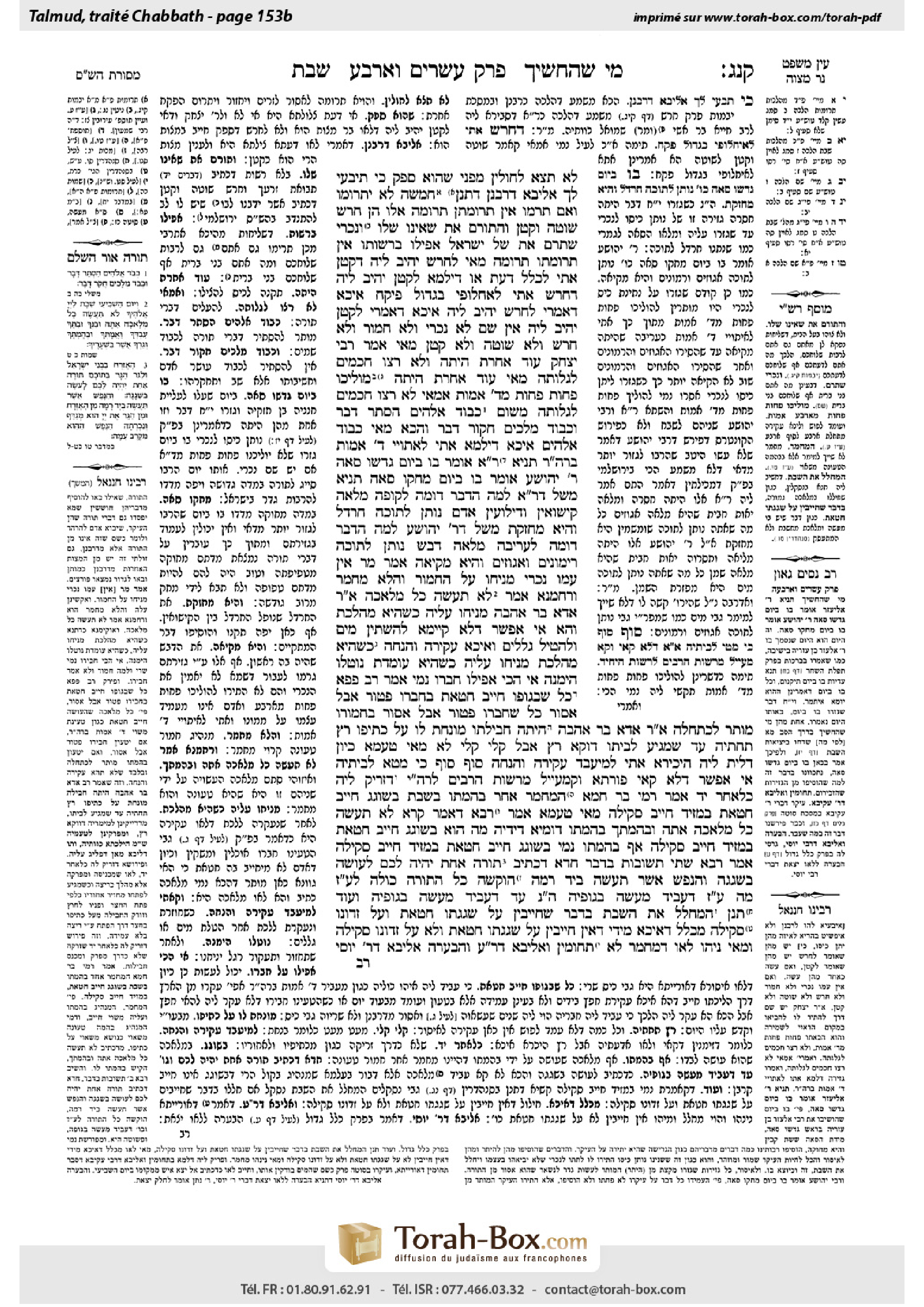
Shabbat 153b: Talmud study for Daf Yomi
Daf Yomi is the daily study of one Talmud folio. Explore 37 tractates with scans, Hebrew text, Sefaria English and AI-generated French translations where annotated.
Passage selection and English or AI-generated French translation are available where the scan has annotations. Daf Study is independent of Torah-Box and Sefaria.
Browse Shabbat · שבת · All tractatesShabbat 153b text and translations
This page of Shabbat includes the Aramaic text, an English translation and an AI-generated French translation, alongside the scan above.
שבת קנ״ג ב · Aramaic and Hebrew text
לֹא תֵּצֵא לְחוּלִּין, מִפְּנֵי שֶׁהוּא סָפֵק.
כִּי תִּיבְּעֵי לָךְ אַלִּיבָּא דְּרַבָּנַן, דִּתְנַן: חֲמִשָּׁה לֹא יִתְרוֹמוּ, וְאִם תָּרְמוּ אֵין תְּרוּמָתָן תְּרוּמָה, אֵלּוּ הֵן: חֵרֵשׁ שׁוֹטֶה וְקָטָן, וְהַתּוֹרֵם אֶת שֶׁאֵינוֹ שֶׁלּוֹ, וְגוֹי שֶׁתָּרַם אֶת שֶׁל יִשְׂרָאֵל אֲפִילּוּ בִּרְשׁוּתוֹ אֵין תְּרוּמָתוֹ תְּרוּמָה.
מַאי? לְחֵרֵשׁ יָהֵיב לֵיהּ, דְּקָטָן אָתֵי לִכְלַל דַּעַת, אוֹ דִילְמָא לְקָטָן יָהֵיב לֵיהּ, דְּחֵרֵשׁ אָתֵי לְאִחַלּוֹפֵי בְּגָדוֹל פִּיקֵּחַ. אִיכָּא דְאָמְרִי לְחֵרֵשׁ יָהֵיב לֵיהּ, אִיכָּא דְאָמְרִי לְקָטָן יָהֵיב לֵיהּ.
אֵין שָׁם לֹא גּוֹי וְלֹא חֲמוֹר וְלֹא חֵרֵשׁ וְלֹא שׁוֹטֶה וְלֹא קָטָן, מַאי? אָמַר רַבִּי יִצְחָק: עוֹד אַחֶרֶת הָיְתָה, וְלֹא רָצוּ חֲכָמִים לְגַלּוֹתָהּ. מַאי ״עוֹד אַחֶרֶת הָיְתָה״? מוֹלִיכוֹ פָּחוֹת פָּחוֹת מֵאַרְבַּע אַמּוֹת. אַמַּאי לֹא רָצוּ חֲכָמִים לְגַלּוֹתָהּ? — מִשּׁוּם ״כְּבוֹד אֱלֹהִים הַסְתֵּר דָּבָר וּכְבוֹד מְלָכִים חֲקוֹר דָּבָר״. וְהָכָא, מַאי ״כְּבוֹד אֱלֹהִים״ אִיכָּא? דִּילְמָא אָתֵי לְאֵתוֹיֵי אַרְבַּע אַמּוֹת בִּרְשׁוּת הָרַבִּים.
תַּנְיָא, רַבִּי אֱלִיעֶזֶר אוֹמֵר: בּוֹ בַּיּוֹם גָּדְשׁוּ סְאָה. רַבִּי יְהוֹשֻׁעַ אוֹמֵר: בּוֹ בַּיּוֹם מָחֲקוּ סְאָה.
תַּנְיָא: מָשָׁל דְּרַבִּי אֱלִיעֶזֶר, לְמָה הַדָּבָר דּוֹמֶה — לַקּוּפָּה מְלֵאָה קִישּׁוּאִין וְדִילּוּעִין, אָדָם נוֹתֵן לְתוֹכָהּ חַרְדָּל — וְהִיא מַחְזֶקֶת. מָשָׁל דְּרַבִּי יְהוֹשֻׁעַ, לְמָה הַדָּבָר דּוֹמֶה — לַעֲרֵיבָה מְלֵאָה דְּבַשׁ, נוֹתֵן לְתוֹכָהּ רִימּוֹנִים וֶאֱגוֹזִים — וְהִיא מְקִיאָה.
אָמַר מָר אֵין עִמּוֹ גּוֹי מַנִּיחוֹ עַל הַחֲמוֹר. וַהֲלֹא מְחַמֵּר, וְרַחֲמָנָא אָמַר ״לֹא תַעֲשֶׂה כׇל מְלָאכָה״!
אָמַר רַב אַדָּא בַּר אַהֲבָה: מַנִּיחוֹ עָלֶיהָ כְּשֶׁהִיא מְהַלֶּכֶת. וְהָא אִי אֶפְשָׁר דְּלָא קָיְימָא לְהַשְׁתִּין מַיִם וּלְהַטִּיל גְּלָלִים, וְאִיכָּא עֲקִירָה וְהַנָּחָה! כְּשֶׁהִיא מְהַלֶּכֶת — מַנִּיחוֹ עָלֶיהָ, כְּשֶׁהִיא עוֹמֶדֶת — נוֹטְלוֹ הֵימֶנָּה. אִי הָכִי, אֲפִילּוּ חֲבֵרוֹ נָמֵי!
אָמַר רַב פָּפָּא: כׇּל שֶׁבְּגוּפוֹ חַיָּיב חַטָּאת — בַּחֲבֵרוֹ פָּטוּר אֲבָל אָסוּר, כׇּל שֶׁחֲבֵרוֹ פָּטוּר אֲבָל אָסוּר — בַּחֲמוֹרוֹ מוּתָּר לְכַתְּחִלָּה.
אָמַר רַב אַדָּא בַּר אַהֲבָה: הָיְתָה חֲבִילָתוֹ מוּנַּחַת לוֹ עַל כְּתֵיפוֹ — רָץ תַּחְתֶּיהָ עַד שֶׁמַּגִּיעַ לְבֵיתוֹ. דַּוְקָא רָץ, אֲבָל קַלִּי קַלִּי — לָא.
מַאי טַעְמָא? — כֵּיוָן דְּלֵית לֵיהּ הֶיכֵּירָא, אָתֵי לְמִיעְבַּד עֲקִירָה וְהַנָּחָה. סוֹף סוֹף, כִּי מָטֵי לְבֵיתֵיהּ אִי אֶפְשָׁר דְּלָא קָאֵי פּוּרְתָּא, וְקָמְעַיֵּיל מֵרְשׁוּת הָרַבִּים לִרְשׁוּת הַיָּחִיד! דְּזָרֵיק לֵיהּ כִּלְאַחַר יָד.
אָמַר רָמֵי בַּר חָמָא: הַמְחַמֵּר אַחֵר בְּהֶמְתּוֹ בְּשַׁבָּת, בְּשׁוֹגֵג — חַיָּיב חַטָּאת, בְּמֵזִיד — חַיָּיב סְקִילָה. מַאי טַעְמָא? אָמַר רָבָא: דְּאָמַר קְרָא: ״לֹא תַעֲשֶׂה כׇל מְלָאכָה אַתָּה וּבְהֶמְתֶּךָ״ — בְּהֶמְתּוֹ דּוּמְיָא דִידֵיהּ: מָה הוּא — בְּשׁוֹגֵג חַיָּיב חַטָּאת, בְּמֵזִיד חַיָּיב סְקִילָה. אַף בְּהֶמְתּוֹ נָמֵי — בְּשׁוֹגֵג חַיָּיב חַטָּאת, בְּמֵזִיד חַיָּיב סְקִילָה.
אָמַר רָבָא, שְׁתֵּי תְּשׁוּבוֹת בְּדָבָר: חֲדָא, דִּכְתִיב: ״תּוֹרָה אַחַת יִהְיֶה לָכֶם לָעוֹשֶׂה בִּשְׁגָגָה וְהַנֶּפֶשׁ אֲשֶׁר תַּעֲשֶׂה בְּיָד רָמָה״ — הוּקְּשָׁה כָּל הַתּוֹרָה כּוּלָּהּ לַעֲבוֹדָה זָרָה: מָה עֲבוֹדָה זָרָה דְּעָבֵיד מַעֲשֶׂה בְּגוּפֵיהּ, הָכָא נָמֵי עַד דְּעָבֵיד מַעֲשֶׂה בְּגוּפֵיהּ.
וְעוֹד, תְּנַן: הַמְחַלֵּל אֶת הַשַּׁבָּת בְּדָבָר שֶׁחַיָּיבִין עַל שִׁגְגָתוֹ חַטָּאת וְעַל זְדוֹנוֹ סְקִילָה. מִכְּלָל דְּאִיכָּא מִידֵּי דְּאֵין חַיָּיבִין עַל שִׁגְגָתוֹ חַטָּאת וְלֹא עַל זְדוֹנוֹ סְקִילָה,
וּמַאי נִיהוּ, ״לָאו״ דִּמְחַמֵּר? לָא, תְּחוּמִין וְאַלִּיבָּא דְּרַבִּי עֲקִיבָא, וְהַבְעָרָה אַלִּיבָּא דְּרַבִּי יוֹסֵי.
Shabbat 153b · English translation
does not vacate its sanctified status and assume non-sacred status because his status with regard to halakhic intelligence is uncertain. According to Rabbi Eliezer, a deaf-mute apparently has a degree of halakhic intelligence, and therefore has a greater obligation in mitzvot than a minor.
When you raise this dilemma, the issue is in accordance with the opinion of the Rabbis, as we learned in a mishna: There are five categories of people who may not separate teruma ab initio, and if they separated teruma, their teruma is not considered teruma. They are: A deaf-mute, an imbecile, and a minor, and one who separates teruma from produce that is not his; and a gentile who separated teruma from the produce of a Jew, even with his permission, his teruma is not considered teruma because a gentile cannot be appointed as an agent to separate teruma, and all the more so he cannot separate teruma on his own. The deaf-mute and the minor have the same legal status according to the Rabbis; therefore, a dilemma arises as to which of them should receive the pouch on Shabbat.
What should one do? Should he give it to the deaf-mute because the minor will eventually reach the stage of halakhic intelligence, when he will be obligated to observe the mitzvot, and it is preferable that he not become accustomed to desecrating Shabbat? Or perhaps he should give it to the minor, because if he is allowed to give it to the deaf-mute, onlookers will mistake him for an adult with halakhic intelligence and conclude that it is permitted to give his pouch to an adult? In that case it would be preferable to give the pouch to a minor, as it is clear that he is not obligated in mitzvot. Regarding this halakha, some say that he gives it to the deaf-mute and some say that he gives it to the minor, and no definitive conclusion was reached.
The Gemara asks: If there is neither a gentile nor a donkey nor a deaf-mute nor an imbecile nor a minor there, what should one do? Rabbi Yitzḥak said: There was another manner of dealing with this situation, and the Sages did not want to reveal it. The Gemara asks: To what was Rabbi Yitzḥak referring when he said: There was another manner? The Gemara answers: The alternative is to move the pouch in increments, each less than four cubits, and thereby carry the object in the public domain without violating a Torah prohibition. The Gemara asks: Why didn’t the Sages want to reveal this alternative? The Gemara answers that it is due to the verse: “It is the glory of God to conceal a thing; but the glory of kings is to search out a matter” (Proverbs 25:2). And here, what glory of God is there in concealing this option? The Gemara answers: If one were to move the pouch in this manner, there is concern lest he come to carry the object four cubits in the public domain.
The ruling that one should give his pouch to a gentile rather than carry in increments each less than four cubits was among the eighteen decrees issued in accordance with the position of Beit Shammai, enumerated in the first chapter of tractate Shabbat. Sages of later generations disagreed with regard to these eighteen decrees: It was taught in a baraita that Rabbi Eliezer says: On that day they measured with a large se’a measurement, i.e., they did well to issue these decrees, which construct a fence around the Torah to prevent its violation. Rabbi Yehoshua said: On that very day they measured with a minimal se’a, i.e., because these decrees are difficult to observe, they not only will lead people to violate the decrees, but to violate Torah prohibitions as well.
It was taught in another baraita: The Sages articulated a parable to illustrate the opinion of Rabbi Eliezer. To what is this matter similar? It is similar to a basket full of squash and gourds into which a person places mustard seeds. Just as the basket also holds the mustard, the decree will also endure. They also articulated a parable to illustrate the opinion of Rabbi Yehoshua: To what is this matter similar? It is similar to a large bowl full of honey into which one places pomegranates and walnuts. Just as the bowl expels the honey from inside it, so too, the decree will cause Torah prohibitions to be violated.
We learned in the mishna that the Master said: When there is no gentile with him, one places the pouch on the donkey. The Gemara asks: Isn’t he thereby driving a laden animal? And the Torah stated: “And the seventh day is Shabbat for the Lord your God, you shall not perform any manner of labor, neither you, nor your son, nor your daughter, nor your slave, nor your maidservant, nor your animal, nor your stranger that is within your gates” (Exodus 20:10). He is causing the prohibited labors of carrying from domain to domain and of carrying in the public domain by placing the pouch on his donkey on Shabbat.
Rav Adda bar Ahava said: One places the pouch on the donkey as it is walking, because in doing so he does not commit a full-fledged violation of the Torah prohibition against carrying out from domain to domain on Shabbat. A full-fledged violation consists of lifting and placing the object. Because the animal was already walking when the pouch was placed on it, the animal performed no lifting. The Gemara asks: Isn’t it impossible that the animal will not stand in its place at some point after it begins walking, either in order to urinate or to defecate, and when it begins walking again there is both an act of lifting and an act of placing performed by the donkey. The Gemara answers: There is a solution to that problem. When the donkey is walking, one places the pouch on it, and when it stands, he removes it. The Gemara asks: If so, one could even place the pouch on another Jew as well, as there would be neither lifting nor placing.
Rav Pappa said: Any action that if one performs it by himself, he is liable to bring a sin-offering for it, if he performed it by means of another, he is exempt but it is still prohibited for him to do so. And any action that if performed by means of another, he is exempt from bringing a sin-offering but it is still prohibited for him to do so, performing the action by means of his donkey is permitted ab initio.
Rav Adda bar Ahava said: One who was traveling on Shabbat eve and his package was resting on his shoulder as night fell, he runs beneath it, i.e., with his package on his shoulder, until he reaches his home. The Gemara infers: Specifically, one runs until he reaches home; however, walking a little bit at a time, no, he may not do so.
The Gemara asks: What is the reason for this? Since, when walking in the usual manner, he has no conspicuous reminder that it is Shabbat, there is concern lest he come to perform the acts of lifting and placing by stopping to rest on his way home. The Gemara asks: Ultimately, when he reaches his home, it is impossible that he will not stop and stand a bit, and at that point, he will have performed the prohibited labor of carrying the package from the public domain into the private domain of his house. The Gemara answers: This is referring to a case in which he does not place the package in the typical manner when he reaches his home. Rather, he throws it down in an unusual manner. Since he did not perform the action in the typical manner, it is not prohibited by Torah law.
With regard to the topic of driving a donkey on Shabbat, the Gemara cites that which Rami bar Ḥama said: With regard to one who drives his laden animal on Shabbat, if he does so unwittingly, he is liable to bring a sin-offering, and if he does so intentionally, he is liable to be executed by stoning. The Gemara asks: What is the reason for this ruling? Rava said that the verse states: “You shall not perform any manner of labor, neither you…nor your animal” (Exodus 20:10). From this he derived: His animal is similar to himself; just as he, if he performed a prohibited labor on Shabbat unwittingly, he is liable to bring a sin-offering, and if he did so intentionally, he is liable to be executed by stoning, so too, if he performed a prohibited labor by means of his animal, if he did so unwittingly, he is liable to bring a sin-offering, and if he did so intentionally, he is liable to be executed by stoning.
Rava said: There are two possible responses with which this statement can be rejected. One is, as it is written: “You shall have one law [Torah] for him that does unwittingly…and for the proselyte who resides among them. But the soul that does with a high hand, whether he be home-born or a stranger, he blasphemes the Lord; and that soul shall be cut off from among his people” (Numbers 15:29–30). This verse is referring to one who worships idolatry unwittingly. The entire Torah is juxtaposed to idolatry, and from that juxtaposition it is derived: Just as in the case of idolatry one is liable only when he performs an action with his body, i.e., himself, here too, in the case of Shabbat, he is liable only if he performs an action with his body, i.e., himself. He is not liable for an action performed by his animal.
And furthermore, with regard to the statement that if he drove the laden donkey he is liable to be executed by stoning, we learned in a mishna that enumerates those who are executed by stoning: One who desecrates Shabbat by performing a matter that for its unwitting performance one is liable to bring a sin-offering, and for its intentional performance one is liable to be executed by stoning. By inference, there is another matter, another prohibition, that for which its unwitting performance one is not liable to bring a sin-offering, and for which its intentional performance one is not liable to be executed by stoning.
And what is that Torah prohibition? Is it not the prohibition of driving a laden animal? Apparently, driving a laden animal and other labors performed by means of animals on Shabbat are not punishable by stoning, even though they are prohibited by Torah law. The Gemara rejects this second proof. No, this is not necessarily so. It is possible that the mishna is referring to the prohibition of Shabbat limits, and it is in accordance with the opinion of Rabbi Akiva, who holds that it is a Torah prohibition but that one is neither liable to bring a sin-offering for violating it unwittingly, nor is he liable to be executed by stoning for violating it intentionally. And likewise, it may refer to the prohibition of kindling a fire on Shabbat in accordance with the opinion of Rabbi Yosei, who holds that it is not punishable by stoning but by lashes, like other prohibitions.
Shabbat 153b · Traduction française (IA)
ne perd pas son statut sacré pour devenir profane, car son degré d’intelligence au regard de la halakha est incertain. Selon Rabbi Eliezer, un sourd-muet semble posséder un certain degré d’intelligence halakhique et est donc davantage tenu aux mitsvot qu’un mineur.
Lorsque tu soulèves cette question, elle relève de l’opinion des Rabbins, comme nous l’avons appris dans une Michna : cinq catégories de personnes ne peuvent pas prélever la terouma a priori et, si elles l’ont prélevée, leur prélèvement n’est pas valable. Ce sont : un sourd-muet, un déficient mental et un mineur ; celui qui prélève la terouma sur des produits qui ne lui appartiennent pas ; et un non-Juif qui prélève la terouma sur les produits d’un Juif, même avec l’autorisation de celui-ci. Son prélèvement n’est pas valable, car un non-Juif ne peut pas être désigné comme mandataire pour prélever la terouma, et il peut encore moins la prélever de sa propre initiative. Selon les Rabbins, le sourd-muet et le mineur ont le même statut juridique ; on se demande donc auquel des deux il faut confier la sacoche pendant Chabbat.
Que faut-il faire ? Faut-il la donner au sourd-muet, puisque le mineur finira par atteindre le stade de l’intelligence halakhique, où il sera tenu d’observer les mitsvot, et qu’il vaut mieux éviter qu’il s’habitue à profaner Chabbat ? Ou peut-être faut-il la donner au mineur, car si on la confie au sourd-muet, les observateurs pourraient le prendre pour un adulte doté d’intelligence halakhique et en conclure qu’il est permis de confier sa sacoche à un adulte. Dans ce cas, il serait préférable de la donner à un mineur, dont il est évident qu’il n’est pas tenu aux mitsvot. Au sujet de cette halakha, certains disent qu’on la donne au sourd-muet, et d’autres qu’on la donne au mineur ; aucune conclusion définitive n’a été établie.
La Guemara demande : S’il n’y a là ni non-Juif, ni âne, ni sourd-muet, ni déficient mental, ni mineur, que faut-il faire ? Rabbi Yitzḥak a dit : Il existait une autre manière de faire face à cette situation, que les Sages ne voulaient pas révéler. La Guemara demande : À quoi Rabbi Yitzḥak faisait-il référence en disant qu’il existait une autre manière ? La Guemara répond : L’autre possibilité consiste à déplacer la sacoche par étapes de moins de quatre coudées chacune, et ainsi à transporter l’objet dans le domaine public sans enfreindre une interdiction de la Torah. La Guemara demande : Pourquoi les Sages ne voulaient-ils pas révéler cette possibilité ? La Guemara répond que c’est en raison du verset : « La gloire de Dieu est de cacher une chose, et la gloire des rois est d’examiner une affaire » (Proverbes 25, 2). Mais ici, quelle gloire de Dieu y a-t-il à cacher cette possibilité ? La Guemara répond : Si quelqu’un déplaçait ainsi la sacoche, on craindrait qu’il finisse par transporter l’objet sur quatre coudées dans le domaine public.
La règle selon laquelle il faut confier sa sacoche à un non-Juif plutôt que de la transporter par étapes de moins de quatre coudées faisait partie des dix-huit décrets émis conformément à la position de Beit Shammaï, énumérés dans le premier chapitre du traité Chabbat. Les Sages des générations suivantes divergeaient au sujet de ces dix-huit décrets. Une baraïta enseigne que Rabbi Eliezer dit : Ce jour-là, ils mesurèrent avec une grande mesure de séa, c’est-à-dire qu’ils firent bien d’émettre ces décrets, qui constituent une barrière autour de la Torah afin d’en empêcher la transgression. Rabbi Yehoshua dit : Ce jour-là même, ils mesurèrent avec une petite mesure de séa, c’est-à-dire que, ces décrets étant difficiles à observer, ils conduiront non seulement les gens à enfreindre les décrets, mais aussi à transgresser des interdictions de la Torah.
Une autre baraïta enseigne : les Sages formulèrent une parabole pour illustrer l’opinion de Rabbi Eliezer. À quoi cela ressemble-t-il ? À un panier plein de courges et de coloquintes dans lequel quelqu’un met des graines de moutarde. De même que le panier contient aussi la moutarde, le décret perdurera lui aussi. Ils formulèrent également une parabole pour illustrer l’opinion de Rabbi Yehoshua. À quoi cela ressemble-t-il ? À un grand bol plein de miel dans lequel on met des grenades et des noix. De même que le bol fait déborder le miel qu’il contient, le décret conduira lui aussi à la transgression d’interdictions de la Torah.
Nous avons appris dans la Michna que le maître a dit : Lorsqu’il n’a pas de non-Juif avec lui, on place la sacoche sur l’âne. La Guemara demande : Ne fait-il pas ainsi travailler un animal chargé ? Or la Torah a déclaré : « Le septième jour est un Chabbat pour l’Éternel ton Dieu ; tu n’accompliras aucun travail, ni toi, ni ton fils, ni ta fille, ni ton esclave, ni ta servante, ni ton animal, ni l’étranger qui est dans tes portes » (Exode 20, 10). En plaçant la sacoche sur son âne pendant Chabbat, il lui fait accomplir les travaux interdits consistant à transporter d’un domaine à un autre et à transporter dans le domaine public.
Rav Adda bar Ahava a dit : On place la sacoche sur l’âne pendant qu’il marche, car ainsi on ne commet pas une transgression complète de l’interdiction de la Torah de transporter d’un domaine à un autre pendant Chabbat. Une transgression complète consiste à soulever l’objet puis à le déposer. Puisque l’animal marchait déjà quand on a placé la sacoche sur lui, il n’a effectué aucun soulèvement. La Guemara demande : Est-il possible que l’animal ne s’arrête pas à un moment après s’être mis en marche, que ce soit pour uriner ou pour déféquer, et que, lorsqu’il repart, il accomplisse à la fois un soulèvement et un dépôt ? La Guemara répond : Il existe une solution à ce problème. Lorsque l’âne marche, on place la sacoche sur lui, et lorsqu’il s’arrête, on la lui enlève. La Guemara demande : Dans ce cas, on pourrait aussi placer la sacoche sur un autre Juif, puisqu’il n’y aurait ni soulèvement ni dépôt.
Rav Pappa a dit : Toute action pour laquelle quelqu’un qui l’accomplit lui-même est passible d’apporter un sacrifice expiatoire reste interdite s’il l’accomplit par l’intermédiaire d’un autre, même s’il n’est alors pas passible d’apporter un sacrifice expiatoire. Et toute action pour laquelle quelqu’un qui l’accomplit par l’intermédiaire d’un autre n’est pas passible d’apporter un sacrifice expiatoire, mais qu’il lui est néanmoins interdit d’accomplir de cette façon, est permise a priori s’il l’accomplit par l’intermédiaire de son âne.
Rav Adda bar Ahava a dit : Celui qui voyageait la veille de Chabbat et dont le paquet était posé sur l’épaule à la tombée de la nuit court jusqu’à ce qu’il arrive chez lui, c’est-à-dire avec son paquet sur l’épaule. La Guemara en déduit : Il court précisément jusqu’à son arrivée chez lui ; en revanche, marcher par petites étapes, non, il ne le peut pas.
La Guemara demande : Quelle en est la raison ? Lorsqu’il marche de la manière habituelle, rien ne lui rappelle clairement que c’est Chabbat ; on craint donc qu’en s’arrêtant pour se reposer sur le chemin du retour, il accomplisse les actes de soulèvement et de dépôt. La Guemara demande : En fin de compte, une fois arrivé chez lui, il lui est impossible de ne pas s’arrêter un instant ; à ce moment-là, il aura accompli le travail interdit consistant à transporter le paquet du domaine public au domaine privé de sa maison. La Guemara répond : Il s’agit d’un cas où, en arrivant chez lui, il ne pose pas le paquet de la manière habituelle ; au contraire, il le jette de façon inhabituelle. Puisqu’il n’a pas accompli l’action de la manière habituelle, elle n’est pas interdite par la Torah.
À propos du transport d’un âne pendant Chabbat, la Guemara cite ce que Rami bar Ḥama a dit : Celui qui fait avancer son animal chargé pendant Chabbat est, s’il le fait par inadvertance, passible d’apporter un sacrifice expiatoire ; s’il le fait intentionnellement, il est passible de la lapidation. La Guemara demande : Quelle est la raison de cette règle ? Rava a dit que le verset déclare : « Tu n’accompliras aucun travail, ni toi… ni ton animal » (Exode 20, 10). Il en déduit que son animal est semblable à lui : de même que lui, s’il accomplit par inadvertance un travail interdit pendant Chabbat, est passible d’apporter un sacrifice expiatoire, et s’il le fait intentionnellement, est passible de la lapidation, de même, s’il accomplit un travail interdit par l’intermédiaire de son animal, il est passible d’apporter un sacrifice expiatoire s’il le fait par inadvertance, et de la lapidation s’il le fait intentionnellement.
Rava a dit : Il existe deux réponses possibles pour réfuter cette affirmation. La première se fonde sur ce qui est écrit : « Il y aura une seule loi [Torah] pour celui qui agit par inadvertance… et pour le prosélyte qui réside parmi eux. Mais celui qui agit délibérément, qu’il soit né parmi eux ou étranger, blasphème contre l’Éternel ; cette personne sera retranchée de son peuple » (Nombres 15, 29-30). Ce verset concerne celui qui pratique l’idolâtrie par inadvertance. Toute la Torah est mise en parallèle avec l’idolâtrie, et l’on déduit de ce parallèle que, de même que, dans le cas de l’idolâtrie, on n’est passible que si l’on accomplit une action avec son propre corps, c’est-à-dire soi-même, de même, dans le cas de Chabbat, on n’est passible que si l’on accomplit une action avec son propre corps, c’est-à-dire soi-même. On n’est pas passible pour une action accomplie par son animal.
En outre, au sujet de l’affirmation selon laquelle celui qui fait avancer l’âne chargé est passible de la lapidation, nous avons appris dans une Michna qui énumère ceux qui sont exécutés par lapidation : celui qui profane Chabbat en accomplissant un acte dont l’exécution par inadvertance le rend passible d’apporter un sacrifice expiatoire et dont l’exécution intentionnelle le rend passible de la lapidation. On en déduit qu’il existe un autre acte, une autre interdiction, dont l’exécution par inadvertance ne rend pas passible d’apporter un sacrifice expiatoire et dont l’exécution intentionnelle ne rend pas passible de la lapidation.
Et quelle est cette interdiction de la Torah ? N’est-ce pas l’interdiction de faire avancer un animal chargé ? Il semble que faire avancer un animal chargé et accomplir d’autres travaux par l’intermédiaire d’animaux pendant Chabbat ne soient pas punissables de la lapidation, bien que ces actes soient interdits par la Torah. La Guemara rejette cette seconde preuve. Non, il ne s’ensuit pas nécessairement cela. Il est possible que la Michna fasse référence à l’interdiction des limites de Chabbat et qu’elle suive l’opinion de Rabbi Akiva, qui considère qu’il s’agit d’une interdiction de la Torah, mais que l’on n’est passible ni d’apporter un sacrifice expiatoire si on la transgresse par inadvertance, ni de la lapidation si on la transgresse intentionnellement. De même, elle peut faire référence à l’interdiction d’allumer un feu pendant Chabbat, selon l’opinion de Rabbi Yosei, qui considère que cette transgression n’est pas punie de la lapidation, mais de coups de fouet, comme les autres interdictions.
Traduction française générée par IA à partir de l’édition anglaise de Sefaria. Vérifie toujours un passage avec le texte source.
Text from Sefaria: William Davidson Edition - Vocalized Aramaic (CC BY NC); William Davidson Edition - English (CC BY NC).