Shabbat 154a: Talmud study for Daf Yomi
Daf Yomi is the daily study of one Talmud folio. Explore 37 tractates with scans, Hebrew text, Sefaria English and AI-generated French translations where annotated.
Passage selection and English or AI-generated French translation are available where the scan has annotations. Daf Study is independent of Torah-Box and Sefaria.
Browse Shabbat · שבת · All tractatesShabbat 154a text and translations
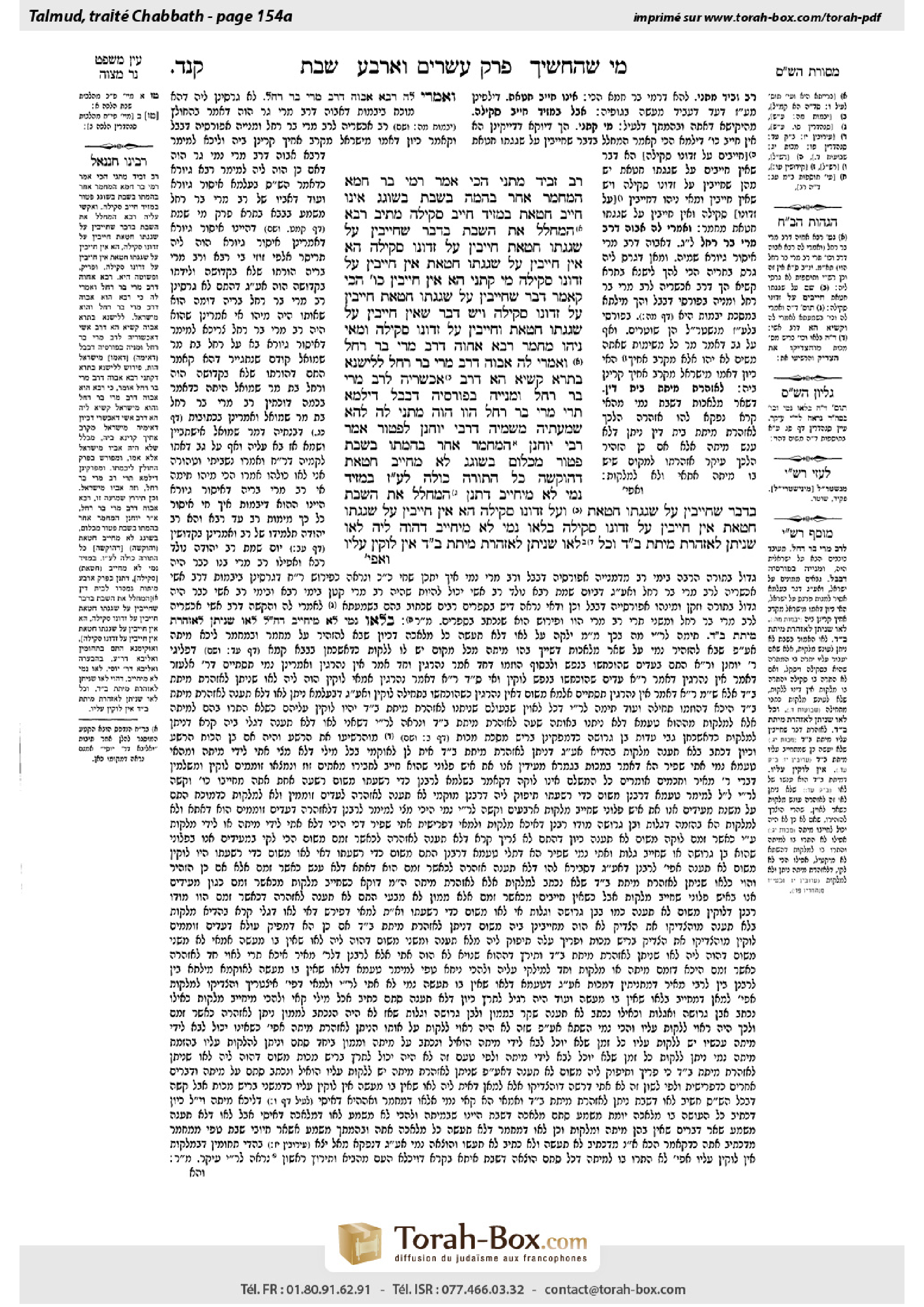
This page of Shabbat includes the Aramaic text, an English translation and an AI-generated French translation, alongside the scan above.
שבת קנ״ד א · Aramaic and Hebrew text
רַב זְבִיד מַתְנֵי הָכִי: אָמַר רָמֵי בַּר חָמָא: הַמְחַמֵּר אַחַר בְּהֵמָה בְּשַׁבָּת, בְּשׁוֹגֵג — אֵינוֹ חַיָּיב חַטָּאת, בְּמֵזִיד — חַיָּיב סְקִילָה.
מֵתִיב רָבָא: הַמְחַלֵּל אֶת הַשַּׁבָּת בְּדָבָר שֶׁחַיָּיבִין עַל שִׁגְגָתוֹ חַטָּאת — חַיָּיבִין עַל זְדוֹנוֹ סְקִילָה. הָא אֵין חַיָּיבִין עַל שִׁגְגָתוֹ חַטָּאת — אֵין חַיָּיבִין עַל זְדוֹנוֹ סְקִילָה!
מִי קָתָנֵי ״הָא אֵין חַיָּיבִין כּוּ׳״? הָכִי קָאָמַר: דָּבָר שֶׁחַיָּיבִין עַל שִׁגְגָתוֹ חַטָּאת — חַיָּיבִין עַל זְדוֹנוֹ סְקִילָה. וְיֵשׁ דָּבָר שֶׁאֵין חַיָּיבִין עַל שִׁגְגָתוֹ חַטָּאת — וְחַיָּיבִין עַל זְדוֹנוֹ סְקִילָה, וּמַאי נִיהוּ? — מְחַמֵּר.
רָבָא אֲחוּהּ דְּרַב מָרִי בַּר רָחֵל, וְאָמְרִי לַהּ אֲבוּהּ דְּרַב מָרִי בַּר רָחֵל. לְלִישָּׁנָא בָּתְרָא, קַשְׁיָא הָא דְּרַב אַכְשְׁרֵיהּ לְרַב מָרִי בַּר רָחֵל וּמַנְּיֵיהּ בְּפוּרְסֵי דְּבָבֶל. דִילְמָא תְּרֵי מָרִי בַּר רָחֵל הֲווֹ.
הֲוָה מַתְנִי לַהּ לְהָא שְׁמַעְתָּא מִשְּׁמֵיהּ דְּרַבִּי יוֹחָנָן לִפְטוּר. אָמַר רַבִּי יוֹחָנָן: הַמְחַמֵּר אַחֵר בְּהֶמְתּוֹ בְּשַׁבָּת פָּטוּר מִכְּלוּם.
בְּשׁוֹגֵג לָא מִחַיַּיב חַטָּאת — דְּהוּקְּשָׁה כָּל הַתּוֹרָה כּוּלָּהּ לַעֲבוֹדָה זָרָה. בְּמֵזִיד נָמֵי לָא מִיחַיַּיב — דִּתְנַן הַמְחַלֵּל אֶת הַשַּׁבָּת בְּדָבָר שֶׁחַיָּיבִין עַל שִׁגְגָתוֹ חַטָּאת וְעַל זְדוֹנוֹ סְקִילָה. הָא אֵין חַיָּיבִין עַל שִׁגְגָתוֹ חַטָּאת — אֵין חַיָּיבִין עַל זְדוֹנוֹ סְקִילָה.
בְּלָאו נָמֵי לָא מִיחַיַּיב — דַּהֲוָה לֵיהּ לָאו שֶׁנִּיתַּן לְאַזְהָרַת מִיתַת בֵּית דִין, וְכׇל לָאו שֶׁנִּיתַּן לְאַזְהָרַת מִיתַת בֵּית דִין אֵין לוֹקִין עָלָיו.
Shabbat 154a · English translation
Rav Zevid taught this as follows. Rami bar Ḥama said: With regard to one who drives his laden animal on Shabbat, if he does so unwittingly, he is not liable to bring a sin-offering, and if he does so intentionally, he is liable to be executed by stoning.
Rava raised an objection based on that which was taught in a baraita: One who desecrates Shabbat by performing a matter that for its unwitting performance one is liable to bring a sin-offering, then for its intentional performance one is liable to be executed by stoning. The Gemara explains: By inference, for a matter that for its unwitting performance one is not liable to bring a sin-offering, for its intentional performance one is not liable to be executed by stoning. This contradicts Rami bar Ḥama’s statement.
The Gemara answers: Was it taught in the baraita: By inference, for a matter that for its unwitting performance one is not liable to bring a sin-offering, for its intentional performance one is not liable to be executed by stoning? The baraita can be understood differently, and this is what it is saying: With regard to a matter that for its unwitting performance one is liable to bring a sin-offering, for its intentional performance one is always liable to be executed by stoning. However, there is also a matter that for its unwitting performance one is not liable to bring a sin-offering, and nevertheless, for its intentional performance one is liable to be executed by stoning. And what is that case? It is the case of driving a laden animal.
Rava, the brother of Rav Mari bar Raḥel, cites a different opinion with regard to the halakha of driving a laden animal on Shabbat, and some say that he was the father of Rav Mari bar Raḥel and stated this halakha. As an aside, the Gemara comments: According to the latter version above, that Rava was the father of Rav Mari bar Raḥel, the fact that Rav needed to validate the status of Rav Mari bar Raḥel and only then appoint him as an official [pursei] of Babylonia is difficult. This incident teaches that Rav Mari bar Raḥel’s father was not Jewish, and before he could be appointed his status required validation through the fact that his mother was Jewish. If Rav Mari bar Raḥel’s father was a sage named Rava, why was it necessary to validate his status by means of his mother’s lineage? The Gemara answers: Perhaps there were two people named Mari bar Raḥel. One was the son of a convert and a Jewish mother, and the other was the son of a Sage named Rava.
In any event, that Sage taught his halakha in the name of Rabbi Yoḥanan to exempt one who drives a laden animal, as Rabbi Yoḥanan said: One who drives a laden animal on Shabbat is exempt from any punishment.
The Gemara explains: For driving the animal unwittingly, he is not liable to bring a sin-offering because all of the prohibitions in the Torah were juxtaposed to the prohibition of idolatry, from which the principle is derived that one is liable only for actions that he himself performed. And for driving the animal intentionally, he is also not liable to be executed by stoning, as we learned in the mishna: One who desecrates Shabbat by performing a matter that for its unwitting performance one is liable to bring a sin-offering, and for its intentional performance one is liable to be executed by stoning. By inference, for a matter that for its unwitting performance one is not liable to bring a sin-offering, for its intentional performance one is not liable to be executed by stoning.
And similarly, he is not even liable to be flogged for violating a Torah prohibition for which the punishment is lashes. Even though the Torah explicitly warns against performing labor on Shabbat, it is a prohibition that was fundamentally given, not as a standard prohibition punishable by lashes, but rather as a warning of court-imposed capital punishment, and for any prohibition that was given as a warning of court-imposed capital punishment, if the death penalty is not imposed for any reason, one is not flogged for its violation.
Shabbat 154a · Traduction française (IA)
Rav Zevid enseigna la chose comme suit. Rami bar Ḥama dit : Celui qui conduit son animal chargé pendant Chabbat, s’il le fait involontairement, n’est pas tenu d’apporter un sacrifice expiatoire ; s’il le fait intentionnellement, il est passible de la peine de lapidation.
Rava objecta en s’appuyant sur ce qui a été enseigné dans une baraïta : Celui qui profane Chabbat en accomplissant un acte dont l’exécution involontaire le rend passible d’un sacrifice expiatoire est, pour son exécution intentionnelle, passible de la peine de lapidation. La Guemara explique : On en déduit que, pour un acte dont l’exécution involontaire ne rend pas passible d’un sacrifice expiatoire, l’exécution intentionnelle ne rend pas passible de la peine de lapidation. Cela contredit la déclaration de Rami bar Ḥama.
La Guemara répond : La baraïta a-t-elle enseigné : « On en déduit que, pour un acte dont l’exécution involontaire ne rend pas passible d’un sacrifice expiatoire, l’exécution intentionnelle ne rend pas passible de la peine de lapidation » ? On peut comprendre la baraïta autrement ; voici ce qu’elle dit : Pour un acte dont l’exécution involontaire rend passible d’un sacrifice expiatoire, l’exécution intentionnelle rend toujours passible de la peine de lapidation. Toutefois, il existe aussi un acte dont l’exécution involontaire ne rend pas passible d’un sacrifice expiatoire, mais dont l’exécution intentionnelle rend néanmoins passible de la peine de lapidation. De quel cas s’agit-il ? De celui où l’on conduit un animal chargé.
Rava, le frère de Rav Mari bar Raḥel, rapporte une autre opinion concernant la halakha relative au fait de conduire un animal chargé pendant Chabbat. Selon certains, Rava était son père et c’est lui qui enseigna cette halakha. À ce propos, la Guemara fait remarquer : Selon la seconde version rapportée ci-dessus, d’après laquelle Rava était le père de Rav Mari bar Raḥel, il est difficile de comprendre pourquoi Rav dut faire vérifier le statut de Rav Mari bar Raḥel avant de le nommer fonctionnaire [pursei] de Babylonie. Cet épisode enseigne que le père de Rav Mari bar Raḥel n’était pas juif et que, avant sa nomination, son statut devait être vérifié en établissant que sa mère était juive. Si le père de Rav Mari bar Raḥel était un Sage nommé Rava, pourquoi était-il nécessaire de vérifier son statut en se fondant sur sa lignée maternelle ? La Guemara répond : Il se peut qu’il y ait eu deux hommes nommés Mari bar Raḥel. L’un était le fils d’un converti et d’une mère juive, et l’autre, le fils d’un Sage nommé Rava.
Quoi qu’il en soit, ce Sage enseigna sa halakha au nom de Rabbi Yoḥanan afin d’exempter celui qui conduit un animal chargé, car Rabbi Yoḥanan dit : Celui qui conduit un animal chargé pendant Chabbat est exempt de toute peine.
La Guemara explique : Pour avoir conduit l’animal involontairement, il n’est pas tenu d’apporter un sacrifice expiatoire, car toutes les interdictions de la Torah ont été rapprochées de l’interdiction de l’idolâtrie ; de là est déduit le principe selon lequel on n’est passible que pour les actes que l’on a accomplis soi-même. Pour avoir conduit l’animal intentionnellement, il n’est pas non plus passible de la peine de lapidation, comme nous l’avons appris dans la Michna : Celui qui profane Chabbat en accomplissant un acte dont l’exécution involontaire le rend passible d’un sacrifice expiatoire est, pour son exécution intentionnelle, passible de la peine de lapidation. On en déduit que, pour un acte dont l’exécution involontaire ne rend pas passible d’un sacrifice expiatoire, l’exécution intentionnelle ne rend pas passible de la peine de lapidation.
De même, il n’est même pas passible de flagellation pour avoir transgressé une interdiction de la Torah punie de flagellation. Bien que la Torah interdise explicitement d’accomplir un travail pendant Chabbat, cette interdiction a été formulée à l’origine non comme une interdiction ordinaire punie de flagellation, mais comme un avertissement relatif à une peine capitale prononcée par le tribunal. Or, pour toute interdiction formulée comme un avertissement relatif à une peine capitale prononcée par le tribunal, si la peine de mort n’est pas appliquée pour quelque raison que ce soit, on ne reçoit pas de flagellation pour sa transgression.
Traduction française générée par IA à partir de l’édition anglaise de Sefaria. Vérifie toujours un passage avec le texte source.
Text from Sefaria: William Davidson Edition - Vocalized Aramaic (CC BY NC); William Davidson Edition - English (CC BY NC).