Shabbat 154b: Talmud study for Daf Yomi
Daf Yomi is the daily study of one Talmud folio. Explore 37 tractates with scans, Hebrew text, Sefaria English and AI-generated French translations where annotated.
Passage selection and English or AI-generated French translation are available where the scan has annotations. Daf Study is independent of Torah-Box and Sefaria.
Browse Shabbat · שבת · All tractatesShabbat 154b text and translations
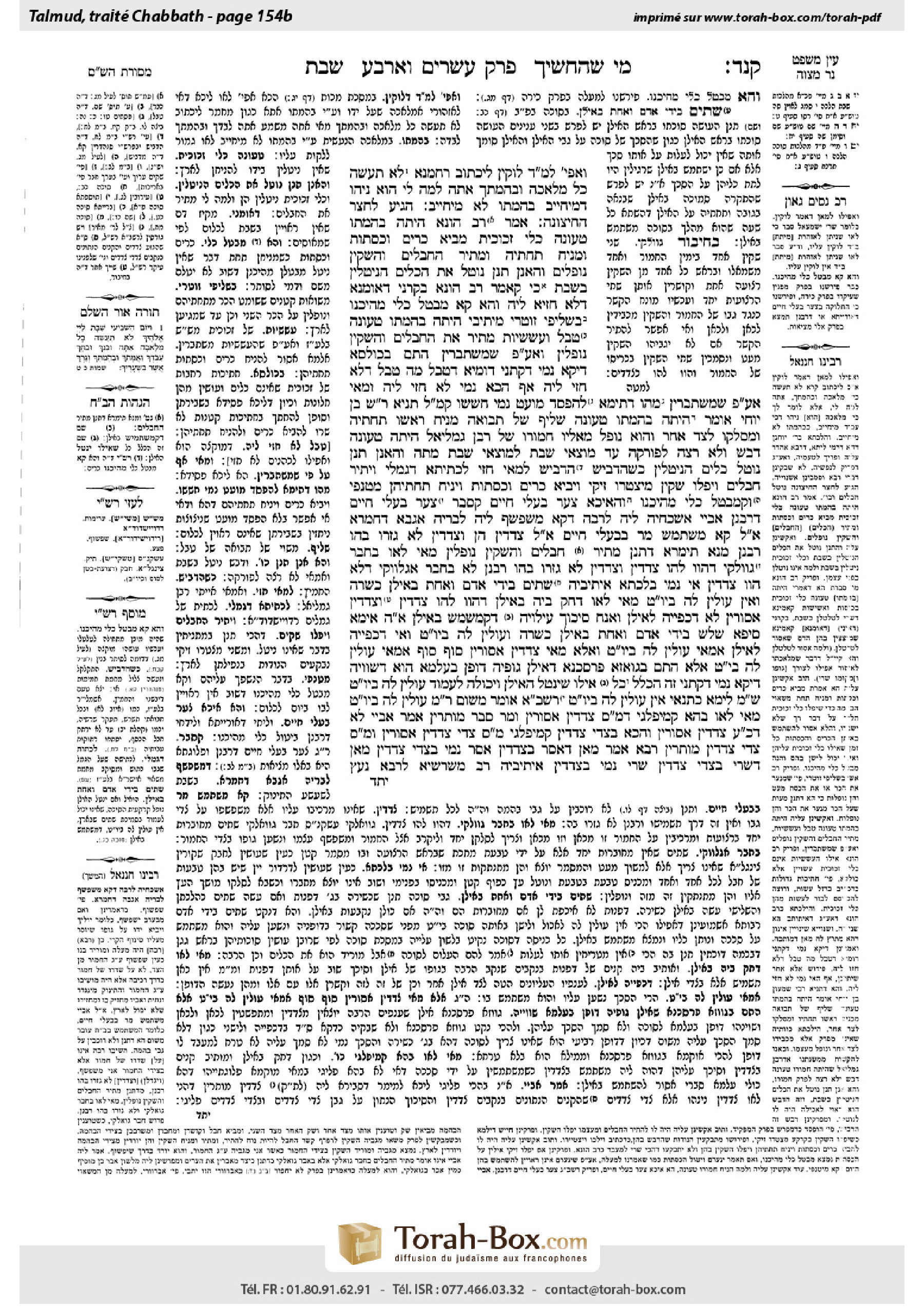
This page of Shabbat includes the Aramaic text, an English translation and an AI-generated French translation, alongside the scan above.
שבת קנ״ד ב · Aramaic and Hebrew text
וַאֲפִילּוּ לְמַאן דְּאָמַר לוֹקִין, לִיכְתּוֹב רַחֲמָנָא ״לֹא תַעֲשֶׂה כׇל מְלָאכָה וּבְהֶמְתֶּךָ״, ״אַתָּה״ לְמָה לִי? הוּא נִיהוּ דְּמִיחַיַּיב, בִּבְהֶמְתּוֹ לָא מִיחַיַּיב.
הִגִּיעַ לֶחָצֵר הַחִיצוֹנָה. אָמַר רַב הוּנָא: הָיְתָה בְּהֶמְתּוֹ טְעוּנָה כְּלֵי זְכוּכִית, מֵבִיא כָּרִים וּכְסָתוֹת וּמַנִּיחַ תַּחְתֶּיהָ, וּמַתִּיר הַחֲבָלִים וְהַשַּׂקִּין נוֹפְלִים.
וְהָאֲנַן תְּנַן: נוֹטֵל אֶת הַכֵּלִים הַנִּיטָּלִין בְּשַׁבָּת?
כִּי קָאָמַר רַב הוּנָא, בְּקַרְנֵי דְאוּמָּנָא, דְּלָא חַזְיָא לֵיהּ. וְהָא קָא מְבַטֵּל כְּלִי מֵהֵיכֵנוֹ! בִּשְׁלִיפֵי זוּטְרֵי.
מֵיתִיבִי: הָיְתָה בְּהֶמְתּוֹ טְעוּנָה טֶבֶל וַעֲשָׁשִׁיּוֹת — מַתִּיר אֶת הַחֲבָלִים וְהַשַּׂקִּין נוֹפְלִין, וְאַף עַל פִּי שֶׁמִּשְׁתַּבְּרִין. הָתָם בְּכוּלְסָא. דַּיְקָא נָמֵי, דְּקָתָנֵי דּוּמְיָא דְּטֶבֶל. מָה טֶבֶל — דְּלָא חֲזֵי לֵיהּ, אַף הָכָא נָמֵי לָא חֲזֵי לֵיהּ.
וּמַאי ״אַף עַל פִּי שֶׁמִּשְׁתַּבְּרִין״ — מַהוּ דְּתֵימָא לְהֶפְסֵד מוּעָט נָמֵי חָשְׁשׁוּ, קָא מַשְׁמַע לַן.
תַּנְיָא, רַבִּי שִׁמְעוֹן בֶּן יוֹחַי אוֹמֵר: הָיְתָה בְּהֶמְתּוֹ טְעוּנָה שְׁלִיף שֶׁל תְּבוּאָה — מַנִּיחַ רֹאשׁוֹ תַּחְתֶּיהָ, וּמְסַלְּקוֹ לְצַד אַחֵר, וְהוּא נוֹפֵל מֵאֵלָיו.
חֲמוֹרוֹ שֶׁל רַבָּן גַּמְלִיאֵל הָיְתָה טְעוּנָה דְּבַשׁ וְלֹא רָצָה לְפוֹרְקָהּ עַד מוֹצָאֵי שַׁבָּת, לְמוֹצָאֵי שַׁבָּת מֵתָה. וְהָאֲנַן תְּנַן נוֹטֵל כֵּלִים הַנִּיטָּלִין? כְּשֶׁהִדְבִּישׁ. הִדְבִּישׁ לְמַאי חֲזֵי? לִכְתִיתָא דְגַמְלֵי.
וְיַתִּיר חֲבָלִים וְיִפְּלוּ שַׂקִּין! מִיצְטְרוּ זִיקֵי. וְיָבִיא כָּרִים וּכְסָתוֹת וְיַנִּיחַ תַּחְתֵּיהֶן! מִטַּנְּפִי, וְקָמְבַטֵּל כְּלִי מֵהֵיכָנוֹ. וְהָאִיכָּא צַעַר בַּעֲלֵי חַיִּים! קָסָבַר: צַעַר בַּעֲלֵי חַיִּים דְּרַבָּנַן.
אַבָּיֵי אַשְׁכְּחֵיהּ לֵיהּ לְרַבָּה דְּקָא מְשַׁפְשֵׁף לֵיהּ לִבְרֵיהּ אַגַּבָּא דְחַמְרָא. אֲמַר לֵיהּ: קָא מִשְׁתַּמֵּשׁ מָר בְּבַעֲלֵי חַיִּים! אֲמַר לֵיהּ: צְדָדִין הֵן, וּצְדָדִין לָא גְּזַרוּ בְּהוּ רַבָּנַן. מְנָא תֵּימְרָא — דִּתְנַן: מַתִּיר חֲבָלִים וְהַשַּׂקִּין נוֹפְלִין. מַאי לָאו — בְּחֶבֶר גְּווֹלְקֵי, דְּהָווּ לְהוּ צְדָדִין וּצְדָדִין, לָא גְזַרוּ בְּהוּ רַבָּנַן.
לָא — בְּאֵבֶר גְּווֹלְקֵי, דְּלָא הֲווֹ צְדָדִין. אִי נָמֵי, בְּלַכְתָּא.
אֵיתִיבֵיהּ: שְׁתַּיִם בִּידֵי אָדָם, וְאַחַת בְּאִילָן — כְּשֵׁרָה, וְאֵין עוֹלִין לָהּ בְּיוֹם טוֹב. מַאי לָאו, דְּחַק בֵּיהּ בְּאִילָן [וְסַכֵּיךְ בֵּיהּ] דְּהָווּ לְהוּ צְדָדִין, וּצְדָדִין אֲסוּרִין!
לָא, דְּכַפְיֵיהּ לְאִילָן וְאַנַּח סִיכּוּךְ עִילָּוֵיהּ, דְּקָמִשְׁתַּמֵּשׁ בְּאִילָן. אִי הָכִי, אֵימָא סֵיפָא: שָׁלֹשׁ בִּידֵי אָדָם וְאַחַת בְּאִילָן כְּשֵׁרָה, וְעוֹלִין לָהּ בְּיוֹם טוֹב. וְאִי דְּכַפְיֵיהּ לְאִילָן — אַמַּאי עוֹלִין לָהּ בְּיוֹם טוֹב?
וְאֶלָּא מַאי, צְדָדִין אֲסוּרִין? סוֹף סוֹף אַמַּאי עוֹלִין לָהּ בְּיוֹם טוֹב? אֶלָּא: הָתָם בִּגְוָאזָא פַּרְסִכְנָא, דְּאִילָן גּוּפֵיהּ דּוֹפֶן בְּעָלְמָא הוּא דְּשַׁוְּויֵהּ. דַּיְקָא נָמֵי — דְּקָתָנֵי: זֶה הַכְּלָל, כׇּל שֶׁאִילּוּ יִנָּטֵל הָאִילָן וִיכוֹלָה לַעֲמוֹד — עוֹלִין לָהּ בְּיוֹם טוֹב. שְׁמַע מִינַּהּ.
לֵימָא כְתַנָּאֵי, אֵין עוֹלִין לָהּ בְּיוֹם טוֹב. רַבִּי שִׁמְעוֹן בֶּן אֶלְעָזָר אוֹמֵר מִשּׁוּם רַבִּי מֵאִיר: עוֹלִין לָהּ בְּיוֹם טוֹב. מַאי לָאו, בְּהָא קָמִיפַּלְגִי: דְּמָר סָבַר צְדָדִין אֲסוּרִין, וּמָר סָבַר מוּתָּרִין?
אָמַר אַבָּיֵי: לָא, דְּכוּלֵּי עָלְמָא צְדָדִין אֲסוּרִין, וְהָכָא בְּצִדֵּי צְדָדִין קָמִיפַּלְגִי: מָר סָבַר צִדֵּי צְדָדִין אֲסוּרִין, וּמָר סָבַר צִדֵּי צְדָדִין מוּתָּרִין.
רָבָא אָמַר: מַאן דְּאָסַר בִּצְדָדִין — אָסַר נָמֵי בְּצִדֵּי צְדָדִין, מַאן דְּשָׁרֵי בְּצִדֵּי צְדָדִין — שָׁרֵי נָמֵי בִּצְדָדִין. אֵיתִיבֵיהּ רַב מְשַׁרְשְׁיָא לְרָבָא: נָעַץ
Shabbat 154b · English translation
And even according to the one who said that one is flogged for violating a prohibition that was given as a warning of court-imposed capital punishment, the halakha with regard to driving a laden animal can be derived by means of an inference from the language of the verse. Let the Torah write: “You shall not perform any manner of labor…and neither shall your animal.” Why do I need the superfluous word you in the phrase: You and your animal? Rather it is to teach that it is he himself who is liable for performing a prohibited labor on Shabbat; however, for a prohibited labor performed by his animal, he is not liable.
We learned in the mishna: Once he reached the outer courtyard, he may untie the ropes that attach his bags to the donkey, and the bags of vessels that may not be moved on Shabbat fall on their own. Rav Huna said: If one’s animal was laden with glass vessels, which would break if he let them fall to the ground, he may bring cushions and blankets and place them beneath the animal and untie the ropes and let the bags fall onto the cushions.
The Gemara asks: Why is it necessary to unload glass vessels in so complicated a manner? Didn’t we learn in the mishna: He takes the vessels that may be moved on Shabbat off the donkey? As glass vessels fall into that category, why not simply remove the glass vessels and then untie the bags?
The Gemara answers: When Rav Huna stated this halakha, he was referring to the horns of a blood letter, which are not suitable for any other purpose and are therefore set-aside on Shabbat due to prohibition and repulsiveness. The Gemara asks: Isn’t he thereby negating a vessel’s preparedness? Initially, the cushion was available for any use. Since it now has the set-aside vessels on it, the cushion, too, may no longer be moved. The Sages ruled that one may not place a vessel in a circumstance that will render it prohibited to move. The Gemara answers: This mishna is referring to small bundles of glass vessels that will not break if the cushions are subsequently removed from beneath them.
The Gemara raises an objection based on that which was taught in a baraita: If one’s animal was laden with untithed produce and chunks of glass [ashashiot], one unties the ropes and the bags fall on their own, even though they break. Apparently, placing cushions beneath the animal is prohibited. The Gemara answers: There, the baraita is not referring to vessels but rather to chunks [kulsa] of glass that are designated to be broken so that they can be melted and crafted into vessels. The Gemara adds: The language of the baraita is also precise, as it teaches that chunks are similar to untithed produce: Just as untithed produce is not fit for his use, here too, the chunks are also not fit for his use.
The Gemara explains: And what is the meaning of the phrase: Even though they break? If the mishna is indeed referring to chunks of glass, they are designated to be broken. Rather, lest you say that the Sages were also concerned about a minimal loss, as certainly some small slivers of glass will be lost when the chunks fall and break, the tanna in the baraita teaches us that the Sages did not consider minimal loss a reason significant enough to permit carrying the prohibited glass.
It was taught in a baraita that Rabbi Shimon ben Yoḥai says: If one’s animal was loaded with a burden of untithed grain, he may place his head beneath the pile and move it to a different side of the animal, and it falls by itself. The Sages prohibited moving set-aside objects in the typical manner, but there is no concern about doing so in an unusual manner.
The Gemara relates: Rabban Gamliel’s donkey was laden with honey and he did not want to unload the donkey until the conclusion of Shabbat. At the conclusion of Shabbat, the donkey died of fatigue. The Gemara asks: Didn’t we learn in the mishna: He takes the vessels that may be moved on Shabbat off the donkey? Why, then, did Rabban Gamliel not unload the honey? The Gemara answers: This is a case where the honey had spoiled. The Gemara asks: For what use is spoiled honey suited? Why did Rabban Gamliel bring it? The Gemara answers: It can be used to rub on the wounds of camels.
The Gemara asks: And let Rabban Gamliel untie the ropes and the bags will fall on their own. The Gemara answers: It was due to the concern that the jugs containing the honey would crack. The Gemara asks: And let him bring cushions and blankets and place them beneath the jugs. The Gemara answers: He was concerned lest they become soiled and he would thereby negate the vessel’s preparedness, i.e., the cushions and blankets would be rendered unusable. The Gemara asks: Isn’t there the matter of the suffering of a living creature? He should suffer monetary loss rather than cause the animal to suffer. The Gemara answers: Rabban Gamliel holds that causing a living creature to suffer is prohibited not by Torah law but rather by rabbinic law. Therefore, he need not suffer monetary loss due to the rabbinic prohibition (Ramban).
The Gemara relates: Abaye found Rabba sliding his son on the back of a donkey on Shabbat to entertain him. He said to him: The Master is making use of living creatures on Shabbat, and the Sages prohibited doing so. Rabba said to him: I placed my son on the side of the donkey, and as they are sides, the Sages did not issue a decree prohibiting making use of them. From where do you say that this is so? As we learned in the mishna: One may untie the ropes and the bags fall on their own. What, is it not referring to a case where one attached the bags by means of guvalaki, where the bags are strapped to the animal and the only way to loosen them involves leaning against the sides of animal in order to unstrap them? That is because it is a case of making use of the sides, and the Sages did not issue a decree prohibiting making use of an animal’s sides.
Abaye answered: No, this is a case where one attached the bags by means of agalavki, i.e., where the bags were not tightly strapped to the animal, but rather attached by means of a hook. In such a case, there is no need to make use of the sides of the animal in order to unhook the strap. Alternatively, the bags were tied to the sides of the animal with a rope, which could likewise be untied with ease and without leaning against the animal.
Abaye raised an objection to Rabba’s opinion based on that which was taught in a mishna: A sukka that had two of its walls on the ground, built by a person, and one wall on a tree is valid and can be used to fulfill the mitzva of sukka. However, one may not enter it on the festival day of Sukkot because it is prohibited to use trees rooted in the ground on Shabbat or a Festival. What, is this not referring to a case where one carved a hole in the tree and inserted a beam into the hole for support, in which case these are sides of the tree that are being used, and apparently, using the sides of the tree is prohibited?
Rabba rejected this: No, it is referring to a case where one bent the tree over and placed the roofing atop it, as in that case, he is making use of the tree itself and not its sides. Abaye asked: If so, say the latter clause of the mishna: If there are three walls built by a person and one on a tree, it is a valid sukka and one may enter it on a Festival. And if one bent a tree and placed the roofing atop it, why may one enter it on a Festival?
Rabba rejected this question: Rather, what would you say? Making use of sides is prohibited. If so, the same problem still exists, why is the sukka fit for use in the latter case? Ultimately, why may one enter it on a Festival? Rather, there it is referring to a case where the branches [gavaza] are spread out and where one made the tree itself into a wall, not where he leaned a wall against it. The language of the mishna is also precise. The wall may not be used if it is an integral part of the sukka, meaning that it is one of the three required walls. However, if it serves as a fourth wall, one may use the sukka on a Festival as it is taught that this is the principle: In any case where if the tree was taken the sukka would still be able to stand, one may enter it on a Festival. Then it is clear that the walls are not leaning against the tree; rather, the tree itself serves as a wall. The Gemara says in summary: Learn from here that this is so.
The Gemara suggests: Let us say that these amora’im disagree in a dispute parallel to a dispute between tanna’im with regard to making use of the sides of a tree, as it was taught in the Tosefta: One may not enter a sukka whose walls are leaning against a tree on a Festival. Rabbi Shimon ben Elazar says in the name of Rabbi Meir: One may enter it on a Festival. What, is it not that they are disagreeing about this issue, as this Master, meaning the Rabbis, holds that making use of the sides is prohibited, and this Master, Rabbi Meir, holds that they are permitted?
Abaye said: No. Everyone agrees that the sides are prohibited, and it is with regard to the sides of the sides, i.e., not a wall leaning against the tree itself, but a wall that is supported by a beam that is placed in the hole carved in the tree, that they disagree. This Master, meaning the Rabbis, holds that the sides of the sides are prohibited, and this Master, Rabbi Meir, holds that the sides of the sides are permitted.
Rava said: The one who prohibited making use of the sides also prohibited making use of the sides of the sides, and the one who permitted making use of the sides of the sides also permitted making use of the sides. Rav Mesharshiyya raised an objection to the opinion of Rava: If one drove
Shabbat 154b · Traduction française (IA)
Et même selon celui qui affirme que l’on reçoit la flagellation pour avoir enfreint une interdiction assortie d’un avertissement de peine capitale prononcée par un tribunal, la halakha concernant le fait de faire porter une charge à son animal peut être déduite du libellé du verset. Que la Torah écrive : « Tu n’accompliras aucun travail… et ton animal non plus. » Pourquoi le mot « toi » est-il nécessaire dans l’expression « toi et ton animal » ? Il vient plutôt enseigner que c’est lui-même qui est passible d’une sanction pour avoir accompli un travail interdit pendant Chabbat ; en revanche, il n’est pas passible d’une sanction pour un travail interdit accompli par son animal.
Nous avons appris dans la Michna : une fois arrivé dans la cour extérieure, il peut dénouer les cordes qui attachent ses sacs à l’âne, et les sacs contenant des objets qu’il est interdit de déplacer pendant Chabbat tombent d’eux-mêmes. Rav Houna a dit : si l’animal de quelqu’un était chargé de récipients en verre qui se briseraient s’il les laissait tomber à terre, il peut apporter des coussins et des couvertures, les placer sous l’animal, dénouer les cordes et laisser les sacs tomber sur les coussins.
La Guemara demande : pourquoi faut-il décharger les récipients en verre de manière aussi compliquée ? N’avons-nous pas appris dans la Michna : « Il retire de l’âne les objets qu’il est permis de déplacer pendant Chabbat » ? Puisque les récipients en verre entrent dans cette catégorie, pourquoi ne pas simplement les retirer, puis dénouer les sacs ?
La Guemara répond : lorsque Rav Houna a énoncé cette halakha, il parlait des ventouses d’un saigneur, qui ne conviennent à aucun autre usage et sont donc considérées comme mouktsé pendant Chabbat en raison de leur interdiction et de leur caractère répugnant. La Guemara demande : ne neutralise-t-il pas ainsi la disponibilité d’un ustensile ? Au départ, le coussin pouvait servir à tout usage. Puisqu’il porte maintenant les objets mouktsé, le coussin, lui aussi, ne peut plus être déplacé. Les Sages ont statué qu’on ne peut pas placer un ustensile dans une situation qui le rendra interdit à déplacer. La Guemara répond : cette Michna parle de petits paquets de récipients en verre, qui ne se briseront pas si l’on retire ensuite les coussins placés dessous.
La Guemara soulève une objection à partir de ce qui a été enseigné dans une baraïta : si l’animal de quelqu’un était chargé de produits non prélevés et de morceaux de verre [ashashiot], on dénoue les cordes et les sacs tombent d’eux-mêmes, même s’ils se brisent. Il semble donc interdit de placer des coussins sous l’animal. La Guemara répond : là, la baraïta ne parle pas de récipients, mais de blocs [kulsa] de verre destinés à être brisés afin d’être fondus et façonnés en récipients. La Guemara ajoute : le libellé de la baraïta est également précis, puisqu’elle enseigne que les blocs sont comparables aux produits non prélevés : de même que les produits non prélevés ne peuvent être utilisés par lui, de même les blocs ne peuvent pas être utilisés par lui.
La Guemara explique : que signifie l’expression « même s’ils se brisent » ? Si la baraïta parle effectivement de blocs de verre, ils sont destinés à être brisés. Il faut plutôt comprendre que, sans cela, tu aurais pu dire que les Sages se préoccupaient aussi d’une perte minime, car il est certain que de petits éclats de verre seront perdus lorsque les blocs tomberont et se briseront. Le tanna de la baraïta nous apprend que les Sages n’ont pas considéré une perte minime comme un motif suffisamment important pour autoriser le transport du verre interdit.
Il a été enseigné dans une baraïta que Rabbi Shimon ben Yoḥaï dit : si l’animal de quelqu’un était chargé d’un fardeau de céréales non prélevées, il peut glisser sa tête sous le tas, le déplacer vers l’autre côté de l’animal, et celui-ci tombe de lui-même. Les Sages ont interdit de déplacer des objets mouktsé de la manière habituelle, mais il n’y a pas lieu de s’en inquiéter lorsqu’on agit de manière inhabituelle.
La Guemara rapporte : l’âne de Rabban Gamliel était chargé de miel, et il ne voulait pas le décharger avant la fin de Chabbat. À la fin de Chabbat, l’âne mourut d’épuisement. La Guemara demande : n’avons-nous pas appris dans la Michna : « Il retire de l’âne les objets qu’il est permis de déplacer pendant Chabbat » ? Pourquoi Rabban Gamliel n’a-t-il donc pas déchargé le miel ? La Guemara répond : le miel avait tourné. La Guemara demande : à quoi peut servir du miel tourné ? Pourquoi Rabban Gamliel l’avait-il transporté ? La Guemara répond : on peut l’utiliser pour frotter les plaies des chameaux.
La Guemara demande : que Rabban Gamliel dénoue les cordes, et les sacs tomberont d’eux-mêmes. La Guemara répond : il craignait que les cruches contenant le miel ne se fendent. La Guemara demande : qu’il apporte des coussins et des couvertures et les place sous les cruches. La Guemara répond : il craignait qu’ils ne se salissent et qu’il ne neutralise ainsi la disponibilité de l’ustensile, c’est-à-dire que les coussins et les couvertures deviennent inutilisables. La Guemara demande : et la souffrance d’un être vivant ? Il devrait subir une perte financière plutôt que de faire souffrir l’animal. La Guemara répond : Rabban Gamliel tient que faire souffrir un être vivant est interdit non par la Torah, mais par décret rabbinique. Il n’a donc pas à subir une perte financière en raison de cette interdiction rabbinique (Ramban).
La Guemara rapporte : Abayé trouva Rabba faisant glisser son fils sur le dos d’un âne pendant Chabbat pour le divertir. Il lui dit : « Le Maître utilise un être vivant pendant Chabbat, et les Sages l’ont interdit. » Rabba lui dit : « J’ai installé mon fils sur le côté de l’âne ; or, puisqu’il s’agit des côtés, les Sages n’ont pas édicté de décret interdisant de les utiliser. » D’où sais-tu cela ? De ce que nous avons appris dans la Michna : on peut dénouer les cordes, et les sacs tombent d’eux-mêmes. N’est-ce pas un cas où les sacs ont été attachés au moyen de guvalaki, c’est-à-dire sanglés à l’animal, de sorte que la seule manière de les détacher consiste à s’appuyer contre ses flancs pour les défaire ? C’est parce qu’il s’agit d’utiliser les côtés, et que les Sages n’ont pas édicté de décret interdisant d’utiliser les côtés d’un animal.
Abayé répondit : non, il s’agit d’un cas où les sacs ont été attachés au moyen de agalavki, c’est-à-dire qu’ils n’étaient pas étroitement sanglés à l’animal, mais fixés à l’aide d’un crochet. Dans ce cas, il n’est pas nécessaire d’utiliser les côtés de l’animal pour décrocher la sangle. Autre possibilité : les sacs étaient attachés aux côtés de l’animal par une corde, que l’on pouvait également dénouer facilement, sans s’appuyer contre l’animal.
Abayé souleva une objection contre l’opinion de Rabba à partir de ce qui a été enseigné dans une Michna : une soukka dont deux parois reposent au sol et ont été construites par une personne, tandis qu’une paroi repose sur un arbre, est valide et permet d’accomplir la mitsva de la soukka. Cependant, on ne peut pas y entrer pendant la fête de Soukkot, car il est interdit d’utiliser des arbres enracinés dans le sol pendant Chabbat ou un jour de fête. N’est-ce pas un cas où quelqu’un a creusé un trou dans l’arbre et y a inséré une poutre pour soutenir la paroi ? Dans ce cas, ce sont les côtés de l’arbre qui sont utilisés, et il semble donc que l’utilisation des côtés de l’arbre soit interdite.
Rabba réfuta cet argument : non, il s’agit d’un cas où quelqu’un a courbé l’arbre et posé la couverture sur lui ; dans ce cas, il utilise l’arbre lui-même, et non ses côtés. Abayé demanda : si c’est ainsi, considérons la dernière clause de la Michna : si trois parois ont été construites par une personne et qu’une repose sur un arbre, la soukka est valide et on peut y entrer pendant un jour de fête. Or, si quelqu’un a courbé un arbre et posé la couverture sur lui, pourquoi peut-on y entrer pendant un jour de fête ?
Rabba réfuta cette question : mais alors, que dirais-tu ? Que l’utilisation des côtés est interdite. Dans ce cas, le même problème subsiste : pourquoi la soukka est-elle utilisable dans la dernière clause ? En définitive, pourquoi peut-on y entrer pendant un jour de fête ? Il faut plutôt dire que là, il s’agit d’un cas où les branches [gavaza] sont étalées et où l’on a fait de l’arbre lui-même une paroi, et non d’un cas où l’on a appuyé une paroi contre lui. Le libellé de la Michna est également précis. On ne peut pas utiliser la paroi si elle constitue une partie intégrante de la soukka, c’est-à-dire si elle est l’une des trois parois requises. En revanche, si elle sert de quatrième paroi, on peut utiliser la soukka pendant un jour de fête, car il est enseigné que voici le principe : dans tout cas où, si l’arbre était retiré, la soukka pourrait néanmoins tenir debout, on peut y entrer pendant un jour de fête. Il est alors clair que les parois ne sont pas appuyées contre l’arbre ; l’arbre lui-même sert plutôt de paroi. La Guemara conclut : déduis de là qu’il en est ainsi.
La Guemara propose : peut-on dire que ces amoraïm sont en désaccord dans une controverse parallèle à celle qui oppose des tannaïm au sujet de l’utilisation des côtés d’un arbre ? Car il a été enseigné dans la Tosefta : on ne peut pas entrer pendant un jour de fête dans une soukka dont les parois sont appuyées contre un arbre. Rabbi Shimon ben Elazar dit au nom de Rabbi Meïr : on peut y entrer pendant un jour de fête. N’est-ce pas sur cette question qu’ils sont en désaccord : ce Maître, c’est-à-dire les Rabbins, tient que l’utilisation des côtés est interdite, tandis que ce Maître, Rabbi Meïr, tient qu’elle est permise ?
Abayé dit : non. Tous sont d’accord pour dire que l’utilisation des côtés est interdite ; leur désaccord porte sur les côtés des côtés, c’est-à-dire non pas une paroi appuyée contre l’arbre lui-même, mais une paroi soutenue par une poutre placée dans le trou creusé dans l’arbre. Ce Maître, c’est-à-dire les Rabbins, tient que l’utilisation des côtés des côtés est interdite, tandis que ce Maître, Rabbi Meïr, tient qu’elle est permise.
Rava dit : celui qui interdit l’utilisation des côtés interdit également l’utilisation des côtés des côtés, et celui qui autorise l’utilisation des côtés des côtés autorise également l’utilisation des côtés. Rav Mesharshiyya souleva une objection contre l’opinion de Rava : si quelqu’un enfonça
Traduction française générée par IA à partir de l’édition anglaise de Sefaria. Vérifie toujours un passage avec le texte source.
Text from Sefaria: William Davidson Edition - Vocalized Aramaic (CC BY NC); William Davidson Edition - English (CC BY NC).