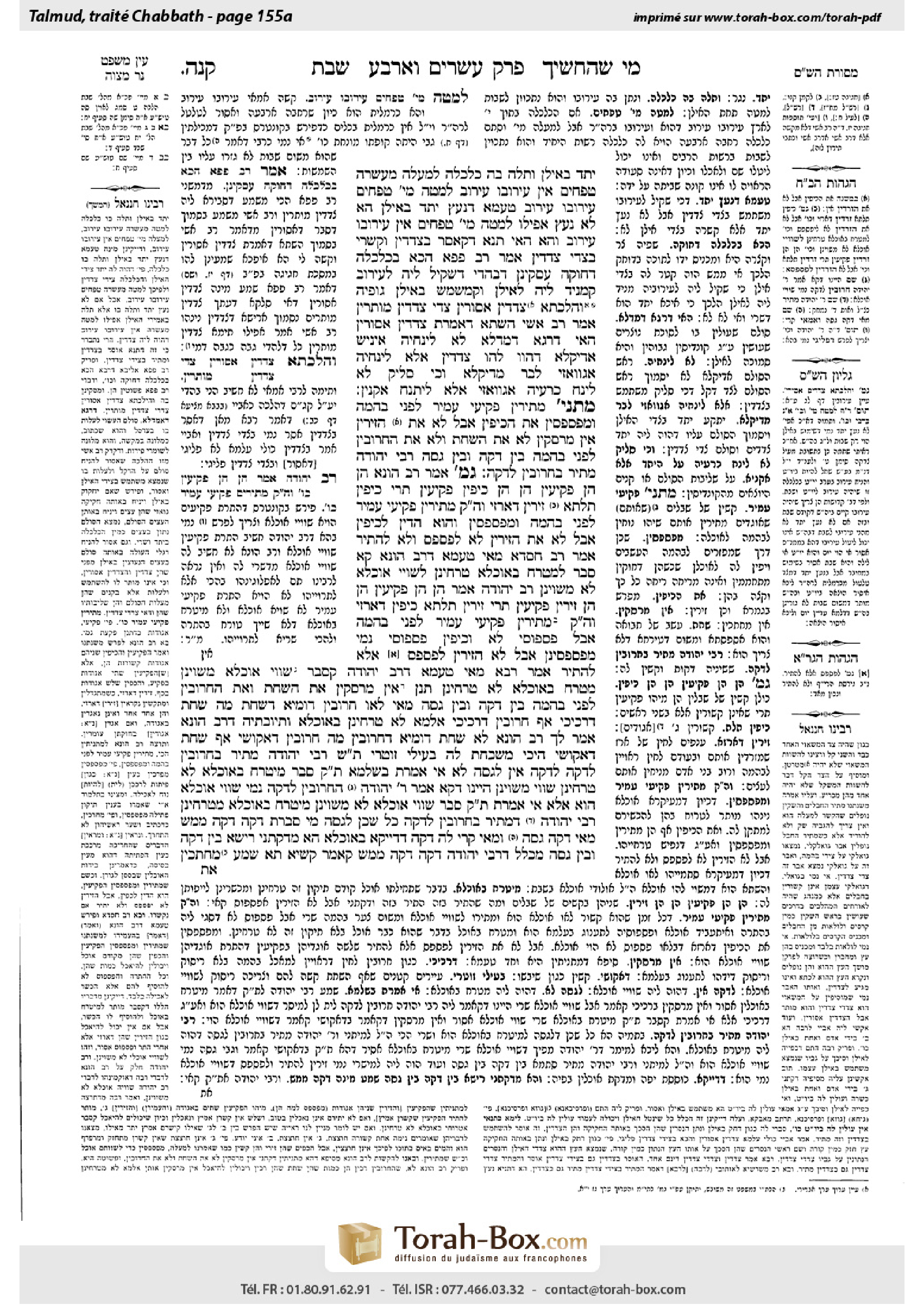
Shabbat 155a: Talmud study for Daf Yomi
Daf Yomi is the daily study of one Talmud folio. Explore 37 tractates with scans, Hebrew text, Sefaria English and AI-generated French translations where annotated.
Passage selection and English or AI-generated French translation are available where the scan has annotations. Daf Study is independent of Torah-Box and Sefaria.
Browse Shabbat · שבת · All tractatesShabbat 155a text and translations
This page of Shabbat includes the Aramaic text, an English translation and an AI-generated French translation, alongside the scan above.
שבת קנ״ה א · Aramaic and Hebrew text
יָתֵד בָּאִילָן וְתָלָה בָּהּ כַּלְכַּלָּה. לְמַעְלָה מֵעֲשָׂרָה טְפָחִים — אֵין עֵירוּבוֹ עֵירוּב. לְמַטָּה מֵעֲשָׂרָה טְפָחִים — עֵירוּבוֹ עֵירוּב.
טַעְמָא דְּנָעַץ יָתֵד בָּאִילָן, הָא לֹא נָעַץ, אֲפִילּוּ לְמַטָּה מֵעֲשָׂרָה טְפָחִים אֵין עֵירוּבוֹ עֵירוּב. וְהָא הַאי תַּנָּא דְּקָאָסַר בִּצְדָדִין, וְקָשָׁרֵי בְּצִדֵּי צְדָדִין!
אָמַר רַב פָּפָּא: הָכָא בְּכַלְכַּלָּה דְּחוּקָה עָסְקִינַן, דְּבַהֲדֵי דְּשָׁקֵיל לֵיהּ לְעֵירוּב — קָמְנַיֵּד לֵיהּ לְאִילָן, וְקָמִשְׁתַּמֵּשׁ בְּאִילָן גּוּפֵיהּ. וְהִלְכְתָא: צְדָדִין אֲסוּרִין, צִדֵּי צְדָדִין מוּתָּרִין.
אָמַר רַב אָשֵׁי: הַשְׁתָּא דְּאָמְרַתְּ צְדָדִין אֲסוּרִין, הַאי דַּרְגָּא דְּמִדַּלְיָא — לָא לַינְּחֵיהּ אִינִישׁ אַדִּיקְלָא, דְּהָווּ לְהוּ צְדָדִין. אֶלָּא, לַינְּחֵיהּ אַגְּווֹאזֵי לְבַר מִדִּיקְלָא, וְכִי סָלֵיק — לָא לַינַּח כַּרְעֵיהּ אַגְּווֹאזֵי, אֶלָּא לִיתְּנַח אַקָּנִין.
מַתְנִי׳ מַתִּירִין פְּקִיעֵי עָמִיר לִפְנֵי בְּהֵמָה, וּמְפַסְפְּסִין אֶת הַכִּיפִין, אֲבָל לֹא אֶת הַזִּירִין. אֵין מְרַסְּקִין לֹא אֶת הַשַּׁחַת וְלֹא אֶת הֶחָרוּבִין לִפְנֵי בְּהֵמָה, בֵּין דַּקָּה וּבֵין גַּסָּה. רַבִּי יְהוּדָה מַתִּיר בֶּחָרוּבִין לַדַּקָּה.
גְּמָ׳ אָמַר רַב הוּנָא: הֵן הֵן פְּקִיעִין, הֵן הֵן כִּיפִין. פְּקִיעִין תְּרֵי, כִּיפִין תְּלָתָא, זִירִין — דְּאַרְזֵי. וְהָכִי קָאָמַר: מַתִּירִין פְּקִיעֵי עָמִיר לִפְנֵי בְּהֵמָה, וּמְפַסְפְסִין. וְהוּא הַדִּין לְכִיפִין, אֲבָל לֹא אֶת הַזִּירִין — לֹא לְפַסְפֵס וְלֹא לְהַתִּיר. אָמַר רַב חִסְדָּא: מַאי טַעְמָא דְּרַב הוּנָא קָא סָבַר לְמִטְרַח בְּאוּכְלָא — טָרְחִינַן, לְשַׁוּוֹיֵי אוּכְלָא לָא מְשַׁוֵּינַן.
רַב יְהוּדָה אָמַר: הֵן הֵן פְּקִיעִין, הֵן הֵן זִירִין. פְּקִיעִין תְּרֵי, זִירִין תְּלָתָא, כִּיפִין — דְּאַרְזֵי. וְהָכִי קָאָמַר: מַתִּירִין פְּקִיעֵי עָמִיר לִפְנֵי בְּהֵמָה, אֲבָל פַּסְפּוֹסֵי — לָא, וְכִיפִין — פַּסְפּוֹסֵי נָמֵי מְפַסְפְּסִינַן, אֲבָל לֹא הַזִּירִין, לְפַסְפֵּס אֶלָּא לְהַתִּיר. אָמַר רָבָא: מַאי טַעְמָא דְּרַב יְהוּדָה — קָסָבַר: שַׁוּוֹיֵי אוּכְלָא — מְשַׁוֵּינַן, מִטְרָח בְּאוּכְלָא — לָא טָרְחִינַן.
תְּנַן: אֵין מְרַסְּקִין אֶת הַשַּׁחַת וְאֶת הֶחָרוּבִין לִפְנֵי בְּהֵמָה, בֵּין דַּקָּה וּבֵין גַּסָּה. מַאי לָאו, חָרוּבִין דּוּמְיָא דְשַׁחַת: מָה שַׁחַת דְּרַכִּיכָא, אַף חָרוּבִין דְּרַכִּיכֵי. אַלְמָא לָא טָרְחִינַן בְּאוּכְלָא — וּתְיוּבְתֵּיהּ דְּרַב הוּנָא!
אָמַר לְךָ רַב הוּנָא: לָא, שַׁחַת דּוּמְיָא דְּחָרוּבִין: מָה חָרוּבִין דַּאֲקוֹשֵׁי, אַף שַׁחַת דַּאֲקוֹשֵׁי. הֵיכִי מַשְׁכַּחַתְּ לַהּ? בְּעִילֵי זוּטְרֵי.
תָּא שְׁמַע: רַבִּי יְהוּדָה מַתִּיר בֶּחָרוּבִין לַדַּקָּה. לַדַּקָּה — אִין, לְגַסָּה — לָא. אִי אָמְרַתְּ בִּשְׁלָמָא תַּנָּא קַמָּא סָבַר: מִיטְרָח בְּאוּכְלָא לָא טָרְחִינַן, שַׁוּוֹיֵי מְשַׁוֵּינַן, הַיְינוּ דְּקָא אָמַר רַבִּי יְהוּדָה חָרוּבִין לַדַּקָּה נָמֵי שַׁוּוֹיֵי אוּכְלָא הוּא. אֶלָּא אִי אָמְרַתְּ תַּנָּא קַמָּא סָבַר שַׁוּוֹיֵי אוּכְלָא לָא מְשַׁוֵּינַן, מִיטְרָח בְּאוּכְלָא טָרְחִינַן — רַבִּי יְהוּדָה מַתִּיר בֶּחָרוּבִין לַדַּקָּה, כׇּל שֶׁכֵּן לְגַסָּה!
מִי סָבְרַתְּ ״דַּקָּה״ — דַּקָּה מַמָּשׁ? מַאי ״דַּקָּה״ — גַּסָּה, וּמַאי קָרֵי לַהּ ״דַּקָּה״ — דְּדָיְיקָא בְּאוּכְלָא.
הָא מִדְּקָתָנֵי רֵישָׁא: ״בֵּין דַּקָּה וּבֵין גַּסָּה״, מִכְּלָל דְּרַבִּי יְהוּדָה ״דַּקָּה״ — דַּקָּה מַמָּשׁ קָאָמַר! קַשְׁיָא.
תָּא שְׁמַע: מְחַתְּכִין
Shabbat 155a · English translation
a stake in a tree and hung a four-by-four handbreadth basket from it into which he placed the food for his joining of the Shabbat boundaries, if the basket was above ten handbreadths from the ground, his eiruv is not a valid eiruv. It is prohibited for him to take the bread from the basket on Shabbat, because the basket’s area and height render it a private domain, and he is standing in a different domain. If the basket was below ten handbreadths from the ground, his eiruv is a valid eiruv.
The Gemara examines this statement: The reason for this distinction between above and below ten handbreadths is specifically because he drove a stake into a tree and hung the basket from it. However, if he did not drive a stake into a tree, but tied the basket to the tree itself, even if it was below ten handbreadths from the ground his eiruv is not a valid eiruv. If he were to take the bread from the basket he would be making use of the sides of the tree, which is prohibited on Shabbat. And isn’t it the case that this is the tanna who prohibits using the sides of the tree, and nevertheless, he permits using the sides of the sides, contrary to Rava’s opinion?
Rav Pappa said: Here, we are dealing with a narrow-mouthed basket that is tightly tied to the tree. Since it is difficult to remove anything from it, when he takes the bread for the eiruv he moves the tree, and he is thereby using the sides of the tree itself and not the sides of the sides of the tree. The Gemara concludes: And the halakha is that use of the sides of a tree or an animal is prohibited on Shabbat, but use of the sides of the sides is permitted.
Rav Ashi said: Now that you said that the halakha is that use of the sides is prohibited, with regard to this ladder that one climbs to an elevated area, a person may not lean it against the palm tree itself because it is considered use of the sides of the tree on Shabbat. Rather, he should lean it on stakes that are external to the trunk of the palm tree. And when one climbs the ladder, he should not place his foot on the stakes. Rather, he should place it on the rungs of the ladder because it is prohibited to use the sides of the tree.
MISHNA: One may untie peki’in of grain before an animal on Shabbat, and one may spread the kifin but not the zirin. These terms will be explained in the Gemara. One may not crush hay or carobs before an animal on Shabbat in order to facilitate its eating. He may do so neither for a small animal [daka] nor for a large one. Rabbi Yehuda permits to do so with carobs for a small animal, because it can swallow the hard carobs only with difficulty.
GEMARA: Rav Huna said: They are called peki’in and they are also called kifin. The difference between them is that peki’in are tied with two knots, whereas kifin are tied with three. Zirin, which may not be moved on Shabbat, are bundles of cedar branches eaten by animals when the branches are small and moist. And this is what the mishna is saying: One may untie peki’in of grain before an animal and spread them, and the same is true for kifin, but not for zirin, which one may neither spread nor untie. Rav Ḥisda said: What is the reason for the opinion of Rav Huna? He holds that with regard to exerting oneself with food on Shabbat, one may exert himself; however, with regard to rendering food edible, one may not render it so. Bundles of crops which are fit for animal consumption in their present state may be further prepared on Shabbat. Cedar branches cannot be eaten when bound together; therefore, one may not exert himself to untie them and render them edible on Shabbat.
Rav Yehuda understood the mishna differently and said: They are called peki’in and they are also called zirin. The difference between them is that peki’in are tied with two knots, whereas zirin are tied with three. Kifin are bundles of cedar branches. And this is what the mishna is saying: One may untie peki’in of grain before an animal; however, with regard to spreading them, no, he may not spread them. And with regard to kifin, one may also spread them. However, that is not the case with regard to zirin, as it is prohibited to spread them, and it is only permitted to untie them. Rava said: What is the reason for Rav Yehuda’s opinion? He holds the opposite of Rav Huna’s opinion. He holds that with regard to rendering food edible, one may render it so; however, with regard to exerting oneself on Shabbat with food that is already in an edible state, one may not exert himself.
We learned in the mishna: One may not crush hay or carobs before an animal on Shabbat in order to facilitate its eating. He may do so neither for a small animal nor for a large one. Is this not referring to carobs that are similar to hay? Just as it is referring to hay that is soft, so too, it is referring to carobs that are soft. Apparently, we do not exert ourselves with food. Since the carobs are suitable for animal consumption without being crushed, it is prohibited to exert oneself and crush them. And this is a conclusive refutation of the opinion of Rav Huna.
The Gemara answers that Rav Huna could have said to you: No, the mishna is referring to hay that is similar to carobs. Just as it is referring to carobs that are hard, so too, it is referring to hay that is hard and crushing it renders it edible. The Gemara asks: How is it possible to find hay that is so hard that an animal cannot eat it? The Gemara answers: It is referring to young donkeys, that can only eat hay that is crushed well.
Come and hear a proof from that which we learned in the continuation of the mishna: Rabbi Yehuda permits crushing carobs for a small animal. The Gemara infers: For a small animal, yes, it is permitted; for a large one, no, it is not permitted. Granted, if you say that the first tanna holds: One may not exert himself with food on Shabbat, but with regard to rendering food edible, one may render food edible, that explains that which Rabbi Yehuda said in response: Feeding carobs to a small animal is also a case of rendering food edible because the animal cannot eat hard carobs. However, if you say that the first tanna holds that with regard to rendering food edible, one may not render food edible on Shabbat, but with regard to exerting oneself with food, one may exert himself, then Rabbi Yehuda, who permits crushing carobs for a small animal, all the more so he should permit crushing carobs for a large one. If carobs are suitable for consumption by a small animal, all the more so are they suitable for consumption by a large animal.
The Gemara rejects this: Do you hold that the small animal [daka] mentioned here is referring to an actual small animal? No; rather, what is the meaning of daka here? It is referring to a large animal. And what is the reason that the mishna calls it daka? Because it is particular [dayka] about its food. Since this animal can eat uncrushed carobs when there is no alternative, one may exert himself and crush them for it.
The Gemara asks: From the fact that it is taught in the first clause of the mishna: Neither for a small animal nor for a large animal, it can be inferred that when Rabbi Yehuda said daka, he meant an actual small animal. The Gemara was unable to answer to find an answer to this question and it remains difficult. Nonetheless, Rav Huna’s opinion was not refuted.
Therefore, come and hear a proof from that which we learned in another mishna: One may chop
Shabbat 155a · Traduction française (IA)
un pieu dans un arbre et y suspendit une corbeille de quatre téfa’him sur quatre, dans laquelle il plaça la nourriture destinée à son érouv de תחומין. Si la corbeille se trouvait à plus de dix téfa’him du sol, son érouv n’est pas valide. Il lui est interdit de prendre le pain dans la corbeille pendant Chabbat, car sa superficie et sa hauteur en font un domaine privé, alors qu’il se tient dans un autre domaine. Si la corbeille se trouvait à moins de dix téfa’him du sol, son érouv est valide.
La Guemara examine cette déclaration : cette distinction entre plus et moins de dix téfa’him s’explique précisément par le fait qu’il a enfoncé un pieu dans un arbre et y a suspendu la corbeille. En revanche, s’il n’avait pas enfoncé de pieu dans l’arbre, mais avait attaché la corbeille directement à l’arbre, son érouv ne serait pas valide, même si elle se trouvait à moins de dix téfa’him du sol. En prenant le pain dans la corbeille, il utiliserait les côtés de l’arbre, ce qui est interdit pendant Chabbat. Or, n’est-ce pas le tanna qui interdit d’utiliser les côtés de l’arbre et qui, malgré tout, permet d’utiliser les côtés des côtés, contrairement à l’opinion de Rava ?
Rav Pappa dit : Ici, il s’agit d’une corbeille à ouverture étroite, solidement attachée à l’arbre. Comme il est difficile d’en retirer quoi que ce soit, lorsqu’il prend le pain destiné à l’érouv, il fait bouger l’arbre ; il utilise ainsi les côtés de l’arbre lui-même, et non les côtés des côtés de l’arbre. La Guemara conclut : La halakha est qu’il est interdit, pendant Chabbat, d’utiliser les côtés d’un arbre ou d’un animal, mais qu’il est permis d’utiliser les côtés des côtés.
Rav Ashi dit : À présent que vous avez dit que la halakha interdit d’utiliser les côtés, concernant cette échelle qui permet de monter vers un endroit élevé, on ne peut pas l’appuyer directement contre le palmier, car cela est considéré comme utiliser les côtés de l’arbre pendant Chabbat. Il faut plutôt l’appuyer contre des pieux placés à l’extérieur du tronc du palmier. Lorsqu’on monte à l’échelle, il ne faut pas poser le pied sur les pieux, mais sur les barreaux de l’échelle, car il est interdit d’utiliser les côtés de l’arbre.
MICHNA : On peut défaire devant un animal des bottes de céréales appelées peki’in pendant Chabbat, et l’on peut déployer les kifin, mais pas les zirin. Ces termes seront expliqués dans la Guemara. On ne peut pas broyer du foin ou des caroubes devant un animal pendant Chabbat afin de lui faciliter la consommation. On ne peut le faire ni pour un petit animal [daka] ni pour un grand. Rabbi Yehouda le permet pour les caroubes destinées à un petit animal, car celui-ci ne peut avaler les caroubes dures qu’avec difficulté.
GUEMARA : Rav Houna dit : On les appelle peki’in et on les appelle aussi kifin. La différence entre les deux est que les peki’in sont attachées par deux nœuds, tandis que les kifin le sont par trois. Les zirin, qu’il est interdit de déplacer pendant Chabbat, sont des fagots de branches de cèdre dont les animaux se nourrissent lorsque les branches sont petites et humides. Voici donc ce que dit la Michna : On peut défaire devant un animal des peki’in de céréales et les déployer ; il en va de même des kifin, mais pas des zirin, qu’on ne peut ni déployer ni défaire. Rav Hisda dit : Quelle est la raison de l’opinion de Rav Houna ? Il considère que, concernant l’effort fourni pour préparer de la nourriture pendant Chabbat, on peut faire un effort ; en revanche, on ne peut pas rendre la nourriture propre à la consommation. Les bottes de récoltes qui conviennent déjà à la consommation des animaux peuvent être davantage préparées pendant Chabbat. Les branches de cèdre ne peuvent pas être mangées tant qu’elles sont liées ensemble ; on ne peut donc pas faire l’effort de les défaire pour les rendre propres à la consommation pendant Chabbat.
Rav Yehouda comprend la Michna autrement et dit : On les appelle peki’in et on les appelle aussi zirin. La différence entre les deux est que les peki’in sont attachées par deux nœuds, tandis que les zirin le sont par trois. Les kifin sont des fagots de branches de cèdre. Voici donc ce que dit la Michna : On peut défaire devant un animal des peki’in de céréales ; toutefois, quant à les déployer, non, on ne peut pas les déployer. On peut aussi déployer les kifin. Mais il n’en va pas ainsi des zirin : il est interdit de les déployer, et seule leur séparation est permise. Rava dit : Quelle est la raison de l’opinion de Rav Yehouda ? Il soutient l’opinion inverse de celle de Rav Houna. Il considère que l’on peut rendre la nourriture propre à la consommation ; en revanche, on ne peut pas faire d’effort, pendant Chabbat, sur une nourriture déjà propre à la consommation.
Nous avons appris dans la Michna : On ne peut pas broyer du foin ou des caroubes devant un animal pendant Chabbat afin de lui faciliter la consommation. On ne peut le faire ni pour un petit animal ni pour un grand. Cela ne désigne-t-il pas des caroubes semblables au foin ? De même qu’il s’agit de foin tendre, de même s’agit-il de caroubes tendres. Il apparaît donc qu’on ne peut pas faire d’effort sur de la nourriture. Puisque les caroubes conviennent à la consommation des animaux sans être broyées, il est interdit de faire l’effort de les broyer. C’est une réfutation décisive de l’opinion de Rav Houna.
La Guemara répond que Rav Houna aurait pu te dire : Non, il s’agit de foin semblable aux caroubes. De même qu’il s’agit de caroubes dures, de même s’agit-il de foin dur, dont le broyage le rend propre à la consommation. La Guemara demande : Comment trouver du foin si dur qu’un animal ne puisse pas le manger ? La Guemara répond : Il s’agit de jeunes ânes, qui ne peuvent manger que du foin finement broyé.
Viens et écoute une preuve tirée de la suite de la Michna que nous avons apprise : Rabbi Yehouda permet de broyer des caroubes pour un petit animal. La Guemara en déduit : Pour un petit animal, oui, c’est permis ; pour un grand, non, ce n’est pas permis. Si tu dis que le premier tanna considère qu’on ne peut pas faire d’effort sur de la nourriture pendant Chabbat, mais qu’on peut la rendre propre à la consommation, cela explique la réponse de Rabbi Yehouda : donner des caroubes à un petit animal relève aussi du fait de rendre la nourriture propre à la consommation, puisque l’animal ne peut pas manger les caroubes dures. Mais si tu dis que le premier tanna considère qu’on ne peut pas rendre la nourriture propre à la consommation pendant Chabbat, mais qu’on peut faire un effort sur de la nourriture, alors Rabbi Yehouda, qui permet de broyer des caroubes pour un petit animal, devrait à plus forte raison permettre de les broyer pour un grand animal. Si les caroubes conviennent à la consommation d’un petit animal, elles conviennent à plus forte raison à celle d’un grand animal.
La Guemara rejette cette déduction : Penses-tu que le petit animal [daka] mentionné ici désigne réellement un petit animal ? Non ; que signifie donc daka ici ? Cela désigne un grand animal. Et pourquoi la Michna l’appelle-t-elle daka ? Parce qu’il est exigeant [dayka] pour sa nourriture. Puisque cet animal peut manger des caroubes non broyées lorsqu’il n’a pas d’autre choix, on peut faire l’effort de les broyer pour lui.
La Guemara demande : Puisque le début de la Michna enseigne : « ni pour un petit animal ni pour un grand », on peut en déduire que lorsque Rabbi Yehouda a dit daka, il voulait parler d’un véritable petit animal. La Guemara ne parvient pas à trouver de réponse à cette question, et elle demeure donc difficile. Néanmoins, l’opinion de Rav Houna n’a pas été réfutée.
Par conséquent, viens et écoute une preuve tirée d’une autre Michna que nous avons apprise : On peut hacher
Traduction française générée par IA à partir de l’édition anglaise de Sefaria. Vérifie toujours un passage avec le texte source.
Text from Sefaria: William Davidson Edition - Vocalized Aramaic (CC BY NC); William Davidson Edition - English (CC BY NC).