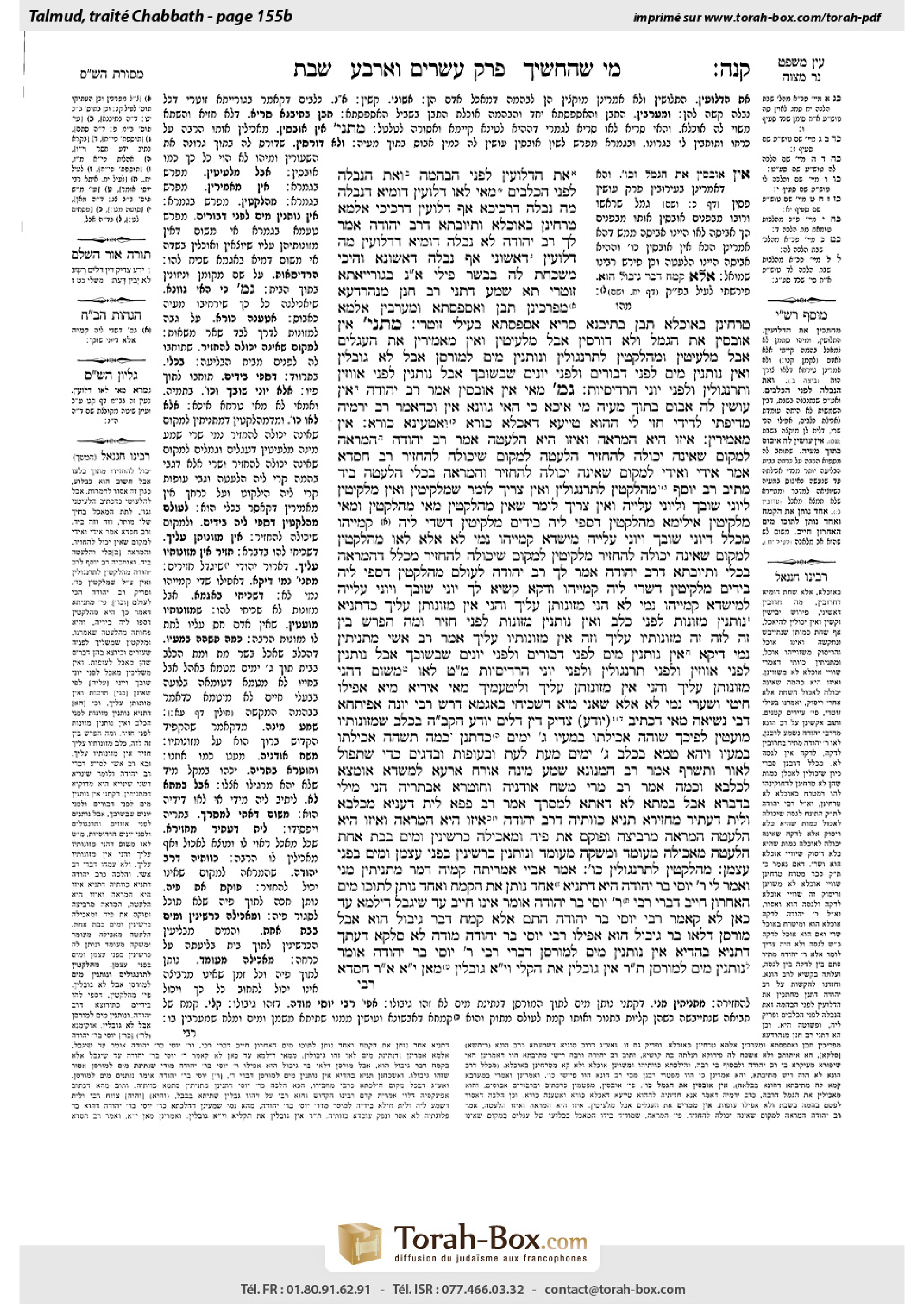
Shabbat 155b: Talmud study for Daf Yomi
Daf Yomi is the daily study of one Talmud folio. Explore 37 tractates with scans, Hebrew text, Sefaria English and AI-generated French translations where annotated.
Passage selection and English or AI-generated French translation are available where the scan has annotations. Daf Study is independent of Torah-Box and Sefaria.
Browse Shabbat · שבת · All tractatesShabbat 155b text and translations
This page of Shabbat includes the Aramaic text, an English translation and an AI-generated French translation, alongside the scan above.
שבת קנ״ה ב · Aramaic and Hebrew text
אֶת הַדִּלּוּעִין לִפְנֵי הַבְּהֵמָה וְאֶת הַנְּבֵלָה לִפְנֵי הַכְּלָבִים. מַאי לָאו, דִּלּוּעִין דּוּמְיָא דִנְבֵלָה: מָה נְבֵלָה — דְּרַכִּיכָא, אַף דִּלּוּעִין — דְּרַכִּיכֵי, אַלְמָא טָרְחִינַן בְּאוּכְלָא, וּתְיוּבְתָּא דְרַב יְהוּדָה! אָמַר לָךְ רַב יְהוּדָה: לָא, נְבֵלָה דּוּמְיָא דְּדִלּוּעִין: מָה דִלּוּעִין דְּאַשּׁוּנֵי, אַף נְבֵלָה — דְּאַשּׁוּנָא. וְהֵיכִי מַשְׁכַּחַתְּ לַהּ? בִּבְשַׂר פִּילֵי. אִי נָמֵי, בְּגוּרְיָיאתָא זוּטְרֵי.
תָּא שְׁמַע, דְּתָנֵי רַב חָנָן מִנְּהַרְדְּעָא: מְפָרְכִין תֶּבֶן וְאַסְפַּסְתָּא וּמְעָרְבִין. אַלְמָא טָרְחִינַן בְּאוּכְלָא! תֶּבֶן בְּתִיבְנָא סַרְיָא, אַסְפַּסְתָּא — בְּעִילֵי זוּטְרֵי.
מַתְנִי׳ אֵין אוֹבְסִין אֶת הַגָּמָל וְלֹא דּוֹרְסִין, אֲבָל מַלְעִיטִין. וְאֵין מַאֲמִירִין אֶת הָעֲגָלִים, אֲבָל מַלְעִיטִין. וּמְהַלְקְטִין לַתַּרְנְגוֹלִין, וְנוֹתְנִין מַיִם לַמּוּרְסָן, אֲבָל לֹא גּוֹבְלִין. וְאֵין נוֹתְנִין מַיִם לִפְנֵי דְּבוֹרִים וְלִפְנֵי יוֹנִים שֶׁבַּשּׁוֹבָךְ, אֲבָל נוֹתְנִין לִפְנֵי אֲווֹזִין וְתַרְנְגוֹלִין, וְלִפְנֵי יוֹנֵי הַרְדִּיסָיוֹת.
גְּמָ׳ מַאי ״אֵין אוֹבְסִין״? אָמַר רַב יְהוּדָה: אֵין עוֹשִׂין לָהּ אֵבוּס בְּתוֹךְ מֵעֶיהָ. מִי אִיכָּא כִּי הַאי גַוְונָא? אִין, וְכִדְאָמַר רַב יִרְמְיָה מִדִּיפְתִּי: לְדִידִי חֲזֵי לִי הַהוּא טַיָּיעָא דְּאוֹכְלַהּ כּוֹרָא, וְאַטְעֵינַהּ כּוֹרָא.
אֵין מַאֲמִירִין. אֵיזוֹ הִיא הַמְרָאָה וְאֵיזוֹ הִיא הַלְעָטָה? אָמַר רַב יְהוּדָה: הַמְרָאָה — לִמְקוֹם שֶׁאֵינָהּ יְכוֹלָה לְהַחֲזִיר, הַלְעָטָה — לִמְקוֹם שֶׁיְּכוֹלָה לְהַחֲזִיר. רַב חִסְדָּא אָמַר: אִידֵּי וְאִידֵּי לִמְקוֹם שֶׁאֵינָהּ יְכוֹלָה לְהַחֲזִיר, וְהַמְרָאָה בִּכְלִי, הַלְעָטָה בַּיָּד.
מֵתִיב רַב יוֹסֵף: מְהַלְקְטִין לַתַּרְנְגוֹלִין, וְאֵין צָרִיךְ לוֹמַר שֶׁמַּלְקִיטִין. וְאֵין מַלְקִיטִין לְיוֹנֵי שׁוֹבָךְ וּלְיוֹנֵי עֲלִיָּיה, וְאֵין צָרִיךְ לוֹמַר שֶׁאֵין מְהַלְקְטִין. מַאי ״מְהַלְקְטִין״ וּמַאי ״מַלְקִיטִין״? אִילֵּימָא מְהַלְקְטִין — דְּסָפֵי לֵיהּ בִּידֵיהּ, מַלְקִיטִין — דְּשָׁדֵי לֵיהּ קַמַּיְיהוּ, מִכְּלָל דְּיוֹנֵי שׁוֹבָךְ וְיוֹנֵי עֲלִיָּיה מִישְׁדֵּא קַמַּיְיהוּ נָמֵי לָא?
אֶלָּא לָאו, מְהַלְקְטִין — לִמְקוֹם שֶׁאֵינָהּ יְכוֹלָה לְהַחֲזִיר, מַלְקִיטִין — לִמְקוֹם שֶׁיְּכוֹלָה לְהַחֲזִיר. מִכְּלָל דְּהַמְרָאָה בִּכְלִי, וּתְיוּבְתָּא דְרַב יְהוּדָה!
אָמַר לְךָ רַב יְהוּדָה: לְעוֹלָם ״מְהַלְקְטִין״ דְּסָפֵי לֵיהּ בִּידֵיהּ, ״מַלְקִיטִין״ דְּשָׁדֵי לֵיהּ קַמַּיְיהוּ, וּדְקָא קַשְׁיָא לָךְ יוֹנֵי שׁוֹבָךְ וְיוֹנֵי עֲלִיָּיה לְמִישְׁדֵּא קַמַּיְיהוּ נָמֵי לָא? הָנֵי מְזוֹנוֹתָן עָלֶיךָ, וְהָנֵי אֵין מְזוֹנוֹתָן עָלֶיךָ. כִּדְתַנְיָא: נוֹתְנִין מְזוֹנוֹת לִפְנֵי כֶלֶב, וְאֵין נוֹתְנִין מְזוֹנוֹת לִפְנֵי חֲזִיר. וּמָה הֶפְרֵשׁ בֵּין זֶה לָזֶה? זֶה מְזוֹנוֹתָיו עָלֶיךָ, וְזֶה אֵין מְזוֹנוֹתָיו עָלֶיךָ.
אָמַר רַב אָשֵׁי: מַתְנִיתִין נָמֵי דַּיְקָא, אֵין נוֹתְנִין מַיִם לִפְנֵי דְבוֹרִים וְלִפְנֵי יוֹנִים שֶׁבַּשּׁוֹבָךְ, אֲבָל נוֹתְנִין לִפְנֵי אֲווֹזִין וְלִפְנֵי תַרְנְגוֹלִין וְלִפְנֵי יוֹנֵי הַרְדִּיסָיוֹת. מַאי טַעְמָא? לָאו מִשּׁוּם דְּהָנֵי מְזוֹנוֹתָן עָלֶיךָ, וְהָנֵי אֵין מְזוֹנוֹתָן עָלֶיךָ.
וְלִיטַעְמָיךְ, מַאי אִירְיָא מַיָּא? אֲפִילּוּ חִיטֵּי וּשְׂעָרֵי נָמֵי לָא! אֶלָּא, שָׁאנֵי מַיָּא דִּשְׁכִיחִי בְּאַגְמָא.
דְּרַשׁ רַבִּי יוֹנָה אַפִּיתְחָא דְּבֵי נְשִׂיאָה: מַאי דִּכְתִיב ״יוֹדֵעַ צַדִּיק דִּין דַּלִּים״ — יוֹדֵעַ הַקָּדוֹשׁ בָּרוּךְ הוּא בַּכֶּלֶב שֶׁמְּזוֹנוֹתָיו מוּעָטִין, לְפִיכָךְ שׁוֹהָה אֲכִילָתוֹ בְּמֵעָיו שְׁלֹשָׁה יָמִים. כְּדִתְנַן: כַּמָּה תִּשְׁהֶה אֲכִילָתוֹ בְּמֵעָיו וִיהֵא טָמֵא — בַּכֶּלֶב שְׁלֹשָׁה יָמִים מֵעֵת לְעֵת, וּבָעוֹפוֹת וּבַדָּגִים כְּדֵי שֶׁתִּפּוֹל לָאוּר וְתִשָּׂרֵף.
אָמַר רַב הַמְנוּנָא: שְׁמַע מִינַּהּ אוֹרַח אַרְעָא לְמִשְׁדֵּא אוּמְצָא לְכַלְבָּא. וְכַמָּה? אָמַר רַב מָרִי: מְשַׁח אוּדְנֵיהּ, וְחוּטְרָא אַבָּתְרֵיהּ. הָנֵי מִילֵּי בְּדַבְרָא, אֲבָל בְּמָתָא לָא, דְּאָתֵי לְמִסְרַךְ. אָמַר רַב פָּפָּא: לֵית דְּעָנִי מִכַּלְבָּא, וְלֵית דְּעַתִּיר מֵחֲזִירָא.
תַּנְיָא כְּווֹתֵיהּ דְּרַב יְהוּדָה: אֵיזוֹ הִיא הַמְרָאָה, וְאֵיזוֹ הִיא הַלְעָטָה? הַמְרָאָה — מַרְבִּיצָהּ וּפוֹקֵס אֶת פִּיהָ וּמַאֲכִילָהּ כַּרְשִׁינִין וּמַיִם בְּבַת אַחַת. הַלְעָטָה — מַאֲכִילָהּ מְעוּמָּד וּמַשְׁקָהּ מְעוּמָּד, וְנוֹתְנִין כַּרְשִׁינִין בִּפְנֵי עַצְמָן וּמַיִם בִּפְנֵי עַצְמָן.
מְהַלְקְטִין לַתַּרְנְגוֹלִין כּוּ׳. אָמַר אַבָּיֵי, אַמְרִיתַהּ קַמֵּיהּ דְּמָר: מַתְנִיתִין מַנִּי? וַאֲמַר לִי: רַבִּי יוֹסֵי בַּר יְהוּדָה הִיא. דְּתַנְיָא: אֶחָד נוֹתֵן אֶת הַקֶּמַח וְאֶחָד נוֹתֵן לְתוֹכוֹ מַיִם — הָאַחֲרוֹן חַיָּיב, דִּבְרֵי רַבִּי. רַבִּי יוֹסֵי בַּר יְהוּדָה אוֹמֵר: אֵינוֹ חַיָּיב עַד שֶׁיְּגַבֵּל.
דִּילְמָא עַד כָּאן לָא קָאָמַר רַבִּי יוֹסֵי בַּר יְהוּדָה הָתָם אֶלָּא קֶמַח דְּבַר גִּיבּוּל הוּא, אֲבָל מוּרְסָן דְּלָאו בַּר גִּיבּוּל הוּא, אֲפִילּוּ רַבִּי יוֹסֵי בַּר יְהוּדָה מוֹדֶה. לָא סָלְקָא דַּעְתָּא, דְּתַנְיָא בְּהֶדְיָא: אֵין נוֹתְנִין מַיִם לַמּוּרְסָן, דִּבְרֵי רַבִּי. רַבִּי יוֹסֵי בַּר יְהוּדָה אוֹמֵר: נוֹתְנִין מַיִם לַמּוּרְסָן.
תָּנוּ רַבָּנַן: אֵין גּוֹבְלִין אֶת הַקָּלִי. וְיֵשׁ אוֹמְרִים: גּוֹבְלִין. מַאן ״יֵשׁ אוֹמְרִים״? אָמַר רַב חִסְדָּא:
Shabbat 155b · English translation
pumpkins before an animal and an animal carcass before dogs. Is this not referring to pumpkins that are similar to an animal carcass? Just as an animal carcass is soft, so too, the pumpkins referred to here are soft. Apparently, one may exert himself with food, and this is a conclusive refutation of the opinion of Rav Yehuda. The Gemara answers that Rav Yehuda could have said to you: No, the mishna is referring to an animal carcass that is similar to pumpkins. Just as the reference is to pumpkins that are hard, so too, the reference is to an animal carcass that is hard, and chopping it renders it edible. The Gemara asks: And how is it possible to find an animal carcass that is so hard that another animal cannot eat it? The Gemara answers: The mishna is referring to elephant flesh. Alternatively, it can be explained that the mishna is referring to more common animal meat placed before puppies that can eat only chopped meat.
Come and hear a proof from that which Rav Ḥanan of Neharde’a taught: One may crumble straw and alfalfa on Shabbat and mix the two together, and the animal then eats the straw because it is mixed with the alfalfa. Apparently, one may exert himself with food on Shabbat. The Gemara rejects this proof: No, the straw mentioned here is rotten straw that requires special preparation to render it suitable for animal consumption, and alfalfa is taught with regard to young donkeys who can only eat it in small pieces.
MISHNA: One may not forcibly overfeed a camel on Shabbat and one may not force-feed it, even if in doing so he does not overfeed the camel. However, one may place food into its mouth. And the mishna makes a distinction, which will be explained in the Gemara, between two manners of placing food in the mouths of cattle. One may not place food in the mouths of calves on Shabbat in the manner of hamra’a, but one may do so in the manner of halata. And one may force-feed chickens. And one may add water to bran used as animal feed, but one may not knead the mixture. And one may not place water before bees or before doves in a dove-cote, because they are capable of finding their own food; however, one may place water before geese and chickens and before hardisian [hardeisiyyot] doves.
GEMARA: We learned in the mishna that one may not forcibly overfeed a camel on Shabbat. The Gemara asks: What is meaning of: One may not forcibly overfeed? Rav Yehuda said: One may not feed a camel to the point that it creates a trough inside of its stomach. The Gemara asks: Is there the possibility of feeding a camel in that manner? The Gemara answers: Yes; and as Rav Yirmeya of Difti said: I saw an Arab who fed his camel a kor of food and loaded it with another kor on its back.
We learned in the mishna: One may not place food in the mouths of calves on Shabbat in the manner of hamra’a, but one may do so in the manner of halata. The Gemara asks: Which is hamra’a and which is halata? Rav Yehuda said: Hamra’a is positioning food into a place in the animal’s throat from which it cannot return and expel the food. Halata is positioning food into a place in the animal’s mouth from which it can return and expel the food. Rav Ḥisda said: Both this and that refer to positioning food into a place from which the animal cannot return and expel the food; however, the difference between them is that in hamra’a the food is placed with a vessel, whereas in halata the food is placed by hand.
Rav Yosef raised an objection from that which was taught in the Tosefta: One may force-feed [mehalketin] chickens, and needless to say, one may malkitin. And one may not malkitin doves in a dove-cote or doves in an attic, and needless to say, one may not force-feed. The Gemara asks: What is mehalketin and what is malkitin? If you say that mehalketin means that one feeds the bird by hand and malkitin means that one throws the food before them, by inference, throwing food before doves in a dove-cote or before doves in an attic is also not permitted. But why would that be prohibited?
Rather, is it not that mehalketin means positioning food into a place from which the bird cannot return and expel the food, and malkitin means positioning food into a place from which it can return and expel the food? Therefore, mehalketin in the case of birds is similar to halata into a camel’s mouth, which the mishna permitted. By inference, the hamra’a prohibited in the mishna is performed with a vessel, and this poses a conclusive refutation to the opinion of Rav Yehuda.
Rav Yehuda could have said to you: Actually, mehalketin means that one feeds the bird by hand, and malkitin mean that one throws the food before them. And that which was difficult for you: Is throwing food before doves in a dove-cote or doves in an attic also not permitted on Shabbat? This is not difficult because with regard to these chickens and geese that were mentioned, sole responsibility for their sustenance is incumbent upon you as they are incapable of providing for themselves. However, in the case of these doves, responsibility for their sustenance is not incumbent upon you, and therefore, it is prohibited to place food before them, as it was taught in a baraita: One may place sustenance before a dog on Shabbat, but one may not place sustenance before a pig. And what is the difference between this and that? In this case of the dog, responsibility for its sustenance is incumbent upon you, and in that case of the pig, responsibility for its sustenance is not incumbent upon you, as no Jew raises pigs.
Rav Ashi said: The language of the mishna is also precise in support of this explanation, as we learn: And one may not place water before bees or before doves in a dove-cote because they are capable of finding their own food; however, one may place water before geese and chickens and before hardisian doves. What is the reason for this distinction? Is it not because for these, geese and chickens, responsibility for their sustenance is incumbent upon you, and for those, bees and doves, responsibility for their sustenance is not incumbent upon you?
The Gemara rejects this proof: And according to your reasoning, why did the mishna cite a case specifically involving water? Even wheat and barley should also not be permitted. Rather, the reason for the distinction between the halakhot is that water is different because it is found in a lake or in other reservoirs, and therefore one need not exert himself to provide water for bees and doves. That is not the case with the rest of their food.
Returning to the discussion of feeding dogs, the Gemara cites additional statements on the topic. Rabbi Yona taught at the entrance to the house of the Nasi: What is the meaning of that which is written: “The righteous man takes knowledge of the cause of the poor” (Proverbs 29:7)? The Holy One, Blessed be He, knows that for a dog, its sustenance is scarce and they are not fed sufficiently. Therefore, its food remains in its intestines for three days so that the dog will be sustained by that food, as we learned in a mishna dealing with the halakhot of ritual impurity: After an animal eats flesh from a corpse, how long does its food remain in its intestines undigested and therefore ritually impure? In the case of a dog it is for three twenty-four hour periods, and for fowl and fish, who digest their food quickly, it is the equivalent of the time it takes for the flesh to fall into the fire and be consumed by the fire.
Rav Hamnuna said: Learn from it: It is the way of the world, i.e., proper conduct, to throw a piece of meat before a dog, as even the Holy One, Blessed be He, concerns Himself with the dog’s sustenance. The Gemara asks: And how much food should one give to a dog? Rav Mari said: Give it the equivalent of the measure of its ear and strike it immediately thereafter with a staff so that the dog will not grow attached to the one who fed it. This applies specifically when one is in the field, but in the city, one should not give anything to a dog because the dog will be drawn to follow him and remain with him. Rav Pappa said: There is no creature poorer than a dog, and no creature richer than a pig, as pigs will eat anything, and people provide them with plentiful amounts of food.
With regard to the halakhic ruling, a baraita was taught in accordance with the opinion of Rav Yehuda: What is hamra’a and what is halata? Hamra’a is when a person forcibly lays the animal on the ground and forces its mouth open and feeds it vetch and water simultaneously so that the animal will be unable to expel it. Halata is when one feeds the animal while it is standing and gives it to drink while it is standing, i.e., gives it food and drink in the usual manner, and one gives it vetch separately and water separately, to augment what the animal eats on its own.
We learned in the mishna: And one may force-feed chickens, and one may add water to bran, but one may not knead the mixture. Abaye said: I said this before my Master, Rabba: Whose opinion is it in the mishna? And he said to me: It is the opinion of Rabbi Yosei bar Yehuda, as it was taught in a baraita: If one person places flour and another one places water into it, the latter is liable to bring a sin-offering for performing the prohibited labor of kneading. This is the statement of Rabbi Yehuda HaNasi. Rabbi Yosei bar Yehuda says: One is only liable when he actually kneads the flour and water together. He is not liable for merely adding water to the flour. This is similar to the ruling of the mishna that one may pour water into the bran but may not knead the mixture.
The Gemara rejects this: Perhaps Rabbi Yosei bar Yehuda only stated that actual kneading is required to be liable for performing the prohibited labor of kneading in the case of flour, which can be kneaded; however, in the case of bran, which cannot be kneaded into a dough, even Rabbi Yosei bar Yehuda would concede that it is prohibited, even if one does not actually knead the mixture. The Gemara rejects this statement: It should not enter your mind to explain it that way, as it was taught explicitly in a baraita: One may not place water into bran on Shabbat; this is the statement of Rabbi Yehuda HaNasi. Rabbi Yosei bar Yehuda says: One may place water into bran.
The Sages taught: On Shabbat, one may not knead sweet flour made from unripe grain that was dried in an oven, and some say: One may knead it. The Gemara asks: Whose is the opinion introduced as: And some say? Rav Ḥisda said:
Shabbat 155b · Traduction française (IA)
des citrouilles devant un animal et une carcasse devant des chiens. Cela ne désigne-t-il pas des citrouilles semblables à une carcasse ? De même qu’une carcasse est molle, les citrouilles dont il est question ici le sont également. Il apparaît donc que l’on peut se donner de la peine pour préparer de la nourriture, ce qui constitue une réfutation décisive de l’opinion de Rav Yehouda. La Guemara répond que Rav Yehouda aurait pu te dire : non, la Michna parle d’une carcasse semblable à des citrouilles. De même qu’il s’agit de citrouilles dures, il s’agit aussi d’une carcasse dure, et la couper la rend comestible. La Guemara demande : comment peut-on trouver une carcasse si dure qu’un autre animal ne puisse pas la manger ? La Guemara répond : la Michna parle de chair d’éléphant. On peut aussi expliquer que la Michna parle de viande d’animaux plus courants, placée devant de jeunes chiens qui ne peuvent manger que de la viande coupée en morceaux.
Viens entendre une preuve de ce que Rav Ḥanan de Neharde’a enseigna : le Chabbat, on peut émietter de la paille et de la luzerne, puis les mélanger ; l’animal mange alors la paille parce qu’elle est mêlée à la luzerne. Il apparaît donc que l’on peut se donner de la peine pour préparer de la nourriture le Chabbat. La Guemara rejette cette preuve : non, la paille mentionnée ici est de la paille pourrie, qui nécessite une préparation particulière pour devenir propre à la consommation animale, et la luzerne est mentionnée à propos de jeunes ânes, qui ne peuvent la manger qu’en petits morceaux.
MICHNA : Le Chabbat, on ne peut pas faire manger un chameau de force jusqu’à le gaver, ni le gaver de force, même si l’on ne le gave pas complètement. Cependant, on peut lui mettre de la nourriture dans la bouche. La Michna distingue ensuite, comme l’expliquera la Guemara, deux façons de mettre de la nourriture dans la bouche du bétail. Le Chabbat, on ne peut pas mettre de nourriture dans la bouche des veaux selon la méthode du hamra’a, mais on peut le faire selon la méthode du halata. On peut gaver les poulets. On peut ajouter de l’eau au son utilisé comme aliment pour animaux, mais on ne peut pas pétrir le mélange. On ne peut pas mettre d’eau à la disposition des abeilles ni des colombes dans un colombier, car elles sont capables de trouver elles-mêmes leur nourriture ; en revanche, on peut en mettre à la disposition des oies, des poulets et des colombes hardisiennes [hardeisiyyot].
GUEMARA : Nous avons appris dans la Michna qu’on ne peut pas faire manger un chameau de force jusqu’à le gaver le Chabbat. La Guemara demande : que signifie « faire manger de force jusqu’à le gaver » ? Rav Yehouda dit : on ne peut pas nourrir un chameau au point de former une auge dans son estomac. La Guemara demande : est-il possible de nourrir un chameau de cette façon ? La Guemara répond : oui, comme le dit Rav Yirmeya de Difti : « J’ai vu un Arabe donner à manger à son chameau un kor de nourriture et lui en charger un autre kor sur le dos. »
Nous avons appris dans la Michna : le Chabbat, on ne peut pas mettre de nourriture dans la bouche des veaux selon la méthode du hamra’a, mais on peut le faire selon la méthode du halata. La Guemara demande : qu’est-ce que le hamra’a et qu’est-ce que le halata ? Rav Yehouda dit : le hamra’a consiste à placer la nourriture dans une partie de la gorge de l’animal d’où il ne peut ni la faire remonter ni la recracher. Le halata consiste à placer la nourriture dans une partie de la bouche d’où l’animal peut la faire remonter et la recracher. Rav Ḥisda dit : les deux méthodes consistent à placer la nourriture dans une partie d’où l’animal ne peut ni la faire remonter ni la recracher ; toutefois, la différence entre elles est que, dans le hamra’a, la nourriture est placée à l’aide d’un ustensile, tandis que, dans le halata, elle est placée à la main.
Rav Yossef soulève une objection à partir de ce qui fut enseigné dans la Tossefta : on peut gaver [mehalketin] les poulets, et à plus forte raison on peut les malkitin. On ne peut pas malkitin les colombes dans un colombier ni celles qui se trouvent dans un grenier, et à plus forte raison on ne peut pas les gaver. La Guemara demande : que signifient mehalketin et malkitin ? Si tu dis que mehalketin signifie nourrir l’oiseau à la main et que malkitin signifie jeter la nourriture devant lui, il en ressort que jeter de la nourriture devant des colombes dans un colombier ou dans un grenier est également interdit. Mais pourquoi cela serait-il interdit ?
Ne faut-il pas plutôt dire que mehalketin signifie placer la nourriture dans une partie d’où l’oiseau ne peut ni la faire remonter ni la recracher, et que malkitin signifie la placer dans une partie d’où il peut la faire remonter et la recracher ? Par conséquent, mehalketin, lorsqu’il s’agit d’oiseaux, correspond au halata dans la bouche d’un chameau, que la Michna a permis. Il en ressort que le hamra’a interdit par la Michna se fait à l’aide d’un ustensile, ce qui constitue une réfutation décisive de l’opinion de Rav Yehouda.
Rav Yehouda aurait pu te dire : en réalité, mehalketin signifie nourrir l’oiseau à la main, et malkitin signifie jeter la nourriture devant lui. Quant à la difficulté que tu as soulevée — jeter de la nourriture devant des colombes dans un colombier ou dans un grenier serait également interdit le Chabbat —, elle n’en est pas une : pour ces poulets et ces oies mentionnés ici, leur subsistance relève entièrement de ta responsabilité, puisqu’ils sont incapables de subvenir eux-mêmes à leurs besoins. En revanche, pour ces colombes, leur subsistance ne relève pas de ta responsabilité ; il est donc interdit de mettre de la nourriture à leur disposition, comme il fut enseigné dans une baraïta : le Chabbat, on peut mettre de la nourriture à la disposition d’un chien, mais pas à celle d’un porc. Quelle est la différence entre l’un et l’autre ? Dans le cas du chien, sa subsistance relève de ta responsabilité ; dans celui du porc, elle n’en relève pas, car aucun Juif n’élève de porcs.
Rav Ashi dit : le libellé de la Michna confirme lui aussi cette explication, car nous apprenons : on ne peut pas mettre d’eau à la disposition des abeilles ni des colombes dans un colombier, car elles sont capables de trouver elles-mêmes leur nourriture ; en revanche, on peut en mettre à la disposition des oies, des poulets et des colombes hardisiennes. Quelle est la raison de cette distinction ? N’est-ce pas que, pour les unes — les oies et les poulets —, leur subsistance relève de ta responsabilité, tandis que, pour les autres — les abeilles et les colombes —, elle n’en relève pas ?
La Guemara rejette cette preuve : selon ton raisonnement, pourquoi la Michna mentionne-t-elle précisément l’eau ? Il devrait également être interdit de leur donner du blé ou de l’orge. Il faut plutôt dire que la raison de la distinction entre ces halakhot est que l’eau est différente : on en trouve dans un lac ou dans d’autres réservoirs, et il n’est donc pas nécessaire de se donner de la peine pour fournir de l’eau aux abeilles et aux colombes. Il n’en va pas de même pour le reste de leur nourriture.
Revenant à la discussion sur le fait de nourrir les chiens, la Guemara rapporte d’autres enseignements sur le sujet. Rabbi Yona enseigna à l’entrée de la maison du Nassi : que signifie ce qui est écrit : « Le juste connaît la cause des pauvres » (Proverbes 29,7) ? Le Saint, béni soit-Il, sait que la nourriture du chien est rare et qu’il n’est pas suffisamment nourri. C’est pourquoi sa nourriture reste dans ses intestins pendant trois jours, afin qu’il puisse en tirer sa subsistance, comme nous l’avons appris dans une Michna consacrée aux lois de l’impureté rituelle : après qu’un animal a mangé de la chair provenant d’un cadavre, combien de temps sa nourriture reste-t-elle dans ses intestins sans être digérée et demeure-t-elle donc rituellement impure ? Pour un chien, c’est pendant trois périodes de vingt-quatre heures ; pour les oiseaux et les poissons, qui digèrent rapidement leur nourriture, cela correspond au temps qu’il faut à la chair pour tomber dans le feu et y être consumée.
Rav Hamnouna dit : apprends de là qu’il est conforme aux usages du monde, c’est-à-dire à la conduite convenable, de jeter un morceau de viande à un chien, puisque le Saint, béni soit-Il, se soucie lui aussi de la subsistance du chien. La Guemara demande : quelle quantité de nourriture faut-il donner à un chien ? Rav Mari dit : donne-lui l’équivalent de la mesure de son oreille, puis frappe-le aussitôt avec un bâton, afin que le chien ne s’attache pas à celui qui l’a nourri. Cela s’applique précisément lorsqu’on est dans les champs ; en ville, il ne faut rien donner à un chien, car il sera attiré par toi, te suivra et restera avec toi. Rav Pappa dit : aucune créature n’est plus pauvre qu’un chien, et aucune créature n’est plus riche qu’un porc, car les porcs mangent de tout et les gens leur fournissent de grandes quantités de nourriture.
Concernant la décision halakhique, une baraïta fut enseignée conformément à l’opinion de Rav Yehouda : que sont le hamra’a et le halata ? Le hamra’a consiste à coucher de force l’animal sur le sol, à lui ouvrir la bouche de force et à lui faire avaler simultanément de la vesce et de l’eau, afin qu’il ne puisse pas recracher ce qu’il a avalé. Le halata consiste à nourrir l’animal pendant qu’il est debout et à le faire boire dans cette position, c’est-à-dire à lui donner nourriture et boisson de la manière habituelle ; on lui donne la vesce séparément et l’eau séparément, afin d’augmenter ce qu’il mange de lui-même.
Nous avons appris dans la Michna : on peut gaver les poulets et ajouter de l’eau au son, mais on ne peut pas pétrir le mélange. Abaye dit : « J’ai demandé ceci à mon maître, Rabba : “De qui la Michna exprime-t-elle l’opinion ?” Il me répondit : “C’est l’opinion de Rabbi Yossei bar Yehouda” », comme il fut enseigné dans une baraïta : si une personne met de la farine et qu’une autre y verse de l’eau, cette dernière est tenue d’apporter un sacrifice expiatoire pour avoir accompli le travail interdit de pétrir. Telle est la déclaration de Rabbi Yehouda HaNassi. Rabbi Yossei bar Yehouda dit : on n’est passible que lorsqu’on pétrit effectivement la farine et l’eau ensemble. On n’est pas passible pour avoir simplement ajouté de l’eau à la farine. Cela correspond à la décision de la Michna, selon laquelle on peut verser de l’eau dans le son, mais pas pétrir le mélange.
La Guemara rejette cette explication : peut-être Rabbi Yossei bar Yehouda a-t-il dit que seul le pétrissage effectif rend passible du fait d’accomplir le travail interdit de pétrir dans le cas de la farine, qui peut être pétrie ; cependant, dans le cas du son, qui ne peut pas être pétri pour former une pâte, même Rabbi Yossei bar Yehouda reconnaîtrait que cela est interdit, même si l’on ne pétrit pas effectivement le mélange. La Guemara rejette cette possibilité : il ne faut pas comprendre les choses ainsi, car cela fut enseigné explicitement dans une baraïta : le Chabbat, on ne peut pas mettre d’eau dans le son ; telle est la déclaration de Rabbi Yehouda HaNassi. Rabbi Yossei bar Yehouda dit : on peut mettre de l’eau dans le son.
Les Sages ont enseigné : le Chabbat, on ne peut pas pétrir de la farine douce faite à partir de grains immatures séchés dans un four ; certains disent qu’on peut la pétrir. La Guemara demande : à qui appartient l’opinion introduite par les mots « certains disent » ? Rav Ḥisda dit :
Traduction française générée par IA à partir de l’édition anglaise de Sefaria. Vérifie toujours un passage avec le texte source.
Text from Sefaria: William Davidson Edition - Vocalized Aramaic (CC BY NC); William Davidson Edition - English (CC BY NC).