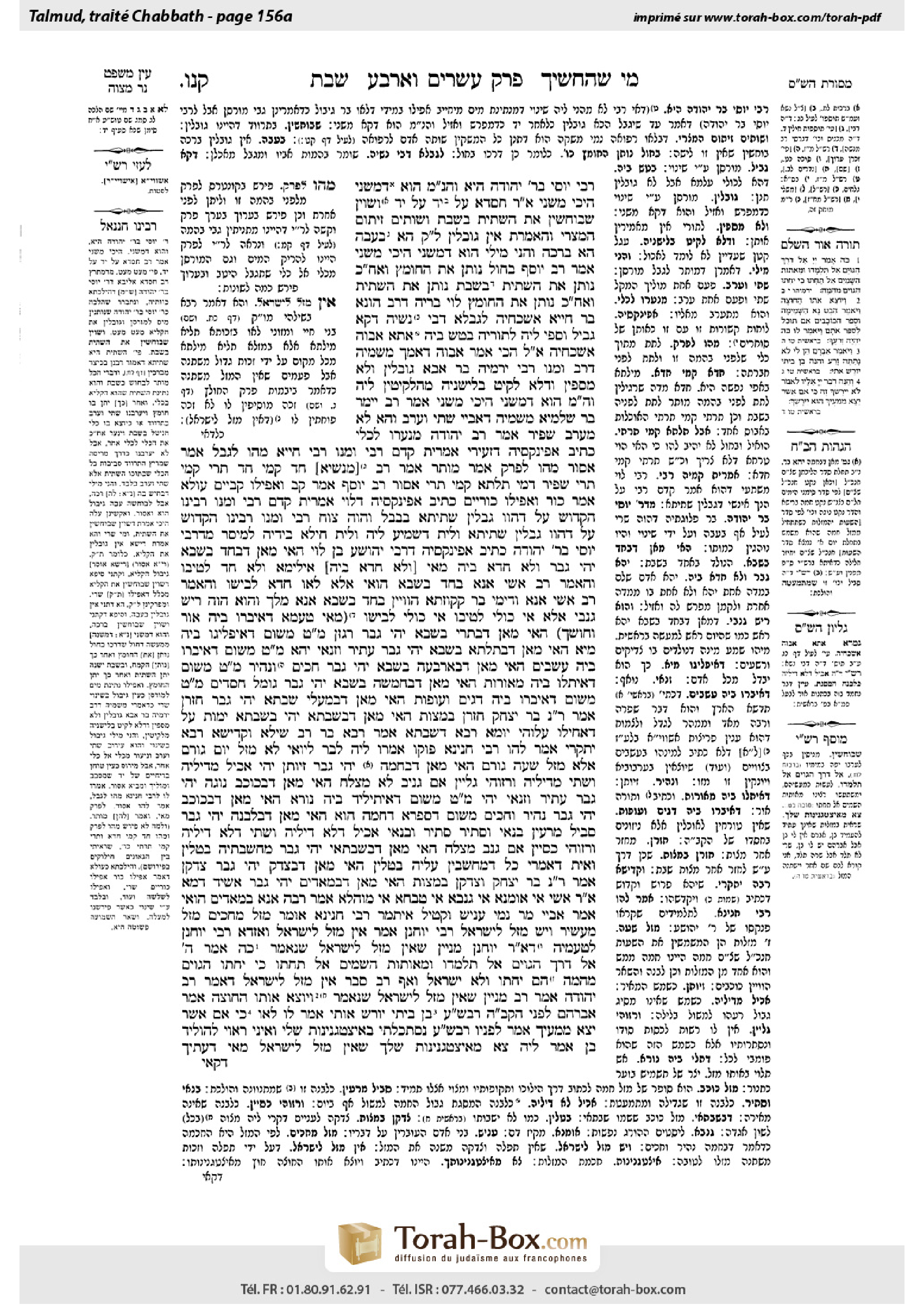
Shabbat 156a: Talmud study for Daf Yomi
Daf Yomi is the daily study of one Talmud folio. Explore 37 tractates with scans, Hebrew text, Sefaria English and AI-generated French translations where annotated.
Passage selection and English or AI-generated French translation are available where the scan has annotations. Daf Study is independent of Torah-Box and Sefaria.
Browse Shabbat · שבת · All tractatesShabbat 156a text and translations
This page of Shabbat includes the Aramaic text, an English translation and an AI-generated French translation, alongside the scan above.
שבת קנ״ו א · Aramaic and Hebrew text
רַבִּי יוֹסֵי בְּרַבִּי יְהוּדָה הִיא. וְהָנֵי מִילֵּי הוּא דִּמְשַׁנֵּי. הֵיכִי מְשַׁנֵּי? אָמַר רַב חִסְדָּא: עַל יָד עַל יָד.
וְשָׁוִין שֶׁבּוֹחֲשִׁין אֶת הַשַּׁתִּית בַּשַּׁבָּת וְשׁוֹתִים זֵיתוֹם הַמִּצְרִי. וְהָאָמְרַתְּ ״אֵין גּוֹבְלִין״! לָא קַשְׁיָא: הָא בְּעָבָה, הָא בְּרַכָּה. וְהָנֵי מִילֵּי הוּא דִּמְשַׁנֵּי.
הֵיכִי מְשַׁנֵּי? אָמַר רַב יוֹסֵף: בַּחוֹל נוֹתֵן אֶת הַחוֹמֶץ וְאַחַר כָּךְ נוֹתֵן אֶת הַשַּׁתִּית, בַּשַּׁבָּת נוֹתֵן אֶת הַשַּׁתִּית וְאַחַר כָּךְ נוֹתֵן אֶת הַחוֹמֶץ. לֵוִי בְּרֵיהּ דְּרַב הוּנָא בַּר חִיָּיא אַשְׁכְּחֵיהּ לְגַבָּלָא דְּבֵי נְשֵׁיהּ דְּקָא גָבֵיל וְסָפֵי לֵיהּ לְתוֹרֵיהּ. בְּטַשׁ בֵּיהּ. אֲתָא אֲבוּהּ אַשְׁכְּחֵיהּ, אֲמַר לֵיהּ: הָכִי אָמַר אֲבוּהּ דְּאִמָּךְ מִשְּׁמֵיהּ דְּרַב, וּמַנּוּ — רַבִּי יִרְמְיָה בַּר אַבָּא: גּוֹבְלִין וְלֹא מַסְפִּין, וּדְלָא לָקֵיט בְּלִישָּׁנֵיהּ — מַלְקִיטִין לֵיהּ. וְהָנֵי מִילֵּי הוּא דִּמְשַׁנֵּי.
הֵיכִי מְשַׁנֵּי? אָמַר רַב יֵימַר בַּר שֶׁלֶמְיָא מִשְּׁמֵיהּ דְּאַבָּיֵי: שְׁתִי וָעֵרֶב. וְהָא לָא מִעָרַב שַׁפִּיר? אָמַר רַב יְהוּדָה: מְנַעֲרוֹ לִכְלִי.
כְּתִיב אַפִּינְקָסֵיהּ דִּזְעֵירִי: אֲמַרִית קֳדָם רַבִּי, וּמַנּוּ — רַבִּי חִיָּיא: מַהוּ לְגַבֵּל? אָמַר: אָסוּר. מַהוּ לְפָרֵק? אָמַר: מוּתָּר. אָמַר רַב [מְנַשְּׁיָא]: חַד קַמֵּי חַד, תְּרֵי קַמֵּי תְּרֵי — שַׁפִּיר דָּמֵי. תְּלָתָא קַמֵּי תְּרֵי — אֲסִיר. רַב יוֹסֵף אָמַר: קַב וַאֲפִילּוּ קַבַּיִים. עוּלָּא אָמַר: כּוֹר וַאֲפִילּוּ כּוֹרַיִים.
כְּתִיב אַפִּינְקָסֵיהּ דְּלֵוִי: אֲמַרִית קֳדָם רַבִּי, וּמַנּוּ — רַבֵּינוּ הַקָּדוֹשׁ, עַל דַּהֲווֹ גָּבְלִין שְׁתִיתָא בְּבָבֶל, וַהֲוָה צָוַח רַבִּי (וּמַנּוּ? — רַבֵּינוּ הַקָּדוֹשׁ, עַל דַּהֲווֹ גָּבְלִין שַׁתִּיתָא), וְלֵית דְּשָׁמַע לֵיהּ, וְלֵית חֵילָא בִּידֵיהּ לְמֵיסַר מִדְּרַבִּי יוֹסֵי בְּרַבִּי יְהוּדָה.
כְּתִיב אַפִּינְקָסֵיהּ דְּרַבִּי יְהוֹשֻׁעַ בֶּן לֵוִי: הַאי מַאן דִּבְחַד בְּשַׁבָּא, יְהֵי גְּבַר וְלָא חֲדָא בֵּיהּ.
מַאי [״וְלָא חֲדָא בֵּיהּ״]? אִילֵּימָא: וְלָא חַד לְטֵיבוּ, וְהָאָמַר רַב אָשֵׁי: אֲנָא בְּחַד בְּשַׁבָּא הֲוַאי! אֶלָּא לָאו חֲדָא לְבִישׁוּ, וְהָאָמַר רַב אָשֵׁי: אֲנָא וְדִימִי בַּר קָקוֹזְתָּא הֲוֵינַן בְּחַד בְּשַׁבָּא, אֲנָא מֶלֶךְ, וְהוּא הֲוָה רֵישׁ גַּנָּבֵי! אֶלָּא: אִי כּוּלֵּיהּ לְטֵיבוּ, אִי כּוּלֵּיהּ לְבִישׁוּ. מַאי טַעְמָא? דְּאִיבְּרוֹ בֵּיהּ אוֹר וָחוֹשֶׁךְ.
הַאי מַאן דְּבִתְרֵי בְּשַׁבָּא יְהֵי גְּבַר רַגְזָן. מַאי טַעְמָא? מִשּׁוּם דְּאִיפְּלִיגוּ בֵּיהּ מַיָּא. הַאי מַאן דְּבִתְלָתָא בְּשַׁבָּא — יְהֵי גְּבַר עַתִּיר וְזַנַּאי יְהֵא. מַאי טַעְמָא? מִשּׁוּם דְּאִיבְּרוֹ בֵּיהּ עֲשָׂבִים. הַאי מַאן דִּבְאַרְבְּעָה בְּשַׁבָּא — יְהֵי גְּבַר חַכִּים וְנָהִיר. מַאי טַעְמָא? מִשּׁוּם דְּאִיתְּלוֹ בֵּיהּ מְאוֹרוֹת.
הַאי מַאן דִּבְחַמְשָׁה בְּשַׁבָּא — יְהֵי גְּבַר גּוֹמֵל חֲסָדִים. מַאי טַעְמָא? מִשּׁוּם דְּאִיבְּרוֹ בֵּיהּ דָּגִים וְעוֹפוֹת. הַאי מַאן דִּבְמַעֲלֵי שַׁבְּתָא — יְהֵי גְּבַר חַזְרָן. אָמַר רַב נַחְמָן בַּר יִצְחָק: חַזְרָן בְּמִצְוֹת. הַאי מַאן דִּבְשַׁבְּתָא יְהֵי — בְּשַׁבְּתָא יְמוּת, עַל דְּאַחִילוּ עֲלוֹהִי יוֹמָא רַבָּא דְּשַׁבְּתָא. אָמַר רָבָא בַּר רַב שֵׁילָא: וְקַדִּישָׁא רַבָּא יִתְקְרֵי.
אֲמַר לְהוּ רַבִּי חֲנִינָא, פּוּקוּ אֱמַרוּ לֵיהּ לְבַר לֵיוַאי: לֹא מַזַּל יוֹם גּוֹרֵם אֶלָּא מַזַּל שָׁעָה גּוֹרֵם. הַאי מַאן דִּבְחַמָּה — יְהֵי גְּבַר זִיוְתָן, יְהֵי אָכֵיל מִדִּילֵיהּ וְשָׁתֵי מִדִּילֵיהּ, וְרָזוֹהִי גַּלְיִין, אִם גָּנֵיב — לָא מַצְלַח. הַאי מַאן דִּבְכוֹכָב נוֹגַהּ — יְהֵי גְּבַר עַתִּיר וְזַנַּאי יְהֵי. מַאי טַעְמָא? מִשּׁוּם דְּאִיתְיְלִיד בֵּיהּ נוּרָא. הַאי מַאן דִּבְכוֹכָב — יְהֵי גְּבַר נָהִיר וְחַכִּים, מִשּׁוּם דְּסָפְרָא דְחַמָּה הוּא. הַאי מַאן דְּבִלְבָנָה — יְהֵי גְּבַר סָבֵיל מַרְעִין, בָּנֵי וְסָתַר, סָתַר וּבָנֵי, אָכֵיל דְּלָא דִּילֵיהּ וְשָׁתֵי דְּלָא דִּילֵיהּ וְרָזוֹהִי כַּסְיִין אִם גָּנֵב — מַצְלַח. הַאי מַאן דִּבְשַׁבְּתַאי — יְהֵי גְּבַר מַחְשְׁבָתֵיהּ בָּטְלִין. וְאִית דְּאָמְרִי: כׇּל דִּמְחַשְּׁבִין עֲלֵיהּ בָּטְלִין. הַאי מַאן דִּבְצֶדֶק — יְהֵי גְּבַר צִדְקָן. אָמַר רַב נַחְמָן בַּר יִצְחָק: וְצַדְקָן בְּמִצְוֹת. הַאי מַאן דִּבְמַאְדִּים — יְהֵי גְּבַר אָשֵׁיד דְּמָא. אָמַר רַב אָשֵׁי: אִי אוּמָּנָא, אִי גַּנָּבָא, אִי טַבָּחָא, אִי מָהוֹלָא. אָמַר רַבָּה: אֲנָא בְּמַאְדִּים הֲוַאי. אָמַר אַבָּיֵי: מָר נָמֵי עָנֵישׁ וְקָטֵיל.
אִיתְּמַר, רַבִּי חֲנִינָא אוֹמֵר: מַזָּל מַחְכִּים, מַזָּל מַעֲשִׁיר, וְיֵשׁ מַזָּל לְיִשְׂרָאֵל. רַבִּי יוֹחָנָן אָמַר: אֵין מַזָּל לְיִשְׂרָאֵל. וְאַזְדָּא רַבִּי יוֹחָנָן לְטַעְמֵיהּ, דְּאָמַר רַבִּי יוֹחָנָן: מִנַּיִין שֶׁאֵין מַזָּל לְיִשְׂרָאֵל? שֶׁנֶּאֱמַר: ״כֹּה אָמַר ה׳ אֶל דֶּרֶךְ הַגּוֹיִם אַל תִּלְמָדוּ וּמֵאוֹתוֹת הַשָּׁמַיִם אַל תֵּחָתּוּ כִּי יֵחַתּוּ הַגּוֹיִם מֵהֵמָּה״ — הֵם יֵחַתּוּ, וְלֹא יִשְׂרָאֵל.
וְאַף רַב סָבַר אֵין מַזָּל לְיִשְׂרָאֵל, דְּאָמַר רַב יְהוּדָה אָמַר רַב: מִנַּיִין שֶׁאֵין מַזָּל לְיִשְׂרָאֵל? — שֶׁנֶּאֱמַר: ״וַיּוֹצֵא אוֹתוֹ הַחוּצָה״, אָמַר אַבְרָהָם לִפְנֵי הַקָּדוֹשׁ בָּרוּךְ הוּא: רִבּוֹנוֹ שֶׁל עוֹלָם, ״בֶן בֵּיתִי יוֹרֵשׁ אוֹתִי״, אָמַר לוֹ: לָאו — ״כִּי אִם אֲשֶׁר יֵצֵא מִמֵּעֶיךָ״.
אָמַר לְפָנָיו: רִבּוֹנוֹ שֶׁל עוֹלָם נִסְתַּכַּלְתִּי בְּאִיצְטַגְנִינוּת שֶׁלִּי, וְאֵינִי רָאוּי לְהוֹלִיד בֵּן. אָמַר לוֹ: צֵא מֵאִיצְטַגְנִינוּת שֶׁלְּךָ, שֶׁאֵין מַזָּל לְיִשְׂרָאֵל. מַאי דַּעְתָּיךְ?
Shabbat 156a · English translation
It is the opinion of Rabbi Yosei, son of Rabbi Yehuda. And this leniency applies only in a case where one alters the way that he kneads. The Gemara asks: How does one alter the manner in which he kneads? Rav Ḥisda said: One does not knead the dough all at once but rather a little bit at a time.
It was also taught: And they agree that one may mix the shatit, roasted barley to which honey is added, on Shabbat, and drink Egyptian beer, as it is not considered to be for medicinal purposes. The Gemara asks: Didn’t you say: One may not knead? That contradicts the statement that they agree that it is permitted to stir the shatit. The Gemara answers: This is not difficult, as there is a distinction between the cases. This dispute with regard to shatit is referring to mixing a thick mixture, which is similar to kneading. However, that statement where they agree that mixing is permitted is referring to a soft, thin mixture that cannot be kneaded. And all of these statements are referring to a case where one alters the way he kneads or stirs.
The Gemara asks: How does one alter the manner in which he performs these actions? Rav Yosef said: On a weekday one first places the vinegar in a vessel and then places the shatit. On Shabbat one first places the shatit and then places the vinegar. The Gemara relates that Levi, son of Rav Huna bar Ḥiyya, found the one who kneads in his parents’ home kneading bran on Shabbat and feeding it to his ox. He kicked him so that he would stop. When his father came and found him, he said to him: This is what your mother’s father said in the name of Rav. The Gemara interjects: And who is his mother’s father? It is Rabbi Yirmeya bar Abba, who said: One may knead but not feed animals, and a calf that does not take the food with its tongue may be fed on Shabbat. And this applies only when one alters the manner in which he does so.
The Gemara asks: How does one alter the manner in which he does so? Rav Yeimar bar Shelamya said in the name of Abaye: One moves the ladle or stirring utensil in the directions of warp and woof. The Gemara asks: Isn’t it the case that it will not mix well, so what is the point of stirring it that way? Rav Yehuda said: It means that one pours it into another vessel and in the process it is mixed.
It was written in Ze’eiri’s notebook: I said before my rabbi, and the Gemara asks: And who is his rabbi? It is Rabbi Ḥiyya. And Ze’eiri said before him: What is the ruling? Is it permitted to knead on Shabbat? He said: It is prohibited. What is the ruling with regard to emptying food from a vessel before one animal to place it before another animal? He said: It is permitted. Rav Menashya said: Placing one trough before one animal or two troughs before two animals, one may well do so. Placing three troughs before two animals is prohibited, because it is considered to be superfluous labor as he is bringing the animals more food than they need. Rav Yosef said: It is permitted to add a kav of additional food or even two kav. Ulla said: One may add a kor or even two kor and there is no need for concern.
It was written in Levi’s notebook: I said before my rabbi, and the Gemara asks: And who is his rabbi? It is our holy Rabbi, Rabbi Yehuda HaNasi. Levi spoke about the fact that people would knead shatit in Babylonia, and my rabbi, and who is it, our holy Rabbi, cried in protest over the fact that people would knead shatit. And there was no one who listened to him, and he did not have the power to prohibit it due to the people’s reliance on the opinion of Rabbi Yosei, son of Rabbi Yehuda, who permitted doing so.
After citing relevant halakhot written in the notebooks of various Sages, the Gemara relates that it was written in Rabbi Yehoshua ben Levi’s notebook: One who was born on the first day of the week, Sunday, will be a person and there will not be one in him.
The Gemara asks: What is the meaning of the phrase: There will not be one in him? If you say that there is not one quality for the best, that cannot be, as Rav Ashi said: I was born on the first day of the week, and one cannot say that there was nothing good about him. Rather, it must mean that there is not one quality for the worst. Didn’t Rav Ashi say: I and Dimi bar Kakuzta were both born on the first day of the week. I became a king, the head of a yeshiva, and he became the head of a gang of thieves, clearly a negative quality. Rather, one born on a Sunday is either completely for the best or completely for the worst. What is the reason for this? It is because both light and darkness were created on the first day of Creation.
One who was born on the second day of the week, Monday, will be a short-tempered person. What is the reason for this? It is because on that day, the second day of Creation, the upper and lower waters were divided. Therefore, it is a day of contentiousness.
One who was born on the third day of the week will be a rich man and a promiscuous person. What is the reason for this? It is because on that day, the third day, vegetation was created. It grows abundantly but is also mixed together without boundaries between the grass and the plants.
One who was born on the fourth day of the week will be a wise and enlightened person. What is the reason for this? It is because the heavenly lights were hung in the heavens on that day, and wisdom is likened to light.
One who was born on the fifth day of the week will be a person who performs acts of kindness. What is the reason for this? It is because on that day the fish and fowl were created, and they do not receive their sustenance by performing work for people. They are sustained by the kindness of God alone.
One who was born on the sixth day of the week will be a seeker. Rav Naḥman bar Yitzḥak said that this means that he will be one who seeks out mitzvot, as most of the activity on Friday involves preparation for Shabbat.
One who was born on Shabbat will die on Shabbat, because they desecrated the great day of Shabbat on his behalf. Rava bar Rav Sheila said: And he will be called a person of great sanctity because he was born on the sacred day of Shabbat.
Rabbi Ḥanina said to his students who heard all this: Go and tell the son of Leiva’i, Rabbi Yehoshua ben Levi: It is not the constellation of the day of the week that determines a person’s nature; rather, it is the constellation of the hour that determines his nature.
One who was born under the influence of the sun will be a radiant person; he will eat from his own resources and drink from his own resources, and his secrets will be exposed. If he steals he will not succeed, because he will be like the sun that shines and is revealed to all.
One who was born under the influence of Venus will be a rich and promiscuous person. What is the reason for this? Because fire was born during the hour of Venus, he will be subject the fire of the evil inclination, which burns perpetually.
One who was born under the influence of Mercury will be an enlightened and expert man, because Mercury is the sun’s scribe, as it is closest to the sun.
One who was born under the influence of the moon will be a man who suffers pains, who builds and destroys, and destroys and builds. He will be a man who eats not from his own resources and drinks not from his own resources, and whose secrets are hidden. If he steals he will succeed, as he is like the moon that constantly changes form, whose light is not its own, and who is at times exposed and at times hidden.
One who was born under the influence of Saturn will be a man whose thoughts are for naught. And some say that everything that others think about him and plan to do to him is for naught.
One who was born under the influence of Jupiter [tzedek] will be a just person [tzadkan]. Rav Naḥman bar Yitzḥak said: And just in this context means just in the performance of mitzvot.
One who was born under the influence of Mars will be one who spills blood. Rav Ashi said: He will be either a blood letter, or a thief, or a slaughterer of animals, or a circumciser. Rabba said: I was born under the influence of Mars and I do not perform any of those activities. Abaye said: My Master also punishes and kills as a judge.
It was stated that Rabbi Ḥanina says: A constellation makes one wise and a constellation makes one wealthy, and there is a constellation for the Jewish people that influences them. Rabbi Yoḥanan said: There is no constellation for the Jewish people that influences them. The Jewish people are not subject to the influence of astrology. And Rabbi Yoḥanan follows his own reasoning, as Rabbi Yoḥanan said: From where is it derived that there is no constellation for the Jewish people? As it is stated: “Thus said the Lord: Learn not the way of the nations, and be not dismayed at the signs of heaven; for the nations are dismayed at them” (Jeremiah 10:2). The nations will be dismayed by them, but not the Jewish people.
And Rav also holds that there is no constellation for the Jewish people, as Rav Yehuda said that Rav said: From where is it derived that there is no constellation for the Jewish people? As it is stated with regard to Abraham: “And He brought him outside, and said: Look now toward heaven, and count the stars, if you are able to count them; and He said unto him: So shall your offspring be” (Genesis 15:5). The Sages derived from this that Abraham said before the Holy One, Blessed be He: Master of the Universe, “Behold, You have given me no offspring, and one born in my house is to be my heir” (Genesis 15:3). The Holy One, Blessed be He, said to him: No. “And, behold, the word of the Lord came to him, saying: This man shall not be your heir; rather, one that will come forth from your own innards shall be your heir” (Genesis 15:4).
Abraham said before Him: Master of the Universe, I looked at my astrological map, and according to the configuration of my constellations I am not fit to have a son. The Holy One, Blessed be He, said to him: Emerge from your astrology, as the verse states: “And He brought him outside,” as there is no constellation for Israel. What is your thinking?
Shabbat 156a · Traduction française (IA)
C’est l’opinion de Rabbi Yossei, fils de Rabbi Yehouda. Cette indulgence ne s’applique que lorsqu’on modifie sa manière de pétrir. La Guemara demande : Comment modifie-t-on sa manière de pétrir ? Rav Ḥisda dit : Au lieu de pétrir toute la pâte d’un seul coup, on la pétrit petit à petit.
Il a également été enseigné : Ils conviennent qu’on peut mélanger le shatit, de l’orge grillée à laquelle on ajoute du miel, pendant Chabbat, et boire de la bière égyptienne, car cela n’est pas considéré comme ayant une visée thérapeutique. La Guemara demande : N’as-tu pas dit qu’on ne peut pas pétrir ? Cela contredit l’affirmation selon laquelle ils conviennent qu’il est permis de mélanger le shatit. La Guemara répond : Il n’y a pas de difficulté, car les cas diffèrent. La controverse au sujet du shatit porte sur le mélange d’une préparation épaisse, qui s’apparente au pétrissage. En revanche, l’affirmation selon laquelle ils conviennent que le mélange est permis porte sur une préparation molle et liquide, qui ne peut pas être pétrie. Toutes ces affirmations concernent un cas où l’on modifie sa manière de pétrir ou de mélanger.
La Guemara demande : Comment modifie-t-on sa manière d’accomplir ces actions ? Rav Yossef dit : En semaine, on met d’abord le vinaigre dans un récipient, puis le shatit. Chabbat, on met d’abord le shatit, puis le vinaigre. La Guemara rapporte que Levi, fils de Rav Houna bar Ḥiyya, trouva chez ses parents celui qui pétrissait du son pendant Chabbat et le donnait à son bœuf. Il lui donna un coup de pied pour qu’il s’arrête. Lorsque son père arriva et le trouva, il lui dit : C’est ce qu’a dit le père de ta mère au nom de Rav. La Guemara intervient : Et qui est le père de sa mère ? C’est Rabbi Yirmeya bar Abba, qui a dit : On peut pétrir, mais pas donner à manger aux animaux ; un veau qui ne prend pas la nourriture avec sa langue peut être nourri pendant Chabbat. Et cela ne s’applique que lorsqu’on modifie sa manière de procéder.
La Guemara demande : Comment modifie-t-on sa manière de procéder ? Rav Yeimar bar Chelamya dit au nom d’Abaye : On déplace la louche ou l’ustensile de mélange dans le sens de la chaîne et de la trame. La Guemara demande : Mais le mélange ne sera pas homogène ; à quoi bon le mélanger ainsi ? Rav Yehouda dit : Cela signifie qu’on le verse dans un autre récipient et qu’il se mélange au cours de cette opération.
Il était écrit dans le carnet de Ze’eiri : J’ai dit devant mon maître — et la Guemara demande : Qui est son maître ? C’est Rabbi Ḥiyya — et Ze’eiri lui a demandé : Quelle est la halakha ? Est-il permis de pétrir pendant Chabbat ? Il répondit : C’est interdit. Quelle est la halakha lorsqu’on vide la nourriture d’un récipient placé devant un animal pour la mettre devant un autre animal ? Il répondit : C’est permis. Rav Menachya dit : On peut tout à fait placer une auge devant un animal ou deux auges devant deux animaux. Il est interdit de placer trois auges devant deux animaux, car cela constitue un travail superflu, puisqu’on donne aux animaux plus de nourriture qu’ils n’en ont besoin. Rav Yossef dit : Il est permis d’ajouter un kav de nourriture, ou même deux kav. Oulla dit : On peut ajouter un kor, ou même deux kor, sans qu’il y ait lieu de s’inquiéter.
Il était écrit dans le carnet de Levi : J’ai dit devant mon maître — et la Guemara demande : Qui est son maître ? C’est notre saint maître, Rabbi Yehouda HaNassi. Levi évoqua le fait qu’en Babylonie, les gens pétrissaient du shatit ; mon maître — et qui est-ce ? notre saint maître — protesta en pleurant contre le fait que les gens pétrissaient du shatit. Personne ne l’écouta, et il n’avait pas le pouvoir de l’interdire, car les gens s’appuyaient sur l’opinion de Rabbi Yossei, fils de Rabbi Yehouda, qui le permettait.
Après avoir cité des halakhot pertinentes consignées dans les carnets de différents Sages, la Guemara rapporte qu’il était écrit dans le carnet de Rabbi Yehoshoua ben Levi : Celui qui naît le premier jour de la semaine, le dimanche, sera une personne ordinaire, sans qualité particulière.
La Guemara demande : Que signifie l’expression « il n’y aura pas une qualité en lui » ? Si tu dis qu’il n’aura aucune qualité favorable, cela ne peut être le cas, car Rav Achi a dit : Je suis né le premier jour de la semaine, et on ne peut pas dire qu’il n’y avait rien de bon en moi. Il faut donc plutôt comprendre qu’il n’aura aucune qualité défavorable. Mais Rav Achi n’a-t-il pas dit : Dimi bar Kakousta et moi sommes nés tous deux le premier jour de la semaine. Je suis devenu roi, à la tête d’une yeshiva, tandis que lui est devenu le chef d’une bande de voleurs, ce qui est clairement une qualité négative. Il faut donc plutôt dire que celui qui naît un dimanche sera entièrement voué au bien ou entièrement au mal. Pour quelle raison ? Parce que la lumière et l’obscurité ont toutes deux été créées le premier jour de la Création.
Celui qui naît le deuxième jour de la semaine, le lundi, sera colérique. Pour quelle raison ? Parce que ce jour-là, le deuxième jour de la Création, les eaux supérieures et les eaux inférieures furent séparées. C’est donc un jour de discorde. Celui qui naît le troisième jour de la semaine sera riche et débauché. Pour quelle raison ? Parce que ce jour-là, le troisième jour, la végétation fut créée. Elle pousse en abondance, mais se développe aussi sans séparation entre l’herbe et les plantes. Celui qui naît le quatrième jour de la semaine sera sage et éclairé. Pour quelle raison ? Parce que les luminaires célestes furent suspendus dans le ciel ce jour-là, et la sagesse est comparée à la lumière.
Celui qui naît le cinquième jour de la semaine sera porté aux actes de bonté. Pour quelle raison ? Parce que ce jour-là, les poissons et les oiseaux furent créés, et ils ne reçoivent pas leur subsistance en travaillant pour les hommes. Ils sont nourris par la seule bonté de Dieu. Celui qui naît le sixième jour de la semaine sera en quête. Rav Naḥman bar Yitsḥak dit que cela signifie qu’il sera en quête de mitsvot, car la plupart des activités du vendredi consistent à préparer Chabbat. Celui qui naît Chabbat mourra Chabbat, car le grand jour de Chabbat aura été profané à cause de lui. Rava bar Rav Sheila dit : On l’appellera un homme d’une grande sainteté, puisqu’il est né le jour saint de Chabbat.
Rabbi Ḥanina dit à ses élèves, qui avaient entendu tout cela : Allez dire au fils de Leivaï, Rabbi Yehoshoua ben Levi : Ce n’est pas le signe zodiacal du jour de la semaine qui détermine la nature d’une personne ; c’est le signe zodiacal de l’heure qui la détermine. Celui qui naît sous l’influence du soleil sera une personne rayonnante ; il mangera de ses propres ressources et boira de ses propres ressources, et ses secrets seront dévoilés. S’il vole, il ne réussira pas, car il sera comme le soleil, qui brille et est visible de tous. Celui qui naît sous l’influence de Vénus sera riche et débauché. Pour quelle raison ? Parce que le feu naît durant l’heure de Vénus, il sera soumis au feu du mauvais penchant, qui brûle sans cesse. Celui qui naît sous l’influence de Mercure sera un homme éclairé et expert, car Mercure est le scribe du soleil, étant la planète la plus proche de lui. Celui qui naît sous l’influence de la lune sera un homme qui souffre, qui construit et détruit, puis détruit et construit. Il ne mangera pas de ses propres ressources et ne boira pas de ses propres ressources, et ses secrets resteront cachés. S’il vole, il réussira, car il est comme la lune, qui change constamment de forme, dont la lumière ne lui appartient pas et qui est tantôt visible, tantôt cachée. Celui qui naît sous l’influence de Saturne sera un homme dont les pensées ne mènent à rien. Certains disent que tout ce que les autres pensent à son sujet et projettent de lui faire ne mènera à rien. Celui qui naît sous l’influence de Jupiter [tzedek] sera un homme juste [tzadkan]. Rav Naḥman bar Yitsḥak dit : Ici, « juste » signifie juste dans l’accomplissement des mitsvot. Celui qui naît sous l’influence de Mars répandra le sang. Rav Achi dit : Il sera soit un saigneur, soit un voleur, soit un boucher, soit un circonciseur. Rabba dit : Je suis né sous l’influence de Mars et je ne pratique aucune de ces activités. Abaye dit : Mon maître aussi punit et condamne à mort en tant que juge.
Il a été rapporté que Rabbi Ḥanina dit : Un signe zodiacal rend l’homme sage, un signe zodiacal rend l’homme riche, et il existe un signe zodiacal qui exerce son influence sur le peuple juif. Rabbi Yoḥanan dit : Il n’existe pas de signe zodiacal qui exerce son influence sur le peuple juif. Le peuple juif n’est pas soumis à l’influence de l’astrologie. Rabbi Yoḥanan suit ici son propre raisonnement, car Rabbi Yoḥanan a dit : D’où déduit-on qu’il n’existe pas de signe zodiacal pour le peuple juif ? Comme il est écrit : « Ainsi parle l’Éternel : N’apprenez pas les voies des nations et ne soyez pas effrayés par les signes du ciel, car les nations en sont effrayées » (Jérémie 10, 2). Les nations en seront effrayées, mais pas le peuple juif.
Rav soutient lui aussi qu’il n’existe pas de signe zodiacal pour le peuple juif, car Rav Yehouda a dit au nom de Rav : D’où déduit-on qu’il n’existe pas de signe zodiacal pour le peuple juif ? Comme il est écrit au sujet d’Abraham : « Il le fit sortir dehors et dit : Regarde vers le ciel et compte les étoiles, si tu peux les compter ; et il lui dit : Telle sera ta descendance » (Genèse 15, 5). Les Sages en ont déduit qu’Abraham dit devant le Saint, béni soit-Il : Maître du monde, « Tu ne m’as donné aucune descendance, et celui qui est né dans ma maison sera mon héritier » (Genèse 15, 3). Le Saint, béni soit-Il, lui dit : Non. « Et voici que la parole de l’Éternel lui parvint, disant : Cet homme ne sera pas ton héritier ; c’est celui qui sortira de tes entrailles qui sera ton héritier » (Genèse 15, 4).
Abraham dit devant Lui : Maître du monde, j’ai consulté ma carte astrologique et, d’après la configuration de mes signes zodiacaux, je ne suis pas apte à avoir un fils. Le Saint, béni soit-Il, lui dit : Sors de ton astrologie, comme le dit le verset : « Il le fit sortir dehors », car il n’existe pas de signe zodiacal pour Israël. Qu’en penses-tu ?
Traduction française générée par IA à partir de l’édition anglaise de Sefaria. Vérifie toujours un passage avec le texte source.
Text from Sefaria: William Davidson Edition - Vocalized Aramaic (CC BY NC); William Davidson Edition - English (CC BY NC).