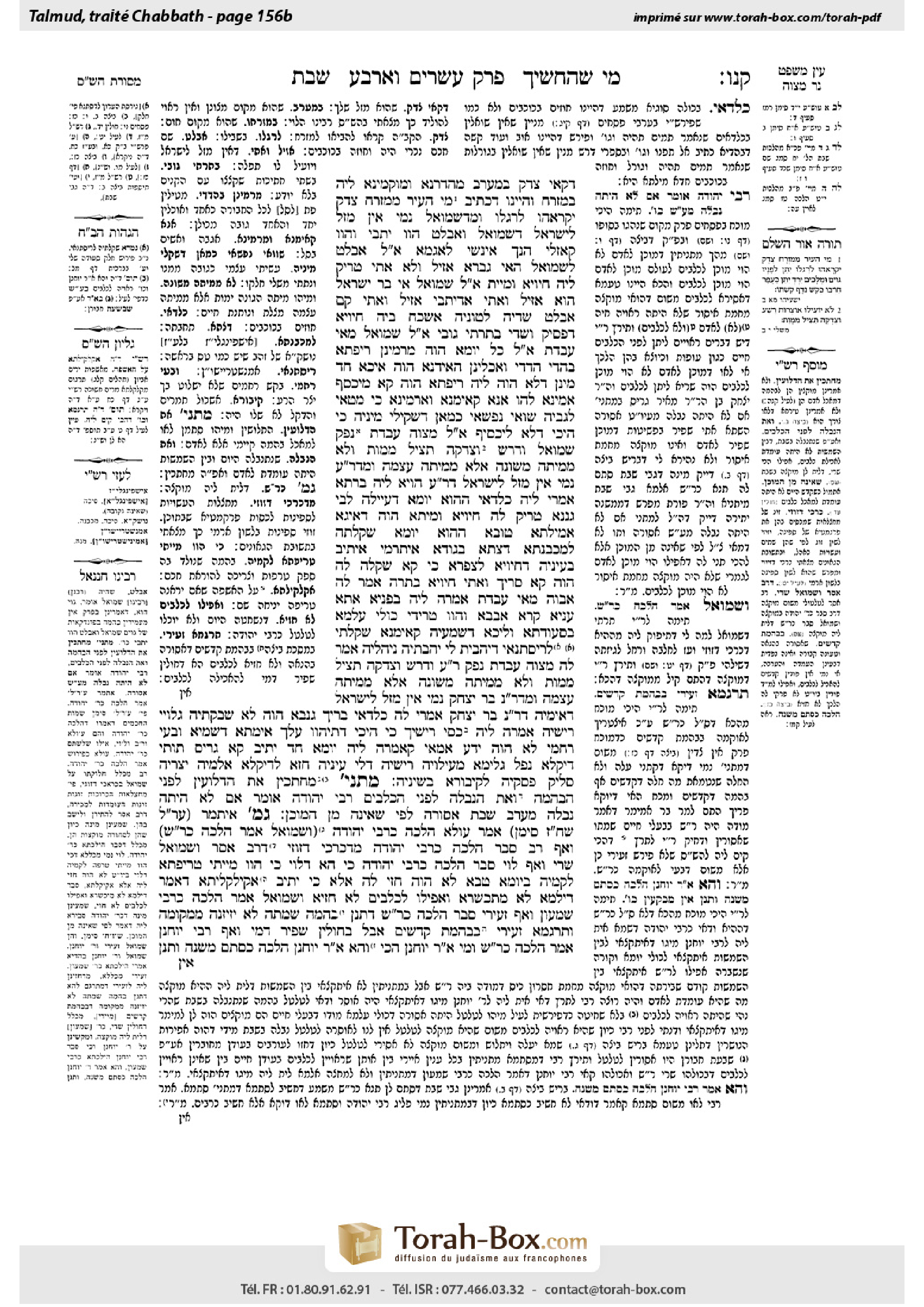
Shabbat 156b: Talmud study for Daf Yomi
Daf Yomi is the daily study of one Talmud folio. Explore 37 tractates with scans, Hebrew text, Sefaria English and AI-generated French translations where annotated.
Passage selection and English or AI-generated French translation are available where the scan has annotations. Daf Study is independent of Torah-Box and Sefaria.
Browse Shabbat · שבת · All tractatesShabbat 156b text and translations
This page of Shabbat includes the Aramaic text, an English translation and an AI-generated French translation, alongside the scan above.
שבת קנ״ו ב · Aramaic and Hebrew text
דְּקָאֵי צֶדֶק בְּמַעֲרָב — מְהַדַּרְנָא וּמוֹקֵימְנָא לֵיהּ בְּמִזְרָח. וְהַיְינוּ דִּכְתִיב: ״מִי הֵעִיר מִמִּזְרָח צֶדֶק יִקְרָאֵהוּ לְרַגְלוֹ״.
וּמִדִּשְׁמוּאֵל נָמֵי אֵין מַזָּל לְיִשְׂרָאֵל. דִּשְׁמוּאֵל וְאַבְלֵט הֲווֹ יָתְבִי, וַהֲווֹ קָאָזְלִי הָנָךְ אִינָשֵׁי לְאַגְמָא. אֲמַר לֵיהּ אַבְלֵט לִשְׁמוּאֵל: הַאי גַּבְרָא אָזֵיל וְלָא אָתֵי, טָרֵיק לֵיהּ חִיוְיָא וּמָיֵית. אֲמַר לֵיהּ שְׁמוּאֵל: אִי בַּר יִשְׂרָאֵל הוּא, אָזֵיל וְאָתֵי. אַדְּיָתְבִי אֲזַל וַאֲתָא.
קָם אַבְלֵט שַׁדְיֵהּ לְטוּנֵיהּ, אַשְׁכַּח בֵּיהּ חִיוְיָא דִּפְסִיק וּשְׁדֵי בְּתַרְתֵּי גוּבֵּי. אֲמַר לֵיהּ שְׁמוּאֵל: מַאי עֲבַדְתְּ? אֲמַר לֵיהּ: כׇּל יוֹמָא הֲוָה מַרְמִינַן רִיפְתָּא בַּהֲדֵי הֲדָדֵי וְאָכְלִינַן. הָאִידָּנָא הֲוָה אִיכָּא חַד מִינַּן דְּלָא הֲוָה לֵיהּ רִיפְתָּא, הֲוָה קָא מִיכְּסַף. אָמֵינָא לְהוּ: אֲנָא קָאֵימְנָא וּמַרְמֵינָא. כִּי מְטַאי לְגַבֵּיהּ, שַׁוַּאי נַפְשַׁאי כְּמַאן דִּשְׁקִילִי מִינֵּיהּ, כִּי הֵיכִי דְּלָא לִיכְּסִיף. אֲמַר לֵיהּ: מִצְוָה עֲבַדְתְּ. נְפַק שְׁמוּאֵל וּדְרַשׁ: ״וּצְדָקָה תַּצִּיל מִמָּוֶת״, וְלֹא מִמִּיתָה מְשׁוּנָּה, אֶלָּא מִמִּיתָה עַצְמָהּ.
וּמִדְּרַבִּי עֲקִיבָא נָמֵי אֵין מַזָּל לְיִשְׂרָאֵל. דְּרַבִּי עֲקִיבָא הַוְיָא לֵיהּ בְּרַתָּא, אָמְרִי לֵיהּ כַּלְדָּאֵי: הָהוּא יוֹמָא דְּעָיְילָה לְבֵי גְנָנָא, טָרֵיק לַהּ חִיוְיָא, וּמִיתָא. הֲוָה דָּאֵיג אַמִּילְּתָא טוּבָא. הָהוּא יוֹמָא שְׁקַלְתַּהּ לְמַכְבַּנְתָּא, דַּצְתַּהּ בְּגוּדָא, אִיתְרְמִי אִיתִּיב בְּעֵינֵיהּ דְּחִיוְיָא. לְצַפְרָא כִּי קָא שָׁקְלָה לַהּ, הֲוָה קָא סָרֵיךְ וְאָתֵי חִיוְיָא בָּתְרַהּ.
אֲמַר לַהּ אֲבוּהּ: מַאי עֲבַדְתְּ? אֲמַרָה לֵיהּ בְּפַנְיָא אֲתָא עַנְיָא, קְרָא אַבָּבָא וַהֲווֹ טְרִידִי כּוּלֵּי עָלְמָא בִּסְעוּדְתָּא, וְלֵיכָּא דְּשָׁמְעֵיהּ. קָאֵימְנָא, שְׁקַלְתֵּיהּ לְרִיסְתָּנַאי דִּיהַבְתְּ לִי, יַהְבִתֵּיהּ נִיהֲלֵיהּ. אֲמַר לַהּ: מִצְוָה עֲבַדְתְּ. נְפַק רַבִּי עֲקִיבָא וּדְרַשׁ: ״וּצְדָקָה תַּצִּיל מִמָּוֶת״, וְלֹא מִמִּיתָה מְשׁוּנָּה, אֶלָּא מִמִּיתָה עַצְמָהּ.
וּמִדְּרַב נַחְמָן בַּר יִצְחָק נָמֵי אֵין מַזָּל לְיִשְׂרָאֵל. דְּאִימֵּיהּ דְּרַב נַחְמָן בַּר יִצְחָק אָמְרִי לַהּ כַּלְדָּאֵי: בְּרִיךְ גַּנָּבָא הָוֵה. לָא שְׁבַקְתֵּיהּ גַּלּוֹיֵי רֵישֵׁיהּ. אֲמַרָה לֵיהּ: כַּסִּי רֵישָׁיךָ, כִּי הֵיכִי דְּתִיהְוֵי עֲלָךְ אֵימְתָא דִשְׁמַיָּא, וּבְעִי רַחֲמֵי. לָא הֲוָה יָדַע אַמַּאי קָאָמְרָה לֵיהּ. יוֹמָא חַד יָתֵיב קָא גָרֵיס תּוּתֵי דִיקְלָא, נְפַל גְּלִימָא מֵעִילָּוֵי רֵישֵׁיהּ, דְּלִי עֵינֵיהּ חֲזָא לְדִיקְלָא, אַלְּמֵיהּ יִצְרֵיהּ, סְלֵיק, פַּסְקֵיהּ לְקִיבּוּרָא בְּשִׁינֵּיהּ.
מַתְנִי׳ מְחַתְּכִין אֶת הַדִּלּוּעִין לִפְנֵי הַבְּהֵמָה, וְאֶת הַנְּבֵלָה לִפְנֵי הַכְּלָבִים. רַבִּי יְהוּדָה אוֹמֵר: אִם לֹא הָיְתָה נְבֵלָה מֵעֶרֶב שַׁבָּת, אֲסוּרָה — לְפִי שֶׁאֵינָהּ מִן הַמּוּכָן.
גְּמָ׳ אִיתְּמַר: (עָרֵל שַׁחַז סִימָן.) אָמַר עוּלָּא: הֲלָכָה כְּרַבִּי יְהוּדָה (וּשְׁמוּאֵל אָמַר: הֲלָכָה כְּרַבִּי שִׁמְעוֹן).
וְאַף רַב סָבַר הֲלָכָה כְּרַבִּי יְהוּדָה. מִדִּכְרָכֵי דְזוּזֵי, דְּרַב אָסַר וּשְׁמוּאֵל שָׁרֵי. וְאַף לֵוִי סָבַר הֲלָכָה כְּרַבִּי יְהוּדָה. כִּי הָא דְּלֵוִי כִּי הֲווֹ מַיְיתִי טְרֵיפְתָּא לְקַמֵּיהּ בְּיוֹמָא טָבָא, לָא הֲוָה חָזֵי לַהּ אֶלָּא כִּי יָתֵיב אַקִּיקְלִיתָא. דַּאֲמַר: דִּילְמָא לָא מִתַּכְשְׁרָא, וַאֲפִילּוּ לִכְלָבִים לָא חַזְיָא.
וּשְׁמוּאֵל אָמַר: הֲלָכָה כְּרַבִּי שִׁמְעוֹן, וְאַף זְעֵירִי סָבַר הֲלָכָה כְּרַבִּי שִׁמְעוֹן. דִּתְנַן: בְּהֵמָה שֶׁמֵּתָה — לֹא יְזִיזֶנָּה מִמְּקוֹמָהּ, וְתַרְגְּמַהּ זְעֵירִי: בְּבֶהֱמַת קׇדָשִׁים. אֲבָל בְּחוּלִּין — שַׁפִּיר דָּמֵי. וְאַף רַבִּי יוֹחָנָן אָמַר הֲלָכָה כְּרַבִּי שִׁמְעוֹן. וּמִי אָמַר רַבִּי יוֹחָנָן הָכִי? וְהָא אָמַר רַבִּי יוֹחָנָן: הֲלָכָה כִּסְתַם מִשְׁנָה, וּתְנַן:
Shabbat 156b · English translation
Is it because Jupiter is situated in the west that you cannot have children? I will restore it and establish it in the east. And that is the meaning of that which is written with regard to Abraham: “Who has raised up one from the east, he will call justice [tzedek] to his steps [leraglo]. He gives nations before him, and makes him rule over kings; his sword makes them as the dust, his bow as the driven stubble” (Isaiah 41:2). God established Jupiter [tzedek] in the east on behalf of [leraglo] Abraham.
And from that which transpired to Shmuel, one can also conclude that there is no constellation for the Jewish people. The Gemara relates that Shmuel and the gentile sage Ablet were sitting, and they saw these people were going to the lake. Ablet said to Shmuel: This person will go and he will not return, because a snake will bite him and he will die. Shmuel said to him: If he is a Jew, he will go and come back. As they were sitting for a while, the person they discussed went away and then returned.
Ablet stood up, threw down the person’s burden, and inside he found a snake cut and cast in two pieces. Shmuel said to him: What did you do to merit being saved from death? The person said to him: Every day we all take bread together and eat from the bread. Today, there was one of us who did not have bread, and when it came time to gather the bread, he was embarrassed because he did not have any to give. I said to the others: I will go and take the bread. When I came to the person who did not have bread, I rendered myself as one who was taking from him so that he would not be embarrassed. Shmuel said to him: You performed a mitzva. Shmuel went out and taught based on this incident that even though it is written: “And charity will save from death” (Proverbs 10:2), it does not only mean that it will save a person from an unusual death but even from death itself.
And from that which transpired to Rabbi Akiva as well it can be derived that there is no constellation for the Jewish people, as Rabbi Akiva had a daughter, and Chaldean astrologers told him that on the same day that she enters the wedding canopy, a snake will bite her and she will die. She was very worried about this. On that day, her wedding day, she took the ornamental pin from her hair and stuck it into a hole in the wall for safekeeping, and it happened that it entered directly into the eye of the snake. In the morning, when she took the pin, the snake was pulled and came out with it.
Her father Rabbi Akiva said to her: What did you do to merit being saved from the snake? She told him: In the evening a poor person came and knocked on the door, and everyone was preoccupied with the feast and nobody heard him. I stood and took the portion that you had given me and gave it to him. Rabbi Akiva said to her: You performed a mitzva, and you were saved in its merit. Rabbi Akiva went out and taught based on this incident that even though it is written: “And charity will save from death” (Proverbs 10:2), it does not mean that it will save a person only from an unusual death, but even from death itself.
And from that which transpired to Rav Naḥman bar Yitzḥak as well it can be derived that there is no constellation for the Jewish people, As Chaldean astrologers told Rav Naḥman bar Yitzḥak’s mother: Your son will be a thief. She did not allow him to uncover his head. She said to her son: Cover your head so that the fear of Heaven will be upon you, and pray for Divine mercy. He did not know why she said this to him. One day he was sitting and studying beneath a palm tree that did not belong to him, and the cloak fell off of his head. He lifted his eyes and saw the palm tree. He was overcome by impulse and he climbed up and detached a bunch of dates with his teeth. Apparently, he had an inborn inclination to steal, but was able to overcome that inclination with proper education and prayer.
MISHNA: One may cut the pumpkins before an animal on Shabbat, as long as they were picked prior to Shabbat. And likewise one may cut an animal carcass before the dogs on Shabbat. Rabbi Yehuda says: If it was not already a carcass, i.e., it was not dead, prior to Shabbat, it is prohibited to cut it or even move it on Shabbat because it is not prepared for use on Shabbat.
GEMARA: A dispute between the amora’im with regard to the prohibition of set-aside on Shabbat was stated. Ayin, reish, lamed, shin, ḥet, zayin is a mnemonic for the names of the amora’im who stated the following halakhot. Ulla said: The halakha is in accordance with the opinion of Rabbi Yehuda, who holds that there is a prohibition of set-aside on Shabbat. And Shmuel said: The halakha is in accordance with the opinion of Rabbi Shimon.
And Rav also holds that the halakha is in accordance with the opinion of Rabbi Yehuda. From where is it ascertained that this is Rav’s opinion? From that which was taught with regard to the mats that are on ships; Rav prohibited moving them on Shabbat due to the prohibition of set-aside, and Shmuel permitted moving them. And Levi also holds that the halakha is in accordance with the opinion of Rabbi Yehuda, as can be seen from his practice when they would bring a slaughtered animal with regard to which there was concern that it was an animal with a condition that will cause it to die within twelve months [tereifa], before Levi on a Festival. He would examine it only when he was sitting near a garbage dump, as he said: Perhaps it would not be determined to be kosher and it would not be suited even for dogs, and then it would be prohibited to move the carcass. Apparently, he holds that it is prohibited to move a carcass that was not prepared for use before Shabbat.
And Shmuel said: The halakha is in accordance with the opinion of Rabbi Shimon, who holds that the prohibition of set-aside does not apply on Shabbat. And Ze’eiri also holds that the halakha is in accordance with the opinion of Rabbi Shimon, as we learned in a mishna: With regard to an animal that died on Shabbat, one may not move it from its place on Shabbat. And Ze’eiri explained: This prohibition only applies to a consecrated animal, as consecrated items may not be fed to dogs in deference to their sanctity; therefore, it is set-aside and may not be moved on Shabbat. However, in the case of a non-sacred animal, one may well move it and use it because it does not have set-aside status. And Rabbi Yoḥanan also said that the halakha is in accordance with the opinion of Rabbi Shimon. The Gemara asks: And did Rabbi Yoḥanan really say that? Didn’t Rabbi Yoḥanan say: The halakha is in accordance with an unattributed mishna, and we learned in a mishna:
Shabbat 156b · Traduction française (IA)
Est-ce parce que Jupiter se trouve à l’ouest que tu ne peux pas avoir d’enfants ? Je vais le déplacer et l’établir à l’est. Et tel est le sens de ce qui est écrit au sujet d’Abraham : « Qui a suscité de l’est celui qu’il appelle justice [tzedek] à ses pas [leraglo]. Il livre des nations devant lui et le fait régner sur des rois ; son épée les réduit en poussière, son arc en chaume emporté par le vent » (Isaïe 41, 2). Dieu établit Jupiter [tzedek] à l’est en faveur de [leraglo] Abraham.
Et de ce qui arriva à Shmuel, on peut également conclure qu’il n’y a pas de constellation pour le peuple juif. La Guemara rapporte que Shmuel et le sage non juif Ablet étaient assis et virent ces hommes se diriger vers le lac. Ablet dit à Shmuel : « Cet homme va partir et ne reviendra pas, car un serpent le mordra et il mourra. » Shmuel lui dit : « S’il est juif, il partira et reviendra. » Après qu’ils furent restés assis quelque temps, l’homme dont ils avaient parlé partit, puis revint.
Ablet se leva, jeta à terre le fardeau de l’homme et y trouva un serpent coupé en deux morceaux. Shmuel lui dit : « Qu’as-tu fait pour mériter d’être sauvé de la mort ? » L’homme lui répondit : « Chaque jour, nous partageons tous du pain et mangeons ensemble. Aujourd’hui, l’un d’entre nous n’avait pas de pain et, au moment de rassembler le pain, il était gêné de n’avoir rien à donner. J’ai dit aux autres : “Je vais aller prendre le pain.” Lorsque je suis arrivé auprès de celui qui n’avait pas de pain, j’ai fait comme si je prenais le pain de lui, afin qu’il ne soit pas gêné. » Shmuel lui dit : « Tu as accompli une mitsva. » Shmuel sortit et enseigna, à partir de cet épisode, que, bien qu’il soit écrit : « La charité sauve de la mort » (Proverbes 10, 2), cela ne signifie pas seulement qu’elle sauve une personne d’une mort inhabituelle, mais qu’elle la sauve même de la mort elle-même.
Et de ce qui arriva à Rabbi Akiva, on peut également déduire qu’il n’y a pas de constellation pour le peuple juif. Rabbi Akiva avait une fille, et des astrologues chaldéens lui avaient annoncé que, le jour même où elle entrerait sous le dais nuptial, un serpent la mordrait et elle mourrait. Elle en était très inquiète. Le jour de son mariage, elle retira de ses cheveux l’épingle qui les ornait et la planta dans un trou du mur pour la mettre en sûreté. Or, elle entra directement dans l’œil du serpent. Le matin, lorsqu’elle reprit l’épingle, le serpent fut entraîné et sortit avec elle.
Son père, Rabbi Akiva, lui dit : « Qu’as-tu fait pour mériter d’être sauvée du serpent ? » Elle lui répondit : « Le soir, un pauvre est venu frapper à la porte, mais tout le monde était occupé par le festin et personne ne l’a entendu. Je me suis levée, j’ai pris la part que tu m’avais donnée et je la lui ai donnée. » Rabbi Akiva lui dit : « Tu as accompli une mitsva et tu as été sauvée grâce à son mérite. » Rabbi Akiva sortit et enseigna, à partir de cet épisode, que, bien qu’il soit écrit : « La charité sauve de la mort » (Proverbes 10, 2), cela ne signifie pas qu’elle sauve une personne seulement d’une mort inhabituelle, mais qu’elle la sauve même de la mort elle-même.
Et de ce qui arriva à Rav Naḥman bar Yitzḥak, on peut également déduire qu’il n’y a pas de constellation pour le peuple juif. Des astrologues chaldéens dirent à la mère de Rav Naḥman bar Yitzḥak : « Ton fils sera un voleur. » Elle ne le laissait pas se découvrir la tête. Elle disait à son fils : « Couvre ta tête, afin que la crainte du Ciel soit sur toi, et prie pour obtenir la miséricorde divine. » Il ne savait pas pourquoi elle lui disait cela. Un jour, il étudiait assis sous un palmier qui ne lui appartenait pas, et son manteau glissa de sa tête. Il leva les yeux et vit le palmier. Saisi par l’envie, il grimpa et arracha avec les dents une grappe de dattes. Apparemment, il avait une inclination innée au vol, mais il put la surmonter grâce à une éducation appropriée et à la prière.
MICHNA : On peut couper des courges devant un animal le Chabbat, à condition qu’elles aient été cueillies avant le Chabbat. De même, on peut couper une carcasse d’animal devant les chiens le Chabbat. Rabbi Yehouda dit : Si l’animal n’était pas déjà mort avant le Chabbat, il est interdit de le couper, voire même de le déplacer le Chabbat, car il n’a pas été préparé en vue d’un usage le Chabbat.
GUEMARA : Une divergence entre les amoraïm a été rapportée au sujet de l’interdiction des objets mis de côté le Chabbat. Les lettres ayin, reish, lamed, shin, ḥet, zayin constituent un moyen mnémotechnique pour les noms des amoraïm qui ont énoncé les halakhot suivantes. Ulla dit : La halakha suit l’avis de Rabbi Yehouda, qui considère que l’interdiction des objets mis de côté s’applique le Chabbat. Shmuel dit : La halakha suit l’avis de Rabbi Shimon.
Rav considère lui aussi que la halakha suit l’avis de Rabbi Yehouda. D’où sait-on que tel est l’avis de Rav ? De ce qui fut enseigné au sujet des nattes qui se trouvent sur les bateaux : Rav interdit de les déplacer le Chabbat en raison de l’interdiction des objets mis de côté, tandis que Shmuel permet de les déplacer. Levi considère lui aussi que la halakha suit l’avis de Rabbi Yehouda, comme le montre sa pratique : lorsqu’on lui apportait, un jour de fête, un animal abattu dont on craignait qu’il soit atteint d’un défaut susceptible de le faire mourir dans les douze mois [tereifa], il ne l’examinait que lorsqu’il était assis près d’un dépotoir. Il disait en effet : « Peut-être ne sera-t-il pas déclaré casher et ne conviendra-t-il même pas aux chiens ; il serait alors interdit de déplacer la carcasse. » Apparemment, il considère qu’il est interdit de déplacer une carcasse qui n’a pas été préparée en vue d’un usage avant le Chabbat.
Shmuel dit : La halakha suit l’avis de Rabbi Shimon, qui considère que l’interdiction des objets mis de côté ne s’applique pas le Chabbat. Ze’eiri considère lui aussi que la halakha suit l’avis de Rabbi Shimon, comme nous l’avons appris dans une Michna : « Un animal qui est mort le Chabbat ne peut pas être déplacé de l’endroit où il se trouve le Chabbat. » Ze’eiri expliqua que cette interdiction ne s’applique qu’à un animal consacré, car les animaux consacrés ne peuvent pas être donnés aux chiens, par égard pour leur sainteté ; il est donc mis de côté et ne peut pas être déplacé le Chabbat. En revanche, un animal non consacré peut être déplacé et utilisé, car il n’a pas le statut d’objet mis de côté. Rabbi Yoḥanan dit lui aussi que la halakha suit l’avis de Rabbi Shimon. La Guemara demande : « Rabbi Yoḥanan a-t-il vraiment dit cela ? Rabbi Yoḥanan n’a-t-il pas dit : “La halakha suit une Michna anonyme”, et nous avons appris dans une Michna : »
Traduction française générée par IA à partir de l’édition anglaise de Sefaria. Vérifie toujours un passage avec le texte source.
Text from Sefaria: William Davidson Edition - Vocalized Aramaic (CC BY NC); William Davidson Edition - English (CC BY NC).