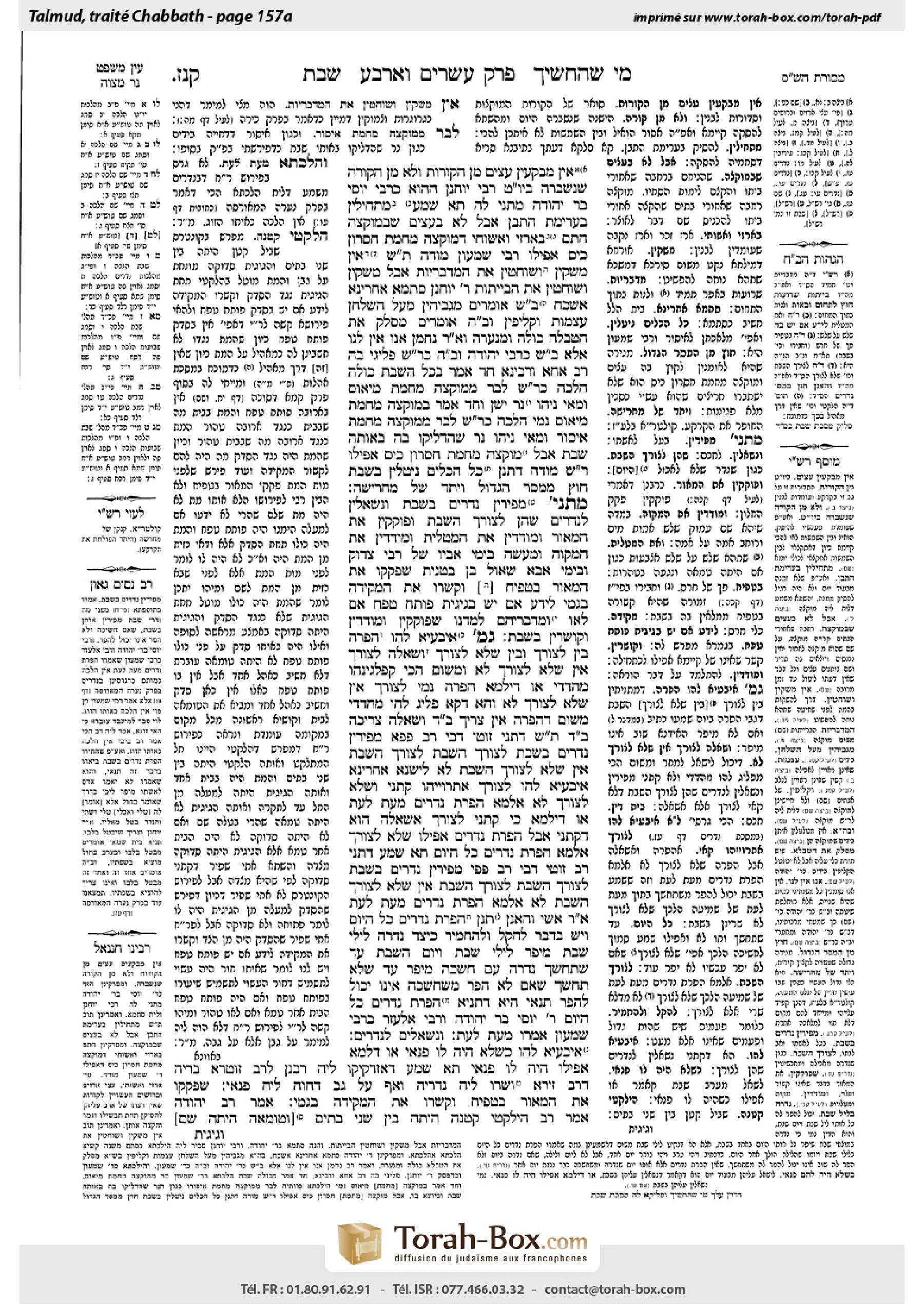
Shabbat 157a: Talmud study for Daf Yomi
Daf Yomi is the daily study of one Talmud folio. Explore 37 tractates with scans, Hebrew text, Sefaria English and AI-generated French translations where annotated.
Passage selection and English or AI-generated French translation are available where the scan has annotations. Daf Study is independent of Torah-Box and Sefaria.
Browse Shabbat · שבת · All tractatesShabbat 157a text and translations
This page of Shabbat includes the Aramaic text, an English translation and an AI-generated French translation, alongside the scan above.
שבת קנ״ז א · Aramaic and Hebrew text
אֵין מְבַקְּעִין עֵצִים מִן הַקּוֹרוֹת, וְלֹא מִן הַקּוֹרָה שֶׁנִּשְׁבְּרָה בְּיוֹם טוֹב. רַבִּי יוֹחָנָן, הָהוּא — כְּרַבִּי יוֹסֵי בַּר יְהוּדָה מַתְנֵי לַהּ. תָּא שְׁמַע: מַתְחִילִין בַּעֲרֵימַת הַתֶּבֶן, אֲבָל לֹא בָּעֵצִים שֶׁבַּמּוּקְצֶה! הָתָם בְּאַרְזֵי וְאַשּׁוּחֵי, דְּמוּקְצֶה מֵחֲמַת חֶסְרוֹן כִּיס, אֲפִילּוּ רַבִּי שִׁמְעוֹן מוֹדֶה.
תָּא שְׁמַע: אֵין מַשְׁקִין וְשׁוֹחֲטִין אֶת הַמִּדְבָּרִיּוֹת, אֲבָל מַשְׁקִין וְשׁוֹחֲטִין אֶת הַבַּיָּיתוֹת!
רַבִּי יוֹחָנָן סְתָמָא אַחֲרִינָא אַשְׁכַּח: בֵּית שַׁמַּאי אוֹמְרִים: מַגְבִּיהִין מֵעַל הַשֻּׁלְחָן עֲצָמוֹת וּקְלִיפִּין, וּבֵית הִלֵּל אוֹמְרִים: מְסַלֵּק אֶת הַטַּבְלָה כּוּלָּהּ וּמְנַעֲרָהּ. וְאָמַר רַב נַחְמָן, אָנוּ אֵין לָנוּ אֶלָּא בֵּית שַׁמַּאי כְּרַבִּי יְהוּדָה, וּבֵית הִלֵּל כְּרַבִּי שִׁמְעוֹן.
פְּלִיגִי בַּהּ רַב אַחָא וְרָבִינָא, חַד אָמַר: בְּכׇל הַשַּׁבָּת כּוּלָּהּ הֲלָכָה כְּרַבִּי שִׁמְעוֹן, לְבַר מִמּוּקְצֶה מֵחֲמַת מִיאוּס, וּמַאי נִיהוּ? — נֵר יָשָׁן. וְחַד אָמַר: בְּמוּקְצֶה מֵחֲמַת מִיאוּס נָמֵי הֲלָכָה כְּרַבִּי שִׁמְעוֹן, לְבַר מִמּוּקְצֶה מֵחֲמַת אִיסּוּר, וּמַאי נִיהוּ? — נֵר שֶׁהִדְלִיקוּ בָּהּ בְּאוֹתָהּ שַׁבָּת, אֲבָל מוּקְצֶה מֵחֲמַת חֶסְרוֹן כִּיס, אֲפִילּוּ רַבִּי שִׁמְעוֹן מוֹדֶה. דִּתְנַן: כׇּל הַכֵּלִים נִיטָּלִין בַּשַּׁבָּת, חוּץ מִמַּסָּר הַגָּדוֹל וְיָתֵד שֶׁל מַחֲרֵישָׁה.
מַתְנִי׳ מְפִירִין נְדָרִים בַּשַּׁבָּת, וְנִשְׁאָלִין לִנְדָרִים שֶׁהֵן לְצוֹרֶךְ הַשַּׁבָּת. וּפוֹקְקִין אֶת הַמָּאוֹר, וּמוֹדְדִין אֶת הַמַּטְלֵית, וּמוֹדְדִין אֶת הַמִּקְוֶה. וּמַעֲשֶׂה בִּימֵי אָבִיו שֶׁל רַבִּי צָדוֹק וּבִימֵי אַבָּא שָׁאוּל בֶּן בָּטְנִית שֶׁפָּקְקוּ אֶת הַמָּאוֹר בַּטָּפִיחַ, וְקָשְׁרוּ אֶת הַמְּקִידָּה בְּגֶמִי לֵידַע אִם יֵשׁ בַּגִּיגִית פּוֹתֵחַ טֶפַח אִם לָאו, וּמִדִּבְרֵיהֶם לָמַדְנוּ, שֶׁפּוֹקְקִין וּמוֹדְדִין וְקוֹשְׁרִין בְּשַׁבָּת.
גְּמָ׳ אִיבַּעְיָא לְהוּ: הֲפָרָה בֵּין לְצוֹרֶךְ וּבֵין שֶׁלֹּא לְצוֹרֶךְ, וּשְׁאֵלָה לְצוֹרֶךְ — אִין, שֶׁלֹּא לְצוֹרֶךְ — לָא. וּמִשּׁוּם הָכִי קָפָלְגִינְהוּ מֵהֲדָדֵי,
אוֹ דִילְמָא: הֲפָרָה נָמֵי לְצוֹרֶךְ — אִין, שֶׁלֹּא לְצוֹרֶךְ — לָא, וְהָא דְּקָא פָּלֵיג לְהוּ מֵהֲדָדֵי מִשּׁוּם דַּהֲפָרָה אֵין צָרִיךְ בֵּית דִּין, וּשְׁאֵלָה צְרִיכָה בֵּית דִּין?
תָּא שְׁמַע, דְּתָנֵי [רַב] זוּטֵי דְּבֵי רַב פַּפִּי: מְפִירִין נְדָרִים בְּשַׁבָּת לְצוֹרֶךְ הַשַּׁבָּת. לְצוֹרֶךְ הַשַּׁבָּת אִין, שֶׁלֹּא לְצוֹרֶךְ הַשַּׁבָּת — לָא.
לִישָּׁנָא אַחֲרִינָא, אִיבַּעְיָא לְהוּ: ״לְצוֹרֶךְ״ אַתַּרְוַיְיהוּ קָתָנֵי, וְשֶׁלֹּא לְצוֹרֶךְ — לָא, אַלְמָא הֲפָרַת נְדָרִים מֵעֵת לְעֵת, אוֹ דִילְמָא כִּי קָתָנֵי ״לְצוֹרֶךְ״ — אַשְּׁאֵלָה הוּא דְּקָתָנֵי, אֲבָל הֲפָרַת נְדָרִים אֲפִילּוּ שֶׁלֹּא לְצוֹרֶךְ, אַלְמָא הֲפָרַת נְדָרִים כׇּל הַיּוֹם.
תָּא שְׁמַע, דְּתָנֵי רַב זוּטֵי דְּבֵי רַב פַּפִּי: מְפִירִין נְדָרִים בְּשַׁבָּת לְצוֹרֶךְ הַשַּׁבָּת. לְצוֹרֶךְ הַשַּׁבָּת — אִין, שֶׁלֹּא לְצוֹרֶךְ הַשַּׁבָּת — לָא, אַלְמָא הֲפָרַת נְדָרִים מֵעֵת לְעֵת.
אָמַר רַב אָשֵׁי: וְהָאֲנַן תְּנַן: הֲפָרַת נְדָרִים כׇּל הַיּוֹם, וְיֵשׁ בַּדָּבָר לְהָקֵל וּלְהַחֲמִיר. כֵּיצַד? נָדְרָה לֵילֵי שַׁבָּת — מֵיפֵר לֵילֵי שַׁבָּת וְיוֹם הַשַּׁבָּת עַד שֶׁתֶּחְשַׁךְ. נָדְרָה עִם חֲשֵׁכָה — מֵיפֵר עַד שֶׁלֹּא תֶּחְשַׁךְ, שֶׁאִם לֹא הֵפֵר מִשֶּׁחָשֵׁכָה, אֵינוֹ יָכוֹל לְהָפֵר. תַּנָּאֵי הִיא, דְּתַנְיָא: הֲפָרַת נְדָרִים כׇּל הַיּוֹם. רַבִּי יוֹסֵי בַּר יְהוּדָה וְרַבִּי אֶלְעָזָר בְּרַבִּי שִׁמְעוֹן אָמְרוּ: מֵעֵת לְעֵת.
וְנִשְׁאָלִים לִנְדָרִים. אִיבַּעְיָא לְהוּ: כְּשֶׁלֹּא הָיָה לוֹ פְּנַאי, אוֹ דִלְמָא אֲפִילּוּ הָיָה לוֹ פְּנַאי? תָּא שְׁמַע דְּאִזְדְּקִיקוּ לֵיהּ רַבָּנַן לְרַב זוּטְרָא בְּרֵיהּ דְּרַב זֵירָא וּשְׁרוֹ לֵיהּ נִדְרֵיהּ, וְאַף עַל גַּב דַּהֲוָה לֵיהּ פְּנַאי.
שֶׁפָּקְקוּ אֶת הַמָּאוֹר בַּטָּפִיחַ וְקָשְׁרוּ אֶת הַמְּקִידָּה בְּגֶמִי. אָמַר רַב יְהוּדָה אָמַר רַב: הִילְקָטִי קְטַנָּה הָיְתָה בֵּין שְׁנֵי בָתִּים, [וְטוּמְאָה הָיְתָה שָׁם]
Shabbat 157a · English translation
One may chop wood neither from beams set aside for building nor from a beam that broke on a Festival. Apparently, this unattributed mishna is in accordance with the opinion of Rabbi Yehuda. The Gemara answers that Rabbi Yoḥanan answered: That mishna is actually in accordance with the opinion of Rabbi Yosei bar Yehuda, which is an individual opinion. Come and hear: One may start a fire on a Festival with a pile of straw but not with wood that is from the wood storage behind one’s house, because that wood is set aside for other uses. Apparently, this is an unattributed mishna in accordance with the opinion of Rabbi Yehuda with regard to the prohibition of set-aside. The Gemara answers: There, the mishna is referring to wood from cedar and fir trees that are set aside due to monetary loss. Even Rabbi Shimon concedes that the prohibition of set-aside is in effect in that case.
Come and hear a proof from another mishna: One may neither give water to nor slaughter non-domesticated desert animals, animals that are always grazing in the fields. Since people do not generally tend to them, they are considered set-aside and may not be used. Giving them water would ease removal of their hides. However, one may give water to and slaughter domesticated animals. This is apparently an unattributed mishna in accordance with the opinion of Rabbi Yehuda.
The Gemara answers: Rabbi Yoḥanan found a different unattributed mishna in accordance with the opinion of Rabbi Shimon. Beit Shammai say: One may lift bones and peels and shells, which are set-aside, from the table on Shabbat. And Beit Hillel say: One must remove the entire board from atop the table and shake it; however, he may not lift the set-aside objects. And Rav Naḥman said to reverse the two opinions, and we have only Beit Shammai in accordance with the opinion of Rabbi Yehuda, and Beit Hillel in accordance with the opinion of Rabbi Shimon. As the halakha is always ruled in accordance with the opinion of Beit Hillel, this mishna has the authority of an unattributed mishna.
Rav Aḥa and Ravina disputed this matter. One said: In all of the halakhot of Shabbat in which there is a tannaitic dispute involving Rabbi Shimon, the halakha is in accordance with the opinion of Rabbi Shimon, except for the case of an item set aside due to repulsiveness. And what is that case? It is the case of an old oil lamp, which may not be moved on Shabbat, contrary to Rabbi Shimon’s opinion. And one said: In the case of an item set aside due to repulsiveness, the halakha is also in accordance with the opinion of Rabbi Shimon. The halakha is in accordance with the opinion of Rabbi Shimon except for the case of set aside due to prohibition. And what is that case? It is the case of moving an oil lamp that one kindled for that very Shabbat. However, with regard to an item set aside due to monetary loss, even Rabbi Shimon concedes that it is prohibited to move that item, as we learned in a mishna according to his position: All vessels may be moved on Shabbat except for a large saw and the blade of a plow, both of which are prohibited. Due to their significance, their owners make certain that they will not be damaged.
MISHNA: A father or husband may nullify his daughter’s or his wife’s vows on Shabbat, and one may request from a Sage to dissolve vows that are for the purpose of Shabbat. Failure to dissolve the vow will compromise one’s fulfillment of the mitzva to delight in Shabbat. And one may seal a window on Shabbat to prevent light from entering, and one may measure a rag to determine whether or not it is large enough to contract ritual impurity, and one may measure a ritual bath to determine if it contains enough water for immersion. The mishna relates that there was an incident in the time of Rabbi Tzadok’s father and the time of Abba Shaul ben Botnit, in which they sealed a window using an earthenware vessel and tied an earthenware shard with a long reed-grass with a temporary knot, in order to ascertain whether or not the roofing had an opening the size of a handbreadth. And from their statements and their actions, we derived that one may seal a window, and measure, and tie a knot on Shabbat.
GEMARA: We learned in the mishna that it is permitted to nullify vows and to request that Sages dissolve vows for the purpose of Shabbat. In an attempt to understand the mishna, a dilemma was raised before the Sages: Is nullification of vows on Shabbat permitted both for the purpose of Shabbat and when it is not for the purpose of Shabbat? And the request to dissolve vows, when it is for the purpose of Shabbat, yes, it is permitted, but when it is not for the purpose of Shabbat, no, it is prohibited? And is it due to that distinction that the tanna of the mishna separated the cases from each other and listed them separately?
Or perhaps with regard to nullification of vows on Shabbat as well, when it is for the purpose of Shabbat, yes, it is permitted, but when they are not for the purpose of Shabbat, no, it is prohibited; and the fact that the tanna of the mishna separated the cases from each other and listed them separately is due to the fact that for nullification one does not require a court, and a husband or father can nullify a woman’s vows on his own, but for the request to dissolve vows one requires a court.
Come and hear a resolution to the dilemma from that which the Sage, Zutei, of the school of Rav Pappa taught: One may nullify vows on Shabbat for the purpose of Shabbat. Apparently, when the nullification is for the purpose of Shabbat, yes, it is permitted to nullify vows, but when it is not for the purpose of Shabbat, no, it is prohibited.
The Gemara cites another version of the dilemma that was raised before the Sages. Was the phrase: When they are for the purpose of Shabbat, taught about both of them, and nullification is only permitted for the purpose of Shabbat, but when it is not for the purpose of Shabbat, no, it is prohibited? If so, apparently, nullification of vows may be performed for an entire twenty-four hour period after hearing the vow, and the father or husband can wait until after Shabbat to nullify the vow if he does not need to do so for the purpose of Shabbat. Or perhaps when the mishna taught that it is permitted when the nullification is for the purpose of Shabbat, that was taught only with regard to the request to dissolve that which was prohibited by the vow, but nullification of vows may be performed on Shabbat even when it is not for the purpose of Shabbat. If so, apparently nullification of vows may be performed only for the entire day that the husband or father heard the vow. Once Shabbat concludes, the vow may no longer be nullified. Therefore, even vows whose nullification is not for the purpose of Shabbat may be nullified on Shabbat.
Come and hear a resolution to the dilemma from that which the Sage, Zutei, of the school of Rav Pappa taught: One may nullify vows on Shabbat for the purpose of Shabbat. Apparently, when the nullification is for the purpose of Shabbat, yes, it is permitted to nullify vows, but when it is not for the purpose of Shabbat, no, it is prohibited. If so, apparently nullification of vows may be performed for the entire twenty-four hour period after hearing the vow.
Rav Ashi said: Didn’t we learn in a mishna that one may nullify vows for the entire day, and there is both a leniency and a stricture in this matter to extend or curtail the period during which the vow may be nullified. How so? If the woman vowed on Shabbat evening, her father or husband may nullify the vow on Shabbat evening and on Shabbat day until dark. However, if she vowed before Shabbat at nightfall, her father or husband may only nullify the vow until nightfall, as if he did not nullify the vow before nightfall, he can no longer nullify it because the day ended. The Gemara answers that this issue is subject to a tannaitic dispute, as it was taught in a baraita: One may nullify vows for the entire day. Rabbi Yosei bar Yehuda and Rabbi Elazar, son of Rabbi Shimon, said: For a twenty-four hour period.
We learned in the mishna: And one may request from a Sage to dissolve vows on Shabbat. A dilemma was raised before the Sages: Is this only permitted when one did not have time to request to have the vow dissolved before Shabbat, or perhaps it is permitted even if one had time before Shabbat to request to have his vow dissolved? Come and hear a resolution to this dilemma from the fact that the Sages attended to Rav Zutra, the son of Rav Zeira, and dissolved his vow even though he had time to request its dissolution before Shabbat.
The mishna related: They sealed a window using an earthenware vessel and tied an earthenware shard with a long reed-grass. Rav Yehuda said that Rav said in explanation: There was a small alleyway [heilketei] between two houses, and there was ritual impurity imparted by a corpse there in the alleyway,
Shabbat 157a · Traduction française (IA)
On ne peut fendre du bois ni provenant de poutres réservées à la construction, ni d’une poutre qui s’est brisée pendant un jour de fête. Apparemment, cette Michna anonyme est conforme à l’opinion de Rabbi Yehouda. La Guemara répond que Rabbi Yoḥanan a expliqué que cette Michna est en réalité conforme à l’opinion de Rabbi Yosei bar Yehouda, qui est une opinion individuelle. Écoute une autre preuve : on peut allumer un feu un jour de fête avec un tas de paille, mais pas avec du bois provenant du tas entreposé derrière la maison, car ce bois est réservé à d’autres usages. Apparemment, il s’agit d’une Michna anonyme conforme à l’opinion de Rabbi Yehouda concernant l’interdiction des objets mis à l’écart. La Guemara répond : ici, la Michna parle de bois de cèdre et de sapin, mis à l’écart en raison de la perte financière que leur utilisation entraînerait. Même Rabbi Shimon reconnaît que l’interdiction des objets mis à l’écart s’applique dans ce cas.
Écoute une preuve tirée d’une autre Michna : on ne peut ni abreuver ni abattre les animaux sauvages du désert, c’est-à-dire ceux qui paissent constamment dans les champs. Comme les gens ne s’en occupent généralement pas, ils sont considérés comme mis à l’écart et ne peuvent être utilisés. Les abreuver faciliterait le retrait de leur peau. En revanche, on peut abreuver et abattre les animaux domestiques. Apparemment, il s’agit d’une Michna anonyme conforme à l’opinion de Rabbi Yehouda.
La Guemara répond : Rabbi Yoḥanan a trouvé une autre Michna anonyme conforme à l’opinion de Rabbi Shimon. Beit Shammaï disent : on peut retirer de la table, pendant Chabbat, les os, les épluchures et les coquilles, qui sont mis à l’écart. Beit Hillel disent : il faut enlever toute la planche posée sur la table et la secouer ; cependant, on ne peut pas soulever les objets mis à l’écart. Rav Naḥman a dit d’inverser les deux opinions : nous avons donc Beit Shammaï conformes à l’opinion de Rabbi Yehouda, et Beit Hillel conformes à celle de Rabbi Shimon. Comme la halakha est toujours tranchée conformément à l’opinion de Beit Hillel, cette Michna a l’autorité d’une Michna anonyme.
Rav Aḥa et Ravina étaient en désaccord sur cette question. Selon l’un, dans toutes les halakhot de Chabbat faisant l’objet d’un désaccord entre tannaïm auquel Rabbi Shimon est partie, la halakha suit l’opinion de Rabbi Shimon, sauf dans le cas d’un objet mis à l’écart parce qu’il est répugnant. De quel cas s’agit-il ? De celui d’une vieille lampe à huile, qu’il est interdit de déplacer pendant Chabbat, contrairement à l’opinion de Rabbi Shimon. Selon l’autre, même dans le cas d’un objet mis à l’écart parce qu’il est répugnant, la halakha suit l’opinion de Rabbi Shimon. La halakha suit l’opinion de Rabbi Shimon, sauf dans le cas d’un objet mis à l’écart en raison d’une interdiction. De quel cas s’agit-il ? Du déplacement d’une lampe à huile allumée précisément pour ce Chabbat. Toutefois, concernant un objet mis à l’écart en raison d’une perte financière, même Rabbi Shimon reconnaît qu’il est interdit de le déplacer, comme nous l’avons appris dans une Michna conforme à sa position : on peut déplacer tous les ustensiles pendant Chabbat, à l’exception d’une grande scie et de la lame d’une charrue, qu’il est interdit de déplacer. En raison de leur valeur, leurs propriétaires veillent à ce qu’ils ne soient pas endommagés.
MICHNA : Un père ou un mari peut annuler pendant Chabbat les vœux de sa fille ou de son épouse, et on peut demander à un Sage de délier les vœux qui concernent Chabbat. Ne pas délier le vœu compromettrait l’accomplissement de la mitsva de se réjouir pendant Chabbat. On peut également calfeutrer une fenêtre pendant Chabbat pour empêcher la lumière d’entrer, mesurer un chiffon afin de déterminer s’il est assez grand pour contracter l’impureté rituelle, et mesurer un bain rituel pour vérifier s’il contient assez d’eau pour l’immersion. La Michna rapporte qu’à l’époque du père de Rabbi Tsadok et à celle d’Abba Shaul ben Botnit, ils calfeutrèrent une fenêtre au moyen d’un récipient en terre cuite et attachèrent un fragment de terre cuite à un long roseau par un nœud temporaire, afin de vérifier si la toiture comportait une ouverture de la taille d’un téfaḥ. De leurs paroles et de leurs actes, nous avons déduit qu’on peut calfeutrer une fenêtre, mesurer et faire un nœud pendant Chabbat.
GUEMARA : Nous avons appris dans la Michna qu’il est permis d’annuler des vœux et de demander à des Sages de délier des vœux pour les besoins de Chabbat. Pour comprendre la Michna, les Sages soulevèrent cette question : l’annulation des vœux pendant Chabbat est-elle permise aussi bien pour les besoins de Chabbat que lorsqu’elle n’est pas nécessaire à Chabbat ? Et la demande de délier des vœux est-elle permise lorsqu’elle concerne les besoins de Chabbat, mais interdite lorsqu’elle ne les concerne pas ? Est-ce en raison de cette distinction que le tanna de la Michna a séparé les cas et les a énumérés distinctement ?
Ou peut-être que l’annulation des vœux pendant Chabbat, elle aussi, est permise lorsqu’elle concerne les besoins de Chabbat, mais interdite lorsqu’elle ne les concerne pas ? Si le tanna de la Michna a séparé les cas et les a énumérés distinctement, c’est peut-être parce que l’annulation ne nécessite pas de tribunal : un mari ou un père peut annuler seul les vœux d’une femme, tandis que, pour demander à délier des vœux, il faut un tribunal.
Écoute la résolution de cette question, tirée de l’enseignement du Sage Zutei, de l’école de Rav Pappa : on peut annuler des vœux pendant Chabbat pour les besoins de Chabbat. Apparemment, lorsque l’annulation concerne les besoins de Chabbat, il est permis d’annuler les vœux ; mais lorsqu’elle ne les concerne pas, cela est interdit.
La Guemara rapporte une autre version de la question soulevée par les Sages. L’expression « pour les besoins de Chabbat » s’appliquait-elle aux deux cas, de sorte que l’annulation n’est permise que pour les besoins de Chabbat et qu’elle est interdite lorsqu’elle ne les concerne pas ? Si tel est le cas, apparemment, les vœux peuvent être annulés pendant les vingt-quatre heures qui suivent le moment où l’on en a pris connaissance ; le père ou le mari peut donc attendre la fin de Chabbat pour annuler le vœu s’il n’a pas besoin de le faire pour les besoins de Chabbat. Ou peut-être que, lorsque la Michna a enseigné que l’annulation était permise pour les besoins de Chabbat, cela ne concernait que la demande de délier ce qui avait été interdit par le vœu, tandis que les vœux peuvent être annulés pendant Chabbat même si ce n’est pas pour les besoins de Chabbat. Si tel est le cas, apparemment, les vœux ne peuvent être annulés que pendant toute la journée où le mari ou le père en a pris connaissance. Une fois Chabbat terminé, le vœu ne peut plus être annulé. Par conséquent, même les vœux dont l’annulation n’est pas nécessaire pour les besoins de Chabbat peuvent être annulés pendant Chabbat.
Écoute la résolution de cette question, tirée de l’enseignement du Sage Zutei, de l’école de Rav Pappa : on peut annuler des vœux pendant Chabbat pour les besoins de Chabbat. Apparemment, lorsque l’annulation concerne les besoins de Chabbat, il est permis d’annuler les vœux ; mais lorsqu’elle ne les concerne pas, cela est interdit. Si tel est le cas, apparemment, les vœux peuvent être annulés pendant toute la période de vingt-quatre heures qui suit le moment où l’on en a pris connaissance.
Rav Ashi dit : N’avons-nous pas appris dans une Michna que l’on peut annuler des vœux pendant toute la journée, et qu’il existe à cet égard à la fois un assouplissement et une restriction, qui prolongent ou raccourcissent la période pendant laquelle le vœu peut être annulé ? Comment cela ? Si la femme a fait son vœu le vendredi soir, son père ou son mari peut l’annuler pendant la nuit de Chabbat et la journée de Chabbat, jusqu’à la tombée de la nuit. En revanche, si elle a fait son vœu avant Chabbat, à la tombée de la nuit, son père ou son mari ne peut l’annuler que jusqu’à la tombée de la nuit ; s’il ne l’a pas annulé avant ce moment, il ne peut plus le faire, car la journée est terminée. La Guemara répond que cette question fait l’objet d’un désaccord entre tannaïm, comme il a été enseigné dans une baraïta : on peut annuler des vœux pendant toute la journée. Rabbi Yosei bar Yehouda et Rabbi Elazar, fils de Rabbi Shimon, ont dit : pendant une période de vingt-quatre heures.
Nous avons appris dans la Michna : on peut demander à un Sage de délier des vœux pendant Chabbat. Les Sages soulevèrent cette question : cela n’est-il permis que si l’on n’a pas eu le temps de demander que le vœu soit délié avant Chabbat, ou est-ce peut-être permis même si l’on a eu le temps de demander que son vœu soit délié avant Chabbat ? Écoute la résolution de cette question : les Sages ont traité le cas de Rav Zutra, fils de Rav Zeira, et ont délié son vœu, bien qu’il ait eu le temps d’en demander la dissolution avant Chabbat.
La Michna rapportait : ils calfeutrèrent une fenêtre au moyen d’un récipient en terre cuite et attachèrent un fragment de terre cuite à un long roseau. Rav Yehouda a dit au nom de Rav, pour expliquer : il y avait une petite ruelle [heilketei] entre deux maisons, où se trouvait une impureté rituelle causée par un cadavre,
Traduction française générée par IA à partir de l’édition anglaise de Sefaria. Vérifie toujours un passage avec le texte source.
Text from Sefaria: William Davidson Edition - Vocalized Aramaic (CC BY NC); William Davidson Edition - English (CC BY NC).