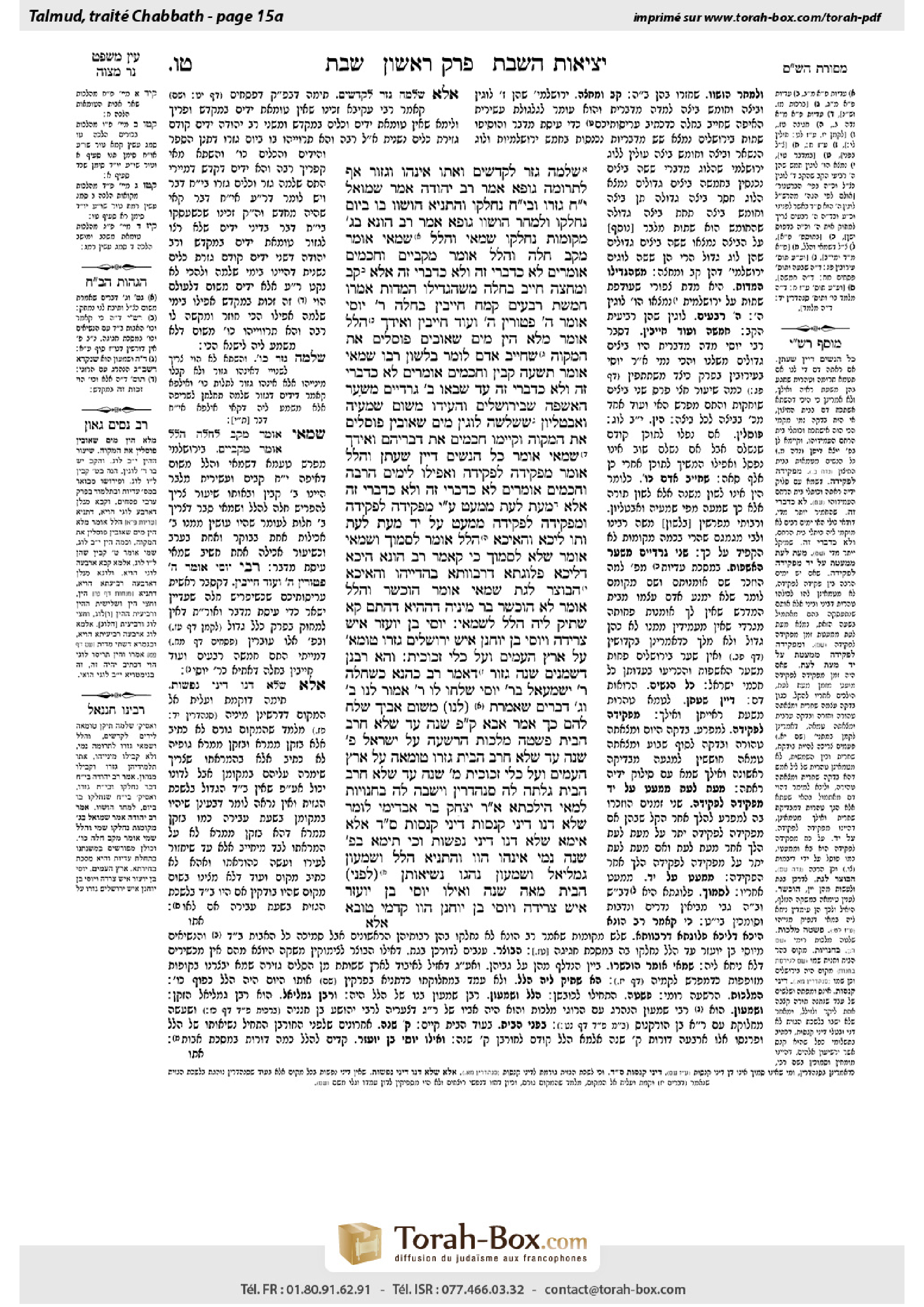
Shabbat 15a: Talmud study for Daf Yomi
Daf Yomi is the daily study of one Talmud folio. Explore 37 tractates with scans, Hebrew text, Sefaria English and AI-generated French translations where annotated.
Passage selection and English or AI-generated French translation are available where the scan has annotations. Daf Study is independent of Torah-Box and Sefaria.
Browse Shabbat · שבת · All tractatesShabbat 15a text and translations
This page of Shabbat includes the Aramaic text, an English translation and an AI-generated French translation, alongside the scan above.
שבת י״ה א · Aramaic and Hebrew text
שְׁלֹמֹה גְּזַר לְקׇדָשִׁים, וַאֲתוֹ אִינְהוּ וּגְזוּר אַף לִתְרוּמָה.
גּוּפָא, אָמַר רַב יְהוּדָה אָמַר שְׁמוּאֵל: שְׁמֹנָה עָשָׂר גָּזְרוּ וּבִשְׁמֹנָה עָשָׂר נֶחְלְקוּ. וְהָתַנְיָא הוּשְׁווּ! בּוֹ בַּיּוֹם נֶחְלְקוּ, וּלְמָחָר הוּשְׁווּ.
גּוּפָא, אָמַר רַב הוּנָא: בִּשְׁלֹשָׁה מְקוֹמוֹת נֶחְלְקוּ שַׁמַּאי וְהִלֵּל. שַׁמַּאי אוֹמֵר: מִקַּב חַלָּה. וְהִלֵּל אוֹמֵר: מִקַּבַּיִים. וַחֲכָמִים אוֹמְרִים: לֹא כְּדִבְרֵי זֶה וְלֹא כְּדִבְרֵי זֶה, אֶלָּא קַב וּמֶחֱצָה חַיָּיב בַּחַלָּה. מִשֶּׁהִגְדִּילוּ הַמִּדּוֹת, אָמְרוּ חֲמֵשֶׁת רְבָעִים קֶמַח חַיָּיבִין בַּחַלָּה. רַבִּי יוֹסֵי אוֹמֵר: חֲמִשָּׁה פְּטוּרִין, חֲמִשָּׁה וְעוֹד חַיָּיבִין.
וְאִידַּךְ, הִלֵּל אוֹמֵר: מְלֹא הִין מַיִם שְׁאוּבִים פּוֹסְלִים אֶת הַמִּקְוֶה — שֶׁחַיָּיב אָדָם לוֹמַר בִּלְשׁוֹן רַבּוֹ. שַׁמַּאי אוֹמֵר: תִּשְׁעָה קַבִּין. וַחֲכָמִים אוֹמְרִים: לֹא כְּדִבְרֵי זֶה וְלֹא כְּדִבְרֵי זֶה. עַד שֶׁבָּאוּ שְׁנֵי גַרְדִּיִּים מִשַּׁעַר הָאַשְׁפָּה שֶׁבִּירוּשָׁלַיִם וְהֵעִידוּ מִשּׁוּם שְׁמַעְיָה וְאַבְטַלְיוֹן שֶׁשְּׁלֹשָׁה לוּגִּין מַיִם שְׁאוּבִין פּוֹסְלִים אֶת הַמִּקְוֶה, וְקִיְּימוּ חֲכָמִים אֶת דִּבְרֵיהֶם.
וְאִידַּךְ, שַׁמַּאי אוֹמֵר: כׇּל הַנָּשִׁים דַּיָּין שְׁעָתָן. וְהִלֵּל אוֹמֵר: מִפְּקִידָה לִפְקִידָה, וַאֲפִילּוּ לְיָמִים הַרְבֵּה. וַחֲכָמִים אוֹמְרִים: לֹא כְּדִבְרֵי זֶה וְלֹא כְּדִבְרֵי זֶה, אֶלָּא: מֵעֵת לְעֵת מְמַעֵט עַל יָד מִפְּקִידָה לִפְקִידָה, וּמִפְּקִידָה לִפְקִידָה מְמַעֵט עַל יָד מֵעֵת לְעֵת.
וְתוּ לֵיכָּא? וְהָאִיכָּא הִלֵּל אוֹמֵר לִסְמוֹךְ, וְשַׁמַּאי אוֹמֵר שֶׁלֹּא לִסְמוֹךְ. כִּי קָאָמַר רַב הוּנָא, הֵיכָא דְּלֵיכָּא פְּלוּגְתָּא דְּרַבְּווֹתָא בַּהֲדַיְיהוּ.
וְהָאִיכָּא הַבּוֹצֵר לַגַּת — שַׁמַּאי אוֹמֵר: הוּכְשַׁר, וְהִלֵּל אוֹמֵר: לֹא הוּכְשַׁר. בַּר מִינֵּיהּ דְּהַהִיא, דְּהָתָם קָא שָׁתֵיק לֵיהּ הִלֵּל לְשַׁמַּאי.
יוֹסֵי בֶּן יוֹעֶזֶר אִישׁ צְרֵידָה וְיוֹסֵי בֶּן יוֹחָנָן אִישׁ יְרוּשָׁלַיִם גָּזְרוּ טוּמְאָה עַל אֶרֶץ הָעַמִּים וְעַל כְּלֵי זְכוּכִית. וְהָא רַבָּנַן דִּשְׁמֹנִים שָׁנָה גְּזוּר! דְּאָמַר רַב כָּהֲנָא: כְּשֶׁחָלָה רַבִּי יִשְׁמָעֵאל בְּרַבִּי יוֹסֵי, שָׁלְחוּ לוֹ: רַבִּי, אֱמוֹר לָנוּ שְׁנַיִם וּשְׁלוֹשָׁה דְּבָרִים שֶׁאָמַרְתָּ לָנוּ מִשּׁוּם אָבִיךָ.
שָׁלַח לָהֶם, כָּךְ אָמַר אַבָּא: מֵאָה וּשְׁמֹנִים שָׁנָה עַד שֶׁלֹּא חָרַב הַבַּיִת, פָּשְׁטָה מַלְכוּת הָרְשָׁעָה עַל יִשְׂרָאֵל. שְׁמֹנִים שָׁנָה עַד שֶׁלֹּא חָרַב הַבַּיִת גָּזְרוּ טוּמְאָה עַל אֶרֶץ הָעַמִּים וְעַל כְּלֵי זְכוּכִית. אַרְבָּעִים שָׁנָה עַד שֶׁלֹּא חָרַב הַבַּיִת גָּלְתָה לָהּ סַנְהֶדְרִין וְיָשְׁבָה לָהּ בַּחֲנוּיוֹת. לְמַאי הִילְכְתָא? אָמַר רַבִּי יִצְחָק בַּר אַבְדִּימִי: לוֹמַר שֶׁלֹּא דָּנוּ דִּינֵי קְנָסוֹת. דִּינֵי קְנָסוֹת סָלְקָא דַּעְתָּךְ? אֶלָּא אֵימָא: שֶׁלֹּא דָּנוּ דִּינֵי נְפָשׁוֹת!
וְכִי תֵימָא בִּשְׁמֹנִים שָׁנָה נָמֵי אִינְהוּ הֲווֹ, וְהָתַנְיָא: הִלֵּל וְשִׁמְעוֹן, גַּמְלִיאֵל וְשִׁמְעוֹן, נָהֲגוּ נְשִׂיאוּתָן לִפְנֵי הַבַּיִת מֵאָה שָׁנָה. וְאִילּוּ יוֹסֵי בֶּן יוֹעֶזֶר אִישׁ צְרֵידָה וְיוֹסֵי בֶּן יוֹחָנָן הֲווֹ קָדְמִי טוּבָא!
Shabbat 15a · English translation
Solomon and decreed impurity on hands to prohibit contact with consecrated items, and Shammai, Hillel, and their disciples came and decreed impurity on hands even to prohibit contact with teruma.
As to the matter itself that was mentioned above in passing, Rav Yehuda said that Shmuel said: With regard to eighteen matters they issued decrees that day, and with regard to those eighteen matters they disagreed prior to that. The Gemara asks: Wasn’t it taught in a baraita that they reached a consensus in their opinions with regard to the eighteen decrees? They answer: On that day they disagreed, and the following day, after the matter was decided in a vote, they reached a consensus in their opinions.
As to the matter itself that was mentioned above in passing, Rav Huna said: Shammai and Hillel disagreed in three places. The Gemara cites the disputes. One, Shammai says: From a kav of dough, one is required to separate ḥalla, the portion of the dough given to a priest. From any less than that measure there is no obligation to separate ḥalla, as that is not the measure alluded to in the verse: “The first of your dough” (Numbers 15:20), written with regard to the mitzva of separating ḥalla. And Hillel says: One must separate ḥalla only from two kav. And the Rabbis say: The halakha is neither in accordance with the statement of this one, who is stringent, nor in accordance with the statement of that one, who is lenient. Rather, one and a half kav is the measure from which one is obligated to separate ḥalla. Once the measures increased and the Sages recalculated the volume of a kav to be greater, they said that based on the measure of the new kav, five quarters of a kav of flour is the measure from which one is obligated to separate ḥalla. Rabbi Yosei says: Five quarters are exempt; only from dough the size of five quarters and a bit more is one obligated to separate ḥalla.
And another dispute between Hillel and Shammai is that Hillel says: A full hin, twelve log, of drawn water poured into a ritual bath in which there was not yet a full measure of forty se’a disqualifies the water of the ritual bath and accords even the water that had been there previously the status of drawn water. Even if water fit for a ritual bath is subsequently added to complete the measure of forty se’a, the ritual bath remains unfit for immersion. Hillel used the biblical measure, hin, because, when quoting one’s teacher, a person must speak employing the language of his teacher. Shammai says: Nine kav of water is enough to disqualify the ritual bath. And the Rabbis say: The halakha is neither in accordance with the statement of this one nor in accordance with the statement of that one. The Sages did not determine a measure for the water disqualifying a ritual bath until two weavers came from the Dung Gate in Jerusalem and testified in the name of Shemaya and Avtalyon that three log of drawn water disqualify the ritual bath, and the Rabbis upheld their statement against the opinions of the great Sages of Israel, Hillel and Shammai. The Gemara emphasized their occupation and the place that they lived to underscore that, despite the fact that their occupation was despised and their place was contemptible, there is no preferential treatment when it comes to Torah.
And another dispute between Hillel and Shammai is that Shammai says: All women, their time is sufficient, i.e., a woman who notices that she saw blood of menstruation but did not feel the flow beforehand, need not worry that perhaps the flow of blood began before she saw it, and it is sufficient if she assumes ritual impurity status beginning at that moment. Hillel says: From examination to examination, i.e., a woman who saw blood, if she does not know when the menstrual flow began, she is considered impure retroactive to the last time she examined herself and found herself to be ritually pure, and even if the examination took place several days earlier. Anything that she touched in the interim becomes ritually impure. And the Rabbis say: The halakha is neither in accordance with the statement of this one nor in accordance with the statement of that one; rather, the principle is: A full day, twenty-four hours, reduces the time from examination to examination, i.e., if her final self-examination took place a long time before, she need only concern herself with ritual impurity for the twenty-four hour period prior to noticing the blood. And from examination to examination reduces the time from a full day, i.e., if she examined herself in the course of the previous day and discovered no blood, she was certainly ritually pure prior to the examination.
The Gemara asks: And are there no more disputes between them? Isn’t there what we learned that Hillel says that it is permitted to lay hands on the heads of offerings sacrificed on a Festival, and one performs no prohibited labor and does not desecrate the Festival by doing so; and Shammai says not to lay hands? The Gemara answers: When Rav Huna said his statement, he was referring to disputes where there is no dispute between the great Sages who predated them concomitant with theirs. The dispute with regard to laying hands on the Festival is ancient, and their predecessors, Sages dating back to the beginning of the era of the pairs, already disputed it.
The Gemara asks further: Isn’t there also the dispute with regard to one who harvests grapes in order to take them to the press and stomp them as to whether or not the liquid that seeps out of the grapes is considered as having seeped out willfully and renders the grapes susceptible to impurity? Shammai says: It has become susceptible, and Hillel says: It has not become susceptible. The Gemara rejects this: Except for that one, as there, although they originally disagreed, ultimately Hillel was silent and did not respond to Shammai and ultimately accepted his opinion.
Earlier it was mentioned that Yosei ben Yo’ezer of Tzereida and Yosei ben Yoḥanan of Jerusalem decreed impurity upon the land of the nations and upon glass vessels. The Gemara asks: Was it these two Sages, who were among the first Sages in the era of the pairs, who issued these decrees? Wasn’t it the Sages who lived in the final eighty years of the Second Temple period who issued these decrees? As Rav Kahana said: When Rabbi Yishmael, son of Rabbi Yosei, fell ill, the Sages sent to him: Rabbi, tell us two or three statements that you once told us in the name of your father.
He sent to them: This is what my father said: One hundred and eighty years before the Temple was destroyed, the evil kingdom of Rome invaded Israel. Eighty years before the Temple was destroyed, they decreed impurity on the land of the nations and on glass vessels. Forty years before the Temple was destroyed, the Sanhedrin was exiled from the Chamber of Hewn Stones and sat in the stores on the Temple Mount. With regard to the last statement, the Gemara asks: What are the halakhic ramifications of this statement? Rabbi Yitzḥak bar Avdimi said: To say that they no longer judged cases of fines. The Gemara wonders: Does it enter your mind that they no longer judged cases of fines? Even several generations after the Temple was destroyed they continued to judge cases of fines in Eretz Yisrael. Rather, emend and say: That they no longer judged capital cases. The authority to impose the death penalty was stripped from the Sanhedrin, and therefore they willingly left the Chamber of Hewn Stone. Since the Sanhedrin no longer convenes in its designated place, the halakha is that it no longer has the authority to judge capital cases (Tosafot).
In any case, we learned that the Sages of the last eighty years before the destruction are the ones who decreed impurity on the land of the nations. And if you say that Yosei ben Yo’ezer and Yosei ben Yoḥanan were also there during those eighty years, wasn’t it taught in a baraita: Hillel, and his son Shimon, and his grandson Gamliel, and his great-grandson Shimon filled their position of Nasi before the House, while the Temple was standing, for a hundred years, while Yosei ben Yo’ezer of Tzereida and Yosei ben Yoḥanan were much earlier than Hillel?
Shabbat 15a · Traduction française (IA)
Salomon décréta l’impureté des mains afin d’interdire tout contact avec les objets consacrés. Puis Chammaï, Hillel et leurs disciples vinrent et décrétèrent l’impureté des mains afin d’interdire aussi tout contact avec la terouma.
À propos de ce qui a été mentionné précédemment en passant, Rav Yehouda dit au nom de Chmouel : Ils édictèrent des décrets concernant dix-huit sujets ce jour-là, et ils étaient en désaccord sur ces dix-huit sujets auparavant. La Guemara demande : N’a-t-il pas été enseigné dans une baraïta qu’ils parvinrent à un accord au sujet des dix-huit décrets ? Ils répondent : Ce jour-là, ils étaient en désaccord ; le lendemain, après que la question eut été tranchée par un vote, ils parvinrent à un accord.
À propos de ce qui a été mentionné précédemment en passant, Rav Houna dit : Chammaï et Hillel furent en désaccord sur trois points. La Guemara rapporte ces différends. Premièrement, Chammaï dit : Il faut prélever la ḥalla, la portion de pâte donnée à un prêtre, à partir d’un kav de pâte. En dessous de cette mesure, il n’y a pas d’obligation de prélever la ḥalla, car ce n’est pas la mesure à laquelle fait allusion le verset : « Le premier de votre pâte » (Nombres 15:20), relatif à la mitsva du prélèvement de la ḥalla. Hillel dit, lui, qu’on ne doit prélever la ḥalla qu’à partir de deux kav. Les Sages disent : La halakha ne suit ni l’opinion de celui-ci, qui est rigoureux, ni celle de celui-là, qui est indulgent. La mesure à partir de laquelle on est tenu de prélever la ḥalla est plutôt d’un kav et demi. Lorsque les mesures augmentèrent et que les Sages recalculèrent le volume d’un kav en l’évaluant à la hausse, ils dirent que, selon la nouvelle mesure du kav, cinq quarts de kav de farine constituent la mesure à partir de laquelle on est tenu de prélever la ḥalla. Rabbi Yossi dit : Cinq quarts ne sont pas soumis à l’obligation ; on n’est tenu de prélever la ḥalla qu’à partir d’une pâte de cinq quarts et un peu plus.
Un autre différend entre Hillel et Chammaï porte sur la quantité d’eau qui invalide un mikvé. Hillel dit : Un hin entier, soit douze log, d’eau puisée versée dans un mikvé qui ne contient pas encore le volume requis de quarante séa invalide l’eau du mikvé et confère même à l’eau qui s’y trouvait déjà le statut d’eau puisée. Même si l’on ajoute ensuite de l’eau propre à l’immersion pour atteindre les quarante séa, le mikvé reste impropre à l’immersion. Hillel emploie la mesure biblique du hin, car lorsqu’on rapporte les paroles de son maître, on doit s’exprimer dans les termes de celui-ci. Chammaï dit que neuf kav d’eau suffisent à invalider le mikvé. Les Sages disent : La halakha ne suit ni l’opinion de celui-ci ni celle de celui-là. Les Sages ne fixèrent aucune mesure pour la quantité d’eau qui invalide un mikvé jusqu’à ce que deux tisserands viennent de la Porte du Fumier, à Jérusalem, et témoignent au nom de Shemaya et Avtalyon que trois log d’eau puisée invalident le mikvé. Les Sages retinrent leur avis plutôt que ceux des grands Sages d’Israël, Hillel et Chammaï. La Guemara souligne leur métier et le lieu où ils vivaient afin de montrer que, même si leur métier était méprisé et leur lieu de résidence tenu pour méprisable, il n’y a pas de favoritisme en matière de Torah.
Un autre différend entre Hillel et Chammaï porte sur le moment où commence l’impureté menstruelle d’une femme. Chammaï dit : Pour toutes les femmes, le moment où elles constatent le sang fait foi. Autrement dit, une femme qui remarque un saignement menstruel sans avoir senti auparavant l’écoulement n’a pas à craindre que celui-ci ait commencé avant qu’elle ne le remarque ; elle est considérée comme rituellement impure à partir de cet instant seulement. Hillel dit : Depuis un examen jusqu’au suivant. Autrement dit, si une femme constate du sang sans savoir quand le flux menstruel a commencé, elle est considérée comme impure rétroactivement depuis le dernier examen où elle s’est vérifiée et s’est trouvée rituellement pure, même si cet examen remonte à plusieurs jours. Tout ce qu’elle a touché entre-temps devient rituellement impur. Les Sages disent : La halakha ne suit ni l’opinion de celui-ci ni celle de celui-là. Le principe est plutôt le suivant : une journée entière, soit vingt-quatre heures, réduit la période entre deux examens. Autrement dit, si son dernier examen remonte à longtemps, elle ne doit tenir compte de l’impureté rituelle que pendant les vingt-quatre heures précédant le moment où elle remarque le sang. Et la période entre deux examens réduit la période d’une journée entière. Autrement dit, si elle s’est examinée au cours de la journée précédente et n’a constaté aucun sang, elle était certainement rituellement pure avant cet examen.
La Guemara demande : N’y a-t-il pas d’autres différends entre eux ? N’avons-nous pas appris que Hillel dit qu’il est permis d’imposer les mains sur la tête des offrandes sacrifiées lors d’un jour de fête, car on n’accomplit ainsi aucun travail interdit et l’on ne profane pas la fête ; tandis que Chammaï dit de ne pas imposer les mains ? La Guemara répond : Lorsque Rav Houna prononça sa déclaration, il faisait référence aux différends qui ne faisaient pas déjà l’objet d’un désaccord entre de grands Sages antérieurs. Le désaccord sur l’imposition des mains lors d’un jour de fête est ancien : leurs prédécesseurs, des Sages remontant au début de l’époque des couples, étaient déjà en désaccord à ce sujet.
La Guemara demande encore : N’y a-t-il pas aussi le différend au sujet de celui qui vendange des raisins afin de les apporter au pressoir et de les y fouler : le liquide qui s’écoule des raisins est-il considéré comme s’étant écoulé intentionnellement et rend-il les raisins susceptibles de contracter l’impureté ? Chammaï dit : Ils sont devenus susceptibles ; Hillel dit : Ils ne sont pas devenus susceptibles. La Guemara écarte cette objection : à l’exception de ce cas, car là, bien qu’ils aient été en désaccord au départ, Hillel finit par garder le silence, ne répondit pas à Chammaï et accepta finalement son opinion.
Il a été dit précédemment que Yossi ben Yoézer de Tséréda et Yossi ben Yoḥanan de Jérusalem décrétèrent l’impureté concernant le territoire des nations et les récipients en verre. La Guemara demande : Ces deux Sages, qui comptaient parmi les premiers Sages de l’époque des couples, ont-ils édicté ces décrets ? Les Sages qui vécurent durant les quatre-vingts dernières années de la période du Second Temple ne sont-ils pas ceux qui les édictèrent ? Car Rav Kahana a dit : Lorsque Rabbi Yishmaël, fils de Rabbi Yossi, tomba malade, les Sages lui envoyèrent ce message : Rabbi, dis-nous deux ou trois déclarations que tu nous as autrefois transmises au nom de ton père.
Il leur envoya cette réponse : Voici ce qu’a dit mon père : Cent quatre-vingts ans avant la destruction du Temple, le royaume maléfique de Rome envahit Israël. Quatre-vingts ans avant la destruction du Temple, on décréta l’impureté concernant le territoire des nations et les récipients en verre. Quarante ans avant la destruction du Temple, le Sanhédrin fut exilé de la Chambre de pierre taillée et siégea dans les boutiques du mont du Temple. À propos de cette dernière déclaration, la Guemara demande : Quelles en sont les conséquences pour la halakha ? Rabbi Yitzḥak bar Avdimi dit : Cela signifie qu’ils ne jugeaient plus les affaires donnant lieu à des amendes. La Guemara s’étonne : Peut-on penser qu’ils ne jugeaient plus les affaires donnant lieu à des amendes ? Même plusieurs générations après la destruction du Temple, ils continuaient à juger de telles affaires en Eretz Israël. Il faut plutôt corriger le texte et dire qu’ils ne jugeaient plus les affaires capitales. L’autorité d’appliquer la peine de mort fut retirée au Sanhédrin, qui quitta donc de son plein gré la Chambre de pierre taillée. Puisque le Sanhédrin ne siège plus à l’endroit qui lui est assigné, la halakha veut qu’il n’ait plus autorité pour juger les affaires capitales (Tossafot).
Quoi qu’il en soit, nous avons appris que ce sont les Sages des quatre-vingts dernières années précédant la destruction qui décrétèrent l’impureté concernant le territoire des nations. Et si tu dis que Yossi ben Yoézer et Yossi ben Yoḥanan étaient eux aussi présents durant ces quatre-vingts années, n’a-t-il pas été enseigné dans une baraïta : Hillel, son fils Chimon, son petit-fils Gamliel et son arrière-petit-fils Chimon occupèrent la fonction de Nassi devant la Maison, tant que le Temple était debout, pendant cent ans ; or Yossi ben Yoézer de Tséréda et Yossi ben Yoḥanan vécurent bien avant Hillel ?
Traduction française générée par IA à partir de l’édition anglaise de Sefaria. Vérifie toujours un passage avec le texte source.
Text from Sefaria: William Davidson Edition - Vocalized Aramaic (CC BY NC); William Davidson Edition - English (CC BY NC).