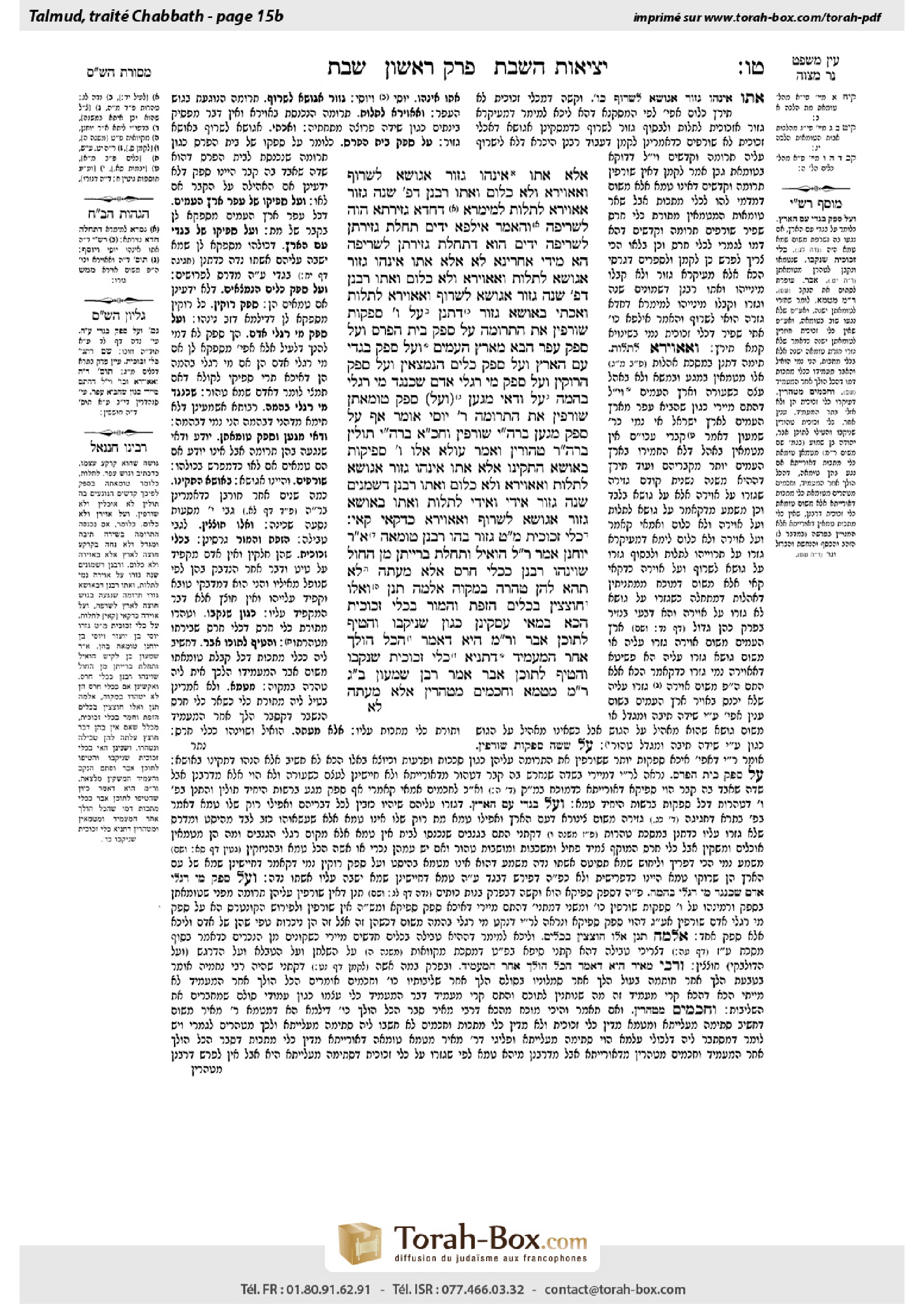
Shabbat 15b: Talmud study for Daf Yomi
Daf Yomi is the daily study of one Talmud folio. Explore 37 tractates with scans, Hebrew text, Sefaria English and AI-generated French translations where annotated.
Passage selection and English or AI-generated French translation are available where the scan has annotations. Daf Study is independent of Torah-Box and Sefaria.
Browse Shabbat · שבת · All tractatesShabbat 15b text and translations
This page of Shabbat includes the Aramaic text, an English translation and an AI-generated French translation, alongside the scan above.
שבת י״ה ב · Aramaic and Hebrew text
אֶלָּא: אֲתוֹ אִינְהוּ גְּזוּר אַגּוּשָּׁא לִשְׂרוֹף וְאַאֲוִירָא וְלֹא כְלוּם, וַאֲתוֹ רַבָּנַן דִּשְׁמֹנִים שָׁנָה גְּזוּר אַאֲוִירָא לִתְלוֹת.
לְמֵימְרָא דַּחֲדָא גְּזֵירְתָא הֲוָה לִשְׂרֵיפָה? וְהָאָמַר אִילְפָא: יָדַיִם תְּחִלַּת גְּזֵירָתָן לִשְׂרֵיפָה! יָדַיִם הוּא דִּתְחִלַּת גְּזֵירָתָן לִשְׂרֵיפָה, הָא מִידֵּי אַחֲרִינָא — לָא.
אֶלָּא: אֲתוֹ אִינְהוּ גְּזוּר אַגּוּשָּׁא לִתְלוֹת וְאַאֲוִירָא וְלֹא כְלוּם, וַאֲתוֹ רַבָּנַן דִּשְׁמֹנִים שָׁנָה גְּזוּר אַגּוּשָּׁא לִשְׂרוֹף וְאַאֲוִירָא לִתְלוֹת.
וְאַכַּתִּי, בְּאוּשָׁא גְּזוּר! דִּתְנַן: עַל שִׁשָּׁה סְפֵקוֹת שׂוֹרְפִין אֶת הַתְּרוּמָה: עַל סְפֵק בֵּית הַפְּרָס, וְעַל סְפֵק עָפָר הַבָּא מֵאֶרֶץ הָעַמִּים, וְעַל סְפֵק בִּגְדֵי עַם הָאָרֶץ, וְעַל סְפֵק כֵּלִים הַנִּמְצָאִין, וְעַל סְפֵק הָרוּקִּין, וְעַל סְפֵק מֵי רַגְלֵי אָדָם שֶׁכְּנֶגֶד מֵי רַגְלֵי בְּהֵמָה — עַל וַדַּאי מַגָּעָן וְעַל סְפֵק טוּמְאָתָן שׂוֹרְפִין אֶת הַתְּרוּמָה.
רַבִּי יוֹסֵי אוֹמֵר: אַף עַל סְפֵק מַגָּעָן בִּרְשׁוּת הַיָּחִיד — שׂוֹרְפִין. וַחֲכָמִים אוֹמְרִים: בִּרְשׁוּת הַיָּחִיד תּוֹלִין, בִּרְשׁוּת הָרַבִּים — טְהוֹרִין.
וְאָמַר עוּלָּא: אֵלּוּ שִׁשָּׁה סְפֵיקוֹת בְּאוּשָׁא הִתְקִינוּ! אֶלָּא אֲתוֹ אִינְהוּ גְּזוּר אַגּוּשָּׁא לִתְלוֹת וְאַאֲוִירָא וְלֹא כְלוּם, וַאֲתוֹ רַבָּנַן דִּשְׁמֹנִים שָׁנָה גְּזוּר אִידֵּי וְאִידֵּי לִתְלוֹת, וַאֲתוֹ בְּאוּשָׁא גְּזוּר אַגּוּשָּׁא לִשְׂרוֹף, וְאַאֲוִירָא — כִּדְקָאֵי קָאֵי.
כְּלֵי זְכוּכִית — מַאי טַעְמָא גְּזוּר בְּהוּ רַבָּנַן טוּמְאָה? אָמַר רַבִּי יוֹחָנָן אָמַר רֵישׁ לָקִישׁ: הוֹאִיל וּתְחִלַּת בְּרִיָּיתָן מִן הַחוֹל שַׁוִּינְהוּ רַבָּנַן כִּכְלֵי חֶרֶס. אֶלָּא, מֵעַתָּה לֹא תְּהֵא לָהֶן טׇהֳרָה בְּמִקְוֶה. אַלְּמָה תְּנַן: וְאֵלּוּ חוֹצְצִין בְּכֵלִים — הַזֶּפֶת וְהַמּוֹר בִּכְלֵי זְכוּכִית!
הָכָא בְמַאי עָסְקִינַן? — כְּגוֹן שֶׁנִּיקְּבוּ וְהִטִּיף לְתוֹכָן אֲבָר. וְרַבִּי מֵאִיר הִיא, דְּאָמַר הַכֹּל הוֹלֵךְ אַחַר הַמַּעֲמִיד. דְּתַנְיָא: כְּלֵי זְכוּכִית שֶׁנִּקְּבוּ וְהִטִּיף לְתוֹכָן אֲבָר, אָמַר רַבָּן שִׁמְעוֹן בֶּן גַּמְלִיאֵל: רַבִּי מֵאִיר מְטַמֵּא וַחֲכָמִים מְטַהֲרִין.
אֶלָּא מֵעַתָּה
Shabbat 15b · English translation
Rather, this decree was issued in stages. First, Yosei ben Yo’ezer and Yosei ben Yoḥanan came and issued a decree that teruma that comes into contact with a clump of earth of the land of the nations is to be burned, and they decreed nothing with regard to teruma that enters into the air space of the land of the nations. The Sages of the final eighty years prior to the destruction of the Temple came and issued a decree with regard to teruma that enters into the air space of the land of the nations that its legal status is in abeyance, and it is not burned.
The Gemara asks: Is that to say that there was one decree issued immediately to subject teruma to burning? Didn’t Ilfa say: With regard to hands, from the beginning their decree was that teruma that comes into contact with them is to be burned? The Gemara infers from this that, with regard to hands alone, the beginning of their decree was to render teruma that came into contact with them impure to the point of burning; however, with regard to other matters, they did not immediately issue so severe a decree.
Rather, the stages of the decree were as follows: Yosei ben Yo’ezer and Yosei ben Yoḥanan came and decreed that any item that came into contact with a clump of earth is to be in abeyance, and they decreed nothing with regard to teruma that enters into the air space of the land of the nations. The Sages of the last eighty years came and were stringent by one more level; they decreed that teruma that came into contact with a clump of earth of the land of the nations is to be burned, and, with regard to teruma that enters into the air space of the land of the nations, its legal status is in abeyance.
The Gemara asked further: And still is the matter clear? Didn’t the Sages issue this decree in Usha, many years after the destruction of the Temple? As we learned in a mishna: For six cases of uncertain impurity one burns the teruma which came into contact with them:
For the uncertain case of beit haperas, meaning teruma that entered a field where a grave was plowed and the location of the bones of the corpse is unknown, and it is uncertain whether or not the teruma became impure;
And for the uncertain case of earth that comes from the land of the nations, whose impurity itself has the status of uncertain impurity. Therefore, teruma that came into contact with it also has the status of uncertain impurity;
And for the uncertain case of the clothes of an am ha’aretz. Since an am ha’aretz is not careful with regard to purity, we are concerned lest a menstruating woman touch his clothes. Due to that uncertainty, his clothes are considered impure with a severe degree of impurity. If teruma came into contact with them there is uncertainty with regard to whether or not they became impure;
And for the uncertain case of vessels that are not his that are found. Since he does not know whether or not those vessels are impure, if teruma came into contact with them, there is uncertainty whether or not they are impure;
And for the uncertain case of spittle, as perhaps it is the spittle of a zav and transmits impurity by Torah law. If teruma came into contact with it there is uncertainty whether or not it is impure;
And for the uncertain case of a person’s urine, even though it was adjacent to the urine of an animal, there is room for concern that perhaps it is the urine of a zav, and impure by Torah law. If teruma came into contact with it, there is uncertainty whether or not it is impure.
In all of these cases, the Sages established that for their definite contact, when it is clear that these came into contact with teruma, and although there is uncertainty with regard to their essential impurity, i.e., it is uncertain whether or not these items are impure, one burns the teruma that came into contact with them.
Rabbi Yosei says: Even in a case of uncertain contact; if it was in the private domain one burns teruma that came into contact with it, as with regard to impurity by Torah law an uncertainty that developed in a private domain is also ruled impure. According to Rabbi Yosei, these decrees, even though they are fundamentally cases of uncertainty, are sufficiently stringent that the Sages applied Torah law to them. And the Rabbis say: Since these cases are only impure by rabbinic decree, in a case of uncertain contact in the private domain, one does not burn the teruma but rather places it in abeyance. While in the public domain, they are ritually pure.
And Ulla said with regard to these six uncertain cases: In Usha they instituted how one must act in terms of practical halakha. If so, a clump of earth from the land of the nations transmits impurity from the time of the Usha ordinances and not from eighty years prior to the destruction of the Temple. Rather, Yosei ben Yo’ezer and Yosei ben Yoḥanan came and decreed that if teruma came into contact with a clump of earth from the land of the nations, its legal status is in abeyance and one does not burn it, and upon teruma that entered the air space of the land of the nations they decreed nothing. And the Sages of the last eighty years of the Temple came along and issued a decree upon this, earth, and upon that, air, that in both cases the teruma is in abeyance. And the Sages of the city of Usha came along and decreed that teruma that came into contact with a clump of earth from the land of the nations is burned. And teruma that entered the air space of the land of the nations, as it stood, it continues to stand in abeyance. They did not impose any greater stringency in this matter.
One of the matters mentioned above was the decree of impurity on glass vessels. With regard to glass vessels, what is the reason that the Sages decreed impurity upon them? Rabbi Yoḥanan said that Reish Lakish said: Since the beginning of the manufacture of glass vessels is from sand, the Sages equated them to earthenware vessels. The Gemara asks: But if what you say is so, if the Sages truly equated the impurity of glass vessels to the impurity of earthenware vessels, there should not be purification in the ritual bath for glass vessels, just as there is no purification for earthenware vessels. Why, then, did we learn in a mishna with regard to the halakhot of immersing vessels: And these materials interpose in vessels, i.e., if they were stuck to the vessel when it was immersed the vessel is not purified: The pitch and the myrrh that were stuck on glass vessels obstruct their immersion. Apparently, glass vessels are purified in a ritual bath.
The Gemara answers that glass cannot usually be purified in a ritual bath. However, with what are we dealing here? With a special case where the glass vessels were perforated and he dripped molten lead into them to seal the hole. This halakha is in accordance with the opinion of Rabbi Meir, who said: Everything follows the nature of the facilitator, i.e., if an object that is not fit for use on its own is reinforced with a different material that facilitates its use, the entire object assumes the legal status of that material. Therefore, since the substance that sealed the holes in these glass vessels is lead, which can be purified through immersion like other metals, these glass vessels can also be purified in a ritual bath. As it was taught in a baraita: Glass vessels that were perforated and one dripped lead into them; Rabban Shimon ben Gamliel said that Rabbi Meir deems them ritually impure and the Rabbis deem them ritually pure.
The Gemara asks further: But if that is so, and glass vessels are equated with earthenware vessels,
Shabbat 15b · Traduction française (IA)
En réalité, ce décret fut promulgué par étapes. D’abord, Yosse ben Yoézer et Yosse ben Yo’hanan vinrent et décrétèrent que la terouma qui entre en contact avec une motte de terre du pays des nations doit être brûlée ; ils ne décrétèrent rien au sujet de la terouma qui pénètre dans l’espace aérien du pays des nations. Les Sages des quatre-vingts dernières années précédant la destruction du Temple vinrent et décrétèrent que la terouma qui pénètre dans l’espace aérien du pays des nations a un statut en suspens et n’est pas brûlée.
La Guemara demande : Cela signifie-t-il qu’un seul décret fut immédiatement promulgué, imposant de brûler la terouma ? Ilfa n’a-t-il pas dit qu’en ce qui concerne les mains, dès le début, leur décret fut que la terouma qui entre en contact avec elles doit être brûlée ? La Guemara en déduit que, pour les mains seulement, leur décret initial fut de rendre la terouma qui entrait en contact avec elles impure au point qu’elle doive être brûlée ; en revanche, pour les autres sujets, ils ne promulguèrent pas immédiatement un décret aussi sévère.
En réalité, les étapes du décret furent les suivantes : Yosse ben Yoézer et Yosse ben Yo’hanan vinrent et décrétèrent que tout élément qui entrait en contact avec une motte de terre avait un statut en suspens ; ils ne décrétèrent rien au sujet de la terouma qui pénètre dans l’espace aérien du pays des nations. Les Sages des quatre-vingts dernières années vinrent et ajoutèrent un degré de rigueur : ils décrétèrent que la terouma qui entrait en contact avec une motte de terre du pays des nations devait être brûlée et que la terouma qui pénètre dans l’espace aérien du pays des nations avait un statut en suspens.
La Guemara demande encore : La question est-elle pour autant réglée ? Les Sages n’ont-ils pas promulgué ce décret à Oucha, de nombreuses années après la destruction du Temple ? En effet, nous avons appris dans une Michna : Dans six cas d’impureté douteuse, on brûle la terouma qui est entrée en contact avec l’élément concerné : Dans le cas douteux du beit haperas, c’est-à-dire la terouma qui a pénétré dans un champ où une tombe a été labourée et où l’emplacement des ossements du défunt est inconnu ; on ne sait pas si la terouma est devenue impure ou non ; Dans le cas douteux de la terre provenant du pays des nations, dont l’impureté elle-même a le statut d’une impureté douteuse. Par conséquent, la terouma qui entre en contact avec elle a également le statut d’une impureté douteuse ; Dans le cas douteux des vêtements d’un am ha’aretz. Comme un am ha’aretz ne veille pas à la pureté, on craint qu’une femme menstruée ait touché ses vêtements. En raison de cette incertitude, ses vêtements sont considérés comme impurs à un degré sévère. Si la terouma entre en contact avec eux, on ne sait pas si elle est devenue impure ou non ; Dans le cas douteux des récipients qui ne lui appartiennent pas et qui sont trouvés. Comme il ignore si ces récipients sont impurs ou non, si la terouma entre en contact avec eux, on ne sait pas s’ils sont impurs ou non ; Dans le cas douteux de la salive, car il se peut que ce soit celle d’un zav et qu’elle transmette l’impureté selon la Torah écrite. Si la terouma entre en contact avec elle, on ne sait pas si elle est impure ou non ; Dans le cas douteux de l’urine d’une personne, même si elle se trouvait à côté de l’urine d’un animal : il y a lieu de craindre qu’il s’agisse de l’urine d’un zav, impure selon la Torah écrite. Si la terouma entre en contact avec elle, on ne sait pas si elle est impure ou non. Dans tous ces cas, les Sages ont établi que, lorsque le contact est certain — c’est-à-dire lorsqu’il est clair que ces éléments sont entrés en contact avec la terouma —, même si leur impureté intrinsèque demeure incertaine, autrement dit, si l’on ne sait pas si ces éléments sont impurs ou non, on brûle la terouma qui est entrée en contact avec eux.
Rabbi Yossi dit : Même dans un cas de contact douteux, si cela s’est produit dans le domaine privé, on brûle la terouma qui est entrée en contact avec l’élément concerné, car en matière d’impureté selon la Torah écrite, une incertitude survenue dans le domaine privé est également tranchée comme impure. Selon Rabbi Yossi, ces décrets, bien qu’il s’agisse fondamentalement de cas d’incertitude, sont suffisamment sévères pour que les Sages leur appliquent la règle de la Torah écrite. Les Sages disent, eux : Puisque ces cas ne sont impurs qu’en vertu d’un décret rabbinique, en cas de contact douteux dans le domaine privé, on ne brûle pas la terouma, mais on la met en suspens. Dans le domaine public, elle est rituellement pure.
Et Oulla a dit au sujet de ces six cas douteux : À Oucha, on a fixé la conduite à suivre en pratique, conformément à la halakha. Si tel est le cas, la motte de terre provenant du pays des nations ne transmet l’impureté qu’à partir des ordonnances d’Oucha, et non depuis les quatre-vingts années précédant la destruction du Temple. En réalité, Yosse ben Yoézer et Yosse ben Yo’hanan vinrent et décrétèrent que si la terouma entrait en contact avec une motte de terre provenant du pays des nations, son statut était en suspens et on ne la brûlait pas ; ils ne décrétèrent rien au sujet de la terouma qui pénètre dans l’espace aérien du pays des nations. Puis les Sages des quatre-vingts dernières années du Temple vinrent et décrétèrent, à propos de ceci — la terre — et de cela — l’air —, que dans les deux cas le statut de la terouma était en suspens. Enfin, les Sages de la ville d’Oucha vinrent et décrétèrent que la terouma qui entrait en contact avec une motte de terre provenant du pays des nations devait être brûlée. Quant à la terouma qui pénétrait dans l’espace aérien du pays des nations, son statut demeura tel qu’il était : elle resta en suspens. Ils n’imposèrent pas de rigueur supplémentaire en la matière.
L’un des sujets mentionnés plus haut était le décret d’impureté concernant les récipients en verre. Pour quelle raison les Sages décrétèrent-ils que les récipients en verre sont impurs ? Rabbi Yo’hanan dit au nom de Reish Lakish : Puisque la fabrication des récipients en verre commence avec du sable, les Sages les assimilèrent aux récipients en terre cuite. La Guemara demande : Mais si ce que tu dis est vrai, si les Sages ont réellement assimilé l’impureté des récipients en verre à celle des récipients en terre cuite, les récipients en verre ne devraient pas pouvoir être purifiés au mikvé, tout comme les récipients en terre cuite ne peuvent pas être purifiés. Pourquoi donc avons-nous appris dans une Michna, au sujet des lois de l’immersion des récipients : « Et ces matières font obstacle pour les récipients », c’est-à-dire que si elles adhèrent au récipient lorsqu’il est immergé, celui-ci n’est pas purifié : le goudron et la myrrhe qui adhéraient aux récipients en verre empêchent leur immersion. Il apparaît donc que les récipients en verre sont purifiés au mikvé.
La Guemara répond que, normalement, les récipients en verre ne peuvent pas être purifiés au mikvé. Mais de quel cas s’agit-il ici ? D’un cas particulier où les récipients en verre étaient perforés et où l’on a fait couler du plomb fondu dans les trous pour les boucher. Cette halakha est conforme à l’opinion de Rabbi Meïr, qui dit : Tout dépend de la nature de l’élément qui rend l’objet utilisable ; autrement dit, si un objet qui ne peut pas être utilisé seul est renforcé par une autre matière qui permet son utilisation, l’objet tout entier prend le statut juridique de cette matière. Par conséquent, puisque la substance qui a bouché les trous de ces récipients en verre est du plomb, lequel peut être purifié par immersion comme les autres métaux, ces récipients en verre peuvent eux aussi être purifiés au mikvé. Comme cela a été enseigné dans une baraïta : Des récipients en verre étaient perforés et l’on y a fait couler du plomb ; Rabban Shimon ben Gamliel rapporte que Rabbi Meïr les considère comme rituellement impurs, tandis que les Sages les considèrent comme rituellement purs.
La Guemara demande encore : Mais si tel est le cas, et que les récipients en verre sont assimilés aux récipients en terre cuite,
Traduction française générée par IA à partir de l’édition anglaise de Sefaria. Vérifie toujours un passage avec le texte source.
Text from Sefaria: William Davidson Edition - Vocalized Aramaic (CC BY NC); William Davidson Edition - English (CC BY NC).