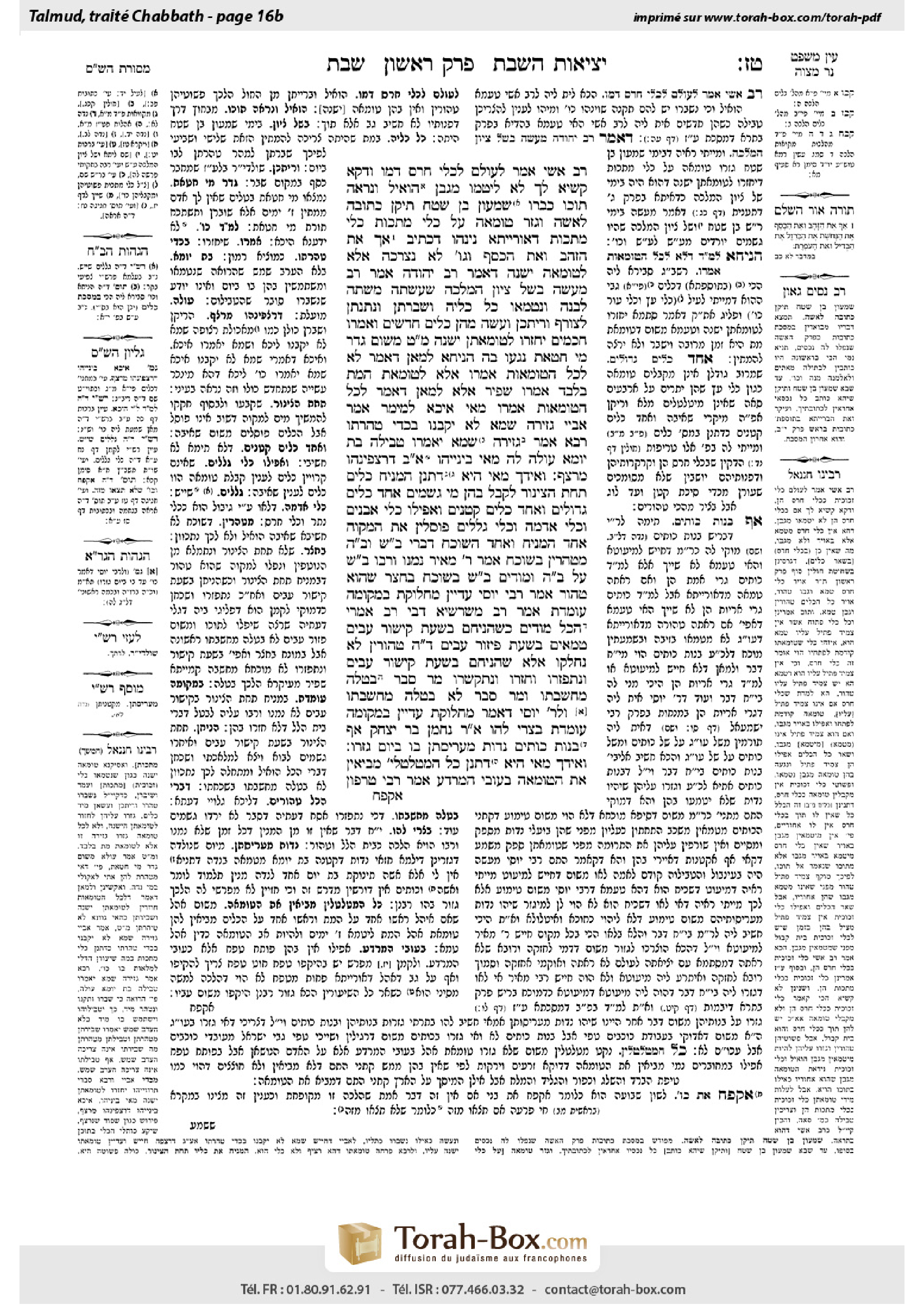
Shabbat 16b: Talmud study for Daf Yomi
Daf Yomi is the daily study of one Talmud folio. Explore 37 tractates with scans, Hebrew text, Sefaria English and AI-generated French translations where annotated.
Passage selection and English or AI-generated French translation are available where the scan has annotations. Daf Study is independent of Torah-Box and Sefaria.
Browse Shabbat · שבת · All tractatesShabbat 16b text and translations
This page of Shabbat includes the Aramaic text, an English translation and an AI-generated French translation, alongside the scan above.
שבת י״ו ב · Aramaic and Hebrew text
רַב אָשֵׁי אָמַר: לְעוֹלָם לִכְלֵי חֶרֶס דָּמוּ, וּדְקָא קַשְׁיָא לָךְ לָא לִיטַּמּוּ מִגַּבָּן? — הוֹאִיל וְנִרְאֶה תּוֹכוֹ כְּבָרוֹ.
שִׁמְעוֹן בֶּן שָׁטַח תִּיקֵּן כְּתוּבָה לָאִשָּׁה וְגָזַר טוּמְאָה עַל כְּלֵי מַתָּכוֹת. כְּלֵי מַתָּכוֹת דְּאוֹרָיְיתָא נִינְהוּ! דִּכְתִיב: ״אַךְ אֶת הַזָּהָב וְאֶת הַכָּסֶף וְגוֹ׳״. לֹא נִצְרְכָה אֶלָּא לְטוּמְאָה יְשָׁנָה, דְּאָמַר רַב יְהוּדָה אָמַר רַב: מַעֲשֶׂה בְּשֶׁל צִיּוֹן הַמַּלְכָּה שֶׁעָשְׁתָה מִשְׁתֶּה לִבְנָהּ וְנִטְמְאוּ כׇּל כֵּלֶיהָ, וְשִׁבְּרָתַן וּנְתָנָתַן לְצוֹרֵף וְרִיתְּכָן וְעָשָׂה מֵהֶן כֵּלִים חֲדָשִׁים. וְאָמְרוּ חֲכָמִים: יַחְזְרוּ לְטוּמְאָתָן יְשָׁנָה.
מַאי טַעְמָא? מִשּׁוּם גֶּדֶר מֵי חַטָּאת נָגְעוּ בָּהּ.
הָנִיחָא לְמַאן דְּאָמַר לֹא לְכׇל הַטּוּמְאוֹת אָמְרוּ, אֶלָּא לְטוּמְאַת הַמֵּת בִּלְבַד אָמְרוּ — שַׁפִּיר.
אֶלָּא לְמַאן דְּאָמַר לְכׇל הַטּוּמְאוֹת אָמְרוּ, מַאי אִיכָּא לְמֵימַר? אָמַר אַבָּיֵי: גְּזֵירָה שֶׁמָּא לֹא יִקֳּבֶנּוּ בִּכְדֵי טׇהֳרָתוֹ.
רָבָא אָמַר: גְּזֵירָה שֶׁמָּא יֹאמְרוּ טְבִילָה בַּת יוֹמָא עוֹלָה לָהּ. מַאי בֵּינַיְיהוּ? אִיכָּא בֵּינַיְיהוּ דְּרַצְפִינְהוּ מִרְצָף.
וְאִידַּךְ מַאי הִיא? דִּתְנַן: הַמַּנִּיחַ כֵּלִים תַּחַת הַצִּינּוֹר לְקַבֵּל בָּהֶן מֵי גְּשָׁמִים — אֶחָד כֵּלִים גְּדוֹלִים וְאֶחָד כֵּלִים קְטַנִּים, וַאֲפִילּוּ כְּלֵי אֲבָנִים וּכְלֵי אֲדָמָה וּכְלֵי גְלָלִים — פּוֹסְלִין אֶת הַמִּקְוֶה. אֶחָד הַמַּנִּיחַ וְאֶחָד הַשּׁוֹכֵחַ, דִּבְרֵי בֵּית שַׁמַּאי. וּבֵית הִלֵּל מְטַהֲרִין בַּשּׁוֹכֵחַ. אָמַר רַבִּי מֵאִיר: נִמְנוּ וְרַבּוּ בֵּית שַׁמַּאי עַל בֵּית הִלֵּל. וּמוֹדִים בֵּית שַׁמַּאי בַּשּׁוֹכֵחַ בֶּחָצֵר, שֶׁהוּא טָהוֹר. אָמַר רַבִּי יוֹסֵי: עֲדַיִין מַחֲלוֹקֶת בִּמְקוֹמָהּ עוֹמֶדֶת.
אָמַר רַב מְשַׁרְשְׁיָא: דְּבֵי רַב אָמְרִי: הַכֹּל מוֹדִים כְּשֶׁהִנִּיחָם בִּשְׁעַת קִישּׁוּר עָבִים, טְמֵאִים. בִּשְׁעַת פִּיזּוּר עָבִים — דִּבְרֵי הַכֹּל טְהוֹרִין. לֹא נֶחְלְקוּ אֶלָּא שֶׁהִנִּיחָם בִּשְׁעַת קִישּׁוּר עָבִים, וְנִתְפַּזְּרוּ, וְחָזְרוּ וְנִתְקַשְּׁרוּ. מָר סָבַר בָּטְלָה מַחְשַׁבְתּוֹ, וּמָר סָבַר לֹא בָּטְלָה מַחְשַׁבְתּוֹ.
וּלְרַבִּי יוֹסֵי דְּאָמַר מַחֲלוֹקֶת עֲדַיִין בִּמְקוֹמָהּ עוֹמֶדֶת, בָּצְרִי לְהוּ! אָמַר רַב נַחְמָן בַּר יִצְחָק: אַף בְּנוֹת כּוּתִים נִדּוֹת מֵעֲרִיסָתָן — בּוֹ בַּיּוֹם גָּזְרוּ.
וְאִידַּךְ מַאי הִיא? דִּתְנַן: כׇּל הַמִּטַּלְטְלִין מְבִיאִין אֶת הַטּוּמְאָה בְּעוֹבִי הַמַּרְדֵּעַ. אָמַר רַבִּי טַרְפוֹן:
Shabbat 16b · English translation
Rav Ashi said: There was never a need to equate glass vessels and metal vessels. Actually, glass vessels are likened to earthenware vessels in every sense. And that which was difficult for you, that if so, glass vessels, like other earthenware vessels, should not become impure from contact of their outer side with a source of ritual impurity; since in glass vessels its inner side looks like its outer side, the legal status of the outer side was equated with that of the inner side, as there is no visible separation between them.
We learned that Shimon ben Shataḥ instituted the formula of the marriage contract for a woman and decreed impurity upon metal vessels. The Gemara asks: Aren’t metal vessels impure by Torah law, as it is written: “But the gold, and silver, and the bronze, and the iron, and the tin, and the lead. Anything that came in fire, make it pass through fire and it will be pure, but with the water of sprinkling it will be purified and anything that did not come in fire make it pass through water” (Numbers 31:22–23)? The Gemara answers: This ordinance of Shimon ben Shataḥ with regard to the impurity of metal vessels in general was only needed with regard to previous impurity reassumed by metal vessels after they are recast. As Rav Yehuda said that Rav said: There was an incident involving Shimon ben Shataḥ’s sister, Shel Tziyyon the queen, who made a wedding feast for her son. All of her vessels became impure, and she broke them and gave them to the smith, and he welded the broken vessels together and made new vessels. And the Sages said: What she did was ineffective, as all the vessels will reassume their previous impurity.
With regard to the essence of the matter, the Gemara asks: What is the reason that they imposed a decree of previous impurity on metal vessels? The Gemara answers: Due to a fence constructed to maintain the integrity of the water of a purification offering, the Sages touched upon it. In order to purify a vessel that came into contact with a corpse, one is required to have the water of a purification offering sprinkled on the vessel on the third day and the seventh day after it became impure, as it is written: “He should be purified with it on the third day and on the seventh day he will become pure, and if he is not purified with it on the third day and on the seventh day he will not become pure” (Numbers 19:20). This involves a significant inconvenience. If people will prefer to break or damage impure metal vessels in order to purify them more easily, the use of water of a purification offering will become obsolete. As a result, the Sages decreed that metal vessels will remain impure until they undergo the purification process.
The Gemara asks: Granted, according to the one who said that they did not say the decree of previous impurity on metal vessels with regard to all forms of impurity; rather, they only said the decree with regard to the impurity caused by contact with a corpse, it works out well. In the case of impurity caused by contact with a corpse, the Sages issued this decree because its purification process is demanding. It requires immersion and sprinkling of the water of a purification offering on the third and the seventh days. However, with regard to other forms of impurity, whose purification is accomplished by means of immersion alone, a person will not break a vessel in order to avoid immersion. Consequently, there is no need to institute a decree in those cases.
However, according to the one who said that they said the decree of previous impurity in metal vessels with regard to all forms of impurity, which includes those forms of impurity that do not require sprinkling of the water of a purification offering for their purification, what is there to say as a rationale for the decree? Abaye said: Shimon ben Shataḥ instituted a decree due to the concern that perhaps he would not perforate that vessel with a hole large enough to render it ritually pure. To purify a vessel by breaking it, one must make a hole large enough to ensure that the vessel will no longer be able to hold the contents that it was designed to hold. Abaye explained that Shimon ben Shataḥ’s concern was that one who values the vessel will not break it sufficiently to render it ritually pure.
Rava said: It is a decree lest they say that immersion on the same day is sufficient for this vessel to be purified. People will be unaware of the manner in which the metal vessel became pure, and they will assume that its purity was achieved by means of immersion and not by means of breaking. That will lead them to the conclusion that any vessel becomes pure immediately upon immersion, and there is no need to wait for sunset, contrary to Torah law. Therefore, the Sages decreed that repaired vessels retain previous impurity. The Gemara asks: What is the practical difference between the reasons of Abaye and Rava? The Gemara answers: The difference between them is found in a case where he broke the vessel completely. If there was concern that perhaps he will not perforate it sufficiently, there is no longer room for concern. However, if there was concern lest people say that immersion is effective on that day, there remains room for concern.
To this point, several, but not all, of the eighteen decrees were enumerated. The Gemara asks: And what is the other decree? The Gemara answers: As we learned in a mishna in tractate Mikvaot: One who places vessels under the drain pipe in order to collect rainwater, the water collected in the vessels is considered drawn water. This is true both in the case of large vessels which, due to their size, do not become impure, and in the case of small vessels. And even if they were stone vessels and earth vessels and dung vessels, made from dry cattle dung, which are not considered vessels in terms of ritual impurity and do not become impure at all, this ruling applies. The water in the vessels is considered drawn water in all respects. If it leaked from those vessels and flowed into a ritual bath that had not yet reached its full measure, forty se’a, and filled it, the water invalidates the ritual bath. The Gemara adds that this halakha applies both in a case where one places the vessels beneath the drainpipe with premeditated intent to collect the water flowing through it as well as in a case where one forgets the vessels there and they are filled unintentionally; this is the statement of Beit Shammai. And Beit Hillel deem the ritual bath pure, i.e., fit to complete the full measure of the ritual bath, in a case where one forgets the vessels. Rabbi Meir said: They were counted in the attic of Ḥananya ben Ḥizkiya and Beit Shammai outnumbered Beit Hillel. And Rabbi Meir said that Beit Shammai agree with Beit Hillel that in a case where one forgets vessels in the courtyard and they fill with rainwater, the water is pure. Rabbi Yosei said: The dispute still remains in place, and Beit Shammai did not agree with Beit Hillel at all.
Rav Mesharshiya said: The Sages of the school of Rav say: Everyone agrees that if he placed the vessels in the courtyard at the time of the massing of the clouds, a sign that it is about to rain, just before it began to rain, then the water in the vessels is impure, unfit, as he certainly intended that the water fill the vessels. If one placed the vessels at the time of the dispersal of the clouds, and then the clouds massed together, and then rain fell and the vessels filled with the rainwater, everyone agrees that the water is pure. It is fit to fill the ritual bath to its capacity because at the time that he placed the vessels under the drainpipe his intention was not that they fill with rainwater. They only disagreed in a case where he placed them at the time of the massing of the clouds, and the clouds dispersed, and rain did not fall then, and only later the clouds massed again, and rain fell and filled the vessels. In that case, this Sage, Beit Hillel, holds that because the clouds dispersed after he placed the vessels, his thought to fill the vessels with water was negated. The vessels remained in the courtyard due to his forgetfulness, and when they filled afterward it was not his intention that they fill. And this Sage, Beit Shammai, holds that his thought was not negated, as his original intention was ultimately fulfilled despite the delay in its fulfillment.
The Gemara wonders: Indeed, according to Rabbi Meir, another decree was added to the total. However, according to Rabbi Yosei, who said that in this case the dispute still remains in place, the tally of eighteen decrees is lacking. Rav Naḥman bar Yitzḥak said: The decree that the daughters of the Samaritans [kutim] are considered to already have the status of menstruating women from their cradle, their birth, they issued on that day. The halakha is that any female who sees blood of menstruation is impure, regardless of her age, even if she is a day old. The Samaritans did not accept that halakha. Consequently, it is possible that there were girls among them who saw blood of menstruation before their coming-of-age, and the Samaritans ignored their impurity. Therefore, due to this uncertainty, the Sages decreed impurity on all daughters of the Samaritans from birth.
The Gemara asks: And what is the other decree? The Gemara answers that another decree is as we learned a halakhic tradition in a mishna that all movable objects with the width of an ox goad, a long stick for prodding and directing a plowing animal, transmit impurity. If one side of the object was over a corpse and the other side of the object was over vessels, the vessels become impure due to the impurity of a tent over a corpse. Rabbi Tarfon said:
Shabbat 16b · Traduction française (IA)
Rav Ashi dit : Il n’a jamais été nécessaire d’assimiler les récipients en verre aux récipients en métal. En réalité, les récipients en verre sont assimilés en tout point aux récipients en terre cuite. Quant à la difficulté que tu soulevais — si tel était le cas, les récipients en verre, comme les autres récipients en terre cuite, ne devraient pas devenir impurs par le contact de leur face extérieure avec une source d’impureté rituelle —, elle se résout ainsi : dans les récipients en verre, la face intérieure ressemble à la face extérieure ; le statut de la face extérieure a donc été assimilé à celui de la face intérieure, puisqu’aucune séparation visible ne les distingue.
Nous avons appris que Shimon ben Shataḥ institua la formule de l’acte de mariage d’une femme et décréta l’impureté des récipients en métal. La Guemara demande : Les récipients en métal ne sont-ils pas impurs selon la Torah, comme il est écrit : « Mais l’or, l’argent, le bronze, le fer, l’étain et le plomb. Tout ce qui a passé par le feu, faites-le passer par le feu et il sera pur ; toutefois, il devra être purifié par l’eau d’aspersion, et tout ce qui n’a pas passé par le feu, faites-le passer par l’eau » (Nombres 31, 22-23) ? La Guemara répond : Cette ordonnance de Shimon ben Shataḥ concernant l’impureté des récipients en métal en général n’était nécessaire qu’au sujet de l’impureté antérieure que les récipients en métal retrouvent après avoir été refondus. Car Rav Yehouda a dit au nom de Rav : Un événement concerna la sœur de Shimon ben Shataḥ, la reine Shel Tziyyon, qui organisa un festin de mariage pour son fils. Tous ses récipients devinrent impurs ; elle les brisa et les remit au forgeron, qui souda les morceaux et en fit de nouveaux récipients. Les Sages dirent alors : Ce qu’elle a fait est sans effet, car tous les récipients retrouvent leur impureté antérieure.
Sur le fond, la Guemara demande : Pourquoi ont-ils décrété que les récipients en métal retrouvaient leur impureté antérieure ? La Guemara répond : Pour ériger une barrière destinée à préserver l’usage de l’eau d’un sacrifice expiatoire, les Sages se sont saisis de cette question. Pour purifier un récipient qui a été en contact avec un cadavre, il faut l’asperger avec l’eau d’un sacrifice expiatoire le troisième et le septième jour après qu’il est devenu impur, comme il est écrit : « Il sera purifié par elle le troisième jour et le septième jour il sera pur ; mais s’il n’est pas purifié par elle le troisième et le septième jour, il ne sera pas pur » (Nombres 19, 20). Cela entraîne un désagrément considérable. Si les gens préféraient briser ou endommager les récipients en métal impurs afin de les purifier plus facilement, l’usage de l’eau d’un sacrifice expiatoire tomberait en désuétude. Les Sages décrétèrent donc que les récipients en métal resteraient impurs jusqu’à ce qu’ils subissent le processus de purification.
La Guemara demande : Cela se comprend selon celui qui dit qu’ils n’ont décrété le maintien de l’impureté antérieure des récipients en métal que dans le cas de l’impureté causée par le contact avec un cadavre, et non pour toutes les formes d’impureté. Dans le cas de l’impureté causée par le contact avec un cadavre, les Sages ont édicté ce décret parce que le processus de purification est contraignant : il exige une immersion ainsi qu’une aspersion de l’eau d’un sacrifice expiatoire les troisième et septième jours. En revanche, pour les autres formes d’impureté, dont la purification s’accomplit par la seule immersion, une personne ne brisera pas un récipient pour éviter l’immersion. Par conséquent, il n’est pas nécessaire d’édicter un décret dans ces cas.
Cependant, selon celui qui dit qu’ils ont décrété le maintien de l’impureté antérieure des récipients en métal pour toutes les formes d’impureté, y compris celles dont la purification ne requiert pas l’aspersion de l’eau d’un sacrifice expiatoire, quelle raison peut-on donner à ce décret ? Abaye dit : Shimon ben Shataḥ institua un décret par crainte que la personne ne perce pas le récipient d’un trou assez grand pour le rendre rituellement pur. Pour purifier un récipient en le brisant, il faut faire un trou suffisamment grand pour que le récipient ne puisse plus contenir ce qu’il était conçu pour contenir. Abaye explique que Shimon ben Shataḥ craignait que celui qui tient à son récipient ne le brise pas suffisamment pour le rendre rituellement pur.
Rava dit : C’est un décret pris de crainte que les gens ne disent que l’immersion le jour même suffit à purifier ce récipient. Les gens ignoreraient de quelle manière le récipient en métal est devenu pur et supposeraient qu’il a été purifié par immersion, et non par brisure. Ils en viendraient alors à conclure que tout récipient devient pur immédiatement après l’immersion et qu’il n’est pas nécessaire d’attendre le coucher du soleil, contrairement à la loi de la Torah. Les Sages décrétèrent donc que les récipients réparés conservaient leur impureté antérieure. La Guemara demande : Quelle différence pratique y a-t-il entre les raisons d’Abaye et de Rava ? La Guemara répond : La différence apparaît dans le cas où il a complètement brisé le récipient. S’il craignait que la personne ne le perce pas suffisamment, il n’y a plus lieu de s’inquiéter. En revanche, s’il craignait que les gens disent que l’immersion est efficace ce jour-là, le risque subsiste.
Jusqu’ici, plusieurs des dix-huit décrets ont été énumérés, mais pas tous. La Guemara demande : Quel est l’autre décret ? La Guemara répond : Comme nous l’avons appris dans une Michna du traité Mikvaot : Celui qui place des récipients sous la gouttière afin d’y recueillir l’eau de pluie rend l’eau recueillie dans ces récipients considérée comme de l’eau puisée. Cela vaut aussi bien pour les grands récipients qui, en raison de leur taille, ne deviennent pas impurs que pour les petits récipients. Cela vaut même s’il s’agit de récipients en pierre, de récipients en terre ou de récipients en fumier — fabriqués à partir de fumier sec de bétail —, qui ne sont pas considérés comme des récipients du point de vue de l’impureté rituelle et ne deviennent pas impurs. À tous égards, l’eau contenue dans ces récipients est considérée comme de l’eau puisée. Si elle s’en écoule et se déverse dans un mikvé qui n’a pas encore atteint sa mesure complète de quarante séa, puis le complète, cette eau invalide le mikvé. La Guemara ajoute que cette halakha s’applique aussi bien lorsque quelqu’un place délibérément les récipients sous la gouttière afin d’y recueillir l’eau qui s’écoule que lorsqu’il les y oublie et qu’ils se remplissent sans qu’il le veuille ; telle est la déclaration de Beit Shammaï. Beit Hillel considère le mikvé comme pur, c’est-à-dire apte à être complété jusqu’à sa mesure entière, lorsque la personne a oublié les récipients. Rabbi Meïr dit : Ils furent dénombrés dans le grenier de Ḥananya ben Ḥizkiya, et Beit Shammaï était plus nombreux que Beit Hillel. Rabbi Meïr dit également que Beit Shammaï est d’accord avec Beit Hillel : si quelqu’un oublie des récipients dans la cour et qu’ils se remplissent d’eau de pluie, l’eau est pure. Rabbi Yossei dit : La controverse demeure, et Beit Shammaï n’a nullement été d’accord avec Beit Hillel.
Rav Mesharshiya dit : Les Sages de l’école de Rav disent que tous sont d’accord : si quelqu’un a placé les récipients dans la cour au moment où les nuages s’amoncelaient, signe qu’il allait pleuvoir, juste avant que la pluie ne commence, alors l’eau contenue dans les récipients est impure et impropre, car il avait certainement l’intention de les remplir. Si quelqu’un a placé les récipients au moment où les nuages se dispersaient, puis que les nuages se sont amoncelés et qu’il a plu, remplissant les récipients, tous sont d’accord pour dire que l’eau est pure. Elle peut compléter le mikvé jusqu’à sa mesure requise, car, au moment où il a placé les récipients sous la gouttière, il n’avait pas l’intention qu’ils se remplissent d’eau de pluie. Les Sages ne sont en désaccord que dans le cas où il les a placés alors que les nuages s’amoncelaient, puis que les nuages se sont dispersés sans qu’il pleuve, et que, plus tard seulement, les nuages se sont de nouveau amoncelés et qu’il a plu, remplissant les récipients. Dans ce cas, Beit Hillel estime que, puisque les nuages se sont dispersés après qu’il a placé les récipients, son intention de les remplir d’eau a été annulée. Les récipients sont restés dans la cour parce qu’il les avait oubliés et, lorsqu’ils se sont remplis par la suite, ce n’était pas intentionnel. Beit Shammaï, lui, estime que son intention n’a pas été annulée, car son intention initiale s’est finalement réalisée, malgré le retard.
La Guemara s’interroge : Certes, selon Rabbi Meïr, un autre décret a été ajouté au total. Mais selon Rabbi Yossei, qui a dit que, dans ce cas, la controverse demeure, il manque un décret au décompte des dix-huit. Rav Naḥman bar Yitzḥak dit : Ce jour-là, ils décrétèrent que les filles des Samaritains [kutim] étaient considérées comme des femmes menstruées dès le berceau, c’est-à-dire dès leur naissance. La halakha veut que toute fille qui voit du sang menstruel soit impure, quel que soit son âge, même si elle n’a qu’un jour. Les Samaritains n’acceptaient pas cette halakha. Il est donc possible que certaines de leurs filles aient vu du sang menstruel avant leur majorité et que les Samaritains n’aient pas tenu compte de leur impureté. En conséquence, en raison de cette incertitude, les Sages décrétèrent que toutes les filles des Samaritains étaient impures dès leur naissance.
La Guemara demande : Quel est l’autre décret ? La Guemara répond qu’il s’agit d’un autre décret, comme nous l’avons appris dans une tradition halakhique rapportée dans une Michna : tout objet mobile ayant la largeur d’un aiguillon à bœufs — un long bâton servant à stimuler et à diriger un animal de labour — transmet l’impureté. Si une extrémité de l’objet se trouvait au-dessus d’un cadavre et l’autre au-dessus de récipients, ceux-ci deviennent impurs en raison de l’impureté transmise sous une tente au-dessus d’un cadavre. Rabbi Tarfon dit :
Traduction française générée par IA à partir de l’édition anglaise de Sefaria. Vérifie toujours un passage avec le texte source.
Text from Sefaria: William Davidson Edition - Vocalized Aramaic (CC BY NC); William Davidson Edition - English (CC BY NC).