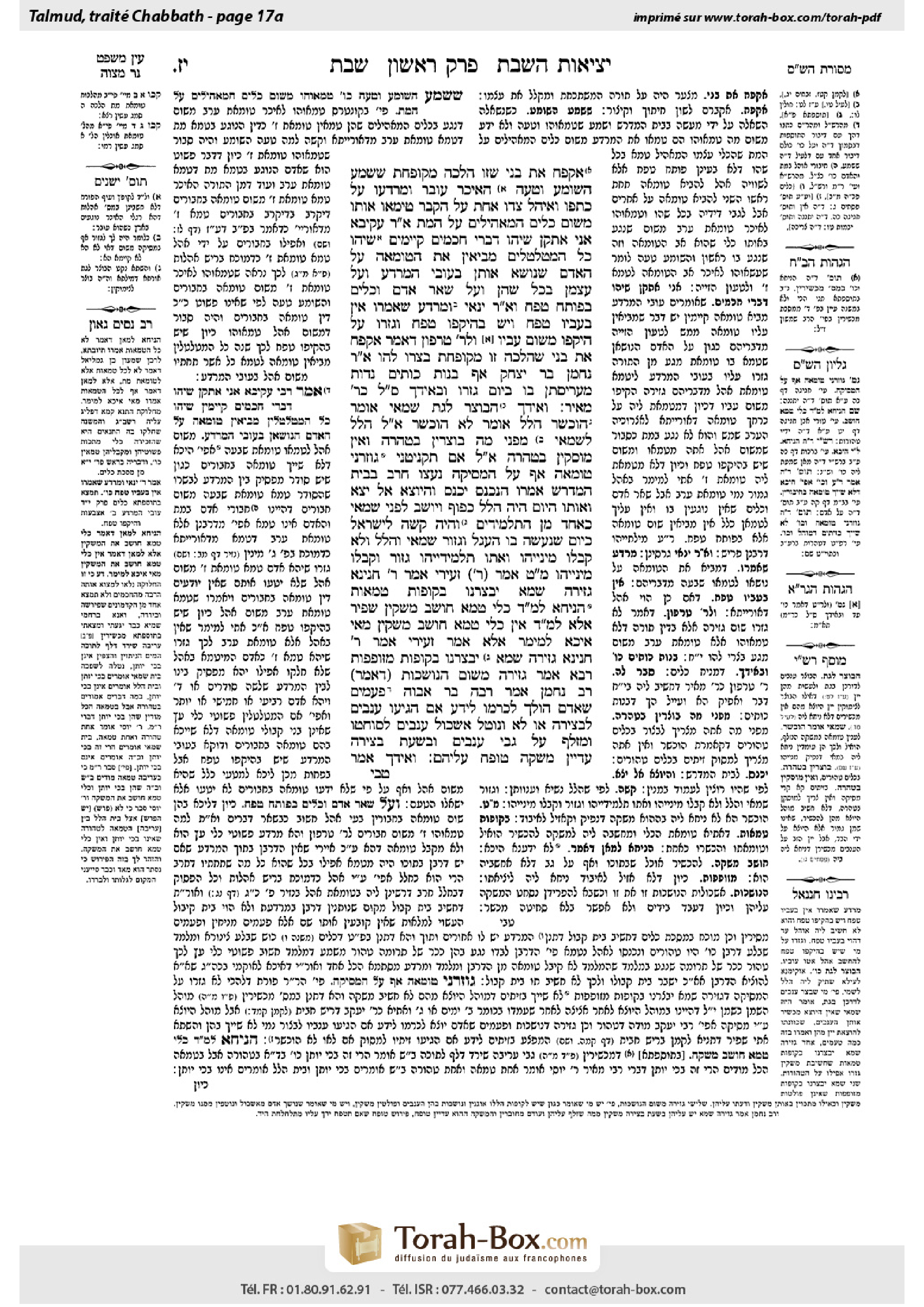
Shabbat 17a: Talmud study for Daf Yomi
Daf Yomi is the daily study of one Talmud folio. Explore 37 tractates with scans, Hebrew text, Sefaria English and AI-generated French translations where annotated.
Passage selection and English or AI-generated French translation are available where the scan has annotations. Daf Study is independent of Torah-Box and Sefaria.
Browse Shabbat · שבת · All tractatesShabbat 17a text and translations
This page of Shabbat includes the Aramaic text, an English translation and an AI-generated French translation, alongside the scan above.
שבת י״ז א · Aramaic and Hebrew text
אֲקַפֵּחַ אֶת בָּנַי שֶׁזּוֹ הֲלָכָה מְקוּפַּחַת, שֶׁשָּׁמַע הַשּׁוֹמֵעַ, וְטָעָה: הָאִיכָּר עוֹבֵר וּמַרְדְּעוֹ עַל כְּתֵפוֹ וְאִיהֵל צִדּוֹ אֶחָד עַל הַקֶּבֶר — טִימְּאוּ אוֹתוֹ, מִשּׁוּם כֵּלִים הַמַּאֲהִילִים עַל הַמֵּת.
אָמַר רַבִּי עֲקִיבָא, אֲנִי אֲתַקֵּן שֶׁיְּהוּ דִּבְרֵי חֲכָמִים קַיָּימִים: שֶׁיְּהוּ כׇּל הַמִּטַּלְטְלִים מְבִיאִין אֶת הַטּוּמְאָה עַל הָאָדָם שֶׁנּוֹשֵׂא אוֹתָן בְּעוֹבִי הַמַּרְדֵּעַ, וְעַל עַצְמָן בְּכָל שֶׁהֵן. וְעַל שְׁאָר אָדָם וְכֵלִים — בְּפוֹתֵחַ טֶפַח.
וְאָמַר רַבִּי יַנַּאי: וּמַרְדֵּעַ שֶׁאָמְרוּ, אֵין בְּעׇבְיוֹ טֶפַח וְיֵשׁ בְּהֶיקֵּפוֹ טֶפַח — וְגָזְרוּ עַל הֶיקֵּפוֹ מִשּׁוּם עׇבְיוֹ.
וּלְרַבִּי טַרְפוֹן דְּאָמַר אֲקַפֵּחַ אֶת בָּנַי שֶׁהֲלָכָה זוֹ מְקוּפַּחַת — בָּצְרוּ לְהוּ! אָמַר רַב נַחְמָן בַּר יִצְחָק: אַף בְּנוֹת כּוּתִים נִדּוֹת מֵעֲרִיסָתָן, בּוֹ בַּיּוֹם גָּזְרוּ. וּבְאִידַּךְ סְבִירָא לֵיהּ כְּרַבִּי מֵאִיר.
וְאִידַּךְ — הַבּוֹצֵר לַגַּת, שַׁמַּאי אוֹמֵר: הוּכְשַׁר, הִלֵּל אוֹמֵר: לֹא הוּכְשַׁר. אָמַר לוֹ הִלֵּל לְשַׁמַּאי: מִפְּנֵי מַה בּוֹצְרִין בְּטָהֳרָה וְאֵין מוֹסְקִין בְּטָהֳרָה?
אָמַר לוֹ: אִם תַּקְנִיטֵנִי, גּוֹזְרַנִי טוּמְאָה אַף עַל הַמְּסִיקָה. נָעֲצוּ חֶרֶב בְּבֵית הַמִּדְרָשׁ, אָמְרוּ: הַנִּכְנָס — יִכָּנֵס, וְהַיּוֹצֵא — אַל יֵצֵא. וְאוֹתוֹ הַיּוֹם הָיָה הִלֵּל כָּפוּף וְיוֹשֵׁב לִפְנֵי שַׁמַּאי כְּאֶחָד מִן הַתַּלְמִידִים. וְהָיָה קָשֶׁה לְיִשְׂרָאֵל כַּיּוֹם שֶׁנַּעֲשָׂה בּוֹ הָעֵגֶל. וּגְזוּר שַׁמַּאי וְהִלֵּל וְלָא קַבִּלוּ מִינַּיְיהוּ, וַאֲתוֹ תַּלְמִידַיְיהוּ גְּזוּר וְקַבִּלוּ מִינַּיְיהוּ.
מַאי טַעְמָא? אָמַר רַבִּי זְעֵירִי אָמַר רַבִּי חֲנִינָא: גְּזֵירָה שֶׁמָּא יִבְצְרֶנּוּ בְּקוּפּוֹת טְמֵאוֹת.
הָנִיחָא לְמַאן דְּאָמַר כְּלִי טָמֵא חוֹשֵׁב מַשְׁקִין — שַׁפִּיר, אֶלָּא לְמַאן דְּאָמַר אֵין כְּלִי טָמֵא חוֹשֵׁב מַשְׁקִין — מַאי אִיכָּא לְמֵימַר? אֶלָּא אָמַר זְעֵירִי אָמַר רַבִּי חֲנִינָא: גְּזֵירָה שֶׁמָּא יִבְצְרֶנּוּ בְּקוּפּוֹת מְזוּפָּפוֹת.
רָבָא אָמַר: גְּזֵירָה מִשּׁוּם הַנּוֹשְׁכוֹת. דְּאָמַר רַב נַחְמָן אָמַר רַבָּה בַּר אֲבוּהּ: פְּעָמִים שֶׁאָדָם הוֹלֵךְ לְכַרְמוֹ לֵידַע אִם הִגִּיעוּ עֲנָבִים לִבְצִירָה אוֹ לֹא, וְנוֹטֵל אֶשְׁכּוֹל עֲנָבִים לְסוֹחֳטוֹ, וּמְזַלֵּף עַל גַּבֵּי עֲנָבִים — וּבִשְׁעַת בְּצִירָה עֲדַיִין מַשְׁקֶה טוֹפֵחַ עֲלֵיהֶם.
וְאִידַּךְ, אָמַר
Shabbat 17a · English translation
I will bury my sons if this is not a truncated halakha, i.e., that the one who heard it, heard a halakhic ruling concerning a different situation and erred. He thought this halakha was established with regard to the following: Movable objects with the thickness of an ox goad transmit impurity to another vessel when the movable object is over both the source of impurity and the vessel at the same time. However, the original halakha is as follows: If the farmer was passing and his ox goad was on his shoulder and one side of the ox goad covered the grave, the Sages deemed the ox goad itself impure due to the impurity of vessels that cover a corpse. Any object located over a grave becomes impure. However, just because the ox goad itself became impure, this does not necessarily mean that it transmits impurity to other objects.
Rabbi Akiva said: I will correct and explain the halakha so that the statements of the Sages will be upheld as they were originally said, and this halakha will be explained as follows: All movable objects transmit impurity to the person carrying them if the objects are at least as thick as an ox goad. As will be explained below, there is room to decree that a round object with the circumference of an ox goad should have the legal status of a tent over a corpse. Something that serves as a covering over a corpse not only becomes impure itself, but also transmits impurity, as it is written: “Anything that is in the tent will become impure for seven days” (Numbers 19:14). Therefore, even the person carrying the ox goad becomes impure due to the ox goad. And, however, movable objects that covered the corpse bring impurity upon themselves by means of this makeshift tent at any size, and there is no minimum measure. And, however, those objects that cover the corpse do not transmit impurity to other people who are not carrying them. And the same is true with regard to vessels, unless the width of these vessels is at least one handbreadth.
And Rabbi Yannai said: And the ox goad that they mentioned is specifically one in which its width is not a handbreadth and, however, its circumference is a handbreadth, and they, the Sages, issued a decree on its circumference due to its width. If its width was a handbreadth it would transmit impurity as a tent by Torah law. Therefore, they issued a rabbinic decree with regard to an object whose circumference is a handbreadth. This is another of the eighteen decrees.
The Gemara asks: And according to Rabbi Tarfon, who said: I will bury my son if this is not a truncated halakha, the tally of the decrees is lacking, and there are not eighteen. Rav Naḥman bar Yitzḥak said: The decree that the daughters of the Samaritans are considered to already have the status of menstruating women from their cradle, they issued on that day. And in the other matter of drawn water, he holds in accordance with the opinion of Rabbi Meir, and thereby the tally of the decrees is complete.
And another of those decrees is the matter of one who harvests grapes in order to take them to the press. Shammai says: It has become susceptible, and Hillel says: It has not become susceptible. Hillel said to Shammai: If so, for what purpose do they harvest grapes in purity, i.e., utilizing pure vessels, as in your opinion, since the grapes are susceptible to impurity by means of the juice that seeps from them, care must be taken to avoid impurity while gathering; and, however, they do not harvest olives in purity? According to your opinion that liquid that seeps out renders the fruit susceptible to impurity, why is there not a similar concern with regard to the liquid that seeps out of olives?
Shammai said to him: If you provoke me and insist that there is no difference between gathering olives and grapes, then, in order not to contradict this, I will decree impurity on the gathering of olives as well. They related that since the dispute was so intense, they stuck a sword in the study hall, and they said: One who seeks to enter the study hall, let him enter, and one who seeks to leave may not leave, so that all of the Sages will be assembled to determine the halakha. That day Hillel was bowed and was sitting before Shammai like one of the students. The Gemara said: And that day was as difficult for Israel as the day the Golden Calf was made, as Hillel, who was the Nasi, was forced to sit in submission before Shammai, and the opinion of Beit Shammai prevailed in the vote conducted that day. And Shammai and Hillel issued the decree, and the people did not accept it from them. And their students came and issued the decree, and the people accepted it from them.
As to the essence of the matter, the Gemara asks: What is the reason they decreed that liquids that seeped from the grapes unintentionally render the grapes susceptible to impurity? Rabbi Ze’iri said that Rabbi Ḥanina said: The Sages issued a decree due to concern lest he gather the grapes in impure baskets. The impurity of the vessel would accord the liquid in it the status of a liquid that renders food items susceptible to impurity.
The Gemara asks: This works out well, according to the one who said that an impure vessel accords liquids in it the halakhic status as if they were placed there willfully, and they render foods susceptible to impurity even if he did not want the liquids in the vessel. However, according to the one who said that an impure vessel does not accord liquids that status, what can be said in explanation of the decree? Rather, Rabbi Ze’iri said that Rabbi Ḥanina said the following: The reason is not as we suggested; rather, this is a decree instituted by the Sages lest he gather them in pitched baskets, which are sealed. Since liquids that seep out of the grapes do not spill out of the baskets, it is opportune for him to have the liquids seep out of the grapes as he thereby accelerates the production of wine in the press. Because the seeping of the liquid is opportune, it renders the grapes susceptible to impurity.
Rava said: The reason for the decree is due to the case of liquid that squirted out when one separated clusters of grapes that were stuck together. Since he did so by his own hand, consciously and willfully, the liquid that seeps out renders the grapes susceptible to impurity. Just as Rav Naḥman said that Rabba bar Avuh said: Sometimes a person goes to his vineyard in order to ascertain whether or not the grapes have reached the time for gathering, and he takes a cluster of grapes to squeeze it, and he sprays the juice onto the grapes. Based on the quality of the juice, he determines whether or not the grapes are sufficiently ripe. If so, this grape juice was squeezed by his own hand willfully and it renders the grapes susceptible to impurity, as even at the time of gathering it is conceivable that the liquid is still moist upon the grapes.
Since all eighteen decrees decreed that day have not yet been enumerated, the Gemara asks: And what is the other? Said
Shabbat 17a · Traduction française (IA)
J’ensevelirai mes fils si ceci n’est pas une halakha tronquée, c’est-à-dire si celui qui l’a entendue n’avait pas entendu une décision halakhique concernant une autre situation et ne s’était pas trompé. Il pensait que cette halakha avait été établie au sujet du cas suivant : les objets mobiles d’une épaisseur égale à celle d’un aiguillon de bœuf transmettent l’impureté à un autre récipient lorsque l’objet mobile se trouve simultanément au-dessus de la source d’impureté et du récipient. Mais la halakha initiale est la suivante : si un paysan passait avec son aiguillon sur l’épaule et qu’un côté de l’aiguillon recouvrait la tombe, les Sages ont déclaré l’aiguillon lui-même impur, en raison de l’impureté des récipients qui recouvrent un cadavre. Tout objet situé au-dessus d’une tombe devient impur. Toutefois, le fait que l’aiguillon lui-même soit devenu impur ne signifie pas nécessairement qu’il transmette l’impureté à d’autres objets.
Rabbi Akiva dit : Je vais rectifier et expliquer la halakha, afin que les paroles des Sages soient maintenues telles qu’elles ont été prononcées à l’origine. Voici comment cette halakha doit être expliquée : tous les objets mobiles transmettent l’impureté à la personne qui les porte si ces objets ont au moins l’épaisseur d’un aiguillon de bœuf. Comme cela sera expliqué ci-dessous, il y a lieu de décréter qu’un objet rond dont la circonférence est égale à celle d’un aiguillon de bœuf ait le statut d’une tente au-dessus d’un cadavre. Ce qui sert de couverture au-dessus d’un cadavre ne devient pas seulement impur, mais transmet aussi l’impureté, comme il est écrit : « Tout ce qui se trouvera dans la tente sera impur pendant sept jours » (Nombres 19,14). Par conséquent, même la personne qui porte l’aiguillon devient impure à cause de celui-ci. En revanche, les objets mobiles qui recouvrent le cadavre deviennent eux-mêmes impurs par le biais de cette tente improvisée, quelle que soit leur taille ; aucune mesure minimale n’est requise. Toutefois, ces objets qui recouvrent le cadavre ne transmettent pas l’impureté à d’autres personnes qui ne les portent pas. Il en va de même pour les récipients, à moins que leur largeur ne soit d’au moins une palme.
Rabbi Yannai dit : L’aiguillon de bœuf dont ils ont parlé est précisément un aiguillon dont la largeur est inférieure à une palme, mais dont la circonférence est d’une palme ; les Sages ont décrété au sujet de sa circonférence en raison de sa largeur. Si sa largeur était d’une palme, il transmettrait l’impureté comme une tente selon la Torah écrite. C’est pourquoi ils ont institué un décret rabbinique concernant un objet dont la circonférence est d’une palme. Voilà un autre des dix-huit décrets.
La Guemara demande : Et selon Rabbi Tarfon, qui a dit : « J’ensevelirai mon fils si ceci n’est pas une halakha tronquée », il manque un décret au décompte, qui n’en comporte donc pas dix-huit. Rav Naḥman bar Yitzḥak dit : Le décret selon lequel les filles des Samaritains sont considérées comme ayant déjà le statut de femmes menstruées dès leur berceau a été institué ce jour-là. Quant à l’autre sujet, celui de l’eau puisée, il suit l’opinion de Rabbi Meïr ; ainsi, le décompte des décrets est complet.
Un autre de ces décrets concerne celui qui vendange des raisins pour les apporter au pressoir. Chammaï dit : Ils sont devenus susceptibles à l’impureté ; Hillel dit : Ils ne sont pas devenus susceptibles à l’impureté. Hillel dit à Chammaï : Dans ce cas, pourquoi vendange-t-on les raisins en état de pureté, c’est-à-dire en utilisant des récipients purs ? Selon ton opinion, puisque les raisins sont susceptibles à l’impureté à cause du jus qui suinte, il faut prendre soin d’éviter l’impureté pendant la récolte ; pourtant, on ne récolte pas les olives en état de pureté. Selon ton opinion, puisque le liquide qui suinte rend les fruits susceptibles à l’impureté, pourquoi ne prend-on pas une précaution semblable à l’égard du liquide qui suinte des olives ?
Chammaï lui dit : Si tu me provoques et insistes pour dire qu’il n’y a pas de différence entre la récolte des olives et celle des raisins, alors, afin de ne pas me contredire, je décréterai également l’impureté pour la récolte des olives. On rapporte que, comme la controverse était si vive, on planta une épée dans la maison d’étude et l’on déclara : « Que celui qui veut entrer dans la maison d’étude entre ; mais que celui qui veut sortir n’en sorte pas », afin que tous les Sages soient réunis pour déterminer la halakha. Ce jour-là, Hillel était courbé et siégeait devant Chammaï, comme l’un de ses élèves. La Guemara dit : Ce jour-là fut aussi difficile pour Israël que le jour où le Veau d’or fut fabriqué, car Hillel, qui était le nassi, fut contraint de s’asseoir humblement devant Chammaï, et l’opinion de Beit Chammaï l’emporta lors du vote tenu ce jour-là. Chammaï et Hillel instituèrent le décret, mais le peuple ne l’accepta pas d’eux. Leurs élèves vinrent ensuite et instituèrent le décret, et le peuple l’accepta d’eux.
Sur le fond de la question, la Guemara demande : Pourquoi ont-ils décrété que le liquide qui suinte involontairement des raisins les rend susceptibles à l’impureté ? Rabbi Ze’iri dit au nom de Rabbi Ḥanina : Les Sages ont institué un décret par crainte qu’il ne récolte les raisins dans des paniers impurs. L’impureté du récipient conférerait au liquide qu’il contient le statut d’un liquide qui rend les aliments susceptibles à l’impureté.
La Guemara demande : Cela convient selon celui qui dit qu’un récipient impur confère aux liquides qu’il contient le statut de liquides qui y ont été placés intentionnellement, et qu’ils rendent les aliments susceptibles à l’impureté même si la personne ne voulait pas que ces liquides se trouvent dans le récipient. Mais, selon celui qui dit qu’un récipient impur ne confère pas ce statut aux liquides qu’il contient, que peut-on dire pour expliquer le décret ? Rabbi Ze’iri dit alors au nom de Rabbi Ḥanina : La raison n’est pas celle que nous avons suggérée ; le décret des Sages vise plutôt à prévenir le cas où il récolterait les raisins dans des paniers enduits de poix, qui sont étanches. Comme le liquide qui suinte des raisins ne s’écoule pas des paniers, il lui est avantageux que le jus suinte des raisins, puisqu’il accélère ainsi la production de vin au pressoir. Le suintement du liquide lui étant avantageux, il rend les raisins susceptibles à l’impureté.
Rava dit : La raison du décret tient au cas du liquide qui jaillit lorsqu’on sépare des grappes de raisins collées les unes aux autres. Comme il le fait de sa propre main, consciemment et volontairement, le liquide qui suinte rend les raisins susceptibles à l’impureté. De même, Rav Naḥman a dit que Rabba bar Avuh a dit : Il arrive qu’une personne se rende dans sa vigne pour vérifier si les raisins sont arrivés à maturité et peuvent être récoltés ; elle prend une grappe pour la presser et projette le jus sur les raisins. D’après la qualité du jus, elle détermine si les raisins sont suffisamment mûrs. Dans ce cas, ce jus de raisin a été extrait de sa propre main, volontairement, et il rend les raisins susceptibles à l’impureté, car il est concevable que le liquide soit encore humide sur les raisins au moment de la récolte.
Comme les dix-huit décrets institués ce jour-là n’ont pas encore tous été énumérés, la Guemara demande : Et quel est l’autre ? Il dit
Traduction française générée par IA à partir de l’édition anglaise de Sefaria. Vérifie toujours un passage avec le texte source.
Text from Sefaria: William Davidson Edition - Vocalized Aramaic (CC BY NC); William Davidson Edition - English (CC BY NC).