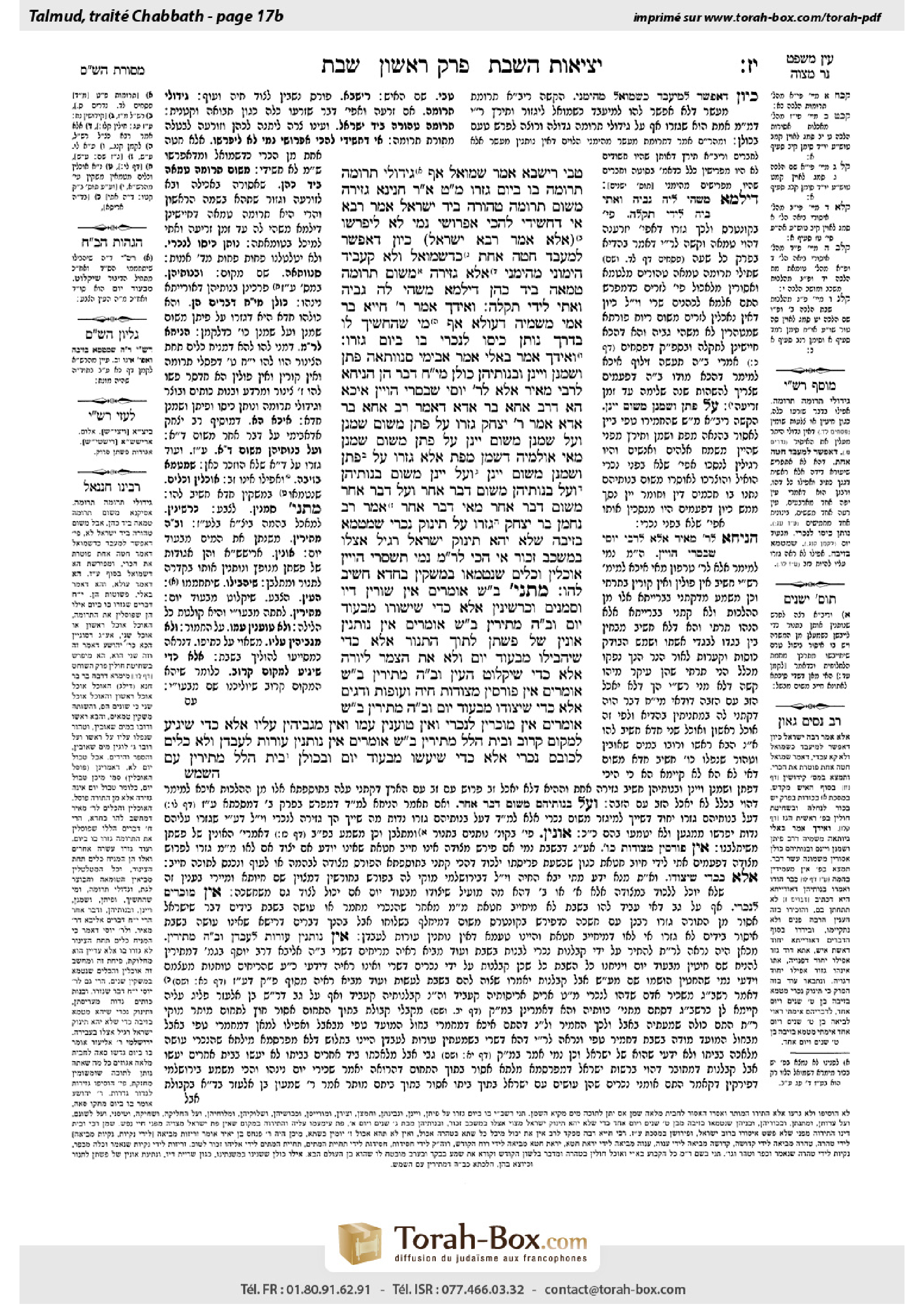
Shabbat 17b: Talmud study for Daf Yomi
Daf Yomi is the daily study of one Talmud folio. Explore 37 tractates with scans, Hebrew text, Sefaria English and AI-generated French translations where annotated.
Passage selection and English or AI-generated French translation are available where the scan has annotations. Daf Study is independent of Torah-Box and Sefaria.
Browse Shabbat · שבת · All tractatesShabbat 17b text and translations
This page of Shabbat includes the Aramaic text, an English translation and an AI-generated French translation, alongside the scan above.
שבת י״ז ב · Aramaic and Hebrew text
טָבִי רִישְׁבָּא אָמַר שְׁמוּאֵל: אַף גִּידּוּלֵי תְרוּמָה תְּרוּמָה, בּוֹ בַּיּוֹם גָּזְרוּ. מַאי טַעְמָא? אָמַר רַבִּי חֲנִינָא: גְּזֵירָה מִשּׁוּם תְּרוּמָה טְהוֹרָה בְּיַד יִשְׂרָאֵל.
אָמַר רָבָא: אִי דַּחֲשִׁידִי לְהָכִי, אַפְרוֹשֵׁי נָמֵי לָא לַיפְרְשׁוּ! (אֶלָּא אָמַר רָבָא: יִשְׂרָאֵל) כֵּיוָן דְּאֶפְשָׁר לְמֶעְבַּד חִטָּה אַחַת כְּדִשְׁמוּאֵל וְלָא קָעָבֵיד, הֵימוֹנֵי מְהֵימְנֵי. אֶלָּא גְּזֵירָה מִשּׁוּם תְּרוּמָה טְמֵאָה בְּיַד כֹּהֵן, דִילְמָא מַשְׁהֵי לַהּ גַּבֵּיהּ וְאָתֵי לִידֵי תַקָּלָה.
וְאִידַּךְ, אָמַר רַבִּי חִיָּיא בַּר אַמֵּי מִשְּׁמֵיהּ דְּעוּלָּא: אַף מִי שֶׁהֶחֱשִׁיךְ לוֹ בַּדֶּרֶךְ נוֹתֵן כִּיסוֹ לְגוֹי — בּוֹ בַּיּוֹם גָּזְרוּ.
וְאִידַּךְ, אָמַר בָּאלִי אָמַר אֲבִימִי סִנְוְותָאָה: פִּתָּן וְשַׁמְנָן וְיֵינָן וּבְנוֹתֵיהֶן — כּוּלָּן מִשְּׁמוֹנָה עָשָׂר דָּבָר הֵן. הָנִיחָא לְרַבִּי מֵאִיר, אֶלָּא לְרַבִּי יוֹסֵי שִׁבְסְרֵי הָוְיָין! אִיכָּא הָא דְּרַב אַחָא בַּר אַדָּא. דְּאָמַר רַב אַחָא בַּר אַדָּא אָמַר רַבִּי יִצְחָק: גָּזְרוּ עַל פִּתָּן מִשּׁוּם שַׁמְנָן, וְעַל שַׁמְנָן מִשּׁוּם יֵינָן.
עַל פִּתָּן מִשּׁוּם שַׁמְנָן?! מַאי אוּלְמֵיהּ דְּשֶׁמֶן מִפַּת? אֶלָּא גָּזְרוּ עַל פִּתָּן וְשַׁמְנָן מִשּׁוּם יֵינָן, וְעַל יֵינָן מִשּׁוּם בְּנוֹתֵיהֶן, וְעַל בְּנוֹתֵיהֶן מִשּׁוּם דָּבָר אַחֵר, וְעַל דָּבָר אַחֵר מִשּׁוּם דָּבָר אַחֵר. מַאי דָּבָר אַחֵר? אָמַר רַב נַחְמָן בַּר יִצְחָק: גָּזְרוּ עַל תִּינוֹק גּוֹי שֶׁמְטַמֵּא בְּזִיבָה, שֶׁלֹּא יְהֵא תִּינוֹק יִשְׂרָאֵל רָגִיל אֶצְלוֹ בְּמִשְׁכַּב זָכוּר. אִי הָכִי, לְרַבִּי מֵאִיר נָמֵי תְּשַׁסְרֵי הָוְיָין! אוֹכָלִין וְכֵלִים שֶׁנִּטְמְאוּ בְּמַשְׁקִין בַּחֲדָא חָשֵׁיב לְהוּ.
מַתְנִי׳ בֵּית שַׁמַּאי אוֹמְרִים: אֵין שׁוֹרִין דְּיוֹ וְסַמָּנִים וְכַרְשִׁינִין אֶלָּא כְּדֵי שֶׁיִּשּׁוֹרוּ מִבְּעוֹד יוֹם, וּבֵית הִלֵּל מַתִּירִין. בֵּית שַׁמַּאי אוֹמְרִים: אֵין נוֹתְנִין אוּנִּין שֶׁל פִּשְׁתָּן לְתוֹךְ הַתַּנּוּר אֶלָּא כְּדֵי שֶׁיַּהְבִּילוּ מִבְּעוֹד יוֹם, וְלֹא אֶת הַצֶּמֶר לַיּוֹרָה אֶלָּא כְּדֵי שֶׁיִּקְלוֹט הָעַיִן, וּבֵית הִלֵּל מַתִּירִין.
בֵּית שַׁמַּאי אוֹמְרִים: אֵין פּוֹרְסִין מְצוּדוֹת חַיָּה וְעוֹפוֹת וְדָגִים אֶלָּא כְּדֵי שֶׁיִּצּוֹדוּ מִבְּעוֹד יוֹם, וּבֵית הִלֵּל מַתִּירִין. בֵּית שַׁמַּאי אוֹמְרִים: אֵין מוֹכְרִין לְגוֹי וְאֵין טוֹעֲנִין עִמּוֹ וְאֵין מַגְבִּיהִין עָלָיו אֶלָּא כְּדֵי שֶׁיַּגִּיעַ לְמָקוֹם קָרוֹב, וּבֵית הִלֵּל מַתִּירִין. בֵּית שַׁמַּאי אוֹמְרִים: אֵין נוֹתְנִין עוֹרוֹת לְעַבְּדָן, וְלֹא כֵּלִים לְכוֹבֵס גּוֹי אֶלָּא כְּדֵי שֶׁיֵּעָשׂוּ מִבְּעוֹד יוֹם. וּבְכוּלָּן בֵּית הִלֵּל מַתִּירִין עִם
Shabbat 17b · English translation
Tavi the bird hunter [rishba] that Shmuel said: The decree that growths of teruma, i.e., produce that grows from teruma that was planted in the ground, are considered teruma, the Sages also issued on that day. The Gemara asks: What is the reason for this decree? Rabbi Ḥanina said: A decree due to pure teruma in the hand of a non-priest Israelite. One who seeks to avoid giving teruma to a priest would plant it in the ground and thereby negate its teruma status. To prevent him from doing so, the Sages decreed that that which grows from the teruma is also considered teruma. Consequently, one would gain nothing by replanting the teruma.
Rava said: If they are suspected of that, let them refrain from separating teruma altogether. Rather, Rava said: We know that with regard to an Israelite, as opposed to a Levite, fundamentally it is possible to perform the mitzva of teruma by separating merely one grain of wheat, in accordance with the opinion of Shmuel, who said that by Torah law there is no fixed measure for teruma. By separating one grain of wheat as teruma for all the wheat on the threshing floor, one fulfills his obligation. Since he nevertheless did not take advantage of that possibility to exempt himself from the obligation of separating teruma, he is trustworthy, and there is no reason to suspect that he will seek to avoid giving teruma to the priest by planting it. Rather, the reason for the decree is due to impure teruma in the hand of a priest. A priest is forbidden to eat impure teruma and he is required to burn it. However, the priest is permitted to derive benefit from its burning. The Sages were concerned lest he keep the impure teruma with him until the season of sowing and sow his field with it, and, as a result, he encounter a stumbling-block because over time he is liable to forget that the teruma is impure and eat it.
With regard to the total of eighteen decrees, the Gemara asks: And what is the other decree? Rabbi Ḥiyya bar Ami said in the name of Ulla: In a case of one who was carrying a purse with money in it on Shabbat eve, and it got dark for him on the way, the Torah law permitted him to carry the purse in increments, each of which is less than four cubits. However, the Sages issued the following decree: It is prohibited to carry in increments; he should give his purse to a gentile accompanying him. This decree was also issued on that day.
And the other decree: The Sage Bali said that Avimi of Sanvata said: The decrees with regard to gentiles that prohibit their bread, and their oil, and their wine, and their daughters are all one decree of the eighteen matters. The Gemara asks: This works out well according to Rabbi Meir, as according to his opinion the Gemara already enumerated eighteen decrees. However, according to Rabbi Yosei, who holds that the dispute remains with regard to the matter of vessels in the courtyard, they are only seventeen. The Gemara answers: There is also that statement of Rav Aḥa bar Adda, as Rav Aḥa bar Adda said that Rabbi Yitzḥak said: The Sages issued a decree prohibiting eating their bread due to their oil. And they issued a decree prohibiting their oil due to their wine. Consequently, there are two separate decrees.
The Gemara wonders: They issued a decree on their bread because of their oil. In what way is the prohibition on oil stronger than the prohibition on bread? Rather, say that they issued a decree prohibiting their bread and their oil due to their wine. And they issued a decree prohibiting their wine due to the fact that it leads to familiarity, and people will come to marry their daughters. And they issued a decree prohibiting their daughters due to something else, idolatry. And they further issued a decree on something else, idolatry, due to something else. The Gemara asks: What is the something else alluded to here? Rav Naḥman bar Yitzḥak said: They issued a decree on a gentile baby, according him the legal status that he transmits impurity as one with the legal status of a great zav, who experienced three emissions, even though he did not experience an emission. This was in order to distance Jewish children from gentile children so that a Jewish boy should not be accustomed to be with a gentile in homosexual relations. The Gemara asks: If so, according to Rabbi Meir it is difficult as well, as they are now nineteen decrees. The Gemara answers: Rabbi Meir counts the decrees of food items and vessels that became impure through contact with liquids as one. Consequently, according to Rabbi Meir, too, there are only eighteen decrees.
MISHNA: In this mishna there is a fundamental dispute between Beit Hillel and Beit Shammai: Must one begin refraining from actions prohibited on Shabbat on Shabbat eve? Or, may one initiate an action prior to Shabbat, even if he knows that it will continue on its own on Shabbat itself? These are the details of that dispute: Beit Shammai say: One may only soak dry ink in water and dry plants, which produce dyes, in water and vetch for animal food to soften them in water on Shabbat eve, adjacent to Shabbat, if there is clearly sufficient time for them to soak for their designated purpose while it is still day, before Shabbat begins, and their continued soaking on Shabbat will have no effect. And Beit Hillel permit doing so. Beit Shammai say: One may only place bundles of combed flax inside the oven on Shabbat eve if there is sufficient time so that they will be heated while it is still day. And one may only place wool into the dyer’s kettle if there is sufficient time for the wool to absorb the dye while it is still day. And Beit Hillel permit doing so.
Beit Shammai say: One may spread traps for an animal and birds and fish only if there is sufficient time remaining in the day for them to be trapped in them while it is still day, and Beit Hillel permit doing so even if there is not sufficient time remaining in the day. Beit Shammai say: One may only sell an item to a gentile on Shabbat eve, and one may only load a burden on his donkey with him, and one may only lift a burden on him if there remains sufficient time for the gentile to arrive to a near place prior to Shabbat, and the Jew will play no role in the performance of a prohibited labor by the gentile on Shabbat. And Beit Hillel permit doing so. Beit Shammai say: One may not give skins to a gentile tanner, nor clothes to a gentile launderer, unless there is sufficient time for work on them to be completed while it is still day, before Shabbat begins. And in all of them Beit Hillel permit doing so with
Shabbat 17b · Traduction française (IA)
Tavi, l’oiseleur [rishba], dont Shmuel a parlé : le décret selon lequel les pousses de terouma, c’est-à-dire les produits qui poussent à partir de terouma plantée en terre, sont considérées comme de la terouma, fut également promulgué ce jour-là. La Guemara demande : Quelle est la raison de ce décret ? Rabbi Ḥanina dit : Il s’agit d’un décret visant la terouma pure qui se trouve entre les mains d’un Israélite non prêtre. Celui qui cherche à éviter de donner la terouma à un prêtre pourrait la planter en terre et ainsi annuler son statut de terouma. Pour l’en empêcher, les Sages décrétèrent que ce qui pousse à partir de cette terouma est également considéré comme de la terouma. Par conséquent, on ne gagnerait rien à replanter la terouma.
Rava dit : S’ils sont soupçonnés de cela, qu’ils s’abstiennent complètement de prélever la terouma. Rava dit plutôt : Nous savons qu’en ce qui concerne un Israélite, par opposition à un lévite, il est fondamentalement possible d’accomplir la mitsva de terouma en ne prélevant qu’un seul grain de blé, conformément à l’opinion de Shmuel, qui a dit que, selon la Torah, la terouma n’a pas de mesure fixe. En prélevant un grain de blé comme terouma sur tout le blé de l’aire de battage, on s’acquitte de son obligation. Puisqu’il n’a pourtant pas tiré parti de cette possibilité pour se soustraire à l’obligation de prélever la terouma, il est digne de confiance, et rien ne justifie de soupçonner qu’il cherchera à éviter de donner la terouma au prêtre en la plantant. La raison du décret est plutôt la terouma impure qui se trouve entre les mains d’un prêtre. Un prêtre n’a pas le droit de manger de terouma impure et doit la brûler. Cependant, il lui est permis de tirer profit de sa combustion. Les Sages craignirent qu’il ne conserve la terouma impure jusqu’à la saison des semailles et ne sème son champ avec, au risque de trébucher : avec le temps, il pourrait oublier que la terouma est impure et la manger.
À propos du total de dix-huit décrets, la Guemara demande : Et quel est l’autre décret ? Rabbi Ḥiyya bar Ami a dit au nom d’Ulla : Dans le cas de quelqu’un qui portait une bourse contenant de l’argent à la veille de Chabbat et qui fut surpris par la nuit en chemin, la Torah écrite lui permettait de transporter la bourse par étapes, chacune de moins de quatre coudées. Cependant, les Sages promulguèrent le décret suivant : il est interdit de la transporter par étapes ; il doit confier sa bourse à un non-Juif qui l’accompagne. Ce décret fut également promulgué ce jour-là.
Et l’autre décret : le Sage Bali a dit qu’Avimi de Sanvata a dit que les décrets concernant les non-Juifs — qui interdisent leur pain, leur huile, leur vin et leurs filles — constituent tous un seul des dix-huit décrets. La Guemara demande : Cela convient selon Rabbi Meir, car, d’après son opinion, la Guemara a déjà dénombré dix-huit décrets. Mais selon Rabbi Yosei, qui soutient que le différend concernant les ustensiles dans la cour demeure, il n’y en a que dix-sept. La Guemara répond : Il faut également compter cette déclaration de Rav Aḥa bar Adda, car Rav Aḥa bar Adda a dit que Rabbi Yitzḥak a dit : Les Sages ont décrété d’interdire leur pain à cause de leur huile, et ils ont décrété d’interdire leur huile à cause de leur vin. Il s’agit donc de deux décrets distincts.
La Guemara s’interroge : Ils ont décrété contre leur pain à cause de leur huile. En quoi l’interdiction de l’huile est-elle plus sévère que celle du pain ? Il faut plutôt dire qu’ils ont décrété contre leur pain et leur huile à cause de leur vin. Ils ont décrété contre leur vin parce qu’il entraîne une familiarité, et les gens en viendraient à épouser leurs filles. Ils ont décrété contre leurs filles à cause d’autre chose : l’idolâtrie. Et ils ont également décrété contre cette autre chose, l’idolâtrie, à cause d’autre chose encore. La Guemara demande : À quelle autre chose fait-on ici allusion ? Rav Naḥman bar Yitzḥak dit : Ils ont décrété qu’un nourrisson non juif avait le statut juridique de transmettre l’impureté comme un grand zav, qui a connu trois écoulements, bien qu’il n’en ait connu aucun. Cela visait à éloigner les enfants juifs des enfants non juifs, afin qu’un garçon juif ne prenne pas l’habitude d’entretenir des relations homosexuelles avec un non-Juif. La Guemara demande : Si c’est le cas, la difficulté se pose aussi selon Rabbi Meir, car il y aurait alors dix-neuf décrets. La Guemara répond : Rabbi Meir compte ensemble les décrets concernant les denrées alimentaires et les ustensiles devenus impurs au contact de liquides. Par conséquent, même selon Rabbi Meir, il n’y a que dix-huit décrets.
MICHNA : Cette Michna expose un différend fondamental entre Beit Hillel et Beit Shammaï : faut-il commencer à s’abstenir, dès la veille de Chabbat, des actes interdits pendant Chabbat ? Ou peut-on entreprendre une action avant Chabbat, même si l’on sait qu’elle se poursuivra d’elle-même pendant Chabbat ? Voici les détails de ce différend : Beit Shammaï disent : On ne peut faire tremper de l’encre sèche dans l’eau, des plantes tinctoriales dans l’eau et de la vesce destinée à l’alimentation des animaux dans l’eau pour la ramollir, à la veille de Chabbat, juste avant Chabbat, que s’il reste clairement assez de temps pour qu’elles trempent en vue de l’usage auquel elles sont destinées pendant qu’il fait encore jour, avant le début de Chabbat, de sorte que leur trempage ultérieur pendant Chabbat n’ait aucun effet. Beit Hillel le permettent. Beit Shammaï disent : On ne peut placer des bottes de lin peigné dans le four à la veille de Chabbat que s’il reste assez de temps pour qu’elles chauffent pendant qu’il fait encore jour. On ne peut mettre de la laine dans la cuve du teinturier que s’il reste assez de temps pour qu’elle absorbe la teinture pendant qu’il fait encore jour. Beit Hillel le permettent.
Beit Shammaï disent : On ne peut tendre des pièges pour capturer un animal, des oiseaux ou des poissons que s’il reste assez de temps dans la journée pour qu’ils y soient pris pendant qu’il fait encore jour ; Beit Hillel le permettent même s’il ne reste pas assez de temps dans la journée. Beit Shammaï disent : On ne peut vendre un objet à un non-Juif à la veille de Chabbat, lui charger un fardeau sur son âne, ni soulever un fardeau pour lui, que s’il reste assez de temps pour que le non-Juif parvienne à un lieu proche avant Chabbat et que le Juif ne prenne aucune part à l’accomplissement d’un travail interdit par le non-Juif pendant Chabbat. Beit Hillel le permettent. Beit Shammaï disent : On ne peut confier des peaux à un tanneur non juif, ni des vêtements à un blanchisseur non juif, à moins qu’il ne reste assez de temps pour que le travail soit achevé pendant qu’il fait encore jour, avant le début de Chabbat. Et dans tous ces cas, Beit Hillel le permettent même si ce délai ne reste pas.
Traduction française générée par IA à partir de l’édition anglaise de Sefaria. Vérifie toujours un passage avec le texte source.
Text from Sefaria: William Davidson Edition - Vocalized Aramaic (CC BY NC); William Davidson Edition - English (CC BY NC).