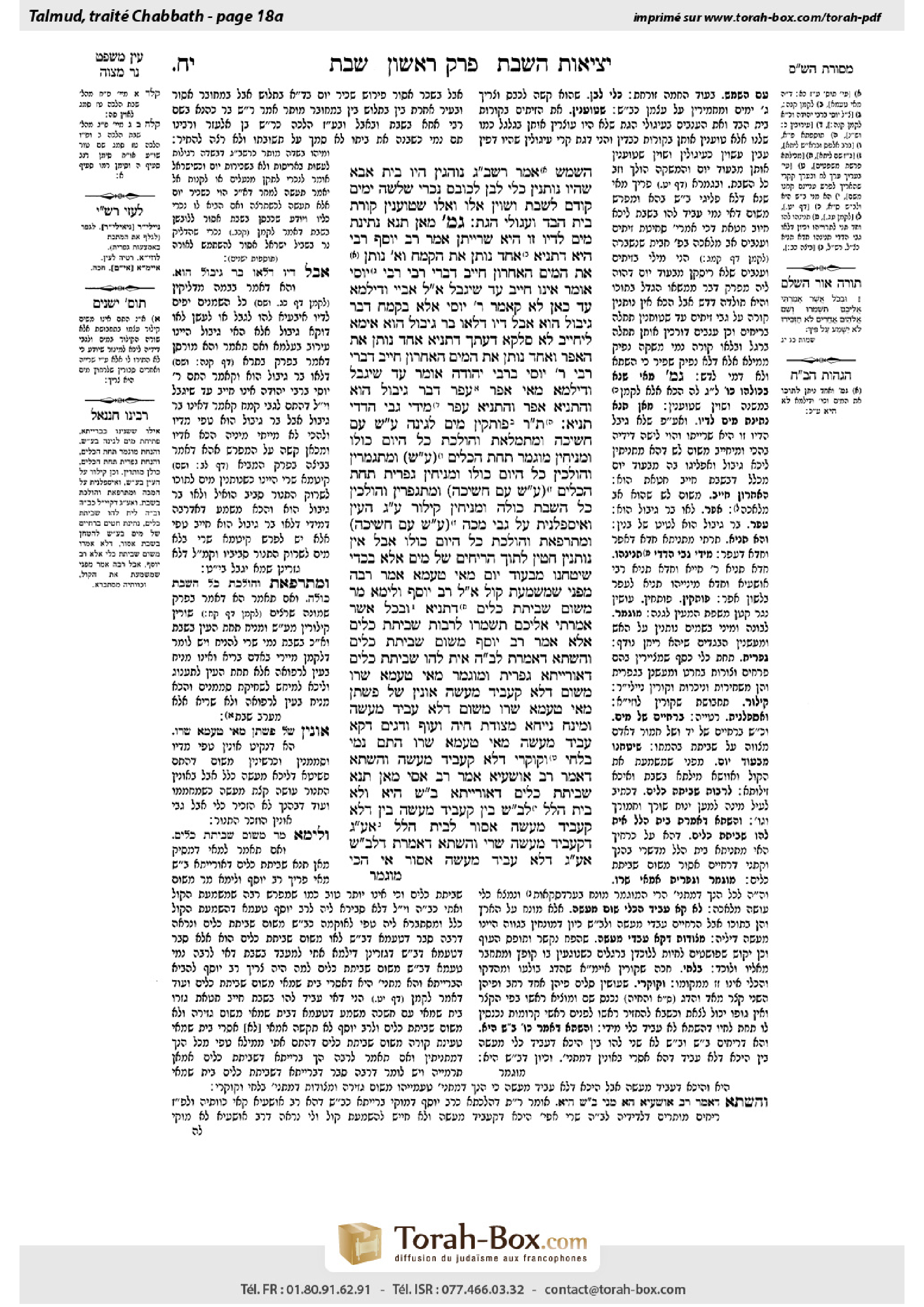
Shabbat 18a: Talmud study for Daf Yomi
Daf Yomi is the daily study of one Talmud folio. Explore 37 tractates with scans, Hebrew text, Sefaria English and AI-generated French translations where annotated.
Passage selection and English or AI-generated French translation are available where the scan has annotations. Daf Study is independent of Torah-Box and Sefaria.
Browse Shabbat · שבת · All tractatesShabbat 18a text and translations
This page of Shabbat includes the Aramaic text, an English translation and an AI-generated French translation, alongside the scan above.
שבת י״ח א · Aramaic and Hebrew text
הַשֶּׁמֶשׁ. אָמַר רַבָּן שִׁמְעוֹן בֶּן גַּמְלִיאֵל: נוֹהֲגִין הָיוּ בֵּית אַבָּא שֶׁהָיוּ נוֹתְנִין כְּלֵי לָבָן לְכוֹבֵס גּוֹי שְׁלֹשָׁה יָמִים קוֹדֶם לַשַּׁבָּת. וְשָׁוִין אֵלּוּ וְאֵלּוּ, שֶׁטּוֹעֲנִין קוֹרַת בֵּית הַבַּד וְעִגּוּלֵי הַגַּת.
גְּמָ׳ מַאן תְּנָא נְתִינַת מַיִם לִדְיוֹ זוֹ הִיא שְׁרִיָּיתָן? אָמַר רַב יוֹסֵף: רַבִּי הִיא. דְּתַנְיָא: אֶחָד נוֹתֵן אֶת הַקֶּמַח וְאֶחָד נוֹתֵן אֶת הַמַּיִם — הָאַחֲרוֹן חַיָּיב, דִּבְרֵי רַבִּי. רַבִּי יוֹסֵי אוֹמֵר: אֵינוֹ חַיָּיב עַד שֶׁיְּגַבֵּל.
אָמַר לֵיהּ אַבָּיֵי: וְדִילְמָא עַד כָּאן לָא קָאָמַר רַבִּי יוֹסֵי אֶלָּא בְּקֶמַח, דְּבַר גִּיבּוּל הוּא. אֲבָל דְּיוֹ דְּלָאו בַּר גִּיבּוּל הוּא, אֵימָא לִיחַיַּיב! לָא סָלְקָא דַּעְתָּךְ, דְּתַנְיָא: אֶחָד נוֹתֵן אֶת הָאֵפֶר וְאֶחָד נוֹתֵן אֶת הַמַּיִם — הָאַחֲרוֹן חַיָּיב, דִּבְרֵי רַבִּי. רַבִּי יוֹסֵי בְּרַבִּי יְהוּדָה אוֹמֵר: עַד שֶׁיְּגַבֵּל.
וְדִילְמָא מַאי ״אֵפֶר״ — עָפָר דְּבַר גִּיבּוּל הוּא?! וְהָתַנְיָא ״אֵפֶר״, וְהָתַנְיָא ״עָפָר״! מִידֵּי גַּבֵּי הֲדָדֵי תַּנְיָא?
תָּנוּ רַבָּנַן: פּוֹתְקִין מַיִם לַגִּינָּה עֶרֶב שַׁבָּת עִם חֲשֵׁיכָה וּמִתְמַלֵּאת וְהוֹלֶכֶת כׇּל הַיּוֹם כּוּלּוֹ, וּמַנִּיחִין מוּגְמָר תַּחַת הַכֵּלִים עֶרֶב שַׁבָּת וּמִתְגַּמְּרִין וְהוֹלְכִין כׇּל הַיּוֹם כּוּלּוֹ, וּמַנִּיחִין גׇּפְרִית תַּחַת הַכֵּלִים עֶרֶב שַׁבָּת עִם חֲשֵׁיכָה וּמִתְגַּפְּרִין וְהוֹלְכִין כׇּל הַשַּׁבָּת כּוּלָּהּ, וּמַנִּיחִין קִילוֹר עַל גַּבֵּי הָעַיִן וְאִיסְפְּלָנִית עַל גַּבֵּי מַכָּה עֶרֶב שַׁבָּת עִם חֲשֵׁיכָה וּמִתְרַפֵּאת וְהוֹלֶכֶת כׇּל הַיּוֹם כּוּלּוֹ. אֲבָל אֵין נוֹתְנִין חִטִּין לְתוֹךְ הָרֵיחַיִם שֶׁל מַיִם אֶלָּא בִּכְדֵי שֶׁיִּטָּחֲנוּ מִבְּעוֹד יוֹם.
מַאי טַעְמָא? אָמַר רַבָּה: מִפְּנֵי שֶׁמַּשְׁמַעַת קוֹל. אָמַר לֵיהּ רַב יוֹסֵף: וְלֵימָא מָר מִשּׁוּם שְׁבִיתַת כֵּלִים! דְּתַנְיָא: ״וּבְכֹל אֲשֶׁר אָמַרְתִּי אֲלֵיכֶם תִּשָּׁמֵרוּ״ — לְרַבּוֹת שְׁבִיתַת כֵּלִים. אֶלָּא אָמַר רַב יוֹסֵף: מִשּׁוּם שְׁבִיתַת כֵּלִים.
וְהַשְׁתָּא דְּאָמְרַתְּ לְבֵית הִלֵּל אִית לְהוּ שְׁבִיתַת כֵּלִים דְּאוֹרָיְיתָא, גׇּפְרִית וּמוּגְמָר מַאי טַעְמָא שָׁרוּ? מִשּׁוּם דְּלָא קָעָבֵיד מַעֲשֶׂה. אוּנִּין שֶׁל פִּשְׁתָּן מַאי טַעְמָא שָׁרוּ — מִשּׁוּם דְּלָא עָבֵיד מַעֲשֶׂה, וּמֵינָח נַיְיחָא. מְצוּדַת חַיָּה וְעוֹף וְדָגִים דְּקָא עָבֵיד מַעֲשֶׂה, מַאי טַעְמָא שָׁרוּ? הָתָם נָמֵי בְּלֶחִי וְקוּקְרֵי דְּלָא קָעָבֵיד מַעֲשֶׂה.
וְהַשְׁתָּא דְּאָמַר רַב אוֹשַׁעְיָא אָמַר רַב אַסִּי: מַאן תְּנָא שְׁבִיתַת כֵּלִים דְּאוֹרָיְיתָא — בֵּית שַׁמַּאי הִיא וְלָא בֵּית הִלֵּל, לְבֵית שַׁמַּאי בֵּין קָעָבֵיד מַעֲשֶׂה בֵּין דְּלָא קָעָבֵיד מַעֲשֶׂה — אָסוּר. לְבֵית הִלֵּל אַף עַל גַּב דְּקָעָבֵיד מַעֲשֶׂה — שְׁרֵי. וְהַשְׁתָּא דְּאָמְרַתְּ דִּלְבֵית שַׁמַּאי אַף עַל גַּב דְּלָא עָבֵיד מַעֲשֶׂה — אָסוּר, אִי הָכִי,
Shabbat 18a · English translation
the sun, i.e., as long as the sun is shining on Friday. Rabban Shimon ben Gamliel said: The ancestral house of my father, the dynasty of Nesi’im from the house of Hillel, was accustomed to give its white clothes to a gentile launderer no fewer than three days before Shabbat. And, however, these, Beit Shammai, and those, Beit Hillel, agree that, ab initio, one may load the beam of the olive press on the olives on Shabbat eve while it is still day, so that the oil will continue to be squeezed out of the olives on Shabbat. So too, one may load the circular wine press to accelerate the process of producing wine from the grapes.
GEMARA: Before clarifying the matters themselves, the Gemara seeks to determine: Who is the tanna who holds that merely adding water to ink without any additional action constitutes its soaking, and one is liable for doing so on Shabbat, as he performed an act of kneading, one of the primary categories of labor? Rav Yosef said: It is the opinion of Rabbi Yehuda HaNasi. As it was taught in a baraita: In a case where one person adds the flour and another one adds the water into one vessel, the latter one is liable for kneading the dough, which is a prohibited labor on Shabbat, even though he did not actually knead the dough; that is the statement of Rabbi Yehuda HaNasi. Rabbi Yosei says: He is not liable for the prohibited labor of kneading until he actually kneads the dough. According to Rabbi Yehuda HaNasi, merely soaking the dough in water is considered a prohibited labor.
Abaye said to Rav Yosef: And perhaps Rabbi Yosei only stated that actual kneading is required to be liable for performing the prohibited labor of kneading in the case of flour, which can be kneaded; however, ink, which cannot be kneaded, say that its soaking is considered a full-fledged prohibited labor, and he will therefore be liable, even according to the opinion of Rabbi Yosei. The Gemara rejects this: It should not enter your mind to say so, as it was taught in a baraita: In a case where one places the ashes and one adds the water, the latter one is liable, although he did not knead them. That is the statement of Rabbi Yehuda HaNasi. Rabbi Yosei, son of Rabbi Yehuda, says: He is not liable until he actually kneads them. Apparently, according to the opinion of Rabbi Yosei, son of Rabbi Yehuda, he is only liable for committing the prohibited labor of kneading on Shabbat if he actually kneads the mixture, as he stated his halakha even with regard to ashes, which cannot be kneaded.
The Gemara asks: And perhaps, what is the meaning of ashes [efer] mentioned here? Perhaps it is soil [afar], which can be kneaded. In that case he is not liable until he actually kneads the mixture. However, with regard to ashes, which cannot be kneaded, Rabbi Yosei, son of Rabbi Yehuda, also holds that even if he did not actually knead the mixture he is liable. The Gemara rejects this: Wasn’t the dispute taught in one baraita with regard to ashes, and wasn’t it taught in another baraita with regard to soil? In both cases, Rabbi Yosei, son of Rabbi Yehuda, disagreed. The Gemara rejects this proof: Were they taught next to each other? Had both of these baraitot been taught together, it would have been truly possible to arrive at the conclusion that Rabbi Yosei, son of Rabbi Yehuda, disagrees both in the case of ashes and in the case of soil. However, since the baraita that speaks about ashes was taught elsewhere by a different amora who cited it in the name of Rabbi Yosei, the difference in language does not prove that Rabbi Yosei disagrees in both cases.
The Sages taught in a Tosefta: One may open a canal that passes adjacent to a garden on Shabbat eve at nightfall, so that water will flow into a garden and the garden continuously fills with water all day long on Shabbat. Similarly, one may place incense, perfumed herbs placed on coals to produce a fragrance, on coals beneath the clothes on Shabbat eve and the clothes may be continuously perfumed all day long. And, similarly, one may place sulfur beneath the silver vessels on Shabbat eve at nightfall for the purpose of coloring the vessels, and they may be continuously exposed to sulfur all day long. And one may place an eye salve [kilor] on the eye and a bandage [ispelanit] smeared with cream on a wound on Shabbat eve at nightfall, and the wound may continuously heal all day long on Shabbat. However, one may not place wheat kernels into the water mill unless he does so in a way so that they will be ground while it is still day on Friday and not on Shabbat.
The Gemara asks: What is the reason that the baraita prohibited a mill and permitted other prohibited labor? Rabba said: Because it makes noise and the public will hear the mill grinding on Shabbat. Although no prohibited labor is being performed, doing so displays contempt for Shabbat. Therefore, the Sages prohibited it. Rav Yosef said to Rabba: And let the Master say a better reason, due to the obligation to ensure the resting of utensils. Even the utensils of a Jewish person may not be used for prohibited labor on Shabbat. As it was taught in halakhic midrash, the Mekhilta: That which is stated: “And in all that I said to you, take heed” (Exodus 23:13), is an allusion to matters mentioned in the Oral Torah. It comes to include the resting of utensils on Shabbat. Rather, Rav Yosef said: The reason for the prohibition of the mill on Shabbat is due to the resting of utensils.
Since the obligation of resting utensils on Shabbat was mentioned, the Gemara says: Now that you said that Beit Hillel also hold that resting utensils on Shabbat is required by Torah law, with regard to sulfur and incense on coals that are placed under silver vessels and clothes, respectively, what is the reason that the Sages permitted this on Shabbat? Isn’t that performed on Shabbat in utensils? The Gemara answers: Because the utensil itself does not perform an action when the incense or sulfur is burning. With regard to the bundles of flax, what is the reason that they permitted placing them in the oven on Shabbat eve at nightfall to dry, even though the oven is performing a prohibited labor on Shabbat? Because it does not perform an action; rather, on the contrary, it sits idle in its place and the prohibited labor occurs on its own. However, with regard to traps of an animal, and a bird, and a fish, which perform a bona fide action of trapping, what is the reason that they permitted spreading them on Shabbat eve at nightfall? The Gemara explains: There too, it is referring to a fish hook and nets [kokrei], which perform no action. They stand in place, and the fish comes to them and is trapped. Indeed, a trap that performs an action is prohibited.
And now that Rav Oshaya said that Rav Asi said: Who is the tanna who states that the obligation of resting utensils on Shabbat is by Torah law? The tanna is Beit Shammai and not Beit Hillel. Consequently, according to Beit Shammai, whether the utensil performs an action or whether it does not perform an action, it is prohibited. And according to Beit Hillel, even though it performs an action, it is nevertheless permitted. The Gemara asks: And now that you said that according to Beit Shammai even though the utensil does not perform an action it is prohibited, if so,
Shabbat 18a · Traduction française (IA)
le soleil, c’est-à-dire tant que le soleil brille le vendredi. Rabban Shimon ben Gamliel dit : La maison ancestrale de mon père, la dynastie des Nessi’im issue de la maison de Hillel, avait coutume de confier ses vêtements blancs à un blanchisseur non juif au moins trois jours avant Chabbat. Toutefois, Beit Shammaï et Beit Hillel s’accordent sur le fait que, a priori, on peut poser la poutre du pressoir à olives sur les olives, la veille de Chabbat alors qu’il fait encore jour, afin que l’huile continue d’être extraite des olives pendant Chabbat. De même, on peut charger le pressoir circulaire à vin afin d’accélérer la production du vin à partir des raisins.
GUEMARA : Avant d’éclaircir les questions elles-mêmes, la Guemara cherche à déterminer : quel est le tanna qui estime que le simple fait d’ajouter de l’eau à de l’encre, sans aucune autre action, constitue son trempage, et que l’on est passible pour cela pendant Chabbat, puisqu’on a accompli un acte de pétrissage, l’une des catégories principales de travaux interdits ? Rav Yossef dit : C’est l’opinion de Rabbi Yehouda HaNassi. En effet, il a été enseigné dans une baraïta : lorsqu’une personne ajoute la farine et qu’une autre ajoute l’eau dans un même récipient, cette dernière est passible pour avoir pétri la pâte, ce qui constitue un travail interdit pendant Chabbat, bien qu’elle n’ait pas effectivement pétri la pâte. Telle est l’opinion de Rabbi Yehouda HaNassi. Rabbi Yossi dit : Elle n’est pas passible du travail interdit de pétrissage tant qu’elle n’a pas effectivement pétri la pâte. Selon Rabbi Yehouda HaNassi, le simple fait de faire tremper la pâte dans l’eau est considéré comme un travail interdit.
Abayé dit à Rav Yossef : Peut-être Rabbi Yossi a-t-il seulement dit qu’il faut pétrir effectivement pour être passible du travail interdit de pétrissage dans le cas de la farine, qui peut être pétrie ; mais l’encre, qui ne peut pas être pétrie, pourrait être considérée comme un véritable travail interdit dès qu’elle est trempée, et l’on serait donc passible, même selon l’opinion de Rabbi Yossi. La Guemara rejette cette hypothèse : Ne va pas croire cela, car il a été enseigné dans une baraïta : lorsqu’une personne met les cendres et qu’une autre ajoute l’eau, cette dernière est passible, bien qu’elle ne les ait pas pétries. Telle est l’opinion de Rabbi Yehouda HaNassi. Rabbi Yossi, fils de Rabbi Yehouda, dit : Elle n’est pas passible tant qu’elle ne les a pas effectivement pétries. Il ressort donc que, selon Rabbi Yossi, fils de Rabbi Yehouda, on n’est passible du travail interdit de pétrissage pendant Chabbat que si l’on pétrit effectivement le mélange, puisqu’il a énoncé cette halakha même à propos des cendres, qui ne peuvent pas être pétries.
La Guemara demande : Et peut-être le terme « cendres » [efer] mentionné ici désigne-t-il de la terre [afar], qui peut être pétrie. Dans ce cas, on n’est pas passible tant que l’on n’a pas effectivement pétri le mélange. Mais à propos des cendres, qui ne peuvent pas être pétries, Rabbi Yossi, fils de Rabbi Yehouda, estime lui aussi que l’on est passible même si l’on n’a pas effectivement pétri le mélange. La Guemara rejette cette réponse : La controverse n’a-t-elle pas été enseignée dans une baraïta à propos des cendres, et dans une autre baraïta à propos de la terre ? Dans les deux cas, Rabbi Yossi, fils de Rabbi Yehouda, était en désaccord. La Guemara rejette cette preuve : Ces baraïtot ont-elles été enseignées l’une à côté de l’autre ? Si elles avaient été enseignées ensemble, il aurait effectivement été possible de conclure que Rabbi Yossi, fils de Rabbi Yehouda, est en désaccord aussi bien dans le cas des cendres que dans celui de la terre. Cependant, puisque la baraïta qui parle des cendres a été enseignée ailleurs par un autre amora, qui l’a citée au nom de Rabbi Yossi, la différence de formulation ne prouve pas que Rabbi Yossi soit en désaccord dans les deux cas.
Les Sages ont enseigné dans une Tosefta : On peut ouvrir, à la tombée de la nuit de la veille de Chabbat, un canal qui longe un jardin, afin que l’eau s’écoule dans le jardin et que celui-ci continue de se remplir d’eau tout au long de la journée de Chabbat. De même, on peut placer de l’encens, c’est-à-dire des herbes parfumées disposées sur des braises pour produire une fragrance, sur des braises sous les vêtements la veille de Chabbat, et les vêtements peuvent être parfumés sans interruption toute la journée. De même, on peut placer du soufre sous des récipients en argent à la tombée de la nuit de la veille de Chabbat afin de les colorer, et ils peuvent rester exposés au soufre toute la journée. On peut également appliquer un collyre [kilor] sur l’œil et un pansement [ispelanit] enduit de crème sur une plaie à la tombée de la nuit de la veille de Chabbat, et la plaie peut continuer de guérir toute la journée de Chabbat. En revanche, on ne peut pas mettre des grains de blé dans le moulin à eau, à moins de le faire de manière qu’ils soient moulus alors qu’il fait encore jour le vendredi, et non pendant Chabbat.
La Guemara demande : Pourquoi la baraïta a-t-elle interdit le moulin tout en permettant les autres travaux interdits ? Rabba dit : Parce qu’il fait du bruit et que le public entendra le moulin moudre pendant Chabbat. Même si aucun travail interdit n’est accompli, cela témoigne d’un mépris pour Chabbat. Les Sages l’ont donc interdit. Rav Yossef dit à Rabba : Pourquoi le Maître ne donnerait-il pas une meilleure raison, à savoir l’obligation d’assurer le repos des ustensiles ? Même les ustensiles d’un Juif ne peuvent pas être utilisés pour un travail interdit pendant Chabbat. En effet, il a été enseigné dans le midrash halakhique, la Mekhilta : les mots « Et tout ce que je vous ai dit, prenez-y garde » (Exode 23:13) font allusion à des sujets mentionnés dans la Torah orale. Ils viennent inclure le repos des ustensiles pendant Chabbat. Rav Yossef dit plutôt : La raison de l’interdiction du moulin pendant Chabbat est l’obligation du repos des ustensiles.
Puisque l’obligation du repos des ustensiles pendant Chabbat a été mentionnée, la Guemara dit : Maintenant que tu as dit que Beit Hillel estime également que le repos des ustensiles pendant Chabbat est exigé par la Torah, pourquoi les Sages ont-ils permis de placer du soufre et de l’encens sur des braises sous des récipients en argent et des vêtements, respectivement, et de procéder ainsi pendant Chabbat ? Cela ne se fait-il pas au moyen d’ustensiles pendant Chabbat ? La Guemara répond : Parce que l’ustensile lui-même n’accomplit aucune action lorsque l’encens ou le soufre brûle. À propos des bottes de lin, pourquoi ont-ils permis de les placer dans le four à la tombée de la nuit de la veille de Chabbat pour les faire sécher, bien que le four accomplisse un travail interdit pendant Chabbat ? Parce qu’il n’accomplit aucune action ; au contraire, il reste immobile à sa place et le travail interdit se produit de lui-même. Mais à propos des pièges à animaux, à oiseaux et à poissons, qui accomplissent véritablement une action de capture, pourquoi ont-ils permis de les disposer à la tombée de la nuit de la veille de Chabbat ? La Guemara explique : Là aussi, il s’agit d’un hameçon et de filets [kokrei], qui n’accomplissent aucune action. Ils restent en place, et le poisson vient à eux et se fait prendre. En effet, un piège qui accomplit une action est interdit.
Et maintenant que Rav Oshaya a dit que Rav Assi a dit : Quel est le tanna qui affirme que l’obligation du repos des ustensiles pendant Chabbat relève de la Torah ? C’est le tanna de Beit Shammaï, et non celui de Beit Hillel. Par conséquent, selon Beit Shammaï, que l’ustensile accomplisse ou non une action, cela est interdit. Selon Beit Hillel, en revanche, même si l’ustensile accomplit une action, cela reste permis. La Guemara demande : Et maintenant que tu as dit que, selon Beit Shammaï, même si l’ustensile n’accomplit aucune action, cela est interdit, si tel est le cas,
Traduction française générée par IA à partir de l’édition anglaise de Sefaria. Vérifie toujours un passage avec le texte source.
Text from Sefaria: William Davidson Edition - Vocalized Aramaic (CC BY NC); William Davidson Edition - English (CC BY NC).