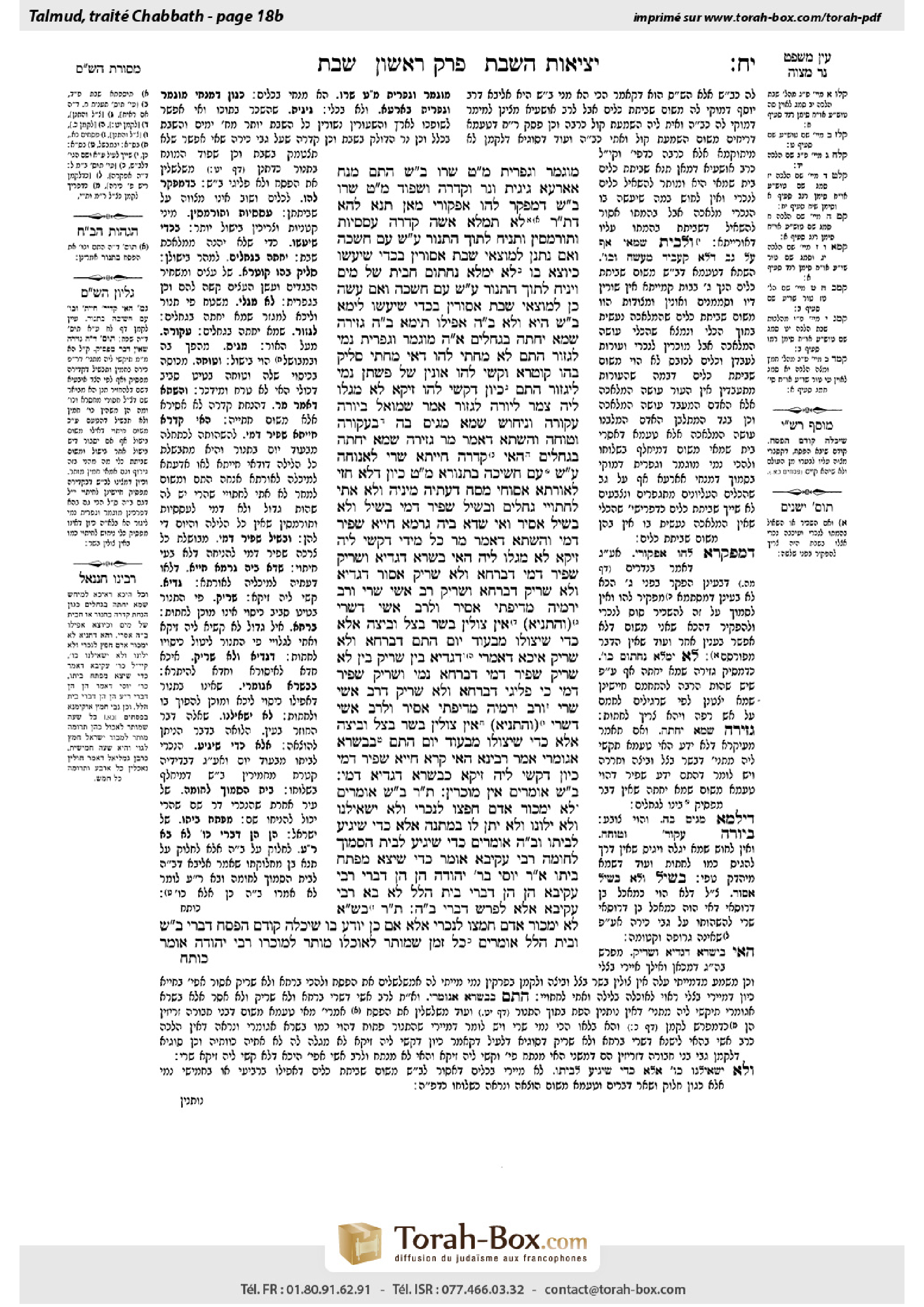
Shabbat 18b: Talmud study for Daf Yomi
Daf Yomi is the daily study of one Talmud folio. Explore 37 tractates with scans, Hebrew text, Sefaria English and AI-generated French translations where annotated.
Passage selection and English or AI-generated French translation are available where the scan has annotations. Daf Study is independent of Torah-Box and Sefaria.
Browse Shabbat · שבת · All tractatesShabbat 18b text and translations
This page of Shabbat includes the Aramaic text, an English translation and an AI-generated French translation, alongside the scan above.
שבת י״ח ב · Aramaic and Hebrew text
מוּגְמָר וְגׇפְרִית מַאי טַעְמָא שָׁרוּ בֵּית שַׁמַּאי? הָתָם מַנַּח אַאַרְעָא. גִּיגִית וְנֵר וּקְדֵרָה וְשַׁפּוּד מַאי טַעְמָא שָׁרוּ בֵּית שַׁמַּאי? דְּמַפְקַר לְהוּ אַפְקוֹרֵי.
מַאן תְּנָא לְהָא דְּתָנוּ רַבָּנַן: לֹא תְּמַלֵּא אִשָּׁה קְדֵרָה עֲסָסִיּוֹת וְתוּרְמְסִין וְתַנִּיחַ לְתוֹךְ הַתַּנּוּר עֶרֶב שַׁבָּת עִם חֲשֵׁכָה, וְאִם נְתָנָן — לְמוֹצָאֵי שַׁבָּת אֲסוּרִין בִּכְדֵי שֶׁיֵּעָשׂוּ. כַּיּוֹצֵא בּוֹ: לֹא יְמַלֵּא נַחְתּוֹם חָבִית שֶׁל מַיִם וְיַנִּיחַ לְתוֹךְ הַתַּנּוּר עֶרֶב שַׁבָּת עִם חֲשֵׁכָה, וְאִם עָשָׂה כֵּן — לְמוֹצָאֵי שַׁבָּת אֲסוּרִין בִּכְדֵי שֶׁיֵּעָשׂוּ. לֵימָא בֵּית שַׁמַּאי הִיא וְלָא בֵּית הִלֵּל? אֲפִילּוּ תֵּימָא בֵּית הִלֵּל, גְּזֵירָה שֶׁמָּא יְחַתֶּה בַּגֶּחָלִים.
אִי הָכִי מוּגְמָר וְגׇפְרִית נָמֵי לִגְזוֹר! הָתָם לָא מְחַתֵּי לְהוּ, דְּאִי מְחַתֵּי סָלֵיק בְּהוּ קוּטְרָא, וְקָשֵׁי לְהוּ. אוּנִּין שֶׁל פִּשְׁתָּן נָמֵי לִיגְזוֹר! הָתָם, כֵּיוָן דְּקָשֵׁי לְהוּ זִיקָא, לָא מְגַלּוּ לֵיהּ: צֶמֶר לַיּוֹרָה לִיגְזוֹר! אָמַר שְׁמוּאֵל: בְּיוֹרָה עֲקוּרָה. וְנֵיחוּשׁ שֶׁמָּא מֵגִיס בָּהּ! בַּעֲקוּרָה וְטוּחָה.
וְהַשְׁתָּא דְּאָמַר מָר גְּזֵירָה שֶׁמָּא יְחַתֶּה בַּגֶּחָלִים, הַאי קְדֵרָה חַיְּיתָא שְׁרֵי לְאַנּוּחַהּ עֶרֶב שַׁבָּת עִם חֲשֵׁיכָה בְּתַנּוּרָא. מַאי טַעְמָא? — כֵּיוָן דְּלָא חֲזֵי לְאוּרְתָּא, אַסּוֹחֵי מַסַּח דַּעְתֵּיהּ מִינֵּיהּ וְלָא אָתֵי לְחַתּוֹיֵי גֶּחָלִים. וּבְשִׁיל — שַׁפִּיר דָּמֵי. בְּשִׁיל וְלָא בְּשִׁיל — אֲסִיר. וְאִי שְׁדָא בֵּיהּ גַּרְמָא חַיָּיא — שַׁפִּיר דָּמֵי.
וְהַשְׁתָּא דְּאָמַר מָר כׇּל מִידֵּי דְּקָשֵׁי לֵיהּ זִיקָא לָא מְגַלּוּ לֵיהּ, הַאי בִּשְׂרָא דְּגַדְיָא וּשְׁרִיק — שַׁפִּיר דָּמֵי. דְּבַרְחָא וְלָא שְׁרִיק — אֲסִיר. דְּגַדְיָא וְלָא שְׁרִיק, דְּבַרְחָא וּשְׁרִיק — רַב אָשֵׁי שָׁרֵי וְרַב יִרְמְיָה מִדִּיפְתִּי אָסַר. וּלְרַב אָשֵׁי דְּשָׁרֵי, וְהָתַנְיָא אֵין צוֹלִין בָּשָׂר בָּצָל וּבֵיצָה אֶלָּא כְּדֵי שֶׁיִּצּוֹלוּ מִבְּעוֹד יוֹם! הָתָם דְּבַרְחָא וְלָא שְׁרִיק.
אִיכָּא דְּאָמְרִי: דְּגַדְיָא בֵּין שְׁרִיק בֵּין לָא שְׁרִיק — שַׁפִּיר דָּמֵי. דְּבַרְחָא נָמֵי וּשְׁרִיק — שַׁפִּיר דָּמֵי. כִּי פְּלִיגִי דְּבַרְחָא וְלָא שְׁרִיק — דְּרַב אָשֵׁי שָׁרֵי וְרַב יִרְמְיָה מִדִּפְתִּי אָסַר. וּלְרַב אָשֵׁי דְּשָׁרֵי, וְהָתַנְיָא אֵין צוֹלִין בָּשָׂר בָּצָל וּבֵיצָה אֶלָּא כְּדֵי שֶׁיִּצּוֹלוּ מִבְּעוֹד יוֹם! הָתָם בְּבִשְׂרָא אַגּוּמְרֵי. אָמַר רָבִינָא: הַאי קָרָא חַיָּיא — שַׁפִּיר דָּמֵי, כֵּיוָן דְּקָשֵׁי לֵיהּ זִיקָא כְּבִשְׂרָא דְגַדְיָא דָּמֵי.
בֵּית שַׁמַּאי אוֹמְרִים אֵין מוֹכְרִין. תָּנוּ רַבָּנַן, בֵּית שַׁמַּאי אוֹמְרִים: לֹא יִמְכּוֹר אָדָם חֶפְצוֹ לְגוֹי, וְלֹא יַשְׁאִילֶנּוּ, וְלֹא יַלְוֶנּוּ, וְלֹא יִתֵּן לוֹ בְּמַתָּנָה אֶלָּא כְּדֵי שֶׁיַּגִּיעַ לְבֵיתוֹ. וּבֵית הִלֵּל אוֹמְרִים: כְּדֵי שֶׁיַּגִּיעַ לַבַּיִת הַסָּמוּךְ לַחוֹמָה. רַבִּי עֲקִיבָא אוֹמֵר: כְּדֵי שֶׁיֵּצֵא מִפֶּתַח בֵּיתוֹ. אָמַר רַבִּי יוֹסֵי בְּרַבִּי יְהוּדָה: הֵן הֵן דִּבְרֵי רַבִּי עֲקִיבָא, הֵן הֵן דִּבְרֵי בֵּית הִלֵּל — לֹא בָּא רַבִּי עֲקִיבָא אֶלָּא לְפָרֵשׁ דִּבְרֵי בֵּית הִלֵּל.
תָּנוּ רַבָּנַן, בֵּית שַׁמַּאי אוֹמְרִים: לֹא יִמְכּוֹר אָדָם חֲמֵצוֹ לְגוֹי אֶלָּא אִם כֵּן יוֹדֵעַ בּוֹ שֶׁיִּכְלֶה קוֹדֶם הַפֶּסַח, דִּבְרֵי בֵּית שַׁמַּאי. וּבֵית הִלֵּל אוֹמְרִים: כׇּל זְמַן שֶׁמּוּתָּר לְאוֹכְלוֹ — מוּתָּר לְמוֹכְרוֹ. רַבִּי יְהוּדָה אוֹמֵר:
Shabbat 18b · English translation
with regard to placing incense and sulfur beneath clothes and silver vessels, respectively, what is the reason Beit Shammai permitted this? The Gemara answers: The case under discussion was not one where the incense was placed in a vessel; rather, there, the incense was placed on the ground, and therefore there was no utensil that was obligated to rest. The Gemara asks further: A tub in which fruit or grains are placed to ferment into beer, and where they stay for an extended period; and a Shabbat lamp; and a pot in which food is being cooked, which they place on the fire while it is still day; and a spit [shapud] on which they placed food to roast while it is still day; what is the reason Beit Shammai permitted placing them on Shabbat eve while it is still day even though the prohibited labor continues over time, including on Shabbat? The Gemara answers: These are cases where he declares the utensils ownerless. According to Beit Shammai, the utensils must be declared ownerless while it is still day. Once the utensils are declared ownerless, they no longer belong to a Jew and, consequently, there is no obligation to let them rest.
The Gemara asks: Based on these conclusions, who is the tanna who taught this Tosefta that the Sages taught: A woman may not fill up a pot with pounded wheat and lupines, a type of legume, and place them in the oven to cook on Shabbat eve at nightfall. And if she placed them in the oven, not only may they not be eaten on Shabbat itself, but even at the conclusion of Shabbat they are forbidden for a period of time that would be sufficient for them to be prepared, i.e., the time it takes to cook the dish from the beginning, so that he will derive no benefit from a prohibited labor performed on Shabbat. Similarly, the Tosefta said: A baker may not fill a barrel of water and place it in the oven on Shabbat eve at nightfall to boil the water that is in the barrel, and if he did so, even at the conclusion of Shabbat it is forbidden for the period of time that would be sufficient for it to be prepared from the beginning. Let us say that this Tosefta is in accordance with the opinion of Beit Shammai and not in accordance with the opinion of Beit Hillel. The Gemara answers: Even if you say that it is in accordance with the opinion of Beit Hillel, in those cases the Sages issued a decree due to concern lest the one cooking stoke the coals on Shabbat in order to accelerate the cooking.
The Gemara asks: If so, with regard to incense and sulfur, the Sages should also issue a decree that prohibits placing them beneath clothes and silver vessels, respectively, on Shabbat eve at nightfall. The Gemara answers: There, in that case, he will not stoke them, as if he stokes them smoke will rise into the garments and the silver, and that is damaging for them. The smoke from the wood will ruin the fragrance and the coating of sulfur. The Gemara asks further: With regard to bundles of flax, the Sages should also issue a decree. The Gemara answers: There, since wind is damaging for them, he does not expose them, and he will not come to stoke the coals. The Gemara asks further: With regard to wool placed in the dyer’s kettle, the Sages should also issue a decree. Shmuel said: The mishna is referring to a pot that is removed from the fire, where there is no concern lest he stoke the coals. The Gemara still asks: Let us be concerned lest he stir that same pot, thereby accelerating the cooking, which is prohibited by Torah law. Rather, the mishna is referring to a pot that is removed from the fire and sealed with clay spread around its cover to prevent it from opening.
The Gemara comments: And now that the Master said that in these cases the prohibition of placing the pot on the fire is due to a decree issued by the Sages lest he stoke the coals; with regard to this pot of raw meat, it is permitted to place it in an oven on Shabbat eve at nightfall. What is the reason for this? Since it is not fit for consumption during the night, as it will not be cooked by then, he diverts his thoughts from it and will not come to stoke the coals. And the same is true of cooked meat; it is permitted to place it on the fire on Shabbat eve at nightfall. Since it is reasonably cooked, one will not come to stoke the coals to cook it more. Meat that is cooked and not sufficiently cooked is prohibited, as there is concern lest he come to stoke the coals. And if he threw a raw bone into this pot, he may well do so, as due to the bone he will not remove the meat to eat it in the evening.
And now that the Master said that anything for which wind is damaging one does not expose, one could say that with regard to meat of a kid and an oven whose opening is sealed with clay, he may well place it there on Shabbat eve at nightfall. Since the meat of the kid cooks quickly and the opening of the oven is sealed, there is no concern lest he come to stoke the coals. If it is the meat of a ram [barḥa] and the opening of the oven is not sealed with clay, it is prohibited to place it there on Shabbat eve at nightfall. The above are cases where the ruling is clear. However, with regard to the case of the meat of a kid and the opening of the oven is not sealed with clay, or the case of a ram and the opening of the oven is sealed, there is a dispute. Rav Ashi permitted placing it in the oven on Shabbat eve at nightfall, and Rav Yirmeya from Difti prohibited doing so. The Gemara asks: And according to the opinion of Rav Ashi, who permitted placing it there on Shabbat eve at nightfall, wasn’t it taught in a baraita that one may not roast meat, an onion, and an egg on Shabbat eve unless there is sufficient time for them to be roasted while it is still day? Apparently, one may not place meat that is not sufficiently roasted in an oven on Shabbat eve. The Gemara answers: There, the baraita is referring to the meat of a ram and the opening of the oven is not sealed with clay. However, in other cases it is permitted.
Others say that with regard to the meat of a kid, whether it is in an oven that is sealed or whether it is in one that is not sealed, everyone agrees that he may well do so. With regard to the meat of a ram, when the opening of the oven is sealed, one may well do so too. Where they disagreed was in the case of the meat of a ram and the opening of the oven was not sealed. Rav Ashi permitted placing it in the oven on Shabbat eve at nightfall, and Rav Yirmeya from Difti prohibited doing so. The Gemara asks: And according to the opinion of Rav Ashi, who permitted this, wasn’t it taught in a baraita that one may only roast meat, an onion, and an egg on Shabbat eve if there is sufficient time for them to be roasted while it is still day? Apparently, one may not place meat that is not sufficiently roasted in an oven on Shabbat eve. The Gemara answers: There, the baraita is referring to the case of meat roasted directly on the coals. In that case, there is greater concern that he will come to stoke the coals. Ravina said: With regard to that raw gourd, one may well place it in a pot on the fire on Shabbat eve at nightfall. The reason for this is that since the wind is damaging for it, it is considered like the meat of a kid.
The full text of the baraita is: Beit Shammai say: One may only sell an item to a gentile on Shabbat eve, and one may only load a burden onto his donkey with him, and one may only lift a burden onto him if the destination of the gentile is near enough that there remains sufficient time for the gentile to arrive at a place near there prior to Shabbat. The Sages taught in a baraita that elaborated upon this dispute between Beit Shammai and Beit Hillel with regard to selling to a gentile on Shabbat eve: Beit Shammai say: A person may not sell his object to a gentile, and lend it to him, and loan him money, and give him an object as a gift on Shabbat eve, unless there is sufficient time for him, the gentile, to reach his house while it is still day. And Beit Hillel say: He is permitted to do this if there is sufficient time for him to reach a house adjacent to the wall of the place where he is going. Rabbi Akiva says: It is permitted to give an object to a gentile on Shabbat eve if there is sufficient time for him to exit the entrance of the Jewish person’s house. What the gentile does afterward is irrelevant. Rabbi Yosei, son of Rabbi Yehuda, said: That is the statement of Rabbi Akiva; that is the statement of Beit Hillel. Rabbi Akiva came only to explain the statement of Beit Hillel. The tanna whose version of Beit Hillel’s statement was: Until he reaches the house adjacent to the wall, held that Beit Hillel’s opinion was similar to Beit Shammai’s opinion. Rabbi Akiva came to elucidate the actual opinion of Beit Hillel.
The Sages taught a similar principle in a baraita with regard to another tannaitic dispute. Beit Shammai say: A person may not sell his leaven to a gentile on Passover eve unless he knows that the leaven will be finished before Passover. And Beit Hillel say: As long as it is permitted for the Jew to eat leaven, it is also permitted for him to sell it to a gentile. The Jew ceases to be responsible for the leaven sold to a gentile from the moment it is sold. And Rabbi Yehuda says:
Shabbat 18b · Traduction française (IA)
Concernant le fait de placer de l’encens sous des vêtements et du soufre sous des récipients d’argent, pour quelle raison Beit Shammaï l’a-t-il permis ? La Guemara répond : le cas en question n’était pas celui où l’encens avait été placé dans un récipient ; ici, il avait été placé à même le sol, de sorte qu’aucun ustensile n’était tenu de rester au repos. La Guemara demande encore : une cuve dans laquelle on place des fruits ou des céréales pour les faire fermenter et en tirer de la bière, où ils restent longtemps ; une lampe de Chabbat ; une marmite dans laquelle on fait cuire des aliments et qu’on place sur le feu alors qu’il fait encore jour ; et une broche [shapud] sur laquelle on a placé des aliments à rôtir alors qu’il fait encore jour : pour quelle raison Beit Shammaï a-t-il permis de les placer la veille de Chabbat, alors qu’il fait encore jour, bien que le travail interdit se poursuive, y compris pendant Chabbat ? La Guemara répond : dans ces cas, les ustensiles sont déclarés sans propriétaire. Selon Beit Shammaï, ils doivent être déclarés sans propriétaire alors qu’il fait encore jour. Dès lors qu’ils sont déclarés sans propriétaire, ils n’appartiennent plus à un Juif et il n’est donc pas nécessaire de les laisser au repos.
La Guemara demande : au vu de ces conclusions, quel est le tanna qui a enseigné cette Tossefta, transmise par les Sages : une femme ne peut remplir une marmite de blé concassé et de lupins, une sorte de légumineuse, puis la placer dans le four à la tombée de la nuit, la veille de Chabbat, pour les faire cuire. Si elle l’a placée dans le four, non seulement il est interdit d’en manger pendant Chabbat, mais il est également interdit d’en manger à la fin de Chabbat pendant le temps qu’il aurait fallu pour préparer le plat, c’est-à-dire le temps nécessaire pour le cuire depuis le début, afin que l’on ne tire aucun profit d’un travail interdit effectué pendant Chabbat. De même, la Tossefta enseigne : un boulanger ne peut remplir un tonneau d’eau et le placer dans le four à la tombée de la nuit, la veille de Chabbat, pour faire bouillir l’eau qu’il contient. S’il l’a fait, l’eau reste interdite même à la fin de Chabbat, pendant le temps qu’il aurait fallu pour la faire bouillir depuis le début. Faut-il donc dire que cette Tossefta suit l’opinion de Beit Shammaï et non celle de Beit Hillel ? La Guemara répond : même si l’on dit qu’elle suit l’opinion de Beit Hillel, dans ces cas, les Sages ont édicté un décret par crainte que la personne qui fait cuire n’attise les braises pendant Chabbat afin d’accélérer la cuisson.
La Guemara demande : dans ce cas, les Sages auraient également dû édicter un décret interdisant de placer de l’encens sous des vêtements et du soufre sous des récipients d’argent à la tombée de la nuit, la veille de Chabbat. La Guemara répond : dans ces cas, il ne les attisera pas, car la fumée, si elle s’en dégageait, pénétrerait dans les vêtements et se déposerait sur l’argent, ce qui les endommagerait. La fumée du bois gâcherait le parfum de l’encens et le revêtement de soufre. La Guemara demande encore : les Sages auraient également dû édicter un décret concernant les bottes de lin. La Guemara répond : le vent leur étant nuisible, il ne les découvre pas et ne sera donc pas amené à attiser les braises. La Guemara demande encore : les Sages auraient également dû édicter un décret concernant la laine placée dans la cuve du teinturier. Chmouel a dit : la Michna parle d’une marmite retirée du feu, et il n’y a donc pas lieu de craindre qu’il attise les braises. La Guemara demande néanmoins : ne faut-il pas craindre qu’il remue cette même marmite, accélérant ainsi la cuisson, ce qui est interdit par la Torah ? Il faut plutôt dire que la Michna parle d’une marmite retirée du feu et scellée avec de l’argile étalée autour de son couvercle pour l’empêcher de s’ouvrir.
La Guemara commente : maintenant que le Maître a dit que, dans ces cas, l’interdiction de placer la marmite sur le feu découle d’un décret des Sages, édicté par crainte qu’on attise les braises, il est permis de placer cette marmite de viande crue dans un four à la tombée de la nuit, la veille de Chabbat. Pour quelle raison ? Puisqu’elle ne sera pas consommable pendant la nuit, car elle n’aura pas eu le temps de cuire, on cesse d’y penser et on ne sera pas amené à attiser les braises. Il en va de même pour la viande cuite : il est permis de la placer sur le feu à la tombée de la nuit, la veille de Chabbat. Puisqu’elle est raisonnablement bien cuite, on ne sera pas amené à attiser les braises pour la cuire davantage. Il est interdit de placer sur le feu de la viande qui a cuit, mais pas suffisamment, car on craint qu’on ne soit amené à attiser les braises. Et si l’on a jeté un os cru dans cette marmite, on peut bien le faire, car, à cause de l’os, on ne retirera pas la viande pour la manger le soir.
Et maintenant que le Maître a dit que, pour tout ce à quoi le vent est nuisible, on ne le découvre pas, on pourrait dire qu’il est permis de placer de la viande de chevreau dans un four dont l’ouverture est scellée avec de l’argile à la tombée de la nuit, la veille de Chabbat. Puisque la viande de chevreau cuit rapidement et que l’ouverture du four est scellée, il n’y a pas lieu de craindre qu’on attise les braises. S’il s’agit de viande de bélier [barḥa] et que l’ouverture du four n’est pas scellée avec de l’argile, il est interdit de l’y placer à la tombée de la nuit, la veille de Chabbat. Ces cas ont une règle claire. En revanche, il y a controverse pour la viande de chevreau lorsque l’ouverture du four n’est pas scellée avec de l’argile, et pour la viande de bélier lorsque l’ouverture du four est scellée. Rav Achi a permis de la placer dans le four à la tombée de la nuit, la veille de Chabbat, tandis que Rav Yirmeya de Difti l’a interdit. La Guemara demande : selon Rav Achi, qui a permis de l’y placer à la tombée de la nuit, la veille de Chabbat, n’a-t-on pas enseigné dans une baraïta qu’on ne peut faire rôtir de la viande, un oignon et un œuf la veille de Chabbat que s’il reste assez de temps pour qu’ils rôtissent alors qu’il fait encore jour ? Il semblerait donc qu’on ne puisse pas placer au four, la veille de Chabbat, une viande qui n’est pas suffisamment rôtie. La Guemara répond : la baraïta parle du cas d’une viande de bélier dont l’ouverture du four n’est pas scellée avec de l’argile. Dans les autres cas, c’est permis.
D’autres disent que, pour la viande de chevreau, qu’elle soit placée dans un four scellé ou dans un four qui ne l’est pas, tous conviennent qu’on peut bien le faire. Pour la viande de bélier, on peut également le faire lorsque l’ouverture du four est scellée. Leur désaccord porte sur le cas de la viande de bélier lorsque l’ouverture du four n’est pas scellée. Rav Achi a permis de la placer dans le four à la tombée de la nuit, la veille de Chabbat, tandis que Rav Yirmeya de Difti l’a interdit. La Guemara demande : selon Rav Achi, qui l’a permis, n’a-t-on pas enseigné dans une baraïta qu’on ne peut faire rôtir de la viande, un oignon et un œuf la veille de Chabbat que s’il reste assez de temps pour qu’ils rôtissent alors qu’il fait encore jour ? Il semblerait donc qu’on ne puisse pas placer au four, la veille de Chabbat, une viande qui n’est pas suffisamment rôtie. La Guemara répond : la baraïta parle du cas d’une viande rôtie directement sur les braises. Dans ce cas, on craint davantage qu’on ne soit amené à attiser les braises. Ravina a dit : on peut bien placer cette courge crue dans une marmite sur le feu à la tombée de la nuit, la veille de Chabbat. En effet, puisque le vent lui est nuisible, elle est considérée comme de la viande de chevreau.
Le texte complet de la baraïta est le suivant : Beit Shammaï disent : on ne peut vendre un objet à un non-Juif la veille de Chabbat, ni charger un fardeau sur son âne avec lui, ni lui mettre un fardeau sur le dos, que si la destination du non-Juif est assez proche pour qu’il lui reste suffisamment de temps pour arriver en un lieu situé à proximité avant Chabbat. Les Sages ont enseigné dans une baraïta qui développe cette controverse entre Beit Shammaï et Beit Hillel au sujet de la vente à un non-Juif la veille de Chabbat : Beit Shammaï disent : une personne ne peut vendre un objet à un non-Juif, ni le lui prêter, ni lui prêter de l’argent, ni lui donner un objet en cadeau la veille de Chabbat, à moins qu’il reste au non-Juif suffisamment de temps pour atteindre sa maison alors qu’il fait encore jour. Beit Hillel disent : il est permis de le faire s’il lui reste suffisamment de temps pour atteindre une maison située près du mur de la localité où il se rend. Rabbi Akiva dit : il est permis de donner un objet à un non-Juif la veille de Chabbat s’il lui reste suffisamment de temps pour franchir le seuil de la maison du Juif. Ce que le non-Juif fait ensuite n’a pas d’importance. Rabbi Yossei, fils de Rabbi Yehouda, a dit : telle est la déclaration de Rabbi Akiva ; telle est la déclaration de Beit Hillel. Rabbi Akiva n’est venu qu’expliquer la déclaration de Beit Hillel. Le tanna dont la version de la déclaration de Beit Hillel était : « jusqu’à ce qu’il atteigne la maison située près du mur », estimait que l’opinion de Beit Hillel était semblable à celle de Beit Shammaï. Rabbi Akiva est venu exposer l’opinion véritable de Beit Hillel.
Les Sages ont enseigné un principe semblable dans une baraïta au sujet d’une autre controverse entre tannaïm. Beit Shammaï disent : une personne ne peut vendre son hamets à un non-Juif la veille de Pessa’h que si elle sait que le hamets sera consommé avant Pessa’h. Beit Hillel disent : tant qu’il est permis au Juif de manger du hamets, il lui est également permis de le vendre à un non-Juif. Le Juif cesse d’être responsable du hamets vendu au non-Juif dès la vente. Et Rabbi Yehouda dit :
Traduction française générée par IA à partir de l’édition anglaise de Sefaria. Vérifie toujours un passage avec le texte source.
Text from Sefaria: William Davidson Edition - Vocalized Aramaic (CC BY NC); William Davidson Edition - English (CC BY NC).