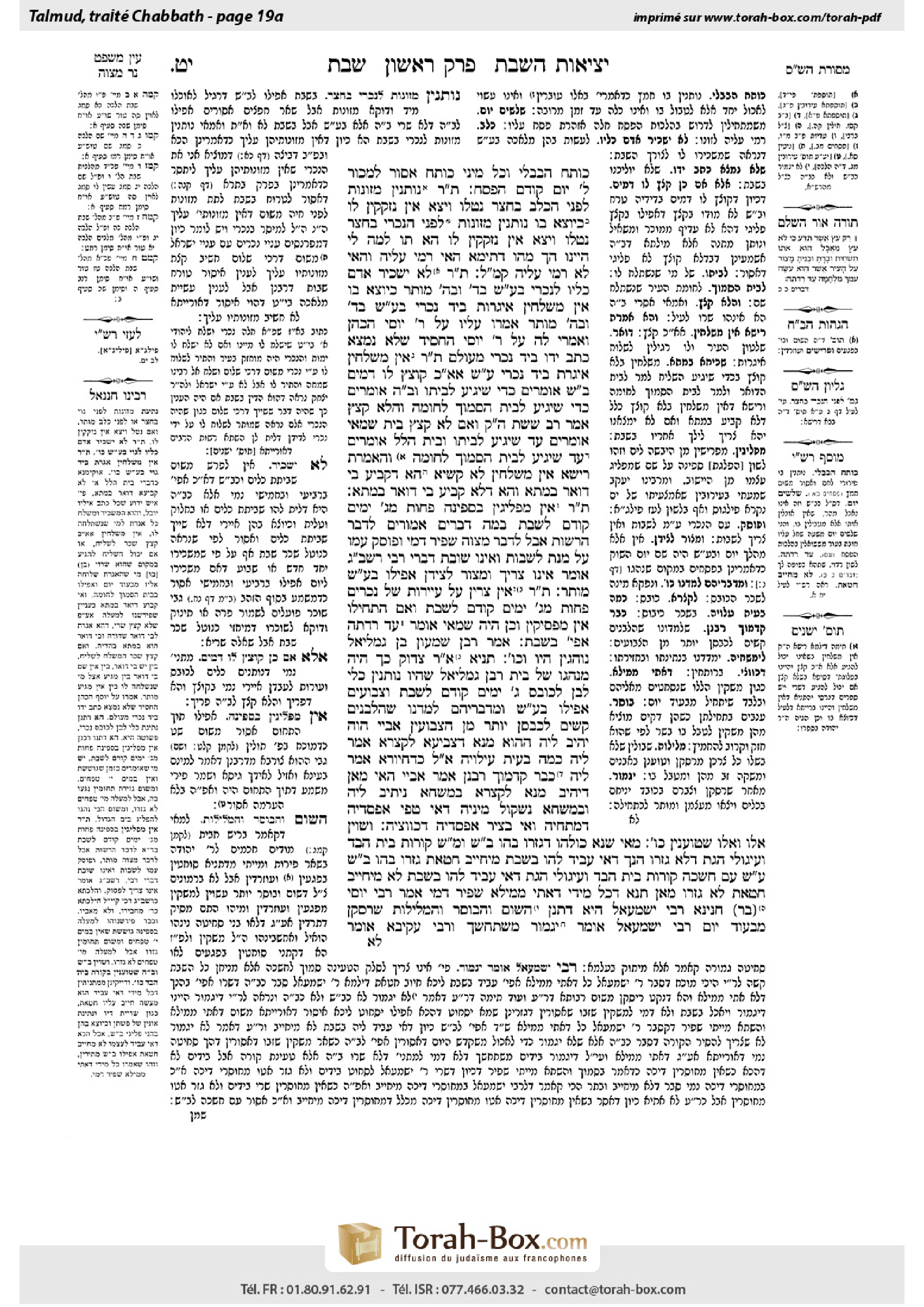
Shabbat 19a: Talmud study for Daf Yomi
Daf Yomi is the daily study of one Talmud folio. Explore 37 tractates with scans, Hebrew text, Sefaria English and AI-generated French translations where annotated.
Passage selection and English or AI-generated French translation are available where the scan has annotations. Daf Study is independent of Torah-Box and Sefaria.
Browse Shabbat · שבת · All tractatesShabbat 19a text and translations
This page of Shabbat includes the Aramaic text, an English translation and an AI-generated French translation, alongside the scan above.
שבת י״ט א · Aramaic and Hebrew text
כּוּתָּח הַבַּבְלִי וְכׇל מִינֵי כּוּתָּח אָסוּר לִמְכּוֹר שְׁלֹשִׁים יוֹם קוֹדֶם הַפֶּסַח.
תָּנוּ רַבָּנַן: נוֹתְנִין מְזוֹנוֹת לִפְנֵי הַכֶּלֶב בֶּחָצֵר. נְטָלוֹ וְיָצָא — אֵין נִזְקָקִין לוֹ.
כַּיּוֹצֵא בּוֹ: נוֹתְנִין מְזוֹנוֹת לִפְנֵי הַגּוֹי בֶּחָצֵר. נְטָלוֹ וְיָצָא — אֵין נִזְקָקִין לוֹ. הָא תּוּ לְמָה לִי, הַיְינוּ הָךְ. מַהוּ דְתֵימָא: הַאי רְמֵי עֲלֵיהּ, וְהַאי לָא רְמֵי עֲלֵיהּ — קָא מַשְׁמַע לַן.
תָּנוּ רַבָּנַן: לֹא יַשְׂכִּיר אָדָם כֵּלָיו לְגוֹי בְּעֶרֶב שַׁבָּת, בִּרְבִיעִי וּבַחֲמִישִׁי מוּתָּר. כַּיּוֹצֵא בּוֹ, אֵין מְשַׁלְּחִין אִיגְּרוֹת בְּיַד גּוֹי בְּעֶרֶב שַׁבָּת, בִּרְבִיעִי וּבַחֲמִישִׁי — מוּתָּר. אָמְרוּ עָלָיו עַל רַבִּי יוֹסֵי הַכֹּהֵן, וְאָמְרִי לַהּ עַל רַבִּי יוֹסֵי הֶחָסִיד, שֶׁלֹּא נִמְצָא כְּתַב יָדוֹ בְּיַד גּוֹי מֵעוֹלָם.
תָּנוּ רַבָּנַן: אֵין מְשַׁלְּחִין אִיגֶּרֶת בְּיַד גּוֹי עֶרֶב שַׁבָּת, אֶלָּא אִם כֵּן קוֹצֵץ לוֹ דָּמִים. בֵּית שַׁמַּאי אוֹמְרִים: כְּדֵי שֶׁיַּגִּיעַ לְבֵיתוֹ, וּבֵית הִלֵּל אוֹמְרִים: כְּדֵי שֶׁיַּגִּיעַ לַבַּיִת הַסָּמוּךְ לַחוֹמָה.
וַהֲלֹא קָצַץ? אָמַר רַב שֵׁשֶׁת, הָכִי קָאָמַר: וְאִם לֹא קָצַץ — בֵּית שַׁמַּאי אוֹמְרִים: עַד שֶׁיַּגִּיעַ לְבֵיתוֹ, וּבֵית הִלֵּל אוֹמְרִים: עַד שֶׁיַּגִּיעַ לַבַּיִת הַסָּמוּךְ לַחוֹמָה.
וְהָאָמְרַתְּ רֵישָׁא אֵין מְשַׁלְּחִין? לָא קַשְׁיָא: הָא דִּקְבִיעַ בֵּי דַוָּאר בְּמָתָא, וְהָא דְּלָא קְבִיעַ בֵּי דַוָּאר בְּמָתָא.
תָּנוּ רַבָּנַן: אֵין מַפְלִיגִין בִּסְפִינָה פָּחוֹת מִשְּׁלֹשָׁה יָמִים קוֹדֶם לַשַּׁבָּת. בַּמֶּה דְּבָרִים אֲמוּרִים — לִדְבַר הָרְשׁוּת, אֲבָל לִדְבַר מִצְוָה — שַׁפִּיר דָּמֵי. וּפוֹסֵק עִמּוֹ עַל מְנָת לִשְׁבּוֹת, וְאֵינוֹ שׁוֹבֵת — דִּבְרֵי רַבִּי. רַבָּן שִׁמְעוֹן בֶּן גַּמְלִיאֵל אוֹמֵר: אֵינוֹ צָרִיךְ. וּמִצּוֹר לְצִידֹן — אֲפִילּוּ בְּעֶרֶב שַׁבָּת מוּתָּר.
תָּנוּ רַבָּנַן: אֵין צָרִין עַל עֲיָירוֹת שֶׁל גּוֹיִם פָּחוֹת מִשְּׁלֹשָׁה יָמִים קוֹדֶם לַשַּׁבָּת. וְאִם הִתְחִילוּ — אֵין מַפְסִיקִין. וְכֵן הָיָה שַׁמַּאי אוֹמֵר: ״עַד רִדְתָּהּ״, אֲפִילּוּ בְּשַׁבָּת.
אָמַר רַבָּן שִׁמְעוֹן בֶּן גַּמְלִיאֵל: נוֹהֲגִין הָיוּ וְכוּ׳. תַּנְיָא אָמַר רַבִּי צָדוֹק: כָּךְ הָיָה מִנְהָגוֹ שֶׁל בֵּית רַבָּן גַּמְלִיאֵל, שֶׁהָיוּ נוֹתְנִין כְּלֵי לָבָן לְכוֹבֵס שְׁלֹשָׁה יָמִים קוֹדֶם לַשַּׁבָּת, וּצְבוּעִים אֲפִילּוּ בְּעֶרֶב שַׁבָּת. וּמִדִּבְרֵיהֶם לָמַדְנוּ שֶׁהַלְּבָנִים קָשִׁים לְכַבְּסָן יוֹתֵר מִן הַצְּבוּעִין.
אַבָּיֵי הֲוָה יָהֵיב לֵיהּ הַהוּא מָנָא דִצְבִיעָא לְקַצָּרָא. אֲמַר לֵיהּ: כַּמָּה בָּעֵית עִילָּוֵיהּ. אֲמַר לֵיהּ: כִּדְחִיוָּרָא. אֲמַר לֵיהּ: כְּבָר קַדְמוּךָ רַבָּנַן. אָמַר אַבָּיֵי: הַאי מַאן דְּיָהֵיב מָנָא לְקַצָּרָא, בְּמִשְׁחָא נִיתֵּיב לֵיהּ וּבְמִשְׁחָא נִשְׁקוֹל מִינֵּיהּ. דְּאִי טְפֵי — אַפְסְדֵיהּ דְּמַתְחֵיהּ. וְאִי בְּצִיר — אַפְסְדֵיהּ דְּכַוְּוצֵיהּ.
וְשָׁוִין אֵלּוּ וְאֵלּוּ, שֶׁטּוֹעֲנִין כּוּ׳: מַאי שְׁנָא כּוּלְּהוּ דִּגְזַרוּ בְּהוּ בֵּית שַׁמַּאי, וּמַאי שְׁנָא קוֹרוֹת בֵּית הַבַּד וְעִיגּוּלֵי הַגַּת דְּלָא גְּזַרוּ? הָנָךְ דְּאִי עָבֵיד לְהוּ בְּשַׁבָּת מִיחַיַּיב חַטָּאת — גְּזַרוּ בְּהוּ בֵּית שַׁמַּאי עֶרֶב שַׁבָּת עִם חֲשֵׁכָה. קוֹרוֹת בֵּית הַבַּד וְעִיגּוּלֵי הַגַּת דְּאִי עָבֵיד לְהוּ בְּשַׁבָּת לָא מִיחַיַּיב חַטָּאת — לָא גְּזַרוּ.
מַאן תַּנָּא דְּכֹל מִידֵּי דְּאָתֵי מִמֵּילָא, שַׁפִּיר דָּמֵי? אָמַר רַבִּי יוֹסֵי (בַּר) [בְּרַבִּי] חֲנִינָא: רַבִּי יִשְׁמָעֵאל הִיא, דִּתְנַן: הַשּׁוּם וְהַבּוֹסֶר וְהַמְּלִילוֹת שֶׁרִסְּקָן מִבְּעוֹד יוֹם, רַבִּי יִשְׁמָעֵאל אוֹמֵר: יִגְמוֹר מִשֶּׁתֶּחְשַׁךְ, וְרַבִּי עֲקִיבָא אוֹמֵר:
Shabbat 19a · English translation
With regard to Babylonian kutaḥ, a spice that contains leavened bread crumbs, and all kinds of kutaḥ, it is prohibited to sell it to a gentile thirty days before Passover. Because kutaḥ is used exclusively as a spice, it lasts longer than other foods.
The Sages taught in a different baraita: One may, ab initio, put food before the dog in the courtyard on Shabbat, and we are not concerned that the dog may lift it and carry it out to the public domain. If the dog lifted it and exited the courtyard, one need not attend to him, as he is not required to ensure that the dog will eat it specifically in that courtyard.
On a similar note, the baraita continued: One may place food before the gentile in the courtyard on Shabbat. If the gentile lifted it and exited, one need not attend to him. The Gemara asks: Why do I need this as well? This case is the same as that case. The halakhot with regard to the dog and the gentile are identical, as Shabbat prohibitions do not apply to either of them. The Gemara answers: There is a distinction. Lest you say that in this case, the case of the dog, responsibility for its food is incumbent upon the owner of the courtyard who owns the dog. And in this case, the case of the gentile, responsibility for his food is not incumbent upon the owner of the courtyard. Therefore, in a situation where there is concern that Shabbat will be desecrated, there is room to say that one may not give the gentile his food. Therefore, the baraita teaches us that in that case, it is also permitted.
The Sages taught in a Tosefta: A person may not rent his utensils to a gentile on Shabbat eve, as it appears that the Jew is receiving payment for work performed on Shabbat. However, on the fourth and on the fifth days of the week it is permitted. On a similar note, one may not send letters in the hand of a gentile on Shabbat eve. However, on the fourth and on the fifth days of the week it is permitted. Nevertheless, they said about Rabbi Yosei the priest, and some say that they said this about Rabbi Yosei the Ḥasid, that a document in his handwriting was never found in the hand of a gentile, so that a gentile would not carry his letter on Shabbat.
The Sages taught in a baraita: One may not send a letter in the hand of a gentile on Shabbat eve unless he stipulates a set sum of money for him. In that case, anything the gentile does with this letter is not in service of the Jew, but rather on his own, since his payment is stipulated in advance. Beit Shammai say: One may only give a letter to a gentile on Shabbat eve if there is sufficient time for the gentile to reach his house before dark. And Beit Hillel say: If there is sufficient time for him to reach the house adjacent to the wall of the city to which he was sent.
The Gemara asks: Didn’t he stipulate a set price? What difference does it make whether he reaches the city on Shabbat eve or on Shabbat? Rav Sheshet said, the baraita is saying as follows: And if he did not stipulate a set price for the task, Beit Shammai say: One may only give a letter to a gentile on Shabbat eve if there is sufficient time for the gentile to reach his house before dark. And Beit Hillel say: If there is sufficient time for him to reach the house adjacent to the wall of the city to which he was sent.
The Gemara asks: Didn’t you say in the first clause of the baraita, that one may not send a letter unless he stipulated a set price? Without stipulating a set price, one may not send a letter at all. The Gemara answers: This is not difficult, as it is possible to explain that this, where we learned that one is permitted to give a letter to a gentile on Shabbat eve even if he did not stipulate a set price, is in a case where the house of the mail carrier [bei doar] is permanently located in the city. And this, where it is permitted to give a letter to a gentile only if he stipulated a set price, is in a case where the house of the mail carrier is not permanently located in the city.
The Sages taught: One may not set sail on a ship fewer than three days before Shabbat, to avoid appearances that the Jew is performing a prohibited labor on Shabbat. In what case is this statement said? In a case where he set sail for a voluntary matter; however, if he sailed for a matter involving a mitzva, he may well do so. And, even then, he must stipulate with the gentile ship captain that this is on the condition that he rests, i.e., stops the ship, and even if the gentile does not rest. Rabban Shimon ben Gamliel says: He need not stipulate. And sailing on a ship that is traveling from Tyre to Sidon, a short journey by sea, is permitted even on Shabbat eve.
The Sages taught in a Tosefta: One may not lay siege to cities of gentiles fewer than three days before Shabbat, to avoid the need to desecrate Shabbat in establishing the siege. And if they already began establishing the siege fewer than three days before Shabbat, they need not stop all war-related actions even on Shabbat. And so Shammai would say: From that which is written: “And you should build a siege against the city that is waging war with you until it falls” (Deuteronomy 20:20), it is derived that the siege should be sustained “until it falls.” Consequently, the siege must continue even on Shabbat.
We learned in the mishna that Rabban Shimon ben Gamliel said: The ancestral house of my father, the dynasty of Nesi’im from the house of Hillel, was accustomed to give its white clothes to a gentile launderer no fewer than three days before Shabbat. It was taught in the Tosefta that Rabbi Tzadok said: This was the custom of the house of Rabban Gamliel: They would give white clothes to the gentile launderer three days before Shabbat, and they would give him colored clothes even on Shabbat eve. The Gemara comments: And from their statement we learned that white garments are more difficult to launder than colored ones, as in white garments every stain is more conspicuous.
On a related note, the Gemara relates that Abaye gave this dyed garment to the launderer. Abaye said to the launderer: How much do you want as payment to wash it? The launderer said to Abaye: Same as for a white garment. Abaye said to him: You cannot deceive me in this matter, as the Sages already preceded you, as it was taught in the baraita which garment is more difficult to wash. On this topic, Abaye said: One who gives clothing to the launderer, he should give it to him by measure and he should take it back from him by measure. In that way, if it is longer, it is an indication that the launderer caused him a loss because he stretched the garment. And if it is shorter, he certainly caused him a loss because he shrunk it.
We learned in the mishna that these, Beit Shammai, and those, Beit Hillel, agree that one may load the beam of the olive press and the circular wine press. The Gemara asks: What is different about all of the cases in the mishna, where Beit Shammai issued a decree prohibiting them, and what is different about the beams of the olive press and the circular wine press that Beit Shammai did not issue a decree prohibiting them? The Gemara answers: Those cases, where if he performed them on Shabbat he is rendered liable to bring a sin-offering, Beit Shammai issued a decree prohibiting them on Shabbat eve at nightfall. However, in the cases of the beams of the olive press and the circular wine press, where even if he performed them on Shabbat he is not rendered liable to bring a sin-offering, Beit Shammai did not issue a decree.
The Gemara asks: Who is the tanna who holds that anything that comes on its own, and not as the result of an action, it may well be done on Shabbat? Rabbi Yosei bar Ḥanina said: It is the opinion of Rabbi Yishmael, as we learned in a mishna: With regard to the garlic and the unripe grapes, and the stalks of wheat that he crushed while it was still day, Rabbi Yishmael says: He may continue tending to them and finish after it gets dark, as after the crushing is completed these items are placed beneath a weight, so that the liquids will continue to seep out. And Rabbi Akiva says:
Shabbat 19a · Traduction française (IA)
Concernant le kutaḥ babylonien, un condiment qui contient des miettes de pain levé, ainsi que toutes les sortes de kutaḥ, il est interdit d’en vendre à un non-Juif dans les trente jours précédant Pessaḥ. Comme le kutaḥ ne sert que de condiment, il se conserve plus longtemps que les autres aliments.
Les Sages ont enseigné dans une autre baraïta : on peut, a priori, déposer de la nourriture devant le chien dans la cour pendant Chabbat, sans craindre que le chien ne la prenne et ne l’emporte dans le domaine public. Si le chien la prend et sort de la cour, on n’a pas à s’en préoccuper, car on n’est pas tenu de veiller à ce que le chien la mange précisément dans cette cour.
Dans le même ordre d’idées, la baraïta poursuit : on peut déposer de la nourriture devant le non-Juif dans la cour pendant Chabbat. Si le non-Juif la prend et sort, on n’a pas à s’en préoccuper. La Guemara demande : Pourquoi faut-il enseigner aussi ce cas ? Il est identique à l’autre. Les halakhot concernant le chien et le non-Juif sont les mêmes, car les interdictions de Chabbat ne s’appliquent ni à l’un ni à l’autre. La Guemara répond : Il existe une distinction. On pourrait penser que, dans le cas du chien, la responsabilité de le nourrir incombe au propriétaire de la cour, qui possède le chien, tandis que, dans le cas du non-Juif, la responsabilité de le nourrir n’incombe pas au propriétaire de la cour. Par conséquent, lorsqu’il y a lieu de craindre une profanation du Chabbat, on pourrait dire qu’il est interdit de donner de la nourriture au non-Juif. La baraïta nous enseigne donc que, dans ce cas aussi, cela est permis.
Les Sages ont enseigné dans une Tosefta : on ne peut pas louer ses ustensiles à un non-Juif la veille de Chabbat, car cela donne l’impression que le Juif reçoit un paiement pour un travail effectué pendant Chabbat. En revanche, le quatrième et le cinquième jour de la semaine, cela est permis. Dans le même ordre d’idées, on ne peut pas envoyer de lettres par l’intermédiaire d’un non-Juif la veille de Chabbat. En revanche, le quatrième et le cinquième jour de la semaine, cela est permis. Néanmoins, on a dit au sujet de Rabbi Yosei le prêtre — et certains disent qu’on l’a dit au sujet de Rabbi Yosei le Ḥasid — qu’on n’a jamais trouvé de document écrit de sa main entre les mains d’un non-Juif, afin qu’un non-Juif ne transporte pas sa lettre pendant Chabbat.
Les Sages ont enseigné dans une baraïta : on ne peut pas envoyer une lettre par l’intermédiaire d’un non-Juif la veille de Chabbat, à moins de convenir avec lui d’un prix fixe. Dans ce cas, tout ce que le non-Juif fait avec cette lettre ne relève pas du service du Juif, mais de sa propre initiative, puisque son paiement a été fixé à l’avance. Beit Chammaï disent : on ne peut remettre une lettre à un non-Juif la veille de Chabbat que s’il lui reste suffisamment de temps pour arriver chez lui avant la tombée de la nuit. Et Beit Hillel disent : il suffit qu’il lui reste suffisamment de temps pour arriver à la maison située près du rempart de la ville où il a été envoyé.
La Guemara demande : N’a-t-il pas convenu d’un prix fixe ? Quelle différence cela fait-il qu’il arrive en ville la veille de Chabbat ou pendant Chabbat ? Rav Chéchet dit que la baraïta veut dire ceci : si l’on n’a pas convenu d’un prix fixe pour la tâche, Beit Chammaï disent qu’on ne peut remettre une lettre à un non-Juif la veille de Chabbat que s’il lui reste suffisamment de temps pour arriver chez lui avant la tombée de la nuit. Et Beit Hillel disent qu’il suffit qu’il lui reste suffisamment de temps pour arriver à la maison située près du rempart de la ville où il a été envoyé.
La Guemara demande : N’as-tu pas dit dans la première partie de la baraïta qu’on ne peut envoyer une lettre que si l’on a convenu d’un prix fixe ? Sans convenir d’un prix fixe, on ne peut pas envoyer de lettre du tout. La Guemara répond : Il n’y a pas de difficulté, car on peut expliquer que le premier cas, où l’on a enseigné qu’il est permis de remettre une lettre à un non-Juif la veille de Chabbat même sans avoir convenu d’un prix fixe, concerne une situation où la maison du facteur [bei doar] se trouve en permanence dans la ville. Le second cas, où il est permis de remettre une lettre à un non-Juif uniquement si l’on a convenu d’un prix fixe, concerne une situation où la maison du facteur ne se trouve pas en permanence dans la ville.
Les Sages ont enseigné : on ne peut pas prendre la mer à bord d’un navire moins de trois jours avant Chabbat, afin d’éviter de donner l’impression que le Juif accomplit un travail interdit pendant Chabbat. Dans quel cas cette règle a-t-elle été énoncée ? Lorsqu’il prend la mer pour une affaire facultative ; mais s’il le fait pour une mitsva, il peut le faire. Même dans ce cas, il doit convenir avec le capitaine non-Juif que le navire s’arrêtera, à condition que lui-même se repose, même si le non-Juif ne s’arrête pas. Rabban Chimon ben Gamliel dit : il n’est pas nécessaire de convenir de cela. Il est permis de naviguer à bord d’un navire qui fait le trajet de Tyr à Sidon, une courte traversée, même la veille de Chabbat.
Les Sages ont enseigné dans une Tosefta : on ne peut pas assiéger les villes des non-Juifs moins de trois jours avant Chabbat, afin d’éviter d’avoir à profaner Chabbat pour établir le siège. Si l’on a déjà commencé à établir le siège moins de trois jours avant Chabbat, il n’est pas nécessaire d’interrompre toutes les opérations de guerre, même pendant Chabbat. Ainsi, Chammaï disait : du verset « Tu construiras un retranchement contre la ville qui te fait la guerre, jusqu’à ce qu’elle tombe » (Deutéronome 20:20), on déduit que le siège doit être maintenu « jusqu’à ce qu’elle tombe ». Par conséquent, le siège doit continuer même pendant Chabbat.
Nous avons appris dans la Michna que Rabban Chimon ben Gamliel a dit : la maison ancestrale de mon père, la dynastie des Nessi’im issue de la maison de Hillel, avait coutume de confier son linge blanc à un blanchisseur non-Juif au moins trois jours avant Chabbat. Il a été enseigné dans la Tosefta que Rabbi Tsadok a dit : telle était la coutume de la maison de Rabban Gamliel : ils confiaient le linge blanc au blanchisseur non-Juif trois jours avant Chabbat, et le linge de couleur même la veille de Chabbat. La Guemara fait remarquer : nous apprenons de leur propos que les vêtements blancs sont plus difficiles à laver que les vêtements de couleur, car chaque tache se remarque davantage sur le blanc.
À ce propos, la Guemara rapporte qu’Abayé a donné ce vêtement teint au blanchisseur. Abayé lui demanda : « Combien veux-tu pour le laver ? » Le blanchisseur répondit à Abayé : « Le même prix que pour un vêtement blanc. » Abayé lui dit : « Tu ne peux pas me tromper sur ce point, car les Sages t’ont déjà devancé : la baraïta a enseigné quel vêtement est le plus difficile à laver. » À ce sujet, Abayé dit : celui qui confie un vêtement au blanchisseur doit le lui donner après l’avoir mesuré et le reprendre après l’avoir mesuré. Ainsi, s’il est plus long, cela indique que le blanchisseur lui a causé un dommage en étirant le vêtement. Et s’il est plus court, il lui a certainement causé un dommage en le faisant rétrécir.
Nous avons appris dans la Michna que ceux-ci, Beit Chammaï, et ceux-là, Beit Hillel, conviennent qu’on peut charger la poutre du pressoir à olives et celle du pressoir circulaire à vin. La Guemara demande : En quoi les autres cas de la Michna, que Beit Chammaï a décrétés interdits, diffèrent-ils des poutres du pressoir à olives et du pressoir circulaire à vin, pour lesquelles Beit Chammaï n’a pas décrété d’interdiction ? La Guemara répond : dans ces autres cas, s’il les accomplissait pendant Chabbat, il serait passible d’un sacrifice expiatoire ; Beit Chammaï a donc décrété qu’ils étaient interdits la veille de Chabbat, à la tombée de la nuit. Mais dans le cas des poutres du pressoir à olives et du pressoir circulaire à vin, même s’il les accomplissait pendant Chabbat, il ne serait pas passible d’un sacrifice expiatoire ; Beit Chammaï n’a donc pas décrété d’interdiction.
La Guemara demande : Quel est le tanna qui estime que tout ce qui se produit de soi-même, et non à la suite d’une action, peut être fait pendant Chabbat ? Rabbi Yosei bar Ḥanina a dit : c’est l’opinion de Rabbi Yichmaël, comme nous l’avons appris dans une Michna : concernant l’ail, les raisins verts et les épis de blé qu’il a écrasés alors qu’il faisait encore jour, Rabbi Yichmaël dit : il peut continuer à s’en occuper et terminer après la tombée de la nuit, car, une fois l’écrasement terminé, ces produits sont placés sous un poids afin que les liquides continuent à s’écouler. Et Rabbi Akiva dit :
Traduction française générée par IA à partir de l’édition anglaise de Sefaria. Vérifie toujours un passage avec le texte source.
Text from Sefaria: William Davidson Edition - Vocalized Aramaic (CC BY NC); William Davidson Edition - English (CC BY NC).