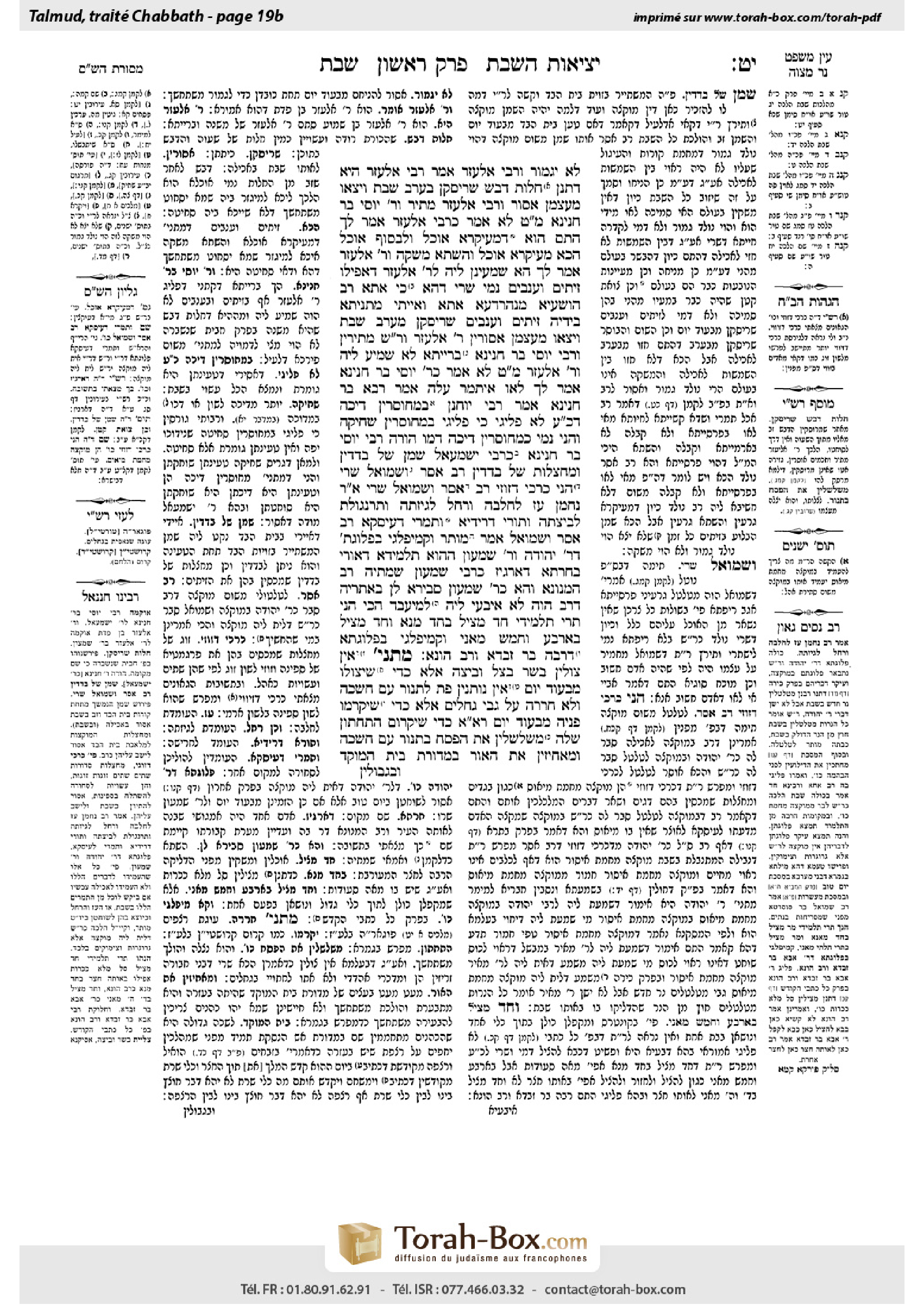
Shabbat 19b: Talmud study for Daf Yomi
Daf Yomi is the daily study of one Talmud folio. Explore 37 tractates with scans, Hebrew text, Sefaria English and AI-generated French translations where annotated.
Passage selection and English or AI-generated French translation are available where the scan has annotations. Daf Study is independent of Torah-Box and Sefaria.
Browse Shabbat · שבת · All tractatesShabbat 19b text and translations
This page of Shabbat includes the Aramaic text, an English translation and an AI-generated French translation, alongside the scan above.
שבת י״ט ב · Aramaic and Hebrew text
לֹא יִגְמוֹר. וְרַבִּי אֶלְעָזָר אָמַר: רַבִּי אֶלְעָזָר הִיא. דִּתְנַן: חַלּוֹת דְּבַשׁ שֶׁרִיסְּקָן בְּעֶרֶב שַׁבָּת וְיָצְאוּ מֵעַצְמָן — אָסוּר, וְרַבִּי אֶלְעָזָר מַתִּיר.
וְרַבִּי יוֹסֵי בַּר חֲנִינָא מַאי טַעְמָא לָא אָמַר כְּרַבִּי אֶלְעָזָר? אָמַר לָךְ, הָתָם הוּא דְּמֵעִיקָּרָא אוֹכֶל וּלְבַסּוֹף אוֹכֶל, הָכָא מֵעִיקָּרָא אוֹכֶל וְהַשְׁתָּא מַשְׁקֶה. וְרַבִּי אֶלְעָזָר אָמַר לָךְ: הָא שָׁמְעִינַן לֵיהּ לְרַבִּי אֶלְעָזָר דַּאֲפִילּוּ זֵיתִים וַעֲנָבִים נָמֵי שָׁרֵי. דְּהָא כִּי אֲתָא רַב הוֹשַׁעְיָא מִנְּהַרְדְּעָא, אֲתָא וְאַיְיתִי מַתְנִיתָא בִּידֵיהּ: זֵיתִים וַעֲנָבִים שֶׁרִיסְּקָן מֵעֶרֶב שַׁבָּת וְיָצְאוּ מֵעַצְמָן — אֲסוּרִין. רַבִּי אֶלְעָזָר וְרַבִּי שִׁמְעוֹן מַתִּירִין. וְרַבִּי יוֹסֵי בַּר חֲנִינָא בָּרָיְיתָא לָא שְׁמִיעַ לֵיהּ.
וְרַבִּי אֶלְעָזָר מַאי טַעְמָא לָא אָמַר כְּרַבִּי יוֹסֵי בַּר חֲנִינָא? אָמַר לָךְ: לָאו אִיתְּמַר עֲלַהּ אָמַר רָבָא בַּר חֲנִינָא אָמַר רַבִּי יוֹחָנָן: בִּמְחוּסָּרִין דִּיכָה — דְּכוּלֵּי עָלְמָא לָא פְּלִיגִי, כִּי פְּלִיגִי בִּמְחוּסָּרִין שְׁחִיקָה. וְהָנֵי נָמֵי כִּמְחוּסָּרִין דִּיכָה דָּמוּ. הוֹרָה רַבִּי יוֹסֵי בַּר חֲנִינָא כְּרַבִּי יִשְׁמָעֵאל.
שֶׁמֶן שֶׁל בַּדָּדִין וּמַחְצָלוֹת שֶׁל בַּדָּדִין — רַב אָסַר וּשְׁמוּאֵל שָׁרֵי. הָנֵי כְּרָכֵי דְזוּזֵי — רַב אָסַר וּשְׁמוּאֵל שָׁרֵי. אָמַר רַב נַחְמָן: עֵז לַחֲלָבָהּ, וְרָחֵל לְגִיזָּתָהּ, וְתַרְנְגוֹלֶת לְבֵיצָתָהּ, וְתוֹרֵי דְרִידְיָא, וְתַמְרֵי דְעִיסְקָא — רַב אָסַר, וּשְׁמוּאֵל אָמַר: מוּתָּר. וְקָמִיפַּלְגִי בִּפְלוּגְתָּא דְּרַבִּי יְהוּדָה וְרַבִּי שִׁמְעוֹן.
הַהוּא תַּלְמִידָא דְּאוֹרִי בְּחַרְתָּא דְאַרְגֵּיז כְּרַבִּי שִׁמְעוֹן, שַׁמְתֵּיהּ רַב הַמְנוּנָא. וְהָא כְּרַבִּי שִׁמְעוֹן סְבִירָא לַן? בְּאַתְרֵיהּ דְּרַב הֲוָה לָא אִיבְּעַי לֵיהּ לְמִיעְבַּד הָכִי. הָנֵי תְּרֵי תַלְמִידֵי, חַד מַצִּיל בְּחַד מָנָא, וְחַד מַצִּיל בְּאַרְבַּע וַחֲמֵשׁ מָאנֵי — וְקָמִיפַּלְגִי בִּפְלוּגְתָּא דְּרַבָּה בַּר זַבְדָּא וְרַב הוּנָא.
מַתְנִי׳ אֵין צוֹלִין בָּשָׂר בָּצָל וּבֵיצָה אֶלָּא כְּדֵי שֶׁיִּצּוֹלוּ מִבְּעוֹד יוֹם. אֵין נוֹתְנִין פַּת לַתַּנּוּר עִם חֲשֵׁכָה, וְלֹא חֲרָרָה עַל גַּבֵּי גֶּחָלִים, אֶלָּא כְּדֵי שֶׁיִּקְרְמוּ פָּנֶיהָ מִבְּעוֹד יוֹם. רַבִּי אֱלִיעֶזֶר אוֹמֵר: כְּדֵי שֶׁיִּקְרוֹם הַתַּחְתּוֹן שֶׁלָּהּ. מְשַׁלְשְׁלִין אֶת הַפֶּסַח בַּתַּנּוּר עִם חֲשֵׁכָה. וּמַאֲחִיזִין אֶת הָאוּר בִּמְדוּרַת בֵּית הַמּוֹקֵד.
Shabbat 19b · English translation
He may not finish. And the amora Rabbi Elazar said: Our mishna is in accordance with the opinion of Rabbi Elazar the tanna. As we learned in a mishna: With regard to honeycombs that he crushed on Shabbat eve and the honey came out on its own on Shabbat day, it is prohibited to eat the honey, like anything that was prepared on Shabbat. And Rabbi Elazar permits eating it on Shabbat.
The Gemara asks: And Rabbi Yosei bar Ḥanina, what is the reason he did not say in accordance with the explanation of Rabbi Elazar? Apparently, Rabbi Elazar’s explanation in the mishna is more accurate. The Gemara answers: Rabbi Yosei could have said to you that there, in the case of the honeycombs, it is food from the beginning and it is food at the end, as honey is considered food. Therefore, there was no squeezing of liquid from food at all. However, here, in all of the cases in the mishna, from the beginning they were food and now they became liquid, and that is the definition of squeezing. And Rabbi Elazar could have said to you in response to this assertion: We heard that Rabbi Elazar permitted olives and grapes as well. As when Rav Hoshaya from Neharde’a came, he came and brought a baraita with him, in which it was taught: Olives and grapes that he crushed from Shabbat eve and the liquids seeped out on their own, the liquids are prohibited. Rabbi Elazar and Rabbi Shimon permit those liquids. The Gemara answers that Rabbi Yosei bar Rabbi Ḥanina did not know this baraita.
On the other hand, the Gemara asks: And Rabbi Elazar, what is the reason he did not say in accordance with the explanation of Rabbi Yosei bar Ḥanina, that our mishna is in accordance with the opinion of Rabbi Yishmael? The Gemara answers: Rabbi Elazar could have said to you: Wasn’t it stated that Rava bar Ḥanina said that Rabbi Yoḥanan said: Here it is referring to items that lack grinding, i.e., when the garlic and the unripe grapes were not ground in a pestle at all, everyone agrees that it is prohibited to place them in a manner that causes their liquids to come out on their own on Shabbat. The case where they disagreed was where they were already completely ground, but they were still lacking additional pounding; and these cases in our mishna are also considered as if they were lacking grinding. The Gemara relates that Rabbi Yosei bar Ḥanina issued a practical ruling in accordance with the opinion of Rabbi Yishmael, and permitted a person to finish tending to them even after dark.
Since the Gemara raised issues related to the olive press, it cites other connected matters: Oil of olive pressers and mats of olive pressers, which they use in their work, Rav prohibited moving them on Shabbat since they are set aside for a specific purpose, and it is prohibited to move an item set aside and designated for a defined purpose on Shabbat. And Shmuel permitted doing so, as according to Shmuel, the legal status of set-aside [muktze] does not apply in most cases. Along the same lines, they disagreed with regard to those mats used to cover merchandise transported on a ship. Rav prohibited using them because they are set aside and Shmuel permitted using them. Similarly, Rav Naḥman said: A goat raised for its milk, and a ewe that is raised for shearing its wool, and a chicken raised for its egg, and oxen used for plowing, all of which are designated for purposes other than eating, as well as dates used for commerce; in all of these Rav prohibited using them for food, or slaughtering them even on a Festival due to the prohibition of set-aside. The reason for this is that during the day, before Shabbat, he had no intention of eating them, as he set them aside for a different purpose. And Shmuel said: They are permitted, as in his opinion there is no prohibition of set-aside. The Gemara comments that they disagree in the dispute of the tanna’im Rabbi Yehuda and Rabbi Shimon with regard to the issue of muktze.
The Gemara relates: There was this student who issued a ruling in the city of Ḥarta De’argiz that items that are set aside are permitted, in accordance with the opinion of Rabbi Shimon, and Rav Hamnuna excommunicated him. The Gemara asks: Don’t we hold that the halakha is in accordance with the opinion of Rabbi Shimon? Why, then, did Rav Hamnuna excommunicate him? The Gemara answers: This incident was in the place of Rav and the student should not have done this; even if the accepted ruling is lenient, the city was under Rav’s jurisdiction, and the student’s public ruling, contrary to Rav’s opinion, was a blatant display of disrespect. Incidentally, the Gemara relates a story involving these two students: One would rescue from a fire with one vessel and one would rescue with four and five vessels, as it is permitted to rescue one’s belongings from a fire on Shabbat. They disagreed with regard to whether it is preferable to carry just one vessel and go back and forth several times, or to carry several vessels and go back and forth fewer times. And they disagree with regard to the same issue that was the subject of the dispute of Rabba bar Zavda and Rav Huna elsewhere.
MISHNA: This mishna enumerates actions that may only be performed on Shabbat eve if the prohibited labor will be totally or mostly completed while it is still day. One may only roast meat, an onion, or an egg if there remains sufficient time so that they could be roasted while it is still day. One may only place dough to bake into bread in the oven on Shabbat eve at nightfall, and may only place a cake on the coals, if there is time enough that the surface of this cake or bread will form a crust while it is still day. Rabbi Eliezer says: Enough time so that its bottom crust should harden, which takes less time. However, in a case that is an exception, one may, ab initio, lower the Paschal lamb into the oven on Shabbat eve at nightfall, so that its roasting is completed on Shabbat if Passover eve coincides with Shabbat eve. And one may, ab initio, kindle the fire in the bonfire of the Chamber of the Hearth in the Temple on Shabbat eve, adjacent to the start of Shabbat, and allow the fire to spread afterward throughout all the wood in the bonfire.
Shabbat 19b · Traduction française (IA)
Il ne doit pas achever. L’amora Rabbi Elazar a dit : Notre Michna suit l’opinion de Rabbi Elazar le tanna. En effet, nous avons appris dans une Michna : Si quelqu’un a écrasé des rayons de miel la veille de Chabbat et que le miel s’est écoulé de lui-même pendant Chabbat, il est interdit de manger ce miel, comme toute chose préparée pendant Chabbat. Rabbi Elazar permet de le manger pendant Chabbat.
La Guemara demande : Pour quelle raison Rabbi Yosei bar Ḥanina n’a-t-il pas donné l’explication de Rabbi Elazar ? Apparemment, l’explication de Rabbi Elazar concernant la Michna est plus exacte. La Guemara répond : Rabbi Yosei aurait pu te dire que, dans le cas des rayons de miel, il s’agit d’un aliment au départ et à l’arrivée, puisque le miel est considéré comme un aliment. Il n’y a donc eu aucune extraction de liquide à partir d’un aliment. Ici, en revanche, dans tous les cas de la Michna, il s’agissait d’aliments au départ, mais ils sont devenus liquides, et c’est cela qui constitue une extraction. Rabbi Elazar aurait pu lui répondre : Nous avons appris que Rabbi Elazar a également autorisé les olives et les raisins. En effet, lorsque Rav Hoshaya de Neharde’a est venu, il a apporté avec lui une baraïta où il était enseigné : Si quelqu’un a écrasé des olives et des raisins la veille de Chabbat et que les liquides se sont écoulés d’eux-mêmes, ces liquides sont interdits. Rabbi Elazar et Rabbi Shimon les autorisent. La Guemara répond que Rabbi Yosei bar Rabbi Ḥanina ne connaissait pas cette baraïta.
D’un autre côté, la Guemara demande : Pour quelle raison Rabbi Elazar n’a-t-il pas donné l’explication de Rabbi Yosei bar Ḥanina, selon laquelle notre Michna suit l’opinion de Rabbi Yishmael ? La Guemara répond : Rabbi Elazar aurait pu te dire : N’a-t-il pas été enseigné que Rava bar Ḥanina a dit au nom de Rabbi Yoḥanan : Ici, il s’agit de choses qui n’ont pas encore été broyées, c’est-à-dire que, lorsque l’ail et les raisins verts n’ont pas du tout été broyés dans un mortier, tous conviennent qu’il est interdit de les placer de manière à ce que leurs liquides s’écoulent d’eux-mêmes pendant Chabbat. Le désaccord porte sur le cas où ils ont déjà été complètement broyés, mais nécessitent encore d’être pilés davantage ; et ces cas de notre Michna sont également considérés comme n’ayant pas encore été broyés. La Guemara rapporte que Rabbi Yosei bar Ḥanina a rendu une décision pratique conformément à l’opinion de Rabbi Yishmael et a autorisé quelqu’un à achever de s’en occuper même après la tombée de la nuit.
Puisque la Guemara a soulevé des questions liées au pressoir à olives, elle cite d’autres sujets connexes : Rav interdit de déplacer l’huile des ouvriers du pressoir et leurs nattes, qu’ils utilisent dans leur travail, pendant Chabbat, car ces objets sont réservés à un usage précis ; or il est interdit de déplacer pendant Chabbat un objet mis de côté et affecté à un usage déterminé. Shmuel, lui, le permettait, car selon lui, la règle des objets mis de côté [muktze] ne s’applique pas dans la plupart des cas. Dans le même ordre d’idées, ils divergeaient au sujet des nattes servant à couvrir les marchandises transportées sur un bateau. Rav interdisait de les utiliser parce qu’elles étaient mises de côté, tandis que Shmuel en permettait l’usage. De même, Rav Naḥman a dit : pour une chèvre élevée pour son lait, une brebis élevée pour sa laine, une poule élevée pour ses œufs, des bœufs employés au labour — tous désignés à des usages autres que la consommation — ainsi que pour des dattes destinées au commerce, Rav interdisait de les consommer ou de les abattre, même un jour de fête, en raison de l’interdiction relative aux objets mis de côté. La raison en est que, pendant la journée précédant Chabbat, il n’avait pas l’intention de les consommer, puisqu’il les avait réservés à un autre usage. Shmuel, lui, disait qu’ils étaient permis, car, selon lui, il n’y a pas d’interdiction relative aux objets mis de côté. La Guemara remarque qu’ils divergent dans le débat des tannaïm Rabbi Yehuda et Rabbi Shimon au sujet du muktze.
La Guemara rapporte : un étudiant avait statué dans la ville de Ḥarta De’argiz que les objets mis de côté étaient permis, conformément à l’opinion de Rabbi Shimon, et Rav Hamnuna l’a mis au ban. La Guemara demande : Ne tenons-nous pas que la halakha suit l’opinion de Rabbi Shimon ? Pourquoi, alors, Rav Hamnuna l’a-t-il mis au ban ? La Guemara répond : cet incident s’est produit dans le domaine de Rav et l’étudiant n’aurait pas dû agir ainsi ; même si la décision admise est indulgente, la ville relevait de l’autorité de Rav, et la décision publique de l’étudiant, contraire à l’opinion de Rav, constituait une manifestation flagrante d’irrespect. À ce propos, la Guemara rapporte un récit concernant ces deux étudiants : l’un sauvait des objets d’un incendie au moyen d’un seul récipient, l’autre en utilisait quatre ou cinq, car il est permis de sauver ses biens d’un incendie pendant Chabbat. Ils divergeaient sur la question de savoir s’il vaut mieux ne transporter qu’un seul récipient et faire plusieurs allers-retours, ou en transporter plusieurs et faire moins d’allers-retours. Ils divergeaient sur la même question que celle qui faisait l’objet du débat entre Rabba bar Zavda et Rav Huna ailleurs.
MICHNA : Cette Michna énumère les actions qui ne peuvent être entreprises la veille de Chabbat que si le travail interdit est achevé entièrement ou en majeure partie avant la tombée de la nuit. On ne peut faire rôtir de la viande, un oignon ou un œuf que s’il reste assez de temps pour qu’ils puissent rôtir avant la tombée de la nuit. On ne peut mettre de la pâte à cuire au four la veille de Chabbat, à la tombée de la nuit, ni placer un gâteau sur les braises, que s’il reste assez de temps pour que la surface du gâteau ou du pain forme une croûte avant la tombée de la nuit. Rabbi Eliezer dit : il suffit qu’il reste assez de temps pour que la croûte du dessous durcisse, ce qui prend moins de temps. Toutefois, dans un cas qui fait exception, on peut, a priori, mettre l’agneau pascal dans le four la veille de Chabbat, à la tombée de la nuit, afin que sa cuisson s’achève pendant Chabbat si la veille de Pessa’h coïncide avec la veille de Chabbat. On peut également, a priori, allumer le feu du bûcher de la Chambre du Foyer dans le Temple la veille de Chabbat, juste avant le début de Chabbat, et laisser ensuite le feu se propager à tout le bois du bûcher.
Traduction française générée par IA à partir de l’édition anglaise de Sefaria. Vérifie toujours un passage avec le texte source.
Text from Sefaria: William Davidson Edition - Vocalized Aramaic (CC BY NC); William Davidson Edition - English (CC BY NC).