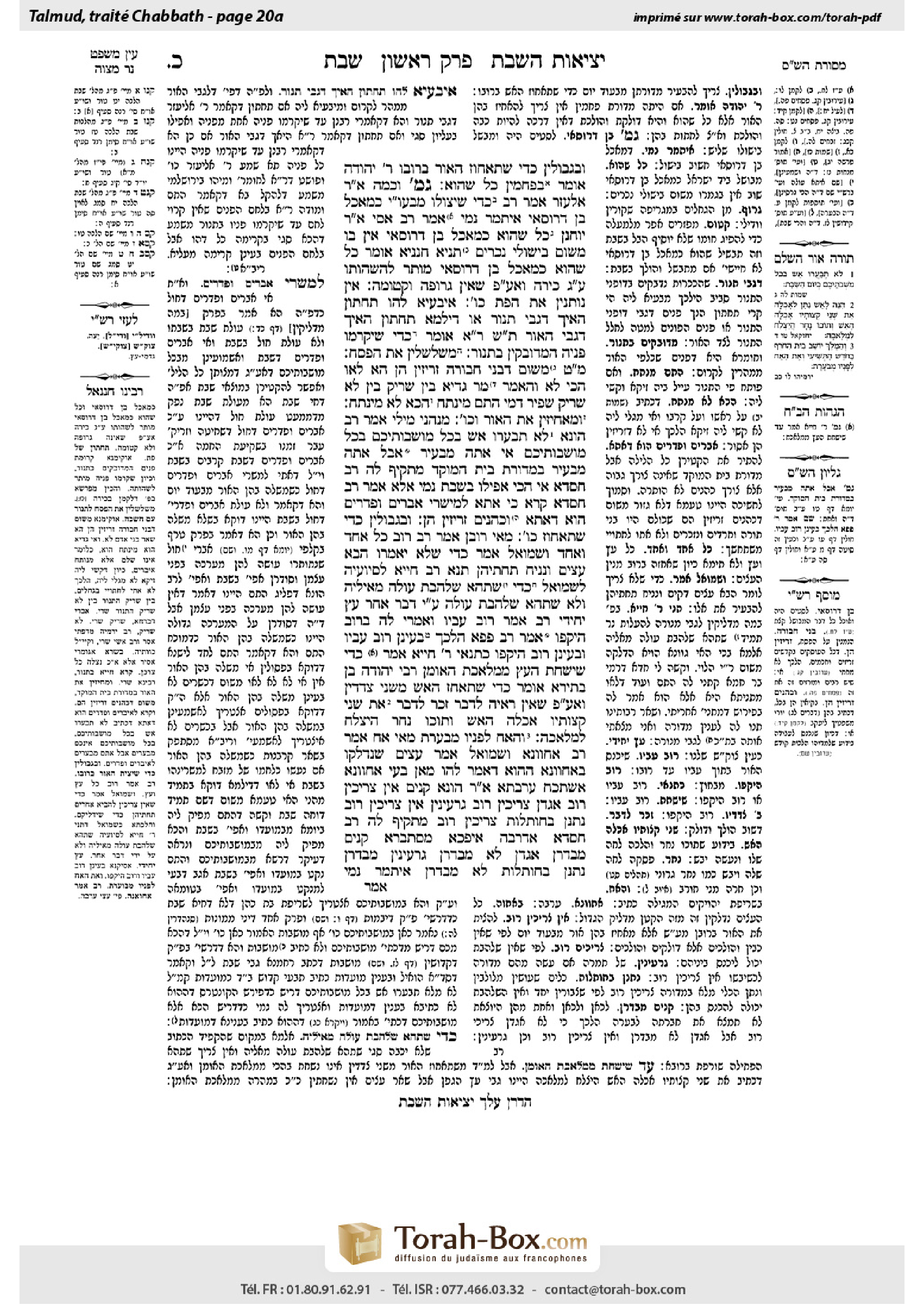
Shabbat 20a: Talmud study for Daf Yomi
Daf Yomi is the daily study of one Talmud folio. Explore 37 tractates with scans, Hebrew text, Sefaria English and AI-generated French translations where annotated.
Passage selection and English or AI-generated French translation are available where the scan has annotations. Daf Study is independent of Torah-Box and Sefaria.
Browse Shabbat · שבת · All tractatesShabbat 20a text and translations
This page of Shabbat includes the Aramaic text, an English translation and an AI-generated French translation, alongside the scan above.
שבת כ׳ א · Aramaic and Hebrew text
וּבַגְּבוּלִין, כְּדֵי שֶׁתֶּאֱחוֹז הָאוּר בְּרוּבּוֹ. רַבִּי יְהוּדָה אוֹמֵר: בְּפֶחָמִין — כׇּל שֶׁהוּא.
גְּמָ׳ וְכַמָּה? אָמַר רַבִּי אֶלְעָזָר אָמַר רַב: כְּדֵי שֶׁיִּצּוֹלוּ מִבְּעוֹד יוֹם כְּמַאֲכָל בֶּן דְּרוֹסַאי. אִיתְּמַר נָמֵי, אָמַר רַב אַסִּי אָמַר רַבִּי יוֹחָנָן: כׇּל שֶׁהוּא כְּמַאֲכָל בֶּן דְּרוֹסַאי, אֵין בּוֹ מִשּׁוּם בִּישּׁוּלֵי גוֹיִם. תַּנְיָא חֲנַנְיָא אוֹמֵר: כׇּל שֶׁהוּא כְּמַאֲכָל בֶּן דְּרוֹסַאי — מוּתָּר לְהַשְׁהוֹתוֹ עַל גַּבֵּי כִּירָה וְאַף עַל פִּי שֶׁאֵין גְּרוּפָה וּקְטוּמָה.
אֵין נוֹתְנִין אֶת הַפַּת כּוּ׳: אִיבַּעְיָא לְהוּ, תַּחְתּוֹן הַאיְךְ דְּגַבֵּי תַנּוּר, אוֹ דִילְמָא תַּחְתּוֹן הַאיְךְ דְּגַבֵּי הָאוּר? תָּא שְׁמַע, רַבִּי אֱלִיעֶזֶר אוֹמֵר: כְּדֵי שֶׁיִּקְרְמוּ פָּנֶיהָ הַמְדוּבָּקִין בַּתַּנּוּר.
מְשַׁלְשְׁלִין אֶת הַפֶּסַח: מַאי טַעְמָא? — מִשּׁוּם דִּבְנֵי חֲבוּרָה זְרִיזִין הֵן. הָא לָאו הָכִי לָא?! וְהָאָמַר מָר: גַּדְיָא בֵּין שְׁרִיק בֵּין לָא שְׁרִיק — שַׁפִּיר דָּמֵי! הָתָם מִינְּתַח, הָכָא לָא מִינְּתַח.
וּמַאֲחִיזִין אֶת הָאוּר וְכוּ׳: מְנָהָנֵי מִילֵּי אָמַר רַב הוּנָא: ״לֹא תְבַעֲרוּ אֵשׁ בְּכֹל מוֹשְׁבוֹתֵיכֶם״. בְּכָל מוֹשְׁבוֹתֵיכֶם אִי אַתָּה מַבְעִיר, אֲבָל אַתָּה מַבְעִיר בִּמְדוּרַת בֵּית הַמּוֹקֵד. מַתְקִיף לַהּ רַב חִסְדָּא: אִי הָכִי, אֲפִילּוּ בְּשַׁבָּת נָמֵי? אֶלָּא אָמַר רַב חִסְדָּא: קְרָא כִּי אֲתָא לְמִישְׁרֵי אֵבָרִים וּפְדָרִים הוּא דַּאֲתָא, וְכֹהֲנִים זְרִיזִין הֵן.
וּבַגְּבוּלִין כְּדֵי שֶׁתֶּאֱחוֹז כּוּ׳. מַאי רוּבָּן? אָמַר רַב: רוֹב כׇּל אֶחָד וְאֶחָד. וּשְׁמוּאֵל אָמַר: כְּדֵי שֶׁלֹּא יֹאמְרוּ ״הָבֵא עֵצִים וְנַנִּיחַ תַּחְתֵּיהֶן״. תָּנֵי רַב חִיָּיא לְסַיּוֹעֵיהּ לִשְׁמוּאֵל, כְּדֵי שֶׁתְּהֵא שַׁלְהֶבֶת עוֹלָה מֵאֵילֶיהָ וְלֹא שֶׁתְּהֵא שַׁלְהֶבֶת עוֹלָה עַל יְדֵי דָּבָר אַחֵר.
עֵץ יְחִידִי, רַב אָמַר: רוֹב עׇבְיוֹ, וְאָמְרִי לַהּ: בְּרוֹב הֶיקֵּפוֹ. אָמַר רַב פָּפָּא: הִלְכָּךְ בָּעֵינַן רוֹב עׇבְיוֹ וּבָעֵינַן רוֹב הֶיקֵּפוֹ. כְּתַנָּאֵי: רַבִּי חִיָּיא אָמַר: כְּדֵי שֶׁיִּשָּׁחֵת הָעֵץ מִמְּלֶאכֶת הָאוּמָּן, רַבִּי יְהוּדָה בֶּן בְּתֵירָא אוֹמֵר: כְּדֵי שֶׁתֹּאחַז הָאֵשׁ מִשְּׁנֵי צְדָדִין. וְאַף עַל פִּי שֶׁאֵין רְאָיָה לַדָּבָר, זֵכֶר לַדָּבָר: ״אֵת שְׁנֵי קְצוֹתָיו אָכְלָה הָאֵשׁ וְתוֹכוֹ נָחָר הֲיִצְלַח לִמְלָאכָה״.
״וְהָאָח לְפָנָיו מְבֹעָרֶת״. מַאי אָח? אָמַר רַב: אַחְווֹנָא. וּשְׁמוּאֵל אָמַר: עֵצִים שֶׁנִּדְלְקוּ בְּאַחְווֹנָא. הַהוּא דְּאָמַר לְהוּ מַאן בָּעֵי אַחְווֹנָא? אִשְׁתְּכַח עֲרַבְתָּא.
אָמַר רַב הוּנָא: קָנִים אֵין צְרִיכִין רוֹב, אֲגָדָן — צְרִיכִין רוֹב. גַּרְעִינִין אֵין צְרִיכִין רוֹב, נְתָנָן בְּחוֹתָלוֹת — צְרִיכִין רוֹב. מַתְקִיף לַהּ רַב חִסְדָּא: אַדְּרַבָּה, אִיפְּכָא מִסְתַּבְּרָא: קָנִים — מִבַּדְּרָן, אֲגָדָן — לָא מִבַּדְּרָן. גַּרְעִינִין — מִבַּדְּרָן, נְתָנָן בְּחוֹתָלוֹת — לָא מִבַּדְּרָן. אִיתְּמַר נָמֵי
Shabbat 20a · English translation
And, however, in the outlying areas, meaning in all of Eretz Yisrael outside the Temple, it is prohibited to light a bonfire on Shabbat eve, unless there is sufficient time for the fire to take hold in most of the bonfire, while it is still day. Rabbi Yehuda says: With a bonfire of coals, even in the outlying areas one is permitted to light the fire on Shabbat eve at nightfall, even if the fire only spread to any amount of the bonfire. The coals, once they are kindled, will not be extinguished again, and there is no concern lest he come to tend to them on Shabbat.
GEMARA: We learned in the mishna that one may only roast meat and other food items if there remains sufficient time so that they could be roasted while it is still day. The Gemara asks: And how much do they need to be roasted in order to be considered sufficient, so that it will be permitted to complete their cooking afterward? Rabbi Elazar said that Rav said: So that they will be roasted while it is still day like the food of ben Drosai, which was partially roasted. Ben Drosai was a robber and pursued by all. He could not wait for his food to roast completely, so he sufficed with a partial roasting. It was also stated by another of the Sages, as Rav Asi said that Rabbi Yoḥanan said: Anything that is already cooked like the food of ben Drosai by a Jew, no longer has a problem of the cooking of gentiles. If a gentile completed cooking this food, it is, nevertheless, permitted to eat, even though, as a rule, it is prohibited to eat food cooked by gentiles. It was taught in a baraita, Ḥananya says: With regard to anything that is already cooked like the food of ben Drosai, it is permitted to keep it on the stove on Shabbat and even though this stove is not swept of coals and the burning coals are not covered with ashes. Since the food was already cooked to that extent, there is no concern that he will come to stoke the coals.
We learned in the mishna that one may only place bread in the oven on Shabbat eve at nightfall if there remains sufficient time for its surface to form a crust while it is still day. According to Rabbi Eliezer, it is permitted to place bread in the oven on Shabbat eve while it is still day if there remains enough time for a crust to form on its bottom side. A dilemma was raised before them: With regard to the bottom mentioned in the mishna, is it that side close to the oven, or perhaps is it the bottom that is close to the fire? Come and hear a resolution to this dilemma from what was taught in a baraita that Rabbi Eliezer says explicitly: So that its surface that is stuck to the oven will form a crust.
We learned in the mishna that one may lower the Paschal lamb into the oven on Shabbat eve at nightfall. The Gemara explains: What is the reason that this was permitted? Because the people of the group who registered to be counted together for the offering and eating of the Paschal lamb are vigilant in the performance of mitzvot and they will not transgress the halakhot of Shabbat. The Gemara asks: And if that was not so, there would not be permission to do so? Didn’t the Master say: The meat of a kid, whether it is in an oven that is sealed or whether it is in one that is not sealed, everyone agrees that he may well place it in the oven at nightfall because taking it out of the oven harms it, and there is no room for concern that he will do so? If so, there is no room for concern with regard to the meat of the Paschal lamb, which must be either a goat or a lamb (Exodus 12:5). The Gemara answers: In any case, it is necessary to emphasize the vigilance of the members of the group, as there, where it was permitted, it was specifically in a case that the goat was cut into pieces. However, here, with regard to the Paschal lamb, the goat is not cut into pieces. It is roasted whole, in accordance with the halakhot of the Paschal lamb. Consequently, it does not roast quickly, and there is room for concern lest he stoke the coals in order to accelerate the roasting. However, since the members of the group are vigilant, the Sages permitted it.
We learned the following in the mishna: And one may light the fire in the bonfire of the Chamber of the Hearth in the Temple on Shabbat eve adjacent to nightfall and allow the fire to spread afterward throughout the entire bonfire. The Gemara asks: From where are these matters that doing so is permitted, derived? Rav Huna said, as it is stated: “You shall kindle no fire in all of your habitations on the day of Shabbat” (Exodus 35:3). The Gemara infers: “In all of your habitations,” the dwelling places of the Jewish people, you may not kindle fire, but you may kindle fire on Shabbat in the bonfire of the Chamber of the Hearth, which is in the Temple. Rav Ḥisda objects: If so, if that is the source for the fact that kindling the fire is permitted on Shabbat eve at nightfall, it should also be permitted to kindle it even on Shabbat itself. Why kindle the fire while it is still day? Rather, Rav Ḥisda said, it should be understood as follows: When the verse came, it came to permit burning the limbs and fats of the sacrifices on the altar, even on Shabbat. Lighting the bonfire of the Chamber of the Hearth was not permitted on Shabbat itself, since it is not part of the Temple service. It was kindled merely for the benefit of the priests. The fact that there was no concern about lighting the bonfire on Shabbat eve at nightfall is because the priests are vigilant with regard to mitzvot, and they will certainly not come to stoke the coals.
We also learned in the mishna that in the outlying areas one may not light a bonfire on Shabbat eve at nightfall unless there is sufficient time for the fire to take hold in most of the bonfire. The Gemara asks about this: What is meant by the measure of most of it? Rav said: Most of each and every one of the branches. And Shmuel said: It is sufficient if the branches are sufficiently lit so that they will not say to each other: Bring thinner branches, which are easier to kindle, and we will place them beneath the existing branches to accelerate their burning. Rav Ḥiyya taught a baraita to support Shmuel, from a halakha that was stated with regard to the Temple candelabrum. The baraita said that it must be lit to the point that the flame will ascend on its own and not that the flame will ascend due to something else. In a place where kindling is required, it is sufficient to ensure that the fire burns on its own (Tosafot).
To this point, the Gemara was discussing a bonfire. However, the Gemara asks: What is the halakha with regard to a single branch that one kindles on Shabbat eve? Rav said: Most of the thickness of the wood must ignite while it is still day, before Shabbat. Others say the same halakha in the name of Rav: Most of the circumference of the wood must ignite while it is still day, before Shabbat. Rav Pappa said: Since there is disagreement with regard to Rav’s halakha, and it is not clear exactly what he said, therefore, we require most of its thickness to ignite and we require most of its circumference to ignite; thereby, we avoid entering into a situation of uncertainty. The Gemara comments: This dispute is parallel to the dispute of the tanna’im, who disagreed with regard to a different matter. Rabbi Ḥiyya said: A fire is considered to be kindled when the wood will be ruined to the extent that it can no longer be used for the work of a craftsman. And Rabbi Yehuda ben Beteira says: So that the fire will take hold from both sides of the wood. And he added: And even though there is no proof for the matter, i.e., what constitutes burning as far as Shabbat is concerned, nevertheless there is an allusion to the matter that wood in this condition is considered burnt, as it is stated: “Behold, it is cast into the fire for fuel; the fire consumed both of its ends and the midst of it is burned. Is it fit for any work?” (Ezekiel 15:4).
Along the same lines, the Gemara cites a different verse that discusses burning fire, as it relates to King Jehoiakim: “And the hearth [aḥ] was burning before him” (Jeremiah 36:22). Amora’im disputed the question: What is the aḥ mentioned in the verse? Rav said that it means willow branch [aḥvana]. And Shmuel said: It is referring to wood that was lit with aḥvana, meaning with fraternity [aḥva], i.e., that each piece of wood is lit from another, even small ones from large ones. The meaning of the word aḥvana was forgotten; the Gemara relates that this man, who said to people in the marketplace: Who wants aḥvana? And he was found to be selling willow, and therefore, the meaning of the word was understood.
Rav Huna said: Reeds with which he lights a bonfire on Shabbat eve do not require that most of the reeds ignite prior to Shabbat, because they burn easily. However, if he tied them together into a bundle, the reeds assume the legal status of a wooden beam and most of the reeds need to catch fire before Shabbat. The same is true with regard to date seeds that he kindles. They do not require that most of them catch fire before Shabbat, because they burn easily. However, if he placed them in woven baskets [ḥotalot], most of the seeds need to ignite before Shabbat. Rav Ḥisda strongly objects to this: On the contrary, the opposite makes sense, as reeds are scattered and difficult to burn. When they are bundled, they are not scattered, and therefore burn more easily. Similarly, seeds are scattered. And if he placed them in woven baskets, they are not scattered. It was also stated
Shabbat 20a · Traduction française (IA)
Toutefois, dans les régions périphériques, c’est-à-dire dans tout Eretz Israël en dehors du Temple, il est interdit d’allumer un bûcher la veille de Chabbat, à moins qu’il ne reste suffisamment de temps pour que le feu prenne dans la majeure partie du bûcher alors qu’il fait encore jour. Rabbi Yehouda dit : pour un bûcher de braises, même dans les régions périphériques, il est permis d’allumer le feu la veille de Chabbat à la tombée de la nuit, même si le feu n’a pris que dans une partie quelconque du bûcher. Une fois allumées, les braises ne s’éteindront plus, et l’on ne craint pas qu’il en vienne à les attiser pendant Chabbat.
GUEMARA : Nous avons appris dans la Michna qu’on ne peut faire rôtir de la viande et d’autres aliments que s’il reste suffisamment de temps pour qu’ils soient rôtis alors qu’il fait encore jour. La Guemara demande : À quel degré doivent-ils avoir rôti pour que cela soit considéré comme suffisant et qu’il soit permis d’achever ensuite leur cuisson ? Rabbi Elazar dit au nom de Rav : Il faut qu’ils aient rôti alors qu’il fait encore jour au degré de cuisson de l’aliment de ben Drosai, qui n’était que partiellement rôti. Ben Drosai était un brigand, poursuivi par tous. Il ne pouvait pas attendre que ses aliments soient complètement rôtis et se contentait donc d’une cuisson partielle. Un autre Sage a également transmis cette règle : Rav Asi dit au nom de Rabbi Yoḥanan que tout aliment déjà cuit par un Juif au degré de cuisson de l’aliment de ben Drosai ne pose plus de problème de cuisson par des non-Juifs. Si un non-Juif achève la cuisson de cet aliment, il est néanmoins permis de le manger, bien qu’en règle générale il soit interdit de manger des aliments cuits par des non-Juifs. Il a été enseigné dans une baraïta : Ḥananya dit que tout aliment déjà cuit au degré de cuisson de l’aliment de ben Drosai peut rester sur le fourneau pendant Chabbat, même si ce fourneau n’a pas été débarrassé de ses braises et que les braises ardentes n’ont pas été recouvertes de cendres. Puisque l’aliment a déjà atteint ce degré de cuisson, on ne craint pas qu’il en vienne à attiser les braises.
Nous avons appris dans la Michna qu’on ne peut mettre du pain au four la veille de Chabbat, à la tombée de la nuit, que s’il reste suffisamment de temps pour que sa surface forme une croûte alors qu’il fait encore jour. Selon Rabbi Eliezer, il est permis de mettre le pain au four la veille de Chabbat, alors qu’il fait encore jour, s’il reste assez de temps pour qu’une croûte se forme sur sa face inférieure. Une question fut soumise aux Sages : la face inférieure mentionnée dans la Michna est-elle celle qui est près du four, ou peut-être s’agit-il de celle qui est près du feu ? Venez entendre la réponse à cette question à partir de ce qui a été enseigné dans une baraïta, où Rabbi Eliezer dit explicitement : il faut que la surface collée au four forme une croûte.
Nous avons appris dans la Michna qu’on peut descendre l’agneau pascal dans le four la veille de Chabbat, à la tombée de la nuit. La Guemara explique : Pourquoi cela a-t-il été permis ? Parce que les membres du groupe qui se sont inscrits ensemble pour l’offrande et la consommation de l’agneau pascal sont vigilants dans l’accomplissement des mitsvot et ne transgresseront pas les halakhot de Chabbat. La Guemara demande : Si ce n’était pas le cas, cela ne serait-il pas permis ? Le Maître n’a-t-il pas dit : pour la viande d’un chevreau, qu’elle se trouve dans un four fermé ou dans un four non fermé, tous conviennent qu’on peut tout à fait la mettre au four à la tombée de la nuit, car la sortir du four l’abîmerait et il n’y a donc pas lieu de craindre qu’on le fasse ? Il n’y aurait donc pas lieu de s’inquiéter pour la viande de l’agneau pascal, qui doit être soit un chevreau, soit un agneau (Exode 12, 5). La Guemara répond : Quoi qu’il en soit, il est nécessaire de souligner la vigilance des membres du groupe, car dans le cas où cela a été permis, le chevreau était précisément découpé en morceaux. Mais ici, pour l’agneau pascal, le chevreau n’est pas découpé en morceaux. Il est rôti entier, conformément aux halakhot de l’agneau pascal. Par conséquent, il ne rôtit pas rapidement, et l’on pourrait craindre qu’on attise les braises pour accélérer la cuisson. Toutefois, puisque les membres du groupe sont vigilants, les Sages l’ont permis.
Nous avons appris ce qui suit dans la Michna : on peut allumer le feu du bûcher de la Chambre du Foyer dans le Temple la veille de Chabbat, à l’approche de la tombée de la nuit, et laisser ensuite le feu se propager dans tout le bûcher. La Guemara demande : D’où déduit-on que cela est permis ? Rav Houna dit : comme il est dit : « Vous n’allumerez aucun feu dans toutes vos demeures le jour du Chabbat » (Exode 35, 3). La Guemara en déduit : « Dans toutes vos demeures », c’est-à-dire dans les lieux où habitent les enfants d’Israël, vous ne devez pas allumer de feu, mais vous pouvez en allumer un le Chabbat dans le bûcher de la Chambre du Foyer, qui se trouve dans le Temple. Rav Ḥisda objecte : Si tel est le cas, si telle est la source permettant d’allumer le feu la veille de Chabbat, à la tombée de la nuit, il devrait aussi être permis de l’allumer pendant Chabbat même. Pourquoi l’allumer alors qu’il fait encore jour ? Rav Ḥisda dit plutôt qu’il faut comprendre ainsi : lorsque le verset a été donné, il visait à permettre de brûler sur l’autel les membres et les graisses des sacrifices, même pendant Chabbat. Il n’était pas permis d’allumer le bûcher de la Chambre du Foyer pendant Chabbat même, puisqu’il ne fait pas partie du service du Temple. On l’allumait uniquement pour le confort des prêtres. Si l’allumage du bûcher à la tombée de la nuit, la veille de Chabbat, ne posait pas de problème, c’est parce que les prêtres sont vigilants dans l’accomplissement des mitsvot et ne viendront certainement pas attiser les braises.
Nous avons également appris dans la Michna que, dans les régions périphériques, on ne peut allumer un bûcher la veille de Chabbat, à la tombée de la nuit, que s’il reste suffisamment de temps pour que le feu prenne dans la majeure partie du bûcher. La Guemara demande à ce sujet : Qu’entend-on par « la majeure partie » ? Rav dit : la majeure partie de chacune des branches. Et Shmuel dit : il suffit que les branches soient suffisamment embrasées pour qu’elles ne se disent pas entre elles : « Apportons des branches plus fines, qui s’allument plus facilement, et plaçons-les sous les branches déjà présentes afin d’accélérer leur combustion. » Rav Ḥiyya enseigna une baraïta à l’appui de l’avis de Shmuel, tirée d’une halakha énoncée au sujet du candélabre du Temple. La baraïta dit qu’il faut l’allumer de manière que la flamme monte d’elle-même, et non qu’elle monte grâce à autre chose. À l’endroit où l’allumage est requis, il suffit de s’assurer que le feu brûle de lui-même (Tossefot).
Jusqu’ici, la Guemara parlait d’un bûcher. Elle demande toutefois : Quelle est la halakha concernant une seule branche qu’on allume la veille de Chabbat ? Rav dit : la majeure partie de l’épaisseur du bois doit s’embraser alors qu’il fait encore jour, avant Chabbat. D’autres transmettent la même halakha au nom de Rav : la majeure partie de la circonférence du bois doit s’embraser alors qu’il fait encore jour, avant Chabbat. Rav Pappa dit : puisqu’il existe un désaccord sur la halakha de Rav et qu’on ne sait pas exactement ce qu’il a dit, nous exigeons que la majeure partie de l’épaisseur et la majeure partie de la circonférence s’embrasent ; nous évitons ainsi de nous trouver dans une situation d’incertitude. La Guemara fait remarquer que ce désaccord correspond à celui des tannaïm, qui divergeaient sur une autre question. Rabbi Ḥiyya dit : un feu est considéré comme allumé lorsque le bois est détérioré au point de ne plus pouvoir servir au travail d’un artisan. Rabbi Yehouda ben Beteira dit : il faut que le feu ait pris des deux côtés du bois. Il ajouta : bien qu’il n’existe aucune preuve sur cette question, c’est-à-dire sur ce qui constitue une combustion au regard de Chabbat, il y a néanmoins une allusion à l’idée qu’un bois dans cet état est considéré comme brûlé, comme il est dit : « Voici, il est jeté au feu comme combustible ; le feu en a consumé les deux extrémités, et le milieu en est brûlé. Peut-il servir à quelque ouvrage ? » (Ézéchiel 15, 4).
Dans le même ordre d’idées, la Guemara cite un autre verset qui parle d’un feu, à propos du roi Joïaqim : « Le brasier [aḥ] brûlait devant lui » (Jérémie 36, 22). Les amoraïm débattirent de la question : que désigne le mot aḥ mentionné dans le verset ? Rav dit qu’il s’agit d’une branche de saule [aḥvana]. Et Shmuel dit : il s’agit de bois allumé au moyen de aḥvana, c’est-à-dire de « fraternité » [aḥva] : chaque morceau de bois est allumé par un autre, les petits morceaux l’étant même par les gros. Le sens du mot aḥvana avait été oublié ; la Guemara raconte qu’un homme disait aux gens du marché : « Qui veut du aḥvana ? » On découvrit qu’il vendait du saule ; le sens du mot fut ainsi compris.
Rav Houna dit : les roseaux avec lesquels on allume un bûcher la veille de Chabbat n’exigent pas que la majeure partie d’entre eux s’embrase avant Chabbat, car ils brûlent facilement. Toutefois, s’il les a attachés en fagot, les roseaux acquièrent le statut juridique d’une poutre de bois et la majeure partie d’entre eux doit prendre feu avant Chabbat. Il en va de même pour les noyaux de dattes qu’on allume. Il n’est pas nécessaire que la majeure partie d’entre eux prenne feu avant Chabbat, car ils brûlent facilement. Toutefois, s’il les a placés dans des paniers tressés [ḥotalot], la majeure partie des noyaux doit s’embraser avant Chabbat. Rav Ḥisda s’oppose vivement à cette explication : au contraire, c’est l’inverse qui paraît logique, car les roseaux sont épars et difficiles à brûler. Lorsqu’ils sont attachés en fagot, ils ne sont plus épars et brûlent donc plus facilement. De même, les noyaux sont épars. Et s’il les a placés dans des paniers tressés, ils ne sont plus épars. Il a également été enseigné
Traduction française générée par IA à partir de l’édition anglaise de Sefaria. Vérifie toujours un passage avec le texte source.
Text from Sefaria: William Davidson Edition - Vocalized Aramaic (CC BY NC); William Davidson Edition - English (CC BY NC).