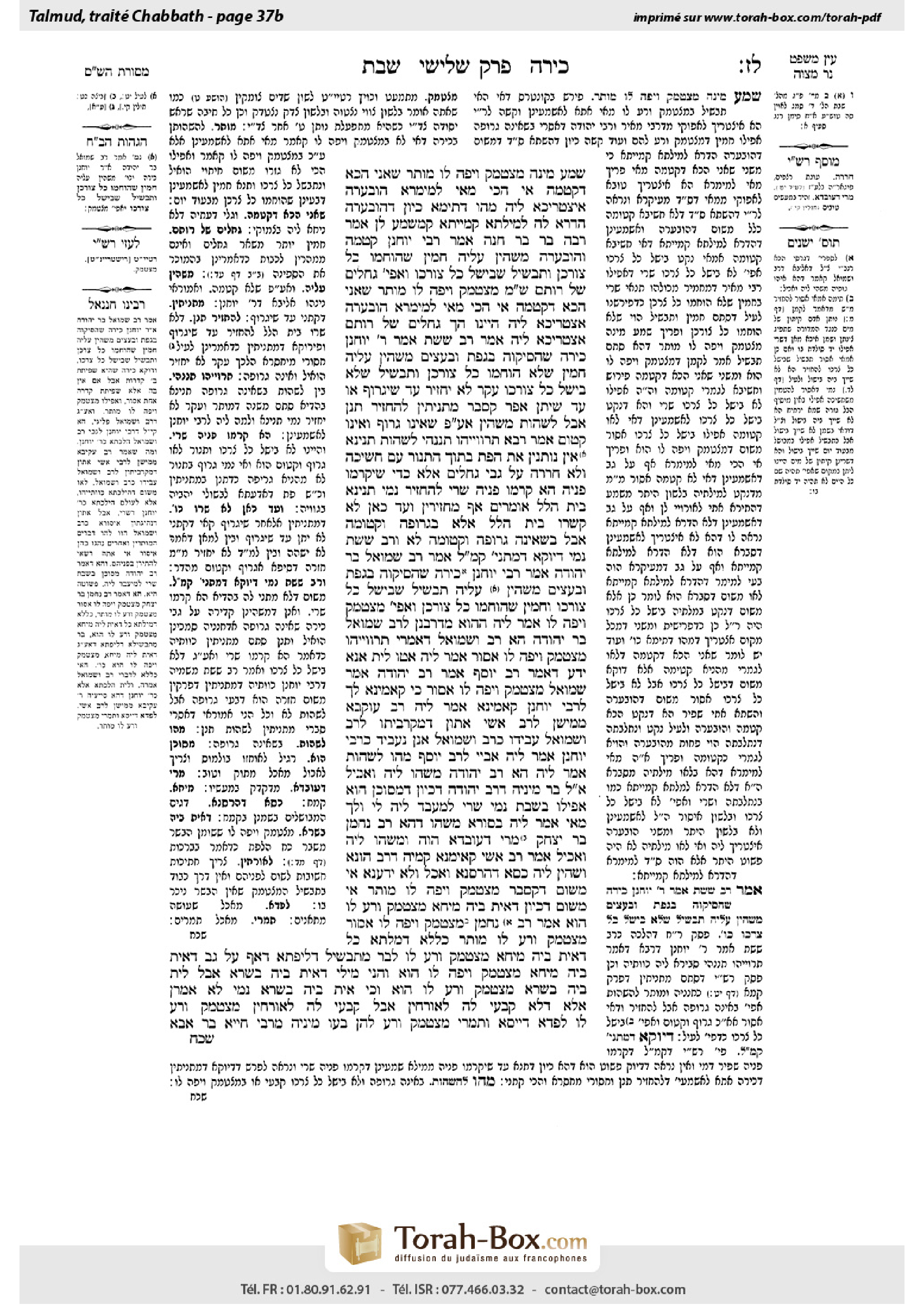
Shabbat 37b: Talmud study for Daf Yomi
Daf Yomi is the daily study of one Talmud folio. Explore 37 tractates with scans, Hebrew text, Sefaria English and AI-generated French translations where annotated.
Passage selection and English or AI-generated French translation are available where the scan has annotations. Daf Study is independent of Torah-Box and Sefaria.
Browse Shabbat · שבת · All tractatesShabbat 37b text and translations
This page of Shabbat includes the Aramaic text, an English translation and an AI-generated French translation, alongside the scan above.
שבת ל״ז ב · Aramaic and Hebrew text
שְׁמַע מִינָּה מִצְטַמֵּק וְיָפֶה לוֹ מוּתָּר! שָׁאנֵי הָכָא דְּקַטְמַהּ. אִי הָכִי מַאי לְמֵימְרָא?! הוּבְעֲרָה אִיצְטְרִיכָא לֵיהּ, מַהוּ דְּתֵימָא כֵּיוָן דְּהוּבְעֲרָה הָדְרָא לָהּ לְמִילְּתָא קַמַּיְיתָא, קָמַשְׁמַע לַן.
אָמַר רַבָּה בַּר בַּר חָנָה אָמַר רַבִּי יוֹחָנָן: קְטָמָהּ וְהוּבְעֲרָה, מְשַׁהִין עָלֶיהָ חַמִּין שֶׁהוּחַמּוּ כׇּל צוֹרְכָּן וְתַבְשִׁיל שֶׁבִּישֵּׁל כׇּל צוֹרְכּוֹ, וַאֲפִילּוּ גֶּחָלִים שֶׁל רוֹתֶם. שְׁמַע מִינָּה מִצְטַמֵּק וְיָפֶה לוֹ מוּתָּר! — שָׁאנֵי הָכָא דְּקַטְמַהּ. אִי הָכִי מַאי לְמֵימְרָא?! הוּבְעֲרָה אִצְטְרִיכָא לֵיהּ. הַיְינוּ הָךְ! — גֶּחָלִים שֶׁל רוֹתֶם אִצְטְרִיכָא לֵיהּ.
אָמַר רַב שֵׁשֶׁת אָמַר רַבִּי יוֹחָנָן: כִּירָה שֶׁהִסִּיקוּהָ בְּגֶפֶת וּבְעֵצִים מְשַׁהִין עָלֶיהָ חַמִּין שֶׁלֹּא הוּחַמּוּ כׇּל צוֹרְכָּן וְתַבְשִׁיל שֶׁלֹּא בִּישֵּׁל כׇּל צוֹרְכּוֹ. עָקַר — לֹא יַחֲזִיר עַד שֶׁיִּגְרוֹף אוֹ עַד שֶׁיִּתֵּן אֵפֶר. קָסָבַר: מַתְנִיתִין ״לְהַחֲזִיר״ תְּנַן, אֲבָל לְשַׁהוֹת — מְשַׁהִין אַף עַל פִּי שֶׁאֵינוֹ גָּרוּף וְאֵינוֹ קָטוּם.
אָמַר רָבָא: תַּרְוַויְיהוּ תְּנַנְהִי. לְשַׁהוֹת תְּנֵינָא: אֵין נוֹתְנִין אֶת הַפַּת בְּתוֹךְ הַתַּנּוּר עִם חֲשֵׁיכָה וְלֹא חֲרָרָה עַל גַּבֵּי גֶּחָלִים אֶלָּא כְּדֵי שֶׁיִּקְרְמוּ פָּנֶיהָ. הָא קָרְמוּ פָּנֶיהָ — שְׁרֵי. לְהַחֲזִיר נָמֵי תְּנֵינָא: בֵּית הִלֵּל אוֹמְרִים אַף מַחְזִירִין. וְעַד כָּאן לָא קָשָׁרוּ בֵּית הִלֵּל אֶלָּא בִּגְרוּפָה וּקְטוּמָה, אֲבָל בְּשֶׁאֵינָהּ גְּרוּפָה וּקְטוּמָה לָא! וְרַב שֵׁשֶׁת נָמֵי דִּיּוּקָא דְמַתְנִיתִין קָמַשְׁמַע לַן.
אָמַר רַב שְׁמוּאֵל בַּר יְהוּדָה אָמַר רַבִּי יוֹחָנָן: כִּירָה שֶׁהִסִּיקוּהָ בְּגֶפֶת וּבְעֵצִים מְשַׁהִין עָלֶיהָ תַּבְשִׁיל שֶׁבִּישֵּׁל כׇּל צוֹרְכּוֹ וְחַמִּין שֶׁהוּחַמּוּ כׇּל צוֹרְכָּן וַאֲפִילּוּ מִצְטַמֵּק וְיָפֶה לוֹ. אֲמַר לֵיהּ הָהוּא מִדְּרַבָּנַן לְרַב שְׁמוּאֵל בַּר יְהוּדָה: הָא רַב וּשְׁמוּאֵל דְּאָמְרִי תַּרְוַויְיהוּ מִצְטַמֵּק וְיָפֶה לוֹ אָסוּר!
אֲמַר לֵיהּ: אַטּוּ לֵית אֲנָא יָדַע דְּאָמַר רַב יוֹסֵף אָמַר רַב יְהוּדָה אָמַר שְׁמוּאֵל מִצְטַמֵּק וְיָפֶה לוֹ — אָסוּר? כִּי קָאָמֵינָא לָךְ, לְרַבִּי יוֹחָנָן קָאָמֵינָא. אֲמַר לֵיהּ רַב עוּקְבָא מִמֵּישָׁן לְרַב אָשֵׁי: אַתּוּן דִּמְקָרְבִיתוּ לְרַב וּשְׁמוּאֵל — עֲבִידוּ כְּרַב וּשְׁמוּאֵל, אֲנַן נַעֲבֵיד כְּרַבִּי יוֹחָנָן.
אֲמַר לֵיהּ אַבָּיֵי לְרַב יוֹסֵף: מַהוּ לְשַׁהוֹת? אֲמַר לֵיהּ: הָא רַב יְהוּדָה מְשַׁהוּ לֵיהּ וְאָכֵיל. אָמַר לֵיהּ: בַּר מִינֵּיהּ דְּרַב יְהוּדָה, דְּכֵיוָן דִּמְסוּכָּן הוּא — אֲפִילּוּ בְּשַׁבָּת נָמֵי שְׁרֵי לְמֶעְבַּד לֵיהּ. לִי וְלָךְ מַאי? אֲמַר לֵיהּ: בְּסוּרָא מְשַׁהוּ, דְּהָא רַב נַחְמָן בַּר יִצְחָק מָרֵי דְעוֹבָדָא הֲוָה, וּמְשַׁהוּ לֵיהּ וְאָכֵיל. אָמַר רַב אָשֵׁי: קָאֵימְנָא קַמֵּיהּ דְּרַב הוּנָא וְשַׁהִין לֵיהּ כָּסָא דְהַרְסָנָא וָאֲכַל, וְלָא יָדַעְנָא אִי מִשּׁוּם דְקָסָבַר מִצְטַמֵּק וְיָפֶה לוֹ מוּתָּר, אִי מִשּׁוּם דְּכֵיוָן דְּאִית בֵּיהּ מִיחָא — מִצְטַמֵּק וְרַע לוֹ הוּא.
אָמַר רַב נַחְמָן: מִצְטַמֵּק וְיָפֶה לוֹ — אָסוּר, מִצְטַמֵּק וְרַע לוֹ — מוּתָּר. כְּלָלָא דְּמִלְּתָא: כׇּל דְּאִית בֵּיהּ מֵיחָא — מִצְטַמֵּק וְרַע לוֹ, לְבַר מִתַּבְשִׁיל דְּלִיפְתָּא דְּאַף עַל גַּב דְּאִית בֵּיהּ מֵיחָא — מִצְטַמֵּק וְיָפֶה לוֹ הוּא. וְהָנֵי מִילֵּי דְּאִית בֵּיהּ בִּשְׂרָא, אֲבָל לֵית בֵּיהּ בִּשְׂרָא — מִצְטַמֵּק וְרַע לוֹ הוּא. וְכִי אִית בֵּיהּ בִּשְׂרָא נָמֵי לָא אֲמַרַן אֶלָּא דְּלָא קָבָעֵי לֵהּ לְאוֹרְחִין, אֲבָל קָבָעֵי לֵהּ לְאוֹרְחִין — מִצְטַמֵּק וְרַע לוֹ. לַפְדָּא דַּיְיסָא וְתַמְרֵי מִצְטַמֵּק וְרַע לָהֶן.
בְּעוֹ מִינֵּיהּ מֵרַבִּי חִיָּיא בַּר אַבָּא:
Shabbat 37b · English translation
Conclude from this halakha that even when it is food that shrivels and improves by remaining on the fire, it is nevertheless permitted to leave it. The food is already completely cooked and there is no concern lest one come to stoke the coals and ignite the fire. Rabbi Oshaya did not distinguish between different types of foods in permitting this. The Gemara rejects this conclusion: Here, it is different because he covered the coals in the stove with ashes, and that is the reason that he is permitted to leave food on the stove. The Gemara asks: If so, what purpose was there to say this halakha? Is it to teach that if the coals are covered with ashes, there is no room for concern? That is obvious. The Gemara answers: The case where he covered it with ashes and it reignited on Shabbat was necessary and required additional articulation. Lest you say that since it reignited, it returns to its original status and is prohibited, therefore it taught us that this is not the case.
Rabba bar bar Ḥana said that Rabbi Yoḥanan said: With regard to a stove that he swept out or covered with ashes before Shabbat and subsequently reignited on Shabbat, one may leave hot water that was already completely heated and cooked food that was already completely cooked upon it, even if the coals were from the wood of a broom tree, which are very hot and long-burning. If so, conclude from this that even if food shrivels and improves while on the stove, it is permitted. The Gemara rejects this: Here, in this case, it is different because he covered it with ashes. Therefore, it is permitted to leave it on the stove. The Gemara asks: If so, what was the purpose of saying this halakha? The Gemara answers: Mention of the case where he covered it with ashes and it reignited on Shabbat was necessary. The Gemara challenges that explanation: This case is identical to the previous one. Why did Rabbi Yoḥanan find it necessary to repeat what was already said? The Gemara responds that there is a novel element in his statement. It was necessary to teach the case of coals from the wood of a broom tree. Even in a case of especially hot coals it is permitted.
Rav Sheshet said that Rabbi Yoḥanan said: With regard to a stove that was lit with pomace or with wood, one may leave hot water on it even if the water has not yet been completely heated, and the same is true for cooked food even if it was not yet completely cooked. However, if one removed the food from the stove, one may only return it if he sweeps the coals out of the stove while it is still day, or if he places ashes on the coals. The reason for mentioning this halakha is because he holds that in our mishna we learned with regard to returning the cooked food to the stove; however, with regard to leaving a pot on top of the stove, if it was placed there while it was still day, one may leave it on the stove even if it is not swept and not covered with ashes.
Rava said: We already learned both aspects of Rav Sheshet’s halakha and there is no need to teach us something that was already stated explicitly in the mishna. We already learned that it is permitted to leave a pot on the stove. One may not put bread into the oven at nightfall and may not place cake on top of coals unless there is enough time before Shabbat that its surface will form a crust. However, if its surface already formed a crust before Shabbat, it is permitted to leave it even in an oven that was not swept and not covered with coals. Likewise, we also already learned in our mishna the second aspect of Rav Sheshet’s halakha that it is permitted to return the pot to the fire, as Beit Hillel say: One may even return. And it is clear that Beit Hillel only went so far as permitting the return of the pot in a stove that is swept or covered with ashes; however, in one that is not swept or covered with ashes, they did not permit doing so. If so, Rav Sheshet’s statement is superfluous. The Gemara answers: Rav Sheshet also only came to teach us the inference from the mishna and not to introduce new halakhot.
Rav Shmuel bar Yehuda said that Rabbi Yoḥanan said: With regard to a stove that was lit with pomace or with wood, on Shabbat eve one may leave a cooked dish that was already completely cooked, as well as hot water that was already completely heated, upon it and even if it is the type of food that when left for a prolonged period of time on the fire it shrivels and improves. There is no concern lest one come to stoke the coals. The Gemara relates that one of the Sages said to Rav Shmuel bar Yehuda: Isn’t it Rav and Shmuel who both say, contrary to your opinion, that if food shrivels and improves when placed on the stove, leaving it on there on Shabbat is prohibited?
Rav Shmuel bar Yehuda said to him: Is that to say that I do not know that Rav Yosef said that Rav Yehuda said that Shmuel said: If food shrivels and improves when left on the fire for an extended period, it is prohibited to leave it there? When I said to you that it is permitted to leave it, I said it in accordance with the opinion of Rabbi Yoḥanan. Rav Ukva from Meishan said to Rav Ashi: You, who are close to the place where Rav and Shmuel lived, act in accordance with the ruling of Rav and Shmuel; we will act in accordance with the ruling of Rabbi Yoḥanan.
Abaye said to Rav Yosef: What is the ruling with regard to leaving food on the stove from Shabbat eve? Rav Yosef said to him: Didn’t they leave food for Rav Yehuda and he ate it? Apparently, it is permitted to do so. Abaye said to him: No proof can be brought from Rav Yehuda. Since he is in danger, as he is sick and needs hot food, even on Shabbat as well, it is permitted to heat up food for him. However, for me and you as well as for all other people what is the ruling? Rav Yosef said to Abaye: In Sura, they leave food on the stove from Shabbat eve, as Rav Naḥman bar Yitzḥak from Sura was a master of good deeds who was meticulous in his performance of mitzvot, and they would leave food for him and he would eat it. Rav Ashi said: I stood before Rav Huna and saw that they left fish fried in oil [kasa deharsena] for him atop the stove on Shabbat, and he ate the fish on Shabbat. And I do not know if his reason for doing so is because he holds that it is permitted to leave food that shrivels and improves when left on the stove for a long time. Or, if it is because this dish has flour in it, and therefore it shrivels and deteriorates. Everyone agrees that it is permitted to leave food atop the stove that shrivels and deteriorates.
Rav Naḥman said: Food that shrivels and improves when left on the stove, it is prohibited to leave it on the stove; if it shrivels and deteriorates, it is permitted. The principle in this matter is as follows: Any food that has flour in it shrivels and deteriorates, except for a cooked turnip dish, which, even though it has flour, shrivels and improves. And this applies only when there is meat in it, but when there is no meat in it, it shrivels and deteriorates. And when there is meat in it, too, we only said that it shrivels and improves when one does not need it for guests, but when one needs it for guests, it shrivels and deteriorates because it is not polite to serve guests overcooked food, which is not aesthetic. Furthermore: Leaving dishes made of figs [lafda], porridge, or dates on the stove causes them to shrivel and deteriorate.
They raised a dilemma before Rabbi Ḥiyya bar Abba:
Shabbat 37b · Traduction française (IA)
Déduis de cette halakha que même lorsqu’il s’agit d’un aliment qui se dessèche et s’améliore en restant sur le feu, il est néanmoins permis de le laisser. L’aliment est déjà entièrement cuit et il n’y a pas lieu de craindre qu’on attise les braises et ravive le feu. Rabbi Oshaya n’a pas distingué entre les différents types d’aliments en accordant cette permission. La Guemara rejette cette déduction : ici, le cas est différent, car il a recouvert les braises du fourneau de cendres, et c’est pour cette raison qu’il est permis d’y laisser un aliment. La Guemara demande : si tel est le cas, quel était l’intérêt d’énoncer cette halakha ? Est-ce pour enseigner que, lorsque les braises sont recouvertes de cendres, il n’y a pas lieu de s’inquiéter ? Cela va de soi. La Guemara répond : il était nécessaire de préciser le cas où il les avait recouvertes de cendres et où le feu s’était ravivé pendant Chabbat ; cela nécessitait une précision supplémentaire. De crainte que tu ne dises que, puisqu’il s’est ravivé, le feu retrouve son statut initial et qu’il est donc interdit, il nous enseigne que ce n’est pas le cas.
Rabba bar bar Ḥana a dit au nom de Rabbi Yoḥanan : concernant un fourneau qu’on a débarrassé de ses braises ou recouvert de cendres avant Chabbat, et dont le feu s’est ensuite ravivé pendant Chabbat, on peut y laisser de l’eau chaude qui a déjà été entièrement chauffée et un plat déjà entièrement cuit, même si les braises proviennent du bois de genêt, qui brûle très fort et longtemps. Si tel est le cas, déduis-en que, même si un aliment se dessèche et s’améliore sur le fourneau, il est permis de l’y laisser. La Guemara rejette cette déduction : ici, le cas est différent, car il l’a recouvert de cendres. Il est donc permis de l’y laisser. La Guemara demande : si tel est le cas, pourquoi énoncer cette halakha ? La Guemara répond : il était nécessaire de mentionner le cas où il l’avait recouvert de cendres et où le feu s’était ravivé pendant Chabbat. La Guemara conteste cette explication : ce cas est identique au précédent. Pourquoi Rabbi Yoḥanan a-t-il jugé nécessaire de répéter ce qui avait déjà été dit ? La Guemara répond que sa déclaration comporte un élément nouveau. Il était nécessaire d’enseigner le cas des braises provenant du bois de genêt : même avec des braises particulièrement ardentes, c’est permis.
Rav Sheshet a dit au nom de Rabbi Yoḥanan : concernant un fourneau alimenté par du marc ou du bois, on peut y laisser de l’eau chaude même si elle n’a pas encore été entièrement chauffée ; il en va de même pour un plat, même s’il n’est pas encore entièrement cuit. Cependant, si l’on a retiré l’aliment du fourneau, on ne peut l’y remettre que si l’on en débarrasse les braises alors qu’il fait encore jour, ou si l’on recouvre les braises de cendres. Cette halakha est mentionnée parce que Rav Sheshet estime que, dans notre Michna, nous avons appris ce qui concerne le fait de remettre le plat sur le fourneau ; en revanche, pour ce qui est de laisser une marmite sur le fourneau, si on l’y a placée alors qu’il faisait encore jour, on peut l’y laisser même si le fourneau n’a pas été débarrassé de ses braises et que celles-ci n’ont pas été recouvertes de cendres.
Rava a dit : nous avons déjà appris les deux aspects de la halakha de Rav Sheshet et il n’est pas nécessaire de nous enseigner ce qui a déjà été explicitement énoncé dans la Michna. Nous avons déjà appris qu’il est permis de laisser une marmite sur le fourneau. On ne peut pas mettre du pain au four à la tombée de la nuit ni placer un gâteau sur des braises, à moins qu’il reste assez de temps avant Chabbat pour que sa surface forme une croûte. Toutefois, si sa surface avait déjà formé une croûte avant Chabbat, il est permis de le laisser même dans un four dont les braises n’ont été ni écartées ni recouvertes de cendres. De même, nous avons déjà appris dans notre Michna le second aspect de la halakha de Rav Sheshet : il est permis de remettre la marmite sur le feu, puisque Beit Hillel disent : « On peut même la remettre. » Il est clair que Beit Hillel sont allés jusqu’à permettre de remettre la marmite dans un fourneau dont les braises ont été écartées ou recouvertes de cendres ; toutefois, ils ne l’ont pas permis dans un fourneau dont les braises n’ont été ni écartées ni recouvertes de cendres. Si tel est le cas, la déclaration de Rav Sheshet est superflue. La Guemara répond : Rav Sheshet voulait lui aussi seulement nous enseigner la déduction à tirer de la Michna, et non introduire de nouvelles halakhot.
Rav Shmuel bar Yehuda a dit au nom de Rabbi Yoḥanan : concernant un fourneau alimenté par du marc ou du bois, la veille de Chabbat, on peut y laisser un plat déjà entièrement cuit, ainsi que de l’eau chaude déjà entièrement chauffée, même s’il s’agit d’un aliment qui, s’il reste longtemps sur le feu, se dessèche et s’améliore. Il n’y a pas lieu de craindre qu’on attise les braises. La Guemara rapporte qu’un des Sages dit à Rav Shmuel bar Yehuda : Rav et Shmuel ne disent-ils pas tous deux, contrairement à ton avis, que si un aliment se dessèche et s’améliore lorsqu’on le laisse sur le fourneau, il est interdit de l’y laisser pendant Chabbat ?
Rav Shmuel bar Yehuda lui répondit : crois-tu que j’ignore que Rav Yosef a dit que Rav Yehuda a dit que Shmuel a dit : « Si un aliment se dessèche et s’améliore lorsqu’on le laisse longtemps sur le feu, il est interdit de l’y laisser » ? Lorsque je t’ai dit qu’il était permis de l’y laisser, je parlais selon l’avis de Rabbi Yoḥanan. Rav Ukva de Meishan dit à Rav Ashi : vous, qui êtes proches du lieu où vivaient Rav et Shmuel, suivez la décision de Rav et Shmuel ; nous, nous suivrons celle de Rabbi Yoḥanan.
Abaye dit à Rav Yosef : quelle est la halakha concernant le fait de laisser un aliment sur le fourneau depuis la veille de Chabbat ? Rav Yosef lui répondit : n’a-t-on pas laissé des aliments pour Rav Yehuda, et ne les a-t-il pas mangés ? Il semble donc que cela soit permis. Abaye lui dit : on ne peut tirer aucune preuve du cas de Rav Yehuda. Puisqu’il est en danger, étant malade et ayant besoin d’aliments chauds, il est permis de réchauffer de la nourriture pour lui, même pendant Chabbat. Mais quelle est la halakha pour moi, pour toi et pour tous les autres ? Rav Yosef répondit à Abaye : à Sura, on laisse des aliments sur le fourneau depuis la veille de Chabbat, car Rav Naḥman bar Yitzḥak de Sura était un homme aux actes méritoires, méticuleux dans l’accomplissement des mitsvot ; on lui laissait des aliments et il les mangeait. Rav Ashi dit : je me tenais auprès de Rav Huna et j’ai vu qu’on lui laissait sur le fourneau, pendant Chabbat, du poisson frit dans l’huile [kasa deharsena], et qu’il le mangeait pendant Chabbat. Je ne sais pas si sa raison était qu’il estimait permis de laisser sur le fourneau un aliment qui se dessèche et s’améliore lorsqu’on l’y laisse longtemps, ou si c’était parce que ce plat contient de la farine et que, par conséquent, il se dessèche et se détériore. Tout le monde convient qu’il est permis de laisser sur le fourneau un aliment qui se dessèche et se détériore.
Rav Naḥman a dit : il est interdit de laisser sur le fourneau un aliment qui se dessèche et s’améliore ; s’il se dessèche et se détériore, c’est permis. Voici le principe en la matière : tout aliment qui contient de la farine se dessèche et se détériore, à l’exception d’un plat de navets cuits qui, bien qu’il contienne de la farine, se dessèche et s’améliore. Cela ne vaut que lorsqu’il contient de la viande ; s’il n’en contient pas, il se dessèche et se détériore. Et même lorsqu’il contient de la viande, nous n’avons dit qu’il se dessèche et s’améliore que lorsqu’on n’en a pas besoin pour des invités. Mais si l’on en a besoin pour des invités, il se dessèche et se détériore, car il n’est pas convenable de servir aux invités un aliment trop cuit, qui n’est pas présentable. En outre, laisser sur le fourneau des préparations à base de figues [lafda], de la bouillie ou des dattes les fait se dessécher et se détériorer.
Ils soulevèrent une question devant Rabbi Ḥiyya bar Abba :
Traduction française générée par IA à partir de l’édition anglaise de Sefaria. Vérifie toujours un passage avec le texte source.
Text from Sefaria: William Davidson Edition - Vocalized Aramaic (CC BY NC); William Davidson Edition - English (CC BY NC).