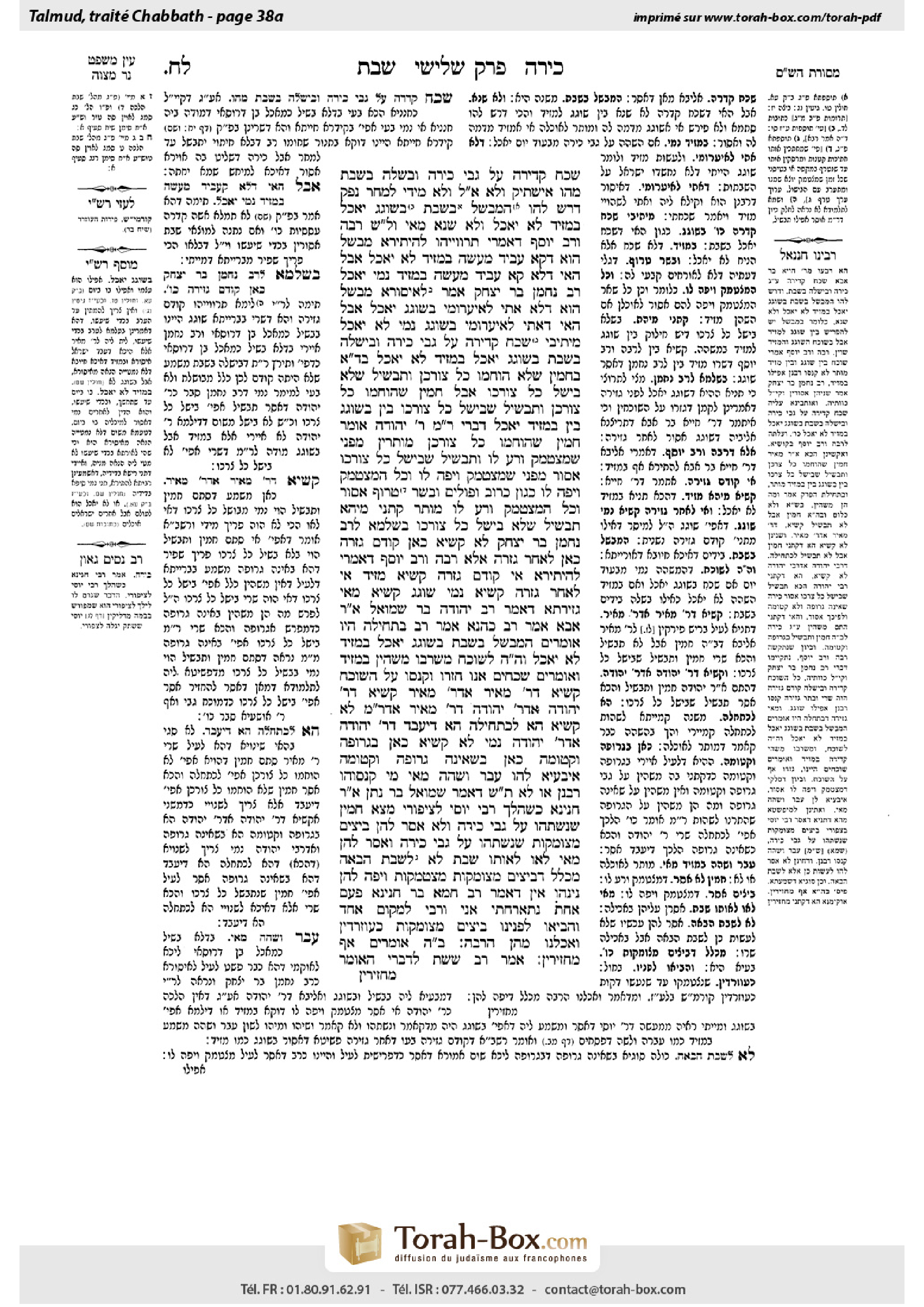
Shabbat 38a: Talmud study for Daf Yomi
Daf Yomi is the daily study of one Talmud folio. Explore 37 tractates with scans, Hebrew text, Sefaria English and AI-generated French translations where annotated.
Passage selection and English or AI-generated French translation are available where the scan has annotations. Daf Study is independent of Torah-Box and Sefaria.
Browse Shabbat · שבת · All tractatesShabbat 38a text and translations
This page of Shabbat includes the Aramaic text, an English translation and an AI-generated French translation, alongside the scan above.
שבת ל״ח א · Aramaic and Hebrew text
שָׁכַח קְדֵירָה עַל גַּבֵּי כִּירָה וּבִשְּׁלָהּ בְּשַׁבָּת, מַהוּ? אִישְׁתִּיק וְלָא אֲמַר לֵיהּ וְלָא מִידֵּי. לִמְחַר נְפַק דְּרַשׁ לְהוּ: הַמְבַשֵּׁל בְּשַׁבָּת, בְּשׁוֹגֵג — יֹאכַל, בְּמֵזִיד — לֹא יֹאכַל, וְלָא שְׁנָא.
מַאי ״וְלָא שְׁנָא״? רַבָּה וְרַב יוֹסֵף דְּאָמְרִי תַּרְוַויְיהוּ לְהֶיתֵּירָא: מְבַשֵּׁל הוּא דְּקָא עָבֵיד מַעֲשֶׂה בְּמֵזִיד — לֹא יֹאכַל, אֲבָל הַאי דְּלָא קָא עָבֵיד מַעֲשֶׂה — בְּמֵזִיד נָמֵי יֹאכַל. רַב נַחְמָן בַּר יִצְחָק אָמַר לְאִיסּוּרָא: מְבַשֵּׁל הוּא דְּלָא אָתֵי לְאִיעָרוֹמֵי, בְּשׁוֹגֵג יֹאכַל, אֲבָל הַאי דְּאָתֵי לְאִיעָרוֹמֵי — בְּשׁוֹגֵג נָמֵי לָא יֹאכַל.
מֵיתִיבִי: שָׁכַח קְדֵירָה עַל גַּבֵּי כִּירָה וּבִישְּׁלָה בְּשַׁבָּת, בְּשׁוֹגֵג — יֹאכַל, בְּמֵזִיד — לֹא יֹאכַל. בַּמֶּה דְּבָרִים אֲמוּרִים — בְּחַמִּין שֶׁלֹּא הוּחַמּוּ כׇּל צוֹרְכָּן וְתַבְשִׁיל שֶׁלֹּא בִּישֵּׁל כׇּל צוֹרְכּוֹ, אֲבָל חַמִּין שֶׁהוּחַמּוּ כׇּל צוֹרְכָּן וְתַבְשִׁיל שֶׁבִּישֵּׁל כׇּל צוֹרְכּוֹ, בֵּין בְּשׁוֹגֵג בֵּין בְּמֵזִיד — יֹאכַל, דִּבְרֵי רַבִּי מֵאִיר.
רַבִּי יְהוּדָה אוֹמֵר: חַמִּין שֶׁהוּחַמּוּ כׇּל צוֹרְכָּן — מוּתָּרִין מִפְּנֵי שֶׁמִּצְטַמֵּק וְרַע לוֹ. וְתַבְשִׁיל שֶׁבִּישֵּׁל כׇּל צוֹרְכּוֹ — אָסוּר מִפְּנֵי שֶׁמִּצְטַמֵּק וְיָפֶה לוֹ, וְכׇל הַמִּצְטַמֵּק וְיָפֶה לוֹ, כְּגוֹן כְּרוּב וּפוֹלִים וּבָשָׂר טָרוּף — אָסוּר, וְכׇל הַמִּצְטַמֵּק וְרַע לוֹ — מוּתָּר.
קָתָנֵי מִיהָא תַּבְשִׁיל שֶׁלֹּא בִּישֵּׁל כׇּל צוֹרְכּוֹ. בִּשְׁלָמָא לָרַב נַחְמָן בַּר יִצְחָק לָא קַשְׁיָא: כָּאן קוֹדֶם גְּזֵרָה, כָּאן לְאַחַר גְּזֵרָה. אֶלָּא רַבָּה וְרַב יוֹסֵף דְּאָמְרִי לְהֶיתֵּירָא, אִי קוֹדֶם גְּזֵרָה — קַשְׁיָא מֵזִיד. אִי לְאַחַר גְּזֵרָה — קַשְׁיָא נָמֵי שׁוֹגֵג. קַשְׁיָא.
מַאי גְּזֵירְתָא? דְּאָמַר רַב יְהוּדָה בַּר שְׁמוּאֵל אָמַר רַבִּי אַבָּא אָמַר רַב כָּהֲנָא אָמַר רַב: בַּתְּחִילָּה הָיוּ אוֹמְרִים הַמְבַשֵּׁל בְּשַׁבָּת, בְּשׁוֹגֵג — יֹאכַל, בְּמֵזִיד — לֹא יֹאכַל, וְהוּא הַדִּין לַשּׁוֹכֵחַ. מִשֶּׁרַבּוּ מְשַׁהִין בְּמֵזִיד וְאוֹמְרִים ״שְׁכֵחִים אָנוּ״, חָזְרוּ וְקָנְסוּ עַל הַשּׁוֹכֵחַ.
קַשְׁיָא דְּרַבִּי מֵאִיר אַדְּרַבִּי מֵאִיר, קַשְׁיָא דְּרַבִּי יְהוּדָה אַדְּרַבִּי יְהוּדָה! דְּרַבִּי מֵאִיר אַדְּרַבִּי מֵאִיר לָא קַשְׁיָא: הָא לְכַתְּחִילָּה, הָא דִיעֲבַד. דְּרַבִּי יְהוּדָה אַדְּרַבִּי יְהוּדָה נָמֵי לָא קַשְׁיָא: כָּאן — בִּגְרוּפָה וּקְטוּמָה, כָּאן — בְּשֶׁאֵינָהּ גְּרוּפָה וּקְטוּמָה.
אִיבַּעְיָא לְהוּ: עָבַר וְשִׁהָה מַאי? מִי קַנְסוּהּ רַבָּנַן, אוֹ לָא? תָּא שְׁמַע, דְּאָמַר שְׁמוּאֵל בַּר נָתָן אָמַר רַבִּי חֲנִינָא: כְּשֶׁהָלָךְ רַבִּי יוֹסֵי לְצִיפּוֹרִי מָצָא חַמִּין שֶׁנִּשְׁתַּהוּ עַל גַּבֵּי כִּירָה וְלֹא אָסַר לָהֶן, בֵּיצִים מְצוּמָּקוֹת שֶׁנִּשְׁתַּהוּ עַל גַּבֵּי כִּירָה, וְאָסַר לָהֶן. מַאי לַָאו לְאוֹתוֹ שַׁבָּת? — לָא, לְשַׁבָּת הַבָּאָה.
מִכְּלָל דְּבֵיצִים מְצוּמָּקוֹת — מִצְטַמְּקוֹת וְיָפֶה לָהֶן נִינְהוּ? אִין. דְּאָמַר רַב חָמָא בַּר חֲנִינָא: פַּעַם אַחַת נִתְאָרַחְתִּי אֲנִי וְרַבִּי לִמְקוֹם אֶחָד וְהֵבִיאוּ לְפָנֵינוּ בֵּיצִים מְצוּמָּקוֹת כְּעוּזְרָּדִין וְאָכַלְנוּ מֵהֶן הַרְבֵּה.
בֵּית הִלֵּל אוֹמְרִים: אַף מַחְזִירִין. אָמַר רַב שֵׁשֶׁת: לְדִבְרֵי הָאוֹמֵר
Shabbat 38a · English translation
If one forgot a pot on Shabbat eve atop a stove and it cooked on Shabbat, what is the ruling in that case? Is one permitted to eat that food, or not? He was silent and did not say a thing to him. The next day, he emerged and publicly taught them the following halakha: With regard to one who cooks on Shabbat, if he did so unwittingly, he may eat it, and if he cooked intentionally, he may not eat it; and the halakha is no different.
The last part of Rabbi Ḥiyya bar Abba’s statement is unclear. The Gemara asks: What is the practical halakhic meaning of the phrase: And it is no different? Rabba and Rav Yosef both said to interpret the phrase permissively in the following manner: One who cooks is one who performs an action. If he did so intentionally, he may not eat what he cooked. However, this one who forgot the pot on the stove, who does not perform an action, even if he intentionally left the pot on Shabbat eve, he may also eat the food. However, Rav Naḥman bar Yitzḥak said that the phrase: And it is no different, should be interpreted restrictively in the following manner: It is one who cooks who will not come to deceive, as there is no room for suspicion that a person will intentionally cook on Shabbat. Therefore, if one cooks unwittingly, he may eat it. However, one who would come to deceive, intentionally leaving the pot on the stove and saying: I forgot it, the Sages penalize him and decree that if he did so unwittingly as well, he may not eat it.
The Gemara raises an objection to this statement from that which was taught in a baraita: One who forgot a pot atop a stove and it cooked on Shabbat, if he did so unwittingly, he may eat it; if he did so intentionally, he may not eat it. In what case is this statement said? It is in a case where the pot contains hot water that was not yet completely heated, and the same applies to cooked food that was not yet completely cooked. However, if it contains hot water that was already completely heated and cooked food that was already completely cooked, whether the pot was left there unwittingly, or whether the pot was left there intentionally, one may eat it; this is the statement of Rabbi Meir.
Rabbi Yehuda says that there is a distinction: Hot water that was already completely heated is permitted because, in that case, the longer it remains on the fire, the more it shrivels, i.e., evaporates, and deteriorates. In that case, one would certainly not come to increase the heat because he would not want to lose more water through evaporation. However, cooked food that was completely cooked, it is prohibited to leave it on the fire because it shrivels and improves. There is room for concern that he will stoke the coals to increase the heat under the food. And there is a general principle: Anything that shrivels and improves, e.g., cabbage, and beans, and meat cut into small pieces is prohibited; and anything that shrivels and deteriorates is permitted.
In any event, it was taught in that baraita that in the case of cooked food that was not completely cooked, if it was cooked unwittingly, it is permitted. Granted, according to the opinion of Rav Naḥman bar Yitzḥak, this is not difficult. Although there is an apparent contradiction, as he prohibits eating from a pot that was unwittingly forgotten on the stove, and the baraita prohibits it only when it was left intentionally, he could explain the following: Here, the baraita, which permits eating it, was taught prior to the decree that was issued lest a person act deceitfully, whereas there, the halakha of Rav Naḥman bar Yitzḥak, was taught after the decree, which prohibited eating food even if it was forgotten unwittingly. However, according to the opinion of Rabba and Rav Yosef, who said to interpret the phrase permissively, whether he left it on the stove unwittingly or he did so intentionally, it is difficult. If this baraita was taught prior to the decree, the ruling with regard to when he did so intentionally is difficult, as Rabba and Rav Yosef permit eating the food even in that case. If this baraita was taught after the decree, the ruling with regard to when he did so unwittingly is also difficult, as Rabba and Rav Yosef permit eating the food in every case. No answer was found to this objection and the Gemara concludes: It is indeed difficult.
With regard to the matter itself, the Gemara asks: What is the decree that was discussed above in terms of the distinction between before the decree and after the decree? The Gemara says: This is the decree that Rav Yehuda bar Shmuel said that Rabbi Abba said that Rav Kahana said that Rav said: Initially, they would say: With regard to one who cooks on Shabbat, if it was unwitting, one may eat it; if it was intentional, one may not eat it. And the same is true with regard to one who forgets the pot atop the stove before Shabbat and it cooks on Shabbat. When the number of those who leave their pots intentionally and say we forgot to justify their actions, increased, the Sages then penalized those who forgot. Even one who forgets unwittingly may not eat it.
In the Tosefta cited earlier, which deals with one who forgot a pot atop the stove and the food cooked on Shabbat, Rabbi Meir ruled leniently and permitted both hot water that was completely heated and cooked food that was completely cooked, even when it was left on the stove intentionally. Rabbi Yehuda ruled stringently and distinguished between different cases. However, in the Tosefta cited at the beginning of the chapter, it was taught that Rabbi Meir and Rabbi Yehuda disagree with regard to the opinions of Beit Hillel and Beit Shammai as far as leaving food on the stove on Shabbat is concerned. Rabbi Meir says that it is completely prohibited to leave cooked food on the stove ab initio, even according to Beit Hillel who rule leniently. Rabbi Yehuda said that Beit Hillel ruled leniently and permitted doing so. There is a contradiction between one statement of Rabbi Meir and the other statement of Rabbi Meir, and there is a contradiction between one statement of Rabbi Yehuda and the other statement of Rabbi Yehuda. The Gemara responds: Between one statement of Rabbi Meir and the other statement of Rabbi Meir there is no contradiction. That which we learned: Rabbi Meir prohibits leaving cooked food under any circumstances, is speaking ab initio; whereas this, where he permits eating the food even if it was left on the stove intentionally, is speaking after the fact. Between one statement of Rabbi Yehuda and the other statement of Rabbi Yehuda there is also no contradiction. There, where he permitted leaving the food on the stove, it is referring to the case of a stove that was swept and covered with ashes, whereas here, where he prohibited doing so, is referring to the case of a stove that is not swept and covered with ashes.
A dilemma was raised before the Sages: One who transgressed and left his pot on the fire on Shabbat, what is his legal status? Did the Sages penalize him and prohibit him from eating the food, or did they not penalize him? Come and hear a resolution to this dilemma from that which Shmuel bar Natan said that Rabbi Ḥanina said: When Rabbi Yosei went to the city of Tzippori, he found hot water that was left on the stove, and he did not prohibit them from drinking it. He found eggs shriveled from overcooking that were left on the stove on Shabbat and he prohibited them from eating them. Is this not referring to permitting and prohibiting their consumption for that same Shabbat? If so, apparently he prohibits eating cooked food that was intentionally left on the stove on Shabbat. The Gemara immediately rejects this assumption: No. Rather, he prohibited them from doing so ab initio the following Shabbat, but he did not prohibit them from eating the eggs on that same Shabbat.
The Gemara is surprised: From this statement it can be inferred that eggs shriveled from overcooking shrivel and improve when left on the fire for a long time, and that is the reason that Rabbi Yosei made a distinction between hot water, which he permitted leaving on the stove, and eggs, which he prohibited leaving on the stove. The Gemara replies: Yes, overcooking improves the eggs. As Rav Ḥama bar Ḥanina said: One time Rabbi Yehuda HaNasi and I were guests in the same place, and they brought before us overcooked eggs that shriveled to the size of crab apples [uzradin] and we ate many of them. Apparently, extended cooking improves eggs. Therefore, when they are left on the fire on Shabbat there is room for concern lest one stoke the coals in order to shrivel them more.
We learned in the mishna: Beit Hillel say that one may even return a pot taken off the stove to the stove on Shabbat. Rav Sheshet said: According to the one who says
Shabbat 38a · Traduction française (IA)
Si quelqu’un avait oublié une marmite sur un fourneau à la veille de Chabbat et que son contenu avait cuit pendant Chabbat, quelle est la halakha dans ce cas ? Peut-on manger cet aliment ou non ? Il garda le silence et ne lui répondit rien. Le lendemain, il sortit et leur enseigna publiquement la halakha suivante : Celui qui cuisine pendant Chabbat, s’il l’a fait par inadvertance, peut manger l’aliment ; s’il l’a fait intentionnellement, il ne peut pas le manger. Et la halakha ne diffère pas.
La fin de la déclaration de Rabbi Ḥiyya bar Abba n’est pas claire. La Guemara demande : Quelle est la portée pratique de l’expression « et la halakha ne diffère pas » ? Rabba et Rav Yosef ont tous deux dit qu’il faut interpréter cette expression dans le sens permissif suivant : Celui qui cuisine accomplit un acte. S’il l’a fait intentionnellement, il ne peut pas manger ce qu’il a préparé. En revanche, celui qui a oublié la marmite sur le fourneau, qui n’accomplit pas d’acte, peut lui aussi manger l’aliment, même s’il a intentionnellement laissé la marmite là à la veille de Chabbat. Rav Naḥman bar Yitzḥak a toutefois dit que l’expression « et la halakha ne diffère pas » doit être interprétée dans le sens restrictif suivant : Celui qui cuisine ne sera pas porté à tromper, puisqu’il n’y a aucune raison de soupçonner quelqu’un de cuisiner intentionnellement pendant Chabbat. Par conséquent, s’il cuisine par inadvertance, il peut manger ce qu’il a préparé. En revanche, celui qui pourrait être tenté de tromper, en laissant intentionnellement la marmite sur le fourneau puis en disant : « Je l’avais oubliée », est pénalisé par les Sages, qui décrètent que même s’il l’a fait par inadvertance, il ne peut pas manger l’aliment.
La Guemara soulève une objection à cette déclaration à partir de ce qui a été enseigné dans une baraïta : Celui qui a oublié une marmite sur un fourneau et dont le contenu a cuit pendant Chabbat, s’il l’a fait par inadvertance, peut manger ce qu’elle contient ; s’il l’a fait intentionnellement, il ne peut pas le manger. Dans quel cas cette règle a-t-elle été énoncée ? Lorsqu’il s’agit d’une marmite contenant de l’eau chaude qui n’avait pas encore complètement chauffé ; il en va de même pour un aliment qui n’était pas encore complètement cuit. Mais si elle contient de l’eau chaude qui avait déjà complètement chauffé ou un aliment qui avait déjà complètement cuit, que la marmite ait été laissée là par inadvertance ou intentionnellement, on peut en manger le contenu. Telle est la déclaration de Rabbi Meïr.
Rabbi Yehouda dit qu’il faut faire une distinction : l’eau chaude qui avait déjà complètement chauffé est permise, car, dans ce cas, plus elle reste longtemps sur le feu, plus elle s’évapore et se détériore. On ne risquerait donc certainement pas d’augmenter la chaleur, puisqu’on ne voudrait pas perdre davantage d’eau par évaporation. En revanche, il est interdit de laisser sur le feu un aliment qui a complètement cuit, car il se dessèche et s’améliore. On peut craindre que la personne attise les braises pour augmenter la chaleur sous l’aliment. Il existe un principe général : tout ce qui se dessèche et s’améliore, par exemple le chou, les haricots et la viande coupée en petits morceaux, est interdit ; tout ce qui se dessèche et se détériore est permis.
Quoi qu’il en soit, cette baraïta enseigne que, dans le cas d’un aliment qui n’avait pas complètement cuit, s’il a cuit par inadvertance, il est permis. Il n’y a pas de difficulté selon l’opinion de Rav Naḥman bar Yitzḥak. Bien qu’il semble y avoir une contradiction, puisqu’il interdit de manger le contenu d’une marmite oubliée par inadvertance sur le fourneau, tandis que la baraïta ne l’interdit que si elle a été laissée intentionnellement, il peut l’expliquer ainsi : la baraïta, qui en permet la consommation, a été enseignée avant le décret édicté de peur que quelqu’un n’agisse par tromperie, tandis que la halakha de Rav Naḥman bar Yitzḥak a été enseignée après le décret, qui interdit de manger l’aliment même s’il a été oublié par inadvertance. Mais selon l’opinion de Rabba et de Rav Yosef, qui interprètent l’expression dans le sens permissif, que la marmite ait été laissée sur le fourneau par inadvertance ou intentionnellement, il y a une difficulté. Si cette baraïta a été enseignée avant le décret, la règle concernant le cas où la personne l’a fait intentionnellement pose problème, car Rabba et Rav Yosef permettent de manger l’aliment même dans ce cas. Si cette baraïta a été enseignée après le décret, la règle concernant le cas où la personne l’a fait par inadvertance pose également problème, car Rabba et Rav Yosef permettent de manger l’aliment dans tous les cas. Aucune réponse n’a été trouvée à cette objection et la Guemara conclut : C’est effectivement difficile.
À propos de la question elle-même, la Guemara demande : Quel est le décret évoqué plus haut, dans la distinction entre avant le décret et après le décret ? La Guemara répond : Il s’agit du décret dont Rav Yehouda bar Shmuel a dit que Rabbi Abba avait dit que Rav Kahana avait dit que Rav avait dit : Au départ, on disait : Celui qui cuisine pendant Chabbat, si c’est par inadvertance, on peut manger ce qu’il a préparé ; si c’est intentionnel, on ne peut pas le manger. Il en va de même pour celui qui oublie une marmite sur un fourneau avant Chabbat et dont le contenu cuit pendant Chabbat. Lorsque le nombre de ceux qui laissaient intentionnellement leur marmite là, puis prétendaient l’avoir oubliée pour justifier leur conduite, augmenta, les Sages pénalisèrent alors ceux qui l’avaient oubliée. Même celui qui l’avait oubliée par inadvertance ne peut pas en manger le contenu.
Dans la Tossefta citée précédemment, au sujet de celui qui a oublié une marmite sur un fourneau et dont le contenu a cuit pendant Chabbat, Rabbi Meïr a statué avec indulgence et a permis aussi bien l’eau chaude qui avait complètement chauffé que l’aliment qui avait complètement cuit, même lorsque la marmite avait été laissée intentionnellement sur le fourneau. Rabbi Yehouda a statué avec rigueur et a distingué différents cas. Cependant, dans la Tossefta citée au début du chapitre, il a été enseigné que Rabbi Meïr et Rabbi Yehouda sont en désaccord sur les opinions de Beit Hillel et de Beit Chammaï concernant le fait de laisser un aliment sur le fourneau pendant Chabbat. Rabbi Meïr dit qu’il est absolument interdit de laisser d’emblée un aliment cuit sur le fourneau, même selon Beit Hillel, qui statue avec indulgence. Rabbi Yehouda a dit que Beit Hillel a statué avec indulgence et a permis de le faire. Il y a une contradiction entre une déclaration de Rabbi Meïr et l’autre déclaration de Rabbi Meïr, ainsi qu’entre une déclaration de Rabbi Yehouda et l’autre déclaration de Rabbi Yehouda. La Guemara répond : Il n’y a pas de contradiction entre les deux déclarations de Rabbi Meïr. La règle que nous avons apprise, selon laquelle Rabbi Meïr interdit de laisser un aliment cuit en toute circonstance, concerne le fait de le laisser d’emblée ; tandis que l’autre règle, où il permet de manger l’aliment même s’il a été laissé intentionnellement sur le fourneau, concerne le cas a posteriori. Il n’y a pas non plus de contradiction entre les deux déclarations de Rabbi Yehouda. Là où il a permis de laisser l’aliment sur le fourneau, il s’agit d’un fourneau dont les braises ont été balayées et recouvertes de cendres ; tandis qu’ici, où il l’a interdit, il s’agit d’un fourneau dont les braises n’ont pas été balayées et qui n’a pas été recouvert de cendres.
Une question fut soumise aux Sages : Quel est le statut de celui qui a enfreint la règle et laissé sa marmite sur le feu pendant Chabbat ? Les Sages l’ont-ils pénalisé et lui ont-ils interdit de manger l’aliment, ou ne l’ont-ils pas pénalisé ? Pour résoudre cette question, venez entendre ce que Shmuel bar Natan a dit au nom de Rabbi Ḥanina : Lorsque Rabbi Yosei se rendit dans la ville de Tzippori, il trouva de l’eau chaude qui avait été laissée sur le fourneau et ne leur interdit pas de la boire. Il trouva des œufs desséchés par une cuisson excessive, qui avaient été laissés sur le fourneau pendant Chabbat, et leur interdit de les manger. N’est-ce pas une permission et une interdiction de consommer ces aliments pendant ce même Chabbat ? Il semble donc qu’il interdise de manger un aliment cuit qui a été intentionnellement laissé sur le fourneau pendant Chabbat. La Guemara rejette immédiatement cette supposition : Non. Il leur interdit plutôt de le faire d’emblée le Chabbat suivant, mais ne leur interdit pas de manger les œufs pendant ce même Chabbat.
La Guemara s’étonne : On peut déduire de cette déclaration que les œufs desséchés par une cuisson excessive continuent de se dessécher et s’améliorent lorsqu’ils restent longtemps sur le feu, et que c’est pour cette raison que Rabbi Yosei a distingué l’eau chaude, qu’il a permis de laisser sur le fourneau, des œufs, qu’il a interdit d’y laisser. La Guemara répond : Oui, une cuisson prolongée améliore les œufs. Car Rav Ḥama bar Ḥanina a dit : Un jour, Rabbi Yehouda HaNassi et moi étions invités au même endroit, et on nous apporta des œufs trop cuits, réduits à la taille de pommes sauvages [uzradin] ; nous en mangeâmes beaucoup. Il apparaît donc qu’une cuisson prolongée améliore les œufs. Par conséquent, lorsqu’on les laisse sur le feu pendant Chabbat, on peut craindre que quelqu’un attise les braises afin de les dessécher davantage.
Nous avons appris dans la Michna : Beit Hillel disent qu’on peut même remettre sur le fourneau, pendant Chabbat, une marmite qu’on en a retirée. Rav Sheshet a dit : Selon celui qui dit
Traduction française générée par IA à partir de l’édition anglaise de Sefaria. Vérifie toujours un passage avec le texte source.
Text from Sefaria: William Davidson Edition - Vocalized Aramaic (CC BY NC); William Davidson Edition - English (CC BY NC).