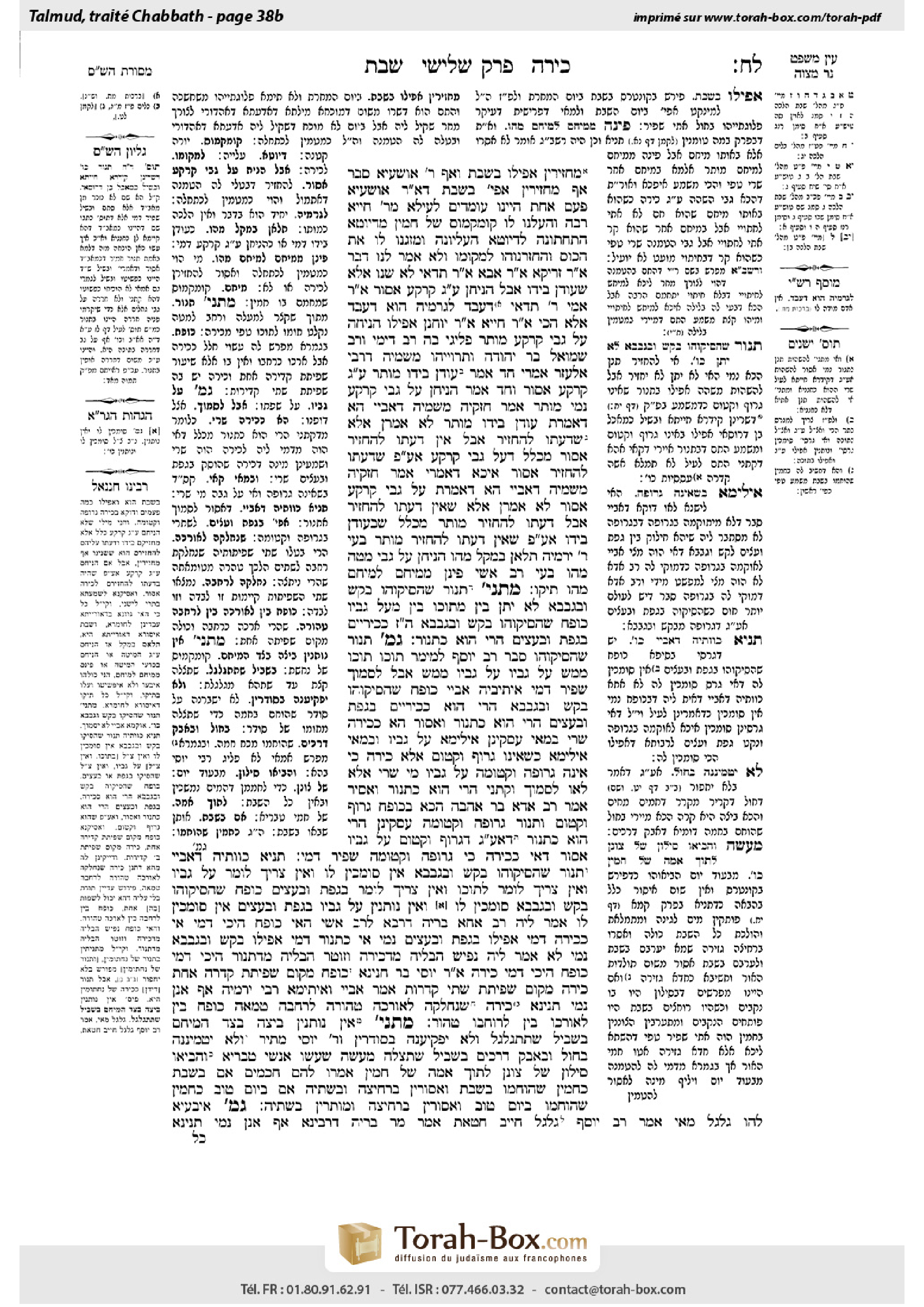
Shabbat 38b: Talmud study for Daf Yomi
Daf Yomi is the daily study of one Talmud folio. Explore 37 tractates with scans, Hebrew text, Sefaria English and AI-generated French translations where annotated.
Passage selection and English or AI-generated French translation are available where the scan has annotations. Daf Study is independent of Torah-Box and Sefaria.
Browse Shabbat · שבת · All tractatesShabbat 38b text and translations
This page of Shabbat includes the Aramaic text, an English translation and an AI-generated French translation, alongside the scan above.
שבת ל״ח ב · Aramaic and Hebrew text
מַחְזִירִין, אֲפִילּוּ בְּשַׁבָּת. וְאַף רַבִּי אוֹשַׁעְיָא סָבַר ״אַף מַחְזִירִין״ — אֲפִילּוּ בְּשַׁבָּת. דְּאָמַר רַבִּי אוֹשַׁעְיָא: פַּעַם אַחַת הַיְינוּ עוֹמְדִים לְעֵילָּא מֵרַבִּי חִיָּיא רַבָּה וְהַעֲלֵנוּ לוֹ קוּמְקְמוֹס שֶׁל חַמִּין מִדְּיוֹטָא הַתַּחְתּוֹנָה לִדְיוֹטָא הָעֶלְיוֹנָה, וּמָזַגְנוּ לוֹ אֶת הַכּוֹס, וְהֶחֱזַרְנוּהוּ לִמְקוֹמוֹ, וְלֹא אָמַר לָנוּ דָּבָר.
אָמַר רַבִּי זְרִיקָא אָמַר רַבִּי אַבָּא אָמַר רַבִּי תַּדַּאי: לֹא שָׁנוּ אֶלָּא שֶׁעוֹדָן בְּיָדוֹ, אֲבָל הִנִּיחָן עַל גַּבֵּי קַרְקַע — אָסוּר. אָמַר רַבִּי אַמֵּי: רַבִּי תַּדַּאי דַּעֲבַד — לְגַרְמֵיהּ הוּא דַּעֲבַד. אֶלָּא הָכִי אָמַר רַבִּי חִיָּיא אָמַר רַבִּי יוֹחָנָן: אֲפִילּוּ הַנִּיחָה עַל גַּבֵּי קַרְקַע — מוּתָּר.
פְּלִיגִי בַּהּ רַב דִּימִי וְרַב שְׁמוּאֵל בַּר יְהוּדָה, וְתַרְוַיְיהוּ מִשְּׁמֵיהּ דְּרַבִּי אֶלְעָזָר אָמְרִי. חַד אָמַר: עוֹדָן בְּיָדוֹ — מוּתָּר, עַל גַּבֵּי קַרְקַע — אָסוּר. וְחַד אָמַר: הִנִּיחָן עַל גַּבֵּי קַרְקַע נָמֵי מוּתָּר. אָמַר חִזְקִיָּה מִשְּׁמֵיהּ דְּאַבָּיֵי: הָא דְּאָמְרַתְּ עוֹדָן בְּיָדוֹ — מוּתָּר, לָא אֲמַרַן אֶלָּא שֶׁדַּעְתּוֹ לְהַחֲזִיר, אֲבָל אֵין דַּעְתּוֹ לְהַחֲזִיר — אָסוּר. מִכְּלָל דְּעַל גַּבֵּי קַרְקַע אַף עַל פִּי שֶׁדַּעְתּוֹ לְהַחֲזִיר — אָסוּר.
אִיכָּא דְאָמְרִי, אָמַר חִזְקִיָּה מִשְּׁמֵיהּ דְּאַבָּיֵי: הָא דְּאָמְרַתְּ עַל גַּבֵּי קַרְקַע — אָסוּר, לָא אֲמַרַן אֶלָּא שֶׁאֵין דַּעְתּוֹ לְהַחֲזִיר, אֲבָל דַּעְתּוֹ לְהַחֲזִיר — מוּתָּר. מִכְּלָל שֶׁבְּעוֹדָן בְּיָדוֹ, אַף עַל פִּי שֶׁאֵין דַּעְתּוֹ לְהַחֲזִיר — מוּתָּר. בָּעֵי רַבִּי יִרְמְיָה: תְּלָאָן בְּמַקֵּל מַהוּ? הִנִּיחָן עַל גַּבֵּי מַטָּה מַהוּ? בָּעֵי רַב אָשֵׁי: פִּינָּן מִמֵּיחַם לִמְיַחֵם מַהוּ? — תֵּיקוּ.
מַתְנֵי׳ תַּנּוּר שֶׁהִסִּיקוּהוּ בְּקַשׁ וּבִגְבָבָא לֹא יִתֵּן בֵּין מִתּוֹכוֹ בֵּין מֵעַל גַּבָּיו. כּוּפָּח שֶׁהִסִּיקוּהוּ בְּקַשׁ וּבִגְבָבָא — הֲרֵי זֶה כְּכִירַיִים, בְּגֶפֶת וּבְעֵצִים — הֲרֵי הוּא כְּתַנּוּר.
גְּמָ׳ תַּנּוּר שֶׁהִסִּיקוּהוּ: סָבַר רַב יוֹסֵף לְמֵימַר ״תּוֹכוֹ״ — תּוֹכוֹ מַמָּשׁ, ״עַל גַּבָּיו״ — עַל גַּבָּיו מַמָּשׁ, אֲבָל לִסְמוֹךְ שַׁפִּיר דָּמֵי. אֵיתִיבֵיהּ אַבָּיֵי: כּוּפָּח שֶׁהִסִּיקוּהוּ בְּקַשׁ וּבִגְבָבָא הֲרֵי הוּא כְּכִירַיִים, בְּגֶפֶת וּבְעֵצִים הֲרֵי הוּא כְּתַנּוּר, וְאָסוּר. הָא כְּכִירָה — שְׁרֵי. בְּמַאי עָסְקִינַן? אִילֵימָא עַל גַּבָּיו, וּבְמַאי? אִילֵימָא כְּשֶׁאֵינוֹ גָּרוּף וְקָטוּם, אֶלָּא כִּירָה כִּי אֵינָהּ גְּרוּפָה וּקְטוּמָה, עַל גַּבָּיו מִי שְׁרֵי? אֶלָּא לָאו לִסְמוֹךְ, וְקָתָנֵי: הֲרֵי הוּא כְּתַנּוּר, וַאֲסִיר!
אָמַר רַב אַדָּא בַּר אַהֲבָה: הָכָא בְּכוּפָּח גָּרוּף וְקָטוּם, וְתַנּוּר גְּרוּפָה וּקְטוּמָה עָסְקִינַן. הֲרֵי הוּא כְּתַנּוּר — דְּאַף עַל גַּב דְּגָרוּף וְקָטוּם — עַל גַּבָּיו אָסוּר, דְּאִי כְּכִירָה כִּי גְּרוּפָה וּקְטוּמָה — שַׁפִּיר דָּמֵי. תַּנְיָא כְּווֹתֵיהּ דְּאַבָּיֵי: תַּנּוּר שֶׁהִסִּיקוּהוּ בְּקַשׁ וּבִגְבָבָא אֵין סוֹמְכִין לוֹ, וְאֵין צָרִיךְ לוֹמַר עַל גַּבָּיו, וְאֵין צָרִיךְ לוֹמַר לְתוֹכוֹ, וְאֵין צָרִיךְ לוֹמַר בְּגֶפֶת וּבְעָצִים. כּוּפָּח שֶׁהִסִּיקוּהוּ בְּקַשׁ וּבִגְבָבָא סוֹמְכִין לוֹ, וְאֵין נוֹתְנִין עַל גַּבָּיו. בְּגֶפֶת וּבְעֵצִים אֵין סוֹמְכִין לוֹ.
אֲמַר לֵיהּ רַב אַחָא בְּרֵיהּ דְּרָבָא לְרַב אָשֵׁי: הַאי כּוּפָּח הֵיכִי דָמֵי? אִי כְּכִירָה דָּמֵי, אֲפִילּוּ בְּגֶפֶת וּבְעֵצִים נָמֵי! אִי כְּתַנּוּר דָּמֵי, אֲפִילּוּ בְּקַשׁ וּבִגְבָבָא נָמֵי לָא! אֲמַר לֵיהּ: נְפִישׁ הַבְלֵיהּ מִדְּכִירָה וְזוּטַר הַבְלֵיהּ מִדְּתַנּוּר.
הֵיכִי דָמֵי כּוּפָּח, הֵיכִי דָמֵי כִּירָה? אֲמַר רַבִּי יוֹסֵי בַּר חֲנִינָא: כּוּפָּח — מְקוֹם שְׁפִיתַת קְדֵרָה אַחַת. כִּירָה — מְקוֹם שְׁפִיתַת שְׁתֵּי קְדֵרוֹת. אֲמַר אַבָּיֵי, וְאִיתֵּימָא רַבִּי יִרְמְיָה: אַף אֲנַן נָמֵי תְּנֵינָא: כִּירָה שֶׁנֶּחְלְקָה לְאוֹרְכָּה — טְהוֹרָה. לְרׇחְבָּהּ — טְמֵאָה. כּוּפָּח, בֵּין לְאוֹרְכּוֹ בֵּין לְרוֹחְבּוֹ — טָהוֹר.
מַתְנִי׳ אֵין נוֹתְנִין בֵּיצָה בְּצַד הַמֵּיחַם בִּשְׁבִיל שֶׁתִּתְגַּלְגֵּל, וְלֹא יַפְקִיעֶנָּה בְּסוּדָרִין. וְרַבִּי יוֹסֵי מַתִּיר. וְלֹא יַטְמִינֶנָּה בְּחוֹל וּבַאֲבַק דְּרָכִים בִּשְׁבִיל שֶׁתִּצָּלֶה.
מַעֲשֶׂה שֶׁעָשׂוּ אַנְשֵׁי טְבֶרְיָא וְהֵבִיאוּ סִילוֹן שֶׁל צוֹנֵן לְתוֹךְ אַמָּה שֶׁל חַמִּין. אָמְרוּ לָהֶם חֲכָמִים: אִם בְּשַׁבָּת — כְּחַמִּין שֶׁהוּחַמּוּ בְּשַׁבָּת, וַאֲסוּרִין בִּרְחִיצָה וּבִשְׁתִיָּהּ. אִם בְּיוֹם טוֹב — כְּחַמִּין שֶׁהוּחַמּוּ בְּיוֹם טוֹב, וַאֲסוּרִין בִּרְחִיצָה, וּמוּתָּרִין בִּשְׁתִיָּה.
גְּמָ׳ אִיבַּעְיָא לְהוּ: גִּלְגֵּל מַאי? אָמַר רַב יוֹסֵף: גִּלְגֵּל — חַיָּיב חַטָּאת. אָמַר מָר בְּרֵיהּ דְּרָבִינָא: אַף אֲנַן נָמֵי תְּנֵינָא:
Shabbat 38b · English translation
that one may even return it, doing so is permitted even on Shabbat and not only on Shabbat eve. And Rav Oshaya also holds: One may even return it even on Shabbat. As Rav Oshaya said: Once we were standing on Shabbat before Rabbi Ḥiyya the Great and we passed up to him a kettle [kumkemos] of hot water from the bottom floor [deyota] to the top floor, and we poured him a cup and returned the kettle to its place on top of the stove, and he did not say anything to us. Apparently, he is of the opinion that even on Shabbat it is permitted to return a pot to the stove.
Rabbi Zerika said that Rabbi Abba said that Rabbi Tadai said: They only taught that it is permitted to return vessels with the food inside them when they are still in his hand; however, if he already placed them on the ground, he obviously regretted placing them on the fire and it is prohibited to replace them on the stove. Rabbi Ami said: That which Rabbi Tadai did and said, he did on his own, and not in accordance with the accepted halakha. Rather, Rabbi Ḥiyya said that Rabbi Yoḥanan said as follows: Even if one placed the pot on the ground, it is permitted to return it to the stove.
The Gemara remarks that Rav Dimi and Rav Shmuel bar Yehuda disagreed about this matter, and both stated their opinion in the name of Rabbi Elazar. One said that when they are still in his hand, it is permitted to return them to the stove; when they were already placed on the ground, it is prohibited to do so. And one said that even if one placed them on the ground, it is also permitted to return it to the stove. Ḥizkiya said in the name of Abaye: That which you said, that when it is still in his hand, it is permitted to return it to the stove; we only said that halakha when his original intention was to return it to the stove. However, when it was not his original intention to return it, and he reconsidered and decided to return it, it is prohibited to return it. This proves by inference that if one placed it on the ground, even if his intention was to return it, it is prohibited.
Some say a different version of what Ḥizkiya said in the name of Abaye: That which you said, if one placed it on the ground it is prohibited; we only said that halakha when it was not his original intention to return it. However, if his original intention was to return it, it is permitted. This proves by inference that while they are still in his hand, even if it was not his original intention to return it, it is permitted. With regard to this matter, Rabbi Yirmeya raised a dilemma: In a case where he neither placed them on the floor nor held them in his hand, but he hung them on a stick, what is the ruling? In a case where he placed it on top of a bed, what is the ruling? Similarly, Rav Ashi raised a dilemma: If one transferred them from one urn to another urn what is the ruling? The Gemara said: These dilemmas stand unresolved.
MISHNA: The halakhot that were stated with regard to a stove were specific to a stove’s unique structure and the manner in which it retains heat. However, with regard to other baking apparatuses, i.e., an oven or a kupaḥ, there are different rules. The mishna delineates: An oven that they lit even with straw or rakings, one may neither place a pot inside it nor atop it on Shabbat. Whereas a kupaḥ that was lit with straw or rakings, its legal status is like that of a stove, and one is permitted to place a pot atop it on Shabbat. If it were lit with pomace or with wood, its legal status is like that of an oven and it is prohibited to place a pot atop it on Shabbat.
GEMARA: With regard to that which we learned in the mishna that an oven that they lit even with straw or rakings, one may neither place a pot atop it nor inside it, Rav Yosef thought to say that when the mishna says inside it, it means actually inside it; and when it says atop it, it means actually atop it. However, to lean a pot against an oven, it may well be done. Abaye raised an objection to Rav Yosef from that which we learned in our mishna: A kupaḥ that was lit with straw or rakings, its legal status is like that of a stove. If it were lit with pomace or with wood, its legal status is like that of an oven, and it is prohibited. By inference: If it were like a stove, it would be permitted. With what circumstances are we dealing? If you say that he placed the pot atop the kupaḥ, and in what case? If you say it is referring to a case where it is not swept and covered with ashes; a stove that is not swept and covered with ashes, is it permitted even to place a pot atop it on Shabbat? Rather, isn’t it referring to a case where one seeks to lean a pot against a kupaḥ, and it taught: It is like an oven, and prohibited?
Rav Adda bar Ahava said: Here we are dealing with the cases of a kupaḥ that is swept and covered with ashes and an oven that is swept and covered with ashes, and the mishna is to be understood as follows: It is like an oven in the sense that, although it is swept and covered with ashes, it is prohibited to place a pot atop it; as, if its legal status were like that of a stove, when it is swept and covered it may well be done. The Gemara comments that there is a baraita that taught in accordance with the opinion of Abaye: An oven that one lit with straw and with rakings, one may not lean a pot against it, and needless to say one may not place a pot atop it, and needless to say one may not place a pot inside it, and, needless to say if it was lit with pomace or with wood it is prohibited. While with regard to a kupaḥ that was lit with straw or with rakings, one may lean a pot against it, but he may not place a pot atop it. If it was lit with pomace or with wood, one may not lean a pot against it.
Rav Aha, son of Rava, said to Rav Ashi: This kupaḥ, what are its circumstances? If it is considered like a stove, even if it was lit with pomace or with wood, it should also be permitted. And if it is considered like an oven, even with straw or with rakings, it should also not be permitted. Rav Ashi said to him: From a halakhic perspective, a kupaḥ has intermediate status. Its heat is greater than that of a stove; however, its heat is less than that of an oven.
The Gemara asks: What are the circumstances of a kupaḥ? What are the circumstances of a stove in terms of the configuration of the vessels? Rabbi Yosei bar Ḥanina said: A kupaḥ is a small vessel that is similar to a stove; however, it only has one hole with enough space to place a single pot. A stove is like a double kupaḥ with enough space to place two pots. Abaye said, and some say that Rabbi Yirmeya said: We also learned this matter in a mishna dealing with the laws of ritual purity and impurity: An impure stove that was divided lengthwise is pure because it can no longer be considered a vessel. It is a broken vessel, and a broken vessel cannot become ritually impure. However, if the stove was divided widthwise, between the spaces for the pots, then it remains impure because it became two small stoves. However, a kupaḥ, whether it was divided lengthwise or whether it was divided widthwise, is pure because it can no longer be used as there is no way to put even a single pot on it. That is the difference between a kupaḥ and a stove.
MISHNA: In addition to the halakhot that deal with cooking on the fire on Shabbat, several related halakhot are discussed. The mishna says: One may not place a raw egg next to an urn full of hot water so that it will roast slightly. And one may not even wrap it in cloths, i.e., one may not heat the egg inside cloths that were heated in the sun. And Rabbi Yosei permits doing so in that case. And, similarly, one may not insulate it in sand or in road dust that was heated in the sun so that it will roast. Although there is no actual cooking with fire here, it is similar to cooking and the Sages issued a decree to prohibit doing so.
The mishna relates a story about the people of the city of Tiberias, and they ran a cold-water pipe [silon] through a canal of hot water from the Tiberias hot springs. They thought that by doing so, they could heat the cold potable water on Shabbat. The Rabbis said to them: If the water passed through on Shabbat, its legal status is like that of hot water that was heated on Shabbat, and the water is prohibited both for bathing and for drinking. And if the water passed through on a Festival, then it is prohibited for bathing but permitted for drinking. On Festivals, one is even permitted to boil water on actual fire for the purposes of eating and drinking.
GEMARA: A dilemma was raised before the Sages: One who violated the halakha in the mishna and slightly roasted an egg next to an urn, what is the ruling? Rav Yosef said: One who slightly cooked an egg is liable to bring a sin-offering, as he performed the act of cooking on Shabbat, which is prohibited by Torah law. Mar, son of Ravina, said: We also learned something similar in the mishna:
Shabbat 38b · Traduction française (IA)
qu’on peut même la remettre ; cela est permis même pendant Chabbat, et pas seulement la veille de Chabbat. Rav Oshaya est lui aussi d’avis qu’on peut la remettre même pendant Chabbat. En effet, Rav Oshaya a dit : Un jour, alors que nous nous tenions devant Rabbi Ḥiyya le Grand pendant Chabbat, nous lui avons monté une marmite [kumkemos] d’eau chaude du rez-de-chaussée [deyota] à l’étage supérieur. Nous lui avons servi une coupe, puis nous avons remis la marmite à sa place, sur le feu, et il ne nous a rien dit. Il semble donc qu’il soit d’avis qu’il est permis, même pendant Chabbat, de remettre une marmite sur le feu.
Rabbi Zerika a dit au nom de Rabbi Abba, qui l’a dit au nom de Rabbi Tadai : On a enseigné qu’il est permis de remettre les récipients contenant les aliments seulement tant qu’ils sont encore dans sa main. En revanche, s’il les a déjà posés à terre, il a manifestement renoncé à les remettre sur le feu, et il est interdit de les replacer sur le fourneau. Rabbi Ami a dit : Ce que Rabbi Tadai a fait et enseigné, il l’a fait de sa propre initiative, et non conformément à la halakha admise. Rabbi Ḥiyya a plutôt dit au nom de Rabbi Yoḥanan : Même si l’on a posé la marmite à terre, il est permis de la remettre sur le fourneau.
La Guemara fait remarquer que Rav Dimi et Rav Shmuel bar Yehuda étaient en désaccord sur cette question, et que chacun a exprimé son avis au nom de Rabbi Elazar. L’un a dit que, tant que les récipients sont encore dans sa main, il est permis de les remettre sur le fourneau, mais que, s’ils ont déjà été posés à terre, il est interdit de le faire. L’autre a dit que même si on les a posés à terre, il est également permis de les remettre sur le fourneau. Ḥizkiya a dit au nom d’Abaye : Ce que tu as dit, à savoir que tant que le récipient est encore dans sa main, il est permis de le remettre sur le fourneau, nous ne l’avons dit que dans le cas où son intention initiale était de le remettre sur le fourneau. En revanche, si ce n’était pas son intention initiale et qu’il a changé d’avis pour décider de le remettre, il est interdit de le remettre. On en déduit que si on l’a posé à terre, même avec l’intention de le remettre, cela est interdit.
Certains rapportent une autre version de ce que Ḥizkiya a dit au nom d’Abaye : Ce que tu as dit, à savoir que si on l’a posé à terre, cela est interdit, nous ne l’avons dit que lorsque son intention initiale n’était pas de le remettre. En revanche, si son intention initiale était de le remettre, cela est permis. On en déduit que tant que les récipients sont encore dans sa main, cela est permis même si son intention initiale n’était pas de les remettre. À ce sujet, Rabbi Yirmeya souleva une question : Dans le cas où il ne les a ni posés à terre ni tenus dans sa main, mais les a suspendus à un bâton, quelle est la règle ? Et s’il l’a posé sur un lit, quelle est la règle ? De même, Rav Ashi souleva une question : S’il les a transvasés d’une marmite à une autre, quelle est la règle ? La Guemara dit : Ces questions restent sans réponse.
MICHNA : Les règles énoncées au sujet d’un fourneau concernent sa structure particulière et la manière dont il conserve la chaleur. Pour les autres appareils de cuisson, c’est-à-dire le four ou le kupaḥ, les règles sont différentes. La Michna précise : Un four qu’on a allumé, même avec de la paille ou des brindilles, on ne peut y placer une marmite ni à l’intérieur ni dessus pendant Chabbat. Quant à un kupaḥ allumé avec de la paille ou des brindilles, son statut est celui d’un fourneau, et il est permis d’y placer une marmite. S’il a été allumé avec du marc ou du bois, son statut est celui d’un four, et il est interdit d’y placer une marmite.
GUEMARA : À propos de l’enseignement de notre Michna selon lequel on ne peut placer une marmite ni sur un four allumé, même avec de la paille ou des brindilles, ni à l’intérieur, Rav Yossef pensa expliquer que, lorsque la Michna dit « à l’intérieur », elle veut dire véritablement à l’intérieur, et que lorsqu’elle dit « dessus », elle veut dire véritablement dessus. En revanche, il serait permis d’appuyer une marmite contre le four. Abaye objecta à Rav Yossef en citant ce que nous avons appris dans notre Michna : Un kupaḥ allumé avec de la paille ou des brindilles a le statut d’un fourneau. S’il a été allumé avec du marc ou du bois, il a le statut d’un four, et cela est interdit. On en déduit que s’il avait le statut d’un fourneau, cela serait permis. De quel cas s’agit-il ? Si tu dis qu’on a placé la marmite dessus, dans quel cas ? Si tu dis qu’il s’agit du cas où il n’a pas été balayé et recouvert de cendres, est-il permis de placer une marmite dessus pendant Chabbat même sur un fourneau qui n’a pas été balayé et recouvert de cendres ? Il faut donc plutôt dire qu’il s’agit du cas où l’on veut appuyer une marmite contre un kupaḥ, et la Michna enseigne que son statut est celui d’un four, et que cela est interdit ?
Rav Adda bar Ahava a dit : Nous parlons ici des cas d’un kupaḥ balayé et recouvert de cendres, ainsi que d’un four balayé et recouvert de cendres ; la Michna doit être comprise ainsi : son statut est celui d’un four, en ce sens que, même balayé et recouvert de cendres, il est interdit d’y placer une marmite. Car si son statut était celui d’un fourneau, cela serait permis une fois qu’il a été balayé et recouvert de cendres. La Guemara fait remarquer qu’une baraïta enseigne conformément à l’avis d’Abaye : Un four qu’on a allumé avec de la paille ou des brindilles, on ne peut appuyer une marmite contre lui ; à plus forte raison, on ne peut pas placer une marmite dessus, et à plus forte raison encore, on ne peut pas placer une marmite à l’intérieur. À plus forte raison, si le four a été allumé avec du marc ou du bois, cela est interdit. Quant à un kupaḥ allumé avec de la paille ou des brindilles, on peut appuyer une marmite contre lui, mais on ne peut pas la placer dessus. S’il a été allumé avec du marc ou du bois, on ne peut pas appuyer une marmite contre lui.
Rav Aḥa, fils de Rava, dit à Rav Ashi : Quelles sont les caractéristiques de ce kupaḥ ? S’il est considéré comme un fourneau, même s’il a été allumé avec du marc ou du bois, cela devrait également être permis. Et s’il est considéré comme un four, même avec de la paille ou des brindilles, cela ne devrait pas non plus être permis. Rav Ashi lui dit : Du point de vue de la halakha, le kupaḥ a un statut intermédiaire. Sa chaleur est supérieure à celle d’un fourneau, mais inférieure à celle d’un four.
La Guemara demande : Quelles sont les caractéristiques d’un kupaḥ ? Quelles sont celles d’un fourneau, du point de vue de la disposition des récipients ? Rabbi Yosei bar Ḥanina a dit : Un kupaḥ est un petit récipient semblable à un fourneau, mais il n’a qu’une seule ouverture, assez grande pour y placer une marmite. Un fourneau est comme un kupaḥ double, assez grand pour y placer deux marmites. Abaye a dit, et certains disent que c’est Rabbi Yirmeya qui l’a dit : Nous avons également appris cette règle dans une Michna traitant des lois de pureté et d’impureté rituelles : Un fourneau impur qui a été fendu dans le sens de la longueur est pur, car il ne peut plus être considéré comme un récipient. C’est un récipient brisé, et un récipient brisé ne peut pas devenir impur rituellement. En revanche, si le fourneau a été fendu dans le sens de la largeur, entre les emplacements des marmites, il reste impur, car il est devenu deux petits fourneaux. Mais un kupaḥ, qu’il ait été fendu dans le sens de la longueur ou dans celui de la largeur, est pur, car il ne peut plus servir : il n’y a aucun moyen d’y poser ne serait-ce qu’une marmite. Telle est la différence entre un kupaḥ et un fourneau.
MICHNA : Outre les règles concernant la cuisson sur le feu pendant Chabbat, plusieurs règles connexes sont abordées. La Michna dit : On ne peut pas placer un œuf cru près d’une urne remplie d’eau chaude afin de le faire cuire légèrement. On ne peut pas non plus l’envelopper dans des étoffes, c’est-à-dire chauffer l’œuf dans des étoffes chauffées au soleil. Rabbi Yosei le permet dans ce cas. De même, on ne peut pas l’enfouir dans du sable ou dans de la poussière de route chauffés au soleil afin de le faire cuire. Bien qu’il ne s’agisse pas ici d’une cuisson véritable au feu, cela ressemble à de la cuisson, et les Sages ont décrété que c’était interdit.
La Michna rapporte l’histoire des habitants de la ville de Tibériade, qui firent passer une conduite d’eau froide [silon] dans un canal d’eau chaude provenant des sources chaudes de Tibériade. Ils pensaient ainsi pouvoir chauffer l’eau potable froide pendant Chabbat. Les Sages leur dirent : Si l’eau a circulé ainsi pendant Chabbat, son statut est celui d’une eau chaude chauffée pendant Chabbat, et il est interdit de l’utiliser aussi bien pour se baigner que pour boire. Si l’eau a circulé ainsi pendant un jour de fête, il est interdit de l’utiliser pour se baigner, mais il est permis de la boire. Les jours de fête, il est permis de faire bouillir de l’eau sur un feu véritable pour les besoins de la consommation.
GUEMARA : Les Sages soulevèrent une question : Quelle est la règle pour celui qui a enfreint l’enseignement de la Michna et fait cuire légèrement un œuf près d’une urne ? Rav Yossef a dit : Celui qui a fait cuire légèrement un œuf est passible d’apporter un sacrifice expiatoire, car il a accompli l’acte de cuire pendant Chabbat, ce qui est interdit par la Torah. Mar, fils de Ravina, a dit : Nous avons également appris quelque chose de semblable dans la Michna :
Traduction française générée par IA à partir de l’édition anglaise de Sefaria. Vérifie toujours un passage avec le texte source.
Text from Sefaria: William Davidson Edition - Vocalized Aramaic (CC BY NC); William Davidson Edition - English (CC BY NC).