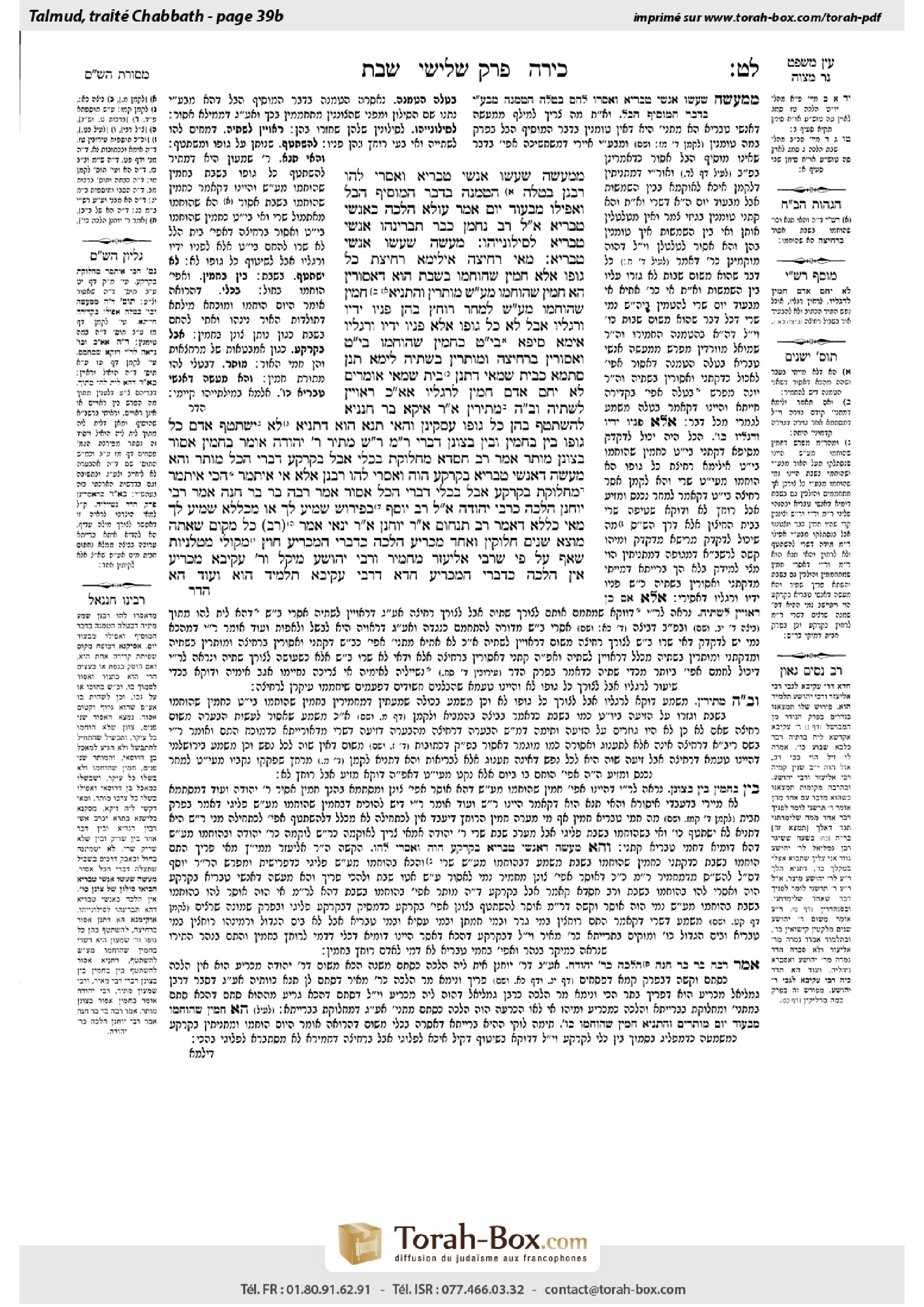
Shabbat 39b: Talmud study for Daf Yomi
Daf Yomi is the daily study of one Talmud folio. Explore 37 tractates with scans, Hebrew text, Sefaria English and AI-generated French translations where annotated.
Passage selection and English or AI-generated French translation are available where the scan has annotations. Daf Study is independent of Torah-Box and Sefaria.
Browse Shabbat · שבת · All tractatesShabbat 39b text and translations
This page of Shabbat includes the Aramaic text, an English translation and an AI-generated French translation, alongside the scan above.
שבת ל״ט ב · Aramaic and Hebrew text
מִמַּעֲשֶׂה שֶׁעָשׂוּ אַנְשֵׁי טְבֶרְיָא וְאָסְרִי לְהוּ רַבָּנַן בָּטְלָה הַטְמָנָה בְּדָבָר הַמּוֹסִיף הֶבֶל, וַאֲפִילּוּ מִבְּעוֹד יוֹם. אֲמַר עוּלָּא: הֲלָכָה כְּאַנְשֵׁי טְבֶרְיָא. אֲמַר לֵיהּ רַב נַחְמָן: כְּבָר תַּבְרִינְהוּ אַנְשֵׁי טְבֶרְיָא לְסִילוֹנַיְיהוּ.
מַעֲשֶׂה שֶׁעָשׂוּ אַנְשֵׁי טְבֶרְיָא: מַאי רְחִיצָה? אִילֵּימָא רְחִיצַת כׇּל גּוּפוֹ — אֶלָּא חַמִּין שֶׁהוּחַמּוּ בְּשַׁבָּת הוּא דַּאֲסוּרִין, הָא חַמִּין שֶׁהוּחַמּוּ מֵעֶרֶב שַׁבָּת מוּתָּרִין? וְהָתַנְיָא: חַמִּין שֶׁהוּחַמּוּ מֵעֶרֶב שַׁבָּת, לְמָחָר רוֹחֵץ בָּהֶן פָּנָיו יָדָיו וְרַגְלָיו, אֲבָל לֹא כׇּל גּוּפוֹ! אֶלָּא פָּנָיו יָדָיו וְרַגְלָיו.
אֵימָא סֵיפָא: בְּיוֹם טוֹב, כְּחַמִּין שֶׁהוּחַמּוּ בְּיוֹם טוֹב, וַאֲסוּרִין בִּרְחִיצָה וּמוּתָּרִין בִּשְׁתִיָּה. לֵימָא תְּנַן סְתָמָא כְּבֵית שַׁמַּאי? דִּתְנַן, בֵּית שַׁמַּאי אוֹמְרִים: לֹא יָחֵם אָדָם חַמִּין לְרַגְלָיו אֶלָּא אִם כֵּן רְאוּיִין לִשְׁתִיָּה, וּבֵית הִלֵּל מַתִּירִין.
אָמַר רַב אִיקָא בַּר חֲנַנְיָא: לְהִשְׁתַּטֵּף בָּהֶן כׇּל גּוּפוֹ עָסְקִינַן, וְהַאי תַּנָּא הוּא דְּתַנְיָא: לֹא יִשְׁתַּטֵּף אָדָם כׇּל גּוּפוֹ בֵּין בְּחַמִּין וּבֵין בְּצוֹנֵן — דִּבְרֵי רַבִּי מֵאִיר. רַבִּי שִׁמְעוֹן מַתִּיר. רַבִּי יְהוּדָה אוֹמֵר: בְּחַמִּין — אָסוּר, בְּצוֹנֵן — מוּתָּר.
אָמַר רַב חִסְדָּא: מַחֲלוֹקֶת בִּכְלִי, אֲבָל בְּקַרְקַע — דִּבְרֵי הַכֹּל מוּתָּר. וְהָא מַעֲשֶׂה דְּאַנְשֵׁי טְבֶרְיָא בְּקַרְקַע הֲוָה וְאָסְרִי לְהוּ רַבָּנַן! אֶלָּא אִי אִיתְּמַר, הָכִי אִיתְּמַר: מַחֲלוֹקֶת בְּקַרְקַע, אֲבָל בִּכְלִי — דִּבְרֵי הַכֹּל אָסוּר.
אָמַר רַבָּה בַּר בַּר חָנָה אָמַר רַבִּי יוֹחָנָן: הֲלָכָה כְּרַבִּי יְהוּדָה. אֲמַר לֵיהּ רַב יוֹסֵף: בְּפֵירוּשׁ שְׁמִיעַ לָךְ, אוֹ מִכְּלָלָא שְׁמִיעַ לָךְ? מַאי כְּלָלָא? — דְּאָמַר רַב תַּנְחוּם אָמַר רַבִּי יוֹחָנָן אָמַר רַבִּי יַנַּאי אָמַר (רַב) [רַבִּי]: כָּל מָקוֹם שֶׁאַתָּה מוֹצֵא שְׁנַיִם חֲלוּקִין וְאֶחָד מַכְרִיעַ — הֲלָכָה כְּדִבְרֵי הַמַּכְרִיעַ. חוּץ מִקּוּלֵּי מַטְלָנִיּוֹת, שֶׁאַף עַל פִּי שֶׁרַבִּי אֱלִיעֶזֶר מַחְמִיר, וְרַבִּי יְהוֹשֻׁעַ מֵיקֵל, וְרַבִּי עֲקִיבָא מַכְרִיעַ — אֵין הֲלָכָה כְּדִבְרֵי הַמַּכְרִיעַ. חֲדָא: דְּרַבִּי עֲקִיבָא תַּלְמִיד הוּא. וְעוֹד: הָא
Shabbat 39b · English translation
From this action performed by the people of Tiberias and the fact that the Sages prohibited them from using the water, the conclusion is that the practice of insulating a pot in something that increases the heat over the course of Shabbat was abolished on Shabbat. And not only is it prohibited to do so on Shabbat itself, but it is also prohibited while it is still day before Shabbat. Running pipes of cold water through hot water is similar to insulating water in something that adds heat. Ulla said: The halakha is in accordance with the people of Tiberias. Rav Naḥman said to him: The people of Tiberias have already broken their pipes. Even they reconsidered their position.
We learned in the mishna with regard to the incident, which related what the people of Tiberias did, that the legal status of water that was heated in the Tiberias hot springs is like that of water heated on Shabbat, and it is prohibited for use in bathing. The Gemara clarifies this matter: What type of bathing is this? If you say that it is referring to bathing one’s entire body, that is difficult. That would indicate that only water heated on Shabbat is prohibited for use in bathing one’s entire body; however, bathing one’s entire body in hot water heated before Shabbat is permitted. That cannot be. Wasn’t it taught in a baraita: With regard to hot water that was heated on Shabbat eve, one may use it the next day to wash his face, his hands, and his feet incrementally; however, not to wash his entire body? Rather, it must be that the bathing prohibited in the mishna with water heated on Shabbat is, in fact, washing his face, his hands, and his feet.
However, if so, say the latter clause of the mishna: On a Festival, the legal status of the water is like that of water that was heated by fire on a Festival, and it is prohibited for bathing and permitted for drinking. Even on a Festival, washing one’s face, hands, and feet is prohibited with this hot water. If so, let us say that we learned the unattributed mishna in accordance with the opinion of Beit Shammai. As we learned in a mishna, Beit Shammai say: A person may not heat water for his feet on a Festival unless it is also fit for drinking, and Beit Hillel permit doing so. According to Beit Hillel, it is permitted to heat water on a Festival for the purpose of washing one’s feet. According to the proposed interpretation of the term bathing in the mishna, as referring to washing one’s face, hands, and feet, our mishna is in accordance with the opinion of Beit Shammai. This is problematic, as the halakhic opinion of Beit Shammai is rejected and only rarely cited in an unattributed mishna.
Rav Ika bar Ḥananya said: In our mishna, we are dealing with water that was heated in order to rinse one’s entire body with it. Rinsing does not have the same legal status as bathing. And that which we learned in the mishna: Water that was heated on Shabbat is prohibited for bathing, from which it can be inferred that water heated before Shabbat is permitted for bathing on Shabbat, is in accordance with the opinion of this tanna, the opinion of Rabbi Shimon in the Tosefta. As it was taught in a Tosefta: One may neither rinse his entire body with hot water, even if it was heated before Shabbat, nor with cold water; this is the statement of Rabbi Meir. Rabbi Shimon permits doing so even with hot water because it was heated before Shabbat. Rabbi Yehuda says: With hot water, it is prohibited; with cold water, it is permitted. According to Rabbi Shimon, it is completely prohibited to rinse with water that was heated on Shabbat itself. Consequently, our mishna, which does not differentiate between hot and cold water, is in accordance with the opinion of Rabbi Shimon.
Rav Ḥisda said: This dispute over washing with water heated before Shabbat is specifically with regard to water in a vessel, as one might mistakenly think that it was heated on Shabbat, and there is then concern lest one permit the use of water heated with fire on Shabbat. However, when the water was collected in the ground, everyone agrees that it is permitted. The Gemara challenges this: Wasn’t the incident involving the people of Tiberias with regard to water in the ground, and nevertheless the Sages prohibited it? Rather, if this was stated, this is what was stated, i.e., this is the correct version of Rav Ḥisda’s statement: This dispute is specifically when the water is collected in the ground. However, when it is in a vessel, everyone agrees that it is prohibited.
Rabba bar bar Ḥana said that Rabbi Yoḥanan said: The halakha in this dispute is in accordance with the opinion of Rabbi Yehuda. Rav Yosef said to him: Did you learn this from Rabbi Yoḥanan explicitly, or did you learn it by inference from something else that he said? The Gemara remarks: What was the statement of Rabbi Yoḥanan from which this conclusion could be inferred? As Rav Tanḥum said that Rabbi Yoḥanan said that Rabbi Yannai said that Rav said: Every place that you find two who disagree and each one of them establishes his opinion in a series of cases, and one of the Sages, a third one, adopts a compromise opinion and says that in some cases the halakha is in accordance with one, and in some cases the halakha is in accordance with the other, the halakha is in accordance with the opinion of the compromiser. This principle holds true except for the case of the ritual impurity of insignificant strips of material. In that case, even though Rabbi Eliezer is stringent, and Rabbi Yehoshua is lenient, and Rabbi Akiva compromises, the halakha is not in accordance with the statement of the compromiser: First, because Rabbi Akiva is a student of Rabbi Eliezer and Rabbi Yehoshua and lacks the authority to decide between the opinions of his rabbis. And furthermore, didn’t
Shabbat 39b · Traduction française (IA)
De l’acte accompli par les habitants de Tibériade et du fait que les Sages leur ont interdit d’utiliser cette eau, on conclut que l’usage consistant à envelopper une marmite dans un matériau qui augmente la chaleur au cours du Chabbat a été aboli le Chabbat. Il est non seulement interdit de le faire pendant le Chabbat lui-même, mais aussi alors qu’il fait encore jour, avant le Chabbat. Faire passer des conduites d’eau froide dans de l’eau chaude revient à envelopper de l’eau dans un matériau qui ajoute de la chaleur. Oulla dit : « La halakha est conforme à l’avis des habitants de Tibériade. » Rav Naḥman lui dit : « Les habitants de Tibériade ont déjà brisé leurs conduites. Eux-mêmes ont changé d’avis. »
Nous avons appris dans la Michna, à propos de l’incident relatant ce que firent les habitants de Tibériade, que l’eau chauffée dans les sources chaudes de Tibériade a le même statut que l’eau chauffée pendant le Chabbat et qu’il est interdit de l’utiliser pour se baigner. La Guemara précise : De quel type de bain s’agit-il ? Si tu dis qu’il s’agit de se baigner tout le corps, cela pose une difficulté. Cela signifierait que seule l’eau chauffée pendant le Chabbat est interdite pour se baigner tout le corps, tandis qu’il serait permis de se baigner tout le corps avec de l’eau chaude chauffée avant le Chabbat. Cela ne peut pas être le cas. N’a-t-il pas été enseigné dans une baraïta : « De l’eau chaude chauffée la veille du Chabbat peut être utilisée le lendemain pour se laver le visage, les mains et les pieds, chacun séparément ; mais pas pour se laver tout le corps » ? Il faut donc plutôt comprendre que le bain interdit dans la Michna avec de l’eau chauffée pendant le Chabbat désigne en réalité le lavage du visage, des mains et des pieds.
Cependant, dans ce cas, considérons la dernière partie de la Michna : « Un jour de fête, l’eau a le même statut que l’eau chauffée au feu pendant un jour de fête ; il est interdit de l’utiliser pour se baigner, mais permis de la boire. » Même un jour de fête, il est interdit de se laver le visage, les mains et les pieds avec cette eau chaude. Il faudrait alors dire que nous avons appris une Michna anonyme conforme à l’avis de Beit Chammaï. En effet, nous avons appris dans une Michna : « Beit Chammaï disent qu’une personne ne peut pas chauffer de l’eau pour se laver les pieds un jour de fête, à moins qu’elle ne soit également propre à la consommation, tandis que Beit Hillel le permettent. » Selon Beit Hillel, il est permis de chauffer de l’eau un jour de fête pour se laver les pieds. Selon l’interprétation proposée du terme « bain » dans la Michna, qui désignerait le lavage du visage, des mains et des pieds, notre Michna serait conforme à l’avis de Beit Chammaï. Cela pose problème, car l’avis halakhique de Beit Chammaï est rejeté et n’est que rarement cité dans une Michna anonyme.
Rav Ika bar Ḥananya dit : Dans notre Michna, il s’agit d’eau chauffée afin de s’en rincer tout le corps. Le rinçage n’a pas le même statut que le bain. Quant à ce que nous avons appris dans la Michna — à savoir que l’eau chauffée pendant le Chabbat est interdite pour le bain, ce dont on pourrait déduire que l’eau chauffée avant le Chabbat peut être utilisée pour le bain pendant le Chabbat —, cela est conforme à l’avis de ce tanna, celui de Rabbi Shimon dans la Tossefta. En effet, il a été enseigné dans une Tossefta : « On ne peut se rincer tout le corps ni à l’eau chaude, même si elle a été chauffée avant le Chabbat, ni à l’eau froide ; telle est la déclaration de Rabbi Meïr. Rabbi Shimon le permet même avec de l’eau chaude, puisqu’elle a été chauffée avant le Chabbat. Rabbi Yehouda dit : Avec de l’eau chaude, c’est interdit ; avec de l’eau froide, c’est permis. » Selon Rabbi Shimon, il est entièrement interdit de se rincer avec de l’eau chauffée pendant le Chabbat lui-même. Par conséquent, notre Michna, qui ne fait pas de distinction entre l’eau chaude et l’eau froide, est conforme à l’avis de Rabbi Shimon.
Rav Ḥisda dit : Cette controverse sur le lavage avec de l’eau chauffée avant le Chabbat concerne précisément l’eau contenue dans un récipient, car on pourrait croire à tort qu’elle a été chauffée pendant le Chabbat ; on craindrait alors que l’on autorise l’usage d’eau chauffée au feu pendant le Chabbat. En revanche, lorsque l’eau a été recueillie dans le sol, tous conviennent que cela est permis. La Guemara objecte : L’incident concernant les habitants de Tibériade ne portait-il pas sur de l’eau dans le sol, alors que les Sages l’ont néanmoins interdite ? Il faut plutôt dire que, si cette déclaration a été formulée, voici ce qui a été dit, c’est-à-dire la version exacte de la déclaration de Rav Ḥisda : Cette controverse concerne précisément le cas où l’eau a été recueillie dans le sol. En revanche, lorsqu’elle se trouve dans un récipient, tous conviennent que c’est interdit.
Rabba bar bar Ḥana dit au nom de Rabbi Yoḥanan : Dans cette controverse, la halakha est conforme à l’avis de Rabbi Yehouda. Rav Yossef lui dit : L’as-tu appris explicitement de Rabbi Yoḥanan, ou l’as-tu déduit d’une autre déclaration de sa part ? La Guemara demande : Quelle déclaration de Rabbi Yoḥanan permettrait de déduire cette conclusion ? Rav Tanḥoum dit au nom de Rabbi Yoḥanan, qui dit au nom de Rabbi Yannai, qui dit au nom de Rav : Partout où deux Sages sont en désaccord, chacun appliquant son avis à une série de cas, et où un troisième Sage adopte une opinion de compromis, disant que, dans certains cas, la halakha est conforme à l’avis de l’un et que, dans d’autres, elle est conforme à l’avis de l’autre, la halakha est conforme à l’avis de celui qui propose le compromis. Ce principe vaut partout, sauf dans le cas de l’impureté rituelle de minces bandes de matière insignifiantes. Dans ce cas, bien que Rabbi Eliezer soit rigoureux, Rabbi Yehoshoua indulgent et Rabbi Akiva propose un compromis, la halakha n’est pas conforme à l’avis de celui qui propose le compromis : tout d’abord, parce que Rabbi Akiva est un disciple de Rabbi Eliezer et de Rabbi Yehoshoua et n’a pas autorité pour trancher entre les avis de ses maîtres. En outre, n’a-t-il pas
Traduction française générée par IA à partir de l’édition anglaise de Sefaria. Vérifie toujours un passage avec le texte source.
Text from Sefaria: William Davidson Edition - Vocalized Aramaic (CC BY NC); William Davidson Edition - English (CC BY NC).