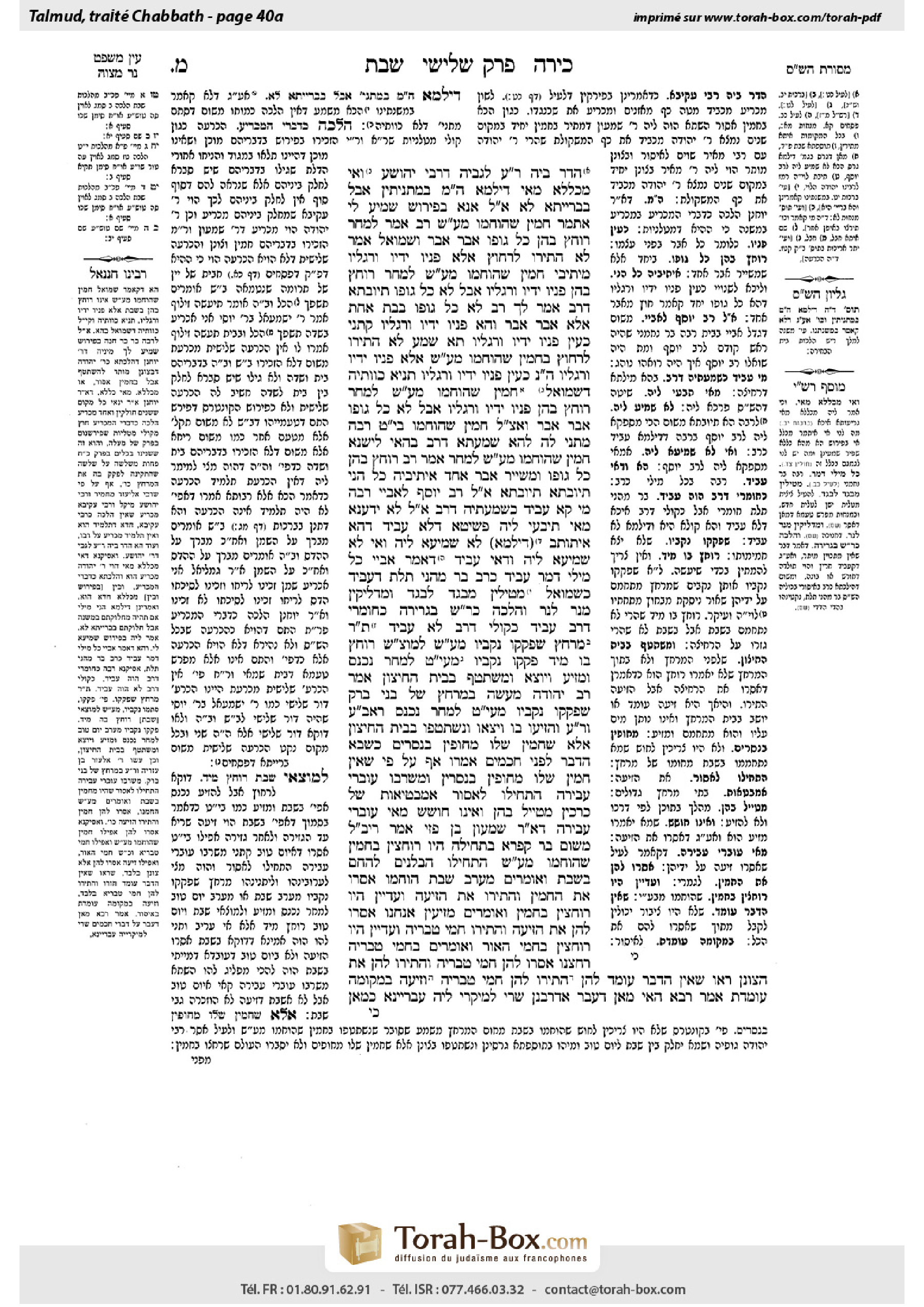
Shabbat 40a: Talmud study for Daf Yomi
Daf Yomi is the daily study of one Talmud folio. Explore 37 tractates with scans, Hebrew text, Sefaria English and AI-generated French translations where annotated.
Passage selection and English or AI-generated French translation are available where the scan has annotations. Daf Study is independent of Torah-Box and Sefaria.
Browse Shabbat · שבת · All tractatesShabbat 40a text and translations
This page of Shabbat includes the Aramaic text, an English translation and an AI-generated French translation, alongside the scan above.
שבת מ׳ א · Aramaic and Hebrew text
הֲדַר בֵּיהּ רַבִּי עֲקִיבָא לְגַבֵּיהּ דְּרַבִּי יְהוֹשֻׁעַ. וְאִי מִכְּלָלָא, מַאי? דִילְמָא הָנֵי מִילֵּי בְּמַתְנִיתִין, אֲבָל בְּבָרַיְיתָא — לָא. אֲמַר לֵיהּ: אֲנָא בְּפֵירוּשׁ שְׁמִיעַ לִי.
אִתְּמַר: חַמִּין שֶׁהוּחַמּוּ מֵעֶרֶב שַׁבָּת, רַב אָמַר: לְמָחָר רוֹחֵץ בָּהֶן כׇּל גּוּפוֹ, אֵבֶר אֵבֶר. וּשְׁמוּאֵל אָמַר: לֹא הִתִּירוּ לִרְחוֹץ אֶלָּא פָּנָיו יָדָיו וְרַגְלָיו. מֵיתִיבִי: חַמִּין שֶׁהוּחַמּוּ מֵעֶרֶב שַׁבָּת, לְמָחָר רוֹחֵץ בָּהֶן פָּנָיו יָדָיו וְרַגְלָיו אֲבָל לֹא כׇּל גּוּפוֹ. תְּיוּבְתָּא דְּרַב. אָמַר לְךָ רַב: ״לֹא כׇּל גּוּפוֹ״ — בְּבַת אַחַת, אֶלָּא אֵבֶר אֵבֶר. וְהָא ״פָּנָיו יָדָיו וְרַגְלָיו״ קָתָנֵי! — כְּעֵין פָּנָיו יָדָיו וְרַגְלָיו.
תָּא שְׁמַע: לֹא הִתִּירוּ לִרְחוֹץ בְּחַמִּין שֶׁהוּחַמּוּ מֵעֶרֶב שַׁבָּת אֶלָּא פָּנָיו יָדָיו וְרַגְלָיו! הָכָא נָמֵי, כְּעֵין פָּנָיו יָדָיו וְרַגְלָיו.
תַּנְיָא כְּווֹתֵיהּ דִּשְׁמוּאֵל: חַמִּין שֶׁהוּחַמּוּ מֵעֶרֶב שַׁבָּת, לְמָחָר רוֹחֵץ בָּהֶן פָּנָיו יָדָיו וְרַגְלָיו, אֲבָל לֹא כׇּל גּוּפוֹ אֵבֶר אֵבֶר. וְאֵין צָרִיךְ לוֹמַר חַמִּין שֶׁהוּחַמּוּ בְּיוֹם טוֹב. רַבָּה מַתְנֵי לַהּ לְהָא שְׁמַעְתָּא דְּרַב בְּהַאי לִישָּׁנָא: חַמִּין שֶׁהוּחַמּוּ מֵעֶרֶב שַׁבָּת לְמָחָר, אָמַר רַב: רוֹחֵץ בָּהֶן כׇּל גּוּפוֹ וּמְשַׁיֵּיר אֵבֶר אֶחָד. אֵיתִיבֵיהּ כׇּל הָנֵי תְּיוּבָתָא. תְּיוּבְתָּא.
אֲמַר לֵיהּ רַב יוֹסֵף לְאַבָּיֵי: רַבָּה מִי קָא עָבֵיד כִּשְׁמַעְתֵּיהּ דְּרַב? אָמַר לֵיהּ: לָא יָדַעְנָא. מַאי תִּיבְּעֵי לֵיהּ? פְּשִׁיטָא דְּלָא עָבֵיד, דְּהָא אִיתּוֹתַב. (דִּילְמָא) לָא שְׁמִיעָא לֵיהּ.
וְאִי לָא שְׁמִיעָא לֵיהּ — וַדַּאי עָבֵיד. דְּאָמַר אַבָּיֵי: כׇּל מִילֵּי דְּמָר עָבֵיד כְּרַב, בַּר מֵהָנֵי תְּלָת דְּעָבֵיד כִּשְׁמוּאֵל. מְטִילִין מִבֶּגֶד לְבֶגֶד, וּמַדְלִיקִין מִנֵּר לְנֵר, וַהֲלָכָה כְּרַבִּי שִׁמְעוֹן בִּגְרִירָה! — כְּחוּמְרֵי דְּרַב עָבֵיד, כְּקוּלֵּי דְּרַב לָא עָבֵיד.
תָּנוּ רַבָּנַן: מֶרְחָץ שֶׁפָּקְקוּ נְקָבָיו מֵעֶרֶב שַׁבָּת, לְמוֹצָאֵי שַׁבָּת רוֹחֵץ בּוֹ מִיָּד. פָּקְקוּ נְקָבָיו מֵעֶרֶב יוֹם טוֹב, לְמָחָר נִכְנָס וּמַזִּיעַ, וְיוֹצֵא וּמִשְׁתַּטֵּף בַּבַּיִת הַחִיצוֹן.
אָמַר רַב יְהוּדָה: מַעֲשֶׂה בַּמֶּרְחָץ שֶׁל בְּנֵי בְּרַק שֶׁפָּקְקוּ נְקָבָיו מֵעֶרֶב יוֹם טוֹב, לְמָחָר נִכְנַס רַבִּי אֶלְעָזָר בֶּן עֲזַרְיָה וְרַבִּי עֲקִיבָא וְהִזִּיעוּ בּוֹ וְיָצְאוּ וְנִשְׁתַּטְּפוּ בַּבַּיִת הַחִיצוֹן. אֶלָּא שֶׁחַמִּין שֶׁלּוֹ מְחוּפִּין בִּנְסָרִים. כְּשֶׁבָּא הַדָּבָר לִפְנֵי חֲכָמִים, אָמְרוּ: אַף עַל פִּי שֶׁאֵין חַמִּין שֶׁלּוֹ מְחוּפִּין בִּנְסָרִין. וּמִשֶּׁרַבּוּ עוֹבְרֵי עֲבֵירָה הִתְחִילוּ לֶאֱסוֹר. אַמְבַּטְיָאוֹת שֶׁל כְּרַכִּין — מְטַיֵּיל בָּהֶן וְאֵינוֹ חוֹשֵׁשׁ.
מַאי ״עוֹבְרֵי עֲבֵירָה״? דְּאָמַר רַבִּי שִׁמְעוֹן בֶּן פַּזִּי אָמַר רַבִּי יְהוֹשֻׁעַ בֶּן לֵוִי מִשּׁוּם בַּר קַפָּרָא: בַּתְּחִילָּה הָיוּ רוֹחֲצִין בְּחַמִּין שֶׁהוּחַמּוּ מֵעֶרֶב שַׁבָּת. הִתְחִילוּ הַבַּלָּנִים לְהָחֵם בְּשַׁבָּת, וְאוֹמְרִים: מֵעֶרֶב שַׁבָּת הוּחַמּוּ. אָסְרוּ אֶת הַחַמִּין וְהִתִּירוּ אֶת הַזֵּיעָה. וַעֲדַיִין הָיוּ רוֹחֲצִין בְּחַמִּין וְאוֹמְרִים: ״מְזִיעִין אֲנַחְנוּ״. אָסְרוּ לָהֶן אֶת הַזֵּיעָה וְהִתִּירוּ חַמֵּי טְבֶרְיָה. וַעֲדַיִין הָיוּ רוֹחֲצִין בְּחַמֵּי הָאוּר, וְאוֹמְרִים: בְּחַמֵּי טְבֶרְיָה רָחַצְנוּ. אָסְרוּ לָהֶן חַמֵּי טְבֶרְיָה וְהִתִּירוּ לָהֶן אֶת הַצּוֹנֵן. רָאוּ שֶׁאֵין הַדָּבָר עוֹמֵד לָהֶן, הִתִּירוּ לָהֶן חַמֵּי טְבֶרְיָה וְזֵיעָה בִּמְקוֹמָהּ עוֹמֶדֶת.
אָמַר רָבָא: הַאי מַאן דְּעָבַר אַדְּרַבָּנַן, שְׁרֵי לְמִיקְרֵי לֵיהּ ״עֲבַרְיָינָא״: כְּמַאן —
Shabbat 40a · English translation
Rabbi Akiva reconsider and adopt Rabbi Yehoshua’s opinion? In the dispute over the laws of bathing as well, the ruling should have been in accordance with the opinion of Rabbi Yehuda because his is the compromise opinion. Therefore, Rav Yosef asked whether the ruling was based on that principle alone. The Gemara asks: And if the halakha was derived by inference, what of it? It is legitimate to draw conclusions by inference. The Gemara responds: Perhaps this principle, that the halakha is established in accordance with the compromise opinion, applies only in a mishna; but in a baraita, no, it does not apply. Perhaps the baraita is not a sufficiently reliable source to establish the halakha in accordance with the compromise opinion based on its formulation. Rabba bar bar Ḥana said to Rav Yosef: I heard it explicitly.
An amoraic dispute was stated: With regard to hot water that was heated on Shabbat eve before Shabbat, Rav said: The next day, on Shabbat, one may wash his entire body with it; however, not all at once. Rather, he washes one limb at a time, in a departure from the standard practice, to remind him that it is Shabbat. And Shmuel said: They only permitted washing one’s face, his hands, and his feet with hot water, even if it was heated on Shabbat eve; however, they did not permit washing his entire body, even in increments. The Gemara raises an objection from what was taught in a baraita: Hot water that was heated on Shabbat eve, the next day one may wash his face, his hands, and his feet with it but not his entire body. This is a conclusive refutation of Rav’s opinion. Rav could have said to you: When the baraita says: Not one’s entire body, it means not his entire body at once, but one limb and then another limb until he washes his entire body is permitted. The Gemara asks: Doesn’t it say one’s face, his hands, and his feet, and no more? Rav answers: It means that one washes his body in a manner similar to the manner that one washes his face, his hands, and his feet, i.e., each limb separately, and they were cited as examples of washing one limb at a time.
The Gemara cites an additional proof. Come and hear from what was taught in a baraita: They only permitted to wash one’s face, his hands, and his feet with hot water that was heated before Shabbat. This poses a difficulty to Rav. Rav answers: Here too, this refers to washing one limb at a time, in a manner similar to the way one washes his face, his hands, and his feet.
The Gemara remarks: A baraita was taught in accordance with the opinion of Shmuel: Hot water that was heated on Shabbat eve, the next day one may wash his face, his hands, and his feet with it but not his entire body, even one limb at a time. And, needless to say, this is the halakha with regard to hot water that was heated on a Festival. Rabba would teach this halakha of Rav in this language: Hot water that was heated on Shabbat eve, the next day, Rav said: One may bathe his entire body in it and exclude one limb to remind himself that today is Shabbat. They raised all of these conclusive refutations, with which they objected to the previous version of Rav’s statement, against him and the Gemara concludes: Indeed, it is a conclusive refutation.
Rav Yosef said to Abaye: Does Rabba act in accordance with this halakha of Rav? He said to him: I do not know. The Gemara asks: What is his dilemma? It is obvious that Rabba did not act in accordance with Rav’s statement, as Rav’s statement was conclusively refuted. The Gemara answers: Perhaps he did not hear, i.e., he did not know of the challenges or he did not consider them substantial. Perhaps, in his opinion, it is still reasonable to act in accordance with Rav’s statement.
The Gemara says: If so, there is still no room for the dilemma. And if Rabba did not hear this refutation, certainly he acted in accordance with Rav’s opinion, as Abaye said: In all halakhic matters of the Master, Rabba, he conducted himself in accordance with the opinion of Rav, except these three where he conducted himself in accordance with the opinion of Shmuel. He ruled: One may untie ritual fringes from garment to garment, and one may light from one Hanukkah lamp to another lamp, and the halakha is in accordance with the opinion of Rabbi Shimon in the case of dragging. According to Rabbi Shimon, it is permitted to drag heavy objects, and there is no concern that, as a result, a ditch might be dug in the ground. In any case, it is certainly reasonable to say that he acted in accordance with the opinion of Rav in the case of bathing on Shabbat as well. The Gemara answers: His is not an absolute proof. Perhaps Rabba’s custom was that he acted in accordance with the stringencies of Rav and he did not act in accordance with the leniencies of Rav. Washing with hot water on Shabbat is one of Rav’s leniencies. Therefore, it is not clear how Rabba acted in practice.
The Sages taught in a Tosefta: A bathhouse whose openings were sealed on Shabbat eve so that the heat would not diminish, after Shabbat one may bathe in it immediately. If its openings were sealed on the eve of a Festival, the next day, on the Festival itself, one may enter and sweat in the heat produced by the hot water and emerge and rinse with cold water in the outer room of the bathhouse.
Rabbi Yehuda said: There was an incident in the bathhouse of Benei Berak, whose openings were sealed on the eve of a Festival. The next day, on the Festival itself, Rabbi Elazar ben Azarya and Rabbi Akiva entered and sweated there, and emerged and rinsed themselves in the outer room. However, this bathhouse was unique because the hot water was covered by wooden boards and there was no concern lest a person bathe in the hot water. When this matter came before the Sages, they said: Even if its hot water is not covered by boards, it is permitted to sweat from the heat in the bathhouse. When the number of transgressors increased, the Sages began to prohibit this. However, the large bathhouses [ambatyaot] in cities, one may stroll through them as usual and need not be concerned about the prohibitions of Shabbat, even if he sweats while doing so.
And the Gemara asks: What are these transgressors? The Gemara answers: Rabbi Shimon ben Pazi said that Rabbi Yehoshua ben Levi said in the name of bar Kappara: Initially, people would bathe even on Shabbat in hot water that was heated before Shabbat. The bathhouse attendants began to heat water on Shabbat and say that it was heated before Shabbat. Therefore, the Sages prohibited bathing in hot water and permitted sweating. And they would still bathe in hot water and say: We are sweating, and that is why we entered the bathhouse. Therefore, the Sages prohibited sweating and permitted bathing in the hot springs of Tiberias. And people would still bathe in hot water heated by fire and say: We bathed in the hot springs of Tiberias. Therefore, they prohibited even the hot springs of Tiberias and permitted them to bathe in cold water. When the Sages saw that their decrees were not upheld by the people because of their stringency, they permitted them to bathe in the hot springs of Tiberias, and the decree prohibiting sweating remained in place.
In this context, Rava said: One who violates a decree of the Sages, it is permitted to call him a transgressor. Transgressor is not a term limited to one who violates a severe Torah prohibition. The Gemara asks: In accordance with whose opinion did Rabba make this statement?
Shabbat 40a · Traduction française (IA)
Rabbi Akiva est-il revenu sur sa position pour adopter celle de Rabbi Yehoshua ? Dans la controverse portant également sur les lois du bain, la décision aurait dû être conforme à l’avis de Rabbi Yehuda, puisque c’est lui qui défend l’opinion de compromis. Rav Yosef demanda donc si la décision reposait uniquement sur ce principe. La Guemara demande : Et si la halakha a été déduite par inférence, qu’importe ? Il est légitime de tirer des conclusions par inférence. La Guemara répond : Peut-être ce principe, selon lequel la halakha est établie conformément à l’opinion de compromis, ne s’applique-t-il que dans une Michna, mais pas dans une baraïta. Peut-être la baraïta n’est-elle pas une source suffisamment fiable pour établir la halakha conformément à l’opinion de compromis sur la base de sa formulation. Rabba bar bar Ḥana dit à Rav Yosef : Je l’ai entendu explicitement.
Une controverse entre amoraïm fut rapportée : au sujet de l’eau chaude chauffée la veille de Chabbat, avant Chabbat, Rav dit : le lendemain, Chabbat, on peut s’en laver tout le corps, mais pas en une seule fois. On se lave plutôt membre après membre, en s’écartant de la pratique habituelle, afin de se rappeler que c’est Chabbat. Et Shmuel dit : on n’a autorisé à se laver à l’eau chaude que le visage, les mains et les pieds, même si elle a été chauffée la veille de Chabbat ; mais on n’a pas autorisé à se laver tout le corps, même en plusieurs fois. La Guemara soulève une objection à partir de ce qui fut enseigné dans une baraïta : avec de l’eau chaude chauffée la veille de Chabbat, le lendemain, on peut se laver le visage, les mains et les pieds, mais pas tout le corps. Cela réfute de manière décisive l’avis de Rav. Rav aurait pu te répondre : lorsque la baraïta dit « pas tout le corps », elle veut dire pas tout le corps en une seule fois ; mais il est permis de se laver membre après membre, jusqu’à ce que tout le corps soit lavé. La Guemara demande : N’est-il pas dit « le visage, les mains et les pieds », et rien de plus ? Rav répond : cela signifie qu’on se lave le corps de la même manière que l’on se lave le visage, les mains et les pieds, c’est-à-dire membre après membre ; ces derniers sont cités comme exemples d’un lavage membre après membre.
La Guemara apporte une preuve supplémentaire. Viens et entends ce qui fut enseigné dans une baraïta : on n’a autorisé à se laver le visage, les mains et les pieds qu’avec de l’eau chaude chauffée avant Chabbat. Cela pose une difficulté à Rav. Rav répond : ici aussi, il s’agit de se laver membre après membre, de la même manière qu’on se lave le visage, les mains et les pieds.
La Guemara remarque : une baraïta fut enseignée conformément à l’avis de Shmuel : avec de l’eau chaude chauffée la veille de Chabbat, le lendemain, on peut se laver le visage, les mains et les pieds, mais pas tout le corps, même membre après membre. À plus forte raison, telle est la halakha concernant l’eau chaude chauffée lors d’un jour de fête. Rabba enseignait cette halakha de Rav dans les termes suivants : au sujet de l’eau chaude chauffée la veille de Chabbat, Rav disait que, le lendemain, on pouvait s’y baigner tout le corps en laissant un membre de côté, afin de se rappeler qu’aujourd’hui, c’est Chabbat. Ils lui opposèrent toutes ces réfutations décisives, qui visaient la formulation précédente de la déclaration de Rav, et la Guemara conclut : effectivement, c’est une réfutation décisive.
Rav Yosef dit à Abaye : Rabba agit-il conformément à cette halakha de Rav ? Il lui répondit : Je ne sais pas. La Guemara demande : Quel est son doute ? Il est évident que Rabba n’a pas agi conformément à la déclaration de Rav, puisque celle-ci a été réfutée de manière décisive. La Guemara répond : Peut-être n’en a-t-il pas eu connaissance, c’est-à-dire qu’il ignorait les objections ou ne les jugeait pas substantielles. Peut-être, à son avis, était-il encore raisonnable d’agir conformément à la déclaration de Rav.
La Guemara dit : Dans ce cas, il n’y a toujours pas lieu d’avoir un doute. Et si Rabba n’a pas eu connaissance de cette réfutation, il est certain qu’il a agi conformément à l’avis de Rav, car Abaye a dit : Dans toutes les questions de halakha de notre Maître Rabba, il se conduisait conformément à l’avis de Rav, à l’exception de ces trois cas où il se conduisait conformément à l’avis de Shmuel. Il statuait qu’on pouvait détacher les franges rituelles d’un vêtement pour les fixer à un autre, qu’on pouvait allumer une lampe de Hanoucca à partir d’une autre, et que la halakha suivait l’avis de Rabbi Shimon dans le cas où l’on traîne un objet. Selon Rabbi Shimon, il est permis de traîner des objets lourds et il n’y a pas lieu de craindre qu’une tranchée soit creusée dans le sol. Quoi qu’il en soit, il est certainement raisonnable de dire qu’il a également agi conformément à l’avis de Rav concernant les bains le Chabbat. La Guemara répond : cela ne constitue pas une preuve absolue. Peut-être Rabba avait-il pour habitude de suivre les positions rigoureuses de Rav, mais pas ses positions indulgentes. Se laver à l’eau chaude le Chabbat est l’une des positions indulgentes de Rav. On ne sait donc pas clairement comment Rabba agissait en pratique.
Les Sages enseignèrent dans une Tossefta : si les ouvertures d’un établissement de bains ont été fermées la veille de Chabbat afin que la chaleur ne diminue pas, on peut s’y baigner immédiatement après Chabbat. Si ses ouvertures ont été fermées la veille d’un jour de fête, le lendemain, le jour de fête lui-même, on peut y entrer et transpirer grâce à la chaleur produite par l’eau chaude, puis sortir et se rincer à l’eau froide dans la salle extérieure de l’établissement de bains.
Rabbi Yehuda dit : Il arriva que, dans l’établissement de bains de Benei Berak, dont les ouvertures avaient été fermées la veille d’un jour de fête, Rabbi Elazar ben Azarya et Rabbi Akiva y entrèrent le lendemain, le jour de fête lui-même, et y transpirèrent ; ils sortirent ensuite et se rincèrent dans la salle extérieure. Cet établissement de bains était toutefois particulier, car l’eau chaude était recouverte de planches et il n’y avait pas lieu de craindre qu’une personne se baigne dans l’eau chaude. Lorsque cette question fut soumise aux Sages, ils dirent : même si l’eau chaude n’est pas recouverte de planches, il est permis de transpirer grâce à la chaleur de l’établissement de bains. Lorsque le nombre de transgresseurs augmenta, les Sages commencèrent à l’interdire. Cependant, dans les grands établissements de bains [ambatyaot] des villes, on peut s’y promener comme à l’ordinaire et il n’est pas nécessaire de se préoccuper des interdits de Chabbat, même si l’on transpire en le faisant.
La Guemara demande : Qui sont ces transgresseurs ? La Guemara répond : Rabbi Shimon ben Pazi dit que Rabbi Yehoshua ben Levi a dit au nom de bar Kappara : au début, les gens se baignaient même le Chabbat dans de l’eau chaude qui avait été chauffée avant Chabbat. Les préposés aux bains commencèrent à chauffer l’eau le Chabbat et à prétendre qu’elle avait été chauffée avant Chabbat. Les Sages interdirent donc de se baigner dans l’eau chaude et autorisèrent la transpiration. Les gens continuaient pourtant à se baigner dans l’eau chaude et disaient : « Nous transpirons, c’est pourquoi nous sommes entrés dans l’établissement de bains. » Les Sages interdirent donc la transpiration et autorisèrent les bains dans les sources chaudes de Tibériade. Les gens continuaient pourtant à se baigner dans de l’eau chaude chauffée au feu et disaient : « Nous nous sommes baignés dans les sources chaudes de Tibériade. » Les Sages interdirent donc même les sources chaudes de Tibériade et leur permirent de se baigner dans l’eau froide. Lorsque les Sages virent que les gens ne respectaient pas leurs décrets en raison de leur rigueur, ils leur permirent de se baigner dans les sources chaudes de Tibériade, tandis que le décret interdisant la transpiration resta en vigueur.
Dans ce contexte, Rava dit : celui qui transgresse un décret des Sages peut être qualifié de transgresseur. Le terme « transgresseur » ne désigne pas uniquement celui qui enfreint une grave interdiction de la Torah. La Guemara demande : De l’avis de qui Rabba a-t-il formulé cette déclaration ?
Traduction française générée par IA à partir de l’édition anglaise de Sefaria. Vérifie toujours un passage avec le texte source.
Text from Sefaria: William Davidson Edition - Vocalized Aramaic (CC BY NC); William Davidson Edition - English (CC BY NC).