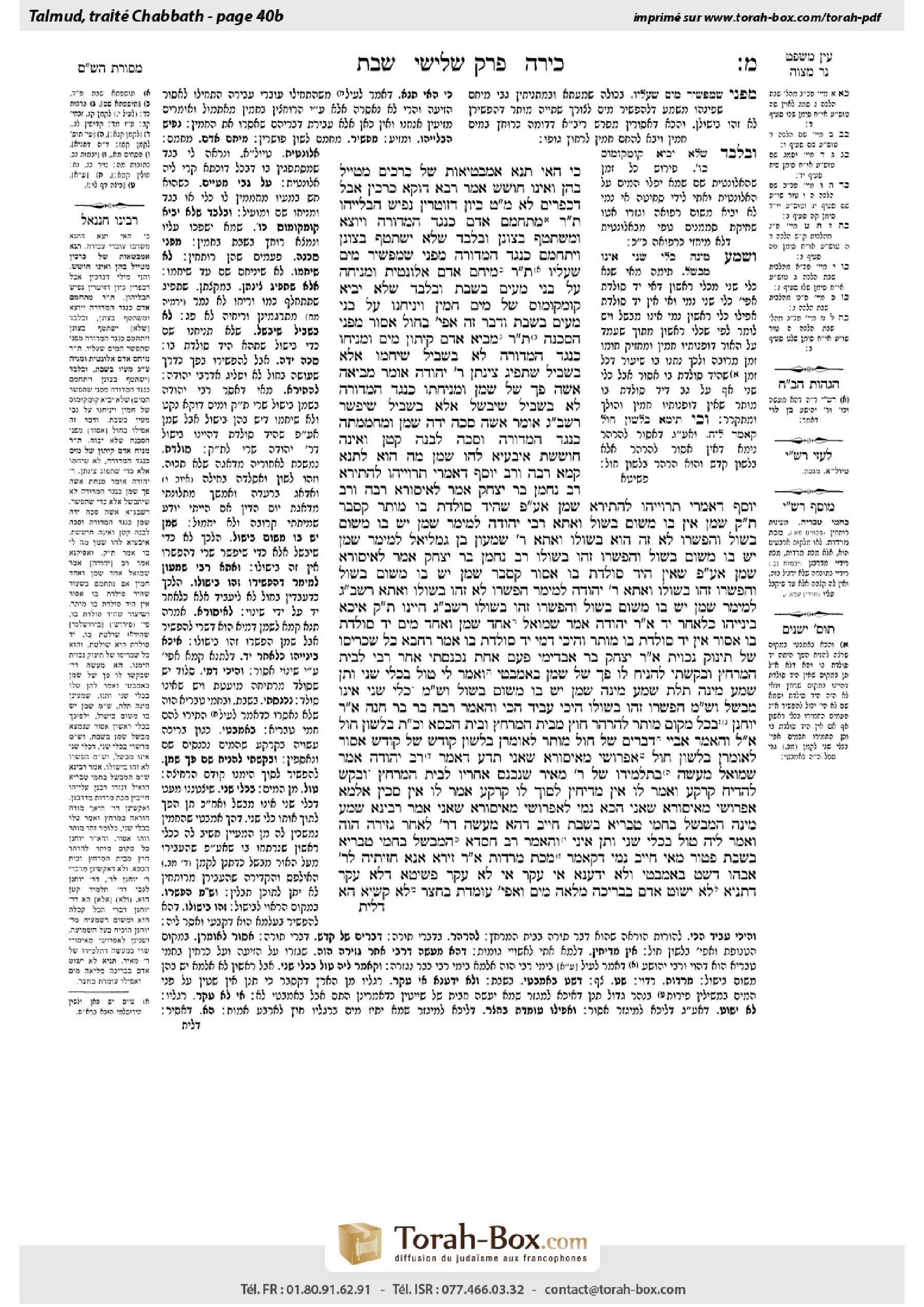
Shabbat 40b: Talmud study for Daf Yomi
Daf Yomi is the daily study of one Talmud folio. Explore 37 tractates with scans, Hebrew text, Sefaria English and AI-generated French translations where annotated.
Passage selection and English or AI-generated French translation are available where the scan has annotations. Daf Study is independent of Torah-Box and Sefaria.
Browse Shabbat · שבת · All tractatesShabbat 40b text and translations
This page of Shabbat includes the Aramaic text, an English translation and an AI-generated French translation, alongside the scan above.
שבת מ׳ ב · Aramaic and Hebrew text
כִּי הַאי תַּנָּא:
אַמְבַּטְיָאוֹת שֶׁל כְּרַכִּים מְטַיֵּיל בָּהֶן וְאֵינוֹ חוֹשֵׁשׁ. אָמַר רָבָא: דַּוְקָא כְּרַכִּין, אֲבָל דִּכְפָרִים — לָא. מַאי טַעְמָא — כֵּיוָן דְּזוּטְרִין נְפִישׁ הַבְלַיְיהוּ.
תָּנוּ רַבָּנַן: מִתְחַמֵּם אָדָם כְּנֶגֶד הַמְּדוּרָה וְיוֹצֵא וּמִשְׁתַּטֵּף בְּצוֹנֵן, וּבִלְבַד שֶׁלֹּא יִשְׁתַּטֵּף בְּצוֹנֵן וְיִתְחַמֵּם כְּנֶגֶד הַמְּדוּרָה, מִפְּנֵי שֶׁמַּפְשִׁיר מַיִם שֶׁעָלָיו. תָּנוּ רַבָּנַן: מֵיחֵם אָדָם אֲלוּנְטִית וּמַנִּיחָהּ עַל בְּנֵי מֵעַיִם בְּשַׁבָּת, וּבִלְבַד שֶׁלֹּא יָבִיא קוֹמְקוּמוֹס שֶׁל מַיִם חַמִּין וְיַנִּיחֶנּוּ עַל בְּנֵי מֵעַיִם בְּשַׁבָּת. וְדָבָר זֶה אֲפִילּוּ בַּחוֹל אָסוּר, מִפְּנֵי הַסַּכָּנָה.
תָּנוּ רַבָּנַן: מֵבִיא אָדָם קִיתוֹן מַיִם וּמַנִּיחוֹ כְּנֶגֶד הַמְּדוּרָה. לֹא בִּשְׁבִיל שֶׁיֵּחַמּוּ, אֶלָּא בִּשְׁבִיל שֶׁתָּפוּג צִינָּתָן. רַבִּי יְהוּדָה אוֹמֵר: מְבִיאָה אִשָּׁה פַּךְ שֶׁל שֶׁמֶן וּמְנִיחָתוֹ כְּנֶגֶד הַמְּדוּרָה. לֹא בִּשְׁבִיל שֶׁיִּבְשַׁל, אֶלָּא בִּשְׁבִיל שֶׁיִּפְשַׁר. רַבָּן שִׁמְעוֹן בֶּן גַּמְלִיאֵל אוֹמֵר: אִשָּׁה סָכָה יָדָהּ שֶׁמֶן וּמְחַמַּמְתָּהּ כְּנֶגֶד הַמְּדוּרָה, וְסָכָה לִבְנָהּ קָטָן, וְאֵינָהּ חוֹשֶׁשֶׁת.
אִיבַּעְיָא לְהוּ: שֶׁמֶן מָה הוּא לְתַנָּא קַמָּא? רַבָּה וְרַב יוֹסֵף דְּאָמְרִי תַּרְוַיְיהוּ לְהֶתֵּירָא, רַב נַחְמָן בַּר יִצְחָק אָמַר לְאִיסּוּרָא. רַבָּה וְרַב יוֹסֵף דְּאָמְרִי תַּרְוַיְיהוּ לְהֶתֵּירָא: שֶׁמֶן אַף עַל פִּי שֶׁהַיָּד סוֹלֶדֶת בּוֹ — מוּתָּר. קָסָבַר תַּנָּא קַמָּא שֶׁמֶן אֵין בּוֹ מִשּׁוּם בִּשּׁוּל. וַאֲתָא רַבִּי יְהוּדָה לְמֵימַר שֶׁמֶן יֵשׁ בּוֹ מִשּׁוּם בִּשּׁוּל, וְהֶפְשֵׁרוֹ לֹא זֶה הוּא בִּשּׁוּלוֹ. וַאֲתָא רַבָּן שִׁמְעוֹן בֶּן גַּמְלִיאֵל לְמֵימַר שֶׁמֶן יֵשׁ בּוֹ מִשּׁוּם בִּשּׁוּל, וְהֶפְשֵׁרוֹ זֶהוּ בִּשּׁוּלוֹ.
רַב נַחְמָן בַּר יִצְחָק אָמַר לְאִיסּוּרָא: שֶׁמֶן אַף עַל פִּי שֶׁאֵין הַיָּד סוֹלֶדֶת בּוֹ — אָסוּר. קָסָבַר שֶׁמֶן יֵשׁ בּוֹ מִשּׁוּם בִּשּׁוּל, וְהֶפְשֵׁרוֹ זֶהוּ בִּשּׁוּלוֹ. וַאֲתָא רַבִּי יְהוּדָה לְמֵימַר הֶפְשֵׁרוֹ לֹא זֶהוּ בִּשּׁוּלוֹ. וַאֲתָא רַבָּן שִׁמְעוֹן בֶּן גַּמְלִיאֵל לְמֵימַר שֶׁמֶן יֵשׁ בּוֹ מִשּׁוּם בִּשּׁוּל, וְהֶפְשֵׁרוֹ זֶהוּ בִּשּׁוּלוֹ. רַבָּן שִׁמְעוֹן בֶּן גַּמְלִיאֵל הַיְינוּ תַּנָּא קַמָּא? אִיכָּא בֵּינַיְיהוּ כִּלְאַחַר יָד.
אָמַר רַבִּי יְהוּדָה אָמַר שְׁמוּאֵל: אֶחָד שֶׁמֶן וְאֶחָד מַיִם, יָד סוֹלֶדֶת בּוֹ — אָסוּר, אֵין יָד סוֹלֶדֶת בּוֹ — מוּתָּר. וְהֵיכִי דָמֵי יָד סוֹלֶדֶת בּוֹ? אָמַר רַחֲבָא: כׇּל שֶׁכְּרֵיסוֹ שֶׁל תִּינוֹק נִכְוֵית.
אָמַר רַבִּי יִצְחָק בַּר אַבְדִּימִי: פַּעַם אַחַת נִכְנַסְתִּי אַחַר רַבִּי לְבֵית הַמֶּרְחָץ, וּבִקַּשְׁתִּי לְהַנִּיחַ לוֹ פַּךְ שֶׁל שֶׁמֶן בְּאַמְבָּטִי, וְאָמַר לִי: טוֹל בִּכְלִי שֵׁנִי וְתֵן. שְׁמַע מִינַּהּ תְּלָת: שְׁמַע מִינַּהּ שֶׁמֶן יֵשׁ בּוֹ מִשּׁוּם בִּשּׁוּל, וּשְׁמַע מִינַּהּ כְּלִי שֵׁנִי אֵינוֹ מְבַשֵּׁל, וּשְׁמַע מִינַּהּ הֶפְשֵׁרוֹ זֶהוּ בִּשּׁוּלוֹ.
הֵיכִי עָבֵיד הָכִי, וְהָאָמַר רַבָּה בַּר בַּר חָנָה אָמַר רַבִּי יוֹחָנָן: בְּכָל מָקוֹם מוּתָּר לְהַרְהֵר חוּץ מִבֵּית הַמֶּרְחָץ וּבֵית הַכִּסֵּא! וְכִי תֵּימָא בִּלְשׁוֹן חוֹל אֲמַר לֵיהּ, וְהָאָמַר אַבָּיֵי: דְּבָרִים שֶׁל חוֹל מוּתָּר לְאוֹמְרָן בִּלְשׁוֹן קוֹדֶשׁ, שֶׁל קוֹדֶשׁ אָסוּר לְאוֹמְרָן בִּלְשׁוֹן חוֹל! אַפְרוֹשֵׁי מֵאִיסּוּרָא שָׁאנֵי.
תִּדַּע, דְּאָמַר רַב יְהוּדָה אָמַר שְׁמוּאֵל: מַעֲשֶׂה בְּתַלְמִידוֹ שֶׁל רַבִּי מֵאִיר שֶׁנִּכְנַס אַחֲרָיו לְבֵית הַמֶּרְחָץ וּבִקֵּשׁ לְהַדִּיחַ קַרְקַע. וְאָמַר לוֹ: אֵין מַדִּיחִין. לָסוּךְ לוֹ קַרְקַע. אָמַר לוֹ: אֵין סָכִין. אַלְמָא אַפְרוֹשֵׁי מֵאִיסּוּרָא שָׁאנֵי, הָכָא נָמֵי לְאַפְרוֹשֵׁי מֵאִיסּוּרָא שָׁאנֵי.
אָמַר רָבִינָא: שְׁמַע מִינַּהּ הַמְבַשֵּׁל בְּחַמֵּי טְבֶרְיָא בְּשַׁבָּת — חַיָּיב. דְּהָא מַעֲשֶׂה דְּרַבִּי לְאַחַר גְּזֵירָה הֲוָה, וַאֲמַר לֵיהּ: טוֹל בִּכְלִי שֵׁנִי וְתֵן. אִינִי?! וְהָאָמַר רַב חִסְדָּא הַמְבַשֵּׁל בְּחַמֵּי טְבֶרְיָא בְּשַׁבָּת — פָּטוּר! מַאי ״חַיָּיב״ נָמֵי דְּקָאָמַר — מַכַּת מַרְדּוּת.
אָמַר רַבִּי זֵירָא: אֲנָא חֲזִיתֵיהּ לְרַבִּי אֲבָהוּ דְּשָׁט בְּאַמְבָּטִי, וְלָא יָדַעְנָא אִי עֲקַר אִי לָא עֲקַר. פְּשִׁיטָא דְּלָא עֲקַר, דְּתַנְיָא: לֹא יָשׁוּט אָדָם בִּבְרֵיכָה מְלֵאָה מַיִם, וַאֲפִילּוּ עוֹמֶדֶת בֶּחָצֵר! לָא קַשְׁיָא, הָא
Shabbat 40b · English translation
Rabba’s statement is according to this tanna in the baraita, who referred to those who violated a rabbinic decree as transgressors.
It was taught in a Tosefta: In bathhouses in cities, one may stroll through them and, even if he sweats while doing so, need not be concerned. Rava said: This applies specifically to bathhouses in cities; but in villages, no, it does not apply. What is the reason for this distinction? Since the bathhouses in the villages are small, their heat is great, and even merely walking through them will certainly cause one to sweat.
The Sages taught: One may warm himself opposite a bonfire on Shabbat and emerge and rinse in cold water as long as he does not first rinse in cold water and then warm himself opposite the bonfire. This is prohibited because he thereby warms the water on his body and renders it lukewarm. The Sages also taught: A person whose intestines are painful may heat up a towel [aluntit] and place it on his intestines even on Shabbat. This is permitted as long as one does not bring a kettle of water and place it on his intestines on Shabbat, lest the water spill and he come to wring it out (Tosafot), which is a prohibited labor on Shabbat. And placing a kettle directly on his intestines is prohibited even on a weekday due to the danger involved. If the water is extremely hot it could spill and scald him.
Similarly, the Sages taught: One may bring a jug [kiton] full of cold water and place it opposite the bonfire on Shabbat; not so that the water will heat up, as it is prohibited to cook on Shabbat, rather to temper the cold, as one is permitted to render water less cold on Shabbat. Rabbi Yehuda says: A woman may take a cruse of oil and place it opposite the bonfire; not so the oil will cook, rather, so it will warm until it is lukewarm. Rabban Shimon ben Gamliel says: A woman may smear her hand with oil, and heat it opposite the fire, and afterward smear her young son with the heated oil, and she need not be concerned about cooking on Shabbat.
A dilemma was raised before the Sages: With regard to heating oil in this manner on Shabbat, what is its legal status according to the first tanna, who permits doing so with water? Does he permit oil as well? Rabba and Rav Yosef both said that the opinion of the first tanna is to permit doing so in the case of oil. Rav Naḥman bar Yitzḥak said that the opinion of the first tanna is to prohibit doing so. Rabba and Rav Yosef both said that the opinion of the first tanna is to permit doing so. The Gemara explains the dispute in the mishna: Oil, even though it is heated to the point at which the hand spontaneously recoils [soledet] from its heat, is permitted to be heated in this manner. The reason is because the first tanna holds that oil is not subject to the prohibition of cooking. Cooking oil to its boiling point requires a very high temperature; merely heating it is not considered cooking. And Rabbi Yehuda came to say that oil is subject to the prohibition of cooking; however, warming it to a lukewarm temperature is not tantamount to cooking it. Therefore, it is permitted to place a jar of oil near the fire in order to raise its temperature, though it is prohibited to heat it to the point of cooking. And Rabban Shimon ben Gamliel came to say that oil is subject to the prohibition of cooking, and warming it is tantamount to cooking it. He permitted it only in the specific case of a woman who smeared her hand with oil, heated it, and smeared her son with it.
Rav Naḥman bar Yitzḥak said: The opinion of the first tanna is to prohibit doing so. He explains the dispute in the following manner: According to the first tanna, with regard to oil, even if the heat is not so great that the hand spontaneously recoils from it, it is prohibited to heat it. He holds that oil is subject to the prohibition of cooking, and warming it is tantamount to cooking it. And Rabbi Yehuda came to say, leniently, that warming it is not tantamount to cooking it. And Rabban Shimon ben Gamliel came to disagree with Rabbi Yehuda and to say that oil is subject to the prohibition of cooking, and warming it is tantamount to cooking it. The Gemara questions: According to this explanation, the opinion of Rabban Shimon ben Gamliel is identical to the opinion of the first tanna. What is the difference between them? The Gemara answers: There is a practical difference between them in a case where this is done in a backhanded manner, i.e., not as it is typically done. According to the first tanna, it is totally prohibited to heat the oil, whereas according to Rabban Shimon ben Gamliel, it is permitted to heat the oil in a backhanded manner.
Rav Yehuda said that Shmuel said that the halakha is: With regard to both oil and water, heating either one to the point where the hand spontaneously recoils from it is prohibited. Heating either one to the point where the hand does not spontaneously recoil from it is permitted. The Gemara asks: And what are the circumstances in which a hand spontaneously recoils from it? Not all hands are equal in their sensitivity to heat. The Sage, Raḥava, said: Any water that could cause a baby’s stomach to be scalded is considered water from which the hand spontaneously recoils.
Rav Yitzḥak bar Avdimi said: One time I followed Rabbi Yehuda HaNasi into the bathhouse on Shabbat to assist him, and I sought to place a jar of oil in the bathtub for him, to heat the oil somewhat before rubbing it on him. And he said to me: Take water from the bath in a secondary vessel and place the oil into it. The Gemara remarks: Learn from this comment of Rabbi Yehuda HaNasi three halakhot: Learn from it that oil is subject to the prohibition of cooking. This explains why he prohibited placing it in the bathtub. And learn from it that a secondary vessel is not hot and does not cook. And learn from it with regard to oil that warming it is tantamount to cooking it.
The Gemara is astonished by this story: How did Rabbi Yehuda HaNasi do this? How did he teach his student halakha in the bathhouse? Didn’t Rabba bar bar Ḥana say that Rabbi Yoḥanan said: In all places, it is permitted to contemplate Torah matters except for the bathhouse and the bathroom? And if you say that he spoke to him in a secular language, didn’t Abaye say: Secular matters are permitted to be spoken in the sacred language, Hebrew, even in the bathhouse, and sacred matters may not be spoken in the bathhouse even in a secular language? The Gemara answers: It was permitted for Rabbi Yehuda HaNasi to conduct himself in that manner because he was preventing an individual from violating a prohibition, which is different.
Know that this is so, as Rav Yehuda said that Shmuel said: There was an incident where a student of Rabbi Meir followed him into the bathhouse on Shabbat and sought to rinse the floor in order to clean it. And Rabbi Meir said to him: One may not rinse the floor on Shabbat. The student asked if it was permitted to smear the floor with oil. He said to him: One may not smear the floor with oil. Apparently, preventing one from violating a prohibition is different. Here too, in the incident involving Rabbi Yehuda HaNasi, preventing one from violating a prohibition is different and permitted.
Ravina said: Learn from it that one who cooks in the hot springs of Tiberias on Shabbat is liable, as the incident with Rabbi Yehuda HaNasi was after the decree, and he said to his student: Take hot water in a secondary vessel and place the oil into it. Had he cooked the oil in the hot water itself, he would have violated a Torah prohibition. Since the incident with Rabbi Yehuda HaNasi took place after the Sages issued a decree to prohibit bathing in hot water on Shabbat, it must have taken place in a bath in the hot springs of Tiberias. The Gemara challenges this: Is that so? Didn’t Rav Ḥisda say that one who cooks in the Tiberias hot springs on Shabbat is not liable? The Gemara answers: There is no contradiction. What, too, is the meaning of the term liable that Ravina said? It does not mean that one who cooked in the hot springs of Tiberias is liable to be stoned or to bring a sin-offering like one who violates a Torah prohibition. Rather, it means liable to receive lashes for rebelliousness, which one receives for intentionally violating rabbinic decrees.
Rabbi Zeira said: I saw Rabbi Abbahu floating in a bath on Shabbat, and I do not know if he lifted his feet and was actually swimming in the water, or if he did not lift his feet. The Gemara questions Rabbi Zeira’s uncertainty. It is obvious that he did not lift his feet, as it was taught in a baraita: A person may not float in a pool full of water on Shabbat, and even if the pool was in a courtyard, where there is no room for concern lest he violate a prohibition. This is not difficult; this baraita is referring to a place
Shabbat 40b · Traduction française (IA)
La déclaration de Rabba suit l’opinion de ce tanna de la baraïta, qui qualifie de transgresseurs ceux qui enfreignent un décret rabbinique.
Il a été enseigné dans une Tossefta : dans les bains publics des villes, on peut se promener et, même si l’on transpire ainsi, il n’y a pas lieu de s’en inquiéter. Rava a dit : cela s’applique précisément aux bains publics des villes, mais pas à ceux des villages. Quelle est la raison de cette distinction ? Les bains publics des villages étant petits, la chaleur y est intense ; même le simple fait de s’y promener fera certainement transpirer.
Les Sages ont enseigné : on peut se réchauffer devant un feu pendant Chabbat, puis en sortir et se rincer à l’eau froide, à condition de ne pas commencer par se rincer à l’eau froide avant de se réchauffer devant le feu. Cela est interdit, car on réchauffe ainsi l’eau qui se trouve sur son corps et on la rend tiède. Les Sages ont également enseigné : une personne qui souffre des intestins peut faire chauffer une serviette [aluntit] et la placer sur son ventre, même pendant Chabbat. Cela est permis, à condition de ne pas apporter une bouilloire remplie d’eau et de la placer sur son ventre pendant Chabbat, de peur que l’eau ne se renverse et qu’elle ne vienne à tordre la serviette (Tossefot), ce qui constitue un travail interdit pendant Chabbat. Placer une bouilloire directement sur son ventre est interdit même en semaine, en raison du danger que cela présente. Si l’eau est extrêmement chaude, elle pourrait se renverser et l’ébouillanter.
De même, les Sages ont enseigné : on peut apporter une cruche [kiton] remplie d’eau froide et la placer devant le feu pendant Chabbat, non pas pour chauffer l’eau — car il est interdit de cuire pendant Chabbat — mais pour en atténuer la froideur, puisqu’il est permis de rendre l’eau moins froide pendant Chabbat. Rabbi Yehouda dit : une femme peut prendre un flacon d’huile et le placer devant le feu, non pas pour cuire l’huile, mais pour la réchauffer jusqu’à ce qu’elle soit tiède. Rabban Chimon ben Gamliel dit : une femme peut enduire sa main d’huile, la réchauffer devant le feu, puis enduire son jeune fils de l’huile ainsi réchauffée, sans avoir à craindre de cuire pendant Chabbat.
Une question fut soumise aux Sages : quel est le statut du réchauffage de l’huile de cette manière pendant Chabbat, selon le premier tanna, qui permet d’agir ainsi avec de l’eau ? Cela est-il également permis avec de l’huile ? Rabba et Rav Yossef ont tous deux dit que, selon le premier tanna, cela est permis dans le cas de l’huile. Rav Naḥman bar Yitzḥak a dit que, selon le premier tanna, cela est interdit. Rabba et Rav Yossef ont tous deux dit que, selon le premier tanna, cela est permis. La Guemara explique la controverse de la Michna : on peut réchauffer l’huile de cette manière, même si elle atteint une chaleur telle que la main se retire spontanément [soledet]. La raison en est que le premier tanna considère que l’interdiction de cuire ne s’applique pas à l’huile. Pour amener l’huile à ébullition, il faut une température très élevée ; la réchauffer simplement n’est pas considéré comme la cuire. Rabbi Yehouda vient dire que l’interdiction de cuire s’applique à l’huile ; toutefois, la réchauffer jusqu’à ce qu’elle soit tiède ne revient pas à la cuire. Il est donc permis de placer un récipient d’huile près du feu pour en augmenter la température, mais il est interdit de la chauffer jusqu’à la cuire. Rabban Chimon ben Gamliel vient dire que l’interdiction de cuire s’applique à l’huile et que la réchauffer revient à la cuire. Il ne l’a permise que dans le cas précis d’une femme qui s’enduit la main d’huile, la réchauffe, puis en enduit son fils.
Rav Naḥman bar Yitzḥak a dit : selon le premier tanna, cela est interdit. Il explique la controverse de la manière suivante : selon le premier tanna, il est interdit de réchauffer l’huile, même si la chaleur n’est pas assez forte pour que la main se retire spontanément. Il considère que l’interdiction de cuire s’applique à l’huile et que la réchauffer revient à la cuire. Rabbi Yehouda vient dire, de manière indulgente, que la réchauffer ne revient pas à la cuire. Rabban Chimon ben Gamliel vient contredire Rabbi Yehouda et dire que l’interdiction de cuire s’applique à l’huile et que la réchauffer revient à la cuire. La Guemara objecte : selon cette explication, l’opinion de Rabban Chimon ben Gamliel est identique à celle du premier tanna. Quelle est donc la différence entre eux ? La Guemara répond : ils diffèrent en pratique dans le cas où l’on procède de manière détournée, c’est-à-dire autrement que d’habitude. Selon le premier tanna, il est absolument interdit de réchauffer l’huile, tandis que selon Rabban Chimon ben Gamliel, il est permis de la réchauffer de manière détournée.
Rav Yehouda a dit au nom de Chmouel : la halakha est la suivante : qu’il s’agisse d’huile ou d’eau, il est interdit de chauffer l’une ou l’autre jusqu’à ce que la main se retire spontanément. Il est permis de chauffer l’une ou l’autre tant que la main ne se retire pas spontanément. La Guemara demande : dans quelles circonstances la main se retire-t-elle spontanément ? Toutes les mains ne sont pas également sensibles à la chaleur. Le Sage Raḥava a dit : toute eau susceptible d’ébouillanter le ventre d’un bébé est considérée comme une eau dont la chaleur fait se retirer spontanément la main.
Rav Yitzḥak bar Avdimi a dit : un jour, j’ai suivi Rabbi Yehouda HaNassi dans les bains publics pendant Chabbat pour l’assister, et j’ai voulu placer un récipient d’huile dans la baignoire afin de réchauffer un peu l’huile avant de la lui appliquer en frictionnant son corps. Il m’a dit : prends de l’eau du bain dans un récipient secondaire et mets-y l’huile. La Guemara remarque : tirez de cette remarque de Rabbi Yehouda HaNassi trois halakhot. Apprenez-en que l’interdiction de cuire s’applique à l’huile ; c’est pourquoi il lui a interdit de la placer dans la baignoire. Apprenez-en aussi qu’un récipient secondaire ne conserve pas la chaleur et ne cuit pas. Enfin, apprenez-en, à propos de l’huile, que la réchauffer revient à la cuire.
La Guemara s’étonne de ce récit : comment Rabbi Yehouda HaNassi a-t-il pu agir ainsi ? Comment a-t-il pu enseigner la halakha à son élève dans les bains publics ? Rabba bar bar Ḥana n’a-t-il pas dit au nom de Rabbi Yoḥanan : partout, il est permis de méditer sur des sujets de Torah, à l’exception des bains publics et des toilettes ? Et si l’on dit qu’il lui a parlé dans une langue profane, Abayé n’a-t-il pas dit qu’il est permis de parler de sujets profanes dans la langue sacrée, l’hébreu, même dans les bains publics, mais qu’il est interdit d’y parler de sujets sacrés, même dans une langue profane ? La Guemara répond : Rabbi Yehouda HaNassi a pu agir ainsi parce qu’il empêchait quelqu’un de transgresser une interdiction, ce qui constitue un cas différent.
Sachez qu’il en est bien ainsi, car Rav Yehouda a dit au nom de Chmouel : un jour, un élève de Rabbi Meïr l’a suivi dans les bains publics pendant Chabbat et a voulu rincer le sol pour le nettoyer. Rabbi Meïr lui a dit : il est interdit de rincer le sol pendant Chabbat. L’élève lui a demandé s’il était permis d’enduire le sol d’huile. Il lui a répondu : il est interdit d’enduire le sol d’huile. Il apparaît donc qu’empêcher quelqu’un de transgresser une interdiction constitue un cas différent. Ici aussi, dans le récit concernant Rabbi Yehouda HaNassi, empêcher quelqu’un de transgresser une interdiction constitue un cas différent et est permis.
Ravina a dit : apprenez-en que celui qui cuit dans les sources chaudes de Tibériade pendant Chabbat est passible d’une sanction, car l’épisode concernant Rabbi Yehouda HaNassi eut lieu après le décret, et il dit à son élève : prends de l’eau chaude dans un récipient secondaire et mets-y l’huile. S’il avait cuit l’huile directement dans l’eau chaude, il aurait enfreint une interdiction de la Torah. Puisque l’épisode concernant Rabbi Yehouda HaNassi eut lieu après que les Sages eurent décrété l’interdiction de se baigner dans l’eau chaude pendant Chabbat, il a nécessairement eu lieu dans un bain alimenté par les sources chaudes de Tibériade. La Guemara conteste : en est-il vraiment ainsi ? Rav Ḥisda n’a-t-il pas dit que celui qui cuit dans les sources chaudes de Tibériade pendant Chabbat n’est pas passible de sanction ? La Guemara répond : il n’y a pas de contradiction. Que signifie alors le terme « passible » employé par Ravina ? Il ne signifie pas que celui qui a cuit dans les sources chaudes de Tibériade est passible de lapidation ou doit apporter un sacrifice expiatoire, comme celui qui enfreint une interdiction de la Torah. Il signifie plutôt qu’il est passible de coups de rébellion, sanction infligée à celui qui enfreint délibérément des décrets rabbiniques.
Rabbi Zeïra a dit : j’ai vu Rabbi Abbahou flotter dans un bain pendant Chabbat, et je ne sais pas s’il a levé les pieds et nageait réellement dans l’eau, ou s’il ne les a pas levés. La Guemara s’interroge sur l’incertitude de Rabbi Zeïra. Il est évident qu’il n’a pas levé les pieds, car il a été enseigné dans une baraïta : une personne ne peut pas flotter dans un bassin rempli d’eau pendant Chabbat, même si le bassin se trouve dans une cour, où il n’y a pas lieu de craindre qu’elle enfreigne une interdiction. Cela n’est pas difficile : cette baraïta parle d’un endroit
Traduction française générée par IA à partir de l’édition anglaise de Sefaria. Vérifie toujours un passage avec le texte source.
Text from Sefaria: William Davidson Edition - Vocalized Aramaic (CC BY NC); William Davidson Edition - English (CC BY NC).