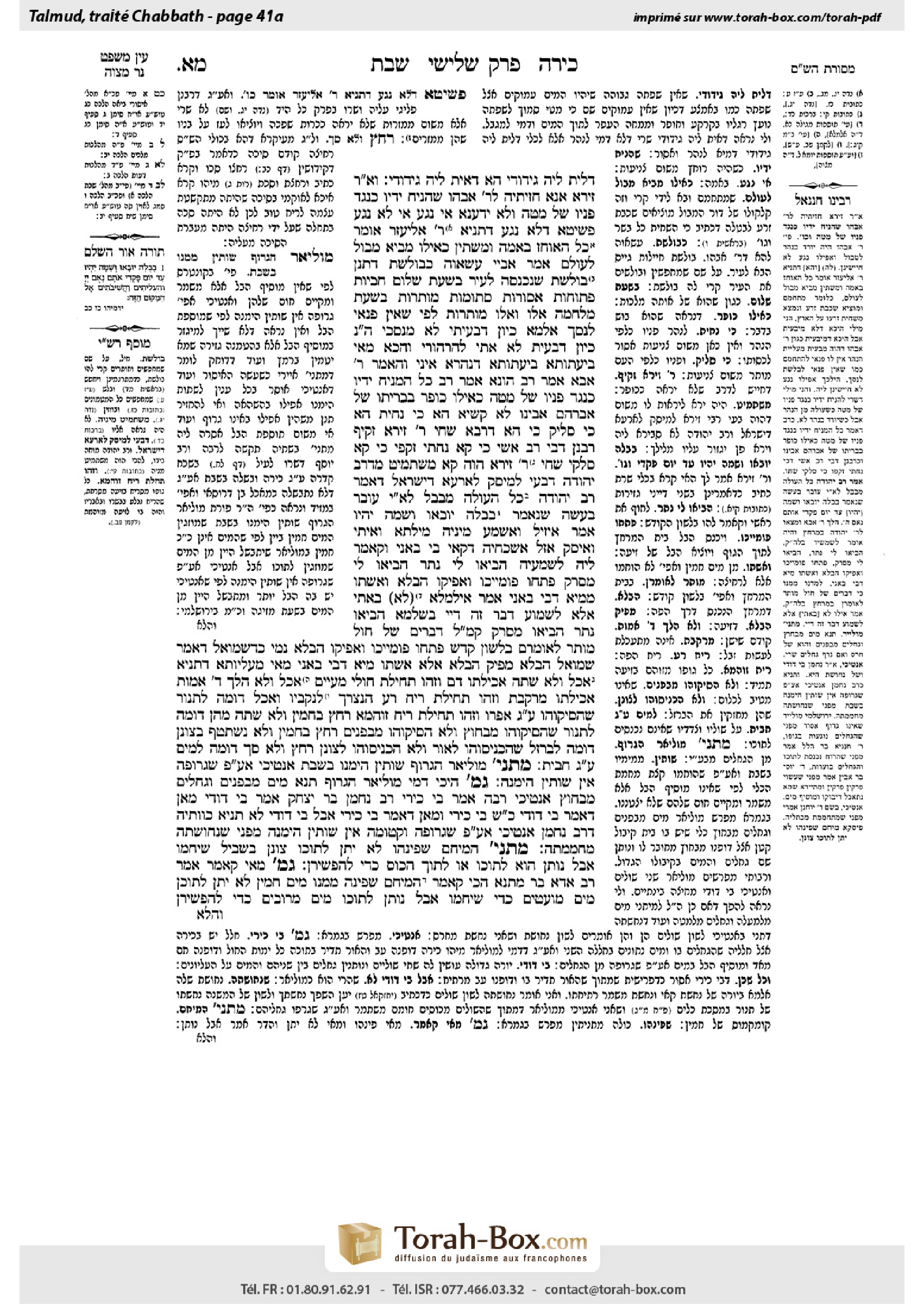
Shabbat 41a: Talmud study for Daf Yomi
Daf Yomi is the daily study of one Talmud folio. Explore 37 tractates with scans, Hebrew text, Sefaria English and AI-generated French translations where annotated.
Passage selection and English or AI-generated French translation are available where the scan has annotations. Daf Study is independent of Torah-Box and Sefaria.
Browse Shabbat · שבת · All tractatesShabbat 41a text and translations
This page of Shabbat includes the Aramaic text, an English translation and an AI-generated French translation, alongside the scan above.
שבת מ״א א · Aramaic and Hebrew text
דְּלֵית לֵיהּ גִּידּוּדֵי, הָא דְּאִית לֵיהּ גִּידּוּדֵי.
וְאָמַר רַבִּי זֵירָא: אֲנָא חֲזִיתֵיהּ לְרַבִּי אֲבָהוּ שֶׁהִנִּיחַ יָדָיו כְּנֶגֶד פָּנָיו שֶׁל מַטָּה, וְלָא יָדַעְנָא אִי נְגַע אִי לָא נְגַע. פְּשִׁיטָא דְּלָא נְגַע, דְּתַנְיָא רַבִּי אֱלִיעֶזֶר אוֹמֵר: כׇּל הָאוֹחֵז בָּאַמָּה וּמַשְׁתִּין — כְּאִילּוּ מֵבִיא מַבּוּל לָעוֹלָם.
אָמַר אַבָּיֵי: עֲשָׂאוּהָ כְּבוֹלֶשֶׁת. דִּתְנַן: בּוֹלֶשֶׁת שֶׁנִּכְנְסָה לָעִיר, בִּשְׁעַת שָׁלוֹם — חָבִיּוֹת פְּתוּחוֹת אֲסוּרוֹת, סְתוּמוֹת מוּתָּרוֹת. בִּשְׁעַת מִלְחָמָה — אֵלּוּ וְאֵלּוּ מוּתָּרוֹת, לְפִי שֶׁאֵין פְּנַאי לְנַסֵּךְ. אַלְמָא כֵּיוָן דִּבְעִיתִי לָא מְנַסְּכִי. הָכָא נָמֵי, כֵּיוָן דִּבְעִית לָא אָתֵי לְהַרְהוֹרֵי. הָכָא מַאי בִּיעֲתוּתָא? בִּיעֲתוּתָא דְנַהְרָא.
אִינִי?! וְהָאָמַר רַבִּי אַבָּא אָמַר רַב הוּנָא אָמַר רַב: כׇּל הַמַּנִּיחַ יָדָיו כְּנֶגֶד פָּנָיו שֶׁל מַטָּה כְּאִילּוּ כּוֹפֵר בִּבְרִיתוֹ שֶׁל אַבְרָהָם אָבִינוּ! לָא קַשְׁיָא: הָא כִּי נָחֵית, הָא כִּי סָלֵיק. כִּי הָא דְּרָבָא שָׁחֵי. רַבִּי זֵירָא זָקֵיף. רַבָּנַן דְּבֵי רַב אָשֵׁי, כִּי קָא נָחֲתִי — זָקְפִי, כִּי קָא סָלְקִי — שָׁחוּ.
רַבִּי זֵירָא הֲוָה קָא מִשְׁתְּמִיט מִדְּרַב יְהוּדָה, דְּבָעֵי לְמִיסַּק לְאַרְעָא דְיִשְׂרָאֵל. דְּאָמַר רַב יְהוּדָה: כׇּל הָעוֹלֶה מִבָּבֶל לְאֶרֶץ יִשְׂרָאֵל עוֹבֵר בַּעֲשֵׂה, שֶׁנֶּאֱמַר: ״בָּבֶלָה יוּבָאוּ וְשָׁמָּה יִהְיוּ״. אֲמַר: אֵיזִיל וְאֶשְׁמַע מִינֵּיהּ מִילְּתָא וְאֵיתֵי וְאֶיסַּק. אֲזַל, אַשְׁכְּחֵיהּ דְּקָאֵי בֵּי בָאנֵי וְקָאָמַר לֵיהּ לְשַׁמָּעֵיהּ: הָבִיאוּ לִי נֶתֶר, הָבִיאוּ לִי מַסְרֵק, פִּתְחוּ פּוּמַּיְיכוּ וְאַפִּיקוּ הַבְלָא, וְאִשְׁתוּ מִמַּיָּא דְּבֵי בָאנֵי. אֲמַר: אִילְמָלֵא לֹא בָּאתִי אֶלָּא לִשְׁמוֹעַ דָּבָר זֶה דַּיִּי.
בִּשְׁלָמָא ״הָבִיאוּ נֶתֶר, הָבִיאוּ מַסְרֵק״ — קָמַשְׁמַע לַן דְּבָרִים שֶׁל חוֹל מוּתָּר לְאוֹמְרָם בִּלְשׁוֹן קֹדֶשׁ. ״פִּתְחוּ פּוּמַּיְיכוּ וְאַפִּיקוּ הַבְלָא״ — נָמֵי כְּדִשְׁמוּאֵל, דְּאָמַר שְׁמוּאֵל: הַבְלָא מַפֵּיק הַבְלָא. אֶלָּא ״אִשְׁתוּ מַיָּא דְּבֵי בָאנֵי״ מַאי מְעַלְּיוּתָא? דְּתַנְיָא אָכַל וְלֹא שָׁתָה — אֲכִילָתוֹ דָּם, וְזֶהוּ תְּחִילַּת חוֹלִי מֵעַיִים. אָכַל וְלֹא הָלַךְ אַרְבַּע אַמּוֹת — אֲכִילָתוֹ מַרְקֶבֶת, וְזֶהוּ תְּחִילַּת רֵיחַ רַע. הַנִּצְרָךְ לִנְקָבָיו וְאָכַל — דּוֹמֶה לְתַנּוּר שֶׁהִסִּיקוּהוּ עַל גַּבֵּי אֶפְרוֹ, וְזֶהוּ תְּחִילַּת רֵיחַ זוּהֲמָא. רָחַץ בְּחַמִּין וְלֹא שָׁתָה מֵהֶן — דּוֹמֶה לְתַנּוּר שֶׁהִסִּיקוּהוּ מִבְּחוּץ וְלֹא הִסִּיקוּהוּ מִבִּפְנִים. רָחַץ בְּחַמִּין וְלֹא נִשְׁתַּטֵּף בְּצוֹנֵן — דּוֹמֶה לְבַרְזֶל שֶׁהִכְנִיסוּהוּ לָאוּר וְלֹא הִכְנִיסוּהוּ לְצוֹנֵן. רָחַץ וְלֹא סָךְ — דּוֹמֶה לְמַיִם עַל גַּבֵּי חָבִית.
מַתְנִי׳ מוּלְיָאר הַגָּרוּף שׁוֹתִין הֵימֶנּוּ בְּשַׁבָּת. אַנְטִיכֵי, אַף עַל פִּי שֶׁגְּרוּפָה אֵין שׁוֹתִין הֵימֶנָּה.
גְּמָ׳ הֵיכִי דָּמֵי מוּלְיָאר הַגָּרוּף? תָּנָא, מַיִם מִבִּפְנִים וְגֶחָלִים מִבְּחוּץ. אַנְטִיכֵי: רַבָּה אָמַר — בֵּי כִירֵי. רַב נַחְמָן בַּר יִצְחָק אָמַר — בֵּי דוּדֵי. מַאן דְּאָמַר בֵּי דוּדֵי כָּל שֶׁכֵּן בֵּי כִירֵי, וּמַאן דְּאָמַר בֵּי כִירֵי אֲבָל בֵּי דוּדֵי — לָא. תַּנְיָא כְּווֹתֵיהּ דְּרַב נַחְמָן: אַנְטִיכֵי אַף עַל פִּי שֶׁגְּרוּפָה וּקְטוּמָה אֵין שׁוֹתִין הֵימֶנָּה מִפְּנֵי שֶׁנְּחוּשְׁתָּהּ מְחַמַּמְתָּהּ.
מַתְנִי׳ הַמֵּיחַם שֶׁפִּינָּהוּ לֹא יִתֵּן לְתוֹכוֹ צוֹנֵן בִּשְׁבִיל שֶׁיֵּחַמּוּ. אֲבָל נוֹתֵן הוּא לְתוֹכוֹ אוֹ לְתוֹךְ הַכּוֹס כְּדֵי לְהַפְשִׁירָן.
גְּמָ׳ מַאי קָאָמַר? אָמַר רַב אַדָּא בַּר מַתְנָא, הָכִי קָאָמַר: הַמֵּיחַם שֶׁפִּינָּה מִמֶּנּוּ מַיִם חַמִּין לֹא יִתֵּן לְתוֹכָן מַיִם מוּעָטִים כְּדֵי שֶׁיֵּחַמּוּ, אֲבָל נוֹתֵן לְתוֹכוֹ מַיִם מְרוּבִּים כְּדֵי לְהַפְשִׁירָן.
Shabbat 41a · English translation
that does not have embankments surrounding it. Since there are no partitions, it appears like an ocean or a river. That incident involving Rabbi Abbahu occurred in a place that has embankments and looks like a vessel. Therefore, the Sages did not prohibit it.
After citing what Rabbi Zeira related with regard to Rabbi Abbahu, the Gemara cites that Rabbi Zeira said: I saw that Rabbi Abbahu, while he was bathing, placed his hands over his genitals for the sake of modesty, and I do not know whether he touched them or did not touch them. The Gemara questions Rabbi Zeira’s uncertainty. It is obvious that he did not touch his genitals, as it was taught in a baraita: Rabbi Eliezer says: One who holds his penis and urinates it is as if he were bringing a flood to the world. He is liable to become aroused by that contact and that is an extremely severe transgression, comparable to the transgressions violated in the generation of the flood.
Abaye said: Nevertheless, no proof can be cited from that baraita. Perhaps the Sages rendered the legal status of this situation like that of a military unit, as we learned in a mishna: A military unit that entered a city, if it entered during peacetime, after the soldiers leave, the open barrels of wine are prohibited and the wine in them may not be drunk due to suspicion that the gentile soldiers may have poured this wine as a libation for idolatry. The sealed barrels are permitted. However, if the unit entered in wartime, both are permitted because in wartime there is no respite to pour wine for idolatry, and one can be certain that the soldiers did not do so. Apparently, since they are afraid, they do not pour libations. Here too, in the case of bathing, since he is afraid, he will not come to have impure thoughts. The Gemara asks: And what fear is there here that would prevent one bathing from having impure thoughts? The Gemara answers: Fear of the river. Since he needs to be careful that the water does not wash him away, he is too distracted to think of other matters.
The Gemara questions the story itself: And is that so? Is it permitted under any circumstances to cover one’s genitals while bathing? Didn’t Rabbi Abba say that Rav Huna said that Rav said: Anyone who places his hands over his genitals is as if he denies the covenant of our father Abraham? It appears as if he is covering himself to obscure the fact that he is circumcised. The Gemara answers: This is not difficult, as there is room to distinguish and say that this, the case where it is prohibited to cover oneself, is when he is descending into the river and there are no people facing him and he need not be concerned with modesty. In that case covering oneself is prohibited as he appears to be renouncing the covenant of Abraham. That, the case where, in certain circumstances, this prohibition does not apply, is when he is emerging from the river. When he emerges, he is facing the people on the riverbank and it is then permitted to cover himself in the interest of modesty, as that which Rava would do. He would bend over when he was naked. Rabbi Zeira would stand upright, in accordance with Rav’s statement that it is prohibited to appear to be renouncing the covenant of Abraham. When the Sages of the school of Rav Ashi descended into the river they stood upright. When they emerged from the river they bent over.
Speaking of bathing and its halakhot, the Gemara relates: Rabbi Zeira was avoiding being seen by his teacher, Rav Yehuda, as Rabbi Zeira sought to ascend to Eretz Yisrael and his teacher disapproved. As Rav Yehuda said: Anyone who ascends from Babylonia to Eretz Yisrael transgresses a positive commandment, as it is stated: “They shall be taken to Babylonia and there they shall remain until the day that I recall them, said the Lord” (Jeremiah 27:22). Based on that verse, Rav Yehuda held that since the Babylonian exile was by divine decree, permission to leave Babylonia for Eretz Yisrael could only be granted by God. Rabbi Zeira did not want to discuss his desire to emigrate with Rav Yehuda, so that he would not be forced to explicitly disobey him. Nevertheless, he said: I will go and hear something from him and then I will leave. He went and found Rav Yehuda standing in the bathhouse and telling his servant: Bring me natron [neter] with which to wash, bring me a comb, open your mouths and let out air, and drink from the water of the bathhouse. Rabbi Zeira said: If I had come only to hear this matter from Rav Yehuda, it would suffice for me.
The Gemara analyzes the lessons learned from this story. Granted, when Rav Yehuda said: Bring me natron, bring me a comb, he was teaching us that mundane matters are permitted to be spoken in the bathhouse, even in the sacred language. When he said: Open your mouths and let out air, that too is in accordance with that which Shmuel said, as Shmuel said: Heat produces heat. The hot air that one inhales causes him to sweat more quickly. However, drink the water of the bathhouse, what benefit is there in doing that? The Gemara answers: As it was taught in a baraita: One who ate and did not drink at all, what he ate becomes blood and that causes the onset of intestinal disease. One who ate and did not walk four cubits after eating, what he ate rots and that causes the onset of bad breath. One who needs to defecate and ate is similar to an oven that was lit on top of its ashes. When ashes from a previous fire are not swept out, and new logs are placed on top of the old ones, it inhibits the burning and dirties the oven, and that causes the onset of odor of the filth of perspiration in a person. As far as our matter is concerned, the baraita teaches: One who bathed in hot water and did not drink from it is like an oven that was lit from the outside and not lit from the inside. The lighting is ineffective and the oven does not heat properly. Rav Yehuda told his servants to drink the hot water while bathing so that they would be heated from the inside and the outside. The baraita continues: One who bathed in hot water and did not rinse afterward with cold water is like iron that was placed in the fire and not placed afterward in cold water, which leaves the iron soft. And one who bathed and did not smear himself with oil afterward is like water that was poured on top of a barrel, and not into it. The water spills outside the barrel.
MISHNA: In this mishna, the Sages discuss two vessels used for heating water. With regard to a mulyar, a bronze vessel into which coals are placed in an outer compartment and water is placed into an adjacent inner compartment, whose coals were swept, one may drink from it on Shabbat. With regard to an antikhi, which is a vessel with a different configuration, even if its coals were swept, one may not drink from it on Shabbat.
GEMARA: The Gemara asks: What are the circumstances of a swept mulyar? The Gemara answers: A mulyar is the vessel, explained in the Tosefta on our mishna, that has water on the inside and coals on the outside. With regard to the identity of an antikhi there are different opinions. Rabba said that it refers to a stove. A space is created in the wall of a stove and filled with water. Since the stove is very hot, it is prohibited to use this water. Rav Naḥman bar Yitzhak said: An antikhi is a cauldron, i.e., a vessel made from two cauldrons stacked one on top of the other with coals in the bottom one and water in the upper one. These two different opinions have halakhic implications. The one who says that it is prohibited to use a vessel composed of two cauldrons, all the more so it is prohibited to use the space inside of a stove. And the one who says that it is prohibited to use the space inside a stove, a vessel composed of two cauldrons, no, it is not prohibited. It was taught in a baraita in accordance with the opinion of Rav Naḥman: An antikhi, even if it was swept and covered with ashes, one may not drink from it on Shabbat because its copper heats it. The heating in an antikhi is by means of the coals beneath the water.
MISHNA: The Sages added to the laws of leaving food on a source of heat and cooking food on Shabbat: An urn that was emptied of its hot water on Shabbat, one may not place cold water into it so that the cold water will be heated. However, one may place cold water into an urn or into a cup that were emptied of their hot water in order to warm it but not in order to heat it.
GEMARA: The mishna seems to contradict itself. The first statement completely prohibits placing water into an urn, and later it was partially permitted. The Gemara asks: What is the mishna saying? Rav Adda bar Mattana said that it said the following: An urn that was emptied of its hot water, one may not put a small amount of water into it so that it will become very hot. However, one may put a large quantity of water into it in order to warm it. A large quantity of cold water will not be heated in those circumstances.
Shabbat 41a · Traduction française (IA)
qui n’est pas entourée de digues. En l’absence de séparations, elle ressemble à un océan ou à un fleuve. L’incident concernant Rabbi Abbahu s’est produit en un lieu entouré de digues, qui ressemble à un récipient. C’est pourquoi les Sages ne l’ont pas interdit.
Après avoir rapporté ce que Rabbi Zeira avait raconté au sujet de Rabbi Abbahu, la Guemara cite ces propos de Rabbi Zeira : « J’ai vu Rabbi Abbahu, alors qu’il se baignait, placer ses mains sur ses organes génitaux par souci de pudeur, et je ne sais pas s’il les a touchés ou non. » La Guemara s’interroge sur l’incertitude de Rabbi Zeira. Il est évident qu’il n’a pas touché ses organes génitaux, car il a été enseigné dans une baraïta : Rabbi Eliezer dit : « Celui qui tient son pénis lorsqu’il urine, c’est comme s’il faisait venir un déluge sur le monde. » Ce contact risque de l’exciter, et c’est une transgression extrêmement grave, comparable aux transgressions commises par la génération du déluge.
Abayé dit : « Néanmoins, on ne peut tirer aucune preuve de cette baraïta. Peut-être les Sages ont-ils assimilé juridiquement cette situation à celle d’une troupe militaire, comme nous l’avons appris dans une Michna : Une troupe militaire entre dans une ville. Si elle y entre en temps de paix, après le départ des soldats, les tonneaux de vin ouverts sont interdits, et le vin qu’ils contiennent ne peut être bu, car on soupçonne que les soldats non juifs en ont fait une libation idolâtre. Les tonneaux scellés sont permis. En revanche, si la troupe est entrée en temps de guerre, les deux sont permis, car, en temps de guerre, les soldats n’ont pas de répit pour faire des libations idolâtres, et l’on peut être certain qu’ils ne l’ont pas fait. Apparemment, parce qu’ils ont peur, ils ne font pas de libations. Ici aussi, dans le cas du bain, parce qu’il a peur, il n’aura pas de pensées impures. » La Guemara demande : « De quoi aurait-il peur ici, ce qui l’empêcherait d’avoir des pensées impures pendant qu’il se baigne ? » La Guemara répond : « Du fleuve. Comme il doit prendre garde à ne pas être emporté par le courant, il est trop préoccupé pour penser à autre chose. »
La Guemara met en question le récit lui-même : « Est-ce vraiment le cas ? Est-il permis, dans quelque circonstance que ce soit, de couvrir ses organes génitaux pendant qu’on se baigne ? Rabbi Abba n’a-t-il pas dit au nom de Rav Houna, au nom de Rav : “Quiconque place ses mains sur ses organes génitaux, c’est comme s’il reniait l’alliance de notre père Abraham” ? Cela donne l’impression qu’il se couvre pour dissimuler qu’il est circoncis. » La Guemara répond : « Il n’y a pas de difficulté, car on peut distinguer les cas et dire que le cas où cela est interdit, c’est lorsqu’il descend dans le fleuve et que personne ne lui fait face ; il n’a alors pas à se soucier de sa pudeur. Dans ce cas, se couvrir est interdit, car cela donne l’impression qu’il renie l’alliance d’Abraham. Le cas où, dans certaines circonstances, cette interdiction ne s’applique pas, c’est lorsqu’il sort du fleuve. En sortant, il fait face aux personnes qui se trouvent sur la berge, et il lui est alors permis de se couvrir par souci de pudeur, comme le faisait Rava : lorsqu’il était nu, il se penchait. Rabbi Zeira, lui, se tenait droit, conformément aux propos de Rav, selon lesquels il est interdit de donner l’impression que l’on renie l’alliance d’Abraham. Lorsque les Sages de l’école de Rav Ashi descendaient dans le fleuve, ils se tenaient droits ; lorsqu’ils en sortaient, ils se penchaient. »
À propos du bain et de ses halakhot, la Guemara rapporte : Rabbi Zeira évitait que son maître, Rav Yehouda, le voie, car il cherchait à monter en terre d’Israël et son maître désapprouvait ce projet. Rav Yehouda disait en effet : « Quiconque monte de Babylonie en terre d’Israël transgresse un commandement positif, comme il est dit : “Ils seront emmenés à Babylone et ils y resteront jusqu’au jour où je m’occuperai d’eux, dit l’Éternel” » (Jérémie 27, 22). Sur la base de ce verset, Rav Yehouda estimait que, puisque l’exil de Babylonie avait été décrété par Dieu, seul Dieu pouvait autoriser à quitter la Babylonie pour la terre d’Israël. Rabbi Zeira ne voulait pas parler à Rav Yehouda de son désir d’émigrer, afin de ne pas être contraint de lui désobéir ouvertement. Néanmoins, il se dit : « Je vais aller entendre quelque chose de sa bouche, puis je partirai. » Il y alla et trouva Rav Yehouda debout dans les bains, en train de dire à son serviteur : « Apporte-moi du natron [neter] pour me laver, apporte-moi un peigne, ouvrez la bouche et soufflez, et buvez de l’eau des bains. » Rabbi Zeira dit : « Si je n’étais venu que pour entendre cela de Rav Yehouda, cela m’aurait suffi. »
La Guemara analyse les enseignements que l’on tire de ce récit. Il est compréhensible que, lorsque Rav Yehouda a dit : « Apporte-moi du natron, apporte-moi un peigne », il nous enseignait qu’il est permis de parler de choses profanes dans les bains, même dans la langue sacrée. Lorsqu’il a dit : « Ouvrez la bouche et soufflez », cela aussi est conforme à ce que Shmouel a dit, car Shmouel a dit : « La chaleur produit de la chaleur. » L’air chaud que l’on inspire fait transpirer plus rapidement. Mais quel avantage y a-t-il à dire : « Buvez de l’eau des bains » ? La Guemara répond : Comme il a été enseigné dans une baraïta : « Celui qui a mangé sans rien boire du tout transforme ce qu’il a mangé en sang, ce qui provoque l’apparition d’une maladie intestinale. Celui qui a mangé sans marcher quatre coudées après le repas voit ce qu’il a mangé pourrir, ce qui provoque l’apparition de la mauvaise haleine. Celui qui a besoin d’aller à la selle et qui mange ressemble à un four allumé sur ses cendres. Lorsque les cendres d’un feu précédent ne sont pas retirées et que de nouvelles bûches sont placées sur les anciennes, la combustion est entravée et le four se salit ; chez l’être humain, cela provoque l’apparition de l’odeur nauséabonde de la transpiration. » Pour ce qui nous concerne, la baraïta enseigne : « Celui qui s’est baigné dans de l’eau chaude sans en boire ressemble à un four allumé de l’extérieur, mais pas de l’intérieur. L’allumage est inefficace et le four ne chauffe pas correctement. » Rav Yehouda disait à ses serviteurs de boire l’eau chaude pendant qu’ils se baignaient, afin d’être chauffés de l’intérieur comme de l’extérieur. La baraïta poursuit : « Celui qui s’est baigné dans de l’eau chaude sans se rincer ensuite à l’eau froide ressemble à du fer mis au feu puis non plongé dans l’eau froide, ce qui laisse le fer mou. Et celui qui s’est baigné sans s’enduire ensuite d’huile ressemble à de l’eau versée sur un tonneau, et non dedans : l’eau coule à l’extérieur du tonneau. »
MICHNA : Dans cette Michna, les Sages examinent deux récipients utilisés pour chauffer de l’eau. Concernant un mulyar, récipient de bronze dont le compartiment extérieur contient des braises et le compartiment intérieur adjacent de l’eau, si les braises en ont été balayées, on peut y boire pendant Shabbat. Concernant un antikhi, récipient d’une configuration différente, même si les braises en ont été balayées, on ne peut pas y boire pendant Shabbat.
GUEMARA : La Guemara demande : « Dans quelles circonstances parle-t-on d’un mulyar dont les braises ont été balayées ? » La Guemara répond : « Un mulyar est le récipient décrit dans la Tossefta sur notre Michna, qui contient de l’eau à l’intérieur et des braises à l’extérieur. » L’identité d’un antikhi fait l’objet de diverses opinions. Rabba dit qu’il s’agit d’un fourneau. Une cavité est aménagée dans la paroi du fourneau et remplie d’eau. Comme le fourneau est très chaud, il est interdit d’utiliser cette eau. Rav Naḥman bar Yitzḥak dit : « Un antikhi est un chaudron, c’est-à-dire un récipient constitué de deux chaudrons empilés l’un sur l’autre, avec des braises dans celui du bas et de l’eau dans celui du haut. » Ces deux opinions divergentes ont des conséquences halakhiques. Celui qui dit qu’il est interdit d’utiliser un récipient composé de deux chaudrons interdit, à plus forte raison, d’utiliser la cavité à l’intérieur d’un fourneau. Mais celui qui dit qu’il est interdit d’utiliser la cavité à l’intérieur d’un fourneau n’interdit pas pour autant un récipient composé de deux chaudrons. Une baraïta a été enseignée conformément à l’opinion de Rav Naḥman : « Un antikhi, même si ses braises ont été balayées et qu’il a été couvert de cendres, on ne peut pas y boire pendant Shabbat, car son cuivre le chauffe. » Dans un antikhi, l’eau est chauffée par les braises qui se trouvent sous elle.
MICHNA : Les Sages ont ajouté des règles aux lois concernant le fait de laisser de la nourriture sur une source de chaleur et de cuire pendant Shabbat : après avoir vidé une urne de son eau chaude pendant Shabbat, on ne peut pas y mettre de l’eau froide afin de la chauffer. En revanche, on peut mettre de l’eau froide dans une urne ou dans un gobelet dont on a vidé l’eau chaude, afin de la réchauffer, mais non de la chauffer.
GUEMARA : La Michna semble se contredire. La première affirmation interdit complètement de mettre de l’eau dans une urne, tandis que la suite l’autorise partiellement. La Guemara demande : « Que dit la Michna ? » Rav Adda bar Mattana dit qu’elle signifie ceci : après avoir vidé une urne de son eau chaude, on ne peut pas y mettre une petite quantité d’eau pour qu’elle devienne très chaude. En revanche, on peut y mettre une grande quantité d’eau afin de la réchauffer. Dans ces circonstances, une grande quantité d’eau froide ne sera pas chauffée.
Traduction française générée par IA à partir de l’édition anglaise de Sefaria. Vérifie toujours un passage avec le texte source.
Text from Sefaria: William Davidson Edition - Vocalized Aramaic (CC BY NC); William Davidson Edition - English (CC BY NC).