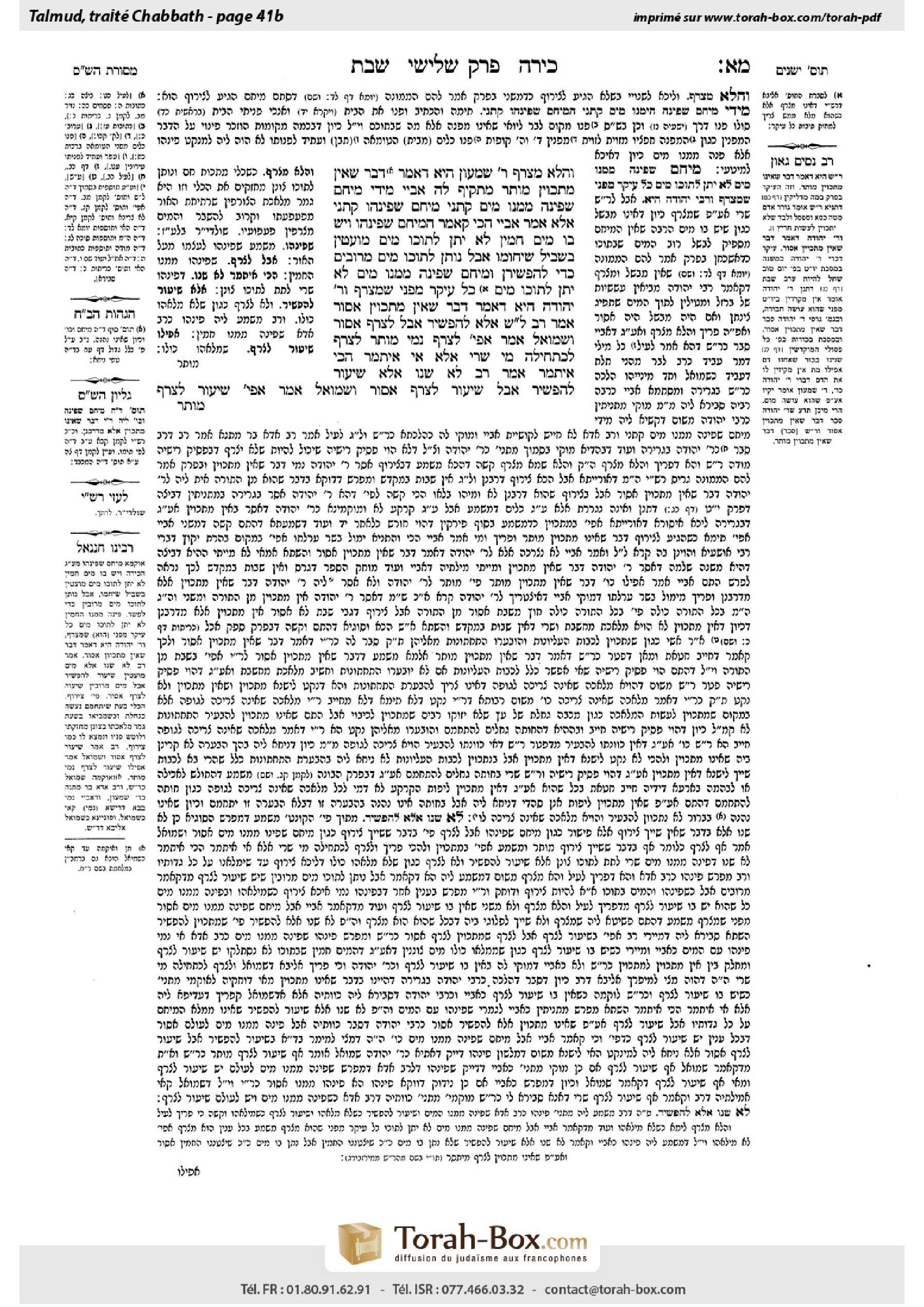
Shabbat 41b: Talmud study for Daf Yomi
Daf Yomi is the daily study of one Talmud folio. Explore 37 tractates with scans, Hebrew text, Sefaria English and AI-generated French translations where annotated.
Passage selection and English or AI-generated French translation are available where the scan has annotations. Daf Study is independent of Torah-Box and Sefaria.
Browse Shabbat · שבת · All tractatesShabbat 41b text and translations
This page of Shabbat includes the Aramaic text, an English translation and an AI-generated French translation, alongside the scan above.
שבת מ״א ב · Aramaic and Hebrew text
וַהֲלֹא מְצָרֵף? רַבִּי שִׁמְעוֹן הִיא, דְּאָמַר: דָּבָר שֶׁאֵין מִתְכַּוֵּין — מוּתָּר. מַתְקִיף לַהּ אַבָּיֵי: מִידֵּי מֵיחַם שֶׁפִּינָּה מִמֶּנּוּ מַיִם קָתָנֵי?! מֵיחַם שֶׁפִּינָּהוּ קָתָנֵי!
אֶלָּא אָמַר אַבָּיֵי, הָכִי קָאָמַר: הַמֵּיחַם שֶׁפִּינָּהוּ וְיֵשׁ בּוֹ מַיִם חַמִּין — לֹא יִתֵּן לְתוֹכוֹ מַיִם מוּעָטִין בִּשְׁבִיל שֶׁיָּחוֹמּוּ, אֲבָל נוֹתֵן לְתוֹכוֹ מַיִם מְרוּבִּים כְּדֵי לְהַפְשִׁירָן. וּמֵיחַם שֶׁפִּינָּה מִמֶּנּוּ מַיִם — לֹא יִתֵּן לְתוֹכוֹ מַיִם כׇּל עִיקָּר, מִפְּנֵי שֶׁמְּצָרֵף. וְרַבִּי יְהוּדָה הִיא, דְּאָמַר דָּבָר שֶׁאֵין מִתְכַּוֵּין אָסוּר.
אָמַר רַב: לֹא שָׁנוּ אֶלָּא לְהַפְשִׁיר, אֲבָל לְצָרֵף — אָסוּר. וּשְׁמוּאֵל אָמַר: אֲפִילּוּ לְצָרֵף נָמֵי מוּתָּר. לְצָרֵף לְכַתְּחִילָּה מִי שְׁרֵי?! אֶלָּא אִי אִיתְּמַר הָכִי אִיתְּמַר: אָמַר רַב לֹא שָׁנוּ אֶלָּא שִׁיעוּר לְהַפְשִׁיר, אֲבָל שִׁיעוּר לְצָרֵף — אָסוּר. וּשְׁמוּאֵל אָמַר: אֲפִילּוּ שִׁיעוּר לְצָרֵף —
Shabbat 41b · English translation
The Gemara questions this leniency: By putting cold water into the urn, doesn’t it harden the vessel? Cold water poured into a heated metal vessel reinforces the vessel. It is one of the stages in the labor of a blacksmith. How is it permitted to do something similar on Shabbat? The Gemara answers: This mishna is in accordance with the opinion of Rabbi Shimon, who stated a principle with regard to the laws of Shabbat: An unintentional act, i.e., a permitted action from which a prohibited labor inadvertently ensues, is permitted. Here too, his intention was to warm the water, not to reinforce the vessel. Abaye strongly objects to this explanation: Does it say in the mishna: An urn from which water was emptied? That would indicate that he sought to fill the vessel with other water and warm up that water. Rather, an urn that was removed was taught in the mishna, meaning that the urn was removed from the fire, not that the water was emptied from it.
Rather, Abaye said this is what the mishna is saying: An urn that was removed from the fire and contains hot water, one may not place a small quantity of water in it so that the water will become hot; rather, one may place a large quantity of water in it so that the water will become warm. And with regard to an urn from which water was removed; one may not place any water into it because he hardens the vessel by placing cold water into a hot vessel. And, according to this explanation, our mishna is in accordance with the opinion of Rabbi Yehuda, who said that an unintentional act from which a prohibited labor inadvertently ensues is prohibited on Shabbat.
With regard to the matter itself, Rav said: They taught that one is permitted to place cold water into an urn with hot water after it was removed from the fire, when his intention is only to warm the cold water. However, if he did this in order to harden the vessel, it is prohibited. And Shmuel said: Even if he does so in order to harden the vessel, it is also permitted. The Gemara wonders: Is hardening permitted ab initio? Isn’t it a full-fledged prohibited labor on Shabbat? Rather, if the dispute between Rav and Shmuel was stated, it was stated as follows. Rav said: They taught that it is permitted to add water only in a measure that is sufficient to warm the water, i.e., to only partially fill the vessel. However, filling it completely with a measure sufficient to harden the vessel is prohibited. And Shmuel said: Even a measure sufficient to harden the vessel
Shabbat 41b · Traduction française (IA)
La Guemara met en question cette indulgence : En versant de l’eau froide dans l’urne, ne durcit-on pas le récipient ? De l’eau froide versée dans un récipient métallique chauffé le durcit. C’est l’une des étapes du travail du forgeron. Comment peut-on faire quelque chose de semblable le Chabbat ? La Guemara répond : Cette Michna est conforme à l’opinion de Rabbi Chimon, qui a énoncé un principe concernant les lois du Chabbat : un acte involontaire, c’est-à-dire une action permise dont découle fortuitement un travail interdit, est permis. Ici aussi, son intention était de réchauffer l’eau, et non de durcir le récipient. Abayé objecte vigoureusement à cette explication : La Michna dit-elle : « une urne dont on a vidé l’eau » ? Cela indiquerait qu’il cherchait à remplir le récipient avec une autre eau et à la réchauffer. Or, la Michna enseigne : « une urne qu’on a retirée », ce qui signifie que l’urne a été retirée du feu, et non que l’eau en a été vidée.
Abayé dit plutôt que voici ce qu’enseigne la Michna : pour une urne retirée du feu qui contient de l’eau chaude, on ne peut pas y verser une petite quantité d’eau afin qu’elle chauffe ; en revanche, on peut y verser une grande quantité d’eau afin qu’elle devienne tiède. Quant à une urne dont on a retiré l’eau, on ne peut y verser aucune eau, car on durcit le récipient en y versant de l’eau froide alors qu’il est chaud. Selon cette explication, notre Michna est conforme à l’opinion de Rabbi Yehouda, qui a dit qu’un acte involontaire dont découle fortuitement un travail interdit est interdit le Chabbat.
À propos de cette question, Rav a dit : Ils ont enseigné qu’il est permis de verser de l’eau froide dans une urne contenant de l’eau chaude après que celle-ci a été retirée du feu, lorsque l’intention est seulement de réchauffer l’eau froide. Toutefois, si on le fait pour durcir le récipient, c’est interdit. Et Chmouel a dit : Même si on le fait pour durcir le récipient, c’est également permis. La Guemara s’étonne : Est-il permis de durcir le récipient a priori ? N’est-ce pas un travail interdit à part entière le Chabbat ? Si une controverse entre Rav et Chmouel a été rapportée, elle l’a donc été sous la forme suivante. Rav a dit : Ils ont enseigné qu’il est permis d’ajouter de l’eau seulement en quantité suffisante pour réchauffer l’eau, c’est-à-dire en ne remplissant le récipient qu’en partie. Toutefois, le remplir entièrement, avec une quantité suffisante pour durcir le récipient, est interdit. Et Chmouel a dit : Même une quantité suffisante pour durcir le récipient
Traduction française générée par IA à partir de l’édition anglaise de Sefaria. Vérifie toujours un passage avec le texte source.
Text from Sefaria: William Davidson Edition - Vocalized Aramaic (CC BY NC); William Davidson Edition - English (CC BY NC).