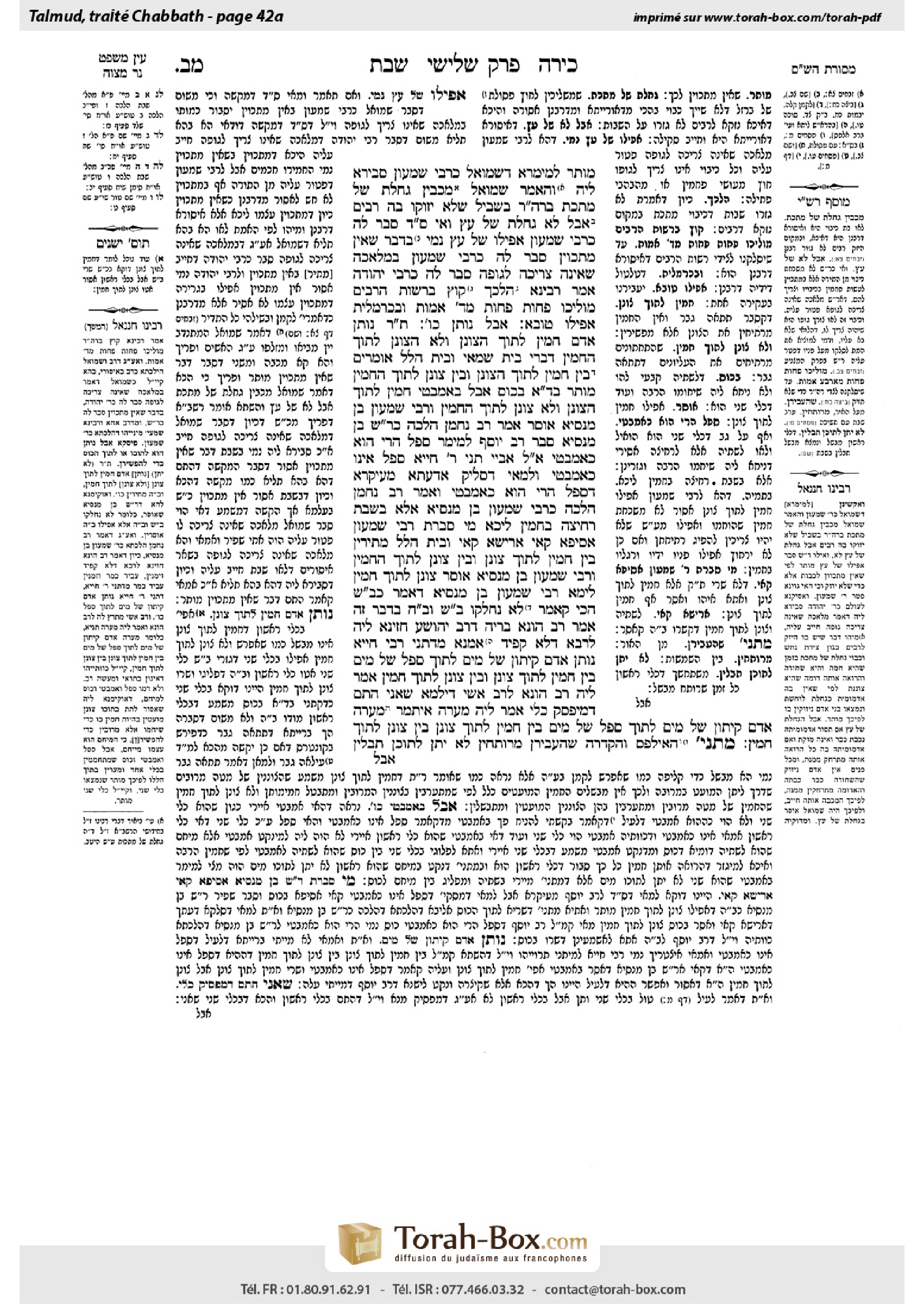
Shabbat 42a: Talmud study for Daf Yomi
Daf Yomi is the daily study of one Talmud folio. Explore 37 tractates with scans, Hebrew text, Sefaria English and AI-generated French translations where annotated.
Passage selection and English or AI-generated French translation are available where the scan has annotations. Daf Study is independent of Torah-Box and Sefaria.
Browse Shabbat · שבת · All tractatesShabbat 42a text and translations
This page of Shabbat includes the Aramaic text, an English translation and an AI-generated French translation, alongside the scan above.
שבת מ״ב א · Aramaic and Hebrew text
מוּתָּר.
לְמֵימְרָא דִּשְׁמוּאֵל כְּרַבִּי שִׁמְעוֹן סְבִירָא לֵיהּ? וְהָאָמַר שְׁמוּאֵל: מְכַבִּין גַּחֶלֶת שֶׁל מַתֶּכֶת בִּרְשׁוּת הָרַבִּים בִּשְׁבִיל שֶׁלֹּא יִזּוֹקוּ בָּהּ רַבִּים, אֲבָל לֹא גַּחֶלֶת שֶׁל עֵץ. וְאִי סָלְקָא דַעְתָּךְ סָבַר לַהּ כְּרַבִּי שִׁמְעוֹן — אֲפִילּוּ שֶׁל עֵץ נָמֵי!
בְּדָבָר שֶׁאֵין מִתְכַּוֵּין סָבַר לַהּ כְּרַבִּי שִׁמְעוֹן, בִּמְלָאכָה שֶׁאֵינָהּ צְרִיכָה לְגוּפָהּ סָבַר לַהּ כְּרַבִּי יְהוּדָה. אָמַר רָבִינָא: הִלְכָּךְ קוֹץ בִּרְשׁוּת הָרַבִּים מוֹלִיכוֹ פָּחוֹת פָּחוֹת מֵאַרְבַּע אַמּוֹת, וּבְכַרְמְלִית אֲפִילּוּ טוּבָא.
אֲבָל נוֹתֵן כּוּ׳. תָּנוּ רַבָּנַן: נוֹתֵן אָדָם חַמִּין לְתוֹךְ הַצּוֹנֵן, וְלֹא הַצּוֹנֵן לְתוֹךְ הַחַמִּין, דִּבְרֵי בֵּית שַׁמַּאי. וּבֵית הִלֵּל אוֹמְרִים: בֵּין חַמִּין לְתוֹךְ הַצּוֹנֵן וּבֵין צוֹנֵן לְתוֹךְ הַחַמִּין מוּתָּר. בַּמֶּה דְּבָרִים אֲמוּרִים — בְּכוֹס, אֲבָל בְּאַמְבָּטִי — חַמִּין לְתוֹךְ הַצּוֹנֵן, וְלֹא צוֹנֵן לְתוֹךְ הַחַמִּין. וְרַבִּי שִׁמְעוֹן בֶּן מְנַסְיָא אוֹסֵר. אָמַר רַב נַחְמָן: הֲלָכָה כְּרַבִּי שִׁמְעוֹן בֶּן מְנַסְיָא.
סָבַר רַב יוֹסֵף לְמֵימַר סֵפֶל הֲרֵי הוּא כְּאַמְבָּטִי. אָמַר לֵיהּ אַבָּיֵי, תָּנֵי רַבִּי חִיָּיא: סֵפֶל אֵינוֹ כְּאַמְבָּטִי. וּלְמַאי דִּסְלֵיק אַדַּעְתָּא מֵעִיקָּרָא דְּסֵפֶל הֲרֵי הוּא כְּאַמְבָּטִי, וְאָמַר רַב נַחְמָן הֲלָכָה כְּרַבִּי שִׁמְעוֹן בֶּן מְנַסְיָא, אֶלָּא בְּשַׁבָּת רְחִיצָה בְּחַמִּין לֵיכָּא!
מִי סָבְרַתְּ רַבִּי שִׁמְעוֹן אַסֵּיפָא קָאֵי? אַרֵישָׁא קָאֵי: וּבֵית הִלֵּל מַתִּירִין בֵּין חַמִּין לְתוֹךְ צוֹנֵן וּבֵין צוֹנֵן לְתוֹךְ הַחַמִּין, וְרַבִּי שִׁמְעוֹן בֶּן מְנַסְיָא אוֹסֵר צוֹנֵן לְתוֹךְ חַמִּין. לֵימָא רַבִּי שִׁמְעוֹן בֶּן מְנַסְיָא דְּאָמַר כְּבֵית שַׁמַּאי? — הָכִי קָאָמַר: לֹא נֶחְלְקוּ בֵּית שַׁמַּאי וּבֵית הִלֵּל בְּדָבָר זֶה.
אָמַר רַב הוּנָא בְּרֵיהּ דְּרַב יְהוֹשֻׁעַ: חֲזֵינָא לֵיהּ לְרָבָא דְּלָא קָפֵיד אַמָּנָא — מִדְּתָנֵי רַבִּי חִיָּיא: נוֹתֵן אָדָם קִיתוֹן שֶׁל מַיִם לְתוֹךְ סֵפֶל שֶׁל מַיִם, בֵּין חַמִּין לְתוֹךְ צוֹנֵן וּבֵין צוֹנֵן לְתוֹךְ חַמִּין. אֲמַר לֵיהּ רַב הוּנָא לְרַב אָשֵׁי: דִּילְמָא שָׁאנֵי הָתָם דְּמַפְסֵיק כְּלִי! אָמַר לֵיהּ — ״מְעָרֶה״ אִיתְּמַר: מְעָרֶה אָדָם קִיתוֹן שֶׁל מַיִם לְתוֹךְ סֵפֶל שֶׁל מַיִם, בֵּין חַמִּין לְתוֹךְ צוֹנֵן, בֵּין צוֹנֵן לְתוֹךְ חַמִּין.
מַתְנִי׳ הָאִילְפָּס וְהַקְּדֵרָה שֶׁהֶעֱבִירָן מְרוּתָּחִין — לֹא יִתֵּן לְתוֹכָן תַּבְלִין.
Shabbat 42a · English translation
is permitted, since one did not intend to perform that prohibited labor.
The Gemara asks: Is that to say that Shmuel, who permits adding water even in an amount sufficient to harden a vessel, holds in accordance with the opinion of Rabbi Shimon, who says that one may perform an action that inadvertently results in a prohibited labor? Didn’t Shmuel say: One may extinguish a piece of white-hot metal in a public area on Shabbat so that the masses will not be injured? That is because the piece of white-hot metal is not actual fire and extinguishing it is prohibited by rabbinic decree, not Torah law. The Sages did not issue decrees in situations where there is concern for public safety. However, one may not extinguish a red-hot wood coal because extinguishing it is prohibited by Torah law. And if it would enter your mind that Shmuel holds in accordance with the opinion of Rabbi Shimon, it should even be permitted to extinguish wood as well. When one extinguishes the coal, he intends neither to perform a prohibited labor nor to derive any benefit. He merely intends to prevent the coal from causing injury. Extinguishing the coal is a labor not necessary for its own sake. Rabbi Shimon says that one who performs a labor not necessary for its own sake is exempt.
The Gemara responds: In the case of an unintentional act, Shmuel holds in accordance with the opinion of Rabbi Shimon. In the case of labor not necessary for its own sake, he holds that he is liable, in accordance with the opinion of Rabbi Yehuda. Ravina said: Therefore, a thorn in the public domain that is liable to cause injury, one may move it from there in increments, each less than four cubits, on Shabbat. Although the Torah prohibits carrying an object four cubits in the public domain on Shabbat, carrying less than four cubits is prohibited only by rabbinic law. From Shmuel’s statement, it is clear that the Sages did not issue a decree in any case where there is a threat to the masses. And, therefore, if the thorn was in a karmelit, where the prohibition to carry is by rabbinic law, one is permitted to carry it even more than four cubits.
We learned in the mishna: However, one may place water into an urn in order to warm it. The Sages taught in a baraita: A person may place hot water into cold water, but not cold into hot; this is the statement of Beit Shammai. In their opinion the cold water becomes heated by the hot water beneath it. And Beit Hillel say: Both hot into cold and cold into hot are permitted. However, Beit Hillel did not permit this in all cases. In what case is this said? It is in the case of a cup. However, in a bath with a lot of water, it is permitted to pour hot into cold but not cold into hot. And Rabbi Shimon ben Menasya prohibits even putting hot into cold. Rav Naḥman said: The halakha is in accordance with the opinion of Rabbi Shimon ben Menasya in this matter.
Rav Yosef thought to say that the legal status of a basin [sefel], which is a vessel used for washing, is like that of a bath, and it is prohibited to pour water into it. Abaye said to him that Rabbi Ḥiyya taught a baraita: A basin is not like a bath in terms of pouring water into it. The Gemara asks: And according to what entered Rav Yosef’s mind initially, that a basin is like a bath with regard to this halakha, and Rav Naḥman said that the halakha is in accordance with the opinion of Rabbi Shimon ben Menasya in this matter, does that mean that on Shabbat there is no possibility of washing with hot water? No all-encompassing prohibition of washing with hot water on Shabbat was ever taught.
The Gemara replies: Do you think that Rabbi Shimon ben Menasya is referring to the latter clause of the mishna? No, he is referring to the first clause of the mishna, where we learned that Beit Hillel permit both hot water into cold and cold water into hot, and Rabbi Shimon ben Menasya prohibits placing cold water into hot. The Gemara asks: If so, say that Rabbi Shimon ben Menasya stated his opinion in accordance with the opinion of Beit Shammai. Isn’t the halakha generally established according to Beit Hillel? The Gemara explains: He said the following: Beit Shammai and Beit Hillel did not dispute this matter. Rabbi Shimon ben Menasya had a different tradition with regard to the opinions of Beit Shammai and Beit Hillel.
Rav Huna, son of Rav Yehoshua, said: I saw that Rava was not strict in the case of a vessel and made no distinction between cold and hot. From where did he derive this leniency? From a baraita that Rabbi Ḥiyya taught: A person may place a jug of water into a basin of water, both hot into cold and cold into hot. Rav Huna said to Rav Ashi: There is a weakness in this proof, as perhaps there it is different because the vessel forms a partition between the hot and cold water. He is not pouring cold water into the basin itself but is placing a jug whose sides form a partition into the basin. He said to him: The term pour was stated in that baraita. This is the correct version: A person may pour a jug of water into a basin of water, both hot into cold or cold into hot. Therefore, there is no room to distinguish between the two cases.
MISHNA: In continuation of the discussion of vessels where the prohibition of cooking applies even though the vessels are not actually on the fire itself, the mishna establishes: A stew pot [ilpas] and a pot that were removed from the fire while they were still boiling, even if they were removed before Shabbat, one may not place spices into them on Shabbat itself. Even though the pot is not actually standing on the fire, the spices are still cooked in it because the pot is a primary vessel, i.e., a vessel whose contents were cooked on the fire.
Shabbat 42a · Traduction française (IA)
est permis, puisque l’on n’avait pas l’intention d’accomplir ce travail interdit.
La Guemara demande : Cela signifie-t-il que Shmuel, qui permet d’ajouter de l’eau même en quantité suffisante pour faire durcir un récipient, suit l’opinion de Rabbi Shimon, selon lequel on peut accomplir une action qui entraîne involontairement un travail interdit ? Shmuel n’a-t-il pas dit : On peut éteindre un morceau de métal chauffé à blanc dans un domaine public le Chabbat, afin que la foule ne soit pas blessée ? C’est parce que ce morceau de métal chauffé à blanc n’est pas un véritable feu et que l’éteindre est interdit par décret rabbinique, et non par la Torah. Les Sages n’ont pas décrété d’interdiction dans les situations où la sécurité du public est en jeu. En revanche, on ne peut pas éteindre un charbon de bois incandescent, car son extinction est interdite par la Torah. Et si l’on devait penser que Shmuel suit l’opinion de Rabbi Shimon, on devrait même permettre d’éteindre le bois. Lorsqu’on éteint le charbon, on n’a l’intention ni d’accomplir un travail interdit ni d’en tirer profit. On veut seulement empêcher le charbon de provoquer une blessure. Éteindre le charbon est un travail qui n’est pas nécessaire en soi. Rabbi Shimon dit que celui qui accomplit un travail qui n’est pas nécessaire en soi est exempt.
La Guemara répond : Dans le cas d’un acte involontaire, Shmuel suit l’opinion de Rabbi Shimon. Pour ce qui est d’un travail qui n’est pas nécessaire en soi, il estime que celui qui l’accomplit en est passible, conformément à l’opinion de Rabbi Yehuda. Ravina dit : Par conséquent, on peut déplacer le Chabbat, par étapes de moins de quatre coudées, une épine située dans un domaine public et susceptible de blesser. Bien que la Torah interdise de transporter un objet sur quatre coudées dans un domaine public le Chabbat, le transporter sur moins de quatre coudées n’est interdit que par la loi rabbinique. Il ressort de la déclaration de Shmuel que les Sages n’ont décrété d’interdiction dans aucun cas où la foule est menacée. Par conséquent, si l’épine se trouve dans un karmelit, où l’interdiction de transporter relève de la loi rabbinique, il est permis de la transporter même sur plus de quatre coudées.
Nous avons appris dans la Michna : Toutefois, on peut mettre de l’eau dans une urne afin de la réchauffer. Les Sages ont enseigné dans une baraïta : On peut mettre de l’eau chaude dans de l’eau froide, mais pas de l’eau froide dans de l’eau chaude ; telle est l’opinion de Beit Shammaï. Selon eux, l’eau froide est chauffée par l’eau chaude qui se trouve en dessous. Beit Hillel disent : Il est permis de mettre aussi bien de l’eau chaude dans de l’eau froide que de l’eau froide dans de l’eau chaude. Cependant, Beit Hillel ne l’ont pas permis dans tous les cas. Dans quel cas cela a-t-il été dit ? Dans celui d’une coupe. En revanche, dans une baignoire contenant beaucoup d’eau, il est permis de verser de l’eau chaude dans de l’eau froide, mais pas de l’eau froide dans de l’eau chaude. Rabbi Shimon ben Menasya interdit même de mettre de l’eau chaude dans de l’eau froide. Rav Naḥman dit : La halakha suit l’opinion de Rabbi Shimon ben Menasya sur ce point.
Rav Yosef pensait que le statut d’une bassine [sefel], récipient utilisé pour se laver, était celui d’une baignoire et qu’il était interdit d’y verser de l’eau. Abaye lui dit que Rabbi Ḥiyya avait enseigné dans une baraïta : pour ce qui est d’y verser de l’eau, une bassine n’est pas comme une baignoire. La Guemara demande : Selon la pensée initiale de Rav Yosef, qui considérait qu’une bassine était comme une baignoire au regard de cette halakha, et puisque Rav Naḥman a dit que la halakha suit l’opinion de Rabbi Shimon ben Menasya sur ce point, cela signifie-t-il qu’il est impossible de se laver à l’eau chaude le Chabbat ? Aucune interdiction générale de se laver à l’eau chaude le Chabbat n’a jamais été enseignée.
La Guemara répond : Penses-tu que Rabbi Shimon ben Menasya se réfère à la dernière partie de la Michna ? Non, il se réfère à la première partie de la Michna, où nous avons appris que Beit Hillel permettent de mettre aussi bien de l’eau chaude dans de l’eau froide que de l’eau froide dans de l’eau chaude, tandis que Rabbi Shimon ben Menasya interdit de mettre de l’eau froide dans de l’eau chaude. La Guemara demande : Dans ce cas, dis que Rabbi Shimon ben Menasya a exprimé son opinion conformément à celle de Beit Shammaï. La halakha n’est-elle pas généralement fixée selon Beit Hillel ? La Guemara explique : Il voulait dire ceci : Beit Shammaï et Beit Hillel n’étaient pas en désaccord sur ce point. Rabbi Shimon ben Menasya avait une tradition différente quant aux opinions de Beit Shammaï et de Beit Hillel.
Rav Huna, fils de Rav Yehoshua, dit : J’ai vu que Rava ne se montrait pas strict dans le cas d’un récipient et ne faisait aucune distinction entre l’eau froide et l’eau chaude. D’où tirait-il cette indulgence ? D’une baraïta enseignée par Rabbi Ḥiyya : On peut placer une cruche d’eau dans une bassine d’eau, aussi bien de l’eau chaude dans de l’eau froide que de l’eau froide dans de l’eau chaude. Rav Huna dit à Rav Ashi : Cette preuve est fragile, car il se peut que le cas soit différent, puisque le récipient forme une séparation entre l’eau chaude et l’eau froide. On ne verse pas l’eau froide directement dans la bassine, mais on y place une cruche dont les parois forment une séparation. Il lui répondit : Le terme « verser » figure dans cette baraïta. Voici la version correcte : On peut verser une cruche d’eau dans une bassine d’eau, aussi bien de l’eau chaude dans de l’eau froide que de l’eau froide dans de l’eau chaude. Il n’y a donc pas lieu de distinguer entre les deux cas.
MICHNA : Dans le prolongement de la discussion sur les récipients auxquels s’applique l’interdiction de cuire même s’ils ne se trouvent pas directement sur le feu, la Michna établit : Une marmite à ragoût [ilpas] et une marmite qui ont été retirées du feu alors qu’elles bouillaient encore — même si elles ont été retirées avant le Chabbat —, on ne peut pas y mettre d’épices le Chabbat même. Bien que la marmite ne soit pas directement sur le feu, les épices y cuisent encore, car il s’agit d’un keli richon, c’est-à-dire d’un récipient dont le contenu a cuit sur le feu.
Traduction française générée par IA à partir de l’édition anglaise de Sefaria. Vérifie toujours un passage avec le texte source.
Text from Sefaria: William Davidson Edition - Vocalized Aramaic (CC BY NC); William Davidson Edition - English (CC BY NC).