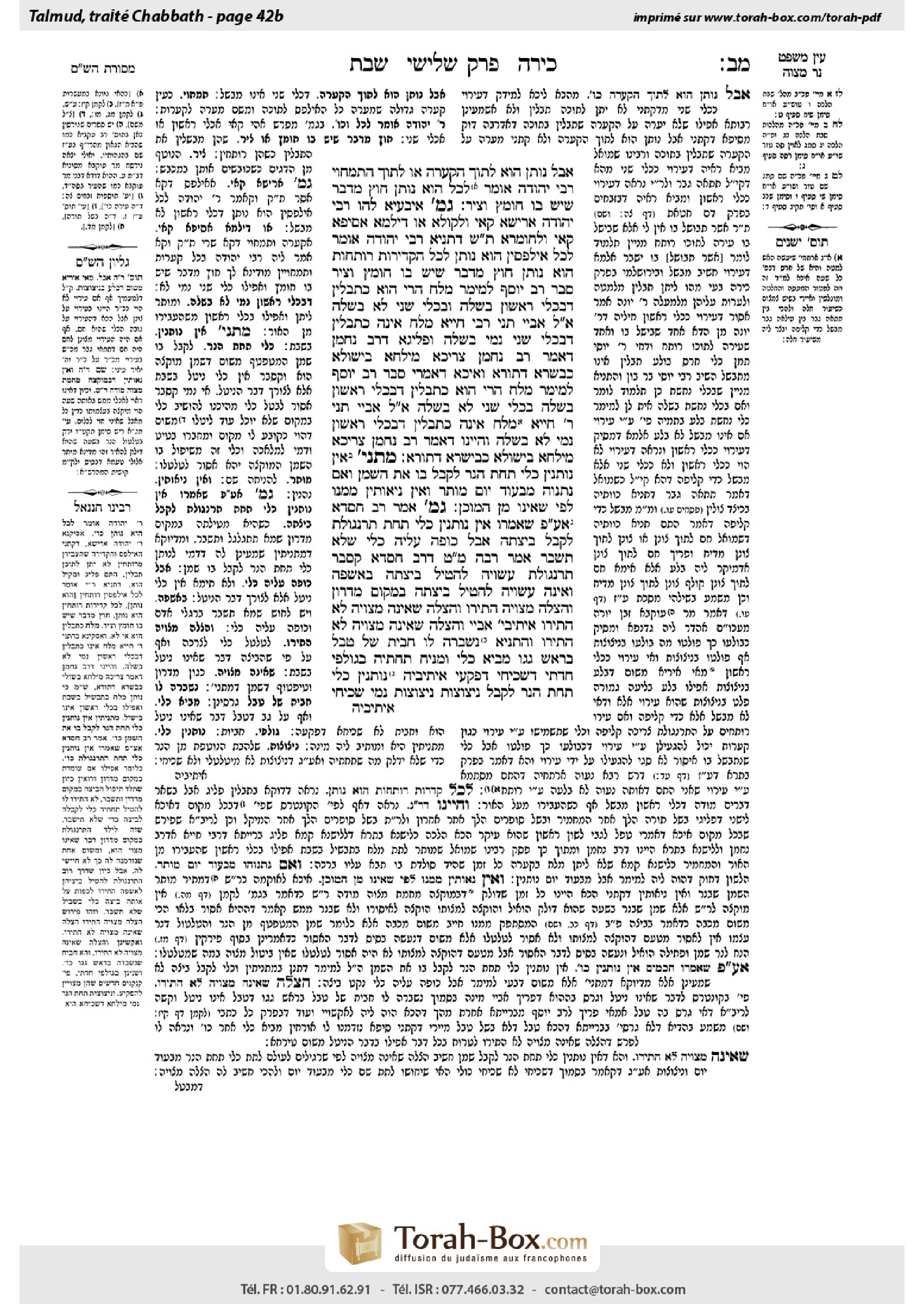
Shabbat 42b: Talmud study for Daf Yomi
Daf Yomi is the daily study of one Talmud folio. Explore 37 tractates with scans, Hebrew text, Sefaria English and AI-generated French translations where annotated.
Passage selection and English or AI-generated French translation are available where the scan has annotations. Daf Study is independent of Torah-Box and Sefaria.
Browse Shabbat · שבת · All tractatesShabbat 42b text and translations
This page of Shabbat includes the Aramaic text, an English translation and an AI-generated French translation, alongside the scan above.
שבת מ״ב ב · Aramaic and Hebrew text
אֲבָל נוֹתֵן הוּא לְתוֹךְ הַקְּעָרָה אוֹ לְתוֹךְ הַתַּמְחוּי. רַבִּי יְהוּדָה אוֹמֵר: לַכֹּל הוּא נוֹתֵן, חוּץ מִדָּבָר שֶׁיֵּשׁ בּוֹ חוֹמֶץ וָצִיר.
גְּמָ׳ אִיבַּעְיָא לְהוּ: רַבִּי יְהוּדָה אַרֵישָׁא קָאֵי — וּלְקוּלָּא, אוֹ דִילְמָא אַסֵּיפָא קָאֵי — וּלְחוּמְרָא.
תָּא שְׁמַע, דְּתַנְיָא רַבִּי יְהוּדָה אוֹמֵר: לְכׇל אִילְפָּסִין הוּא נוֹתֵן, לְכׇל הַקְּדֵירוֹת רוֹתְחוֹת הוּא נוֹתֵן, חוּץ מִדָּבָר שֶׁיֵּשׁ בּוֹ חוֹמֶץ וָצִיר.
סָבַר רַב יוֹסֵף לְמֵימַר מֶלַח הֲרֵי הוּא כְּתַבְלִין, דְּבִכְלִי רִאשׁוֹן — בָּשְׁלָה, וּבִכְלִי שֵׁנִי — לָא בָּשְׁלָה. אָמַר לֵיהּ אַבָּיֵי: תָּנֵי רַבִּי חִיָּיא, מֶלַח אֵינָהּ כְּתַבְלִין, דְּבִכְלִי שֵׁנִי נָמֵי בָּשְׁלָה! וּפְלִיגָא דְּרַב נַחְמָן, דְּאָמַר רַב נַחְמָן: צְרִיכָא מִילְחָא בִּישּׁוּלָא כְּבִשְׂרָא דְתוֹרָא.
וְאִיכָּא דְאָמְרִי: סָבַר רַב יוֹסֵף לְמֵימַר מֶלַח הֲרֵי הוּא כְּתַבְלִין, דְּבִכְלִי רִאשׁוֹן — בָּשְׁלָה, בִּכְלִי שֵׁנִי — לָא בָּשְׁלָה. אָמַר לֵיהּ אַבָּיֵי: תָּנֵי רַבִּי חִיָּיא מֶלַח אֵינָהּ כְּתַבְלִין, דְּבִכְלִי רִאשׁוֹן נָמֵי לָא בָּשְׁלָה, וְהַיְינוּ דְּאָמַר רַב נַחְמָן: צְרִיכָא מִילְחָא בִּישּׁוּלָא כְּבִישְׂרָא דְתוֹרָא.
מַתְנִי׳ אֵין נוֹתְנִין כְּלִי תַּחַת הַנֵּר לְקַבֵּל בּוֹ אֶת הַשֶּׁמֶן. וְאִם נְתָנוּהָ מִבְּעוֹד יוֹם — מוּתָּר, וְאֵין נֵיאוֹתִין מִמֶּנּוּ לְפִי שֶׁאֵינוֹ מִן הַמּוּכָן.
גְּמָ׳ אָמַר רַב חִסְדָּא: אַף עַל פִּי שֶׁאָמְרוּ אֵין נוֹתְנִין כְּלִי תַּחַת תַּרְנְגוֹלֶת לְקַבֵּל בֵּיצָתָהּ, אֲבָל כּוֹפֶה עָלֶיהָ כְּלִי שֶׁלֹּא תִּשָּׁבֵר. אָמַר רַבָּה: מַאי טַעְמָא דְּרַב חִסְדָּא? קָסָבַר, תַּרְנְגוֹלֶת עֲשׂוּיָה לְהַטִּיל בֵּיצָתָהּ בָּאַשְׁפָּה, וְאֵינָהּ עֲשׂוּיָה לְהַטִּיל בֵּיצָתָהּ בִּמְקוֹם מִדְרוֹן. וְהַצָּלָה מְצוּיָה הִתִּירוּ, וְהַצָּלָה שֶׁאֵינָהּ מְצוּיָה — לֹא הִתִּירוּ.
אֵיתִיבֵיהּ אַבָּיֵי: וְהַצָּלָה שֶׁאֵינָהּ מְצוּיָה לֹא הִתִּירוּ?! וְהָתַנְיָא: נִשְׁבְּרָה לוֹ חָבִית שֶׁל טֶבֶל בְּרֹאשׁ גַּגּוֹ, מֵבִיא כְּלִי וּמַנִּיחַ תַּחְתֶּיהָ! — בְּגוּלְפֵי חַדְתֵי דִּשְׁכִיחִי דְּפָקְעִי.
אֵיתִיבֵיהּ: נוֹתְנִין כְּלִי תַּחַת הַנֵּר לְקַבֵּל נִיצוֹצוֹת? — נִיצוֹצוֹת נָמֵי שְׁכִיחִי.
Shabbat 42b · English translation
However, one may place the spices into a bowl or into a tureen [tamḥui], which is a large bowl into which people pour the contents a stew pot or a pot. Bowls and tureens are both secondary vessels and food placed into them does not get cooked. Rabbi Yehuda says: One may place spices into anything on Shabbat except for a vessel that has in it something containing vinegar or brine of salted fish.
GEMARA: A dilemma was raised before the Sages: Is Rabbi Yehuda referring to the first clause of the mishna and being lenient? According to that possibility, the mishna prohibits placing spices into any boiling pot and Rabbi Yehuda holds that this only applies if there is fish brine or vinegar inside the pot. Or perhaps he is referring to the latter clause of the mishna and is being stringent? The Rabbis said that one is permitted to place spices into a bowl or a tureen, and Rabbi Yehuda came to add a stringency and say that if the bowl or tureen contains vinegar or brine, it is prohibited to place spices into it.
Come and hear a resolution to this dilemma from that which was taught explicitly in a baraita that Rabbi Yehuda says: Into all stew pots one may place spices on Shabbat; into all pots, even those that are boiling, one may place spices, except for one that contains vinegar or brine. The baraita clearly indicates that Rabbi Yehuda disputes the first clause of the mishna and is being lenient.
Rav Yosef thought to say that salt is like a spice whose legal status is: In a primary vessel that was on the fire, salt gets cooked and therefore it is prohibited to place salt into it on Shabbat. And in a secondary vessel, into which the contents of a primary vessel were poured, salt does not get cooked. Abaye said to him: Didn’t Rabbi Ḥiyya already teach that salt is not like a spice? Certainly he meant that in a secondary vessel it also gets cooked. And the Gemara remarks that this conclusion disputes the statement of Rav Naḥman, as Rav Naḥman said: Salt requires cooking for as long as the meat of an ox does, i.e., it requires extensive cooking.
And some say a very different version of this: Rav Yosef thought to say that salt is like a spice, i.e., in a primary vessel it gets cooked, whereas in a secondary vessel it does not get cooked. Abaye said to him: Didn’t Rabbi Ḥiyya already teach that salt is not like a spice, meaning that in a primary vessel, it also does not get cooked? And that is precisely what Rav Naḥman said: Salt requires cooking for as long as the meat of an ox does.
MISHNA: From a discussion of the halakhot of insulation and preparation for Shabbat followed by a brief tangent dealing with the prohibited labor of cooking on Shabbat, the mishna proceeds to briefly discuss prohibitions relating to set-aside [muktze] items in terms of Shabbat lamps. One may not place a vessel beneath the oil lamp, the vessel containing the oil and the wick, on Shabbat in order to receive the oil that drips from the wick. And if one placed the vessel on Friday while it was still day, it is permitted. However, in any case, one may not make use of the oil on Shabbat because it is not from the oil prepared from Shabbat eve for use on Shabbat. The oil in the lamp was already set aside and designated solely for the purpose of lighting the lamp.
GEMARA: Rav Ḥisda said: Although the Sages said that one may not place a vessel beneath a hen preparing to lay an egg on Shabbat on an inclined surface, in order to receive its egg and prevent it from breaking when it falls; however, they permitted overturning a vessel onto an egg on Shabbat so that it will not be trampled and break. Rabba said: What is Rav Ḥisda’s reason? He holds that a hen is likely to lay its egg in a garbage dump and people or animals will oftentimes step on it, but it is not likely to lay its egg on an inclined surface where the egg could roll down and break. And in a common case of preservation, the Sages permitted overturning a vessel onto the egg that is located in the garbage dump to protect it from being broken. And in an uncommon case of preservation, i.e., placing a vessel beneath a hen to receive its egg so that it would not roll down an inclined surface, they did not permit doing so.
Abaye raised an objection to Rabba’s opinion from a baraita: And is it so that in an uncommon case of preservation they did not permit taking steps to protect the object on Shabbat? Wasn’t it taught in a baraita: One whose barrel of untithed produce [tevel], which may not be eaten until it is tithed, broke on top of his roof on Shabbat, may bring a vessel and place it beneath the barrel so that the untithed produce is not lost. Even though eating untithed produce is prohibited on Shabbat, they permitted carrying a vessel to preserve it even in the uncommon case of a barrel that breaks. Apparently, even in an uncommon case of preservation the Sages permit taking the necessary steps. Rabba answered: This too, is a common case of preservation because it is an instance of new barrels [gulfei], which commonly break.
Abaye raised another objection to Rabba’s opinion from the last mishna in this chapter: One may place a vessel beneath the oil lamp in order to receive burning sparks of oil that drip from the burning wick even though this is not common. Rabba answered: Sparks are also common and therefore, it is a common case of preservation.
Shabbat 42b · Traduction française (IA)
Cependant, on peut mettre des épices dans un bol ou dans une soupière [tamḥui], grand récipient dans lequel on verse le contenu d’une marmite à ragoût ou d’une casserole. Les bols et les soupières sont tous deux des récipients secondaires, et les aliments qu’on y met ne cuisent pas. Rabbi Yehouda dit : On peut mettre des épices dans n’importe quel récipient le Chabbat, sauf dans un récipient qui contient du vinaigre ou de la saumure de poisson salé.
GUEMARA : Les Sages soulevèrent une question : Rabbi Yehouda se réfère-t-il à la première proposition de la Michna et se montre-t-il indulgent ? Selon cette interprétation, la Michna interdit de mettre des épices dans toute marmite bouillante, tandis que Rabbi Yehouda estime que cette interdiction ne s’applique que si la marmite contient de la saumure de poisson ou du vinaigre. Ou bien se réfère-t-il à la dernière proposition de la Michna et se montre-t-il rigoureux ? Les Sages ont dit qu’il est permis de mettre des épices dans un bol ou une soupière, et Rabbi Yehouda est venu ajouter une rigueur en disant que, si le bol ou la soupière contient du vinaigre ou de la saumure, il est interdit d’y mettre des épices.
Viens et écoute la résolution de cette question, fondée sur ce qui a été explicitement enseigné dans une baraïta. Rabbi Yehouda dit : On peut mettre des épices dans toutes les marmites à ragoût le Chabbat ; on peut en mettre dans toutes les casseroles, même bouillantes, sauf dans celles qui contiennent du vinaigre ou de la saumure. La baraïta indique clairement que Rabbi Yehouda conteste la première proposition de la Michna et se montre indulgent.
Rav Yossef pensa dire que le sel est comme une épice, c’est-à-dire que, dans un récipient primaire qui était sur le feu, le sel cuit et qu’il est donc interdit d’y mettre du sel le Chabbat ; tandis que, dans un récipient secondaire, où l’on a versé le contenu d’un récipient primaire, le sel ne cuit pas. Abayé lui dit : Rabbi Ḥiyya n’a-t-il pas déjà enseigné que le sel n’est pas comme une épice ? Il voulait certainement dire que, dans un récipient secondaire aussi, le sel cuit. La Guemara fait remarquer que cette conclusion contredit l’avis de Rav Naḥman, car Rav Naḥman a dit : Le sel doit cuire aussi longtemps que la viande de bœuf, c’est-à-dire qu’il nécessite une cuisson prolongée.
Certains rapportent une version tout à fait différente de cette discussion : Rav Yossef pensa dire que le sel est comme une épice, c’est-à-dire qu’il cuit dans un récipient primaire, mais ne cuit pas dans un récipient secondaire. Abayé lui dit : Rabbi Ḥiyya n’a-t-il pas déjà enseigné que le sel n’est pas comme une épice, ce qui signifie que, dans un récipient primaire aussi, il ne cuit pas ? C’est précisément ce qu’a dit Rav Naḥman : Le sel doit cuire aussi longtemps que la viande de bœuf.
MICHNA : Après avoir abordé les halakhot de l’isolation thermique et de la préparation pour le Chabbat, puis fait un bref détour par le travail interdit de cuisson le Chabbat, la Michna traite brièvement des interdictions relatives aux objets mis à l’écart [muktze], à propos des lampes de Chabbat. Le Chabbat, on ne peut pas placer un récipient sous la lampe à huile — le récipient contenant l’huile et la mèche — afin de recueillir l’huile qui goutte de la mèche. Si l’on a placé le récipient la veille, alors qu’il faisait encore jour, cela est permis. Toutefois, dans tous les cas, on ne peut pas utiliser l’huile le Chabbat, car elle ne fait pas partie de l’huile préparée la veille du Chabbat en vue de son usage le Chabbat. L’huile de la lampe avait déjà été mise à l’écart et réservée uniquement à l’éclairage de la lampe.
GUEMARA : Rav Ḥisda a dit : Bien que les Sages aient dit qu’on ne peut pas placer, le Chabbat, un récipient sous une poule qui s’apprête à pondre sur une surface inclinée, afin de recueillir son œuf et d’éviter qu’il se casse en tombant, ils ont cependant permis de retourner un récipient sur un œuf le Chabbat afin qu’il ne soit pas piétiné et brisé. Rabba a dit : Quelle est la raison de Rav Ḥisda ? Il estime qu’une poule risque de pondre son œuf dans un dépotoir, où des personnes ou des animaux marchent souvent dessus, mais qu’elle ne risque pas de pondre sur une surface inclinée, d’où l’œuf pourrait rouler et se casser. Dans un cas courant de protection, les Sages ont permis de retourner un récipient sur l’œuf qui se trouve dans le dépotoir afin de le protéger contre la casse. En revanche, dans un cas inhabituel de protection, c’est-à-dire lorsqu’on place un récipient sous une poule pour recueillir son œuf afin qu’il ne roule pas le long d’une surface inclinée, ils n’ont pas permis de le faire.
Abayé souleva une objection contre l’opinion de Rabba à partir d’une baraïta : Est-il vrai que, dans un cas inhabituel de protection, les Sages n’ont pas permis de prendre des mesures pour protéger l’objet le Chabbat ? N’a-t-on pas enseigné dans une baraïta : Si le tonneau de produits non dîmés [tevel] d’une personne — qu’il est interdit de manger avant de les dîmer — se brise sur le toit de sa maison le Chabbat, elle peut apporter un récipient et le placer sous le tonneau afin que les produits non dîmés ne soient pas perdus. Bien que manger des produits non dîmés soit interdit le Chabbat, les Sages ont permis de transporter un récipient pour les préserver, même dans le cas inhabituel d’un tonneau qui se brise. Il semble donc que, même dans un cas inhabituel de protection, les Sages permettent de prendre les mesures nécessaires. Rabba répondit : Ce cas aussi est courant, car il s’agit de tonneaux neufs [gulfei], qui se brisent souvent.
Abayé souleva une autre objection contre l’opinion de Rabba à partir de la dernière Michna de ce chapitre : On peut placer un récipient sous la lampe à huile afin de recueillir les étincelles d’huile brûlantes qui gouttent de la mèche enflammée, bien que cela ne soit pas courant. Rabba répondit : Les étincelles aussi sont courantes ; il s’agit donc d’un cas courant de protection.
Traduction française générée par IA à partir de l’édition anglaise de Sefaria. Vérifie toujours un passage avec le texte source.
Text from Sefaria: William Davidson Edition - Vocalized Aramaic (CC BY NC); William Davidson Edition - English (CC BY NC).