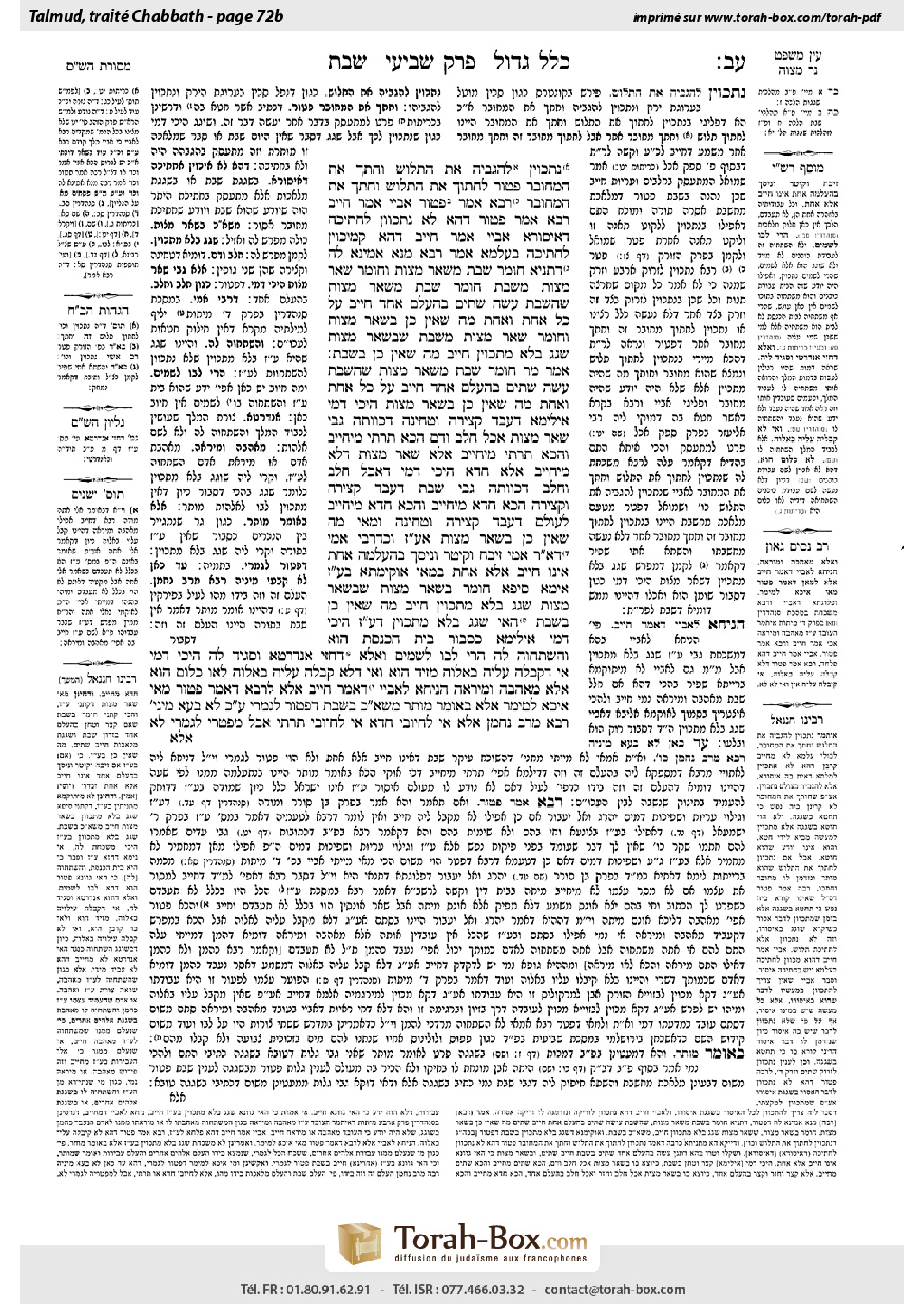
Shabbat 72b: Talmud study for Daf Yomi
Daf Yomi is the daily study of one Talmud folio. Explore 37 tractates with scans, Hebrew text, Sefaria English and AI-generated French translations where annotated.
Passage selection and English or AI-generated French translation are available where the scan has annotations. Daf Study is independent of Torah-Box and Sefaria.
Browse Shabbat · שבת · All tractatesShabbat 72b text and translations
This page of Shabbat includes the Aramaic text, an English translation and an AI-generated French translation, alongside the scan above.
שבת ע״ב ב · Aramaic and Hebrew text
נִתְכַּוֵּין לְהַגְבִּיהַּ אֶת הַתָּלוּשׁ, וְחָתַךְ אֶת הַמְחוּבָּר — פָּטוּר. לַחְתּוֹךְ אֶת הַתָּלוּשׁ, וְחָתַךְ אֶת הַמְחוּבָּר, רָבָא אָמַר: פָּטוּר. אַבָּיֵי אָמַר: חַיָּיב. רָבָא אָמַר פָּטוּר — דְּהָא לָא מִיכַּוֵּון לַחֲתִיכָה דְאִיסּוּרָא. אַבָּיֵי אֲמַר חַיָּיב — דְּהָא קָמִיכַּוֵּין לַחֲתִיכָה בְּעָלְמָא.
אָמַר רָבָא: מְנָא אָמֵינָא לַהּ? דְּתַנְיָא: חוֹמֶר שַׁבָּת מִשְּׁאָר מִצְוֹת, וְחוֹמֶר שְׁאָר מִצְוֹת מִשַּׁבָּת. חוֹמֶר שַׁבָּת מִשְּׁאָר מִצְוֹת, שֶׁהַשַּׁבָּת עָשָׂה שְׁתַּיִם בְּהֶעְלֵם אֶחָד — חַיָּיב עַל כׇּל אַחַת וְאַחַת, מַה שֶּׁאֵין כֵּן בִּשְׁאָר מִצְוֹת. וְחוֹמֶר שְׁאָר מִצְוֹת מִשַּׁבָּת — שֶׁבִּשְׁאָר מִצְוֹת שָׁגַג בְּלֹא מִתְכַּוֵּין — חַיָּיב, מַה שֶּׁאֵין כֵּן בְּשַׁבָּת.
אָמַר מָר: חוֹמֶר שַׁבָּת מִשְּׁאָר מִצְוֹת, שֶׁהַשַּׁבָּת עָשָׂה שְׁתַּיִם בְּהֶעְלֵם אֶחָד — חַיָּיב עַל כׇּל אַחַת וְאַחַת, מַה שֶּׁאֵין כֵּן בִּשְׁאָר מִצְוֹת. הֵיכִי דָמֵי? אִילֵּימָא דַּעֲבַד קְצִירָה וּטְחִינָה, דִּכְווֹתַהּ גַּבֵּי שְׁאָר מִצְוֹת אֲכַל חֵלֶב וְדָם. הָכָא תַּרְתֵּי מִיחַיַּיב, וְהָכָא תַּרְתֵּי מִיחַיַּיב! אֶלָּא שְׁאָר מִצְוֹת דְּלָא מִיחַיַּיב אֶלָּא חֲדָא הֵיכִי דָּמֵי — דַּאֲכַל חֵלֶב וְחֵלֶב. דִּכְווֹתַהּ גַּבֵּי שַׁבָּת — דַּעֲבַד קְצִירָה וּקְצִירָה, הָכָא חֲדָא מִיחַיַּיב, וְהָכָא חֲדָא מִיחַיַּיב!
לְעוֹלָם דַּעֲבַד קְצִירָה וּטְחִינָה, וּמַאי ״מַה שֶּׁאֵין כֵּן בִּשְׁאָר מִצְוֹת״ — אַעֲבוֹדָה זָרָה, וְכִדְרַבִּי אַמֵּי. דְּאָמַר רַבִּי אַמֵּי: זִיבַּח וְקִיטֵּר וְנִיסֵּךְ בְּהַעֲלָמָה אַחַת — אֵינוֹ חַיָּיב אֶלָּא אַחַת.
בְּמַאי אוֹקֵימְתַּהּ — בַּעֲבוֹדָה זָרָה? אֵימָא סֵיפָא: חוֹמֶר בִּשְׁאָר מִצְוֹת, שֶׁבִּשְׁאָר מִצְוֹת שָׁגַג בְּלֹא מִתְכַּוֵּין — חַיָּיב, מַה שֶּׁאֵין כֵּן בְּשַׁבָּת — הַאי שָׁגַג בְּלֹא מִתְכַּוֵּין דַּעֲבוֹדָה זָרָה הֵיכִי דָּמֵי? אִילֵּימָא כְּסָבוּר בֵּית הַכְּנֶסֶת הוּא וְהִשְׁתַּחֲוָה לָהּ — הֲרֵי לִבּוֹ לַשָּׁמַיִם. וְאֶלָּא דְּחָזֵי אִנְדְּרָטָא וְסָגֵיד לֵהּ, הֵיכִי דָּמֵי? אִי דְּקַבְּלֵהּ עֲלֵיהּ בֶּאֱלוֹהַּ — מֵזִיד הוּא. וְאִי דְּלָא קַבְּלֵהּ עֲלֵיהּ בֶּאֱלוֹהַּ — לָאו כְּלוּם הוּא.
אֶלָּא מֵאַהֲבָה וּמִיִּרְאָה. הָנִיחָא לְאַבָּיֵי, דְּאָמַר חַיָּיב. אֶלָּא לְרָבָא דְּאָמַר פָּטוּר, מַאי אִיכָּא לְמֵימַר? אֶלָּא בְּאוֹמֵר ״מוּתָּר״. מַה שֶּׁאֵין כֵּן בְּשַׁבָּת דְּפָטוּר — לִגְמָרֵי.
עַד כָּאן לָא בְּעָא מִינֵּיהּ רָבָא מֵרַב נַחְמָן, אֶלָּא אִי לְחַיּוֹבֵי חֲדָא, אִי לְחַיּוֹבֵי תַּרְתֵּי, אֲבָל מִפְטְרֵיהּ לִגְמָרֵי — לָא.
Shabbat 72b · English translation
One who intended to lift a plant detached from the ground on Shabbat and mistakenly severed a plant still attached to the ground, which under other circumstances constitutes performance of the prohibited labor of reaping, is exempt from bringing a sin-offering for his mistaken act, since he did not intend to perform an act of cutting. One who performs an action unawares [mitasek], i.e., he had no intention to perform the act at all, incurs no liability whatsoever. One who intended to cut a detached plant and unwittingly severed a plant still attached to the ground, Rava said: He too is exempt. Abaye said: He is liable. The Gemara elaborates: Rava said that he is exempt because he did not intend to perform an act of prohibited severing. He intended to perform an action completely permitted on Shabbat. He had no misconception with regard to the halakhot of Shabbat. It was merely a mistaken act. And Abaye said that he is liable because he intended to perform a standard act of cutting. Since he intended to perform that act, and he carried out his intent, the Torah characterizes it as unwitting and not as unawares.
Rava said: From where do I derive to say this opinion? As it was taught in a baraita: There is a stricture with regard to the prohibitions of Shabbat that is greater than the stricture with regard to other mitzvot, and a stricture with regard to other mitzvot that is greater than the stricture with regard to Shabbat. The Gemara elaborates: A stricture with regard to Shabbat that is greater than the stricture with regard to other mitzvot is that, with regard to Shabbat, one who performed two transgressions on Shabbat, even if he did so in the course of one lapse of awareness, is liable to bring a sin-offering for each and every one, which is not the case in other mitzvot. In other mitzvot, if an individual commits a transgression several times in the course of one lapse of awareness, he is liable to bring only one sin-offering. And a stricture with regard to other mitzvot that is greater than the stricture with regard to Shabbat is that, with regard to other mitzvot, one who performs an act unwittingly without intent is liable, which is not the case with regard to Shabbat. Apparently, the phrase unwittingly without intent refers to the case disputed by Abaye and Rava. Therefore, this is proof for Rava’s opinion that, with regard to Shabbat, one who acts unawares, i.e., whose action resulted from involvement in another matter and who had no intention to perform an action that is prohibited, is not considered to have performed an unwitting act.
Before the Gemara discusses the baraita in the context of the dispute between Abaye and Rava, the Gemara analyzes its text. The Master said in the baraita: A stricture with regard to Shabbat that is greater than the stricture with regard to other mitzvot is that, with regard to Shabbat, one who performed two transgressions on Shabbat, even in the course of one lapse of awareness, is liable to bring a sin-offering for each and every one, which is not the case with regard to other mitzvot. The Gemara asks: What are the circumstances? If you say that he unwittingly performed acts of reaping and grinding on Shabbat, the corresponding situation with regard to other mitzvot is a case where he ate forbidden fat and blood. If so, there is no difference between Shabbat and other mitzvot. Here one is liable to bring two sin-offerings and here one is liable to bring two sin-offerings. Rather, what are the circumstances in other mitzvot where he is liable to bring only one sin-offering? It is in a case where he ate forbidden fat and again ate forbidden fat within one lapse of awareness. The corresponding situation with regard to Shabbat is a case where one performed an act of reaping and performed another act of reaping within one lapse of awareness. However, in that case too there is no difference between Shabbat and other mitzvot. Here one is liable to bring one sin-offering, and here one is liable to bring one sin-offering.
The Gemara explains: Actually, it is referring to a case where one performed acts of reaping and grinding. And what is the meaning of the phrase: Which is not the case with regard to other mitzvot? It is not referring to all mitzvot in general. It is referring to the prohibition of idolatry, which is comprised of separate component prohibitions, each of which incurs independent liability. This is in accordance with the opinion of Rabbi Ami, as Rabbi Ami said: One who sacrificed to idolatry, and burned incense before it, and poured wine as a libation before it in the course of one lapse of awareness is liable to bring only one sin-offering. That is the ruling, even though, had he performed those rites separately, he would be liable to bring a sin-offering for each. That, then, is the stricture of other mitzvot relative to Shabbat.
The Gemara asks: In what case did you establish the baraita, in the case of idolatry? If so, state the latter clause and determine whether that explanation applies there as well. The latter clause states: A stricture with regard to other mitzvot that is greater than the stricture with regard to Shabbat is that, with regard to other mitzvot, one who performs an act unwittingly without intent is liable, which is not the case with regard to Shabbat. One who acts unawares with no intent to perform a prohibited act is not considered to have performed an unwitting act. That case of performing an act unwittingly without intent with regard to idolatry, what are the circumstances? If you say that it is referring to a case where he thought that it was a synagogue and bowed to it, and it turned out that he bowed to idolatry, he committed no transgression. Since his heart was directed toward Heaven, it is not even an unwitting transgression. Rather, it is referring to a case where he saw a statue [andarta] in the image of the king and bowed to it. What are the circumstances? If the baraita is referring to a case in which he bowed because he accepted that image upon himself as a god, he worshipped idolatry intentionally and is not liable to bring a sin-offering. And if he did not accept that image upon himself as a god and bowed merely in deference to the monarch, it is meaningless and is not an act of idolatry.
Rather, it is referring to a case where one bowed due to love of someone who requested that he bow before the statue and due to fear of someone coercing him to do so. He is under the impression that unless he wholeheartedly has the intention to worship the idol, there is no prohibition involved. This works out well according to the opinion of Abaye, who said: One who bows due to love or fear is liable to bring a sin-offering. However, according to the opinion of Rava, who said: One who bows due to love or fear is exempt from bringing a sin-offering, what can be said? According to Rava’s opinion, the problem remains. There is no case in which there is a difference between the ruling in the case of idolatry and the ruling in the case of Shabbat. Rather, it is referring to a case where one says to himself that this is permitted. He is under the impression that idolatry is permitted, and his unwitting act was the result of ignorance, not forgetfulness. The statement in the baraita: Which is not the case with regard to Shabbat, is referring to one who was under the impression that performing labors on Shabbat is permitted. One who performs prohibited labors under those circumstances is completely exempt.
That conclusion contradicts another statement of Rava. With regard to one who is unaware of both the essence of Shabbat and the individual prohibited labors, Rava raised a dilemma before Rav Naḥman only whether to deem him liable to bring one or whether to deem him liable to bring two sin-offerings. However, the possibility to exempt him completely did not enter Rava’s mind. That explanation of the baraita is incompatible with Rava’s opinion.
Shabbat 72b · Traduction française (IA)
Celui qui avait l’intention de soulever, pendant Chabbat, une plante détachée du sol et qui, par erreur, a coupé une plante encore attachée au sol — acte qui, dans d’autres circonstances, constitue le travail interdit de moissonner — est dispensé d’apporter un sacrifice expiatoire pour son acte involontaire, puisqu’il n’avait pas l’intention d’effectuer une coupe. Celui qui agit sans en avoir conscience [mitasek], c’est-à-dire sans avoir eu l’intention d’accomplir l’acte, n’encourt aucune responsabilité. Celui qui avait l’intention de couper une plante détachée et qui a, par inadvertance, coupé une plante encore attachée au sol, Rava dit : lui aussi est dispensé. Abayé dit : il est responsable. La Guemara précise : Rava dit qu’il est dispensé parce qu’il n’avait pas l’intention d’effectuer une coupe interdite. Il avait l’intention d’accomplir une action entièrement permise pendant Chabbat. Il ne se méprenait pas sur les halakhot de Chabbat ; il s’agissait simplement d’une erreur d’exécution. Abayé dit qu’il est responsable parce qu’il avait l’intention d’effectuer une coupe ordinaire. Puisqu’il avait l’intention de l’accomplir et qu’il a réalisé ce qu’il voulait faire, la Torah qualifie son acte d’involontaire et non d’accompli sans en avoir conscience.
Rava dit : D’où est-ce que je tire cette opinion ? D’un enseignement d’une baraïta : Il existe une rigueur relative aux interdits de Chabbat qui est plus grande que celle relative aux autres mitsvot, et une rigueur relative aux autres mitsvot qui est plus grande que celle relative à Chabbat. La Guemara précise : La rigueur relative à Chabbat, plus grande que celle relative aux autres mitsvot, tient au fait que, concernant Chabbat, celui qui commet deux transgressions, même au cours d’une seule période d’inadvertance, est tenu d’apporter un sacrifice expiatoire pour chacune d’elles, ce qui n’est pas le cas pour les autres mitsvot. Pour les autres mitsvot, si quelqu’un commet plusieurs fois une transgression au cours d’une seule période d’inadvertance, il n’est tenu d’apporter qu’un seul sacrifice expiatoire. Et la rigueur relative aux autres mitsvot, plus grande que celle relative à Chabbat, tient au fait que, concernant les autres mitsvot, celui qui accomplit involontairement un acte sans intention est responsable, ce qui n’est pas le cas concernant Chabbat. Apparemment, l’expression « involontairement sans intention » désigne le cas faisant l’objet du désaccord entre Abayé et Rava. Il s’agit donc d’une preuve en faveur de l’opinion de Rava : concernant Chabbat, celui qui agit sans en avoir conscience, c’est-à-dire dont l’action résulte du fait qu’il était occupé à une autre chose et qui n’avait pas l’intention d’accomplir un acte interdit, n’est pas considéré comme ayant commis un acte involontaire.
Avant d’examiner la baraïta à la lumière du désaccord entre Abayé et Rava, la Guemara en analyse le texte. Le Maître a enseigné dans la baraïta : La rigueur relative à Chabbat, plus grande que celle relative aux autres mitsvot, tient au fait que, concernant Chabbat, celui qui commet deux transgressions, même au cours d’une seule période d’inadvertance, est tenu d’apporter un sacrifice expiatoire pour chacune d’elles, ce qui n’est pas le cas pour les autres mitsvot. La Guemara demande : Dans quelles circonstances ? Si tu dis qu’il a accompli involontairement les actes de moissonner et de moudre pendant Chabbat, le cas correspondant pour les autres mitsvot serait celui où il a mangé de la graisse interdite et du sang. Dans ce cas, il n’y a aucune différence entre Chabbat et les autres mitsvot : ici, il est tenu d’apporter deux sacrifices expiatoires, et là aussi, il est tenu d’apporter deux sacrifices expiatoires. Alors, dans quelles circonstances, pour les autres mitsvot, n’est-il tenu d’apporter qu’un seul sacrifice expiatoire ? Lorsqu’il a mangé de la graisse interdite, puis en a de nouveau mangé au cours d’une seule période d’inadvertance. Le cas correspondant pour Chabbat serait celui où il a moissonné, puis accompli un autre acte de moissonner au cours d’une seule période d’inadvertance. Cependant, dans ce cas également, il n’y a aucune différence entre Chabbat et les autres mitsvot : ici, il est tenu d’apporter un sacrifice expiatoire, et là aussi, il est tenu d’apporter un sacrifice expiatoire.
La Guemara explique : En réalité, il s’agit du cas où quelqu’un a accompli les actes de moissonner et de moudre. Et que signifie l’expression « ce qui n’est pas le cas pour les autres mitsvot » ? Elle ne concerne pas l’ensemble des mitsvot en général, mais l’interdit de l’idolâtrie, qui comprend plusieurs interdits distincts, chacun entraînant une responsabilité indépendante. Cela est conforme à l’opinion de Rabbi Ami, car Rabbi Ami a dit : Celui qui a offert un sacrifice à l’idolâtrie, lui a brûlé de l’encens et lui a versé du vin en libation au cours d’une seule période d’inadvertance n’est tenu d’apporter qu’un seul sacrifice expiatoire. Telle est la règle, même si, s’il avait accompli ces rites séparément, il aurait été tenu d’apporter un sacrifice expiatoire pour chacun. Telle est donc la rigueur des autres mitsvot par rapport à Chabbat.
La Guemara demande : Dans quel cas as-tu situé la baraïta ? Dans le cas de l’idolâtrie. Si c’est le cas, examinons la clause finale et voyons si cette explication s’y applique également. La clause finale énonce : La rigueur relative aux autres mitsvot, plus grande que celle relative à Chabbat, tient au fait que, concernant les autres mitsvot, celui qui accomplit involontairement un acte sans intention est responsable, ce qui n’est pas le cas concernant Chabbat. Celui qui agit sans en avoir conscience, sans intention d’accomplir un acte interdit, n’est pas considéré comme ayant commis un acte involontaire. Dans le cas de l’idolâtrie, quelles sont les circonstances d’un acte accompli involontairement sans intention ? Si tu dis qu’il s’agit du cas où il pensait qu’il s’agissait d’une synagogue et s’est prosterné devant elle, avant qu’il ne s’avère qu’il s’était prosterné devant une idole, il n’a commis aucune transgression. Puisque son cœur était tourné vers le Ciel, son acte ne constitue même pas une transgression involontaire. Il s’agit plutôt du cas où il a vu une statue [andarta] à l’effigie du roi et s’est prosterné devant elle. Dans quelles circonstances ? Si la baraïta parle du cas où il s’est prosterné parce qu’il avait accepté cette image comme dieu, il a adoré l’idolâtrie intentionnellement et n’est pas tenu d’apporter un sacrifice expiatoire. Et s’il n’a pas accepté cette image comme dieu et s’est prosterné uniquement par déférence envers le monarque, cela n’a aucun sens et ne constitue pas un acte d’idolâtrie.
Il s’agit plutôt du cas où quelqu’un s’est prosterné par amour pour une personne qui lui a demandé de se prosterner devant la statue, ou par crainte d’une personne qui l’y contraignait. Il croit que, s’il n’a pas l’intention de tout son cœur d’adorer l’idole, il n’y a pas d’interdit. Cela convient bien selon l’opinion d’Abayé, qui a dit : Celui qui se prosterne par amour ou par crainte est tenu d’apporter un sacrifice expiatoire. Cependant, selon l’opinion de Rava, qui a dit : Celui qui se prosterne par amour ou par crainte est dispensé d’apporter un sacrifice expiatoire, que peut-on répondre ? Selon l’opinion de Rava, le problème demeure : il n’existe aucun cas où la règle relative à l’idolâtrie diffère de celle relative à Chabbat. Il s’agit plutôt du cas où quelqu’un se dit que cela est permis. Il croit que l’idolâtrie est permise, et son acte involontaire résulte de son ignorance, et non d’un oubli. L’énoncé de la baraïta « ce qui n’est pas le cas concernant Chabbat » fait référence à celui qui croyait qu’il était permis d’accomplir des travaux pendant Chabbat. Celui qui accomplit des travaux interdits dans ces circonstances est entièrement dispensé.
Cette conclusion contredit une autre déclaration de Rava. À propos de celui qui ignore à la fois la nature même de Chabbat et les différents travaux interdits, Rava a posé à Rav Naḥman la seule question de savoir s’il fallait le considérer comme tenu d’apporter un ou deux sacrifices expiatoires. La possibilité de le dispenser entièrement n’a toutefois pas traversé l’esprit de Rava. Cette explication de la baraïta est incompatible avec l’opinion de Rava.
Traduction française générée par IA à partir de l’édition anglaise de Sefaria. Vérifie toujours un passage avec le texte source.
Text from Sefaria: William Davidson Edition - Vocalized Aramaic (CC BY NC); William Davidson Edition - English (CC BY NC).