Shabbat 73a: Talmud study for Daf Yomi
Daf Yomi is the daily study of one Talmud folio. Explore 37 tractates with scans, Hebrew text, Sefaria English and AI-generated French translations where annotated.
Passage selection and English or AI-generated French translation are available where the scan has annotations. Daf Study is independent of Torah-Box and Sefaria.
Browse Shabbat · שבת · All tractatesShabbat 73a text and translations
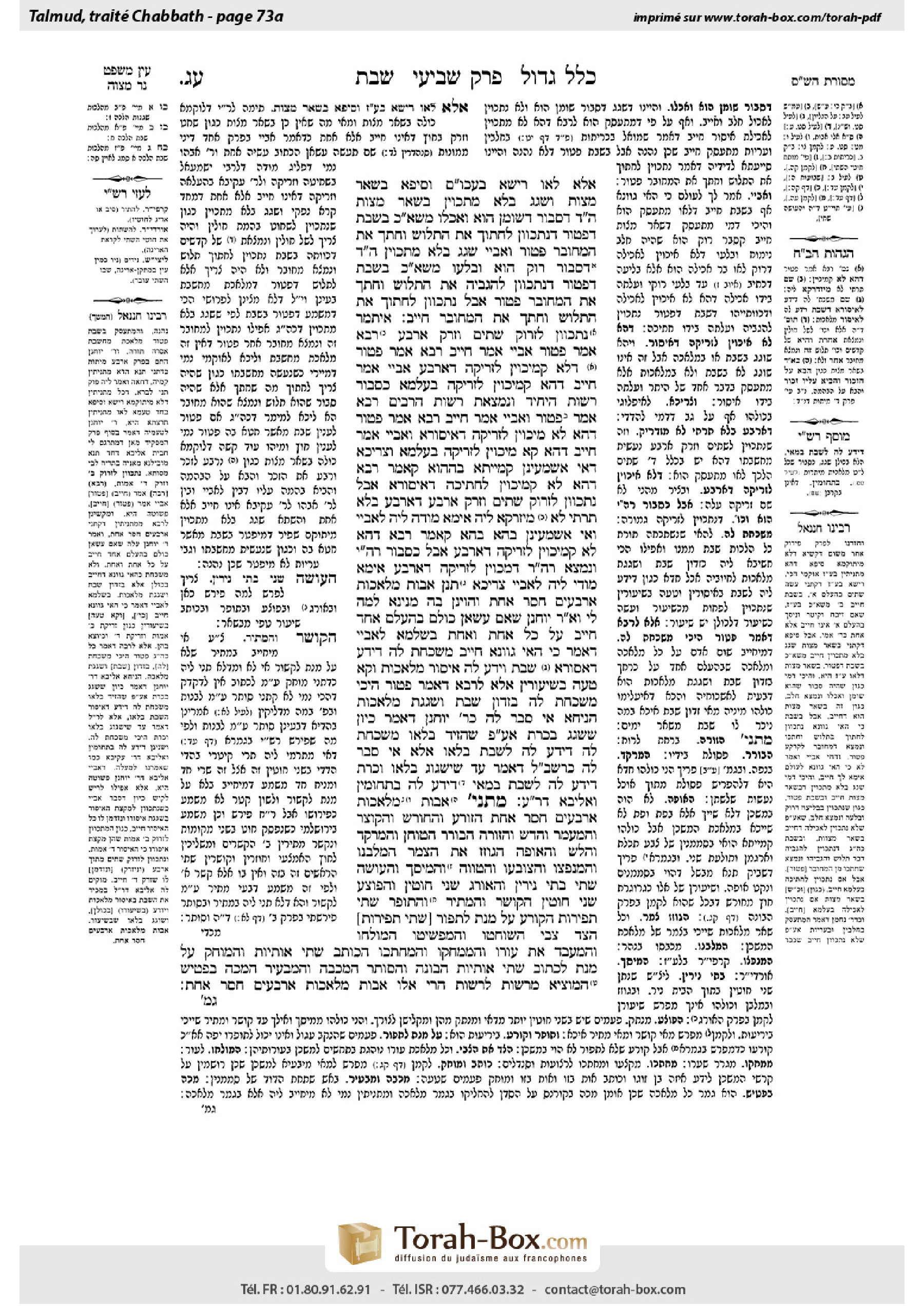
This page of Shabbat includes the Aramaic text, an English translation and an AI-generated French translation, alongside the scan above.
שבת ע״ג א · Aramaic and Hebrew text
אֶלָּא לָאו, רֵישָׁא בַּעֲבוֹדָה זָרָה וְסֵיפָא בִּשְׁאָר מִצְוֹת. וְשָׁגַג בְּלֹא מִתְכַּוֵּין בִּשְׁאָר מִצְוֹת הֵיכִי דָּמֵי? — דְּסָבוּר דְּשׁוּמָּן הוּא, וַאֲכָלוֹ. מַה שֶּׁאֵין כֵּן בְּשַׁבָּת דְּפָטוּר, דְּנִתְכַּוֵּון לַחְתּוֹךְ אֶת הַתָּלוּשׁ וְחָתַךְ אֶת הַמְחוּבָּר פָּטוּר. וְאַבָּיֵי שָׁגַג בְּלֹא מִתְכַּוֵּין הֵיכִי דָּמֵי? — דְּסָבוּר רוֹק הוּא, וּבְלָעוֹ. מַה שֶּׁאֵין כֵּן בְּשַׁבָּת, דְּפָטוּר, דְּנִתְכַּוֵּון לְהַגְבִּיהַּ אֶת הַתָּלוּשׁ וְחָתַךְ אֶת הַמְחוּבָּר פָּטוּר. אֲבָל נִתְכַּוֵּון לַחְתּוֹךְ אֶת הַתָּלוּשׁ וְחָתַךְ אֶת הַמְחוּבָּר — חַיָּיב.
אִיתְּמַר: נִתְכַּוֵּון לִזְרוֹק שְׁתַּיִם וְזָרַק אַרְבַּע, רָבָא אָמַר: פָּטוּר. אַבָּיֵי אָמַר: חַיָּיב. רָבָא אָמַר פָּטוּר — דְּלָא קָמִיכַּוֵּין לִזְרִיקָה דְאַרְבַּע. אַבָּיֵי אֲמַר חַיָּיב — דְּהָא קָמִיכַּוֵּין לִזְרִיקָה בְּעָלְמָא. כְּסָבוּר רְשׁוּת הַיָּחִיד, וְנִמְצֵאת רְשׁוּת הָרַבִּים — רָבָא אָמַר: פָּטוּר, וְאַבָּיֵי אָמַר: חַיָּיב. רָבָא אָמַר פָּטוּר — דְּהָא לָא מִיכַּוֵין לִזְרִיקָה דְאִיסּוּרָא. וְאַבָּיֵי אֲמַר חַיָּיב — דְּהָא קָא מִיכַּוֵין לִזְרִיקָה בְּעָלְמָא.
וּצְרִיכָא: דְּאִי אַשְׁמְעִינַן קַמַּיְיתָא, בְּהַהִיא קָאָמַר רָבָא — דְּהָא לָא קָמִיכַּוֵּין לַחֲתִיכָה דְאִיסּוּרָא. אֲבָל נִתְכַּוֵּון לִזְרוֹק שְׁתַּיִם וְזָרַק אַרְבַּע, דְּאַרְבַּע בְּלָא תַּרְתֵּי לָא מִיזְדַּרְקִי לֵיהּ, אֵימָא מוֹדֶה לֵיהּ לְאַבָּיֵי. וְאִי אַשְׁמְעִינַן בְּהָא, בְּהָא קָאָמַר רָבָא — דְּהָא לָא קָמִיכַּוֵּין לִזְרִיקָה דְאַרְבַּע, אֲבָל כְּסָבוּר רְשׁוּת הַיָּחִיד וְנִמְצָא רְשׁוּת הָרַבִּים, דְּמִכַּוֵּין לִזְרִיקָה דְאַרְבַּע — אֵימָא מוֹדֵי לֵיהּ לְאַבָּיֵי, צְרִיכָא.
תְּנַן ״אֲבוֹת מְלָאכוֹת אַרְבָּעִים חָסֵר אַחַת״, וְהָוֵינַן בַּהּ: מִנְיָנָא לְמָה לִי? וְאָמַר רַבִּי יוֹחָנָן: שֶׁאִם עֲשָׂאָן כּוּלָּם בְּהֶעְלֵם אֶחָד — חַיָּיב עַל כׇּל אַחַת וְאַחַת, בִּשְׁלָמָא לְאַבָּיֵי דְּאָמַר כִּי הַאי גַוְונָא חַיָּיב, מַשְׁכַּחַתְּ לַהּ דְּיָדַע אִסּוּרָא דְשַׁבָּת וְיָדַע (לַהּ) אִיסּוּר מְלָאכוֹת, וְקָא טָעֵי בְּשִׁיעוּרִין. אֶלָּא לְרָבָא דְּאָמַר פָּטוּר, הֵיכִי מַשְׁכַּחַתְּ לַהּ בִּזְדוֹן שַׁבָּת וְשִׁגְגַת מְלָאכוֹת?
הָנִיחָא אִי סָבַר לַהּ כְּרַבִּי יוֹחָנָן, דְּאָמַר כֵּיוָן שֶׁשָּׁגַג בְּכָרֵת, אַף עַל פִּי שֶׁהֵזִיד בְּלָאו — מַשְׁכַּחַתְּ לַהּ דְּיָדַע לַהּ לְשַׁבָּת בְּלָאו. אֶלָּא אִי סָבַר לַהּ כְּרַבִּי שִׁמְעוֹן בֶּן לָקִישׁ, דְּאָמַר עַד שֶׁיִּשְׁגּוֹג בְּלָאו וְכָרֵת, דְּיָדַע לַהּ לְשַׁבָּת בְּמַאי? דְּיָדַע לַהּ בִּתְחוּמִין, וְאַלִּיבָּא דְּרַבִּי עֲקִיבָא.
מַתְנִי׳ אֲבוֹת מְלָאכוֹת אַרְבָּעִים חָסֵר אַחַת: הַזּוֹרֵעַ, וְהַחוֹרֵשׁ, וְהַקּוֹצֵר, וְהַמְעַמֵּר, וְהַדָּשׁ, וְהַזּוֹרֶה. הַבּוֹרֵר, הַטּוֹחֵן, וְהַמְרַקֵּד, וְהַלָּשׁ, וְהָאוֹפֶה.
הַגּוֹזֵז אֶת הַצֶּמֶר, הַמְלַבְּנוֹ, וְהַמְנַפְּצוֹ, וְהַצּוֹבְעוֹ, וְהַטּוֹוֶה, וְהַמֵּיסֵךְ, וְהָעוֹשֶׂה שְׁתֵּי בָתֵּי נִירִין, וְהָאוֹרֵג שְׁנֵי חוּטִין, וְהַפּוֹצֵעַ שְׁנֵי חוּטִין. הַקּוֹשֵׁר, וְהַמַּתִּיר, וְהַתּוֹפֵר שְׁתֵּי תְפִירוֹת, הַקּוֹרֵעַ עַל מְנָת לִתְפּוֹר [שְׁתֵּי תְפִירוֹת].
הַצָּד צְבִי, הַשּׁוֹחֲטוֹ, וְהַמַּפְשִׁיטוֹ, הַמּוֹלְחוֹ, וְהַמְעַבֵּד אֶת עוֹרוֹ, וְהַמְמַחֲקוֹ, וְהַמְחַתְּכוֹ.
הַכּוֹתֵב שְׁתֵּי אוֹתִיּוֹת, וְהַמּוֹחֵק עַל מְנָת לִכְתּוֹב שְׁתֵּי אוֹתִיּוֹת. הַבּוֹנֶה, וְהַסּוֹתֵר, הַמְכַבֶּה, וְהַמַּבְעִיר, הַמַּכֶּה בְּפַטִּישׁ, הַמּוֹצִיא מֵרְשׁוּת לִרְשׁוּת — הֲרֵי אֵלּוּ אֲבוֹת מְלָאכוֹת אַרְבָּעִים חָסֵר אַחַת.
Shabbat 73a · English translation
Rather, is it not that the first clause of the baraita is dealing with the contrast between Shabbat and idolatry, and the latter clause of the baraita is dealing with contrasting Shabbat and other mitzvot? And what are the circumstances of: Unwitting without intent, with regard to other mitzvot? It is in a case where one thought that it was permitted fat, and ate it, and later discovered that it was forbidden fat. This is one example of other mitzvot where one is liable. That is not the case with regard to Shabbat, where he is exempt, as one who intended to cut a detached plant and unwittingly severed a plant still attached to the ground is exempt. And according to Abaye, who holds that he is liable in that case, what are the circumstances of: Unwitting without intent, with regard to other mitzvot? It is in a case where one had something in his mouth and he thought it was spittle and swallowed it with no intention to eat it, and it turned out to be forbidden fat that he swallowed. This is one example of other mitzvot, where he is liable. That is not the case with regard to Shabbat, where the phrase: He is exempt, is referring to the case of one who intended to lift a plant detached from the ground and mistakenly severed a plant still attached to the ground. In that case, even Abaye agrees that he is exempt. However, one who intended to cut a detached plant and unwittingly severed a plant still attached to the ground is liable since he intended to perform a standard act of cutting. Therefore, no proof can be cited from this baraita.
A similar dispute between Abaye and Rava was stated. In the case of one who intended to throw an object two cubits in the public domain, for which he would not be liable by Torah law, and it turned out that he threw it four cubits, in violation of the prohibition by Torah law against carrying an object four cubits in the public domain, Rava said: He is exempt. Abaye said: He is liable. The Gemara elaborates: Rava said: He is exempt, as he does not intend to execute a throw of four cubits, and, consequently, does not intend to perform a prohibited act. Abaye said: He is liable, as he intends to execute a standard throw, and ultimately a throw that traveled a prohibited distance was executed. Another dispute between them was stated. In the case of one who thought that he was in the private domain and threw an object more than four cubits, and, ultimately, it was found to be the public domain, Rava said: He is exempt. And Abaye said: He is liable. The Gemara elaborates: Rava said: He is exempt, as he does not intend to execute a prohibited throw. In a private domain, he may throw an object as far as he chooses. And Abaye said: He is liable, as he intends to execute a standard throw.
The Gemara comments: And it is necessary to mention these three disputes, despite their similarities, because each one teaches a unique element. As, had the Gemara taught us only the first, the case of one who intended to lift a plant detached from the ground and mistakenly severed a plant still attached to the ground, we would have said that it was only in that case that Rava said he is exempt, as he does not intend to perform an act of prohibited severing. He had no intention to perform an action that entails desecration of Shabbat. However, the ruling in the case of one who intended to throw an object two cubits in the public domain and he threw it four cubits would be more stringent, as an object cannot be thrown four cubits without being thrown two cubits. A throw of two cubits is a component part of the four-cubit throw. Consequently, say that in that case Rava agrees with Abaye, as he performed an act that has a prohibited dimension to it. And, had the Gemara taught us the dispute in this case of throwing two cubits as well, we would have said that it is only in that case that Rava says that he is exempt, as he does not intend to execute a throw of four cubits. A throw of fewer than four cubits does not constitute a transgression. However, in the case of one who thought that he was in the private domain, and ultimately it was found to be the public domain where the individual intends to execute a throw of four cubits, which is a prohibited distance, say that Rava agrees with Abaye that he is liable. Therefore, it is necessary to mention all three cases in which they disagree.
We learned in a mishna: The primary categories of labor are forty-less-one, and we discussed it and asked: Why do I need this tally of forty-less-one? And Rabbi Yoḥanan said: The tally was included to teach that if one performed all of the prohibited labors in the course of one lapse of awareness during which he was unaware of the prohibition involved, he is liable for each and every one. Granted, according to Abaye, who said that in a case like that one mentioned above, where one intended to throw an object two cubits and it traveled four cubits he is liable, you find that circumstance in a case where he was aware that the prohibition of Shabbat applies to certain labors, and he was aware that particular labors were prohibited, and was mistaken with regard to measures. He intended to perform an act involving less than the prohibited measure, and it turned out that the action he performed involved an amount equal to or greater than the prohibited measure. That is an unwitting act that renders him liable to bring a sin-offering, according to Abaye. However, according to Rava, who said that he is exempt in a case where one intended to throw an object two cubits and it traveled four cubits, in what circumstances do you find that he would be liable for each and every one? Is it in a case where, with regard to Shabbat, his actions were intentional, and, with regard to the prohibited labors, his actions were unwitting?
It works out well if he holds in accordance with the opinion of Rabbi Yoḥanan, who said: Once he was unwitting with regard to the fact that the punishment for his transgression is karet, even though he was aware that his action was in violation of a Torah prohibition and performed the transgression intentionally, he is considered to have sinned unwittingly. If he holds in accordance with that opinion, you find a case where one could be liable for each and every prohibited labor when he was aware that performing labor on Shabbat involves violation of a Torah prohibition, but he was unaware that the punishment for violating that prohibition is karet. However, if he holds in accordance with the opinion of Rabbi Shimon ben Lakish, who said: It is not considered unwitting until he was unwitting with regard to both the prohibition and karet, the result is that he is completely unaware of all the prohibited labors of Shabbat. The question then arises: With regard to what aspect of Shabbat was he aware? If he was completely unaware of all the labors prohibited on Shabbat, in what sense were his actions intentional with regard to Shabbat? The Gemara answers: He was aware of the halakhot of the prohibition of Shabbat boundaries, in accordance with the opinion of Rabbi Akiva, who holds that this prohibition is by Torah law.
MISHNA: This fundamental mishna enumerates those who perform the primary categories of labor prohibited on Shabbat, which number forty-less-one. They are grouped in accordance with their function: One who sows, and one who plows, and one who reaps, and one who gathers sheaves into a pile, and one who threshes, removing the kernel from the husk, and one who winnows threshed grain in the wind, and one who selects the inedible waste from the edible, and one who grinds, and one who sifts the flour in a sieve, and one who kneads dough, and one who bakes.
Additional primary categories of prohibited labor are the following: One who shears wool, and one who whitens it, and one who combs the fleece and straightens it, and one who dyes it, and one who spins the wool, and one who stretches the threads of the warp in the loom, and one who constructs two meshes, tying the threads of the warp to the base of the loom, and one who weaves two threads, and one who severs two threads for constructive purposes, and one who ties a knot, and one who unties a knot, and one who sews two stitches with a needle, as well as one who tears a fabric in order to sew two stitches.
One who traps a deer, or any living creature, and one who slaughters it, and one who flays it, and one who salts its hide, a step in the tanning process, and one who tans its hide, and one who smooths it, removing hairs and veins, and one who cuts it into measured parts.
One who writes two letters and one who erases in order to write two letters. One who builds a structure, and one who dismantles it, one who extinguishes a fire, and one who kindles a fire. One who strikes a blow with a hammer to complete the production process of a vessel (Rabbeinu Ḥananel), and one who carries out an object from domain to domain. All these are primary categories of labor, and they number forty-less-one.
Shabbat 73a · Traduction française (IA)
N’est-il pas plutôt question, dans la première partie de la baraïta, de la différence entre Chabbat et l’idolâtrie, et, dans sa dernière partie, de la différence entre Chabbat et les autres mitsvot ? Et dans quelles circonstances parle-t-on, pour les autres mitsvot, d’un acte involontaire accompli sans intention ? Dans le cas où quelqu’un pensait qu’une graisse était permise, en a mangé, puis a découvert qu’elle était interdite. C’est un exemple d’une autre mitsva pour laquelle il est passible. Il n’en va pas ainsi pour Chabbat, où il est exempt : celui qui avait l’intention de couper une plante détachée et qui, par inadvertance, a coupé une plante encore attachée au sol est exempt. Et selon Abayé, qui estime qu’il est passible dans ce cas, dans quelles circonstances parle-t-on, pour les autres mitsvot, d’un acte involontaire accompli sans intention ? Dans le cas où quelqu’un avait quelque chose dans la bouche, pensait que c’était de la salive et l’a avalé sans avoir l’intention de manger ; or, il s’est avéré que c’était de la graisse interdite. C’est un exemple d’une autre mitsva pour laquelle il est passible. Il n’en va pas ainsi pour Chabbat, où l’expression « il est exempt » se rapporte au cas de celui qui avait l’intention de soulever une plante détachée du sol et qui a, par erreur, coupé une plante encore attachée au sol. Dans ce cas, même Abayé reconnaît qu’il est exempt. En revanche, celui qui avait l’intention de couper une plante détachée et qui, par inadvertance, a coupé une plante encore attachée au sol est passible, puisqu’il avait l’intention d’accomplir un acte ordinaire de coupe. Par conséquent, on ne peut tirer aucune preuve de cette baraïta.
Un différend analogue entre Abayé et Rava a été rapporté. Dans le cas de quelqu’un qui avait l’intention de lancer un objet à deux coudées dans le domaine public, ce qui ne le rendrait pas passible selon la Torah, mais qui l’a finalement lancé à quatre coudées, enfreignant ainsi l’interdiction de la Torah de transporter un objet sur quatre coudées dans le domaine public, Rava a dit : « Il est exempt. » Abayé a dit : « Il est passible. » La Guemara précise : Rava a dit qu’il est exempt, puisqu’il n’avait pas l’intention d’effectuer un lancer sur quatre coudées et, par conséquent, n’avait pas l’intention d’accomplir un acte interdit. Abayé a dit qu’il est passible, puisqu’il avait l’intention d’effectuer un lancer ordinaire et qu’en fin de compte, un lancer sur une distance interdite a été effectué. Un autre différend entre eux a été rapporté. Dans le cas de quelqu’un qui pensait se trouver dans le domaine privé et a lancé un objet à plus de quatre coudées, avant qu’on découvre finalement qu’il se trouvait dans le domaine public, Rava a dit : « Il est exempt. » Abayé a dit : « Il est passible. » La Guemara précise : Rava a dit qu’il est exempt, puisqu’il n’avait pas l’intention d’effectuer un lancer interdit. Dans le domaine privé, on peut lancer un objet aussi loin qu’on le souhaite. Abayé a dit qu’il est passible, puisqu’il avait l’intention d’effectuer un lancer ordinaire.
La Guemara fait remarquer qu’il est nécessaire de mentionner ces trois différends, malgré leurs ressemblances, car chacun enseigne un élément particulier. En effet, si la Guemara nous avait enseigné uniquement le premier cas, celui de quelqu’un qui avait l’intention de soulever une plante détachée du sol et qui a, par erreur, coupé une plante encore attachée au sol, nous aurions dit que Rava n’avait déclaré l’individu exempt que dans ce cas, puisqu’il n’avait pas l’intention d’accomplir un acte de coupe interdit. Il n’avait pas l’intention d’accomplir une action entraînant une profanation de Chabbat. Cependant, la décision serait plus rigoureuse dans le cas de quelqu’un qui avait l’intention de lancer un objet à deux coudées dans le domaine public et l’a lancé à quatre coudées, car il est impossible de lancer un objet à quatre coudées sans le lancer à deux coudées. Un lancer à deux coudées fait partie intégrante d’un lancer à quatre coudées. On pourrait donc dire que, dans ce cas, Rava est d’accord avec Abayé : l’individu est passible, puisqu’il a accompli un acte comportant un aspect interdit. Et si la Guemara nous avait également enseigné leur différend dans ce cas de lancer à deux coudées, nous aurions dit que Rava ne déclare l’individu exempt que dans ce cas, puisqu’il n’avait pas l’intention d’effectuer un lancer sur quatre coudées. Un lancer sur une distance inférieure à quatre coudées ne constitue pas une transgression. En revanche, dans le cas de quelqu’un qui pensait se trouver dans le domaine privé, mais dont on a finalement découvert qu’il se trouvait dans le domaine public, il avait l’intention d’effectuer un lancer sur quatre coudées, une distance interdite ; on pourrait donc dire que Rava est d’accord avec Abayé et qu’il est passible. Il est donc nécessaire de mentionner les trois cas dans lesquels ils sont en désaccord.
Nous avons appris dans une Michna : « Les catégories principales de travaux sont au nombre de quarante moins un. » Nous avons examiné cette formulation et demandé : « Pourquoi faut-il ce décompte de quarante moins un ? » Rabbi Yoḥanan a répondu : « Ce décompte a été inclus pour enseigner que si quelqu’un a accompli tous les travaux interdits au cours d’une seule période d’inattention, durant laquelle il ignorait l’interdiction en cause, il est passible pour chacun d’entre eux. » Il est vrai que, selon Abayé, qui a dit que, dans un cas comme celui mentionné plus haut — quelqu’un avait l’intention de lancer un objet à deux coudées, mais celui-ci a parcouru quatre coudées —, l’individu est passible, on peut envisager le cas d’une personne qui savait que l’interdiction de Chabbat s’appliquait à certains travaux et savait que ces travaux étaient interdits, mais s’est trompée sur les mesures. Elle avait l’intention d’accomplir un acte inférieur à la mesure interdite, mais il s’est avéré que l’action accomplie atteignait ou dépassait cette mesure. Selon Abayé, il s’agit d’un acte involontaire qui la rend passible d’apporter un sacrifice expiatoire. Cependant, selon Rava, qui a dit qu’une personne est exemptée dans le cas où elle avait l’intention de lancer un objet à deux coudées, mais que celui-ci a parcouru quatre coudées, dans quelles circonstances peut-on dire qu’elle est passible pour chacun des travaux ? Serait-ce dans le cas où, en ce qui concerne Chabbat, ses actes étaient intentionnels, mais où, en ce qui concerne les travaux interdits, ses actes étaient involontaires ?
Cela fonctionne bien s’il suit l’opinion de Rabbi Yoḥanan, qui a dit : « Dès lors qu’il ignorait que sa transgression était passible de karet, même s’il savait que son action enfreignait une interdiction de la Torah et qu’il a accompli intentionnellement la transgression, on considère qu’il a péché involontairement. » S’il suit cette opinion, on peut envisager le cas d’une personne qui serait passible pour chacun des travaux interdits : elle savait que l’accomplissement d’un travail pendant Chabbat enfreint une interdiction de la Torah, mais ignorait que la peine pour la transgression de cette interdiction est le karet. Cependant, s’il suit l’opinion de Rabbi Shimon ben Lakish, qui a dit qu’on ne considère un acte comme involontaire que si la personne ignorait à la fois l’interdiction et le karet, il s’ensuit qu’elle ignorait complètement tous les travaux interdits pendant Chabbat. La question se pose alors : De quel aspect de Chabbat était-elle consciente ? Si elle ignorait complètement tous les travaux interdits pendant Chabbat, en quel sens ses actes étaient-ils intentionnels en ce qui concerne Chabbat ? La Guemara répond : Elle connaissait les halakhot de l’interdiction des limites de Chabbat, conformément à l’opinion de Rabbi Akiva, qui estime que cette interdiction relève de la Torah.
MICHNA : Cette Michna fondamentale énumère les catégories principales de travaux interdits pendant Chabbat, au nombre de quarante moins un, et ceux qui les accomplissent. Elles sont regroupées selon leur fonction : celui qui sème, celui qui laboure, celui qui moissonne, celui qui rassemble les gerbes en tas, celui qui bat le grain pour séparer le grain de son enveloppe, celui qui vanne le grain battu au vent, celui qui trie les déchets non comestibles pour les séparer des aliments, celui qui moud, celui qui tamise la farine, celui qui pétrit la pâte et celui qui cuit.
Les catégories principales de travaux interdits suivantes sont : celui qui tond la laine, celui qui la blanchit, celui qui carde la toison et la lisse, celui qui la teint, celui qui file la laine, celui qui tend les fils de chaîne sur le métier à tisser, celui qui réalise deux mailles en attachant les fils de chaîne à la base du métier, celui qui tisse deux fils, celui qui coupe deux fils à des fins constructives, celui qui noue un nœud, celui qui dénoue un nœud, celui qui coud deux points à l’aiguille, ainsi que celui qui déchire un tissu afin d’y coudre deux points.
Celui qui capture un cerf ou tout autre être vivant, celui qui l’abat, celui qui l’écorche, celui qui sale sa peau — étape du tannage —, celui qui tanne sa peau, celui qui l’assouplit en enlevant les poils et les veines, et celui qui la découpe en morceaux de dimensions mesurées.
Celui qui écrit deux lettres et celui qui en efface afin d’écrire deux lettres. Celui qui construit une structure et celui qui la démonte ; celui qui éteint un feu et celui qui en allume un. Celui qui donne un coup de marteau pour achever la fabrication d’un ustensile (Rabbeinu Ḥananel), et celui qui transporte un objet d’un domaine à un autre. Toutes ces activités sont des catégories principales de travaux, et elles sont au nombre de quarante moins un.
Traduction française générée par IA à partir de l’édition anglaise de Sefaria. Vérifie toujours un passage avec le texte source.
Text from Sefaria: William Davidson Edition - Vocalized Aramaic (CC BY NC); William Davidson Edition - English (CC BY NC).