Shabbat 73b: Talmud study for Daf Yomi
Daf Yomi is the daily study of one Talmud folio. Explore 37 tractates with scans, Hebrew text, Sefaria English and AI-generated French translations where annotated.
Passage selection and English or AI-generated French translation are available where the scan has annotations. Daf Study is independent of Torah-Box and Sefaria.
Browse Shabbat · שבת · All tractatesShabbat 73b text and translations
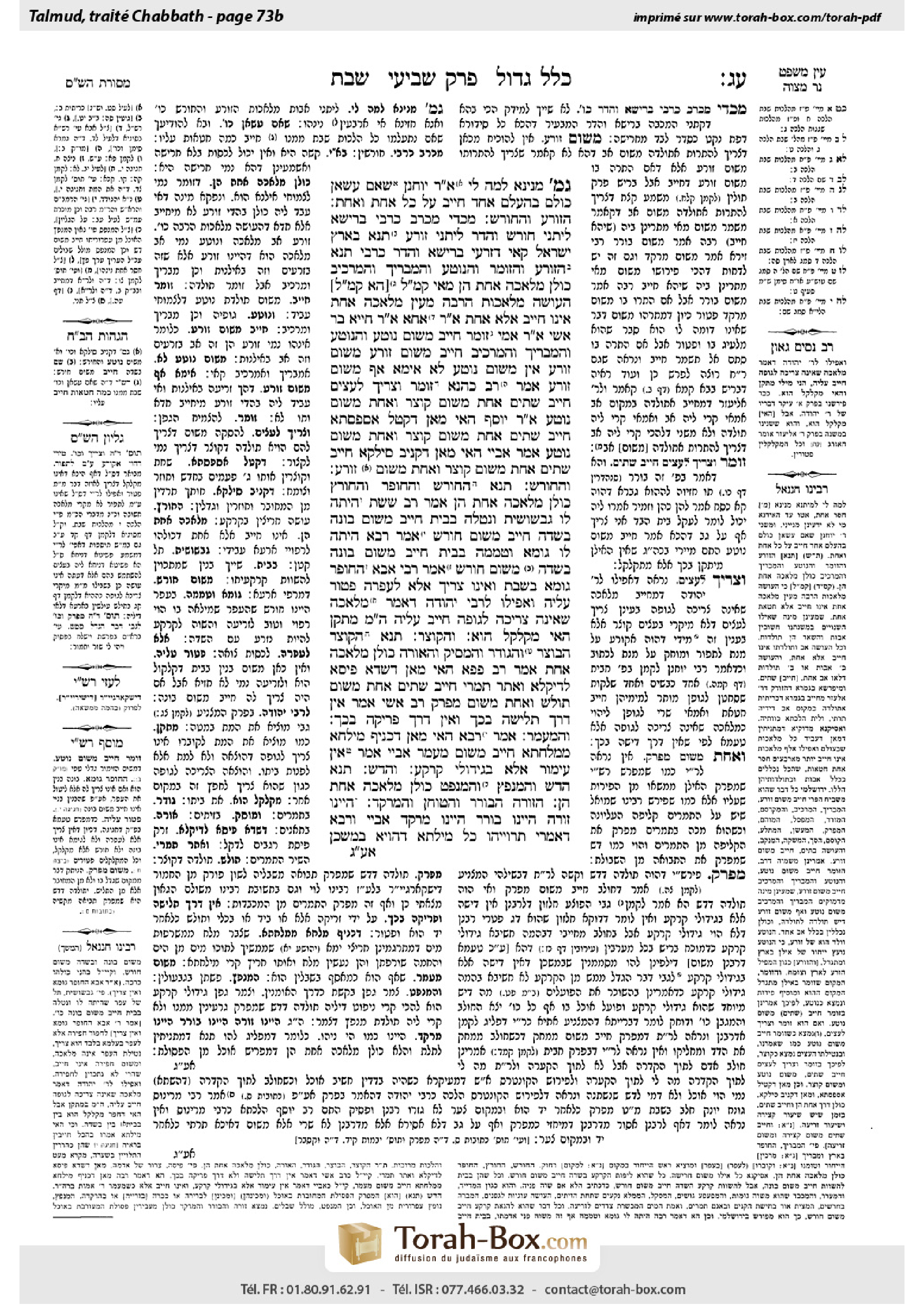
This page of Shabbat includes the Aramaic text, an English translation and an AI-generated French translation, alongside the scan above.
שבת ע״ג ב · Aramaic and Hebrew text
גְּמָ׳ מִנְיָנָא לְמָה לִי? אָמַר רַבִּי יוֹחָנָן: שֶׁאִם עֲשָׂאָן כּוּלָּם בְּהֶעְלֵם אֶחָד — חַיָּיב עַל כׇּל אַחַת וְאַחַת.
הַזּוֹרֵעַ וְהַחוֹרֵשׁ. מִכְּדֵי מִכְרָב כָּרְבִי בְּרֵישָׁא, לִיתְנֵי חוֹרֵשׁ וַהֲדַר לִיתְנֵי זוֹרֵעַ! תַּנָּא בְּאֶרֶץ יִשְׂרָאֵל קָאֵי דְּזָרְעִי בְּרֵישָׁא וַהֲדַר כָּרְבִי.
תָּנָא: הַזּוֹרֵעַ, וְהַזּוֹמֵר, וְהַנּוֹטֵעַ, וְהַמַּבְרִיךְ, וְהַמַּרְכִּיב — כּוּלָּן מְלָאכָה אַחַת הֵן. מַאי קָא מַשְׁמַע לַן? [הָא קָא מַשְׁמַע לַן] הָעוֹשֶׂה מְלָאכוֹת הַרְבֵּה מֵעֵין מְלָאכָה אַחַת אֵינוֹ חַיָּיב אֶלָּא אַחַת. אָמַר רַבִּי אַחָא, אָמַר רַבִּי חִיָּיא בַּר אָשֵׁי, אָמַר רַבִּי אַמֵּי: זוֹמֵר חַיָּיב מִשּׁוּם נוֹטֵעַ, וְהַנּוֹטֵעַ וְהַמַּבְרִיךְ וְהַמַּרְכִּיב חַיָּיב מִשּׁוּם זוֹרֵעַ. מִשּׁוּם זוֹרֵעַ אִין, מִשּׁוּם נוֹטֵעַ לָא? אֵימָא: אַף מִשּׁוּם זוֹרֵעַ.
אָמַר רַב כָּהֲנָא: זוֹמֵר וְצָרִיךְ לָעֵצִים — חַיָּיב שְׁתַּיִם: אַחַת מִשּׁוּם קוֹצֵר, וְאַחַת מִשּׁוּם נוֹטֵעַ. אָמַר רַב יוֹסֵף: הַאי מַאן דְּקָטֵל אַסְפַּסְתָּא חַיָּיב שְׁתַּיִם: אַחַת מִשּׁוּם קוֹצֵר, וְאַחַת מִשּׁוּם נוֹטֵעַ. אָמַר אַבָּיֵי: הַאי מַאן דְּקָנֵיב סִילְקָא חַיָּיב שְׁתַּיִם: אַחַת מִשּׁוּם קוֹצֵר, וְאַחַת מִשּׁוּם זוֹרֵעַ.
וְהַחוֹרֵשׁ. תָּנָא: הַחוֹרֵשׁ וְהַחוֹפֵר וְהַחוֹרֵץ כּוּלָּן מְלָאכָה אַחַת הֵן. אָמַר רַב שֵׁשֶׁת: הָיְתָה לוֹ גַּבְשׁוּשִׁית וּנְטָלָהּ, בַּבַּיִת — חַיָּיב מִשּׁוּם בּוֹנֶה, בַּשָּׂדֶה — חַיָּיב מִשּׁוּם חוֹרֵשׁ. אָמַר רָבָא: הָיְתָה לוֹ גּוּמָּא וּטְמָמָהּ, בַּבַּיִת — חַיָּיב מִשּׁוּם בּוֹנֶה, בַּשָּׂדֶה — מִשּׁוּם חוֹרֵשׁ.
אָמַר רַבִּי אַבָּא: הַחוֹפֵר גּוּמָּא בְּשַׁבָּת וְאֵינוֹ צָרִיךְ אֶלָּא לַעֲפָרָהּ — פָּטוּר עָלֶיהָ. וַאֲפִילּוּ לְרַבִּי יְהוּדָה, דְּאָמַר מְלָאכָה שֶׁאֵינָהּ צְרִיכָה לְגוּפָהּ חַיָּיב עָלֶיהָ — הָנֵי מִילֵּי מְתַקֵּן, הַאי — מְקַלְקֵל הוּא.
וְהַקּוֹצֵר. תָּנָא: הַקּוֹצֵר, הַבּוֹצֵר, וְהַגּוֹדֵר וְהַמַּסִּיק, וְהָאוֹרֶה — כּוּלָּן מְלָאכָה אַחַת. אָמַר רַב פָּפָּא: הַאי מַאן דִּשְׁדָא פִּיסָּא לְדִיקְלָא וְאַתַּר תַּמְרֵי חַיָּיב שְׁתַּיִם: אַחַת מִשּׁוּם תּוֹלֵשׁ, וְאַחַת מִשּׁוּם מְפָרֵק. רַב אָשֵׁי אָמַר: אֵין דֶּרֶךְ תְּלִישָׁה בְּכָךְ, וְאֵין דֶּרֶךְ פְּרִיקָה בְּכָךְ.
וְהַמְעַמֵּר. אָמַר רָבָא: הַאי מַאן דְּכָנֵיף מִילְחָא מִמִּלְחֲתָא חַיָּיב מִשּׁוּם מְעַמֵּר. אַבָּיֵי אָמַר: אֵין עִימּוּר אֶלָּא בְּגִידּוּלֵי קַרְקַע.
וְהַדָּשׁ. תָּנָא: הַדָּשׁ, וְהַמְנַפֵּץ, וְהַמְנַפֵּט — כּוּלָּן מְלָאכָה אַחַת הֵן.
הַזּוֹרֶה, הַבּוֹרֵר, וְהַטּוֹחֵן, וְהַמְרַקֵּד. הַיְינוּ זוֹרֶה, הַיְינוּ בּוֹרֵר, הַיְינוּ מְרַקֵּד. אַבָּיֵי וְרָבָא דְּאָמְרִי תַּרְוַיְיהוּ: כׇּל מִילְּתָא דַּהֲוַאי בְּמִשְׁכָּן,
Shabbat 73b · English translation
GEMARA: We learned in the mishna that the primary categories of labor number forty-less-one. The Gemara asks: Why do I need this tally? Rabbi Yoḥanan said: The tally was included to teach that if he performed all of the prohibited labors in the course of one lapse of awareness, during which he was unaware of the prohibition involved, he is liable for each and every one.
We learned in the mishna, among those liable for performing primary categories of labor: One who sows, and one who plows. The Gemara asks: Since, after all, in terms of plowing, one plows first and only then sows, let the tanna teach first one who plows, and afterward let him teach one who sows. The Gemara answers: The tanna ordered the mishna based on the practice in Eretz Yisrael, where they sow first and then plow. In Eretz Yisrael, the practice was to plow a second time after sowing to cover the seeds.
A baraita is taught with regard to the prohibited labor of sowing: One who sows, and one who prunes the branches of vines to accelerate their growth, and one who plants, and one who bends the branch of a vine or a tree into the ground so that it takes root while still attached to the trunk, and one who grafts the branch of one tree onto another have all performed one type of labor, as they all stimulate plant growth. The Gemara asks: What is the baraita teaching us? The Gemara explains: This teaches us that one who unwittingly performs numerous prohibited labors subsumed under a single primary category of labor, like those listed in the baraita, is liable to bring only one sin-offering, since they are considered aspects of the same labor. Rabbi Aḥa said that Rabbi Ḥiyya bar Ashi said that Rabbi Ami said: One who prunes is liable for the labor of planting. And one who plants, and one who bends, and one who grafts is liable for the labor of sowing. The Gemara is surprised at this: Is that to say that one who bends and one who grafts a branch, for sowing, yes, he is liable; for planting, no, he is not liable? These labors, performed on trees, are more similar to planting. Rather, say as follows: One is liable even for sowing, as with regard to the halakhot of Shabbat there is no difference between sowing and planting.
Rav Kahana said: One who prunes a tree and needs the wood that he hewed from the tree for fuel or some other purpose is liable to bring two sin-offerings: One sin-offering due to the labor of reaping, like anyone who severs an item from the ground for the purpose of harvesting the detached object, and one sin-offering due to the labor of planting, since he thereby stimulates growth of the plant. Similarly, Rav Yosef said: One who reaps alfalfa is liable to bring two sin-offerings: One due to reaping, since he is cutting the plant for animal feed, and one due to planting, since cutting stimulates the growth of the alfalfa. Similarly, Abaye said: One who cuts beet leaves is liable to bring two sin-offerings: One due to reaping and one due to sowing.
We learned in the mishna among those liable for performing primary categories of labor: One who plows. A tanna taught in a baraita with regard to the labor of plowing: One who plows, and one who digs, and one who makes a furrow in the ground have all performed one type of labor. Rav Sheshet said: One who had a mound of earth and removed it in the house, thereby evening the surface, is liable due to the labor of building, as he thereby engages in construction of the house. In the field, he is liable due to the labor of plowing. Similarly, Rava said: One who had a hole and filled it, in the house he is liable due to the labor of building. In the field, he is liable due to the labor of plowing.
Rabbi Abba said: One who digs a hole on Shabbat and digs the hole only because he needs its dirt is exempt for that act, which is not the labor of digging prohibited on Shabbat by Torah law. And even according to Rabbi Yehuda, who said that in general one who performs labor that is not necessary for its own sake, i.e., he performs the labor for a purpose other than the direct result of that action, is liable for it; that ruling applies only to a purpose that is constructive. However, this purpose is destructive, as one performs an act that unnecessarily mars the surface of the ground. Therefore, Rabbi Yehuda would agree that in this case he is exempt.
And we learned in the mishna, among those liable for performing primary categories of labor: One who reaps. It was taught in a Tosefta with regard to the labor of reaping: One who reaps, and one who picks grapes, and one who harvests dates, and one who collects olives, and one who gathers figs have all performed one type of labor, as they all involve picking fruit. Rav Pappa said: One who threw a clod of earth at a palm tree and severed dates is liable to bring two sin-offerings: One due to severing, which is a subcategory of the primary category of reaping; and one for extracting, which is a subcategory of the primary category of threshing, as he removes something edible, the date, from its cover, its cluster. Rav Ashi said: In that case, one is exempt, since that is not the typical manner of severing, and that is not the typical manner of extracting, and one who performs a labor in an atypical manner is exempt.
And we learned in the mishna, among those liable for performing primary categories of labor: One who gathers. Rava said: One who gathers salt from salt pools is liable due to the labor of gathering, as he gathers a substance from the field into a pile. Abaye said: That is not so, as the prohibition of gathering by Torah law applies only to produce that grows from the ground.
And we learned in the mishna, among those liable for performing primary categories of labor: One who threshes. A tanna taught in a Tosefta: One who threshes, and one who beats flax to remove it from the hard cover of its stalk, and one who strikes a cotton plant to remove the cotton seeds have all performed one type of labor.
And we learned in the mishna, among those liable for performing primary categories of labor: One who winnows, and one who selects, and one who grinds, and one who sifts. The Gemara asks: The prohibited labor of winnowing is the same as the prohibited labor of selecting, which is the same as the prohibited labor of sifting. They are all identical in the manner in which they are performed and have the same objective: Separating food from the accompanying waste. Why was it necessary to list them all? An answer was provided by Abaye and Rava, who both said and established a principle: Any manner of labor that was performed in the Tabernacle, for the purposes of the Tabernacle,
Shabbat 73b · Traduction française (IA)
GUEMARA : Nous avons appris dans la Michna que les catégories principales de travaux sont au nombre de trente-neuf. La Guemara demande : Pourquoi cette énumération est-elle nécessaire ? Rabbi Yoḥanan a dit : Elle a été incluse pour enseigner que si quelqu’un accomplit tous les travaux interdits au cours d’une seule inadvertance, durant laquelle il ignorait l’interdiction en cause, il est passible d’un sacrifice expiatoire pour chacun d’eux.
Nous avons appris dans la Michna, parmi ceux qui sont passibles pour avoir accompli des catégories principales de travaux : celui qui sème et celui qui laboure. La Guemara demande : Puisque, en matière de labour, on laboure d’abord et l’on sème ensuite, que le tanna enseigne d’abord celui qui laboure, puis celui qui sème. La Guemara répond : Le tanna a ordonné la Michna selon la pratique en Terre d’Israël, où l’on sème d’abord, puis on laboure. En Terre d’Israël, on avait l’habitude de labourer une seconde fois après les semailles afin de recouvrir les graines.
Une baraïta est enseignée au sujet du travail interdit consistant à semer : celui qui sème, celui qui taille les branches des vignes pour accélérer leur croissance, celui qui plante, celui qui couche la branche d’une vigne ou d’un arbre dans la terre afin qu’elle prenne racine tout en restant attachée au tronc, et celui qui greffe la branche d’un arbre sur un autre ont tous accompli un seul type de travail, car ils stimulent tous la croissance des plantes. La Guemara demande : Que nous enseigne la baraïta ? La Guemara explique : Elle nous enseigne que celui qui accomplit par inadvertance de nombreux travaux interdits relevant d’une même catégorie principale, comme ceux énumérés dans la baraïta, n’est tenu d’apporter qu’un seul sacrifice expiatoire, puisqu’ils sont considérés comme des aspects d’un même travail. Rabbi Aḥa a dit que Rabbi Ḥiyya bar Ashi a dit que Rabbi Ami a dit : Celui qui taille est passible au titre du travail de planter. Et celui qui plante, qui couche une branche ou qui greffe est passible au titre du travail de semer. La Guemara s’en étonne : Cela signifie-t-il que celui qui couche une branche ou qui la greffe est passible pour semer, mais pas pour planter ? Ces travaux, effectués sur des arbres, ressemblent davantage à la plantation. Il faut plutôt dire ainsi : il est passible même pour semer, car, concernant les halakhot de Chabbat, il n’y a pas de différence entre semer et planter.
Rav Kahana a dit : Celui qui taille un arbre et a besoin du bois qu’il en a coupé comme combustible ou pour un autre usage est passible de deux sacrifices expiatoires : un sacrifice expiatoire au titre du travail de moissonner, comme quiconque détache un élément du sol afin de récolter l’objet détaché, et un sacrifice expiatoire au titre du travail de planter, puisqu’il stimule ainsi la croissance de la plante. De même, Rav Yosef a dit : Celui qui récolte de la luzerne est passible de deux sacrifices expiatoires : l’un pour moissonner, puisqu’il coupe la plante pour nourrir les animaux, et l’autre pour planter, puisque la coupe stimule la croissance de la luzerne. De même, Abaye a dit : Celui qui coupe des feuilles de betterave est passible de deux sacrifices expiatoires : l’un pour moissonner et l’autre pour semer.
Nous avons appris dans la Michna, parmi ceux qui sont passibles pour avoir accompli des catégories principales de travaux : celui qui laboure. Un tanna a enseigné dans une baraïta au sujet du travail de labourer : celui qui laboure, celui qui creuse et celui qui trace un sillon dans le sol ont tous accompli un seul type de travail. Rav Sheshet a dit : Celui qui avait un monticule de terre et l’enlève dans la maison, nivelant ainsi la surface, est passible au titre du travail de construire, car il participe ainsi à la construction de la maison. Dans un champ, il est passible au titre du travail de labourer. De même, Rava a dit : Celui qui avait un trou et le comble est passible, dans une maison, au titre du travail de construire. Dans un champ, il est passible au titre du travail de labourer.
Rabbi Abba a dit : Celui qui creuse un trou pendant Chabbat uniquement parce qu’il a besoin de la terre qu’il en retire est exempt pour cet acte, qui ne constitue pas le travail de creuser interdit par la Torah pendant Chabbat. Même selon Rabbi Yehuda, qui a dit qu’en général, celui qui accomplit un travail qui n’est pas nécessaire en lui-même, c’est-à-dire qu’il l’accomplit dans un but autre que le résultat direct de cet acte, en est passible, cette règle ne s’applique qu’à un but constructif. Or, ce but est destructif, puisque l’on accomplit un acte qui détériore inutilement la surface du sol. Rabbi Yehuda conviendrait donc que, dans ce cas, il est exempt.
Nous avons aussi appris dans la Michna, parmi ceux qui sont passibles pour avoir accompli des catégories principales de travaux : celui qui moissonne. Une Tosefta enseigne au sujet du travail de moissonner : celui qui moissonne, celui qui cueille des raisins, celui qui récolte des dattes, celui qui ramasse des olives et celui qui cueille des figues ont tous accompli un seul type de travail, car tous impliquent de cueillir des fruits. Rav Pappa a dit : Celui qui lance une motte de terre contre un palmier et en détache des dattes est passible de deux sacrifices expiatoires : l’un pour le détachement, qui est une sous-catégorie de la catégorie principale de moissonner, et l’autre pour l’extraction, qui est une sous-catégorie de la catégorie principale de battre, puisqu’il retire un aliment, la datte, de son enveloppe, la grappe. Rav Ashi a dit : Dans ce cas, il est exempt, car ce n’est pas la manière habituelle de détacher, ni celle d’extraire ; or, celui qui accomplit un travail d’une manière inhabituelle est exempt.
Nous avons aussi appris dans la Michna, parmi ceux qui sont passibles pour avoir accompli des catégories principales de travaux : celui qui rassemble. Rava a dit : Celui qui recueille du sel dans des marais salants est passible au titre du travail de rassembler, car il rassemble une substance provenant du champ pour en faire un tas. Abaye a dit : Ce n’est pas le cas, car l’interdiction de rassembler selon la Torah ne s’applique qu’aux produits qui poussent dans le sol.
Nous avons aussi appris dans la Michna, parmi ceux qui sont passibles pour avoir accompli des catégories principales de travaux : celui qui bat. Un tanna a enseigné dans une Tosefta : celui qui bat, celui qui frappe le lin pour le séparer de l’enveloppe dure de sa tige, et celui qui frappe une plante de coton pour en retirer les graines de coton ont tous accompli un seul type de travail.
Nous avons aussi appris dans la Michna, parmi ceux qui sont passibles pour avoir accompli des catégories principales de travaux : celui qui vanne, celui qui trie, celui qui moud et celui qui tamise. La Guemara demande : Le travail interdit de vanner est identique au travail interdit de trier, qui est lui-même identique au travail interdit de tamiser. Ils s’accomplissent tous de la même manière et ont le même objectif : séparer les aliments des déchets qui les accompagnent. Pourquoi était-il nécessaire de tous les énumérer ? Abaye et Rava ont tous deux apporté une réponse et établi un principe : tout mode de travail qui a été accompli dans le Tabernacle, pour les besoins du Tabernacle,
Traduction française générée par IA à partir de l’édition anglaise de Sefaria. Vérifie toujours un passage avec le texte source.
Text from Sefaria: William Davidson Edition - Vocalized Aramaic (CC BY NC); William Davidson Edition - English (CC BY NC).