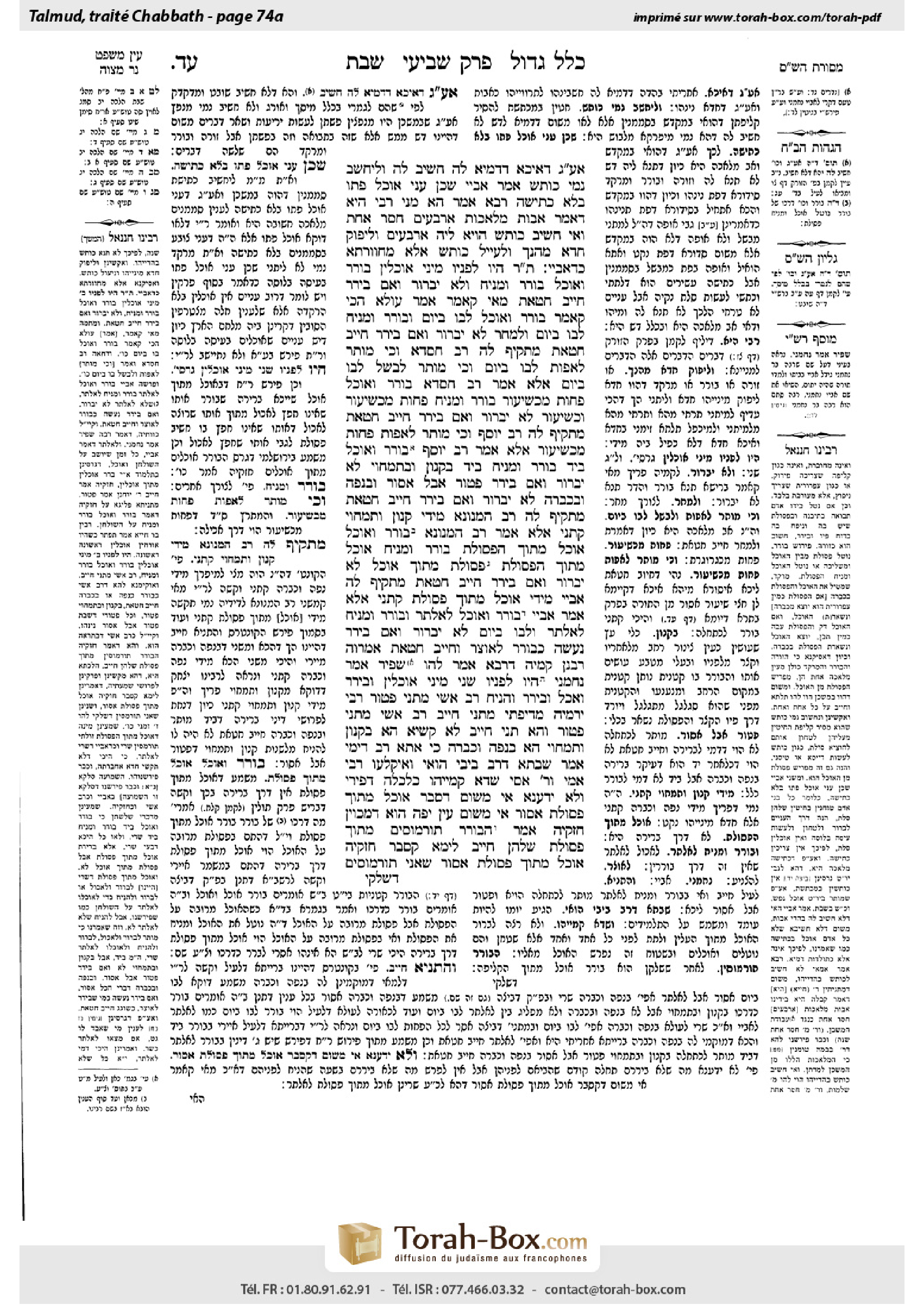
Shabbat 74a: Talmud study for Daf Yomi
Daf Yomi is the daily study of one Talmud folio. Explore 37 tractates with scans, Hebrew text, Sefaria English and AI-generated French translations where annotated.
Passage selection and English or AI-generated French translation are available where the scan has annotations. Daf Study is independent of Torah-Box and Sefaria.
Browse Shabbat · שבת · All tractatesShabbat 74a text and translations
This page of Shabbat includes the Aramaic text, an English translation and an AI-generated French translation, alongside the scan above.
שבת ע״ד א · Aramaic and Hebrew text
אַף עַל גַּב דְּאִיכָּא דְּדָמְיָא לַהּ — חָשֵׁיב לַהּ. וְלִיחְשֹׁב נָמֵי כּוֹתֵשׁ! אָמַר אַבָּיֵי: שֶׁכֵּן עָנִי אוֹכֵל פִּתּוֹ בְּלֹא כְּתִישָׁה. רָבָא אָמַר: הָא מַנִּי — רַבִּי הִיא, דְּאָמַר אֲבוֹת מְלָאכוֹת אַרְבָּעִים חָסֵר אַחַת, וְאִי חָשֵׁיב כּוֹתֵשׁ הָוְיָא לֵיהּ אַרְבָּעִים. וְלַיפֵּיק חֲדָא מֵהָנָךְ וּלְעַיֵּיל כּוֹתֵשׁ! אֶלָּא מְחַוַּורְתָּא כִּדְאַבָּיֵי.
תָּנוּ רַבָּנַן: הָיוּ לְפָנָיו מִינֵי אוֹכָלִין — בּוֹרֵר וְאוֹכֵל, בּוֹרֵר וּמַנִּיחַ. וְלֹא יִבְרוֹר, וְאִם בֵּירַר — חַיָּיב חַטָּאת. מַאי קָאָמַר? אָמַר עוּלָּא, הָכִי קָאָמַר: בּוֹרֵר וְאוֹכֵל לְבוֹ בַּיּוֹם, וּבוֹרֵר וּמַנִּיחַ לְבוֹ בַּיּוֹם. וּלְמָחָר לֹא יִבְרוֹר, וְאִם בֵּירַר — חַיָּיב חַטָּאת. מַתְקִיף לַהּ רַב חִסְדָּא: וְכִי מוּתָּר לֶאֱפוֹת לְבוֹ בַּיּוֹם? וְכִי מוּתָּר לְבַשֵּׁל לְבוֹ בַּיּוֹם?
אֶלָּא אָמַר רַב חִסְדָּא: בּוֹרֵר וְאוֹכֵל פָּחוֹת מִכְּשִׁיעוּר, בּוֹרֵר וּמַנִּיחַ פָּחוֹת מִכְּשִׁיעוּר. וּכְשִׁיעוּר לֹא יִבְרוֹר, וְאִם בֵּירַר — חַיָּיב חַטָּאת. מַתְקִיף לַהּ רַב יוֹסֵף: וְכִי מוּתָּר לֶאֱפוֹת פָּחוֹת מִכְּשִׁיעוּר? אֶלָּא אָמַר רַב יוֹסֵף: בּוֹרֵר וְאוֹכֵל בַּיָּד, בּוֹרֵר וּמַנִּיחַ בַּיָּד. בְּקָנוֹן וּבְתַמְחוּי לֹא יִבְרוֹר, וְאִם בֵּירַר — פָּטוּר אֲבָל אָסוּר, וּבְנָפָה וּבִכְבָרָה לֹא יִבְרוֹר, וְאִם בֵּירַר — חַיָּיב חַטָּאת.
מַתְקִיף לַהּ רַב הַמְנוּנָא: מִידֵּי קָנוֹן וְתַמְחוּי קָתָנֵי? אֶלָּא אָמַר רַב הַמְנוּנָא: בּוֹרֵר וְאוֹכֵל אוֹכֶל מִתּוֹךְ הַפְּסוֹלֶת, בּוֹרֵר וּמַנִּיחַ אוֹכֶל מִתּוֹךְ הַפְּסוֹלֶת. פְּסוֹלֶת מִתּוֹךְ אוֹכֶל לֹא יִבְרוֹר, וְאִם בֵּירַר — חַיָּיב חַטָּאת. מַתְקִיף לַהּ אַבָּיֵי: מִידֵּי אוֹכֶל מִתּוֹךְ פְּסוֹלֶת קָתָנֵי? אֶלָּא אָמַר אַבָּיֵי: בּוֹרֵר וְאוֹכֵל לְאַלְתַּר, וּבוֹרֵר וּמַנִּיחַ לְאַלְתַּר, וּלְבוֹ בַּיּוֹם — לֹא יִבְרוֹר, וְאִם בֵּירַר — נַעֲשָׂה כְּבוֹרֵר לָאוֹצָר וְחַיָּיב חַטָּאת. אַמְרוּהָ רַבָּנַן קַמֵּיהּ דְּרָבָא, אֲמַר לְהוּ: שַׁפִּיר אָמַר נַחְמָנִי.
הָיוּ לְפָנָיו שְׁנֵי מִינֵי אוֹכָלִין, וּבֵירַר וְאָכַל, וּבֵירַר וְהִנִּיחַ. רַב אָשֵׁי מַתְנֵי: פָּטוּר, רַבִּי יִרְמְיָה מִדִּיפְתִּי מַתְנֵי: חַיָּיב. רַב אָשֵׁי מַתְנֵי פָּטוּר, וְהָא תָּנֵי חַיָּיב! לָא קַשְׁיָא: הָא בְּקָנוֹן וְתַמְחוּי, הָא בְּנָפָה וּכְבָרָה.
כִּי אֲתָא רַב דִּימִי, אָמַר: שַׁבְּתָא דְּרַב בִּיבִי הֲוַאי, וְאִיקְּלַעוּ רַבִּי אַמֵּי וְרַבִּי אַסִּי, שְׁדָא קַמַּיְיהוּ כַּלְכַּלָּה דְפֵירֵי. וְלָא יָדַעְנָא אִי מִשּׁוּם דְּסָבַר אוֹכֶל מִתּוֹךְ פְּסוֹלֶת אָסוּר, אִי מִשּׁוּם עַיִן יָפָה הוּא דְּמִכַּוֵּין.
חִזְקִיָּה אָמַר: הַבּוֹרֵר תּוּרְמוֹסִים מִתּוֹךְ פְּסוֹלֶת שֶׁלָּהֶן — חַיָּיב. לֵימָא קָסָבַר חִזְקִיָּה אוֹכֶל מִתּוֹךְ פְּסוֹלֶת אָסוּר? שָׁאנֵי תּוּרְמוֹסָא
Shabbat 74a · English translation
even though there is a different labor that is similar to it, the mishna enumerated it. Every labor that was performed in the Tabernacle is significant. The Gemara asks: And let him enumerate the labor of pounding as well, as wheat was pounded to remove its outer kernel in the Tabernacle. Abaye said: The labor of pounding is not one of the essential stages in the baking of bread, as paupers eat their bread without pounding the wheat to remove the bran. Therefore, since the tanna enumerated threshing, there was no need to include pounding among the labors enumerated in the breadmaking process. Rava said a different explanation: Who is the tanna of this mishna? It is Rabbi Yehuda HaNasi, who said: The primary categories of labor are forty-less-one, a number derived from a textual allusion. Therefore, the list cannot be expanded. And had the tanna enumerated pounding, there would be forty labors rather than thirty-nine. The Gemara asks: And let him take out one of these, selecting or winnowing, and insert pounding, thereby leaving the number intact. Rather, the reason that the tanna did not include pounding is clear, according to the explanation of Abaye.
The Sages taught in a baraita with regard to the laws of selecting: If there were several types of food before him, and he wants to remove one or more from the mixture, one selects and eats, selects and puts aside. And one may not select, and if one did select, he is liable to bring a sin-offering. The Gemara asks: What is the baraita saying? The end of this baraita contradicts the beginning. Ulla said: It is saying as follows: One selects and eats if he is doing so for the purpose of that day, Shabbat. And he selects and puts aside food for the purpose of that day. And one may not select for the purpose of the next day. And if one did select for the next day, he is liable to bring a sin-offering. Rav Ḥisda strongly objects to this explanation: And is it permitted to bake for that day, and is it permitted to cook for that day? No other labor prohibited on Shabbat may be performed for the purpose of Shabbat, and the same should hold true for selecting.
Rather, Rav Ḥisda said it is to be understood as follows: One selects and eats less than the measure of a dried fig-bulk, which is the smallest amount for which one is liable by Torah law. One selects and puts aside less than that measure. And one may not select the measure of a dried fig-bulk, and if one did select that measure, he is liable to bring a sin-offering. Rav Yosef strongly objects to this explanation: And is it permitted to bake less than the measure for liability ab initio? Although performing a prohibited labor on a minute measure does not engender liability, it is prohibited. Therefore, the baraita cannot be interpreted as saying that one may ab initio select an amount that is less than the measure for liability. Rather, Rav Yosef said: One selects and eats by hand, selects and put aside by hand. However, with a basket [kanon] or with a plate, both of which are large, flat vessels used for sorting sizeable quantities, one may not select ab initio. And if he did select, he is exempt from bringing a sin-offering if he did so unwittingly. If he did so intentionally he is exempt from stoning. However, it is prohibited. And one may not select with a sieve or with a sifter. And if he did select with those utensils, he is liable to bring a sin-offering.
Rav Hamnuna strongly objects to this: Does the mishna teach anything about a basket or a plate? Rav Yosef’s explanation is based on the addition of details that do not appear in the baraita either. Rather, Rav Hamnuna said: One selects and eats if he is removing food from the waste, and similarly, selects and puts aside if he is removing food from the waste. However, one may not select waste from food, and if he did select in that manner, he is liable to bring a sin-offering. The typical method of selecting is the removal of waste from the food. An individual who alters the procedure is not liable. Abaye strongly objects to this: Does the mishna teach anything about food from waste? That detail is not mentioned in the baraita either. Rather, Abaye said: One selects and eats if he is removing food for immediate use, and similarly one selects and puts aside for immediate use. However, one may not select for use later that same day. And if he did select, he is considered like one who selects for storage, and he is liable to bring a sin-offering. This explanation requires no emendation of the mishna. It is merely an interpretation of the phrase: One selects and eats, as referring to selecting for immediate use. The Gemara relates that the Sages stated Abaye’s explanation of the baraita before Rava. He said to them: Naḥmani, Abaye, spoke well.
Until this point, the Gemara discussed selecting food from waste. The Gemara proceeds to discuss a different case. If there were two types of foods before him, and he selected and ate one type, and selected and put aside one type, Rav Ashi taught: He is exempt. Rav Yirmeya from Difti taught: He is liable. Rav Ashi taught: He is exempt. The Gemara asks: Wasn’t it taught in a baraita that in that case he is liable? The Gemara answers: This is not difficult: This, where Rav Ashi said that he is exempt, is referring to a case where he selects by means of a basket or a plate, as that method of selecting is not considered expert work; and that, where the baraita said he is liable, is in a case where he selects by means of a sieve or a sifter, as that method of selecting is considered expert work.
The Gemara relates that when Rav Dimi came from Eretz Yisrael to Babylonia he said: It was the Shabbat of Rav Beivai to serve food to the students, and Rabbi Ami and Rabbi Asi happened to come to his house. He placed before them a basket of fruits without removing the leaves and the stems. And I do not know whether he did so because he holds that it is prohibited to select food from waste when it is not for immediate consumption, or whether he did so because he intended to show generosity to his guests by creating the impression that the basket was full. A fruit-filled basket conveys to the guests that there is plenty and that they may take as much as they wish. Therefore, there is no clear proof from this incident.
Ḥizkiya said: One who selects lupines from their waste after boiling them is liable for performing the prohibited labor of selecting. The Gemara asks: Let us say, based on this statement, that Ḥizkiya holds that even selecting food from waste is prohibited. The Gemara rejects this proof: Lupines are different,
Shabbat 74a · Traduction française (IA)
Bien qu’il existe un autre travail qui lui ressemble, la Michna l’a néanmoins énuméré. Tout travail effectué dans le Tabernacle a son importance. La Guemara demande : Pourquoi ne pas énumérer également le pilage, puisque l’on pilait le blé dans le Tabernacle pour en retirer l’enveloppe extérieure ? Abaye dit : Le pilage ne fait pas partie des étapes essentielles de la fabrication du pain, car les pauvres mangent leur pain sans piler le blé pour en retirer le son. Par conséquent, puisque le tanna a énuméré le battage, il n’était pas nécessaire d’inclure le pilage parmi les travaux énumérés dans le processus de fabrication du pain. Rava donne une autre explication : Qui est le tanna de cette Michna ? C’est Rabbi Yehouda HaNassi, qui a dit que les catégories principales de travaux sont au nombre de trente-neuf, nombre déduit d’une allusion dans le texte. La liste ne peut donc pas être élargie. En effet, si le tanna avait énuméré le pilage, il y aurait eu quarante travaux au lieu de trente-neuf. La Guemara demande : Pourquoi ne pas en retirer un, le tri ou le vannage, et y ajouter le pilage, de sorte que le nombre reste inchangé ? Il est donc clair que la raison pour laquelle le tanna n’a pas inclus le pilage est celle qu’expose Abaye.
Les Sages ont enseigné dans une baraïta au sujet des lois du tri : Si plusieurs sortes d’aliments se trouvent devant quelqu’un et qu’il veut en retirer un ou plusieurs du mélange, il trie et mange, il trie et met de côté. Mais il ne doit pas trier ; s’il a trié, il est tenu d’apporter un sacrifice expiatoire. La Guemara demande : Que dit cette baraïta ? Sa conclusion contredit son début. Oulla dit : Voici ce qu’elle veut dire : On trie et on mange pour les besoins de ce jour, le Chabbat. On trie et on met de côté des aliments pour les besoins de ce jour. Mais on ne doit pas trier pour les besoins du lendemain. Si l’on a trié pour les besoins du lendemain, on est tenu d’apporter un sacrifice expiatoire. Rav Ḥisda s’oppose vivement à cette explication : Est-il donc permis de cuire au four pour ce jour ? Et est-il permis de cuisiner pour ce jour ? Aucun autre travail interdit le Chabbat ne peut être effectué pour les besoins du Chabbat, et il devrait en être de même pour le tri.
Rav Ḥisda dit plutôt qu’il faut comprendre ainsi : On trie et on mange une quantité inférieure au volume d’une figue sèche, qui est la quantité minimale engageant la responsabilité selon la Torah. On trie et on met de côté une quantité inférieure à cette mesure. Mais on ne doit pas trier le volume d’une figue sèche ; si l’on a trié cette quantité, on est tenu d’apporter un sacrifice expiatoire. Rav Yossef s’oppose vivement à cette explication : Est-il donc permis, a priori, de cuire au four une quantité inférieure à la mesure engageant la responsabilité ? Même si l’exécution d’un travail interdit sur une quantité infime n’engage pas la responsabilité, elle reste interdite. La baraïta ne peut donc pas être interprétée comme autorisant, a priori, à trier une quantité inférieure à la mesure engageant la responsabilité. Rav Yossef dit plutôt : On trie et on mange à la main, on trie et on met de côté à la main. En revanche, on ne doit pas trier, a priori, à l’aide d’un panier [kanon] ou d’un plateau, deux grands récipients plats utilisés pour trier de grandes quantités. Si l’on a trié ainsi, on est quitte d’apporter un sacrifice expiatoire si on l’a fait par inadvertance. Si on l’a fait intentionnellement, on est quitte de la lapidation. Toutefois, cela reste interdit. On ne doit pas trier avec un tamis ni avec un crible. Si l’on a trié à l’aide de ces ustensiles, on est tenu d’apporter un sacrifice expiatoire.
Rav Hamnouna s’oppose vivement à cela : La Michna enseigne-t-elle quoi que ce soit au sujet d’un panier ou d’un plateau ? L’explication de Rav Yossef repose elle aussi sur l’ajout de détails qui ne figurent pas dans la baraïta. Rav Hamnouna dit plutôt : On trie et on mange si l’on retire les aliments des déchets ; de même, on trie et on met de côté si l’on retire les aliments des déchets. Mais on ne doit pas retirer les déchets des aliments ; si l’on a trié de cette manière, on est tenu d’apporter un sacrifice expiatoire. La méthode habituelle du tri consiste à retirer les déchets des aliments. Celui qui modifie la procédure n’est pas passible. Abaye s’oppose vivement à cela : La Michna enseigne-t-elle quoi que ce soit au sujet du tri des aliments parmi les déchets ? Ce détail ne figure pas non plus dans la baraïta. Abaye dit plutôt : On trie et on mange si l’on retire des aliments pour les consommer immédiatement ; de même, on trie et on met de côté pour une consommation immédiate. Mais on ne doit pas trier pour une utilisation ultérieure le même jour. Si l’on a trié ainsi, on est considéré comme quelqu’un qui trie pour conserver, et l’on est tenu d’apporter un sacrifice expiatoire. Cette explication ne nécessite aucune correction de la Michna. Elle interprète simplement l’expression « on trie et on mange » comme désignant le tri effectué pour une consommation immédiate. La Guemara rapporte que les Sages exposèrent l’explication d’Abaye sur la baraïta devant Rava. Il leur dit : « Naḥmani, Abaye, a bien parlé. »
Jusqu’ici, la Guemara a traité du tri des aliments parmi les déchets. Elle passe à un autre cas. Si deux sortes d’aliments se trouvent devant quelqu’un, et qu’il trie puis mange une sorte, puis trie et met de côté une autre sorte, Rav Ashi enseigne : Il est quitte. Rav Yirmeya de Difti enseigne : Il est passible. Rav Ashi enseigne : Il est quitte. La Guemara demande : N’a-t-on pas enseigné dans une baraïta que, dans ce cas, il est passible ? La Guemara répond : Il n’y a pas de difficulté : le cas où Rav Ashi dit qu’il est quitte concerne un tri effectué au moyen d’un panier ou d’un plateau, car cette manière de trier n’est pas considérée comme un travail spécialisé ; tandis que le cas où la baraïta dit qu’il est passible concerne un tri effectué au moyen d’un tamis ou d’un crible, car cette manière de trier est considérée comme un travail spécialisé.
La Guemara rapporte que, lorsque Rav Dimi vint d’Eretz Israël en Babylonie, il dit : C’était le Chabbat où Rav Beivai devait servir le repas aux étudiants, et Rabbi Ami ainsi que Rabbi Asi se trouvaient par hasard chez lui. Il posa devant eux un panier de fruits sans en retirer les feuilles ni les tiges. Je ne sais pas s’il agit ainsi parce qu’il considère qu’il est interdit de trier les aliments parmi les déchets lorsqu’ils ne sont pas destinés à une consommation immédiate, ou s’il le fit parce qu’il voulait témoigner de sa générosité envers ses invités en donnant l’impression que le panier était plein. Un panier rempli de fruits fait comprendre aux invités qu’il y en a en abondance et qu’ils peuvent en prendre autant qu’ils le souhaitent. Cet épisode ne constitue donc pas une preuve concluante.
Ḥizkiya dit : Celui qui trie des lupins pour les séparer de leurs déchets après les avoir fait bouillir est passible pour avoir accompli le travail interdit de tri. La Guemara demande : Ne peut-on pas déduire de cette déclaration que Ḥizkiya considère que même le tri des aliments parmi les déchets est interdit ? La Guemara rejette cette preuve : Les lupins sont différents,
Traduction française générée par IA à partir de l’édition anglaise de Sefaria. Vérifie toujours un passage avec le texte source.
Text from Sefaria: William Davidson Edition - Vocalized Aramaic (CC BY NC); William Davidson Edition - English (CC BY NC).