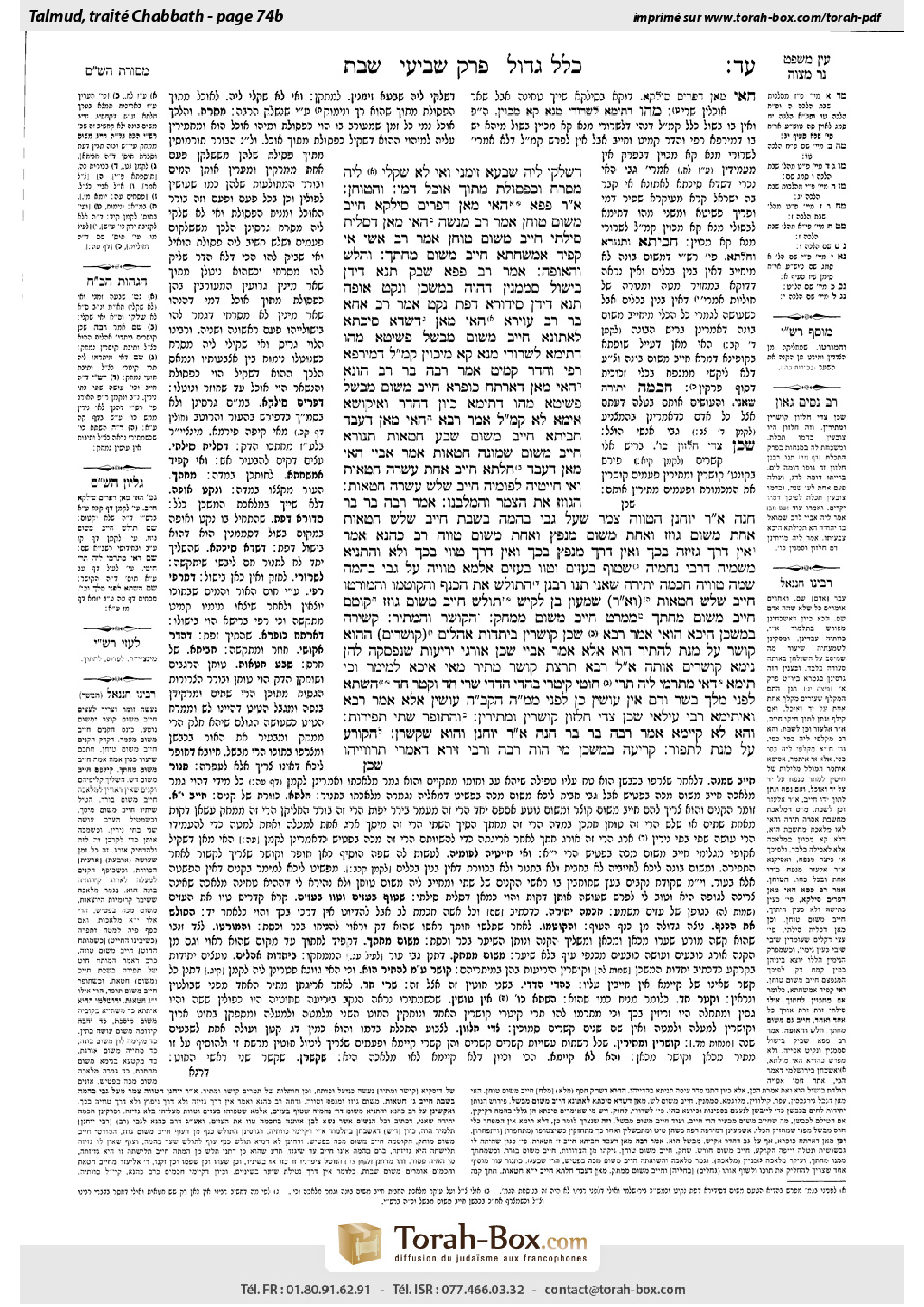
Shabbat 74b: Talmud study for Daf Yomi
Daf Yomi is the daily study of one Talmud folio. Explore 37 tractates with scans, Hebrew text, Sefaria English and AI-generated French translations where annotated.
Passage selection and English or AI-generated French translation are available where the scan has annotations. Daf Study is independent of Torah-Box and Sefaria.
Browse Shabbat · שבת · All tractatesShabbat 74b text and translations
This page of Shabbat includes the Aramaic text, an English translation and an AI-generated French translation, alongside the scan above.
שבת ע״ד ב · Aramaic and Hebrew text
דְּשָׁלְקִי לֵיהּ שִׁבְעָא זִימְנֵי, וְאִי לָא שָׁקְלִי לֵיהּ מַסְרַח — וְכִפְסוֹלֶת מִתּוֹךְ אוֹכֶל דָּמֵי.
וְהַטּוֹחֵן. אָמַר רַב פָּפָּא: הַאי מַאן דְּפָרֵים סִילְקָא — חַיָּיב מִשּׁוּם טוֹחֵן. אָמַר רַב מְנַשֶּׁה: הַאי מַאן דְּסָלֵית סִילְתֵּי — חַיָּיב מִשּׁוּם טוֹחֵן. אָמַר רַב אָשֵׁי: אִי קָפֵיד אַמִּשְׁחֲתָא — חַיָּיב מִשּׁוּם מְחַתֵּךְ.
וְהַלָּשׁ וְהָאוֹפֶה. אָמַר רַב פָּפָּא: שְׁבַק תַּנָּא דִידַן בִּישּׁוּל סַמְמָנִין דַּהֲוָה בְּמִשְׁכָּן וּנְקַט אוֹפֶה?! תַּנָּא דִידַן סִידּוּרָא דְפַת נָקֵט.
אָמַר רַב אַחָא בַּר רַב עַוִּירָא: הַאי מַאן דִּשְׁדָא סִיכְּתָא לְאַתּוּנָא — חַיָּיב מִשּׁוּם מְבַשֵּׁל. פְּשִׁיטָא! מַהוּ דְּתֵימָא לְשָׁרוֹרֵי מָנָא קָא מִיכַּוֵין, קָא מַשְׁמַע לַן דְּמִירְפָּא רָפֵי וַהֲדַר קָמֵיט. אָמַר רַבָּה בַּר רַב הוּנָא: הַאי מַאן דְּאַרְתַּח כּוּפְרָא — חַיָּיב מִשּׁוּם מְבַשֵּׁל. פְּשִׁיטָא! מַהוּ דְּתֵימָא כֵּיוָן דַּהֲדַר וְאִיקִּישׁ אֵימָא לָא, קָא מַשְׁמַע לַן.
אָמַר רָבָא: הַאי מַאן דַּעֲבַד חָבִיתָא — חַיָּיב מִשּׁוּם שֶׁבַע חַטָּאוֹת. תַּנּוּרָא — חַיָּיב מִשּׁוּם שְׁמוֹנֶה חַטָּאוֹת. אָמַר אַבָּיֵי: הַאי מַאן דַּעֲבַד חַלְּתָא — חַיָּיב אַחַת עֶשְׂרֵה חַטָּאוֹת. וְאִי חַיְּיטֵיהּ לְפוּמֵּיהּ — חַיָּיב שְׁלֹשׁ עֶשְׂרֵה חַטָּאוֹת.
הַגּוֹזֵז אֶת הַצֶּמֶר וְהַמְלַבְּנוֹ. אָמַר רַבָּה בַּר בַּר חָנָה אָמַר רַבִּי יוֹחָנָן: הַטּוֹוֶה צֶמֶר שֶׁעַל גַּבֵּי בְּהֵמָה בְּשַׁבָּת — חַיָּיב שָׁלֹשׁ חַטָּאוֹת: אַחַת מִשּׁוּם גּוֹזֵז, וְאַחַת מִשּׁוּם מְנַפֵּץ, וְאַחַת מִשּׁוּם טוֹוֶה. רַב כָּהֲנָא אָמַר: אֵין דֶּרֶךְ גְּזִיזָה בְּכָךְ, וְאֵין דֶּרֶךְ מְנַפֵּץ בְּכָךְ, וְאֵין דֶּרֶךְ טְוִויָּה בְּכָךְ. וְלָא? וְהָתַנְיָא מִשְּׁמֵיהּ דְּרַבִּי נְחֶמְיָה: שָׁטוּף בָּעִזִּים, וְטָווּי בָּעִזִּים, אַלְמָא טְוִויָּה עַל גַּבֵּי בְּהֵמָה שְׁמָהּ טְוִויָּה! חָכְמָה יְתֵירָה שָׁאנֵי.
תָּנוּ רַבָּנַן: הַתּוֹלֵשׁ אֶת הַכָּנָף וְהַקּוֹטְמוֹ וְהַמּוֹרְטוֹ — חַיָּיב שָׁלֹשׁ חַטָּאוֹת. וְאָמַר רַבִּי שִׁמְעוֹן בֶּן לָקִישׁ: תּוֹלֵשׁ — חַיָּיב מִשּׁוּם גּוֹזֵז, קוֹטֵם — חַיָּיב מִשּׁוּם מְחַתֵּךְ, מְמָרֵט — חַיָּיב מִשּׁוּם מְמַחֵק.
הַקּוֹשֵׁר וְהַמַּתִּיר. קְשִׁירָה בַּמִּשְׁכָּן הֵיכָא הֲוַאי? אָמַר רָבָא: שֶׁכֵּן קוֹשְׁרִין בְּיִתְדוֹת אֹהָלִים. קוֹשְׁרִים?! הָהוּא קוֹשֵׁר עַל מְנָת לְהַתִּיר הוּא. אֶלָּא אָמַר אַבָּיֵי: שֶׁכֵּן אוֹרְגֵי יְרִיעוֹת שֶׁנִּפְסְקָה לָהֶן נִימָא קוֹשְׁרִים אוֹתָהּ. אֲמַר לֵיהּ רָבָא: תָּרֵצְתְּ קוֹשֵׁר, מַתִּיר מַאי אִיכָּא לְמֵימַר? וְכִי תֵּימָא: דְּאִי מִתְרְמֵי לֵיהּ תְּרֵי (חוּטֵי) קִיטְרֵי בַּהֲדֵי הֲדָדֵי, שָׁרֵי חַד וְקָטַר חַד — הַשְׁתָּא לִפְנֵי מֶלֶךְ בָּשָׂר וָדָם אֵין עוֹשִׂין כֵּן, לִפְנֵי מֶלֶךְ מַלְכֵי הַמְּלָכִים הַקָּדוֹשׁ בָּרוּךְ הוּא, עוֹשִׂין?! אֶלָּא אָמַר רָבָא וְאִיתֵּימָא רַבִּי עִילַּאי, שֶׁכֵּן צָדֵי חִלָּזוֹן קוֹשְׁרִין וּמַתִּירִין.
וְהַתּוֹפֵר שְׁתֵּי תְּפִירוֹת. וְהָא לָא קָיְימָא! אָמַר רַבָּה בַּר בַּר חָנָה אָמַר רַבִּי יוֹחָנָן: וְהוּא שֶׁקְּשָׁרָן.
הַקּוֹרֵעַ עַל מְנָת לִתְפּוֹר. קְרִיעָה בַּמִּשְׁכָּן מִי הֲוָה? רַבָּה וְרַבִּי זֵירָא דְּאָמְרִי תַּרְוַויְיהוּ:
Shabbat 74b · English translation
as they are boiled seven times. And, if one does not remove them from the shells, they rot. Therefore, it is considered like removing waste from food. The rotting edible portion of the lupine causes the shell to reek. Removing the edible portion, therefore, has the legal status of removing waste.
We learned in the mishna, among those liable for performing primary categories of labor: And one who grinds. Rav Pappa said: One who chops beets into small pieces on Shabbat is liable due to the prohibited labor of grinding, as the actions are similar. Rav Menashe said: One who chops wood chips for sawdust (Rambam) is liable due to the prohibited labor of grinding. Rav Ashi said: If he is particular in his chopping with regard to the measurement, i.e., he is careful to cut all the chips to a particular size, he is also liable due to the labor of cutting.
We learned in the mishna, among those liable for performing primary categories of labor: And one who kneads and one who bakes. Rav Pappa said: Our tanna left out the labor of cooking the spices for dye, which was performed in the Tabernacle, and included the labor of baking, which was not performed in the construction of the Tabernacle. If, as stated above, all the primary categories of labor were derived from the labors in the Tabernacle, why did the tanna omit cooking? The Gemara answers: Our tanna cited the sequence of preparing bread, which was the underlying principle behind his organization of the primary categories of labor. He opened with plowing and concluded with the preparation of bread.
Rav Aḥa bar Rav Avira said: One who places a peg into an oven to dry is liable for performing the labor of cooking. The Gemara asks: That is obvious. The Gemara answers: Lest you say that he intends to strengthen the utensil, as ultimately, the peg is hardened in the oven, in contrast to cooking in which the fire softens the item being cooked. Therefore, he teaches us that initially the wood is softened in the oven, and only afterward it is hardened. Rabba bar Rav Huna said: One who boils pitch is liable for performing the labor of cooking. The Gemara asks: That is obvious. The Gemara answers: Lest you say that since it proceeds to harden afterward, say that it is not considered cooking. One might think that since the pitch was hard before it was cooked and will ultimately be hard after it is cooked, boiling pitch is not considered cooking. Therefore, he teaches us that even a temporary change is considered cooking.
Rava said: One who unwittingly crafted an earthenware barrel on Shabbat is liable to bring seven sin-offerings: He crumbles the lumps of dirt; which is (1) grinding; (2) selects the stones from the dirt; (3) kneads the mortar; (4) cuts the mortar into pieces of a suitable size; (5) builds the mold; (6) kindles the fire, and then fires the earthenware vessel, which is (7) baking (ge’onim). One who crafts an oven is liable for eight sin-offerings, since in addition to those seven labors, he spreads another layer of mortar to finish the job, performing the prohibited labor of (8) smoothing. Abaye said: One who unwittingly crafts a receptacle from reeds on Shabbat is liable to bring eleven sin-offerings. In pruning the reeds, he performed both (1) reaping and (2) planting, as he stimulates growth of the remaining reeds. He (3) gathers the reeds; (4) selects them; (5) smooths and levels them; cuts them into small pieces, which is (6) grinding; and (7) cuts them to a particular measurement. When he begins weaving the reeds, he performs the labors of (8) stretching the warp; (9) constructing two meshes; and (10) weaving. Crafting the object as a whole constitutes (11) building (ge’onim). And if he sews the mouth of the receptacle, he is liable to bring thirteen sin-offerings with the added labors of (12) sewing and (13) tying.
We learned in the mishna, among those liable for performing primary categories of labor: One who shears wool, and one who whitens it, which are labors in the process of shearing and spinning wool. Rabba bar bar Ḥana said that Rabbi Yoḥanan said: One who unwittingly spins wool still attached on the back of an animal on Shabbat is liable to bring three sin-offerings: One due to shearing, since, in the process, some of the wool is detached from the sheep; and one due to combing the wool; and one due to spinning. Rav Kahana said: This is not a typical manner of shearing, and this is not a typical manner of combing, and this is not a typical manner of spinning. The Gemara asks: And is that not a typical manner of spinning? Wasn’t it taught in a baraita in the name of Rabbi Neḥemya that the verse in the context of the work of the Tabernacle: “And all the women whose hearts lifted them with wisdom spun the goats” (Exodus 35:26) means that they washed the hair on the goats, and they spun it into threads on the goats themselves without first shearing the hair? Apparently, spinning on the back of an animal is considered a typical manner of spinning. The Gemara answers: Extraordinary wisdom is different. Although certain individuals are capable of spinning wool that way, the typical person is not capable of performing that feat.
The Sages taught in a Tosefta: One who unwittingly plucks a large feather from the wing of a bird on Shabbat, and who snips the tip of the feather, and who pulls out the thin threads that comprise the feather is liable to bring three sin-offerings. And Rabbi Shimon ben Lakish said in explanation: One who plucks the wing is liable due to the labor of shearing. One who snips the tip of the feather is liable due to cutting. And one who pulls out the threads is liable due to smoothing.
We learned in the mishna, among those liable for performing primary categories of labor: One who ties and one who unties. The Gemara asks: Where was there tying in the Tabernacle? Rava said: They tied the tents of the Tabernacle to the pegs. The Gemara rejects this: And is that considered performance of the labor of tying? That was tying a knot in order to untie it. When the children of Israel departed from an encampment, they dismantled the Tabernacle, which involved untying all of the knots. One is not liable for tying a temporary knot on Shabbat. Rather, Abaye said: As the weavers of curtains for the Tabernacle, when a thread would rip, they would tie it. Rava said to him: You have resolved the problem with regard to the labor of tying; however, with regard to the labor of untying, what can be said? Where, in the construction of the Tabernacle, was the labor of untying performed? And if you say that it was performed if one found two threads with knots tied next to each other, he untied one and left one tied; now, before a king of flesh and blood one would not do so, as the curtain would look flawed, in the Tabernacle, before the King of kings, the Holy One, Blessed be He, would one do so? Rather, Rava said, and some say that Rav Elai said: The trappers of ḥilazon, whose blood was used in the Tabernacle as a dye, tie and untie their nets.
We learned in the mishna, among those liable for performing primary categories of labor: And one who sews two stitches. The Gemara asks: That does not endure; two stitches will unravel immediately. A prohibited labor whose result is temporary is not considered a prohibited labor. Rabba bar bar Ḥana said that Rabbi Yoḥanan said: That has the legal status of a prohibited labor only in a case where, after sewing the stitches, he tied them. He tied a knot at each of the two ends of the thread so that the stitches would not unravel.
We learned in the mishna, among those liable for performing primary categories of labor: One who tears in order to sew two stitches. The Gemara asks: Was there tearing in the construction of the Tabernacle? The Gemara answers that it was Rabba and Rabbi Zeira who both said the following explanation:
Shabbat 74b · Traduction française (IA)
puisqu’on les fait bouillir sept fois. Et si on ne les sort pas de leur enveloppe, elles pourrissent. Cela est donc considéré comme le retrait d’un déchet d’un aliment. La partie comestible du lupin, en pourrissant, fait puer son enveloppe. Retirer la partie comestible a donc le statut juridique du retrait d’un déchet.
Nous avons appris dans la Michna, parmi ceux qui sont passibles pour avoir accompli des catégories principales de travaux : « Et celui qui moud ». Rav Pappa a dit : Celui qui hache des betteraves en petits morceaux pendant Chabbat est passible au titre du travail interdit de moudre, car son action est similaire. Rav Menashe a dit : Celui qui hache du bois pour en faire de la sciure (Rambam) est passible au titre du travail interdit de moudre. Rav Ashi a dit : S’il veille à respecter une mesure en les hachant, c’est-à-dire s’il prend soin de couper tous les copeaux à une taille donnée, il est également passible au titre du travail de couper.
Nous avons appris dans la Michna, parmi ceux qui sont passibles pour avoir accompli des catégories principales de travaux : « Et celui qui pétrit et celui qui cuit ». Rav Pappa a dit : Notre tanna a omis le travail consistant à cuire les épices destinées à la teinture, qui était accompli dans le Tabernacle, et a inclus le travail de cuire du pain, qui n’était pas accompli lors de la construction du Tabernacle. Si, comme cela a été dit plus haut, toutes les catégories principales de travaux ont été déduites des travaux accomplis dans le Tabernacle, pourquoi le tanna a-t-il omis la cuisson ? La Guemara répond : Notre tanna a suivi l’ordre de la préparation du pain, principe qui sous-tendait l’organisation des catégories principales de travaux. Il a commencé par le labourage et a terminé par la préparation du pain.
Rav Aḥa bar Rav Avira a dit : Celui qui place une cheville dans un four pour la faire sécher est passible au titre du travail de cuire. La Guemara demande : Cela va de soi. La Guemara répond : De peur que tu ne dises qu’il cherche à renforcer l’ustensile, puisque, en fin de compte, la cheville durcit dans le four, contrairement à la cuisson, au cours de laquelle le feu ramollit l’objet que l’on cuit. Il nous enseigne donc que le bois est d’abord ramolli dans le four, puis durci. Rabba bar Rav Huna a dit : Celui qui fait bouillir de la poix est passible au titre du travail de cuire. La Guemara demande : Cela va de soi. La Guemara répond : De peur que tu ne dises que, puisqu’elle finit par durcir, on ne considère pas cela comme une cuisson. On pourrait penser que, comme la poix était dure avant d’être cuite et qu’elle sera de nouveau dure après la cuisson, la faire bouillir n’est pas considérée comme une cuisson. Il nous enseigne donc que même un changement temporaire est considéré comme une cuisson.
Rava a dit : Celui qui façonne par inadvertance un tonneau en terre cuite pendant Chabbat est passible d’apporter sept sacrifices expiatoires : il émiette les mottes de terre, ce qui constitue (1) le broyage ; (2) il trie les pierres de la terre ; (3) il pétrit le mortier ; (4) il coupe le mortier en morceaux de taille appropriée ; (5) il construit le moule ; (6) il allume le feu, puis cuit le récipient en terre cuite, ce qui constitue (7) la cuisson (ge’onim). Celui qui façonne un four est passible de huit sacrifices expiatoires, car, en plus de ces sept travaux, il étale une couche supplémentaire de mortier pour terminer l’ouvrage, accomplissant ainsi le travail interdit de (8) lisser. Abaye a dit : Celui qui façonne par inadvertance un réceptacle en roseaux pendant Chabbat est passible d’apporter onze sacrifices expiatoires. En taillant les roseaux, il accomplit à la fois (1) la moisson et (2) la plantation, car il stimule la croissance des roseaux restants. Il (3) rassemble les roseaux ; (4) les trie ; (5) les lisse et les égalise ; les coupe en petits morceaux, ce qui constitue (6) le broyage ; et (7) les coupe à une mesure précise. Lorsqu’il commence à tisser les roseaux, il accomplit les travaux consistant à (8) tendre la chaîne ; (9) construire deux mailles ; et (10) tisser. La confection de l’objet dans son ensemble constitue (11) la construction (ge’onim). Et s’il coud l’ouverture du réceptacle, il est passible d’apporter treize sacrifices expiatoires, avec l’ajout des travaux de (12) coudre et (13) nouer.
Nous avons appris dans la Michna, parmi ceux qui sont passibles pour avoir accompli des catégories principales de travaux : « Celui qui tond la laine et celui qui la blanchit », qui sont des travaux du processus de tonte et de filage de la laine. Rabba bar bar Ḥana a dit au nom de Rabbi Yoḥanan : Celui qui file par inadvertance, pendant Chabbat, de la laine encore attachée au dos d’un animal est passible d’apporter trois sacrifices expiatoires : l’un au titre de la tonte, car, ce faisant, une partie de la laine est détachée du mouton ; un autre au titre du peignage de la laine ; et un troisième au titre du filage. Rav Kahana a dit : Ce n’est pas une manière habituelle de tondre, ce n’est pas une manière habituelle de peigner et ce n’est pas une manière habituelle de filer. La Guemara demande : Et n’est-ce pas une manière habituelle de filer ? N’a-t-il pas été enseigné dans une baraïta au nom de Rabbi Neḥemya que le verset concernant les travaux du Tabernacle : « Et toutes les femmes que leur cœur portait à agir avec sagesse filèrent le poil des chèvres » (Exode 35,26) signifie qu’elles lavaient le poil sur les chèvres et le filaient en fils sur les chèvres elles-mêmes, sans tondre d’abord le poil ? Il ressort apparemment de là que filer sur le dos d’un animal est une manière habituelle de filer. La Guemara répond : Une sagesse exceptionnelle est différente. Bien que certaines personnes soient capables de filer la laine de cette façon, une personne ordinaire n’est pas capable d’accomplir cet exploit.
Les Sages ont enseigné dans une baraïta : Celui qui arrache par inadvertance une grande plume de l’aile d’un oiseau pendant Chabbat, qui en coupe la pointe et qui en retire les fins filaments est passible d’apporter trois sacrifices expiatoires. Rabbi Shimon ben Lakish a expliqué : Celui qui arrache la plume de l’aile est passible au titre du travail de tondre. Celui qui en coupe la pointe est passible au titre de couper. Et celui qui en retire les filaments est passible au titre de lisser.
Nous avons appris dans la Michna, parmi ceux qui sont passibles pour avoir accompli des catégories principales de travaux : « Celui qui noue et celui qui dénoue ». La Guemara demande : Où nouait-on dans le Tabernacle ? Rava a dit : On attachait les tentes du Tabernacle aux piquets. La Guemara rejette cette réponse : Cela constitue-t-il l’accomplissement du travail de nouer ? C’était un nœud fait dans l’intention d’être défait. Lorsque les enfants d’Israël quittaient un campement, ils démontaient le Tabernacle, ce qui impliquait de dénouer tous les nœuds. On n’est pas passible pour avoir fait un nœud temporaire pendant Chabbat. Abaye a plutôt dit : Les tisserands des tentures du Tabernacle nouaient un fil lorsqu’il se rompait. Rava lui dit : Tu as résolu le problème concernant le travail de nouer ; mais qu’en est-il du travail de dénouer ? Où, dans la construction du Tabernacle, accomplissait-on le travail de dénouer ? Et si tu dis qu’on l’accomplissait lorsqu’on trouvait deux fils noués côte à côte, en dénouant l’un et en laissant l’autre noué, on n’agirait pas ainsi devant un roi de chair et de sang, car la tenture aurait l’air abîmée ; agirait-on ainsi dans le Tabernacle, devant le Roi des rois, le Saint, béni soit-Il ? Rava a plutôt dit, et certains disent que c’est Rav Ilai qui l’a dit : Les pêcheurs de ḥilazon, dont le sang servait de teinture dans le Tabernacle, nouent et dénouent leurs filets.
Nous avons appris dans la Michna, parmi ceux qui sont passibles pour avoir accompli des catégories principales de travaux : « Et celui qui coud deux points ». La Guemara demande : Cela ne tient pas ; deux points se déferont aussitôt. Un travail interdit dont le résultat est temporaire n’est pas considéré comme un travail interdit. Rabba bar bar Ḥana a dit au nom de Rabbi Yoḥanan : Cela n’a le statut juridique d’un travail interdit que dans le cas où, après avoir fait les points, il les a noués. Il a fait un nœud à chacune des deux extrémités du fil afin que les points ne se défassent pas.
Nous avons appris dans la Michna, parmi ceux qui sont passibles pour avoir accompli des catégories principales de travaux : « Celui qui déchire afin de coudre deux points ». La Guemara demande : Y a-t-il eu un déchirement lors de la construction du Tabernacle ? La Guemara répond que Rabba et Rabbi Zeira ont tous deux donné l’explication suivante :
Traduction française générée par IA à partir de l’édition anglaise de Sefaria. Vérifie toujours un passage avec le texte source.
Text from Sefaria: William Davidson Edition - Vocalized Aramaic (CC BY NC); William Davidson Edition - English (CC BY NC).