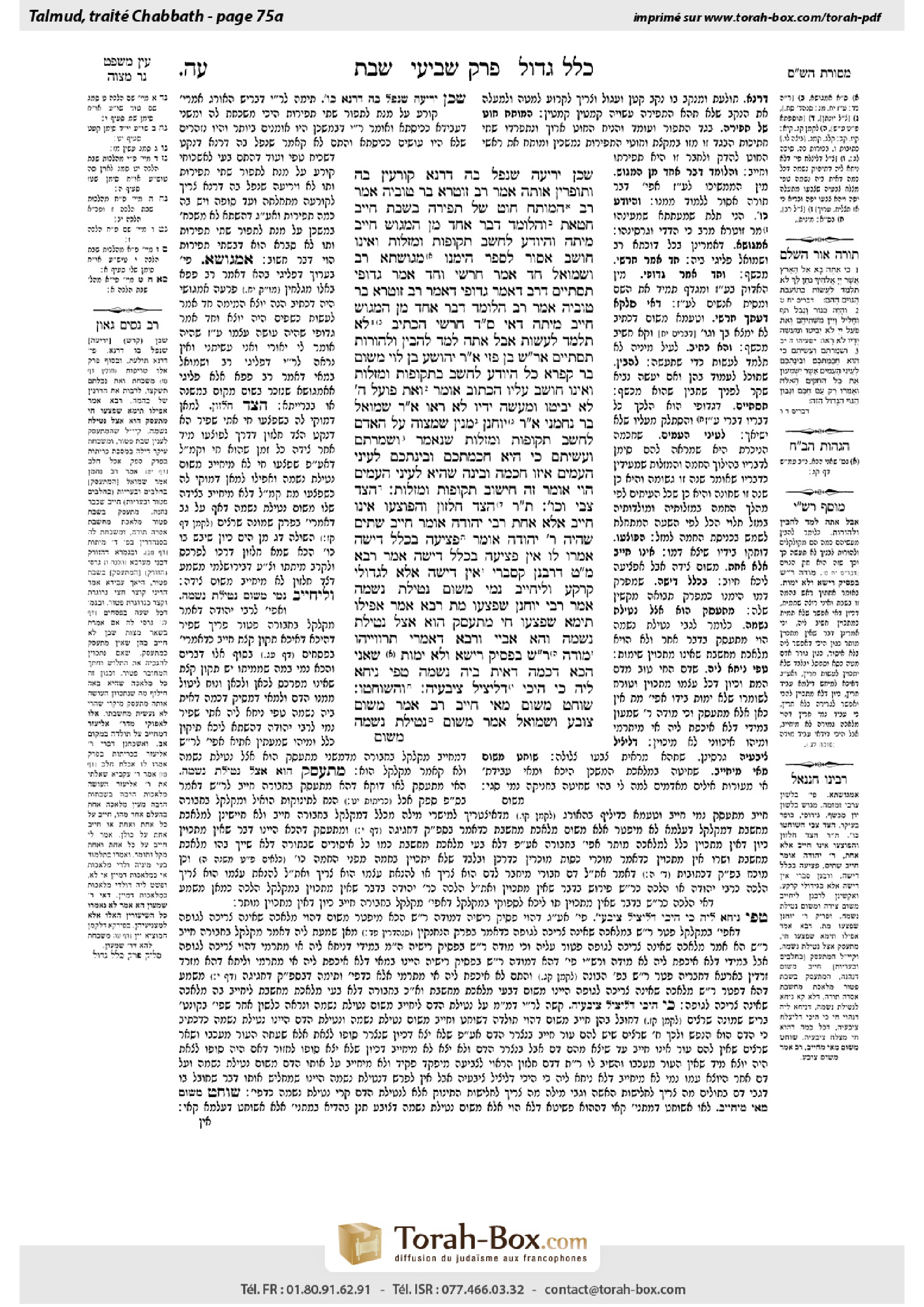
Shabbat 75a: Talmud study for Daf Yomi
Daf Yomi is the daily study of one Talmud folio. Explore 37 tractates with scans, Hebrew text, Sefaria English and AI-generated French translations where annotated.
Passage selection and English or AI-generated French translation are available where the scan has annotations. Daf Study is independent of Torah-Box and Sefaria.
Browse Shabbat · שבת · All tractatesShabbat 75a text and translations
This page of Shabbat includes the Aramaic text, an English translation and an AI-generated French translation, alongside the scan above.
שבת ע״ה א · Aramaic and Hebrew text
שֶׁכֵּן יְרִיעָה שֶׁנָּפַל בָּהּ דַּרְנָא, קוֹרְעִין בָּהּ וְתוֹפְרִין אוֹתָהּ.
אָמַר רַב זוּטְרָא בַּר טוֹבִיָּה אָמַר רַב: הַמּוֹתֵחַ חוּט שֶׁל תְּפִירָה בְּשַׁבָּת — חַיָּיב חַטָּאת, וְהַלּוֹמֵד דָּבָר אֶחָד מִן הַמָּגוֹשׁ — חַיָּיב מִיתָה, וְהַיּוֹדֵעַ לְחַשֵּׁב תְּקוּפוֹת וּמַזָּלוֹת וְאֵינוֹ מְחַשֵּׁב — אָסוּר לְסַפֵּר הֵימֶנּוּ.
אַמְגּוּשְׁתָּא — רַב וּשְׁמוּאֵל, חַד אָמַר: חָרָשֵׁי, וְחַד אָמַר: גָּדוֹפֵי. תִּסְתַּיֵּים דְּרַב דְּאָמַר גָּדוֹפֵי, דְּאָמַר רַב זוּטְרָא בַּר טוֹבִיָּה אָמַר רַב: הַלּוֹמֵד דָּבָר אֶחָד מִן הַמָּגוֹשׁ חַיָּיב מִיתָה. דְּאִי סָלְקָא דַעְתָּךְ חָרָשֵׁי: הָכְתִיב ״לֹא תִלְמַד לַעֲשׂוֹת״ — אֲבָל אַתָּה לָמֵד לְהָבִין וּלְהוֹרוֹת — תִּסְתַּיֵּים.
אָמַר רַבִּי שִׁמְעוֹן בֶּן פַּזִּי, אָמַר רַבִּי יְהוֹשֻׁעַ בֶּן לֵוִי מִשּׁוּם בַּר קַפָּרָא: כָּל הַיּוֹדֵעַ לְחַשֵּׁב בִּתְקוּפוֹת וּמַזָּלוֹת וְאֵינוֹ מְחַשֵּׁב, עָלָיו הַכָּתוּב אוֹמֵר: ״וְאֵת פֹּעַל ה׳ לֹא יַבִּיטוּ וּמַעֲשֵׂה יָדָיו לֹא רָאוּ״. אָמַר רַבִּי שְׁמוּאֵל בַּר נַחְמָנִי אָמַר רַבִּי יוֹחָנָן: מִנַּיִן שֶׁמִּצְוָה עַל הָאָדָם לְחַשֵּׁב תְּקוּפוֹת וּמַזָּלוֹת — שֶׁנֶּאֱמַר: ״וּשְׁמַרְתֶּם וַעֲשִׂיתֶם כִּי הִיא חׇכְמַתְכֶם וּבִינַתְכֶם לְעֵינֵי הָעַמִּים״, אֵיזוֹ חָכְמָה וּבִינָה שֶׁהִיא לְעֵינֵי הָעַמִּים — הֱוֵי אוֹמֵר: זֶה חִישּׁוּב תְּקוּפוֹת וּמַזָּלוֹת.
הַצָּד צְבִי וְכוּ׳. תָּנוּ רַבָּנַן: הַצָּד חִלָּזוֹן וְהַפּוֹצְעוֹ — אֵינוֹ חַיָּיב אֶלָּא אַחַת. רַבִּי יְהוּדָה אוֹמֵר חַיָּיב שְׁתַּיִם. שֶׁהָיָה רַבִּי יְהוּדָה אוֹמֵר: פְּצִיעָה בִּכְלַל דִּישָׁה. אָמְרוּ לוֹ: אֵין פְּצִיעָה בִּכְלַל דִּישָׁה. אָמַר רָבָא: מַאי טַעְמָא דְּרַבָּנַן — קָסָבְרִי אֵין דִּישָׁה אֶלָּא לְגִדּוּלֵי קַרְקַע. וְלִיחַיַּיב נָמֵי מִשּׁוּם נְטִילַת נְשָׁמָה! אָמַר רַבִּי יוֹחָנָן: שֶׁפְּצָעוֹ מֵת.
רָבָא אָמַר: אֲפִילּוּ תֵּימָא שֶׁפְּצָעוֹ חַי, מִתְעַסֵּק הוּא אֵצֶל נְטִילַת נְשָׁמָה. וְהָא אַבָּיֵי וְרָבָא דְּאָמְרִי תַּרְוַויְיהוּ: מוֹדֶה רַבִּי שִׁמְעוֹן בִּ״פְסִיק רֵישֵׁיהּ וְלֹא יָמוּת״! שָׁאנֵי הָכָא, דְּכַמָּה דְּאִית בֵּיהּ נְשָׁמָה טְפֵי נִיחָא לֵיהּ, כִּי הֵיכִי דְּלֵיצִיל צִיבְעֵיהּ.
וְהַשּׁוֹחֲטוֹ. שׁוֹחֵט מִשּׁוּם מַאי חַיָּיב? רַב אָמַר: מִשּׁוּם צוֹבֵעַ. וּשְׁמוּאֵל אָמַר: מִשּׁוּם נְטִילַת נְשָׁמָה.
Shabbat 75a · English translation
As, when a curtain had a worm which made a tear in it, they would tear the curtain further to lengthen the tear, and that enabled them to then sew it in a manner that obscured the tear.
Rav Zutra bar Toviya said that Rav said: One who tightens the thread of a stitch on Shabbat is liable to bring a sin-offering. If two parts of a garment that were sewn together begin to separate, and one pulls the thread to reattach them, it is tantamount to having sewn them. The Gemara cites additional halakhot cited by Rav Zutra in the name of Rav. And one who learns even one matter from a magosh, a Persian priest, is liable to receive the death penalty. And one who knows how to calculate astronomical seasons and the movement of constellations, and does not do so, one may not speak with him because his actions are improper.
The Gemara proceeds to discuss the additional halakhot cited by Rav Zutra bar Toviya. With regard to the magosh, Rav and Shmuel disagreed. One said that they are sorcerers, while the other said they are heretics. The Gemara adds: Conclude that Rav is the one who said that they are heretics, as Rav Zutra bar Toviya said that Rav said: One who learns one matter from the magosh is liable to receive the death penalty. As, if it should enter your mind that they are sorcerers, wasn’t it written: “When you come into the land which the Lord your God gives you, you shall not learn to do after the abominations of those nations. There shall not be found among you any one that makes his son or his daughter to pass through the fire, one that uses divination, a soothsayer, or an enchanter, or a sorcerer” (Deuteronomy 18:9–10)? And the Sages inferred: You shall not learn to do, but you may learn to understand and to teach the topic of sorcery. Apparently, merely learning about sorcery does not violate a prohibition. Only acting upon that learning is prohibited. Rav, who prohibited learning even a single matter from a magosh, must hold that they are heretics, not merely sorcerers. The Gemara states: Indeed, conclude that Rav is the one who said that they are heretics.
Rabbi Shimon ben Pazi said that Rabbi Yehoshua ben Levi said in the name of bar Kappara: Anyone who knows how to calculate astronomical seasons and the movement of constellations and does not do so, the verse says about him: “They do not take notice of the work of God, and they do not see His handiwork” (Isaiah 5:12). And Rabbi Shmuel bar Naḥmani said that Rabbi Yoḥanan said: From where is it derived that there is a mitzva incumbent upon a person to calculate astronomical seasons and the movement of constellations? As it was stated: “And you shall guard and perform, for it is your wisdom and understanding in the eyes of the nations” (Deuteronomy 4:6). What wisdom and understanding is there in the Torah that is in the eyes of the nations, i.e., appreciated and recognized by all? You must say: This is the calculation of astronomical seasons and the movement of constellations, as the calculation of experts is witnessed by all.
We learned in the mishna, among those liable for performing primary categories of labor: One who traps a deer or any other living creature. The Sages taught in a Tosefta: One who traps a ḥilazon and breaks its shell to remove its blood for the dye is liable to bring only one sin-offering. He is not liable for breaking the shell. Rabbi Yehuda says: He is liable to bring two, for performing the prohibited labors of trapping and for threshing, as Rabbi Yehuda would say: The breaking of a ḥilazon is included in the primary category of threshing, as its objective is to extract the matter that he desires from the shell that he does not. The Rabbis said to him: Breaking the shell is not included in the primary category of threshing. Rava said: What is the rationale for the opinion of the Rabbis? They hold: Threshing applies only to produce that grows from the ground. One who extracts other materials from their covering is exempt. The Gemara asks: Even if extracting blood is not considered threshing, let him be liable for taking a life as well. Rabbi Yoḥanan said: This is referring to a case where he broke its shell after it was dead.
Rava said: Even if you say that he broke it when it was alive, he is exempt. Since he had no intention of killing the ḥilazon, he is considered as one who is acting unawares with regard to taking a life. The Gemara raises a difficulty: Didn’t Abaye and Rava both say that Rabbi Shimon, who rules that an unintentional act is permitted, agrees that in a case of: Cut off its head and will it not die, one is liable? One who performs an action that will inevitably result in a prohibited labor cannot claim that he did not intend for his action to lead to that result. Lack of intention is only a valid claim when the result is merely possible, not inevitable. Since one who extracts blood from a ḥilazon inevitably takes its life, how can Rava claim that his action is unintentional? The Gemara answers: Here it is different, as the longer the ḥilazon lives, the better it is for the trapper, so that its dye will become clear. Dye extracted from a live ḥilazon is a higher quality than that which is extracted from a dead one. Rabbi Shimon agrees that one who performs an action with inevitable consequences is liable only in a case where the consequences are not contrary to his interests. Since he prefers that the ḥilazon remain alive as long as possible, he is not liable for the inevitable consequences.
We learned in the mishna, among those liable for performing primary categories of labor: And one who slaughters an animal on Shabbat. The Gemara asks: As there was no slaughter necessary for construction of the Tabernacle, one who slaughters an animal, due to what prohibited labor is he liable? Rav said: He is liable due to dyeing, as in the course of the slaughter the hide is dyed with blood. And Shmuel said: He is liable due to taking a life.
Shabbat 75a · Traduction française (IA)
Ainsi, lorsqu’un ver avait troué un rideau et y avait fait une déchirure, on déchirait davantage le rideau pour allonger la déchirure, ce qui permettait ensuite de le coudre de manière à dissimuler la déchirure.
Rav Zutra bar Toviya a dit au nom de Rav : Celui qui resserre le fil d’une couture pendant Chabbat est passible d’un sacrifice expiatoire. Si deux parties d’un vêtement cousues ensemble commencent à se séparer et que l’on tire sur le fil pour les rattacher, cela équivaut à les avoir cousues. La Guemara cite d’autres halakhot rapportées par Rav Zutra au nom de Rav. Celui qui apprend ne serait-ce qu’une seule chose d’un magosh, un prêtre perse, est passible de la peine de mort. Et celui qui sait calculer les saisons astronomiques et le mouvement des constellations, mais ne le fait pas, est quelqu’un à qui l’on ne doit pas parler, car sa conduite est répréhensible.
La Guemara poursuit l’examen des autres halakhot rapportées par Rav Zutra bar Toviya. Au sujet des magoshim, Rav et Shmuel étaient en désaccord. L’un disait qu’ils étaient des sorciers, tandis que l’autre disait qu’ils étaient des hérétiques. La Guemara ajoute : Concluez que c’est Rav qui disait qu’ils étaient des hérétiques, car Rav Zutra bar Toviya a dit au nom de Rav : Celui qui apprend une seule chose d’un magosh est passible de la peine de mort. En effet, si l’on devait penser qu’ils sont des sorciers, n’est-il pas écrit : « Quand tu entreras dans le pays que le Seigneur ton Dieu te donne, tu n’apprendras pas à faire les abominations de ces nations. Qu’il ne se trouve parmi toi personne qui fasse passer son fils ou sa fille par le feu, personne qui pratique la divination, qui tire des présages, qui soit augure ou sorcier » (Deutéronome 18, 9-10) ? Et les Sages en ont déduit : « Tu n’apprendras pas à faire », mais tu peux apprendre pour comprendre et enseigner le sujet de la sorcellerie. Apparemment, le simple fait d’apprendre la sorcellerie ne transgresse pas une interdiction ; seule sa mise en pratique est interdite. Rav, qui interdit d’apprendre ne serait-ce qu’une seule chose d’un magosh, doit donc tenir qu’ils sont des hérétiques et non de simples sorciers. La Guemara conclut : Effectivement, concluez que c’est Rav qui disait qu’ils étaient des hérétiques.
Rabbi Shimon ben Pazi a dit que Rabbi Yehoshua ben Levi a dit au nom de bar Kappara : Quiconque sait calculer les saisons astronomiques et le mouvement des constellations, mais ne le fait pas, le verset dit à son sujet : « Ils ne prêtent pas attention à l’œuvre de Dieu et ne voient pas l’ouvrage de Ses mains » (Isaïe 5, 12). Et Rabbi Shmuel bar Naḥmani a dit que Rabbi Yoḥanan a dit : D’où apprend-on qu’il incombe à chacun d’accomplir la mitsva de calculer les saisons astronomiques et le mouvement des constellations ? Car il est dit : « Vous les garderez et les accomplirez, car elles sont votre sagesse et votre intelligence aux yeux des nations » (Deutéronome 4, 6). Quelle sagesse et quelle intelligence de la Torah sont aux yeux des nations, c’est-à-dire appréciées et reconnues de tous ? Il faut dire qu’il s’agit du calcul des saisons astronomiques et du mouvement des constellations, car le calcul des experts est reconnu de tous.
Nous avons appris dans la Michna, parmi ceux qui sont passibles d’une peine pour avoir accompli l’une des catégories principales de travaux : celui qui capture un cerf ou toute autre créature vivante. Les Sages ont enseigné dans une baraïta : Celui qui capture un ḥilazon et brise sa coquille pour en extraire le sang destiné à la teinture n’est passible que d’un seul sacrifice expiatoire. Il n’est pas passible pour avoir brisé la coquille. Rabbi Yehuda dit : Il est passible de deux sacrifices expiatoires, pour avoir accompli les travaux interdits de capturer et de battre, car Rabbi Yehuda disait : Le bris de la coquille d’un ḥilazon relève de la catégorie principale du battage, puisque son objectif est d’extraire la substance qu’il désire de la coquille dont il ne veut pas. Les Sages lui dirent : Le bris de la coquille ne relève pas de la catégorie principale du battage. Rava dit : Quel est le raisonnement des Sages ? Ils considèrent que le battage ne s’applique qu’aux produits qui poussent dans le sol. Celui qui extrait d’autres matières de leur enveloppe est exempt. La Guemara demande : Même si l’extraction du sang n’est pas considérée comme du battage, qu’il soit également passible d’avoir pris une vie ! Rabbi Yoḥanan dit : Cela fait référence à un cas où il a brisé la coquille après la mort du ḥilazon.
Rava dit : Même si tu dis qu’il l’a brisée alors qu’il était vivant, il est exempt. Puisqu’il n’avait pas l’intention de tuer le ḥilazon, il est considéré comme agissant sans le vouloir en ce qui concerne le fait de prendre une vie. La Guemara soulève une difficulté : Abaye et Rava n’ont-ils pas tous deux dit que Rabbi Shimon, qui statue qu’un acte involontaire est permis, reconnaît que dans le cas de « Coupe-lui la tête, et ne mourra-t-il pas ? », on est passible d’une peine ? Celui qui accomplit une action dont le résultat inévitable est un travail interdit ne peut prétendre qu’il n’avait pas l’intention que son action produise ce résultat. L’absence d’intention n’est un argument valable que lorsque le résultat est simplement possible, et non inévitable. Puisque celui qui extrait le sang d’un ḥilazon lui prend inévitablement la vie, comment Rava peut-il prétendre que son acte est involontaire ? La Guemara répond : Ici, le cas est différent, car plus le ḥilazon reste en vie, mieux cela vaut pour celui qui l’a capturé, afin que sa teinture devienne limpide. La teinture extraite d’un ḥilazon vivant est de meilleure qualité que celle extraite d’un ḥilazon mort. Rabbi Shimon reconnaît que celui qui accomplit une action aux conséquences inévitables n’est passible d’une peine que lorsque ces conséquences ne vont pas à l’encontre de ses intérêts. Puisqu’il préfère que le ḥilazon reste en vie aussi longtemps que possible, il n’est pas passible des conséquences inévitables.
Nous avons appris dans la Michna, parmi ceux qui sont passibles d’une peine pour avoir accompli l’une des catégories principales de travaux : celui qui abat un animal pendant Chabbat. La Guemara demande : Puisque l’abattage n’était pas nécessaire à la construction du Tabernacle, pour quel travail interdit celui qui abat un animal est-il passible ? Rav dit : Il est passible pour avoir teint, car au cours de l’abattage, le sang teint la peau. Et Shmuel dit : Il est passible pour avoir pris une vie.
Traduction française générée par IA à partir de l’édition anglaise de Sefaria. Vérifie toujours un passage avec le texte source.
Text from Sefaria: William Davidson Edition - Vocalized Aramaic (CC BY NC); William Davidson Edition - English (CC BY NC).