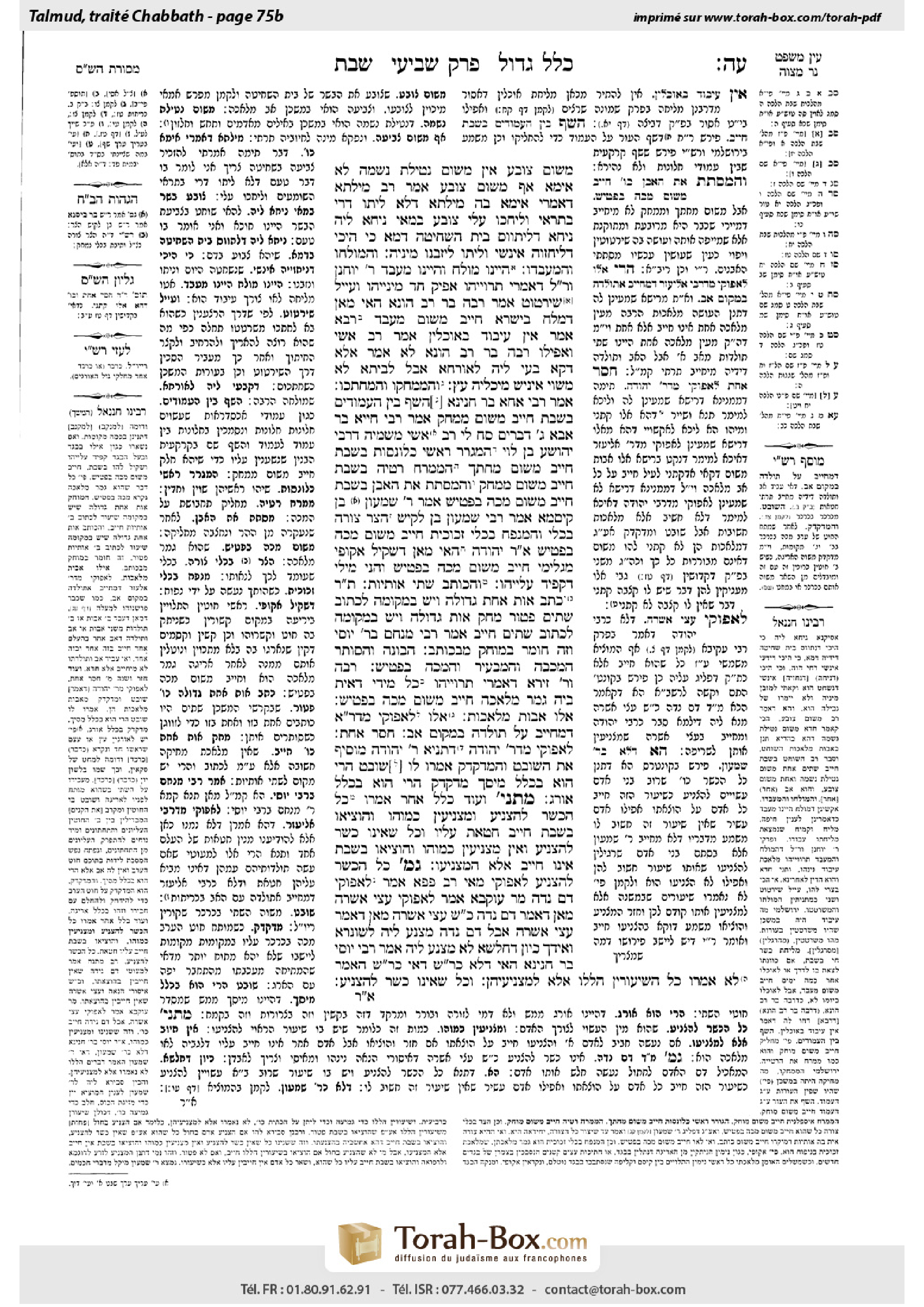
Shabbat 75b: Talmud study for Daf Yomi
Daf Yomi is the daily study of one Talmud folio. Explore 37 tractates with scans, Hebrew text, Sefaria English and AI-generated French translations where annotated.
Passage selection and English or AI-generated French translation are available where the scan has annotations. Daf Study is independent of Torah-Box and Sefaria.
Browse Shabbat · שבת · All tractatesShabbat 75b text and translations
This page of Shabbat includes the Aramaic text, an English translation and an AI-generated French translation, alongside the scan above.
שבת ע״ה ב · Aramaic and Hebrew text
מִשּׁוּם צוֹבֵעַ אִין, מִשּׁוּם נְטִילַת נְשָׁמָה לָא? אֵימָא: אַף מִשּׁוּם צוֹבֵעַ. אָמַר רַב: מִילְּתָא דַּאֲמַרִי, אֵימָא בַּהּ מִילְּתָא, דְּלָא לֵיתוּ דָּרֵי בָּתְרָאֵי וְלִיחֲכוּ עֲלַי: צוֹבֵעַ בְּמַאי נִיחָא לֵיהּ — נִיחָא דְּלִיתַּוַּוס בֵּית הַשְּׁחִיטָה דְּמָא, כִּי הֵיכִי דְּלִיחְזוּהּ אִינָשֵׁי וְלֵיתוּ לִיזְבְּנוּ מִינֵּיהּ.
וְהַמּוֹלְחוֹ וְהַמְעַבְּדוֹ. הַיְינוּ מוֹלֵחַ וְהַיְינוּ מְעַבֵּד! רַבִּי יוֹחָנָן וְרֵישׁ לָקִישׁ דְּאָמְרִי תַּרְוַיְיהוּ: אַפֵּיק חַד מִינַּיְיהוּ וְעַיֵּיל שִׂירְטוּט. אָמַר רַבָּה בַּר רַב הוּנָא: הַאי מַאן דְּמָלַח בִּישְׂרָא — חַיָּיב מִשּׁוּם מְעַבֵּד. רָבָא אָמַר: אֵין עִיבּוּד בָּאוֹכָלִין. אָמַר רַב אָשֵׁי: וַאֲפִילּוּ רַבָּה בַּר רַב הוּנָא לָא אָמַר אֶלָּא דְּקָא בָּעֵי לֵיהּ לְאוֹרְחָא, אֲבָל לְבֵיתָא — לָא מְשַׁוֵּי אִינִישׁ מֵיכְלֵיהּ עֵץ.
וְהַמְמַחֲקוֹ וְהַמְחַתְּכוֹ. אָמַר רַבִּי אַחָא בַּר חֲנִינָא: הַשָּׁף בֵּין הָעַמּוּדִים בְּשַׁבָּת — חַיָּיב מִשּׁוּם מְמַחֵק. אָמַר רַבִּי חִיָּיא בַּר אַבָּא: שְׁלֹשָׁה דְּבָרִים סָח לִי רַב אָשֵׁי מִשְּׁמֵיהּ דְּרַבִּי יְהוֹשֻׁעַ בֶּן לֵוִי: הַמְגָרֵר רָאשֵׁי כְּלוֹנְסוֹת בְּשַׁבָּת — חַיָּיב מִשּׁוּם מְחַתֵּךְ, הַמְמָרֵחַ רְטִיָּה בְּשַׁבָּת — חַיָּיב מִשּׁוּם מְמַחֵק, וְהַמְסַתֵּת אֶת הָאֶבֶן בְּשַׁבָּת — חַיָּיב מִשּׁוּם מַכֶּה בְּפַטִּישׁ. אָמַר רַבִּי שִׁמְעוֹן בֶּן קִיסְמָא אָמַר רַבִּי שִׁמְעוֹן בֶּן לָקִישׁ: הַצָּר צוּרָה בִּכְלִי וְהַמְנַפֵּחַ בִּכְלִי זְכוּכִית — חַיָּיב מִשּׁוּם מַכֶּה בְּפַטִּישׁ. אָמַר רַב יְהוּדָה: הַאי מַאן דְּשָׁקֵיל אַקּוּפֵי מִגְּלִימֵי — חַיָּיב מִשּׁוּם מַכֶּה בְּפַטִּישׁ. וְהָנֵי מִילֵּי דְּקָפֵיד עֲלַיְיהוּ.
וְהַכּוֹתֵב שְׁתֵּי אוֹתִיּוֹת. תָּנוּ רַבָּנַן: כָּתַב אוֹת אַחַת גְּדוֹלָה וְיֵשׁ בִּמְקוֹמָהּ לִכְתּוֹב שְׁתַּיִם — פָּטוּר. מָחַק אוֹת גְּדוֹלָה, וְיֵשׁ בִּמְקוֹמָהּ לִכְתּוֹב שְׁתַּיִם — חַיָּיב. אָמַר רַבִּי מְנַחֵם בְּרַבִּי יוֹסֵי: זֶה חוֹמֶר בַּמּוֹחֵק מִבַּכּוֹתֵב.
הַבּוֹנֶה, וְהַסּוֹתֵר, הַמְכַבֶּה, וְהַמַּבְעִיר, וְהַמַּכֶּה בְּפַטִּישׁ. רַבָּה וְרַבִּי זֵירָא דְּאָמְרִי תַּרְוַיְיהוּ: כֹּל מִידֵּי דְּאִית בֵּיהּ גְּמַר מְלָאכָה חַיָּיב מִשּׁוּם מַכֶּה בְּפַטִּישׁ.
״אֵלּוּ אֲבוֹת מְלָאכוֹת״. ״אֵלּוּ״ — לְאַפּוֹקֵי מִדְּרַבִּי אֱלִיעֶזֶר, דִּמְחַיֵּיב עַל תּוֹלָדָה בִּמְקוֹם אָב. ״חָסֵר אַחַת״ — לְאַפּוֹקֵי מִדְּרַבִּי יְהוּדָה, דְּתַנְיָא: רַבִּי יְהוּדָה מוֹסִיף אֶת הַשּׁוֹבֵט וְהַמְדַקְדֵּק. אָמְרוּ לוֹ: שׁוֹבֵט הֲרֵי הוּא בִּכְלַל מֵיסֵךְ, מְדַקְדֵּק הֲרֵי הוּא בִּכְלַל אוֹרֵג.
מַתְנִי׳ וְעוֹד כְּלָל אַחֵר אָמְרוּ: כׇּל הַכָּשֵׁר לְהַצְנִיעַ וּמַצְנִיעִין כָּמוֹהוּ וְהוֹצִיאוֹ בְּשַׁבָּת — חַיָּיב חַטָּאת עָלָיו. וְכֹל שֶׁאֵינוֹ כָּשֵׁר לְהַצְנִיעַ וְאֵין מַצְנִיעִין כָּמוֹהוּ וְהוֹצִיאוֹ בְּשַׁבָּת — אֵינוֹ חַיָּיב אֶלָּא הַמַּצְנִיעוֹ.
גְּמָ׳ ״כׇּל הַכָּשֵׁר לְהַצְנִיעַ״ לְאַפּוֹקֵי מַאי? רַב פָּפָּא אָמַר: לְאַפּוֹקֵי דַּם נִדָּה. מָר עֻוקְבָא אָמַר: לְאַפּוֹקֵי עֲצֵי אֲשֵׁרָה. מַאן דְּאָמַר דַּם נִדָּה, כׇּל שֶׁכֵּן עֲצֵי אֲשֵׁרָה. מַאן דְּאָמַר עֲצֵי אֲשֵׁרָה, אֲבָל דַּם נִדָּה מַצְנַע לֵיהּ לְשׁוּנָּרָא. וְאִידַּךְ? — כֵּיוָן דְּחָלְשָׁא לָא מַצְנַע לֵיהּ.
אָמַר רַבִּי יוֹסֵי בַּר חֲנִינָא הַאי דְּלָא כְּרַבִּי שִׁמְעוֹן, דְּאִי כְּרַבִּי שִׁמְעוֹן, הָאָמַר: לֹא אָמְרוּ כׇּל הַשִּׁיעוּרִין הַלָּלוּ אֶלָּא לְמַצְנִיעֵיהֶן.
וְכֹל שֶׁאֵינוֹ כָּשֵׁר לְהַצְנִיעַ.
Shabbat 75b · English translation
The Gemara wonders: Is that to say according to Rav, that due to dyeing, yes, he is liable; due to taking a life, no, he is exempt? Rather, emend Rav’s statement and say: He is liable due to dyeing as well. And Rav said: I will say something as an explanation with regard to the statement I said, so that later generations will not come and laugh at me: In what sense is dyeing a desired consequence for him? It is desired that the area of the slaughter will be inundated with blood, so that people will see it freshly dyed and come to purchase fresh meat from him. Therefore, the one slaughtering the animal also wants its neck dyed.
We learned in the mishna, among those liable for performing primary categories of labor: And one who salts it and one who tans it. The Gemara asks: The prohibited labor of salting is the same as the prohibited labor of tanning, i.e., salting is a stage in the tanning process. Rabbi Yoḥanan and Reish Lakish both said: Remove one of them and replace it with drafting. In their opinion, the labor of drafting, drawing lines on the hide to indicate where it should be cut, should replace salting in the list of thirty-nine labors. Rabba bar Rav Huna said: One who salts meat on Shabbat to preserve it is liable due to the labor of tanning. Rava said: There is no tanning with regard to food. No action taken with food falls into this category. Rav Ashi said: And even Rabba bar Rav Huna said it falls into the category of tanning only when he needs to pack the meat for a trip and salts it thoroughly. However, to eat in the house, a person does not render his food inedible, tantamount to a piece of wood. In that case, he certainly would not salt the meat to a degree that would approximate tanning.
We learned in the mishna, among those liable for performing primary categories of labor: And one who smooths it and one who cuts it. Rabbi Aḥa bar Ḥanina said: One who rubs the hide between the pillars on Shabbat, i.e., places the skin between pillars made for that purpose (Rav Hai Gaon) and rubs it between them, is liable due to the labor of smoothing. Rav Ḥiyya bar Abba said: Rav Ashi told me three statements in the name of Rabbi Yehoshua ben Levi: One who planes the tops of posts on Shabbat to make them even is liable due to the labor of cutting, due to his insistence that they all be equal. One who spreads a bandage onto a wound on Shabbat is liable due to the labor of smoothing. And one who chisels a stone on Shabbat is liable due to the labor of striking a blow with a hammer, as he thereby completes work on the stone. Rabbi Shimon ben Kisma said that Rabbi Shimon ben Lakish said: One who engraves a figure onto an earthenware vessel and one who blows in order to craft a glass vessel is liable due to the labor of striking a blow with a hammer. Rav Yehuda said: One who removes protruding, irregular threads from a cloak is liable due to the labor of striking a blow with a hammer. And that applies only if he is particular about them and would not wear the garment until all protruding threads are removed. In that case, work on the garment is not complete until the threads are removed.
We learned in the mishna, among those liable for performing primary categories of labor: And one who writes two letters. The Sages taught: One who wrote one large letter, and in its space there is room to write two, is exempt, as he wrote only one letter. However, one who erased one large letter, and in its space there is room to write two, is liable. Rav Menaḥem, son of Rabbi Yosei, said: And that is a greater stricture with regard to erasing than with regard to writing. Although greater stringency is usually accorded to creative acts, here the destructive act of erasing is more stringent. Although he erased only one letter, he made room for two, which is the essence of the prohibited labor.
We learned in the mishna, among those liable for performing primary categories of labor: One who builds and one who dismantles; one who extinguishes and one who kindles; and one who strikes a blow with a hammer. With regard to the labor of striking a blow with a hammer, it is Rabba and Rabbi Zeira who both stated a principle: One who performs any action on Shabbat that contains an element of completion of work is liable for the labor of striking a blow with a hammer.
The mishna concludes: These are the primary categories of labor. The Gemara explains that the emphasis on the word these, indicating these and no others, comes to exclude the opinion of Rabbi Eliezer, who renders one liable for the performance of a subcategory of prohibited labor when performed together with a primary category under which it is subsumed. Rabbi Eliezer deems one who performs two prohibited labors, a primary category and its subcategory, liable to bring two sin-offerings. In his opinion, one who unwittingly performed all the labors in one lapse of awareness would be liable to bring more than thirty-nine sin-offerings. Therefore, the mishna emphasizes that there are only thirty-nine primary categories of prohibited labor, and one could not possibly be liable to bring a greater number of sacrifices. When the mishna repeats that the labors number forty-less-one, that is to exclude the opinion of Rabbi Yehuda. As it was taught in a baraita: Rabbi Yehuda added lining up the threads of the warp and beating the threads of the woof to the list of primary categories of labor. They said to him: Lining up is a subcategory subsumed under the primary category of stretching the threads of the warp within the loom, since both involve arranging the threads of the warp. Beating is subsumed under the primary category of weaving. The mishna teaches that there are no more than thirty-nine primary categories of labor.
MISHNA: And they stated an additional principle with regard to the halakhot of Shabbat. Anything fit to store, in the sense that it is large enough to make it worthwhile to store for future use, and people typically store items like it, and one carried it out into a prohibited domain on Shabbat, he is liable to bring a sin-offering for that action. And anything not fit to store and people typically do not store items like it, since it is too insignificant to warrant storage, and one carried it out on Shabbat, only the one who stores it is liable. By storing the item, one indicates that the item is significant to him, even though it is not significant for the typical person. Therefore, he alone is liable for carrying it out into a prohibited domain.
GEMARA: With regard to the principle in the mishna: Anything fit to store, the Gemara asks: What does it come to exclude? In the opinion of the tanna, what is not fit for storage? Rav Pappa said: It comes to exclude the blood of a menstruating woman. Mar Ukva said: It comes to exclude the wood of a tree designated for idolatry [ashera]. Since one may derive no benefit from a tree designated for idolatry, it has no monetary value. The Gemara explains these opinions: The one who said that blood of a menstruating woman is not fit for storage, all the more so that the wood of an ashera is unfit, as, by Torah law, one is required to destroy it. However, according to the one who said that the wood of an ashera is unfit for storage, the blood of a menstruating woman is fit, as one stores it to feed to the cat. Although it is not typically stored, it does have some use. And the other, who holds that the blood of a menstruating woman is not fit for any use, isn’t it fit for use as cat food? In his opinion, since feeding a person’s blood to an animal weakens that person, one does not store it.
Rabbi Yosei bar Ḥanina said: All of these objective criteria mentioned in our mishna are not in accordance with the opinion of Rabbi Shimon, as, if one would attempt to say that the mishna is in accordance with the opinion of Rabbi Shimon, didn’t he say: The Sages in the mishna only stated all these fixed measures for items carried out with regard to those who store them? Only one who stores those items is liable for carrying them. However, one who does not store the item, and for whom it is insignificant, is not liable even if that item met the measure for liability delineated in the mishna.
We learned in the mishna: And anything not fit to store, that is too insignificant to warrant storage, only one who stores it is liable for carrying it out.
Shabbat 75b · Traduction française (IA)
La Guemara s’interroge : faut-il comprendre que, selon Rav, il est passible pour la teinture, mais exempt pour la prise d’une vie ? Il faut plutôt rectifier la déclaration de Rav et dire qu’il est également passible pour la teinture. Rav dit : « Je vais expliquer ce que j’ai dit, afin que les générations futures ne viennent pas se moquer de moi : en quel sens la teinture est-elle une conséquence souhaitée pour lui ? Il souhaite que la zone de l’abattage soit inondée de sang, afin que les gens la voient fraîchement teinte et viennent lui acheter de la viande fraîche. Par conséquent, celui qui abat l’animal souhaite lui aussi que son cou soit teint. »
Nous avons appris dans la Michna, parmi ceux qui sont passibles pour avoir accompli des catégories principales de travaux : « Celui qui sale et celui qui tanne. » La Guemara demande : le travail interdit consistant à saler n’est-il pas identique à celui consistant à tanner, puisque le salage est une étape du tannage ? Rabbi Yoḥanan et Reish Lakish ont tous deux dit : « Retirez l’un des deux et remplacez-le par le traçage. » Selon eux, le travail consistant à tracer des lignes sur le cuir pour indiquer où il doit être coupé doit remplacer le salage dans la liste des trente-neuf travaux. Rabba bar Rav Huna a dit : celui qui sale de la viande pendant Chabbat pour la conserver est passible au titre du travail de tannage. Rava a dit : il n’y a pas de tannage en ce qui concerne les aliments. Aucune action effectuée sur des aliments ne relève de cette catégorie. Rav Ashi a dit : même Rabba bar Rav Huna ne considère que cela relève du tannage que lorsqu’il doit emballer la viande pour un voyage et la sale abondamment. En revanche, pour manger chez soi, on ne rend pas ses aliments immangeables, comme un morceau de bois. Dans ce cas, on ne salerait certainement pas la viande au point de la traiter comme lors du tannage.
Nous avons appris dans la Michna, parmi ceux qui sont passibles pour avoir accompli des catégories principales de travaux : « Celui qui lisse et celui qui découpe. » Rabbi Aḥa bar Ḥanina a dit : celui qui frotte le cuir entre des piliers pendant Chabbat, c’est-à-dire qui place la peau entre des piliers prévus à cet effet (Rav Hai Gaon) et la frotte entre eux, est passible au titre du travail de lissage. Rav Ḥiyya bar Abba a dit : Rav Ashi m’a transmis trois enseignements au nom de Rabbi Yehoshua ben Levi : celui qui rabote le sommet de poteaux pendant Chabbat pour les rendre égaux est passible au titre du travail de découpe, car il tient à ce qu’ils soient tous identiques ; celui qui applique un pansement sur une plaie pendant Chabbat est passible au titre du travail de lissage ; et celui qui taille une pierre pendant Chabbat est passible au titre du travail consistant à donner un coup de marteau, car il achève ainsi le travail sur la pierre. Rabbi Shimon ben Kisma a dit que Rabbi Shimon ben Lakish a dit : celui qui grave une figure sur un récipient en terre cuite et celui qui souffle pour fabriquer un récipient en verre sont passibles au titre du travail consistant à donner un coup de marteau. Rav Yehuda a dit : celui qui retire d’un manteau les fils irréguliers qui dépassent est passible au titre du travail consistant à donner un coup de marteau. Cela ne s’applique que s’il y tient et ne porterait pas le vêtement tant que tous les fils qui dépassent n’ont pas été retirés. Dans ce cas, le travail sur le vêtement n’est achevé qu’une fois les fils retirés.
Nous avons appris dans la Michna, parmi ceux qui sont passibles pour avoir accompli des catégories principales de travaux : « Celui qui écrit deux lettres. » Les Sages ont enseigné : celui qui écrit une grande lettre, dans l’espace de laquelle on pourrait en écrire deux, est exempt, car il n’a écrit qu’une seule lettre. En revanche, celui qui efface une grande lettre, dans l’espace de laquelle on pourrait en écrire deux, est passible. Rav Menaḥem, fils de Rabbi Yosei, a dit : cela constitue une rigueur plus grande en matière d’effacement qu’en matière d’écriture. Bien qu’on accorde généralement une plus grande rigueur aux actes créateurs, ici l’acte destructeur consistant à effacer est considéré plus sévèrement. Bien qu’il n’ait effacé qu’une lettre, il a libéré de la place pour deux, ce qui constitue l’essence même du travail interdit.
Nous avons appris dans la Michna, parmi ceux qui sont passibles pour avoir accompli des catégories principales de travaux : « Celui qui construit et celui qui démolit ; celui qui éteint et celui qui allume ; et celui qui donne un coup de marteau. » À propos du travail consistant à donner un coup de marteau, Rabba et Rabbi Zeira ont tous deux énoncé un principe : celui qui accomplit pendant Chabbat une action comportant un élément d’achèvement du travail est passible au titre du travail consistant à donner un coup de marteau.
La Michna conclut : « Telles sont les catégories principales de travaux. » La Guemara explique que l’accent mis sur le mot « telles », qui signifie « celles-ci et aucune autre », vient exclure l’opinion de Rabbi Eliezer, qui rend passible celui qui accomplit une catégorie secondaire de travail interdit en même temps que la catégorie principale dont elle relève. Selon Rabbi Eliezer, celui qui accomplit deux travaux interdits — une catégorie principale et sa catégorie secondaire — doit apporter deux sacrifices expiatoires. À son avis, celui qui aurait accompli par inadvertance tous les travaux au cours d’une seule perte de conscience devrait apporter plus de trente-neuf sacrifices expiatoires. La Michna souligne donc qu’il n’y a que trente-neuf catégories principales de travaux interdits et qu’il est impossible d’être tenu d’apporter un plus grand nombre de sacrifices. Lorsque la Michna répète que les travaux sont au nombre de trente-neuf, cela vient exclure l’opinion de Rabbi Yehuda. En effet, il a été enseigné dans une baraïta : Rabbi Yehuda a ajouté à la liste des catégories principales de travaux le fait d’aligner les fils de la chaîne et de battre les fils de la trame. On lui a répondu : l’alignement relève d’une catégorie secondaire incluse dans la catégorie principale consistant à tendre les fils de la chaîne dans le métier à tisser, puisque les deux opérations consistent à disposer les fils de la chaîne. Le battage relève de la catégorie principale du tissage. La Michna enseigne qu’il n’y a pas plus de trente-neuf catégories principales de travaux.
MICHNA : Ils ont énoncé un autre principe concernant les halakhot de Chabbat. Tout objet qu’il convient de conserver, c’est-à-dire dont la taille justifie qu’on le garde pour un usage futur, et que les gens ont l’habitude de conserver lorsqu’il s’agit d’objets semblables, si quelqu’un le transporte dans un domaine interdit pendant Chabbat, il doit apporter un sacrifice expiatoire pour cette action. Quant à tout objet qu’il ne convient pas de conserver et que les gens n’ont pas l’habitude de conserver parce qu’il est trop insignifiant pour justifier qu’on le garde, si quelqu’un le transporte pendant Chabbat, seul celui qui le conserve est passible. En conservant l’objet, il montre qu’il a de l’importance à ses yeux, même s’il n’en a pas pour les gens en général. Par conséquent, lui seul est passible de l’avoir transporté dans un domaine interdit.
GUEMARA : À propos du principe énoncé dans la Michna — « Tout objet qu’il convient de conserver » —, la Guemara demande : qu’est-ce que cela vient exclure ? Selon le tanna, qu’est-ce qui ne convient pas à la conservation ? Rav Pappa a dit : cela vient exclure le sang d’une femme menstruée. Mar Ukva a dit : cela vient exclure le bois d’un arbre voué à l’idolâtrie [ashera]. Puisqu’il est interdit de tirer le moindre profit d’un arbre voué à l’idolâtrie, celui-ci n’a aucune valeur monétaire. La Guemara explique ces opinions : celui qui a dit que le sang d’une femme menstruée ne convient pas à la conservation admet a fortiori que le bois d’une ashera ne convient pas, car la Torah écrite exige qu’on le détruise. En revanche, selon celui qui a dit que le bois d’une ashera ne convient pas à la conservation, le sang d’une femme menstruée, lui, convient, puisqu’on le conserve pour le donner au chat. Bien qu’on ne le conserve pas habituellement, il a une certaine utilité. Et l’autre, qui estime que le sang d’une femme menstruée ne convient à aucun usage, ne reconnaît-il pas qu’il peut servir de nourriture pour chat ? Selon lui, puisque donner le sang d’une personne à un animal l’affaiblit, on ne le conserve pas.
Rabbi Yosei bar Ḥanina a dit : tous les critères objectifs mentionnés dans notre Michna ne sont pas conformes à l’opinion de Rabbi Shimon. En effet, si l’on voulait dire que la Michna est conforme à l’opinion de Rabbi Shimon, n’a-t-il pas dit : « Les Sages de la Michna n’ont énoncé toutes ces mesures fixes que pour les objets transportés par ceux qui les conservent » ? Seul celui qui conserve ces objets est passible de les avoir transportés. En revanche, celui qui ne conserve pas l’objet et pour qui il est insignifiant n’est pas passible, même si cet objet atteint la mesure définie dans la Michna pour entraîner la responsabilité.
Nous avons appris dans la Michna : « Et tout objet qu’il ne convient pas de conserver », c’est-à-dire tout objet trop insignifiant pour justifier qu’on le garde : seul celui qui le conserve est passible de l’avoir transporté.
Traduction française générée par IA à partir de l’édition anglaise de Sefaria. Vérifie toujours un passage avec le texte source.
Text from Sefaria: William Davidson Edition - Vocalized Aramaic (CC BY NC); William Davidson Edition - English (CC BY NC).