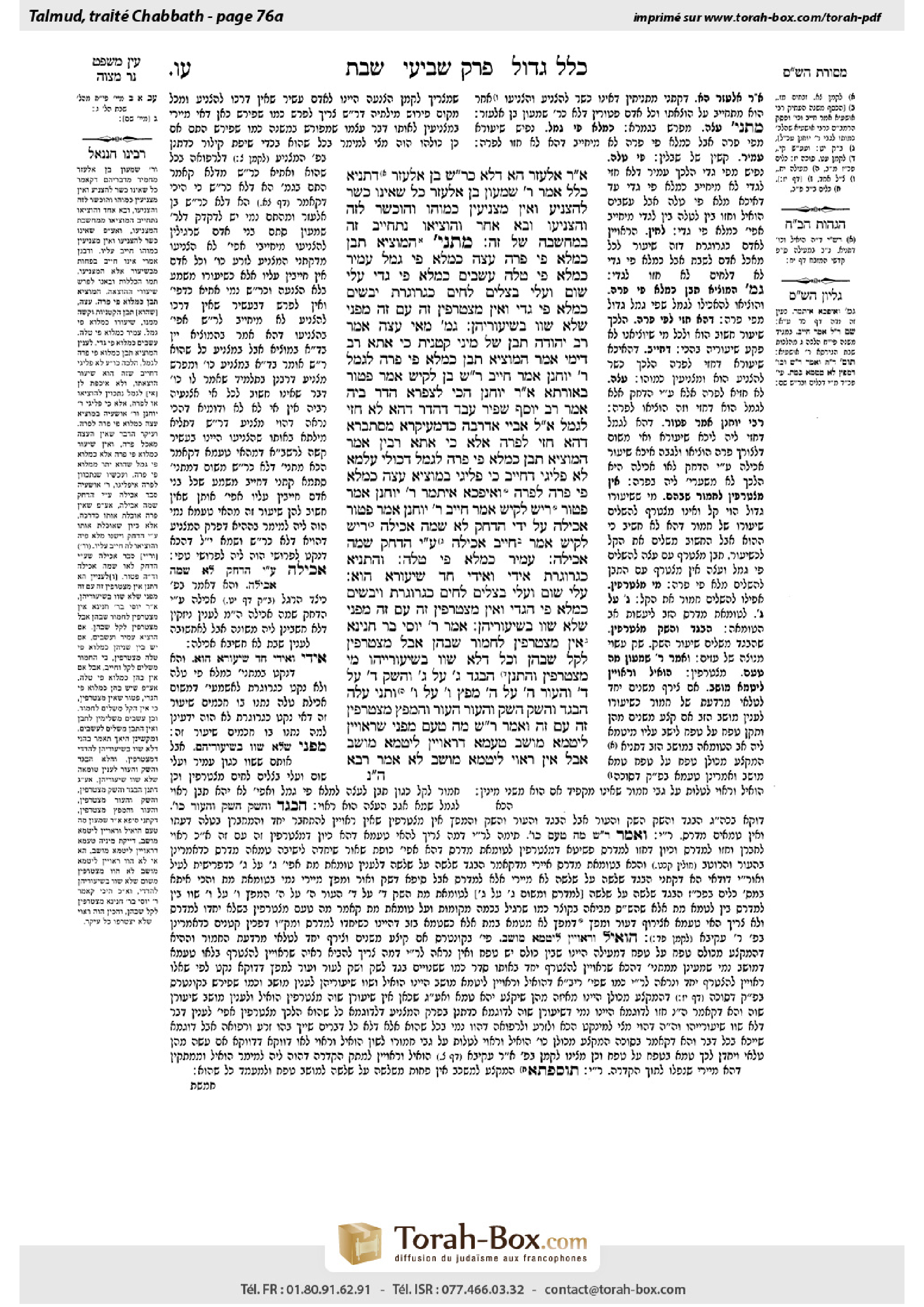
Shabbat 76a: Talmud study for Daf Yomi
Daf Yomi is the daily study of one Talmud folio. Explore 37 tractates with scans, Hebrew text, Sefaria English and AI-generated French translations where annotated.
Passage selection and English or AI-generated French translation are available where the scan has annotations. Daf Study is independent of Torah-Box and Sefaria.
Browse Shabbat · שבת · All tractatesShabbat 76a text and translations
This page of Shabbat includes the Aramaic text, an English translation and an AI-generated French translation, alongside the scan above.
שבת ע״ו א · Aramaic and Hebrew text
אָמַר רַבִּי אֶלְעָזָר: הָא דְּלָא כְּרַבִּי שִׁמְעוֹן בֶּן אֶלְעָזָר. דְּתַנְיָא, כְּלָל אָמַר רַבִּי שִׁמְעוֹן בֶּן אֶלְעָזָר: כׇּל שֶׁאֵינוֹ כָּשֵׁר לְהַצְנִיעַ, וְאֵין מַצְנִיעִין כָּמוֹהוּ, וְהוּכְשַׁר לָזֶה וְהִצְנִיעוֹ, וּבָא אַחֵר וְהוֹצִיאוֹ — נִתְחַיֵּיב זֶה בְּמַחְשָׁבָה שֶׁל זֶה.
מַתְנִי׳ הַמּוֹצִיא תֶּבֶן — כִּמְלֹא פִי פָרָה. עָצָה — כִּמְלֹא פִי גָמָל. עָמִיר — כִּמְלֹא פִי טָלֶה. עֲשָׂבִים — כִּמְלֹא פִי גְדִי. עֲלֵי שׁוּם וַעֲלֵי בְצָלִים, לַחִים — כִּגְרוֹגֶרֶת, יְבֵשִׁים — כִּמְלֹא פִי גְדִי. וְאֵין מִצְטָרְפִין זֶה עִם זֶה מִפְּנֵי שֶׁלֹּא שָׁווּ בְּשִׁיעוּרֵיהֶן.
גְּמָ׳ מַאי עָצָה? אָמַר רַב יְהוּדָה: תֶּבֶן שֶׁל מִינֵי קִטְנִית. כִּי אֲתָא רַב דִּימִי, אֲמַר: הַמּוֹצִיא תֶּבֶן כִּמְלֹא פִי פָרָה לְגָמָל, רַבִּי יוֹחָנָן אָמַר: חַיָּיב, רַבִּי שִׁמְעוֹן בֶּן לָקִישׁ אָמַר: פָּטוּר. בְּאוּרְתָּא אָמַר רַבִּי יוֹחָנָן הָכִי, לְצַפְרָא הֲדַר בֵּיהּ. אֲמַר רַב יוֹסֵף: שַׁפִּיר עֲבַד דַּהֲדַר, דְּהָא לָא חֲזֵי לְגָמָל! אֲמַר לֵיהּ אַבָּיֵי: אַדְּרַבָּה, כִּדְמֵעִיקָּרָא מִסְתַּבְּרָא, דְּהָא חֲזֵי לְפָרָה.
אֶלָּא כִּי אֲתָא רָבִין, אָמַר: הַמּוֹצִיא תֶּבֶן כִּמְלֹא פִי פָרָה לְגָמָל, דְּכוּלֵּי עָלְמָא לָא פְּלִיגִי דְּחַיָּיב. כִּי פְּלִיגִי, בְּמוֹצִיא עָצָה כִּמְלֹא פִי פָרָה לְפָרָה.
וְאִיפְּכָא אִיתְּמַר: רַבִּי יוֹחָנָן אָמַר פָּטוּר, רֵישׁ לָקִישׁ אָמַר חַיָּיב. רַבִּי יוֹחָנָן אָמַר פָּטוּר — אֲכִילָה עַל יְדֵי הַדְּחָק לֹא שְׁמָהּ אֲכִילָה. רֵישׁ לָקִישׁ אָמַר חַיָּיב — אֲכִילָה עַל יְדֵי הַדְּחָק שְׁמָהּ אֲכִילָה.
עָמִיר כִּמְלֹא פִי טָלֶה. וְהָתַנְיָא כִּגְרוֹגֶרֶת! אִידֵּי וְאִידֵּי חַד שִׁיעוּרָא הוּא.
עֲלֵי שׁוּם וַעֲלֵי בְצָלִים, לַחִים כִּגְרוֹגֶרֶת, וִיבֵשִׁים כִּמְלֹא פִי הַגְּדִי, וְאֵין מִצְטָרְפִין זֶה עִם זֶה מִפְּנֵי שֶׁלֹּא שָׁווּ בְּשִׁיעוּרֵיהֶן. אָמַר רַבִּי יוֹסֵי בַּר חֲנִינָא: אֵין מִצְטָרְפִין לֶחָמוּר שֶׁבָּהֶן. אֲבָל מִצְטָרְפִין לַקַּל שֶׁבָּהֶן.
וְכֹל דְּלָא שָׁווּ בְּשִׁיעוּרַיְיהוּ מִי מִצְטָרְפִין? וְהָתְנַן: הַבֶּגֶד — שְׁלֹשָׁה עַל שְׁלֹשָׁה, וְהַשַּׂק — אַרְבָּעָה עַל אַרְבָּעָה, וְהָעוֹר — חֲמִשָּׁה עַל חֲמִשָּׁה, מַפָּץ — שִׁשָּׁה עַל שִׁשָּׁה. וְתָנֵי עֲלַהּ: הַבֶּגֶד וְהַשַּׂק, הַשַּׂק וְהָעוֹר, הָעוֹר וְהַמַּפָּץ — מִצְטָרְפִין זֶה עִם זֶה. וְאָמַר רַבִּי שִׁמְעוֹן: מָה טַעַם — מִפְּנֵי שֶׁרְאוּיִין לִיטַמֵּא מוֹשָׁב. טַעְמָא דִּרְאוּיִין לִיטַמֵּא מוֹשָׁב, אֲבָל אֵין רָאוּי לִיטַמֵּא מוֹשָׁב — לָא!
אָמַר רָבָא:
Shabbat 76a · English translation
Rabbi Elazar said: This is not in accordance with the opinion of Rabbi Shimon ben Elazar, as it was taught in a baraita that Rabbi Shimon ben Elazar stated a principle: Anything that is not fit to be stored and people do not typically store items like it, but it was deemed fit to be stored by this person and he stored it, and another person came and carried out the object that was stored, that person who carried it out is rendered liable by the thought of this person who stored it. Once one person deemed it significant by means of thought and action, it is considered significant for all people. According to our mishna, however, only the person who stored the object is liable for carrying it out.
MISHNA: The mishna lists the measures in which various substances are significant and generally stored. One who carries out straw in a measure equivalent to a cow’s mouthful is liable. The measure that determines liability for etza is equivalent to a camel’s mouthful. Because it is a coarser food, he must carry out a greater amount in order to be liable. The measure that determines liability for ears of grain is equivalent to a lamb’s mouthful. The measure that determines liability for grass is equivalent to a goat’s mouthful, which is smaller than that of a lamb. The measure that determines liability for garlic leaves and onion leaves, if they are moist and fit for human consumption, is equivalent to a dried fig-bulk. A dried fig-bulk is the standard measure for human food. If the garlic leaves and onion leaves are dry, the measure for liability is equivalent to a goat’s mouthful. And none of these substances join together with one another to constitute a measure for liability because they are not equal in their measures.
GEMARA: The Gemara first asks: What is etza mentioned in the mishna? Rav Yehuda said: It is straw of types of legumes. When Rav Dimi came from Eretz Yisrael to Babylonia, he said: In the case of one who carries out a measure of straw equivalent to a cow’s mouthful for a camel, for which it is an insignificant measure, is his liability determined based on the measure that he carried out or based on the objective for which he carried it out? Rabbi Yoḥanan said: He is liable. Rabbi Shimon ben Lakish said: He is exempt. In the evening, Rabbi Yoḥanan said that; however, in the morning, he reversed his opinion and agreed with Reish Lakish. Rav Yosef said: He did well to reverse his opinion, since that amount is not suitable for a camel. There is no liability for carrying out less than a camel’s mouthful for a camel. Abaye said to Rav Yosef: On the contrary, Rabbi Yoḥanan’s original statement that he is liable is reasonable, as it is suitable for a cow. He carried out a significant measure that is fit for use, and he is liable for carrying it out even though it is insignificant for a camel.
Rather, when Ravin later came from Eretz Yisrael to Babylonia, he transmitted a revised version of the dispute and said: With regard to one who carries out a measure equivalent to a cow’s mouthful of straw for a camel, everyone agrees that he is liable. Where they disagree is in a case of one who carries out a measure of etza, which cows do not typically eat, equivalent to a cow’s mouthful for the purpose of feeding a cow. Here the question is more difficult. Clearly, if one were to carry out that measure for a camel, or for no particular purpose, he would be exempt. However, since he designated the food for a cow, for which it is a significant amount, perhaps he should be liable for carrying out.
And the opposite was stated in the dispute between Rabbi Yoḥanan and Reish Lakish. Rabbi Yoḥanan said: He is exempt. Reish Lakish said: He is liable. The Gemara elaborates: Rabbi Yoḥanan said: He is exempt because he holds that eating under duress, i.e., food that is not typically eaten but could be eaten if necessary, such as a cow eating etza, is not considered eating. Reish Lakish said: He is liable because he holds that eating under duress is considered eating.
We learned in the mishna: The measure that determines liability for an ear of grain is equivalent to a lamb’s mouthful. The Gemara asks: Wasn’t it taught in a baraita: Its measure for liability is equivalent to a dried fig-bulk? The Gemara explains: This, a lamb’s mouthful, and that, a dried fig-bulk, are one, the same, measure.
We learned in the mishna: The measure that determines liability for one who carries out garlic leaves and onion leaves, if they are moist, is equivalent to a dried fig-bulk. If the garlic leaves and onion leaves are dry, the measure for liability is equivalent to a goat’s mouthful. And none of these substances join together with one another to constitute an amount for which one would be liable because they are not equal in their measures. Rabbi Yosei bar Ḥanina said: Substances that have a more lenient legal status and have a greater measure for liability do not join together with the substances among them whose legal status is more stringent and whose measure for liability is smaller. For example, one who carries out a goat’s mouthful of a mixture of straw, which is more lenient, and grass, which is more stringent, is exempt. However, substances whose status is more stringent, like grass, join together with the substances among them whose status is more lenient, like an ear of grain. One who carries out a lamb’s mouthful of a mixture of grass, which is more stringent, and an ear of grain, which is more lenient, is liable.
The Gemara questions this principle: And do any items that are not equal in their measures join together? Don’t their fundamental differences preclude any combination? Didn’t we learn in a mishna that the opposite is true? The garment must be at least three by three handbreadths in order to become a primary source of ritual impurity by means of ritual impurity imparted by treading of a zav. And the sack made from goats’ hair must be at least four by four handbreadths. And the animal hide must be five by five, and a mat must be six by six. And a baraita was taught about the mishna: The garment and the sack, the sack and the hide, and the hide and the mat join together with one another. And Rabbi Shimon said: What is the reason that they join together? Because all the component materials are fit to become ritually impure through the ritual impurity imparted to a seat upon which a zav sits, as they can each be used to patch a saddle or saddlecloth. Since they are all suitable for the same use, they join together with regard to the halakhot of ritual impurity. By inference: The reason they can combine is because they are fit to become ritually impure through the ritual impurity imparted to a seat. However, in a case where the combination is of several items not fit to become ritually impure through the ritual impurity imparted to a seat, no, they do not join together even to the more lenient, larger measure. Apparently, in general, items with different measures do not join together.
Rava said:
Shabbat 76a · Traduction française (IA)
Rabbi Elazar a dit : Cela ne correspond pas à l’opinion de Rabbi Shimon ben Elazar, comme il a été enseigné dans une baraïta : Rabbi Shimon ben Elazar a énoncé un principe. Tout objet qui ne peut pas être conservé et que les gens n’ont pas l’habitude de conserver, mais qu’une personne a jugé bon de conserver et a effectivement conservé, si une autre personne vient ensuite emporter cet objet, celle-ci est rendue responsable par la pensée de la personne qui l’a conservé. Dès lors qu’une personne lui a conféré de l’importance par sa pensée et son acte, l’objet est considéré comme important pour tous. Selon notre Michna, toutefois, seule la personne qui a conservé l’objet est responsable de l’avoir emporté.
Michna : La Michna énumère les mesures auxquelles diverses matières sont importantes et généralement conservées. Celui qui emporte de la paille en quantité correspondant à une bouchée de vache est responsable. La mesure qui détermine la responsabilité pour l’etza correspond à une bouchée de chameau. Comme il s’agit d’une nourriture plus grossière, il doit en emporter une quantité plus grande pour être responsable. La mesure qui détermine la responsabilité pour des épis de céréales correspond à une bouchée d’agneau. La mesure qui détermine la responsabilité pour de l’herbe correspond à une bouchée de chèvre, plus petite que celle d’un agneau. Pour les feuilles d’ail et les feuilles d’oignon, si elles sont humides et propres à la consommation humaine, la mesure est le volume d’une figue sèche. Le volume d’une figue sèche est la mesure standard pour la nourriture humaine. Si les feuilles d’ail et d’oignon sont sèches, la mesure de responsabilité correspond à une bouchée de chèvre. Aucune de ces matières ne s’associe à une autre pour constituer la mesure requise pour engager la responsabilité, car leurs mesures ne sont pas identiques.
Guemara : La Guemara demande d’abord : Qu’est-ce que l’etza mentionné dans la Michna ? Rav Yehouda a dit : Il s’agit de paille de variétés de légumineuses. Lorsque Rav Dimi arriva d’Eretz Israël en Babylonie, il dit : Dans le cas de celui qui emporte pour un chameau une quantité de paille correspondant à une bouchée de vache, quantité insignifiante pour un chameau, sa responsabilité est-elle déterminée d’après la quantité qu’il a emportée ou d’après le but pour lequel il l’a emportée ? Rabbi Yoḥanan a dit : Il est responsable. Rabbi Shimon ben Lakish a dit : Il est exempt. Le soir, Rabbi Yoḥanan soutint cette opinion ; mais le matin, il revint sur son avis et se rangea à celui de Reish Lakish. Rav Yosef a dit : Il a bien fait de revenir sur son avis, car cette quantité ne convient pas à un chameau. Il n’y a pas de responsabilité si l’on emporte pour un chameau moins qu’une bouchée de chameau. Abaye dit à Rav Yosef : Au contraire, la première déclaration de Rabbi Yoḥanan, selon laquelle il est responsable, est raisonnable, car cette quantité convient à une vache. Il a emporté une quantité importante, propre à être utilisée, et il est responsable de l’avoir emportée, même si elle est insignifiante pour un chameau.
Cependant, lorsque Ravin arriva plus tard d’Eretz Israël en Babylonie, il transmit une version révisée de la controverse et dit : En ce qui concerne celui qui emporte pour un chameau une quantité de paille correspondant à une bouchée de vache, tous conviennent qu’il est responsable. Leur désaccord porte sur le cas de celui qui emporte, pour nourrir une vache, une quantité d’etza correspondant à une bouchée de vache, alors que les vaches n’ont pas l’habitude d’en manger. La question est ici plus difficile. De toute évidence, s’il emportait cette quantité pour un chameau, ou sans but particulier, il serait exempt. Mais puisqu’il a destiné cette nourriture à une vache, pour laquelle il s’agit d’une quantité importante, peut-être devrait-il être responsable de l’avoir emportée.
L’opinion inverse fut rapportée dans la controverse entre Rabbi Yoḥanan et Reish Lakish. Rabbi Yoḥanan a dit : Il est exempt. Reish Lakish a dit : Il est responsable. La Guemara développe : Rabbi Yoḥanan a dit qu’il est exempt, car, selon lui, manger sous la contrainte — c’est-à-dire consommer un aliment qu’on ne mange pas habituellement, mais qu’on pourrait manger si nécessaire, comme une vache qui mange de l’etza — n’est pas considéré comme manger. Reish Lakish a dit qu’il est responsable, car, selon lui, manger sous la contrainte est considéré comme manger.
Nous avons appris dans la Michna : La mesure qui détermine la responsabilité pour un épi de céréales correspond à une bouchée d’agneau. La Guemara demande : N’a-t-il pas été enseigné dans une baraïta que la mesure requise pour engager la responsabilité est le volume d’une figue sèche ? La Guemara explique : Ceci, une bouchée d’agneau, et cela, le volume d’une figue sèche, sont une seule et même mesure.
Nous avons appris dans la Michna : La mesure qui détermine la responsabilité de celui qui emporte des feuilles d’ail et des feuilles d’oignon, si elles sont humides, est le volume d’une figue sèche. Si les feuilles d’ail et d’oignon sont sèches, la mesure de responsabilité correspond à une bouchée de chèvre. Aucune de ces matières ne s’associe à une autre pour constituer une quantité entraînant une responsabilité, car leurs mesures ne sont pas identiques. Rabbi Yosei bar Ḥanina a dit : Les matières dont le statut juridique est plus indulgent et dont la mesure de responsabilité est plus grande ne s’associent pas aux matières parmi elles dont le statut juridique est plus strict et dont la mesure de responsabilité est plus petite. Par exemple, celui qui emporte une bouchée de chèvre d’un mélange de paille, dont le statut est plus indulgent, et d’herbe, dont le statut est plus strict, est exempt. En revanche, les matières dont le statut est plus strict, comme l’herbe, s’associent aux matières parmi elles dont le statut est plus indulgent, comme un épi de céréales. Celui qui emporte une bouchée d’agneau d’un mélange d’herbe, dont le statut est plus strict, et d’un épi de céréales, dont le statut est plus indulgent, est responsable.
La Guemara met ce principe en question : Des objets dont les mesures ne sont pas identiques s’associent-ils donc ? Leurs différences fondamentales ne devraient-elles pas empêcher toute combinaison ? N’avons-nous pas appris dans une Michna le contraire ? Un vêtement doit mesurer au moins trois sur trois téfaḥim pour devenir une source primaire d’impureté rituelle lorsqu’il est contaminé par l’impureté transmise par le piétinement d’un zav. Un sac en poil de chèvre doit mesurer au moins quatre sur quatre téfaḥim. Une peau d’animal doit mesurer cinq sur cinq, et une natte six sur six. Une baraïta a été enseignée à propos de la Michna : le vêtement et le sac, le sac et la peau, ainsi que la peau et la natte s’associent. Rabbi Shimon a dit : Pourquoi s’associent-ils ? Parce que tous ces matériaux peuvent contracter l’impureté rituelle d’un siège sur lequel s’assied un zav, car chacun peut servir à rapiécer une selle ou un tapis de selle. Puisqu’ils conviennent tous au même usage, ils s’associent pour les halakhot de l’impureté rituelle. On en déduit que la raison de leur association est qu’ils peuvent contracter l’impureté rituelle d’un siège. En revanche, lorsque plusieurs objets qui ne peuvent pas contracter l’impureté rituelle d’un siège sont associés, ils ne s’associent pas, même pour atteindre la mesure plus indulgente et plus grande. Apparemment, en règle générale, des objets dont les mesures diffèrent ne s’associent pas.
Rava a dit :
Traduction française générée par IA à partir de l’édition anglaise de Sefaria. Vérifie toujours un passage avec le texte source.
Text from Sefaria: William Davidson Edition - Vocalized Aramaic (CC BY NC); William Davidson Edition - English (CC BY NC).