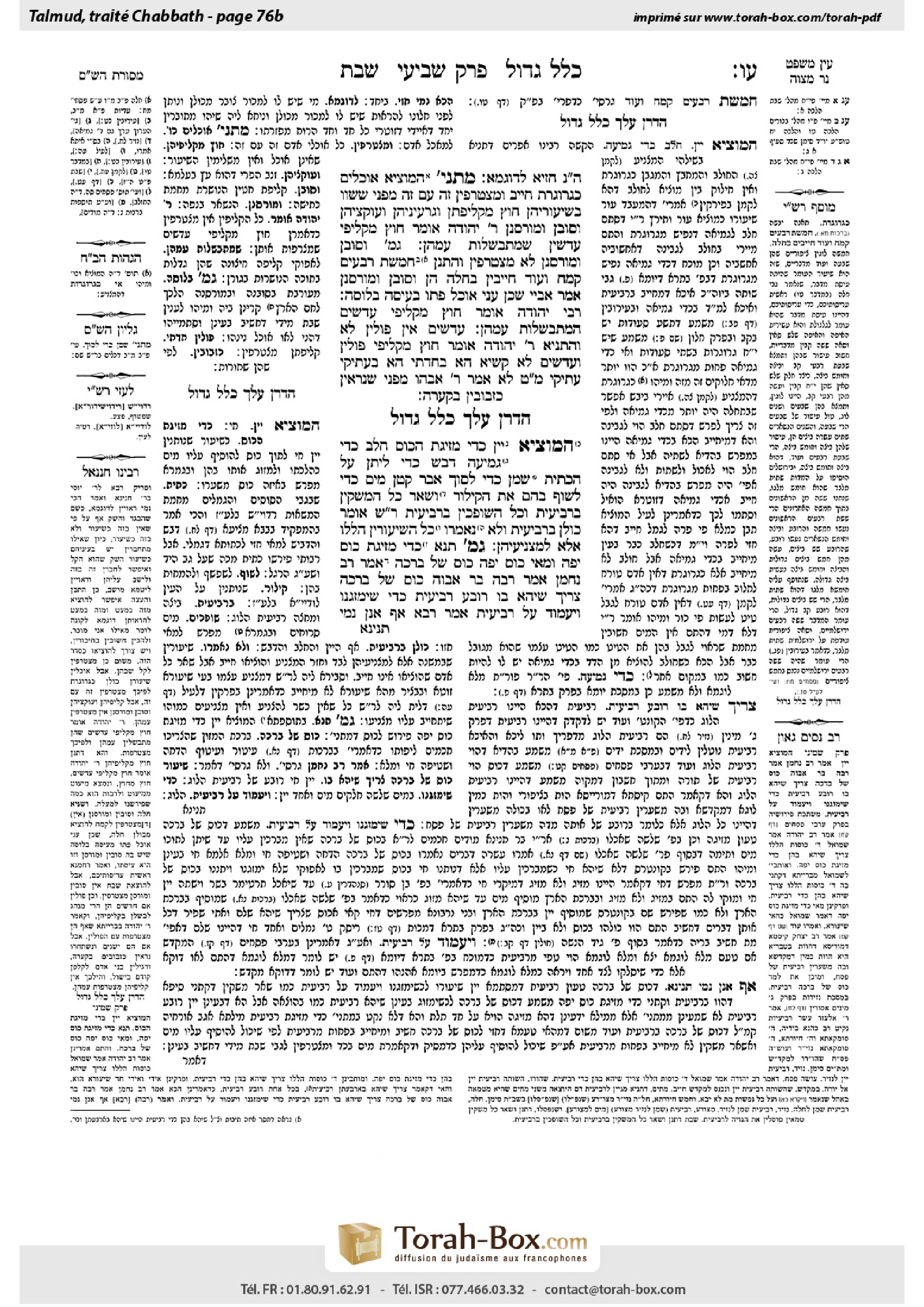
Shabbat 76b: Talmud study for Daf Yomi
Daf Yomi is the daily study of one Talmud folio. Explore 37 tractates with scans, Hebrew text, Sefaria English and AI-generated French translations where annotated.
Passage selection and English or AI-generated French translation are available where the scan has annotations. Daf Study is independent of Torah-Box and Sefaria.
Browse Shabbat · שבת · All tractatesShabbat 76b text and translations
This page of Shabbat includes the Aramaic text, an English translation and an AI-generated French translation, alongside the scan above.
שבת ע״ו ב · Aramaic and Hebrew text
הָכָא נָמֵי, חַזְיָא לְדוּגְמָא.
מַתְנִי׳ הַמּוֹצִיא אוֹכָלִים כִּגְרוֹגֶרֶת — חַיָּיב, וּמִצְטָרְפִין זֶה עִם זֶה מִפְּנֵי שֶׁשָּׁווּ בְּשִׁיעוּרֵיהֶן. חוּץ מִקְּלִיפָּתָן, וְגַרְעִינֵיהֶן, וְעוּקְצֵיהֶן, וְסוּבָּן, וּמוּרְסָנָן. רַבִּי יְהוּדָה אוֹמֵר: חוּץ מִקְּלִיפֵּי עֲדָשִׁין שֶׁמִּתְבַּשְּׁלוֹת עִמָּהֶן.
גְּמָ׳ וְסוּבָּן וּמוּרְסָנָן לֹא מִצְטָרְפִין? וְהָתְנַן: חֲמֵשֶׁת רְבָעִים קֶמַח וְעוֹד, חַיָּיבִין בַּחַלָּה הֵן וְסוּבָּן וּמוּרְסָנָן! אָמַר אַבָּיֵי: שֶׁכֵּן עָנִי אוֹכֵל פִּתּוֹ בְּעִיסָּה בְּלוּסָה.
רַבִּי יְהוּדָה אוֹמֵר: חוּץ מִקְּלִיפֵּי עֲדָשִׁים הַמִּתְבַּשְּׁלוֹת עִמָּהֶן. עֲדָשִׁים אִין, פּוֹלִין לָא? וְהָתַנְיָא, רַבִּי יְהוּדָה אוֹמֵר: חוּץ מִקְּלִיפֵּי פּוֹלִין וַעֲדָשִׁים! לָא קַשְׁיָא: הָא בְּחַדְתֵי, הָא בְּעַתִּיקֵי. עַתִּיקֵי מַאי טַעְמָא לָא? אָמַר רַבִּי אֲבָהוּ: מִפְּנֵי שֶׁנִּרְאִין כִּזְבוּבִין בַּקְּעָרָה.
הדרן עלך כלל גדול
מַתְנִי׳ הַמּוֹצִיא יַיִן — כְּדֵי מְזִיגַת הַכּוֹס. חָלָב — כְּדֵי גְמִיעָה. דְּבַשׁ — כְּדֵי לִיתֵּן עַל הַכָּתִית. שֶׁמֶן — כְּדֵי לָסוּךְ אֵבֶר קָטָן. מַיִם — כְּדֵי לָשׁוּף בָּהֶם אֶת הַקִּילוֹר. וּשְׁאָר כׇּל הַמַּשְׁקִין בִּרְבִיעִית, וְכׇל הַשּׁוֹפְכִין בִּרְבִיעִית. רַבִּי שִׁמְעוֹן אוֹמֵר: כּוּלָּן בִּרְבִיעִית, וְלֹא נֶאֶמְרוּ כׇּל הַשִּׁיעוּרִין הַלָּלוּ אֶלָּא לְמַצְנִיעֵיהֶן.
גְּמָ׳ תָּנָא: כְּדֵי מְזִיגַת כּוֹס יָפֶה. וּמַאי כּוֹס יָפֶה — כּוֹס שֶׁל בְּרָכָה. אָמַר רַב נַחְמָן אָמַר רַבָּה בַּר אֲבוּהּ: כּוֹס שֶׁל בְּרָכָה צָרִיךְ שֶׁיְּהֵא בּוֹ רוֹבַע רְבִיעִית, כְּדֵי שֶׁיִּמְזְגֶנּוּ וְיַעֲמוֹד עַל רְבִיעִית.
אָמַר רָבָא: אַף אֲנַן נָמֵי
Shabbat 76b · English translation
Here too, since these substances are suited to be piled together in the sample of a merchant seeking to sell them, they join together with regard to carrying out on Shabbat as well.
MISHNA: One who carries out a measure of foods fit for human consumption equivalent to a dried fig-bulk into a domain where carrying is prohibited on Shabbat is liable. And all those foods join together with one another to constitute that amount because they are equal in their measures. This amount is calculated without their shells, and their seeds, and their stems, and their bran, the husk that comes off of the wheat kernel when pounded, and their coarse bran that remains in the flour. Rabbi Yehuda says: None of the shells are calculated, except for the shells of lentils, which join together with the lentils to comprise the measure for liability because they are cooked and eaten with them.
GEMARA: The Gemara asks: And do the bran and coarse bran of cereals not join together? Didn’t we learn in a mishna: Dough made from five-quarters of a log of flour and a bit more obligates one to separate ḥalla? That amount includes them, the flour, and their bran, and their coarse bran. Apparently, bran and coarse bran join together with the flour to constitute the requisite measure. Abaye said: Bran joins together with the flour with regard to ḥalla and the making of bread, since a pauper eats his loaf made from dough mixed with bran. However, with regard to carrying out on Shabbat, the food items in question must be suitable for all people, since the measures are small and are calculated by their significance.
We learned in the mishna that shells do not join together to constitute the measure of food. Rabbi Yehuda says: Except for the shells of lentils because they are cooked and eaten with them. The Gemara asks: Is that to say that with lentils, yes, the shells do join together; but with beans, no, they do not? Wasn’t it taught in a baraita that Rabbi Yehuda says: Except for the shells of beans and lentils? The Gemara answers: This is not difficult: This baraita, which teaches that, according to Rabbi Yehuda, shells of beans join together with the beans, is referring to new, fresh beans. That mishna, which teaches that, according to Rabbi Yehuda, shells of beans do not join together with the beans, is referring to old beans. The Gemara asks: Why do the shells of old beans not join together? Rabbi Abbahu said: Because their shell fragments look like flies in the dish; people are repulsed by those shell fragments, they do not eat them and discard them.
MISHNA: One who carries out undiluted wine from a private domain to a public domain or vice versa is liable only for a measure equivalent to the wine typically diluted in a cup. Pure wine was diluted with water. The measure that determines liability for carrying out wine is a measure suitable to be diluted for a significant cup of wine. The measure that determines liability for carrying out milk is equivalent to that which is swallowed in one gulp. The measure that determines liability for carrying out honey is equivalent to that which is used to place on a sore caused by chafing. The measure that determines liability for carrying out oil is equivalent to that which is used to spread on a small limb. The measure that determines liability for carrying out water is equivalent to that which is used to rub and spread on an eye bandage. And the measure that determines liability for carrying out all other liquids is a quarter of a log. And the measure that determines liability for carrying out all waste water is a quarter of a log. Rabbi Shimon says: The measure that determines liability for all liquids is a quarter of a log. He further stated: And all these measures were only stated with regard to those who store them. One indicates that he considers these liquids significant by storing them. One is only liable for carrying out an object that is significant to him. Others, for whom these measures are insignificant, are not liable for carrying them out.
GEMARA: It was taught in a Tosefta: The measure that determines liability for carrying out wine is equivalent to the wine diluted for a significant cup of wine. The Gemara explains: And what is the significant cup of wine to which the Tosefta referred? It is a cup of blessing. And Rav Naḥman said that Rabba bar Avuh said: A cup of blessing must have a quarter of a quarter of a log of undiluted wine in it, so that one will dilute it with water, and the cup will contain a quarter of a log. The ratio of dilution is typically three parts water to one part wine.
Rava said: We too
Shabbat 76b · Traduction française (IA)
Ici aussi, puisque ces substances peuvent être réunies en un tas dans l’échantillon d’un marchand qui cherche à les vendre, elles s’associent également pour déterminer la quantité dont le transport pendant Chabbat rend passible.
MICHNA : Celui qui transporte dans un domaine où le transport est interdit pendant Chabbat une quantité d’aliments propres à la consommation humaine équivalant au volume d’une figue sèche est passible. Tous ces aliments s’associent les uns aux autres pour atteindre cette quantité, car leurs mesures sont équivalentes. Cette quantité se calcule sans les écorces, les graines, les tiges, le son — l’enveloppe qui se détache du grain de blé lorsqu’on le pile — ni le son grossier qui reste dans la farine. Rabbi Yehouda dit : Aucune écorce n’est prise en compte, à l’exception des écorces de lentilles, qui s’associent aux lentilles pour constituer la quantité qui rend passible, car elles sont cuites et mangées avec elles.
GUEMARA : La Guemara demande : Le son et le son grossier des céréales ne s’associent-ils donc pas ? N’avons-nous pas appris dans une Michna : Une pâte préparée avec cinq quarts de log de farine et un peu plus oblige à prélever la ḥalla ? Cette quantité comprend la farine, le son et le son grossier. Il semble donc que le son et le son grossier s’associent à la farine pour atteindre la mesure requise. Abayé dit : Le son s’associe à la farine pour la ḥalla et la confection du pain, car un pauvre mange son pain préparé avec une pâte mélangée à du son. En revanche, pour le transport pendant Chabbat, les aliments en question doivent convenir à tous, puisque les mesures sont petites et se calculent selon leur importance.
Nous avons appris dans la Michna que les écorces ne s’associent pas pour atteindre la mesure d’un aliment. Rabbi Yehouda dit : À l’exception des écorces de lentilles, car elles sont cuites et mangées avec elles. La Guemara demande : Cela signifie-t-il que les écorces s’associent pour les lentilles, mais pas pour les haricots ? N’a-t-il pas été enseigné dans une baraïta que Rabbi Yehouda dit : À l’exception des écorces de haricots et de lentilles ? La Guemara répond : Il n’y a pas de difficulté : cette baraïta, qui enseigne que, selon Rabbi Yehouda, les écorces de haricots s’associent aux haricots, parle de haricots frais. Cette Michna, qui enseigne que, selon Rabbi Yehouda, les écorces de haricots ne s’associent pas aux haricots, parle de haricots anciens. La Guemara demande : Pourquoi les écorces des haricots anciens ne s’associent-elles pas ? Rabbi Abbahou dit : Parce que leurs fragments d’écorce ressemblent à des mouches dans le plat ; les gens en sont dégoûtés, ne les mangent pas et les jettent.
MICHNA : Celui qui transporte du vin pur d’un domaine privé vers un domaine public, ou inversement, n’est passible que pour une quantité équivalant au vin que l’on dilue habituellement dans une coupe. Le vin pur était dilué avec de l’eau. La mesure qui rend passible pour le transport du vin est celle qui permet de préparer une coupe de vin importante. La mesure qui rend passible pour le transport du lait équivaut à ce qui est avalé d’une seule gorgée. La mesure qui rend passible pour le transport du miel équivaut à ce qu’on utilise pour appliquer sur une plaie causée par le frottement. La mesure qui rend passible pour le transport de l’huile équivaut à ce qu’on utilise pour enduire un petit membre. La mesure qui rend passible pour le transport de l’eau équivaut à ce qu’on utilise pour frotter et étaler sur un pansement oculaire. Pour tous les autres liquides, la mesure qui rend passible est un quart de log. Pour toutes les eaux usées, la mesure qui rend passible est un quart de log. Rabbi Chimon dit : Pour tous les liquides, la mesure qui rend passible est un quart de log. Il a ajouté : Toutes ces mesures n’ont été énoncées que pour ceux qui les mettent en réserve. Le fait de mettre ces liquides en réserve indique qu’on les considère comme importants. On n’est passible que pour le transport d’un objet qui a de l’importance à ses yeux. Ceux pour qui ces mesures sont insignifiantes ne sont pas passibles de les transporter.
GUEMARA : Il a été enseigné dans une Tossefta : La mesure qui rend passible pour le transport du vin équivaut au vin dilué pour remplir une coupe de vin importante. La Guemara précise : Quelle est la coupe de vin importante à laquelle la Tossefta fait référence ? C’est une coupe de bénédiction. Rav Naḥman a dit au nom de Rabba bar Avouh : Une coupe de bénédiction doit contenir un quart de quart de log de vin pur, afin qu’on le dilue avec de l’eau et que la coupe contienne un quart de log. La proportion habituelle de dilution est de trois parts d’eau pour une part de vin.
Rava a dit : Nous aussi
Traduction française générée par IA à partir de l’édition anglaise de Sefaria. Vérifie toujours un passage avec le texte source.
Text from Sefaria: William Davidson Edition - Vocalized Aramaic (CC BY NC); William Davidson Edition - English (CC BY NC).