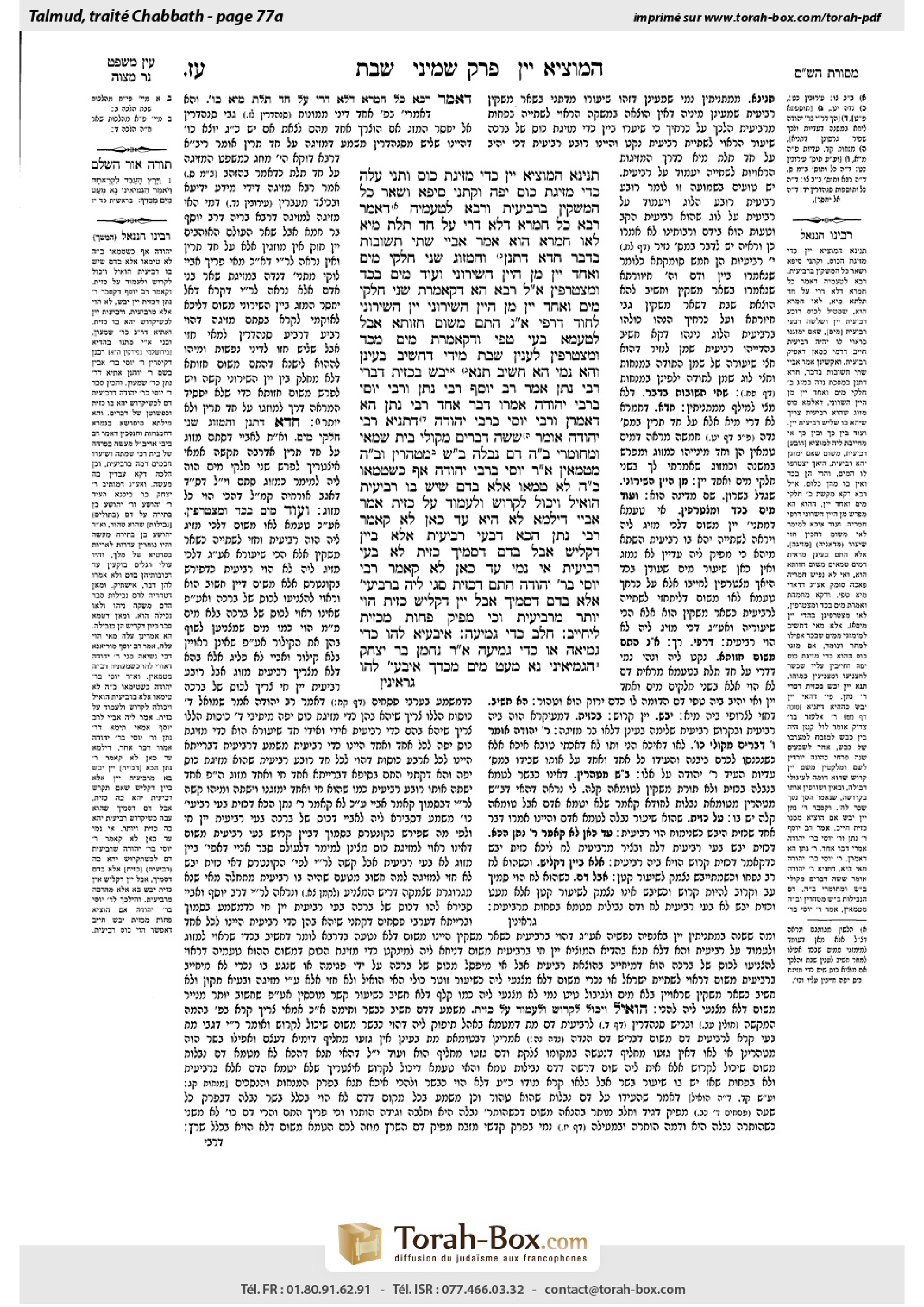
Shabbat 77a: Talmud study for Daf Yomi
Daf Yomi is the daily study of one Talmud folio. Explore 37 tractates with scans, Hebrew text, Sefaria English and AI-generated French translations where annotated.
Passage selection and English or AI-generated French translation are available where the scan has annotations. Daf Study is independent of Torah-Box and Sefaria.
Browse Shabbat · שבת · All tractatesShabbat 77a text and translations
This page of Shabbat includes the Aramaic text, an English translation and an AI-generated French translation, alongside the scan above.
שבת ע״ז א · Aramaic and Hebrew text
תְּנֵינָא: הַמּוֹצִיא יַיִן — כְּדֵי מְזִיגַת כּוֹס, וְתָנֵי עֲלַהּ: כְּדֵי מְזִיגַת כּוֹס יָפֶה. וְקָתָנֵי סֵיפָא: ״וּשְׁאָר כׇּל הַמַּשְׁקִין בִּרְבִיעִית״. וְרָבָא לְטַעְמֵיהּ, דְּאָמַר רָבָא: כֹּל חַמְרָא דְּלָא דָּרֵי עַל חַד תְּלָת מַיָּא לָאו חַמְרָא הוּא.
אָמַר אַבָּיֵי: שְׁתֵּי תְּשׁוּבוֹת בַּדָּבָר — חֲדָא, דִּתְנַן: וְהַמָּזוּג שְׁנֵי חֶלְקֵי מַיִם וְאֶחָד יַיִן, מִן הַיַּיִן הַשֵּׁירוֹנִי. וְעוֹד: מַיִם בַּכַּד וּמִצְטָרְפִין?!
אֲמַר לֵיהּ רָבָא: הָא דְּקָאָמְרַתְּ שְׁנֵי חֶלְקֵי מַיִם וְאֶחָד יַיִן מִן הַיַּיִן הַשֵּׁירוֹנִי — יַיִן הַשֵּׁירוֹנִי לְחוּד, דְּרָפֵי. אִי נָמֵי, הָתָם מִשּׁוּם חֲזוּתָא, אֲבָל לְטַעְמָא בָּעֵי טְפֵי. וּדְקָאָמְרַתְּ: מַיִם בַּכַּד וּמִצְטָרְפִין — לְעִנְיַן שַׁבָּת מִידֵּי דַּחֲשִׁיב בָּעֵינַן, וְהָא נָמֵי — הָא חֲשִׁיב.
תָּנָא: יָבֵשׁ בִּכְזַיִת, דִּבְרֵי רַבִּי נָתָן. אָמַר רַב יוֹסֵף: רַבִּי נָתָן וְרַבִּי יוֹסֵי בְּרַבִּי יְהוּדָה אָמְרוּ דָּבָר אֶחָד. רַבִּי נָתָן — הָא דַּאֲמַרַן, וְרַבִּי יוֹסֵי בְּרַבִּי יְהוּדָה, דְּתַנְיָא: רַבִּי יְהוּדָה אוֹמֵר: שִׁשָּׁה דְּבָרִים מִקּוּלֵּי בֵּית שַׁמַּאי וּמֵחוּמְרֵי בֵּית הִלֵּל. דַּם נְבֵלָה — בֵּית שַׁמַּאי מְטַהֲרִין, וּבֵית הִלֵּל מְטַמְּאִין. אָמַר רַבִּי יוֹסֵי בְּרַבִּי יְהוּדָה: אַף כְּשֶׁטִּמְּאוּ בֵּית הִלֵּל, לֹא טִמְּאוּ אֶלָּא בְּדָם שֶׁיֵּשׁ בּוֹ רְבִיעִית, הוֹאִיל וְיָכוֹל לִקְרוֹשׁ וְלַעֲמוֹד עַל כְּזַיִת.
אָמַר אַבָּיֵי: דִּילְמָא לָא הִיא. עַד כָּאן לָא קָאָמַר רַבִּי נָתָן הָכָא דִּכְזַיִת בָּעֵי רְבִיעִית — אֶלָּא בְּיַיִן דִּקְלִישׁ, אֲבָל בְּדָם דִּסְמִיךְ — כְּזַיִת לָא בָּעֵי רְבִיעִית. אִי נָמֵי, עַד כָּאן לָא קָאָמַר רַבִּי יוֹסֵי בְּרַבִּי יְהוּדָה הָתָם דִּכְזַיִת סַגִּי לֵיהּ בִּרְבִיעִית — אֶלָּא בְּדָם דִּסְמִיךְ, אֲבָל יַיִן דִּקְלִישׁ — כְּזַיִת הָוֵי יוֹתֵר מֵרְבִיעִית, וְכִי מַפֵּיק פָּחוֹת מִכְּזַיִת לִיחַיַּיב.
חָלָב כְּדֵי גְמִיעָה. אִיבַּעְיָא לְהוּ: ״כְּדֵי גְמִיאָה״, אוֹ ״כְּדֵי גְמִיעָה״. אָמַר רַב נַחְמָן בַּר יִצְחָק: ״הַגְמִיאִינִי נָא מְעַט מַיִם מִכַּדֵּךְ״.
אִיבַּעְיָא לְהוּ:
Shabbat 77a · English translation
learned that in the mishna: One who carries out undiluted wine is only liable if he carries out a measure equivalent to the wine typically diluted for a cup. And it was taught with regard to the mishna: A measure equivalent to the wine diluted for a significant cup of wine. And it was taught in the latter clause of the mishna: And the measure that determines liability for carrying out all other liquids is a quarter of a log. Since a quarter of a log is the significant measure for liquids, that is also the significant measure for diluted wine. And Rava is consistent with his line of reasoning, as Rava said: Any wine that does not hold one part wine diluted by three parts water is not wine. Wine must be sufficiently potent to be capable of being diluted with water three times its measure.
Abaye said: There are two possible responses with regard to this matter. One, as we learned in a mishna: Diluted wine, which is used to determine the exact color of red, is two parts water and one part wine from the wine of the Sharon. Apparently, wine constitutes one-third and not one-quarter of the diluted cup. And furthermore: Rava’s opinion is that the measure that determines liability for carrying out wine is a measure that, when diluted, would equal a quarter of a log, i.e., a quarter of a quarter of a log of undiluted wine. Is it possible that the water is in the jug and yet joins together with the wine? The wine that he is carrying out is less than the required measure and is not fit for drinking.
Rava said to him: That which you said that the dilution ratio that determines the color red is two parts water and one part wine, from the wine of the Sharon, is no proof. Wine of the Sharon is unique in that it is weak, and therefore two parts of water are sufficient to dilute it. Alternatively, there the dilution ratio mentioned is for determining the appearance of the color red; however, for the purpose of taste, more water is necessary. And that which you said: Is it possible that the water is in the jug and yet joins together with the wine? With regard to the liability of carrying out on Shabbat, we require an object that is significant, and this quarter of a quarter of a log of wine is also significant.
A tanna taught in a Tosefta: The measure that determines liability for carrying out congealed wine on Shabbat is an olive-bulk; this is the statement of Rabbi Natan. Rav Yosef said: Rabbi Natan and Rabbi Yosei, son of Rabbi Yehuda, said the same thing. Rabbi Natan’s statement is that which we just stated. And the statement of Rabbi Yosei, son of Rabbi Yehuda, is as it was taught in a baraita that Rabbi Yehuda says: Six matters are among the leniencies of Beit Shammai and among the stringencies of Beit Hillel. They include the blood of a carcass. Beit Shammai deem it ritually pure, as, in their opinion, only the flesh of a carcass imparts impurity; and Beit Hillel deem it ritually impure. Rabbi Yosei, son of Rabbi Yehuda, said: Even when Beit Hillel deemed it impure, they deemed impure only a measure of blood that contains a quarter of a log, since it can congeal and constitute an olive-bulk. Rav Yosef draws a parallel between the two opinions. Both tanna’im agree that a quarter of a log of liquid congeals to the size of an olive-bulk.
Abaye said: Perhaps that is not the case, as Rabbi Natan said that a quarter of a log is required only here, with regard to wine, which is liquid; however, with regard to blood, which is viscous, in order to produce an olive-bulk when congealed, a quarter of a log is not required. Less than a quarter of a log of blood congeals into an olive-bulk. Alternatively, Rabbi Yosei, son of Rabbi Yehuda, said that in order to create a congealed olive-bulk, a quarter of a log is sufficient only there, with regard to blood, which is viscous; however, wine, which is liquid, in order to create a congealed olive-bulk, more than a quarter of a log of wine is required. And, therefore, even when he carries out less than an olive-bulk on Shabbat, let him be liable. There is no proof that the two tannaitic opinions are parallel.
We learned in the mishna: The measure that determines liability for carrying out milk is equivalent to that which is swallowed [kedei gemia] in one gulp. A dilemma was raised before the Sages: Is the correct version of the mishna: Kedei gemia with an alef or kedei gemia with an ayin? Rav Naḥman bar Yitzḥak said: It should be written with an alef as we find in the Torah: “And he said: Give me to swallow [hagmi’ini with an alef ] please, a little water from your jug” (Genesis 24:17).
A similar dilemma with regard to spelling was raised before the Sages.
Shabbat 77a · Traduction française (IA)
Nous avons appris dans la Michna : celui qui fait sortir du vin non dilué n’est passible que s’il en fait sortir une quantité équivalant au vin habituellement dilué pour une coupe. Et il a été enseigné au sujet de la Michna : une quantité équivalant au vin dilué pour une coupe de vin importante. La dernière clause de la Michna enseigne que la mesure qui détermine la responsabilité pour faire sortir tous les autres liquides est d’un quart de log. Puisqu’un quart de log est la mesure importante pour les liquides, c’est aussi la mesure importante pour le vin dilué. Rava reste cohérent avec son raisonnement, car il a dit : tout vin qui ne peut pas être dilué avec trois mesures d’eau pour une mesure de vin n’est pas du vin. Le vin doit être suffisamment fort pour pouvoir être dilué avec un volume d’eau égal à trois fois le sien.
Abayé dit : il y a deux réponses possibles à ce sujet. Premièrement, nous avons appris dans une Michna : le vin dilué utilisé pour déterminer la nuance exacte du rouge comprend deux parts d’eau et une part de vin du Sharon. Il apparaît donc que le vin constitue un tiers, et non un quart, de la coupe diluée. En outre, selon Rava, la mesure qui détermine la responsabilité pour faire sortir du vin est une quantité qui, une fois diluée, équivaudrait à un quart de log, c’est-à-dire un quart d’un quart de log de vin non dilué. Est-il possible que l’eau, qui se trouve dans la cruche, s’ajoute pourtant au vin ? La quantité de vin qu’il fait sortir est inférieure à la mesure requise et ne convient pas à la consommation.
Rava lui dit : ce que tu as dit, à savoir que le rapport de dilution qui détermine la nuance du rouge est de deux parts d’eau pour une part de vin du Sharon, n’est pas une preuve. Le vin du Sharon est particulier en ce qu’il est faible ; deux parts d’eau suffisent donc à le diluer. Autre réponse : là-bas, le rapport de dilution mentionné sert à déterminer l’apparence de la couleur rouge ; toutefois, pour le goût, il faut davantage d’eau. Quant à ce que tu as dit : est-il possible que l’eau, qui se trouve dans la cruche, s’ajoute pourtant au vin ? Pour être passible d’avoir fait sortir un objet le Chabbat, il faut que celui-ci ait une importance ; or ce quart de quart de log de vin est également important.
Un tanna a enseigné dans une Tosefta : la mesure qui détermine la responsabilité pour faire sortir du vin solidifié le Chabbat est un volume de la taille d’une olive ; telle est la déclaration de Rabbi Natan. Rav Yossef dit : Rabbi Natan et Rabbi Yossé, fils de Rabbi Yehouda, ont exprimé la même opinion. Nous venons de citer la déclaration de Rabbi Natan. Quant à celle de Rabbi Yossé, fils de Rabbi Yehouda, elle correspond à ce qui a été enseigné dans une baraïta : Rabbi Yehouda dit que six cas relèvent des indulgences de Beit Chammaï et des rigueurs de Beit Hillel. Parmi eux figure le sang d’une carcasse. Beit Chammaï le jugent rituellement pur, car selon eux seule la chair d’une carcasse transmet l’impureté ; Beit Hillel le jugent rituellement impur. Rabbi Yossé, fils de Rabbi Yehouda, dit : même lorsque Beit Hillel l’ont jugé impur, ils ne jugeaient impur qu’un volume de sang contenant un quart de log, puisqu’il peut se solidifier et former un volume de la taille d’une olive. Rav Yossef établit un parallèle entre les deux opinions. Les deux tannaïm s’accordent à dire qu’un quart de log de liquide se solidifie pour atteindre le volume d’une olive.
Abayé dit : peut-être n’en est-il pas ainsi, car Rabbi Natan a dit qu’un quart de log est requis uniquement ici, à propos du vin, qui est liquide ; en revanche, pour le sang, qui est visqueux, il n’est pas nécessaire d’avoir un quart de log pour obtenir un volume de la taille d’une olive une fois solidifié. Une quantité de sang inférieure à un quart de log se solidifie pour former un volume de la taille d’une olive. Autre possibilité : Rabbi Yossé, fils de Rabbi Yehouda, a dit qu’un quart de log suffit pour obtenir un volume de la taille d’une olive une fois solidifié uniquement là-bas, à propos du sang, qui est visqueux ; en revanche, pour le vin, qui est liquide, il faut plus d’un quart de log afin d’obtenir un volume de la taille d’une olive une fois solidifié. Par conséquent, même s’il fait sortir le Chabbat une quantité inférieure à un volume de la taille d’une olive, qu’il soit passible. Il n’est pas prouvé que les deux opinions des tannaïm soient parallèles.
Nous avons appris dans la Michna : la mesure qui détermine la responsabilité pour faire sortir du lait équivaut à la quantité avalée [kedei gemia] en une gorgée. Une question fut posée aux Sages : quelle est la version correcte de la Michna, kedei gemia avec un alef ou kedei gemia avec un ayin ? Rav Naḥman bar Yitzḥak dit : cela doit s’écrire avec un alef, comme on le trouve dans la Torah écrite : « Et il dit : Donne-moi à boire [hagmi’ini avec un alef], s’il te plaît, un peu d’eau de ta cruche » (Genèse 24:17).
Une question semblable sur l’orthographe fut posée aux Sages.
Traduction française générée par IA à partir de l’édition anglaise de Sefaria. Vérifie toujours un passage avec le texte source.
Text from Sefaria: William Davidson Edition - Vocalized Aramaic (CC BY NC); William Davidson Edition - English (CC BY NC).