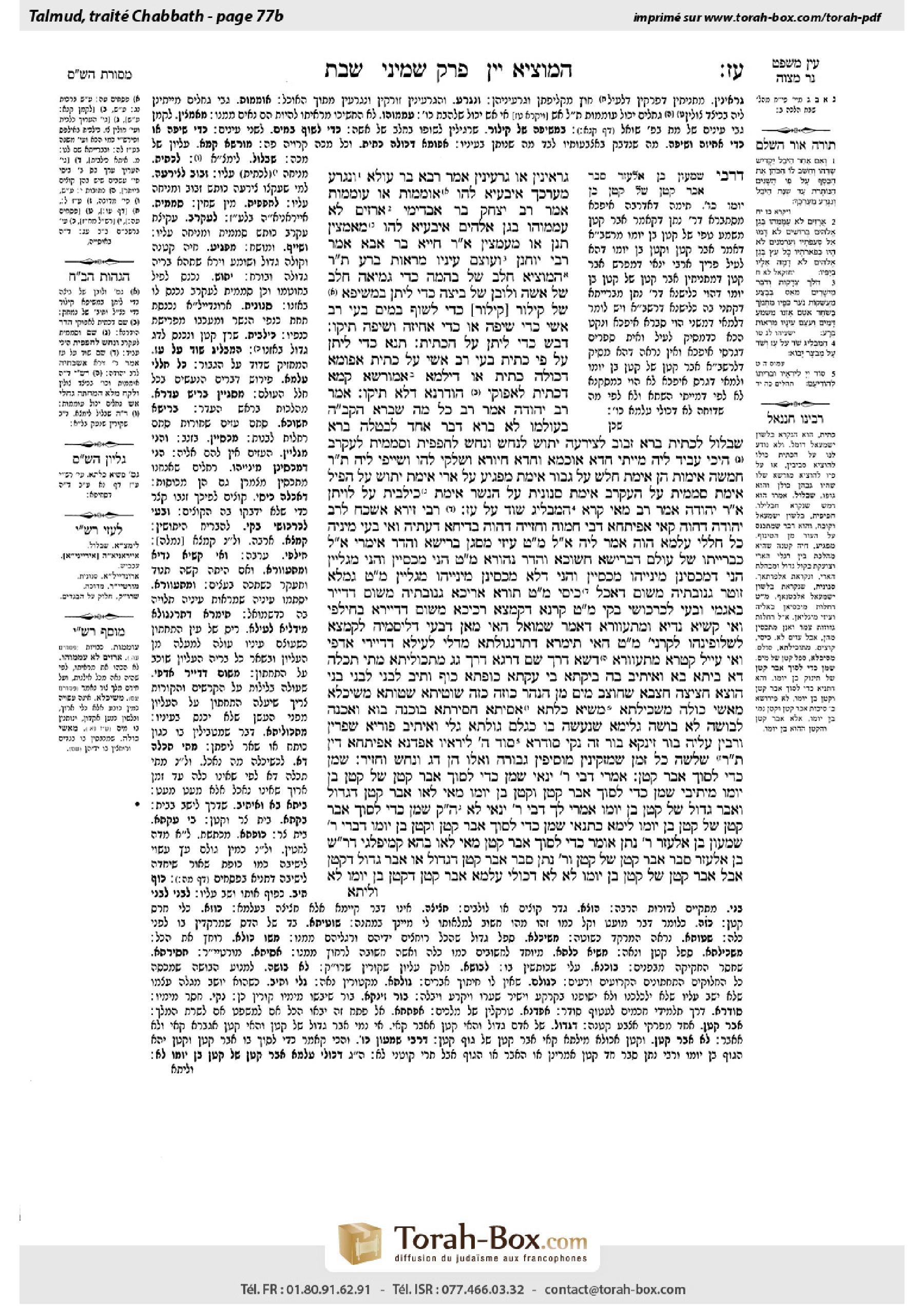
Shabbat 77b: Talmud study for Daf Yomi
Daf Yomi is the daily study of one Talmud folio. Explore 37 tractates with scans, Hebrew text, Sefaria English and AI-generated French translations where annotated.
Passage selection and English or AI-generated French translation are available where the scan has annotations. Daf Study is independent of Torah-Box and Sefaria.
Browse Shabbat · שבת · All tractatesShabbat 77b text and translations
This page of Shabbat includes the Aramaic text, an English translation and an AI-generated French translation, alongside the scan above.
שבת ע״ז ב · Aramaic and Hebrew text
״גַּרְאִינִין״, אוֹ ״גַרְעִינִין״? אָמַר רָבָא בַּר עוּלָּא: ״וְנִגְרַע מֵעֶרְכֶּךָ״.
אִיבַּעְיָא לְהוּ: ״אוֹמְמוֹת״, אוֹ ״עוֹמְמוֹת״? אָמַר רַב יִצְחָק בַּר אַבְדִּימִי: ״אֲרָזִים לֹא עֲמָמֻהוּ בְּגַן אֱלֹהִים״.
אִיבַּעְיָא לְהוּ: ״מְאַמְּצִין״ תְּנַן, אוֹ ״מְעַמְּצִין״. אָמַר רַבִּי חִיָּיא בַּר אַבָּא אָמַר רַבִּי יוֹחָנָן: ״וְעֹצֵם עֵינָיו מֵרְאוֹת בְּרָע״.
תָּנוּ רַבָּנַן: הַמּוֹצִיא חָלָב שֶׁל בְּהֵמָה כְּדֵי גְמִיאָה. חָלָב שֶׁל אִשָּׁה וְלוֹבֶן שֶׁל בֵּיצָה — כְּדֵי לִיתֵּן בִּמְשִׁיפָא שֶׁל קִילוֹר. [קִילוֹר] כְּדֵי לָשׁוּף בְּמַיִם. בָּעֵי רַב אָשֵׁי: כְּדֵי שִׁיפָה, אוֹ כְּדֵי אֲחִיזָה וְשִׁיפָה? תֵּיקוּ.
דְּבַשׁ כְּדֵי לִיתֵּן עַל הַכָּתִית. תָּנָא: כְּדֵי לִיתֵּן עַל פִּי כָתִית. בָּעֵי רַב אָשֵׁי: ״עַל כָּתִית״ — אַפּוּמָּא דְּכוּלַּהּ כָּתִית, אוֹ דִילְמָא אַמּוּרְשָׁא קַמָּא דְּכָתִית, לְאַפּוֹקֵי הוּדְרָנָא דְּלָא — תֵּיקוּ.
אָמַר רַב יְהוּדָה אָמַר רַב: כׇּל מַה שֶּׁבָּרָא הַקָּדוֹשׁ בָּרוּךְ הוּא בְּעוֹלָמוֹ לֹא בָּרָא דָּבָר אֶחָד לְבַטָּלָה. בָּרָא שַׁבְּלוּל — לְכָתִית. בָּרָא זְבוּב — לְצִירְעָה. יַתּוּשׁ — לְנָחָשׁ. וְנָחָשׁ — לַחֲפָפִית. וּסְמָמִית — לְעַקְרָב. הֵיכִי עָבֵיד לֵיהּ — מַיְיתֵי חֲדָא אוּכָּמָא וַחֲדָא חִיוָּרָא, וְשָׁלְקִי לְהוּ וְשָׁיְיפִי לֵיהּ.
תָּנוּ רַבָּנַן, חֲמִשָּׁה אֵימוֹת הֵן אֵימַת חַלָּשׁ עַל גִּבּוֹר: אֵימַת מַפְגִּיעַ עַל הָאֲרִי, אֵימַת יַתּוּשׁ עַל הַפִּיל, אֵימַת סְמָמִית עַל הָעַקְרָב, אֵימַת סְנוּנִית עַל הַנֶּשֶׁר, אֵימַת כִּילְבִּית עַל לִוְיָתָן. אָמַר רַב יְהוּדָה אָמַר רַב: מַאי קְרָא — ״הַמַּבְלִיג שֹׁד עַל עָז״.
רַבִּי זֵירָא אַשְׁכַּח לְרַב יְהוּדָה דַּהֲוָה קָאֵי אַפִּיתְחָא דְּבֵי חֲמוּהּ, וְחַזְיֵיהּ דַּהֲוָה בְּדִיחָא דַּעְתֵּיהּ, וְאִי בָּעֵי מִינֵּיהּ כׇּל חֲלָלֵי עָלְמָא הֲוָה אָמַר לֵיהּ. אֲמַר לֵיהּ: מַאי טַעְמָא עִיזֵּי מְסַגָּן בְּרֵישָׁא וַהֲדַר אִימְּרֵי? אֲמַר לֵיהּ כִּבְרִיָּיתוֹ שֶׁל עוֹלָם, דִּבְרֵישָׁא חֲשׁוֹכָא וַהֲדַר נְהוֹרָא. מַאי טַעְמָא הָנֵי מְכַסְּיָין וְהָנֵי מְגַלְּיָין? הָנֵי דְּמִכַּסִּינַן מִינַּיְיהוּ — מְכַסְּיָין, וְהָנֵי דְּלָא מִכַּסִּינַן מִינַּיְיהוּ — מְגַלְּיָין. מַאי טַעְמָא גַּמְלָא זוּטַר גְּנוּבְתֵּיהּ? מִשּׁוּם דְּאָכֵל כִּיסֵי. מַאי טַעְמָא תּוֹרָא אֲרִיכָא גְּנוּבְתֵּיהּ? מִשּׁוּם דְּדָיֵיר בְּאַגְמֵי, וּבָעֵי לְכַרְכּוֹשֵׁי בָּקֵי.
מַאי טַעְמָא קַרְנָא דְקַמְצָא רַכִּיכָא? מִשּׁוּם דְּדָיְירָא בְּחִילְפֵי, וְאִי קַשְׁיָא — נָדְיָא וּמִתְעַוְּורָא. דְּאָמַר שְׁמוּאֵל: הַאי מַאן דְּבָעֵי דְּלִיסַמְּיֵהּ לְקַמְצָא — לִשְׁלְפִינְהוּ לְקַרְנֵיהּ. מַאי טַעְמָא הַאי תִּימְרָא דְתַרְנְגוֹלְתָּא מִדְּלֵי לְעֵילָּא? דְּדָיְירִי אַדַּפֵּי, וְאִי עָיֵיל קֻטְרָא — מִתְעַוְּורָא. ״דַּשָּׁא״ — דֶּרֶךְ שָׁם. ״דַּרְגָּא״ — דֶּרֶךְ גַּג. ״מַתְכּוּלִיתָא״ — מָתַי תִּכְלֶה דָּא. ״בֵּיתָא״ — בֹּא וְאִיתֵּיב (בַּהּ). ״בִּיקְתָּא״ — בֵּי עָקְתָא.
״כּוּפְתָּא״ — כּוּף וְתִיב. ״לִבְנֵי״ — לִבְנֵי בְּנֵי. ״הוּצָא״ — חֲצִיצָה. ״חַצְבָּא״ — שֶׁחוֹצֵב מַיִם מִן הַנָּהָר. ״כּוּזָה״ — כָּזֶה. ״שׁוּטִיתָא״ — שְׁטוּתָא. ״מְשִׁיכְלָא״ — מָאשֵׁי כּוֹלָּא. ״מְשִׁיכְלְתָא״ — מָשְׁיָא כַּלְּתָא. ״אֲסִיתָא״ — חַסִּירְתָּא. ״בּוּכְנָה״ — בּוֹא וְאַכֶּנָּה.
״לְבוּשָׁה״ — לֹא בּוּשָׁה. ״גְּלִימָא״ — שֶׁנַּעֲשָׂה בּוֹ כְּגֹלֶם. ״גּוּלְּתָא״ — גַּלִּי וְאִיתֵּיב. ״פּוּרְיָא״ — שֶׁפָּרִין וְרָבִין עָלֶיהָ. ״בּוֹר זִינְקָא״ — בּוֹר זֶה נָקִי. ״סוּדָרָא״ — סוֹד ה׳ לִירֵאָיו. ״אַפַּדְנָא״ — אַפִּיתְחָא דֵּין. תָּנוּ רַבָּנַן: שְׁלֹשָׁה כׇּל זְמַן שֶׁמַּזְקִינִין מוֹסִיפִין גְּבוּרָה, וְאֵלּוּ הֵן: דָּג, וְנָחָשׁ, וַחֲזִיר.
שֶׁמֶן כְּדֵי לָסוּךְ אֵבֶר קָטָן. אָמְרִי דְּבֵי רַבִּי יַנַּאי שֶׁמֶן כְּדֵי לָסוּךְ אֵבֶר קָטָן שֶׁל קָטָן בֶּן יוֹמוֹ. מֵיתִיבִי: שֶׁמֶן כְּדֵי לָסוּךְ אֵבֶר קָטָן, וְקָטָן בֶּן יוֹמוֹ. מַאי לָאו: אֵבֶר קָטָן דְּגָדוֹל, וְאֵבֶר גָּדוֹל שֶׁל קָטָן בֶּן יוֹמוֹ! אָמְרִי לָךְ דְּבֵי רַבִּי יַנַּאי — לָא, הָכִי קָאָמַר: שֶׁמֶן כְּדֵי לָסוּךְ אֵבֶר קָטָן, שֶׁל קָטָן בֶּן יוֹמוֹ.
לֵימָא כְּתַנָּאֵי? שֶׁמֶן כְּדֵי לָסוּךְ אֵבֶר קָטָן, וְקָטָן בֶּן יוֹמוֹ — דִּבְרֵי רַבִּי שִׁמְעוֹן בֶּן אֶלְעָזָר. רַבִּי נָתָן אוֹמֵר: כְּדֵי לָסוּךְ אֵבֶר קָטָן. מַאי לָאו בְּהָא קָמִיפַּלְגִי: דְּרַבִּי שִׁמְעוֹן בֶּן אֶלְעָזָר סָבַר אֵבֶר קָטָן שֶׁל קָטָן, וְרַבִּי נָתָן סָבַר אֵבֶר קָטָן דְּגָדוֹל, אוֹ אֵבֶר גָּדוֹל דְּקָטָן. אֲבָל אֵבֶר קָטָן שֶׁל קָטָן בֶּן יוֹמוֹ — לָא. לָא, דְּכוּלֵּי עָלְמָא אֵבֶר קָטָן דְּקָטָן בֶּן יוֹמוֹ לָא,
Shabbat 77b · English translation
In the mishna at the end of the previous chapter we learned that the measure that determines liability for carrying out foods is calculated without their seeds [garinin]. Is the correct version garinin with an alef or garinin with an ayin? Rava bar Ulla said: It is with an ayin, since it stems from the same root as: “And it shall be subtracted [venigra with an ayin] from your valuation” (Leviticus 27:18).
A dilemma was raised before the Sages: Do we describe dimming coals as omemot with an alef or omemot with an ayin? Rav Yitzḥak bar Avdimi said: It is written with an ayin, as it is stated: “The cedars in the garden of God could not hide it [amamuhu with an ayin]” (Ezekiel 31:8).
A dilemma was raised before the Sages: With regard to closing the eyes of the dead, did we learn in the mishna me’amtzin with an alef, or me’amtzin with an ayin? Rabbi Ḥiyya bar Abba said that Rabbi Yoḥanan said: It is written with an ayin as it is stated: “And closes [ve’otzem with an ayin] his eyes from seeing evil” (Isaiah 33:15).
With regard to carrying out milk, the Sages taught: One who carries out the milk of an animal on Shabbat is liable only for a measure equivalent to that which is swallowed in one gulp. The measure that determines liability for carrying out a woman’s milk and the white of an egg is equivalent to that which is used to place on the part of an eye bandage upon which the ointment is placed directly on the wound. And the aforementioned eye bandage must be sufficiently large to use it to rub both his eyes with water. Rav Ashi raised a dilemma: Is the measure that determines liability for the bandage equivalent to that with which water can be rubbed on both eyes, or is it equivalent to that which can be held and rubbed? Is the part of the bandage held in his hand when applying the bandage to his eyes also taken into account? No resolution was found for this dilemma. Therefore, let it stand unresolved.
We learned in the mishna: The measure that determines liability for carrying out honey is equivalent to that which is used to place on a sore caused by chafing. A tanna taught in a Tosefta: The precise measure is equivalent to that which is placed on the opening of a sore, i.e., on the wound itself. Rav Ashi raised a dilemma: Does the term on a sore mean the measure of honey spread on the opening of the entire sore; or, perhaps it means the measure spread on the primary protuberance of the sore, to the exclusion of the surrounding area upon which he does not spread honey? No resolution was found for this dilemma either. Therefore, let it stand unresolved.
On the subject of sores, the Gemara cites a statement referring to one of the methods for healing a sore. Rav Yehuda said that Rav said: Everything that the Holy One, Blessed be He, created in His world, He did not create anything for naught. He created a snail as a remedy for a sore; He created a fly to be crushed and spread as a remedy on a wasp sting; He created a mosquito as a remedy for a snake bite; and He created the snake itself as a remedy for a skin rash; and He created a gecko as a remedy for a scorpion bite. The Gemara explains: How does one implement the remedy? He brings two geckos, one black and one white, cooks them, and spreads the resulting ointment on the affected area.
With regard to these creatures, the Gemara cites that which our Sages taught: There are five dreads, i.e., dread that the weak cast over the mighty: The dread of the mafgia, a small creature, over the lion; the dread of the mosquito over the elephant; the dread of the gecko over the scorpion; the dread of the swallow over the eagle; the dread of the kilbit, a small fish, over a whale. Rav Yehuda said that Rav said: What is the verse that alludes to these matters? As it is written: “He that causes destruction [shod] to flash upon the mighty, so that destruction comes upon the fortress” (Amos 5:9), which is interpreted as: He who lifts the downtrodden [shadud] over the mighty.
On the topic of the nature of the world, the Gemara relates that Rabbi Zeira found Rav Yehuda, who was standing at the entrance of his father-in-law’s house, and observed that he was in an especially cheerful mood. And Rabbi Zeira understood that were he to ask Rabbi Yehuda about anything in the entire world, he would tell him the answer. He therefore posed questions to him on a variety of topics unrelated to halakha. He asked: Why do goats walk in front of the flock and then ewes follow? He said to him: It is just as it was in the creation of the world, which at first was dark and then light followed. Goats, which are typically black, precede the ewes, which are typically white. And he asked: Why are the genitals of these ewes covered with a tail, whereas these goats are exposed? He answered: These ewes, whose wool we use to cover ourselves, are rewarded in that they are covered; and those goats, whose hair we do not use to cover ourselves, are exposed. And he asked: Why is the camel’s tail short? He answered: Because a camel eats thorns, and a long tail would become entangled in the thorns. And he asked: Why is the ox’s tail long? He answered: Because the ox lives in a swamp and must fend off mosquitoes.
He continued to ask: Why is the grasshopper’s antenna soft? He answered: Because it lives in the plains among the grass, and if the antenna were hard it would break and the grasshopper would go blind. When the grasshopper loses its antenna it is unable to move, as Shmuel said: One who seeks to blind a grasshopper should remove its antenna. And he asked: Why does the chicken’s lower eyelid cover the upper one? He answered: Because a chicken lives on rafters in houses, and if the smoke from the houses were to enter its eyes without the protection of the eyelid, it would go blind. He asked further: Why is a door called dasha in Aramaic? He said to him: It is an acronym for derekh sham, which means through there. Why is a stair called darga? He said to him: It is an acronym for derekh gag, which means the way to the roof. Why are spices called mitkolita? He said to him: It is an acronym for matai tikhleh da, which means when will this be finished. Since spices are used sparingly, they last a long time. Why is a house called beita? He said to him: It is an acronym for bo ve’eitiv ba, which means come and I will sit in it. Why is a small house called bikta? He said to him: It is an acronym for bei akta, which means a narrow house.
A barrel is called kufta, which is an acronym for kuf vetiv, which means turn it over and sit. Bricks are called livnei, which is an allusion to livnei benei, which means for the children of children. A fence made of thorns is called hutza and Rav Yehuda said that it is merely a ḥatzitza, which means partition, as opposed to a true fence. A jug used for drawing water is called a ḥatzba because it hews [ḥotzev] water from the river. A small jug is called kuza, alluding to kazeh, which means: Give me one like that. Myrtle branches with which people dance at a wedding are called shutita, an allusion to shetuta, which means madness, as the frenzied dancing appears to be madness. The large vessel used for washing is called meshikhla, which is an acronym for mashei kula, which means: It washes all. A small vessel used for washing is called mashkhilta, and Rav Yehuda explained that it is an acronym for mashya kalta, which means: It washes the bride. A mortar is called asita, alluding to ḥasirta, which means lacking, since it has a large cavity. The pestle that is inserted into the mortar for pounding its contents is called bukhna, which is an acronym for bo ve’akkena, which means: Come and I will strike it.
An outer garment is called levusha, which is an acronym for lo busha, which means no shame, as one who is clothed is no longer ashamed. A broad outer garment is called gelima, an allusion to the fact that, by wearing it, one is transformed into an amorphous golem-like figure, as his limbs are indistinguishable. A beautiful coat is termed golta, which is an acronym for geli ve’eitiv, which means reveal, remove the coat, and only then I will sit, so that the coat will not get dirty. A bed is called purya, an allusion to the fact that people parin veravin, which means procreate, upon it. An empty pit is called bor zinka, which is an acronym for bor ze naki, which means that this pit is empty of water. The head covering of Torah scholars is called sudara, an acronym for sod yareh, which is a reference to the verse: “The counsel of the Lord is with them who fear Him [sod Hashem lire’av]” (Psalms 25:14). A palace is called apadna, which is an acronym for apitḥa dein, meaning: To this entrance all come. The Gemara cites an additional baraita related to the nature of the creatures. There are three creatures that grow mightier with age, and they are the fish, and the snake, and the pig.
We learned in the mishna: The measure that determines liability for carrying out oil is equivalent to that which is used to spread on a small limb. The school of Rabbi Yannai said it should be explained as follows: The measure that determines liability for carrying out oil is equivalent to that which is used to spread on a small limb of a day-old child. The Gemara raises an objection from a baraita: The measure that determines liability for carrying out oil is equivalent to that which is used to spread on a small limb and a day-old child. Does this not mean: A small limb of an adult and a large limb of a day-old child? The Gemara rejects this: The school of Rabbi Yannai could have said to you: No, this is what the baraita is saying: The measure that determines liability for carrying out oil is equivalent to that which is used to spread on a small limb, and the small limb in question is that of a day-old child.
The Gemara suggests: Let us say that this is parallel to a dispute between tanna’im, as it was taught in a baraita: The measure that determines liability for carrying out oil is equivalent to that which is used to spread on a small limb and a day-old child; this is the statement of Rabbi Shimon ben Elazar. Rabbi Natan says: Equivalent to that which is used to spread on a small limb. Is it not that they disagree about the following? Rabbi Shimon ben Elazar holds: It refers to a small limb of a small child, and Rabbi Natan holds: The measure for liability is equivalent to that which is used to spread on a small limb of an adult or a large limb of a child, but for a measure equivalent to that which is used to spread on a small limb of a day-old child, no, one is exempt. The Gemara rejects this: No, everyone agrees that for carrying out oil in a measure equivalent to that which is used to spread on a small limb of a day-old child, no, one is exempt,
Shabbat 77b · Traduction française (IA)
Dans la Michna, à la fin du chapitre précédent, nous avons appris que la mesure qui détermine la responsabilité pour le transport d’aliments est calculée sans leurs graines [garinin]. Faut-il lire garinin avec un aleph ou avec un ayin ? Rava bar Ulla a dit : Il faut lire avec un ayin, car le mot vient de la même racine que celui du verset : « Et elle sera retranchée [venigra avec un ayin] de ton estimation » (Lévitique 27,18).
Une question fut soumise aux Sages : décrit-on des braises qui s’éteignent comme omemot avec un aleph ou avec un ayin ? Rav Yitzḥak bar Avdimi a dit : Le mot s’écrit avec un ayin, comme il est dit : « Les cèdres du jardin de Dieu ne pouvaient la dissimuler [amamuhu avec un ayin] » (Ézéchiel 31,8).
Une question fut soumise aux Sages : au sujet de la fermeture des yeux des morts, avons-nous appris dans la Michna me’amtzin avec un aleph ou avec un ayin ? Rabbi Ḥiyya bar Abba a dit au nom de Rabbi Yoḥanan : Le mot s’écrit avec un ayin, comme il est dit : « Et ferme [ve’otzem avec un ayin] les yeux pour ne pas voir le mal » (Isaïe 33,15).
Au sujet du transport de lait, les Sages ont enseigné : Celui qui transporte du lait animal pendant Chabbat n’est passible que pour une quantité équivalant à ce qui peut être avalé en une seule gorgée. La mesure qui détermine la responsabilité pour le transport du lait d’une femme et du blanc d’œuf équivaut à la quantité utilisée sur la partie du pansement oculaire placée directement sur la plaie, là où l’onguent est appliqué. Le pansement oculaire mentionné doit être assez grand pour permettre de se frotter les deux yeux avec de l’eau. Rav Ashi souleva une question : La mesure qui détermine la responsabilité pour le pansement équivaut-elle à la quantité avec laquelle on peut frotter les deux yeux, ou à la quantité que l’on peut tenir dans la main et utiliser pour frotter ? La partie du pansement tenue dans la main lorsqu’on l’applique sur les yeux est-elle également prise en compte ? Aucune solution ne fut trouvée à cette question. Elle reste donc sans réponse.
Nous avons appris dans la Michna : La mesure qui détermine la responsabilité pour le transport de miel équivaut à la quantité utilisée sur une plaie due au frottement. Un tanna a enseigné dans une Tossefta : La mesure précise équivaut à la quantité appliquée sur l’ouverture d’une plaie, c’est-à-dire sur la plaie elle-même. Rav Ashi souleva une question : L’expression « sur une plaie » désigne-t-elle la quantité de miel étalée sur l’ouverture de toute la plaie, ou bien la quantité étalée sur la protubérance principale de la plaie, à l’exclusion de la zone environnante, sur laquelle il n’étale pas de miel ? Aucune solution ne fut trouvée non plus à cette question. Elle reste donc sans réponse.
À propos des plaies, la Guemara cite une déclaration relative à l’une des méthodes permettant de les soigner. Rav Yehouda a dit au nom de Rav : Tout ce que le Saint, béni soit-Il, a créé dans Son monde, Il ne l’a rien créé en vain. Il a créé un escargot comme remède contre une plaie ; une mouche, que l’on écrase et étale comme remède contre une piqûre de guêpe ; un moustique comme remède contre une morsure de serpent ; le serpent lui-même comme remède contre une éruption cutanée ; et un gecko comme remède contre une piqûre de scorpion. La Guemara explique : Comment applique-t-on ce remède ? On prend deux geckos, l’un noir et l’autre blanc, on les fait cuire et on étale l’onguent ainsi obtenu sur la zone atteinte.
Au sujet de ces créatures, la Guemara cite ce que nos Sages ont enseigné : Il y a cinq terreurs, c’est-à-dire cinq cas où les faibles inspirent de la terreur aux puissants : la terreur du mafgia, une petite créature, sur le lion ; celle du moustique sur l’éléphant ; celle du gecko sur le scorpion ; celle de l’hirondelle sur l’aigle ; et celle du kilbit, un petit poisson, sur la baleine. Rav Yehouda a dit au nom de Rav : Quel verset fait allusion à ces faits ? Comme il est écrit : « Celui qui fait luire la destruction [shod] sur les puissants, si bien que la destruction s’abat sur la forteresse » (Amos 5,9), verset interprété ainsi : celui qui élève les opprimés [shadud] au-dessus des puissants.
À propos de la nature du monde, la Guemara rapporte que Rabbi Zeira trouva Rav Yehouda debout à l’entrée de la maison de son beau-père et remarqua qu’il était d’humeur particulièrement joyeuse. Rabbi Zeira comprit que, s’il interrogeait Rav Yehouda sur n’importe quel sujet au monde, celui-ci lui donnerait la réponse. Il lui posa donc des questions sur divers sujets sans rapport avec la halakha. Il demanda : Pourquoi les chèvres marchent-elles devant le troupeau, puis les brebis les suivent-elles ? Rav Yehouda lui répondit : C’est comme lors de la création du monde : il y eut d’abord l’obscurité, puis la lumière vint ensuite. Les chèvres, généralement noires, précèdent les brebis, généralement blanches. Il demanda aussi : Pourquoi la queue de ces brebis couvre-t-elle leurs organes génitaux, tandis que ceux de ces chèvres sont exposés ? Il répondit : Ces brebis, dont nous utilisons la laine pour nous couvrir, sont récompensées en étant couvertes ; ces chèvres, dont nous n’utilisons pas les poils pour nous couvrir, sont exposées. Il demanda : Pourquoi la queue du chameau est-elle courte ? Il répondit : Parce que le chameau mange des épines, et qu’une longue queue s’y emmêlerait. Il demanda : Pourquoi la queue du bœuf est-elle longue ? Il répondit : Parce que le bœuf vit dans un marécage et doit se défendre contre les moustiques.
Il poursuivit ses questions : Pourquoi les antennes de la sauterelle sont-elles molles ? Il répondit : Parce qu’elle vit dans les plaines, parmi l’herbe ; si ses antennes étaient dures, elles se briseraient et la sauterelle deviendrait aveugle. Quand la sauterelle perd ses antennes, elle est incapable de bouger, comme l’a dit Shmuel : Celui qui veut rendre une sauterelle aveugle doit lui arracher ses antennes. Il demanda : Pourquoi la paupière inférieure de la poule recouvre-t-elle la supérieure ? Il répondit : Parce que la poule vit sur les poutres des maisons ; si la fumée des maisons pénétrait dans ses yeux sans la protection de sa paupière, elle deviendrait aveugle. Il demanda encore : Pourquoi appelle-t-on une porte dasha en araméen ? Rav Yehouda lui répondit : C’est l’acronyme de derekh sham, qui signifie « par là ». Pourquoi appelle-t-on un escalier darga ? Il lui répondit : C’est l’acronyme de derekh gag, qui signifie « le chemin vers le toit ». Pourquoi appelle-t-on les épices mitkolita ? Il lui répondit : C’est l’acronyme de matai tikhleh da, qui signifie « quand cela sera-t-il fini ? ». Comme on utilise les épices avec parcimonie, elles durent longtemps. Pourquoi appelle-t-on une maison beita ? Il lui répondit : C’est l’acronyme de bo ve’eitiv ba, qui signifie « viens et je m’y assiérai ». Pourquoi appelle-t-on une petite maison bikta ? Il lui répondit : C’est l’acronyme de bei akta, qui signifie « maison étroite ».
Un tonneau s’appelle kufta, l’acronyme de kuf vetiv, qui signifie « retourne-le et assieds-toi ». Les briques s’appellent livnei, allusion à livnei benei, qui signifie « pour les enfants des enfants ». Une clôture d’épines s’appelle hutza ; Rav Yehouda dit que ce n’est qu’une ḥatzitza, c’est-à-dire une cloison, et non une véritable clôture. Une cruche servant à puiser de l’eau s’appelle ḥatzba, parce qu’elle taille [ḥotzev] l’eau dans le fleuve. Une petite cruche s’appelle kuza, allusion à kazeh, qui signifie : « Donne-m’en une comme celle-là. » Les branches de myrte avec lesquelles on danse lors d’un mariage s’appellent shutita, allusion à shetuta, qui signifie « folie », car cette danse frénétique semble relever de la folie. Le grand récipient servant à se laver s’appelle meshikhla, l’acronyme de mashei kula, qui signifie « il lave tout ». Le petit récipient servant à se laver s’appelle mashkhilta ; Rav Yehouda expliqua que c’est l’acronyme de mashya kalta, qui signifie « il lave la mariée ». Un mortier s’appelle asita, allusion à ḥasirta, qui signifie « manquant », car il a une grande cavité. Le pilon inséré dans le mortier pour en broyer le contenu s’appelle bukhna, l’acronyme de bo ve’akkena, qui signifie : « Viens et je le frapperai. »
Un vêtement extérieur s’appelle levusha, l’acronyme de lo busha, qui signifie « pas de honte », car celui qui est habillé n’a plus honte. Un ample vêtement extérieur s’appelle gelima, allusion au fait que celui qui le porte se transforme en une sorte de golem informe, ses membres n’étant plus distincts. Un beau manteau s’appelle golta, l’acronyme de geli ve’eitiv, qui signifie « découvre-toi, enlève le manteau, et alors seulement je m’assiérai », afin que le manteau ne se salisse pas. Un lit s’appelle purya, allusion au fait que les gens parin veravin, c’est-à-dire procréent, dessus. Une fosse vide s’appelle bor zinka, l’acronyme de bor ze naki, qui signifie « cette fosse est vide d’eau ». La coiffe des érudits en Torah s’appelle sudara, l’acronyme de sod yareh, allusion au verset : « Le conseil de l’Éternel est avec ceux qui Le craignent [sod Hashem lire’av] » (Psaumes 25,14). Un palais s’appelle apadna, l’acronyme de apitḥa dein, qui signifie : « Tous viennent à cette entrée. » La Guemara cite une autre baraïta relative à la nature des créatures. Il y a trois créatures qui deviennent plus vigoureuses avec l’âge : le poisson, le serpent et le porc.
Nous avons appris dans la Michna : La mesure qui détermine la responsabilité pour le transport d’huile équivaut à la quantité utilisée pour enduire un petit membre. L’école de Rabbi Yannai a dit qu’il faut l’expliquer ainsi : la mesure qui détermine la responsabilité pour le transport d’huile équivaut à la quantité utilisée pour enduire un petit membre d’un enfant âgé d’un jour. La Guemara soulève une objection à partir d’une baraïta : La mesure qui détermine la responsabilité pour le transport d’huile équivaut à la quantité utilisée pour enduire un petit membre et un enfant âgé d’un jour. Cela ne signifie-t-il pas : un petit membre d’un adulte et un grand membre d’un enfant âgé d’un jour ? La Guemara rejette cette interprétation : l’école de Rabbi Yannai aurait pu vous répondre : Non, voici ce que dit la baraïta : la mesure qui détermine la responsabilité pour le transport d’huile équivaut à la quantité utilisée pour enduire un petit membre, et le petit membre en question est celui d’un enfant âgé d’un jour.
La Guemara suggère : Disons que cela correspond à une controverse entre des tannaïm, car une baraïta a enseigné : La mesure qui détermine la responsabilité pour le transport d’huile équivaut à la quantité utilisée pour enduire un petit membre et un enfant âgé d’un jour ; telle est l’opinion de Rabbi Shimon ben Elazar. Rabbi Natan dit : Elle équivaut à la quantité utilisée pour enduire un petit membre. Ne sont-ils pas en désaccord sur le point suivant ? Rabbi Shimon ben Elazar considère qu’il s’agit d’un petit membre d’un petit enfant, tandis que Rabbi Natan considère que la mesure qui détermine la responsabilité équivaut à la quantité utilisée pour enduire un petit membre d’un adulte ou un grand membre d’un enfant, mais que, pour une quantité équivalant à celle utilisée pour enduire un petit membre d’un enfant âgé d’un jour, on est exempt. La Guemara rejette cette interprétation : Non, tous conviennent que, pour le transport d’huile en une quantité équivalant à celle utilisée pour enduire un petit membre d’un enfant âgé d’un jour, on est exempt,
Traduction française générée par IA à partir de l’édition anglaise de Sefaria. Vérifie toujours un passage avec le texte source.
Text from Sefaria: William Davidson Edition - Vocalized Aramaic (CC BY NC); William Davidson Edition - English (CC BY NC).