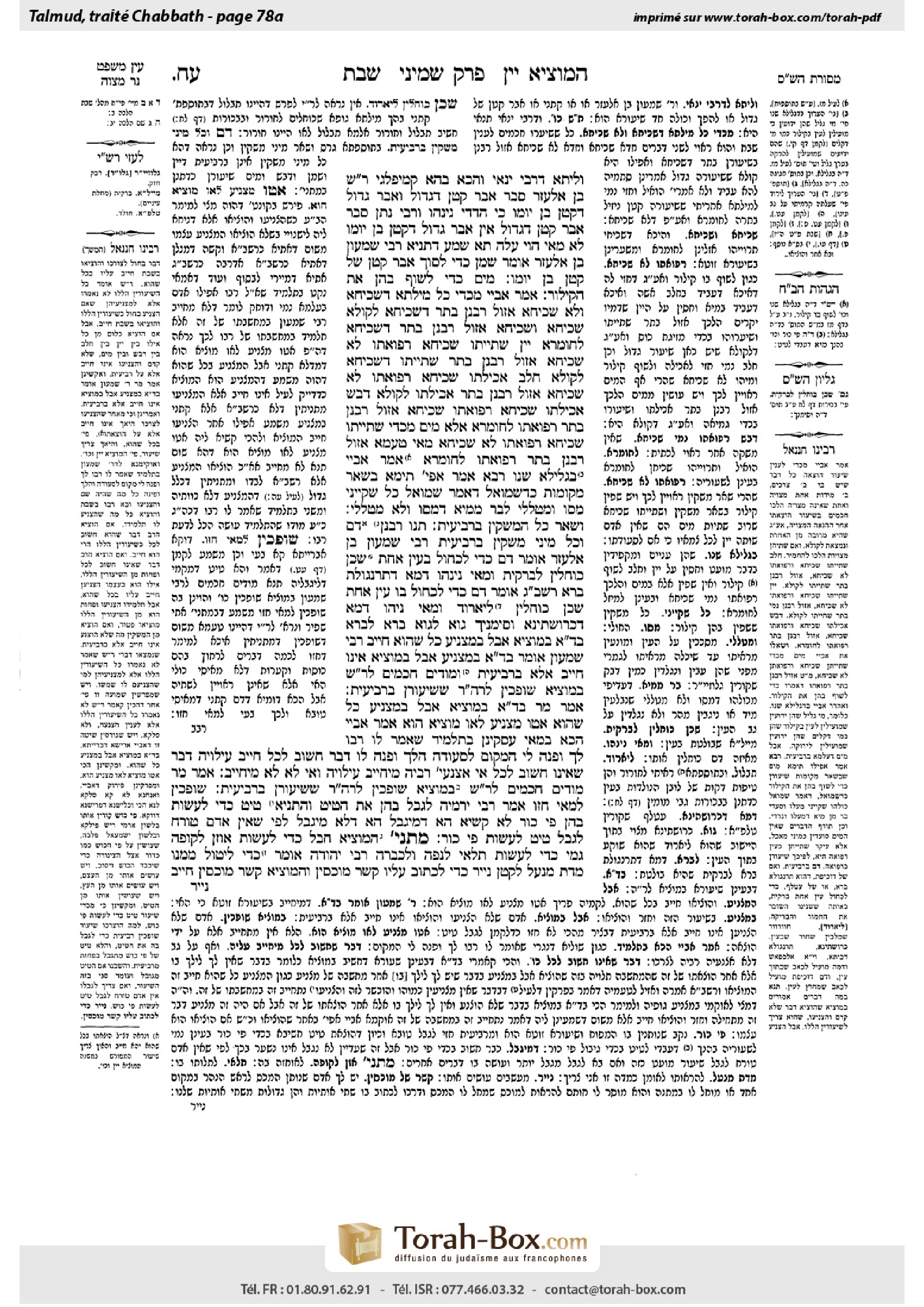
Shabbat 78a: Talmud study for Daf Yomi
Daf Yomi is the daily study of one Talmud folio. Explore 37 tractates with scans, Hebrew text, Sefaria English and AI-generated French translations where annotated.
Passage selection and English or AI-generated French translation are available where the scan has annotations. Daf Study is independent of Torah-Box and Sefaria.
Browse Shabbat · שבת · All tractatesShabbat 78a text and translations
This page of Shabbat includes the Aramaic text, an English translation and an AI-generated French translation, alongside the scan above.
שבת ע״ח א · Aramaic and Hebrew text
וְלֵיתָא דְּרַבִּי יַנַּאי. וְהָכָא בְּהָא קָמִיפַּלְגִי: רַבִּי שִׁמְעוֹן בֶּן אֶלְעָזָר סָבַר: אֵבֶר קָטָן דְּגָדוֹל וְאֵבֶר גָּדוֹל דְּקָטָן בֶּן יוֹמוֹ כִּי הֲדָדֵי נִינְהוּ, וְרַבִּי נָתָן סָבַר: אֵבֶר קָטָן דְּגָדוֹל אִין, אֵבֶר גָּדוֹל דְּקָטָן בֶּן יוֹמוֹ — לָא. מַאי הָוֵי עֲלַהּ? תָּא שְׁמַע: דְּתַנְיָא, רַבִּי שִׁמְעוֹן בֶּן אֶלְעָזָר אוֹמֵר: שֶׁמֶן כְּדֵי לָסוּךְ אֵבֶר קָטָן שֶׁל קָטָן בֶּן יוֹמוֹ.
מַיִם כְּדֵי לָשׁוּף בָּהֶן אֶת הַקִּילוֹר. אָמַר אַבָּיֵי: מִכְּדֵי כׇּל מִילְּתָא דִּשְׁכִיחָא וְלָא שְׁכִיחָא, אֲזוּל רַבָּנַן בָּתַר דִּשְׁכִיחָא לְקוּלָּא. שְׁכִיחָא וּשְׁכִיחָא אֲזוּל רַבָּנַן בָּתַר דִּשְׁכִיחָא לְחוּמְרָא.
יַיִן, שְׁתִיָּיתוֹ שְׁכִיחָא רְפוּאָתוֹ לָא שְׁכִיחָא — אֲזוּל רַבָּנַן בָּתַר שְׁתִיָּיתוֹ דִּשְׁכִיחָא לְקוּלָּא. חָלָב, אֲכִילָתוֹ שְׁכִיחָא רְפוּאָתוֹ לָא שְׁכִיחָא — אֲזוּל רַבָּנַן בָּתַר אֲכִילָתוֹ לְקוּלָּא. דְּבַשׁ, אֲכִילָתוֹ שְׁכִיחָא רְפוּאָתוֹ שְׁכִיחָא — אֲזוּל רַבָּנַן בָּתַר רְפוּאָתוֹ לְחוּמְרָא.
אֶלָּא מַיִם, מִכְּדֵי שְׁתִיָּיתוֹ שְׁכִיחָא רְפוּאָתוֹ לָא שְׁכִיחָא, מַאי טַעְמָא אֲזוּל רַבָּנַן בָּתַר רְפוּאָתוֹ לְחוּמְרָא? אָמַר אַבָּיֵי: בְּגָלִילָא שָׁנוּ. רָבָא אָמַר: אֲפִילּוּ תֵּימָא בִּשְׁאָר מְקוֹמוֹת, כְּדִשְׁמוּאֵל, דְּאָמַר שְׁמוּאֵל: כׇּל שַׁקְיָינֵי מַסּוּ וּמְטַלְּלִי לְבַר מִמַּיָּא דְּמַסּוּ וְלָא מְטַלְּלִי.
וּשְׁאָר כׇּל הַמַּשְׁקִין בִּרְבִיעִית. תָּנוּ רַבָּנַן: דָּם וְכׇל מִינֵי מַשְׁקִין בִּרְבִיעִית. רַבִּי שִׁמְעוֹן בֶּן אֶלְעָזָר אוֹמֵר: דָּם, כְּדֵי לִכְחוֹל בְּעַיִן אַחַת, שֶׁכֵּן כּוֹחֲלִין לְבַרְקִית. וּמַאי נִינְהוּ? דְּמָא דְתַרְנוּגְלָא בַּרָּא. רַבָּן שִׁמְעוֹן בֶּן גַּמְלִיאֵל אוֹמֵר: דָּם כְּדֵי לִכְחוֹל בּוֹ עַיִן אַחַת, שֶׁכֵּן כּוֹחֲלִין לְיָארוּד. וּמַאי נִיהוּ? דְּמָא דִכְרוּשְׁתִּינָא. וְסִימָנָיךְ: גַּוָּא לְגַוָּא, בַּרָּא לְבַרָּא.
בַּמֶּה דְּבָרִים אֲמוּרִים — בְּמוֹצִיא, אֲבָל בְּמַצְנִיעַ — כׇּל שֶׁהוּא חַיָּיב. רַבִּי שִׁמְעוֹן אוֹמֵר: בַּמֶּה דְּבָרִים אֲמוּרִים — בְּמַצְנִיעַ, אֲבָל בְּמוֹצִיא — אֵינוֹ חַיָּיב אֶלָּא בִּרְבִיעִית. וּמוֹדִים חֲכָמִים לְרַבִּי שִׁמְעוֹן בְּמוֹצִיא שׁוֹפְכִין לִרְשׁוּת הָרַבִּים שֶׁשִּׁיעוּרָן בִּרְבִיעִית.
אָמַר מָר: בַּמֶּה דְּבָרִים אֲמוּרִים — בְּמוֹצִיא, אֲבָל בְּמַצְנִיעַ — כׇּל שֶׁהוּא. אַטּוּ מַצְנִיעַ לָאו מוֹצִיא הוּא? אָמַר אַבָּיֵי: הָכָא בְּמַאי עָסְקִינַן — בְּתַלְמִיד שֶׁאָמַר לוֹ רַבּוֹ: לֵךְ וּפַנֵּה לִי הַמָּקוֹם לִסְעוּדָה. הָלַךְ וּפִנָּה לוֹ. דָּבָר חָשׁוּב לַכֹּל — חַיָּיב עִילָּוֵיהּ, דָּבָר שֶׁאֵינוֹ חָשׁוּב לַכֹּל, אִי אַצְנְעֵיהּ רַבֵּיהּ — מִיחַיַּיב עִילָּוֵיהּ, וְאִי לָא — לָא מִיחַיַּיב.
אָמַר מָר: מוֹדִים חֲכָמִים לְרַבִּי שִׁמְעוֹן בְּמוֹצִיא שׁוֹפְכִין לִרְשׁוּת הָרַבִּים שֶׁשִּׁיעוּרָן בִּרְבִיעִית. שׁוֹפְכִין לְמַאי חֲזוּ? אָמַר רַבִּי יִרְמְיָה: לְגַבֵּל בָּהֶן אֶת הַטִּיט. וְהָתַנְיָא: טִיט כְּדֵי לַעֲשׂוֹת בָּהֶן פִּי כוּר! לָא קַשְׁיָא: הָא דְּמִיגַּבַּל, הָא דְּלָא מִיגַּבַּל — לְפִי שֶׁאֵין אָדָם טוֹרֵחַ לְגַבֵּל טִיט לַעֲשׂוֹת פִּי כוּר.
מַתְנִי׳ הַמּוֹצִיא חֶבֶל — כְּדֵי לַעֲשׂוֹת אוֹזֶן לַקּוּפָּה. גֶּמִי — כְּדֵי לַעֲשׂוֹת תְּלַאי לַנָּפָה וְלַכְּבָרָה. רַבִּי יְהוּדָה אוֹמֵר: כְּדֵי לִיטּוֹל מִמֶּנּוּ מִדַּת מִנְעָל לַקָּטָן. נְיָיר — כְּדֵי לִכְתּוֹב עָלָיו קֶשֶׁר מוֹכְסִין. וְהַמּוֹצִיא קֶשֶׁר מוֹכְסִין — חַיָּיב.
Shabbat 78a · English translation
and the opinion of the school of Rabbi Yannai is not accepted. And here, in this baraita, they disagree about this: Rabbi Shimon ben Elazar holds: A small limb of an adult and a large limb of a day-old child are equal to one another, and Rabbi Natan holds: For carrying out oil in a measure equivalent to that which is used to spread on a small limb of an adult, yes, one is liable; however, a large limb of a day-old child, no, he is exempt. The Gemara asks: What conclusion was reached in this matter? Come and hear a proof, as it was taught in a baraita that Rabbi Shimon ben Elazar says explicitly: The measure that determines liability for carrying out oil is equivalent to that which is used to spread on a small limb of a day-old child.
We learned in the mishna: The measure that determines liability for carrying out water is equivalent to that which is used to rub and spread on an eye bandage. Abaye said: Now, since, with regard to any substance that is utilized for both common and uncommon uses, the Sages, in their ruling, followed the common usage even as a leniency, i.e., one is liable only for carrying out the larger measure. However, when a substance has different uses and one is common and the other is common as well, the Sages, in their ruling, followed the common use that leads to a stringency, i.e., one is liable for carrying out even the smaller amount.
Proof for this principle can be seen in the following examples. Wine, its use for drinking is common and its use for healing is uncommon. The Sages, in establishing the measure that determines liability for carrying out wine, followed its use for drinking, which is common, which led to a leniency. The amount of wine that one typically drinks is greater than the amount of wine used for healing. Milk, its consumption is common and its use for healing is uncommon. The Sages, in establishing the measure that determines liability for carrying out milk, followed its consumption, which is common, as a leniency. Honey, its consumption is common and its use for healing is also common. The Sages, in establishing the measure that determines liability for carrying out honey, followed its use for healing, the smaller amount, as a stringency.
However, water, since its drinking is common and its use for healing is uncommon, what is the reason that the Sages followed its use for healing as a stringency? Based on the above principle, the Sages should have determined the measure based on its use for drinking. Abaye said: They taught this halakha in the Galilee where they typically drink wine. There, water is used as commonly for healing as it is for drinking (Tosafot). Rava said: Even if you say that this halakha applies in the rest of the places as well as in the Galilee, the use of water in treating the eye is common, in accordance with the opinion of Shmuel, as Shmuel said: All liquids placed on the eye effect a cure and cloud the vision, except for water which cures and does not cloud the vision.
We learned in the mishna: And the measure that determines liability for all other liquids is a quarter of a log. The Sages taught in a Tosefta: The measure that determines liability for carrying out blood and all types of liquids on Shabbat is a quarter of a log. Rabbi Shimon ben Elazar says: The measure that determines liability for blood is less than that. The measure that determines liability for carrying out blood is equivalent to that which is used to apply to one eye, as one applies blood to heal a wart on the eye. The Gemara asks: And what type of blood effects this cure? The blood of a wild chicken. Rabbi Shimon ben Gamliel says: The measure that determines liability for carrying out blood is equivalent to that which is used to apply to one eye, as one applies blood to heal a cataract. And what type of blood effects this cure? The blood of a bat. And a mnemonic to ensure that you do not confuse these cures: Inside for inside, outside for outside. The blood of a bat, which lives in inhabited areas, for the cataract, which is inside the eye; the blood of a wild chicken, which lives outside inhabited areas, for the wart, which is external to the eye.
The Gemara cites a Tosefta: In what case are these matters, the measures for the substances in the mishna, stated? They were stated with regard to one who carries them out from one domain to another without ascribing special significance to them. However, with regard to one who stores them, thereby ascribing significance to them, the ruling is that he is liable for carrying out any measure. Rabbi Shimon says: In what case are these matters stated? They were stated with regard to one who stores those amounts. However, if one merely carries them out, he is liable only if he carries out a quarter of a log. And the Rabbis agree with Rabbi Shimon with regard to one who carries out waste water to the public domain that even when one merely carries it out, the measure that determines liability is a quarter of a log.
The Master said in the Tosefta: In what case are these matters, the measures for the substances in the mishna, stated? They were stated with regard to one who carries them out from one domain to another without ascribing special significance to them. However, with regard to one who stores them, he is liable for any amount. The Gemara is surprised at this: Isn’t the one who stores also the one who carries out? One is not liable for merely storing. He is liable only for carrying out the stored item. Abaye said: With what are we dealing here? With the case of a student whose teacher said to him: Go and clear for me space for a meal, and he went and cleared space for him and removed the items to another domain. If he cleared an item that is significant to all, he is liable for carrying it out. If he cleared an item that is not significant to all, then, if his teacher had stored it, he is liable for carrying it out, and if his teacher had not stored it, he is not liable for carrying it out, since the student is fulfilling his teacher’s wishes.
The Master said in the Tosefta: And the Rabbis agree with Rabbi Shimon with regard to one who carries out waste water to the public domain, that the measure that determines liability is a quarter of a log. The Gemara asks: For what use is waste water fit? Rabbi Yirmeya said: It is used to knead clay. The Gemara asks: If that is its purpose, why is such a large amount required? Was it not taught in a baraita: The measure that determines liability for carrying out clay on Shabbat is equivalent to that which is used to make an opening for the bellows to be placed in a crucible, which is a much smaller measure? The Gemara answers: This is not difficult. This, where the measure for clay is equivalent to that which is used to make an opening for the bellows to be placed in a crucible, is referring to a case where it was already kneaded; that, where the measure for waste water is a quarter of a log to knead clay, is referring to a case where it is not yet kneaded, as a person does not go to the trouble of kneading clay just to make an opening for the bellows to be placed in a crucible. When carrying out water to knead clay, a large amount is required; however, clay that was already prepared is fit for use for smaller objects as well.
MISHNA: One who carries out a rope is liable in a measure equivalent to that which is used to form an ear-shaped handle for a basket. The measure that determines liability for carrying out reed grass is equivalent to that which is used to make a loop for hanging a sifter or a sieve. Rabbi Yehuda says: The measure for liability is equivalent to that which is used to take the measure of a shoe for a child, as the reed is used to measure the size of the foot. The measure that determines liability for carrying out paper is equivalent to that which is used to write a tax receipt. And one who carries out a tax receipt itself on Shabbat is liable.
Shabbat 78a · Traduction française (IA)
et l’opinion de l’école de Rabbi Yannai n’est pas retenue. Ici, dans cette baraïta, leur désaccord porte sur ce point : Rabbi Shimon ben Elazar estime qu’un petit membre d’un adulte et un grand membre d’un enfant âgé d’un jour sont équivalents, tandis que Rabbi Natan estime que, pour transporter de l’huile en quantité suffisante pour en enduire un petit membre d’un adulte, oui, on est passible ; mais pour un grand membre d’un enfant âgé d’un jour, non, on est quitte. La Guemara demande : Quelle conclusion a-t-on tirée sur cette question ? Écoutez cette preuve : il a été enseigné dans une baraïta que Rabbi Shimon ben Elazar dit explicitement : La mesure qui rend passible celui qui transporte de l’huile équivaut à la quantité utilisée pour en enduire un petit membre d’un enfant âgé d’un jour.
Nous avons appris dans la Michna : La mesure qui rend passible celui qui transporte de l’eau équivaut à la quantité utilisée pour frotter et étaler sur un pansement pour l’œil. Abaye a dit : Or, puisque, pour toute substance qui sert à des usages à la fois courants et peu courants, les Sages ont retenu l’usage courant, même lorsque cela entraîne une indulgence — c’est-à-dire qu’on n’est passible que si l’on transporte la quantité la plus grande —, en revanche, lorsqu’une substance a différents usages, tous deux courants, les Sages ont retenu l’usage courant qui entraîne une rigueur, c’est-à-dire qu’on est passible même si l’on transporte la quantité la plus petite.
Les exemples suivants illustrent ce principe. Le vin est couramment utilisé comme boisson, mais rarement comme remède. Pour fixer la mesure qui rend passible celui qui transporte du vin, les Sages ont retenu son usage courant, c’est-à-dire le boire, ce qui a entraîné une indulgence. La quantité de vin que l’on boit habituellement est supérieure à celle utilisée comme remède. Le lait est couramment consommé, mais rarement utilisé comme remède. Pour fixer la mesure qui rend passible celui qui transporte du lait, les Sages ont retenu son usage courant, c’est-à-dire le consommer, par indulgence. Le miel est couramment consommé et il est également couramment utilisé comme remède. Pour fixer la mesure qui rend passible celui qui transporte du miel, les Sages ont retenu son usage médicinal, qui requiert une quantité plus petite, par rigueur.
Cependant, puisque l’eau est couramment bue et rarement utilisée comme remède, pourquoi les Sages ont-ils retenu son usage médicinal, par rigueur ? Selon le principe énoncé ci-dessus, les Sages auraient dû fixer la mesure en fonction de son usage comme boisson. Abaye a dit : Cette halakha a été enseignée en Galilée, où l’on boit habituellement du vin. Là-bas, l’eau est aussi couramment utilisée comme remède que comme boisson (Tossefot). Rava a dit : Même si l’on dit que cette halakha s’applique aussi dans les autres régions, et pas seulement en Galilée, l’usage de l’eau pour soigner l’œil est courant, conformément à l’opinion de Shmuel. En effet, Shmuel a dit : Tous les liquides qu’on applique sur l’œil guérissent et troublent la vue, à l’exception de l’eau, qui guérit sans troubler la vue.
Nous avons appris dans la Michna : Et la mesure qui rend passible celui qui transporte tous les autres liquides est un quart de log. Les Sages ont enseigné dans une Tossefta : La mesure qui rend passible celui qui transporte du sang et toutes sortes de liquides pendant Chabbat est un quart de log. Rabbi Shimon ben Elazar dit : La mesure qui rend passible celui qui transporte du sang est inférieure à cela. Elle équivaut à la quantité utilisée pour en appliquer sur un œil, puisqu’on applique du sang pour guérir une verrue sur l’œil. La Guemara demande : Et quel type de sang produit cette guérison ? Le sang d’une poule sauvage. Rabbi Shimon ben Gamliel dit : La mesure qui rend passible celui qui transporte du sang équivaut à la quantité utilisée pour en appliquer sur un œil, puisqu’on applique du sang pour guérir une cataracte. Et quel type de sang produit cette guérison ? Le sang d’une chauve-souris. Voici un moyen mnémotechnique pour éviter de confondre ces remèdes : l’intérieur pour l’intérieur, l’extérieur pour l’extérieur. Le sang d’une chauve-souris, qui vit dans les lieux habités, sert à soigner la cataracte, qui se trouve à l’intérieur de l’œil ; le sang d’une poule sauvage, qui vit hors des lieux habités, sert à soigner la verrue, qui se trouve à l’extérieur de l’œil.
La Guemara cite une Tossefta : Dans quel cas ces mesures des substances mentionnées dans la Michna ont-elles été énoncées ? Elles concernent celui qui les transporte d’un domaine à un autre sans leur attribuer d’importance particulière. En revanche, celui qui les met de côté, leur attribuant ainsi de l’importance, est passible quelle que soit la quantité transportée. Rabbi Shimon dit : Dans quel cas ces mesures ont-elles été énoncées ? Elles concernent celui qui met de côté ces quantités. Mais s’il les transporte simplement, il n’est passible que s’il en transporte un quart de log. Et les Sages sont d’accord avec Rabbi Shimon au sujet de celui qui transporte des eaux usées dans le domaine public : même s’il ne fait que les transporter, la mesure qui le rend passible est un quart de log.
Le maître a dit dans la Tossefta : Dans quel cas ces mesures des substances mentionnées dans la Michna ont-elles été énoncées ? Elles concernent celui qui les transporte d’un domaine à un autre sans leur attribuer d’importance particulière. En revanche, celui qui les met de côté est passible quelle que soit la quantité. La Guemara s’en étonne : Celui qui les met de côté ne les transporte-t-il pas lui aussi ? On n’est pas passible du simple fait de les mettre de côté ; on ne l’est que lorsqu’on transporte l’objet mis de côté. Abaye a dit : De quel cas s’agit-il ici ? D’un élève dont le maître lui a dit : « Va me faire de la place pour un repas », et qui est allé faire de la place pour lui en transportant les objets dans un autre domaine. S’il a déplacé un objet qui a de l’importance pour tous, il est passible de l’avoir transporté. S’il a déplacé un objet qui n’a pas d’importance pour tous, alors, si son maître l’avait mis de côté, l’élève est passible de l’avoir transporté ; mais si son maître ne l’avait pas mis de côté, il n’est pas passible de l’avoir transporté, puisque l’élève exécute la volonté de son maître.
Le maître a dit dans la Tossefta : Et les Sages sont d’accord avec Rabbi Shimon au sujet de celui qui transporte des eaux usées dans le domaine public : la mesure qui le rend passible est un quart de log. La Guemara demande : À quel usage les eaux usées peuvent-elles servir ? Rabbi Yirmeya a dit : Elles servent à pétrir de l’argile. La Guemara demande : Si tel est leur usage, pourquoi en faut-il une si grande quantité ? N’a-t-il pas été enseigné dans une baraïta que la mesure qui rend passible celui qui transporte de l’argile pendant Chabbat équivaut à la quantité utilisée pour faire une ouverture destinée à recevoir le soufflet dans un creuset, ce qui est une quantité bien plus petite ? La Guemara répond : Il n’y a pas de difficulté. Le cas où la mesure d’argile équivaut à la quantité utilisée pour faire une ouverture destinée à recevoir le soufflet dans un creuset concerne de l’argile déjà pétrie ; le cas où la mesure d’eaux usées nécessaires pour pétrir de l’argile est d’un quart de log concerne de l’argile qui n’est pas encore pétrie, car on ne se donne pas la peine de pétrir de l’argile simplement pour faire une ouverture destinée à recevoir le soufflet dans un creuset. Pour transporter de l’eau destinée à pétrir de l’argile, il en faut une grande quantité ; en revanche, l’argile déjà préparée peut également servir à fabriquer de petits objets.
MICHNA : Celui qui transporte une corde est passible pour une quantité suffisante à former une anse en forme d’oreille pour un panier. La mesure qui rend passible celui qui transporte de l’herbe de roseau équivaut à la quantité utilisée pour faire une boucle destinée à suspendre un van ou un tamis. Rabbi Yehouda dit : La mesure qui le rend passible équivaut à la quantité utilisée pour prendre la mesure de la chaussure d’un enfant, car le roseau sert à mesurer la taille du pied. La mesure qui rend passible celui qui transporte du papier équivaut à la quantité utilisée pour écrire un reçu d’impôt. Et celui qui transporte le reçu d’impôt lui-même pendant Chabbat est passible.
Traduction française générée par IA à partir de l’édition anglaise de Sefaria. Vérifie toujours un passage avec le texte source.
Text from Sefaria: William Davidson Edition - Vocalized Aramaic (CC BY NC); William Davidson Edition - English (CC BY NC).