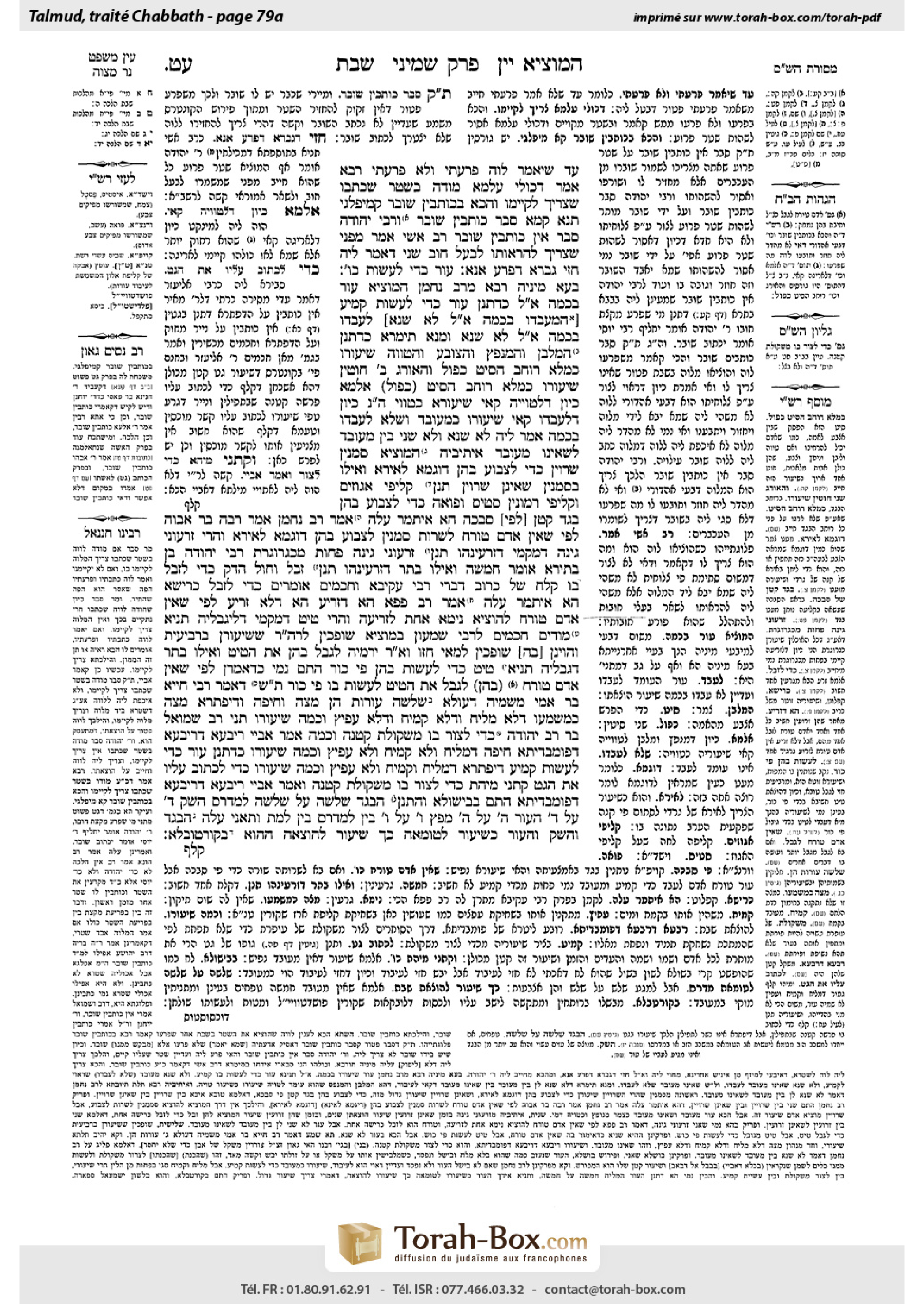
Shabbat 79a: Talmud study for Daf Yomi
Daf Yomi is the daily study of one Talmud folio. Explore 37 tractates with scans, Hebrew text, Sefaria English and AI-generated French translations where annotated.
Passage selection and English or AI-generated French translation are available where the scan has annotations. Daf Study is independent of Torah-Box and Sefaria.
Browse Shabbat · שבת · All tractatesShabbat 79a text and translations
This page of Shabbat includes the Aramaic text, an English translation and an AI-generated French translation, alongside the scan above.
שבת ע״ט א · Aramaic and Hebrew text
עַד שֶׁיֹּאמַר לֹוֶה ״פָּרַעְתִּי״ וְ״לֹא פָּרַעְתִּי״.
רָבָא אָמַר: דְּכוּלֵּי עָלְמָא מוֹדֶה בִּשְׁטָר שֶׁכְּתָבוֹ — שֶׁצָּרִיךְ לְקַיְּימוֹ, וְהָכָא בְּכוֹתְבִין שׁוֹבָר קָמִיפַּלְגִי: תַּנָּא קַמָּא סָבַר כּוֹתְבִין שׁוֹבָר, וְרַבִּי יְהוּדָה סָבַר אֵין כּוֹתְבִין שׁוֹבָר. רַב אָשֵׁי אָמַר: מִפְּנֵי שֶׁצָּרִיךְ לְהַרְאוֹתוֹ לְבַעַל חוֹב שֵׁנִי, דְּאָמַר לֵיהּ: חֲזִי, גַּבְרָא דְּפָרַע אֲנָא.
עוֹר כְּדֵי לַעֲשׂוֹת כּוּ׳. בְּעָא מִינֵּיהּ רָבָא מֵרַב נַחְמָן: הַמּוֹצִיא עוֹר, בְּכַמָּה? אֲמַר לֵיהּ: כְּדִתְנַן: עוֹר כְּדֵי לַעֲשׂוֹת קָמֵיעַ. [הַמְעַבְּדוֹ, בְּכַמָּה? אֲמַר לֵיהּ: לָא שְׁנָא.] לְעַבְּדוֹ בְּכַמָּה? אֲמַר לֵיהּ: לָא שְׁנָא.
וּמְנָא תֵּימְרָא? — כְּדִתְנַן: הַמְלַבֵּן וְהַמְנַפֵּץ וְהַצּוֹבֵעַ וְהַטּוֹוֶה — שִׁיעוּרוֹ כִּמְלֹא רוֹחַב הַסִּיט כָּפוּל. וְהָאוֹרֵג שְׁנֵי חוּטִין — שִׁיעוּרוֹ כִּמְלֹא רוֹחַב הַסִּיט כָּפוּל. אַלְמָא: כֵּיוָן דְּלִטְוִיָּיה קָאֵי — שִׁיעוּרוֹ כְּטָווּי. הָכָא נָמֵי, כֵּיוָן דִּלְעַבְּדוֹ קָאֵי — שִׁיעוּרוֹ כִּמְעוּבָּד. וְשֶׁלֹּא לְעַבְּדוֹ, בְּכַמָּה? אֲמַר לֵיהּ: לָא שְׁנָא.
וְלָא שָׁנֵי בֵּין מְעוּבָּד לְשֶׁאֵינוֹ מְעוּבָּד? אֵיתִיבֵיהּ: הַמּוֹצִיא סַמָּנִין שְׁרוּיִן, כְּדֵי לִצְבּוֹעַ בָּהֶן דּוּגְמָא לְאִירָא. וְאִילּוּ בְּסַמָּנִין שֶׁאֵינָן שְׁרוּיִן תְּנַן: קְלִיפֵּי אֱגוֹזִים וּקְלִיפֵּי רִמּוֹנִין, סְטֵיס וּפוּאָה, כְּדֵי לִצְבּוֹעַ בָּהֶן בֶּגֶד קָטָן [לְפִי] סְבָכָה! הָא אִיתְּמַר עֲלַהּ, אָמַר רַב נַחְמָן אָמַר רַבָּה בַּר אֲבוּהּ: לְפִי שֶׁאֵין אָדָם טוֹרֵחַ לִשְׁרוֹת סַמָּנִין לִצְבּוֹעַ בָּהֶן דּוּגְמָא לְאִירָא.
וַהֲרֵי זֵרְעוֹנֵי גִּינָּה, דְּמִקַּמֵּי דְּזַרְעִינְהוּ תְּנַן: זֵרְעוֹנֵי גִּינָה פָּחוֹת מִכִּגְרוֹגֶרֶת. רַבִּי יְהוּדָה בֶּן בְּתֵירָא אוֹמֵר: חֲמִשָּׁה. וְאִילּוּ בָּתַר דְּזַרְעִינְהוּ תְּנַן: זֶבֶל וְחוֹל הַדַּק כְּדֵי לְזַבֵּל בּוֹ קֶלַח שֶׁל כְּרוּב, דִּבְרֵי רַבִּי עֲקִיבָא. וַחֲכָמִים אוֹמְרִים: כְּדֵי לְזַבֵּל כְּרֵישָׁא! — הָא אִיתְּמַר עֲלַהּ, אָמַר רַב פָּפָּא: הָא דִּזְרִיעַ, הָא דְּלָא זְרִיעַ — לְפִי שֶׁאֵין אָדָם טוֹרֵחַ לְהוֹצִיא נִימָא אַחַת לִזְרִיעָה.
וַהֲרֵי טִיט, דְּמִקַּמֵּי דְּלִיגַבְּלֵיהּ תַּנְיָא: מוֹדִים חֲכָמִים לְרַבִּי שִׁמְעוֹן בְּמוֹצִיא שׁוֹפְכִין לִרְשׁוּת הָרַבִּים שֶׁשִּׁיעוּרָן בִּרְבִיעִית, וְהָוֵינַן [בַּהּ] שׁוֹפְכִין לְמַאי חֲזוּ? וְאָמַר רַבִּי יִרְמְיָה: לְגַבֵּל בָּהֶן אֶת הַטִּיט, וְאִילּוּ בָּתַר דְּגַבְּלֵיהּ תַּנְיָא: טִיט כְּדֵי לַעֲשׂוֹת (בָּהֶן) פִּי כוּר! הָתָם נָמֵי כְּדַאֲמַרַן: לְפִי שֶׁאֵין אָדָם טוֹרֵחַ (בָּהֶן) לְגַבֵּל אֶת הַטִּיט לַעֲשׂוֹת בּוֹ פִּי כוּר.
תָּא שְׁמַע, דְּאָמַר רַבִּי חִיָּיא בַּר אַמֵּי מִשְּׁמֵיהּ דְּעוּלָּא: שְׁלֹשָׁה עוֹרוֹת הֵן: מַצָּה, וְחִיפָּה, וְדִיפְתְּרָא. מַצָּה — כְּמַשְׁמָעוֹ, דְּלָא מְלִיחַ וּדְלָא קְמִיחַ וּדְלָא עֲפִיץ. וְכַמָּה שִׁיעוּרוֹ? תָּנֵי רַב שְׁמוּאֵל בַּר רַב יְהוּדָה: כְּדֵי לָצוּר בּוֹ מִשְׁקוֹלֶת קְטַנָּה. וְכַמָּה? אָמַר אַבָּיֵי: רִיבְעָא דְרִיבְעָא דְפוּמְבְּדִיתָא.
חִיפָּה — דִּמְלִיחַ וְלָא קְמִיחַ וְלָא עֲפִיץ. וְכַמָּה שִׁיעוּרוֹ? כְּדִתְנַן: עוֹר — כְּדֵי לַעֲשׂוֹת קָמֵיעַ. דִּיפְתְּרָא — דִּמְלִיחַ וּקְמִיחַ וְלָא עֲפִיץ וְכַמָּה שִׁיעוּרוֹ? — כְּדֵי לִכְתּוֹב עָלָיו אֶת הַגֵּט. קָתָנֵי מִיהַת, כְּדֵי לָצוּר בּוֹ מִשְׁקוֹלֶת קְטַנָּה, וְאָמַר אַבָּיֵי: רִיבְעָא דְרִיבְעָא דְּפוּמְבְּדִיתָא! הָתָם בְּבִישּׁוּלָא.
וְהָתְנַן: הַבֶּגֶד — שְׁלֹשָׁה עַל שְׁלֹשָׁה לַמִּדְרָס, הַשַּׂק — אַרְבָּעָה עַל אַרְבָּעָה, הָעוֹר — חֲמִשָּׁה עַל חֲמִשָּׁה, מַפָּץ — שִׁשָּׁה עַל שִׁשָּׁה, בֵּין לַמִּדְרָס בֵּין לַמֵּת. וְתָאנֵי עֲלַהּ הַבֶּגֶד וְהַשַּׂק וְהָעוֹר — כְּשִׁיעוּר לַטּוּמְאָה כָּךְ שִׁיעוּר לַהוֹצָאָה! הָהוּא בְּקוּרְטוּבְלָא.
Shabbat 79a · English translation
It means: Until the debtor says: I repaid the debt, or, I did not repay the debt. If the debtor says: I repaid the debt in the promissory note and there are no witnesses to ratify the document in court, the document has no value. That is the opinion of the Rabbis who hold that an unratified document cannot force a debtor to pay. According to Rabbi Yehuda, who holds that a document need not be ratified, the debtor’s claim that he repaid the debt is not accepted and the creditor can collect his debt with the unratified promissory note.
Rava said: Everyone agrees that when a debtor admits that he wrote a promissory note, the creditor must ratify it in court. And here, it is with regard to the question whether or not one writes a receipt that they disagree. The first tanna holds: One writes a receipt for a promissory note that was repaid. Since the debtor has the receipt in his possession, the creditor may keep the note and use it as paper. And Rabbi Yehuda holds: One does not write a receipt. Therefore, the creditor is required to return the note to the debtor immediately upon repayment of the debt. It is in the interest of the debtor to destroy the document, and he has no reason to keep it. Rav Ashi said: The dispute is with regard to a case where the debtor carried out the promissory note into the public domain. Rabbi Yehuda said he is liable because he needs the repaid document to show it to a second creditor, as he says to him: Look, I am a man who repays his debts.
We learned in the mishna: The measure that determines liability for carrying out animal hide is equivalent to that which is used to make an amulet. Rava raised a dilemma before Rav Naḥman: With regard to one who carries out animal hide, how much must he carry out on Shabbat in order to be liable? He said to him, it is as we learned in the mishna: The measure that determines liability for carrying out animal hide is equivalent to that which is used to make an amulet. He raised another dilemma: With regard to one who tans that hide, how much must he tan in order to be liable? He said to him: It is no different, the same measure. He raised another dilemma: With regard to one who carries out animal hide to tan it, how much must he carry out on Shabbat in order to be liable? He said to him: It is no different.
And from where do you derive and say that there is no difference whether or not the hide one carries out is tanned? As we learned in a mishna: With regard to one who whitens, and one who combs, and one who dyes, and one who spins, the measure of wool for which one is liable in performing those prohibited labors is double the full width of the distance between the forefinger and the middle finger. And the measure that determines liability for one who weaves two threads is double the full width of the distance between the forefinger and the middle finger. Apparently, since the wool is designated for spinning, the measure for which one is liable for whitening, combing, and dyeing is equal to the measure for which one is liable for weaving that spun thread. Here too, since it is designated for tanning, its measure that determines liability for carrying it out into the public domain is equal to the measure that determines liability for carrying out tanned hides. Rava raised another dilemma: With regard to one who carries out animal hide and has no intention to tan it, how much must he carry out on Shabbat in order to be liable? He said to him: It is no different.
Rava asked: And is there no halakhic difference between carrying out tanned hides and carrying out hides that are not tanned? He raised an objection to him based on a baraita: One who carries out herbs that were soaked in water and ready for use as a dye is liable if he carried out a measure equivalent to that which is used to dye a sample the size of a stopper for the shuttle of a loom. While with regard to herbs that were not soaked, we learned in a mishna: The measure that determines liability for carrying out nutshells, and pomegranate peels, and for carrying out safflower, and madder, which are herbs used as dyes, is equivalent to that which is used to dye a small cloth to cover the opening of a woman’s hair net. Apparently, the measure for which one is liable for carrying out raw materials is greater than the measure for which one is liable for carrying out prepared dyes. The Gemara answers: But wasn’t it stated with regard to that mishna that Rav Naḥman said that Rabba bar Avuh said: Because a person does not go to the trouble to soak herbs just to dye a sample for the shuttle of a loom? As a rule, there is no distinction between finished and unfinished products. The case of dye is different, as people do not typically prepare dyes in amounts that small. Therefore, even though that size is significant in and of itself, he is exempt for carrying them out.
He asked further: And with regard to seeds of garden plants before one sowed them, we learned in a mishna: The measure that determines liability for carrying out seeds of garden plants is less than a dried fig-bulk. Rabbi Yehuda ben Beteira says: He is liable if he carries out five seeds. While with regard to carrying out seeds after he sowed them, we learned in a mishna: The measure that determines liability for carrying out manure or fine sand is equivalent to that which is used to fertilize one stalk of cabbage with it; this is the statement of Rabbi Akiva. And the Rabbis say: The measure that determines liability for carrying it out is equivalent to that which is used to fertilize a leek. Apparently, after the seed was sown, the measure for liability is one plant. Before it is sown, the measure is at least five. The Gemara answers: As a rule, there is no distinction between an object that was processed and one that was not. However, this case is different. Wasn’t it stated with regard to that halakha that Rav Pappa says that there is a distinction between this, where one is liable for carrying out one plant, and the mishna is referring to a case where it is already sown; and that, where one is only liable for carrying out at least five, and the mishna is referring to a case where it is not yet sown, because a person does not go to the trouble to carry out just one seed for sowing?
He asked further: And with regard to clay before one kneads it, it was taught in a baraita: And the Rabbis agree with Rabbi Shimon with regard to one who carries out waste water to the public domain, that the measure that determines liability is a quarter of a log. And we discussed this question: For what use is waste water fit? Rabbi Yirmeya said: It is used to knead clay. Apparently, the measure that determines liability for the raw material is the amount kneaded with a quarter of a log of waste water to form clay. While with regard to clay after one kneads it, it was taught in a baraita: With regard to clay, the measure for liability is equivalent to that which is used to make an opening for the bellows to be placed in a crucible, which is a small amount. The Gemara answers: There too, it is as we stated: Because a person does not go to the trouble of kneading clay just to make an opening for the bellows to be placed in a crucible.
In order to resolve the dilemma with regard to the measure that determines liability for carrying out an animal hide on Shabbat, the Gemara states: Come and hear a halakha that Rabbi Ḥiyya bar Ami said in the name of Ulla: There are three hides, i.e., three stages in the process of tanning hides, and at each stage it is known by a different name: Matza, and ḥifa, and diftera. Matza, as per its plain meaning, with no additives. It is not salted, and not treated with flour, and not treated with gallnuts. And how much is the measure that determines liability for carrying out that hide on Shabbat? Rav Shmuel bar Rav Yehuda taught: It is equivalent to that which is used to wrap around a small weight. And how big is this small weight? Abaye said: A quarter of a quarter of a litra in the system of weights in use in Pumbedita.
Ḥifa is hide that is salted, and not treated with flour, and not treated with gallnuts. And how much is the measure that determines liability for carrying out that hide on Shabbat? As we learned in the mishna: The measure that determines liability for carrying out animal hide is equivalent to that which is used to make an amulet. Diftera is hide that is salted, and treated with flour, and not treated with gallnuts. And how much is the measure that determines liability for carrying out that hide on Shabbat? The measure that determines liability for carrying it out is equivalent to the amount which is used to write a bill of divorce on it. In any case, it was taught that before it is tanned the measure for liability is equivalent to that which is used to wrap around a small weight. And Abaye said: A quarter of a quarter of a litra in the system of weights in use in Pumbedita. That is not the same as the measure that determines liability for a tanned hide, which is equivalent to that which is used to make an amulet. The Gemara answers: There, it is referring to wet hide just flayed that was left out to dry in the sun and is suitable only for wrapping around a weight (Rabbeinu Ḥananel). However, for carrying out tanned hide, his measure for liability is equivalent to that which is used to make an amulet.
The Gemara raises another difficulty: And didn’t we learn in a mishna: The garment must be at least three by three handbreadths to become impure with ritual impurity imparted by treading? And the sack made from goat hair must be at least four by four handbreadths. And the animal hide must be five by five, and a mat must be six by six. Those are the minimum measures for becoming a primary source of ritual impurity by means of both ritual impurity imparted by treading and ritual impurity imparted by a corpse. And it was taught in the Tosefta with regard to that mishna: With regard to the garment and the sack and the hide; like the measure for ritual impurity, so too is the measure for carrying out on Shabbat. That is significantly larger than the measure for liability cited in the mishna for carrying out hide. The Gemara answers: That Tosefta is referring to kortovela, which is hide that was tanned in a manner that rendered it unfit for writing or wrapping. It is used for covering vessels and other similar uses (Rambam).
Shabbat 79a · Traduction française (IA)
Cela signifie : jusqu’à ce que le débiteur dise : « J’ai remboursé la dette » ou « Je n’ai pas remboursé la dette ». Si le débiteur affirme avoir remboursé la dette inscrite dans le billet à ordre et qu’il n’y a pas de témoins pour authentifier le document au tribunal, celui-ci n’a aucune valeur. Telle est l’opinion des Rabbins, selon lesquels un document non authentifié ne peut contraindre un débiteur à payer. Selon Rabbi Yehouda, qui considère qu’un document n’a pas besoin d’être authentifié, l’affirmation du débiteur selon laquelle il a remboursé la dette n’est pas acceptée, et le créancier peut recouvrer sa créance au moyen du billet à ordre non authentifié.
Rava dit : Tout le monde convient que, lorsqu’un débiteur reconnaît avoir rédigé un billet à ordre, le créancier doit le faire authentifier au tribunal. Leur désaccord porte ici sur la question de savoir si l’on rédige ou non un reçu. Le premier tanna considère que l’on rédige un reçu pour un billet à ordre dont la dette a été remboursée. Puisque le débiteur a le reçu en sa possession, le créancier peut conserver le billet et s’en servir comme papier. Rabbi Yehouda, lui, considère que l’on ne rédige pas de reçu. Le créancier doit donc rendre immédiatement le billet au débiteur après le remboursement de la dette. Le débiteur a intérêt à détruire le document et n’a aucune raison de le garder. Rav Achi dit : Le désaccord concerne un cas où le débiteur a transporté le billet à ordre dans le domaine public. Rabbi Yehouda dit qu’il est passible, car il a besoin du document acquitté pour le montrer à un second créancier, en lui disant : « Regarde, je suis un homme qui rembourse ses dettes. »
Nous avons appris dans la Michna : la mesure qui rend passible celui qui transporte une peau d’animal est celle qui sert à fabriquer une amulette. Rava posa une question à Rav Naḥman : quelle quantité de peau d’animal faut-il transporter pendant Chabbat pour être passible ? Il lui répondit : c’est ce que nous avons appris dans la Michna : la mesure qui rend passible celui qui transporte une peau d’animal est celle qui sert à fabriquer une amulette. Il posa une autre question : quelle quantité de cette peau faut-il tanner pour être passible ? Il lui répondit : c’est la même mesure. Il posa une autre question : quelle quantité de peau d’animal faut-il transporter pendant Chabbat pour la tanner afin d’être passible ? Il lui répondit : c’est la même mesure.
Et d’où tires-tu qu’il n’y a pas de différence selon que la peau transportée est tannée ou non ? Nous l’apprenons d’une Michna : pour celui qui blanchit, qui carde, qui teint ou qui file, la quantité de laine qui le rend passible pour ces travaux interdits est égale au double de la largeur totale de l’espace entre l’index et le majeur. La mesure qui rend passible celui qui tisse deux fils est également égale au double de la largeur totale de l’espace entre l’index et le majeur. Apparemment, puisque la laine est destinée à être filée, la mesure qui rend passible pour le blanchiment, le cardage et la teinture est égale à celle qui rend passible pour le tissage de ce fil. De même ici, puisqu’elle est destinée au tannage, la mesure qui rend passible de son transport dans le domaine public est égale à celle qui rend passible du transport de peaux tannées. Rava posa une autre question : quelle quantité de peau d’animal faut-il transporter pendant Chabbat pour être passible si l’on n’a pas l’intention de la tanner ? Il lui répondit : c’est la même mesure.
Rava demanda : N’y a-t-il donc aucune différence halakhique entre le transport de peaux tannées et celui de peaux non tannées ? Il lui opposa une baraïta : celui qui transporte des herbes trempées dans l’eau et prêtes à servir de teinture est passible s’il en transporte une quantité équivalente à celle qui sert à teindre un échantillon de la taille d’un bouchon de navette de métier à tisser. En revanche, au sujet des herbes qui n’ont pas été trempées, nous avons appris dans une Michna : la mesure qui rend passible celui qui transporte des coques de noix, des écorces de grenade, du carthame ou de la garance, qui sont des herbes utilisées comme teintures, est celle qui sert à teindre un petit morceau d’étoffe destiné à couvrir l’ouverture d’une résille pour cheveux de femme. Apparemment, la mesure qui rend passible du transport de matières premières est supérieure à celle qui rend passible du transport de teintures préparées. La Guemara répond : Mais n’a-t-il pas été dit, à propos de cette Michna, que Rav Naḥman a dit au nom de Rabba bar Avouh : c’est parce qu’une personne ne se donne pas la peine de faire tremper des herbes uniquement pour teindre un échantillon destiné à la navette d’un métier à tisser ? En règle générale, il n’y a pas de différence entre les produits finis et les produits qui ne le sont pas. Le cas de la teinture est différent, car les gens ne préparent généralement pas de teinture en si petites quantités. Par conséquent, bien que cette quantité ait en elle-même une importance, on n’est pas passible de son transport.
Il demanda encore : au sujet des graines de plantes potagères avant leur semis, nous avons appris dans une Michna que la mesure qui rend passible de leur transport est inférieure au volume d’une figue sèche. Rabbi Yehouda ben Beteira dit : il est passible s’il en transporte cinq. En revanche, au sujet du transport de graines après leur semis, nous avons appris dans une Michna que la mesure qui rend passible du transport de fumier ou de sable fin est celle qui sert à fertiliser un pied de chou ; telle est l’opinion de Rabbi Akiva. Les Rabbins disent : la mesure qui rend passible de leur transport est celle qui sert à fertiliser un poireau. Apparemment, après le semis, la quantité qui rend passible correspond à une plante. Avant le semis, elle est d’au moins cinq graines. La Guemara répond : en règle générale, il n’y a pas de différence entre un objet transformé et un objet qui ne l’est pas. Toutefois, ce cas est différent. N’a-t-il pas été dit, à propos de cette halakha, que Rav Pappa distingue entre ceci — où l’on est passible pour le transport d’une seule plante, et où la Michna parle d’un cas où elle a déjà été semée — et cela — où l’on n’est passible que pour le transport d’au moins cinq graines, et où la Michna parle d’un cas où elles n’ont pas encore été semées — parce qu’une personne ne se donne pas la peine de transporter une seule graine pour la semer ?
Il demanda encore : au sujet de l’argile avant qu’on la pétrisse, il a été enseigné dans une baraïta que les Rabbins sont d’accord avec Rabbi Shimon : celui qui transporte des eaux usées dans le domaine public est passible à partir d’un quart de log. Nous nous sommes demandé : à quel usage les eaux usées conviennent-elles ? Rabbi Yirmeya dit : elles servent à pétrir l’argile. Apparemment, la mesure qui rend passible pour la matière première est la quantité d’argile que l’on pétrit avec un quart de log d’eaux usées. En revanche, au sujet de l’argile après son pétrissage, il a été enseigné dans une baraïta que la mesure qui rend passible est celle qui sert à ménager une ouverture pour le soufflet placé dans un creuset, ce qui correspond à une petite quantité. La Guemara répond : là aussi, c’est comme nous l’avons dit : une personne ne se donne pas la peine de pétrir de l’argile uniquement pour ménager une ouverture destinée au soufflet placé dans un creuset.
Pour résoudre la question concernant la mesure qui rend passible celui qui transporte une peau d’animal pendant Chabbat, la Guemara dit : Viens et entends une halakha que Rabbi Ḥiyya bar Ami a rapportée au nom d’Oulla : il existe trois types de peaux, correspondant à trois stades du processus de tannage, et chacune porte un nom différent : matza, ḥifa et diftera. Matza signifie, au sens simple, une peau sans aucun additif : elle n’est ni salée, ni traitée avec de la farine, ni traitée avec des noix de galle. Quelle est la mesure qui rend passible du transport de cette peau pendant Chabbat ? Rav Shmuel bar Rav Yehuda enseigna : la quantité qui sert à envelopper un petit poids. Quelle est la taille de ce petit poids ? Abaye dit : un quart de quart de litra, selon le système de poids en usage à Poumbedita.
La ḥifa est une peau qui a été salée, mais qui n’a été traitée ni avec de la farine ni avec des noix de galle. Quelle est la mesure qui rend passible du transport de cette peau pendant Chabbat ? Comme nous l’avons appris dans la Michna : la mesure qui rend passible celui qui transporte une peau d’animal est celle qui sert à fabriquer une amulette. La diftera est une peau qui a été salée et traitée avec de la farine, mais pas avec des noix de galle. Quelle est la mesure qui rend passible du transport de cette peau pendant Chabbat ? C’est la quantité qui sert à y écrire un acte de divorce. Quoi qu’il en soit, il a été enseigné qu’avant son tannage, la mesure qui rend passible est celle qui sert à envelopper un petit poids. Et Abaye a dit : un quart de quart de litra, selon le système de poids en usage à Poumbedita. Cela ne correspond pas à la mesure qui rend passible du transport d’une peau tannée, à savoir celle qui sert à fabriquer une amulette. La Guemara répond : dans ce cas, il s’agit d’une peau humide qui vient d’être écorchée, laissée au soleil pour sécher et qui ne convient qu’à envelopper un poids (Rabbeinu Ḥananel). En revanche, pour le transport d’une peau tannée, la mesure qui rend passible est celle qui sert à fabriquer une amulette.
La Guemara soulève une autre difficulté : n’avons-nous pas appris dans une Michna qu’un vêtement doit mesurer au moins trois sur trois paumes pour devenir impur par transmission de l’impureté rituelle due au piétinement ? Un sac fait de poils de chèvre doit mesurer au moins quatre sur quatre paumes, une peau d’animal cinq sur cinq, et une natte six sur six. Ce sont les mesures minimales pour devenir une source primaire d’impureté rituelle, tant par transmission de l’impureté due au piétinement que par celle due à un cadavre. Et il a été enseigné dans la Tosefta, à propos de cette Michna : pour le vêtement, le sac et la peau, la mesure requise pour l’impureté rituelle est aussi celle qui rend passible du transport pendant Chabbat. Cela dépasse largement la mesure mentionnée dans la Michna pour rendre passible du transport d’une peau. La Guemara répond : cette Tosefta parle d’une kortovela, c’est-à-dire d’une peau tannée d’une manière qui la rend impropre à l’écriture ou à l’emballage. Elle sert à recouvrir des récipients et à d’autres usages similaires (Rambam).
Traduction française générée par IA à partir de l’édition anglaise de Sefaria. Vérifie toujours un passage avec le texte source.
Text from Sefaria: William Davidson Edition - Vocalized Aramaic (CC BY NC); William Davidson Edition - English (CC BY NC).