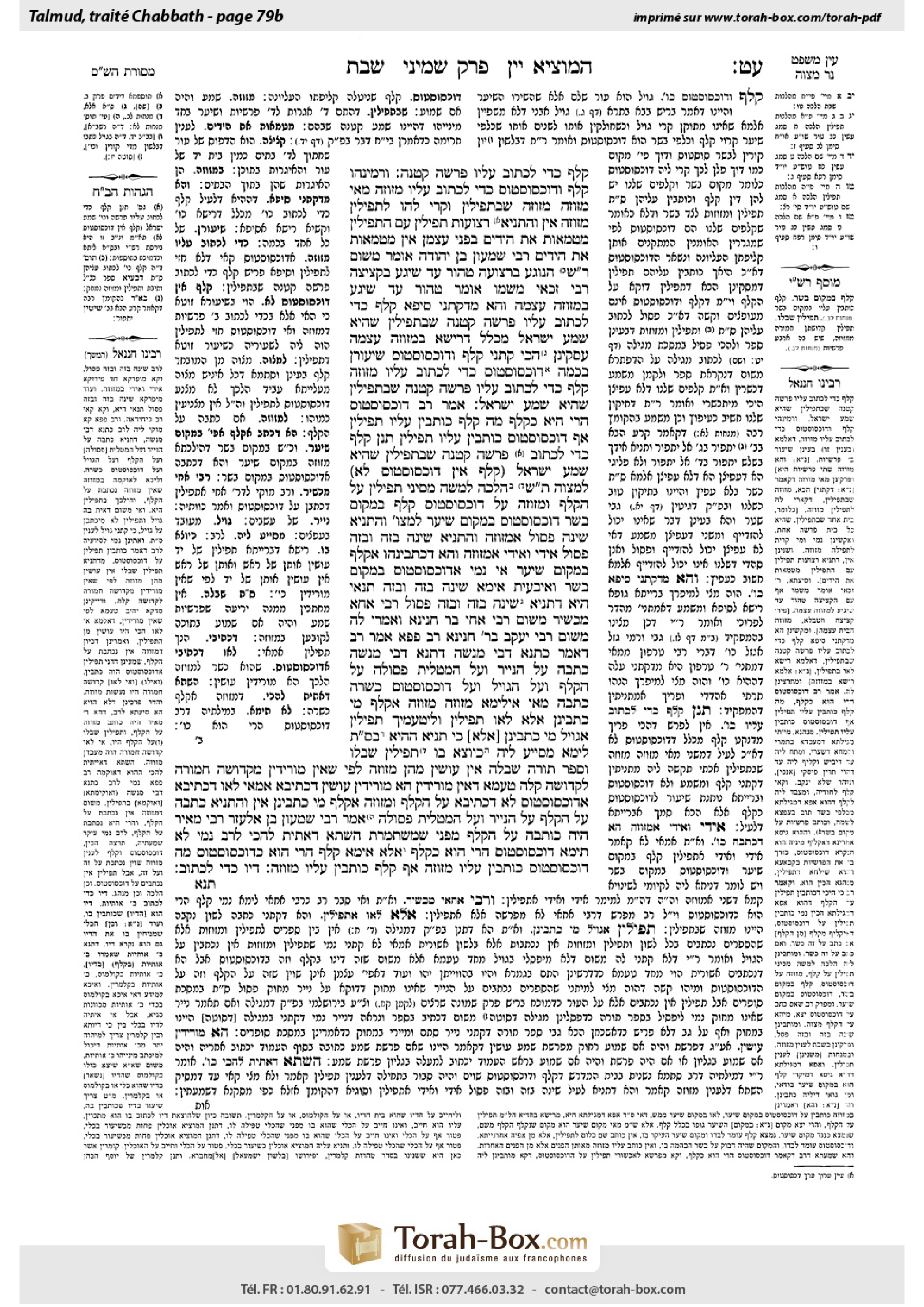
Shabbat 79b: Talmud study for Daf Yomi
Daf Yomi is the daily study of one Talmud folio. Explore 37 tractates with scans, Hebrew text, Sefaria English and AI-generated French translations where annotated.
Passage selection and English or AI-generated French translation are available where the scan has annotations. Daf Study is independent of Torah-Box and Sefaria.
Browse Shabbat · שבת · All tractatesShabbat 79b text and translations
This page of Shabbat includes the Aramaic text, an English translation and an AI-generated French translation, alongside the scan above.
שבת ע״ט ב · Aramaic and Hebrew text
קְלָף כְּדֵי לִכְתּוֹב עָלָיו פָּרָשָׁה קְטַנָּה. וּרְמִינְהוּ, קְלָף וְדוּכְסוּסְטוֹס כְּדֵי לִכְתּוֹב עָלָיו מְזוּזָה! מַאי ״מְזוּזָה״ — מְזוּזָה שֶׁבַּתְּפִילִּין. וְקָרֵי לְהוּ לִתְפִילִּין ״מְזוּזָה״? אִין, וְהָתַנְיָא: רְצוּעוֹת תְּפִילִּין עִם הַתְּפִילִּין מְטַמְּאוֹת אֶת הַיָּדַיִם, בִּפְנֵי עַצְמָן — אֵין מְטַמְּאוֹת אֶת הַיָּדַיִם. רַבִּי שִׁמְעוֹן בֶּן יְהוּדָה אוֹמֵר מִשּׁוּם רַבִּי שִׁמְעוֹן: הַנּוֹגֵעַ בָּרְצוּעָה — טָהוֹר, עַד שֶׁיִּגַּע בַּקְּצִיצָה. רַבִּי זַכַּאי מִשְּׁמוֹ אוֹמֵר: טָהוֹר עַד שֶׁיִּגַּע בַּמְּזוּזָה עַצְמָהּ.
וְהָא מִדְּקָתָנֵי סֵיפָא קְלָף כְּדֵי לִכְתּוֹב עָלָיו פָּרָשָׁה קְטַנָּה שֶׁבַּתְּפִילִּין, שֶׁהִיא ״שְׁמַע יִשְׂרָאֵל״, מִכְּלָל דְּרֵישָׁא בִּמְזוּזָה עַצְמָהּ עָסְקִינַן! הָכִי קָתָנֵי: קְלָף וְדוּכְסוּסְטוֹס שִׁיעוּרָן בְּכַמָּה? דּוּכְסוּסְטוֹס — כְּדֵי לִכְתּוֹב עָלָיו מְזוּזָה. קְלָף — כְּדֵי לִכְתּוֹב עָלָיו פָּרָשָׁה קְטַנָּה שֶׁבַּתְּפִילִּין שֶׁהִיא ״שְׁמַע יִשְׂרָאֵל״.
אָמַר רַב: דּוּכְסוּסְטוֹס הֲרֵי הוּא כִּקְלָף. מַה קְלָף כּוֹתְבִין עָלָיו תְּפִילִּין — אַף דּוּכְסוּסְטוֹס כּוֹתְבִין עָלָיו תְּפִילִּין. תְּנַן: קְלָף כְּדֵי לִכְתּוֹב פָּרָשָׁה קְטַנָּה שֶׁבַּתְּפִילִּין שֶׁהִיא ״שְׁמַע יִשְׂרָאֵל״, קְלָף — אִין, דּוּכְסוּסְטוֹס לָא?! לְמִצְוָה. תָּא שְׁמַע: הֲלָכָה לְמֹשֶׁה מִסִּינַי, תְּפִילִּין עַל הַקְּלָף וּמְזוּזָה עַל דּוּכְסוּסְטוֹס. קְלָף — בִּמְקוֹם בָּשָׂר, דּוּכְסוּסְטוֹס — בִּמְקוֹם שֵׂיעָר. לְמִצְוָה.
וְהָתַנְיָא: שִׁינָּה פָּסוּל! אַמְּזוּזָה. וְהָתַנְיָא: שִׁינָּה בָּזֶה וּבָזֶה פָּסוּל! אִידֵּי וְאִידֵּי אַמְּזוּזָה, וְהָא דְּכַתְבִינְהוּ אַקְּלָף בִּמְקוֹם שֵׂיעָר, אִי נָמֵי אַדּוּכְסוּסְטוֹס בִּמְקוֹם בָּשָׂר. וְאִיבָּעֵית אֵימָא: שִׁינָּה בָּזֶה וּבָזֶה תַּנָּאֵי הִיא. דְּתַנְיָא שִׁינָּה בָּזֶה וּבָזֶה — פָּסוּל. רַבִּי אַחָא מַכְשִׁיר מִשּׁוּם רַבִּי אַחַי בַּר חֲנִינָא, וְאָמְרִי לַהּ מִשּׁוּם רַבִּי יַעֲקֹב בְּרַבִּי חֲנִינָא. רַב פָּפָּא אָמַר: רַב דְּאָמַר כְּתַנָּא דְבֵי מְנַשֶּׁה. דְּתָנָא דְּבֵי מְנַשֶּׁה: כְּתָבָהּ עַל הַנְּיָיר וְעַל הַמַּטְלֵית — פְּסוּלָה. עַל הַקְּלָף וְעַל הַגְּוִיל וְעַל דּוּכְסוּסְטוֹס — כְּשֵׁרָה.
כְּתָבָהּ מַאי? אִילֵּימָא מְזוּזָה — מְזוּזָה אַקְּלָף מִי כָּתְבִינַן? אֶלָּא לָאו — תְּפִילִּין. וְלִיטַעְמָיךְ, תְּפִילִּין אַגְּוִיל מִי כָּתְבִינַן?! [אֶלָּא], כִּי תַּנְיָא הַהִיא בְּסֵפֶר תּוֹרָה. לֵימָא מְסַיַּיע לֵיהּ: כַּיּוֹצֵא בּוֹ, תְּפִילִּין שֶׁבָּלוּ וְסֵפֶר תּוֹרָה שֶׁבָּלָה אֵין עוֹשִׂין מֵהֶן מְזוּזָה, לְפִי שֶׁאֵין מוֹרִידִין מִקְּדוּשָּׁה חֲמוּרָה לִקְדוּשָּׁה קַלָּה.
טַעְמָא דְּאֵין מוֹרִידִין, הָא מוֹרִידִין עוֹשִׂין. דִּכְתִיבָא אַמַּאי? לָאו דִּכְתִיבָא אַדּוּכְסוּסְטוֹס! לָא, דִּכְתִיבָא עַל הַקְּלָף. וּמְזוּזָה אַקְּלָף מִי כָּתְבִינַן? אִין, וְהָתַנְיָא: כְּתָבָהּ עַל הַקְּלָף עַל הַנְּיָיר וְעַל הַמַּטְלִית — פְּסוּלָה. אָמַר רַבִּי שִׁמְעוֹן בֶּן אֶלְעָזָר: רַבִּי מֵאִיר הָיָה כּוֹתְבָהּ עַל הַקְּלָף, מִפְּנֵי שֶׁמִּשְׁתַּמֶּרֶת. הַשְׁתָּא דְּאָתֵית לְהָכִי, לְרַב נָמֵי לָא תֵּימָא דּוּכְסוּסְטוֹס הֲרֵי הוּא כִּקְלָף, אֶלָּא אֵימָא: קְלָף הֲרֵי הוּא כְּדוּכְסוּסְטוֹס, מָה דּוּכְסוּסְטוֹס כּוֹתְבִין עָלָיו מְזוּזָה — אַף קְלָף כּוֹתְבִין עָלָיו מְזוּזָה.
דְּיוֹ כְּדֵי לִכְתּוֹב.
Shabbat 79b · English translation
We learned in the mishna: The measure that determines liability for carrying out parchment is equivalent to that which is used to write the shortest portion in the phylacteries. And the Gemara raised a contradiction from that which was taught: The measure that determines liability for carrying out parchment and dokhsostos is equivalent to that which is used to write a mezuza on it. The Gemara asks: What is the meaning of mezuza in this context? It means those Torah portions of the mezuza that also appear in the phylacteries. The Gemara asks: And are the phylacteries called mezuza? The Gemara answers: Yes, as it was taught in a baraita: The straps of the phylacteries, when they are with the phylacteries, render the hands ritually impure as is the case with regard to contact with any sacred texts. When they are on their own, they do not render the hands ritually impure. Rabbi Shimon ben Yehuda says in the name of Rabbi Shimon: One who touches the strap of the phylacteries remains ritually pure even if it is attached to the phylacteries, unless he touches the actual box of the phylacteries. Rabbi Zakkai says in Rabbi Shimon’s name: One remains ritually pure until he touches the mezuza itself. Apparently the Torah portions in phylacteries are called mezuza.
The Gemara asks: And from the fact that the latter clause of the mishna teaches: The measure that determines liability for carrying out parchment is equivalent to that which is used to write the shortest portion in the phylacteries, which is the portion of Shema Yisrael, by inference, in the first clause of the mishna we are dealing with a mezuza itself. Rather, this is what it teaches: With regard to parchment and dokhsostos, how much is the measure that determines liability for carrying them out? The measure that determines liability for carrying out dokhsostos is equivalent to that which one uses to write a mezuza on it. The measure that determines liability for carrying out parchment is equivalent to that which one uses to write on it the shortest passage that is in the phylacteries, which is Shema Yisrael.
Rav said: Dokhsostos has the same legal status as parchment: Just as one may write the portions of the phylacteries on parchment, so too, one may write the portions of the phylacteries on dokhsostos. The Gemara asks, we learned in the mishna: The measure that determines liability for carrying out parchment is equivalent to that which is used to write the shortest portion in the phylacteries, which is the portion of Shema Yisrael. By inference: Parchment, yes, the portions of the phylacteries may be written on it. Dokhsostos, no, the portions of the phylacteries may not be written on it. The Gemara answers: That is no proof, as the mishna is referring to the optimal manner in which to fulfill the mitzva, i.e., writing the portions of the phylacteries on parchment. However, one fulfills the mitzva by writing on dokhsostos as well. Come and hear that which was taught in a baraita: It is a halakha transmitted to Moses from Sinai that the portions of the phylacteries are written on parchment, and a mezuza is written on dokhsostos. When writing on parchment, one writes on the side of the hide that faced the flesh; on dokhsostos, one writes on the side of the hide on which there was hair. This contradicts the opinion of Rav, who said that phylacteries may be written on dokhsostos. The Gemara answers: The baraita is also referring to the optimal manner in which to fulfill the mitzva.
The Gemara asks: And wasn’t it taught in a baraita that if one deviated and wrote on something else it is invalid, indicating that the portions of the phylacteries may not be written on anything other than parchment? The Gemara rejects this: This baraita is referring to a mezuza, which is invalid if written on parchment. The Gemara asks: But was it not taught in a different baraita: If one deviated in this, phylacteries, and that, mezuza, it is invalid? The Gemara rejects this: Both this and that are referring to a mezuza, and this additional invalidation is in a case where one deviated and wrote it on parchment, on the side that faced the hair; or, alternatively, where he deviated and wrote it on dokhsostos, on the side that faced the flesh. And, if you wish, say instead: Actually, this and that are referring to phylacteries and a mezuza. However, the halakha with regard to a case where one deviated in this and that is subject to a tannaitic dispute, as it was taught in a baraita: If one deviated in this and that it is invalid. Rabbi Aḥa deems it valid in the name of Rabbi Aḥai bar Ḥanina, and some say in the name of Rabbi Ya’akov, son of Rabbi Ḥanina. Rav Pappa said: Rav said his statement in accordance with the opinion of the tanna from the school of Menashe. As it was taught in the school of Menashe: If one wrote it on paper or on a cloth it is invalid. However, if one wrote it on parchment or on a hide that was treated with gallnuts [gevil] or on dokhsostos it is valid.
The Gemara elaborates: If he wrote it; wrote what? If you say that it is referring to a mezuza, do we write a mezuza on parchment? Rather, isn’t it referring to phylacteries? Apparently, as Rav said, there are Sages who hold that the portions of the phylacteries may be written on dokhsostos. The Gemara rejects this: And according to your reasoning, do we write phylacteries on gevil? Rather, that baraita was taught with regard to a Torah scroll. The Gemara comments: Let us say that the following supports the opinion of Rav: Similarly, phylacteries that became tattered and a Torah scroll that became tattered, one may not make them into a mezuza, despite the fact that identical Torah portions appear in all three. This is prohibited because one does not downgrade from a level of greater sanctity, i.e., a Torah scroll or phylacteries, to a level of lesser sanctity, i.e., a mezuza.
The Gemara infers: The reason that one may not do so is because one does not downgrade. However, if the halakha were that one does downgrade, one would make a mezuza from phylacteries. The Gemara elaborates: On what is the portion of the phylacteries written? Isn’t it written on dokhsostos? This supports the opinion of Rav. The Gemara answers: No, the portion of the phylacteries is written on parchment. The Gemara asks: If so, how could a mezuza be made from it? Do we write a mezuza on parchment? The Gemara answers: Yes, as it was taught in a baraita: If one wrote a mezuza on parchment, or on paper, or on a cloth, it is invalid. Rabbi Shimon ben Elazar said: Rabbi Meir would write it on parchment, as it is thereby better preserved. Apparently, even a mezuza may be written on parchment, and there is no proof from the previous baraita. In reaction to the previous baraita, the Gemara comments: Now that you have arrived at this opinion that a mezuza may be written on both dokhsostos and parchment, according to Rav, as well, do not say: Dokhsostos has the same legal status as parchment with regard to phylacteries; rather, say: Parchment has the same legal status as dokhsostos. Just as on dokhsostos, one may write a mezuza, so too, on parchment, one may write a mezuza, in accordance with the opinion of Rabbi Meir.
We learned in the mishna: The measure that determines liability for carrying out ink is equivalent to that which is used to write two letters.
Shabbat 79b · Traduction française (IA)
Nous avons appris dans la Michna : La mesure qui rend passible celui qui transporte du parchemin est équivalente à la quantité nécessaire pour écrire le plus court passage des phylactères. La Guemara soulève une contradiction à partir de ce qui a été enseigné : La mesure qui rend passible celui qui transporte du parchemin et du dokhsostos est équivalente à la quantité nécessaire pour écrire une mezouza sur ce support. La Guemara demande : Que signifie ici « mezouza » ? Il s’agit des passages de la Torah écrite de la mezouza qui figurent également dans les phylactères. La Guemara demande : Les phylactères sont-ils donc appelés « mezouza » ? La Guemara répond : Oui, comme cela a été enseigné dans une baraïta : Les lanières des phylactères, lorsqu’elles sont avec les phylactères, rendent les mains rituellement impures, comme tout contact avec des écrits sacrés. Lorsqu’elles sont séparées, elles ne rendent pas les mains rituellement impures. Rabbi Chim’on ben Yehouda dit au nom de Rabbi Chim’on : Celui qui touche la lanière des phylactères reste rituellement pur, même si elle est attachée aux phylactères, à moins qu’il ne touche la boîte même des phylactères. Rabbi Zakkaï dit au nom de Rabbi Chim’on : On reste rituellement pur jusqu’à ce qu’on touche la mezouza elle-même. Il ressort de là que les passages de la Torah écrite des phylactères sont appelés « mezouza ».
La Guemara demande : Et puisque la dernière partie de la Michna enseigne : La mesure qui rend passible celui qui transporte du parchemin est équivalente à la quantité nécessaire pour écrire le plus court passage des phylactères, à savoir le passage du Chéma Yisrael, il s’ensuit que, dans la première partie de la Michna, il s’agit d’une mezouza proprement dite. Il faut plutôt comprendre qu’elle enseigne ceci : En ce qui concerne le parchemin et le dokhsostos, quelle est la mesure qui rend passible celui qui les transporte ? La mesure qui rend passible celui qui transporte du dokhsostos est équivalente à la quantité nécessaire pour écrire une mezouza sur ce support. La mesure qui rend passible celui qui transporte du parchemin est équivalente à la quantité nécessaire pour y écrire le plus court passage figurant dans les phylactères, à savoir le Chéma Yisrael.
Rav a dit : Le dokhsostos a le même statut halakhique que le parchemin. De même qu’on peut écrire les passages des phylactères sur du parchemin, de même peut-on les écrire sur du dokhsostos. La Guemara demande : Nous avons appris dans la Michna : La mesure qui rend passible celui qui transporte du parchemin est équivalente à la quantité nécessaire pour écrire le plus court passage des phylactères, à savoir le passage du Chéma Yisrael. Il en ressort que les passages des phylactères peuvent être écrits sur du parchemin, mais non sur du dokhsostos. La Guemara répond : Cela ne prouve rien, car la Michna parle de la manière optimale d’accomplir la mitsva, c’est-à-dire en écrivant les passages des phylactères sur du parchemin. Toutefois, on accomplit également la mitsva en les écrivant sur du dokhsostos. Viens et entends ce qui a été enseigné dans une baraïta : Il s’agit d’une halakha transmise à Moïse au Sinaï, selon laquelle les passages des phylactères sont écrits sur du parchemin et une mezouza sur du dokhsostos. Lorsqu’on écrit sur du parchemin, on écrit du côté de la peau qui était tourné vers la chair ; sur du dokhsostos, on écrit du côté de la peau où se trouvaient les poils. Cela contredit l’opinion de Rav, qui a dit que les phylactères peuvent être écrits sur du dokhsostos. La Guemara répond : La baraïta parle, elle aussi, de la manière optimale d’accomplir la mitsva.
La Guemara demande : N’a-t-il pas été enseigné dans une baraïta que, si quelqu’un s’écarte de la règle et écrit sur un autre support, c’est invalide, ce qui indique que les passages des phylactères ne peuvent être écrits que sur du parchemin ? La Guemara rejette cette objection : Cette baraïta parle d’une mezouza, qui est invalide si elle est écrite sur du parchemin. La Guemara demande : Mais n’a-t-il pas été enseigné dans une autre baraïta : Si quelqu’un s’écarte de la règle pour ceci, les phylactères, et pour cela, la mezouza, c’est invalide ? La Guemara rejette cette objection : « Ceci » et « cela » désignent tous deux une mezouza, et cette invalidation supplémentaire concerne un cas où l’on s’est écarté de la règle en l’écrivant sur du parchemin, du côté qui était tourné vers les poils ; ou, alternativement, en s’écartant de la règle et en l’écrivant sur du dokhsostos, du côté qui était tourné vers la chair. Et si tu veux, dis plutôt : En réalité, « ceci » et « cela » désignent les phylactères et la mezouza. Toutefois, la halakha dans le cas où l’on s’écarte de la règle pour l’un et l’autre fait l’objet d’une controverse entre tannaïm, comme cela a été enseigné dans une baraïta : Si quelqu’un s’écarte de la règle pour l’un et l’autre, c’est invalide. Rabbi Aḥa le déclare valide au nom de Rabbi Aḥai bar Ḥanina, et certains disent au nom de Rabbi Ya’akov, fils de Rabbi Ḥanina. Rav Pappa a dit : Rav a énoncé son propos conformément à l’opinion du tanna de l’école de Menashé. En effet, il a été enseigné dans l’école de Menashé : Si quelqu’un l’a écrit sur du papier ou sur un tissu, c’est invalide. Toutefois, s’il l’a écrit sur du parchemin, sur une peau traitée avec des noix de galle [gevil] ou sur du dokhsostos, c’est valide.
La Guemara développe : « S’il l’a écrit » ; qu’a-t-il écrit ? Si tu dis qu’il s’agit d’une mezouza, écrit-on une mezouza sur du parchemin ? Il s’agit donc des phylactères. Il ressort de là que, comme Rav l’a dit, certains Sages considèrent que les passages des phylactères peuvent être écrits sur du dokhsostos. La Guemara rejette cette conclusion : Selon ton raisonnement, écrit-on les phylactères sur du gevil ? Il faut plutôt dire que cette baraïta a été enseignée à propos d’un rouleau de la Torah. La Guemara commente : Disons que ce qui suit vient à l’appui de l’opinion de Rav : De même, des phylactères qui sont devenus usés et un rouleau de la Torah qui est devenu usé, on ne peut pas les transformer en mezouza, bien que les mêmes passages de la Torah écrite figurent dans les trois. Cela est interdit, car on ne rétrograde pas d’un degré de sainteté supérieure, c’est-à-dire un rouleau de la Torah ou des phylactères, à un degré de sainteté inférieure, c’est-à-dire une mezouza.
La Guemara déduit : La raison pour laquelle on ne peut pas agir ainsi est qu’on ne rétrograde pas. Toutefois, si la halakha était qu’on rétrograde, on ferait une mezouza à partir des phylactères. La Guemara développe : Sur quoi le passage des phylactères est-il écrit ? N’est-il pas écrit sur du dokhsostos ? Cela vient à l’appui de l’opinion de Rav. La Guemara répond : Non, le passage des phylactères est écrit sur du parchemin. La Guemara demande : Dans ce cas, comment pourrait-on en faire une mezouza ? Écrit-on une mezouza sur du parchemin ? La Guemara répond : Oui, comme cela a été enseigné dans une baraïta : Si quelqu’un a écrit une mezouza sur du parchemin, du papier ou un tissu, elle est invalide. Rabbi Chim’on ben Elazar a dit : Rabbi Meïr l’écrivait sur du parchemin, car elle est ainsi mieux conservée. Il ressort de là qu’une mezouza aussi peut être écrite sur du parchemin ; il n’y a donc pas de preuve à tirer de la baraïta précédente. En réaction à la baraïta précédente, la Guemara commente : À présent que tu en es arrivé à cette opinion, selon laquelle une mezouza peut être écrite aussi bien sur du dokhsostos que sur du parchemin, même selon Rav, ne dis pas : Le dokhsostos a le même statut halakhique que le parchemin en ce qui concerne les phylactères. Dis plutôt : Le parchemin a le même statut halakhique que le dokhsostos. De même que l’on peut écrire une mezouza sur du dokhsostos, de même peut-on écrire une mezouza sur du parchemin, conformément à l’opinion de Rabbi Meïr.
Nous avons appris dans la Michna : La mesure qui rend passible celui qui transporte de l’encre est équivalente à la quantité nécessaire pour écrire deux lettres.
Traduction française générée par IA à partir de l’édition anglaise de Sefaria. Vérifie toujours un passage avec le texte source.
Text from Sefaria: William Davidson Edition - Vocalized Aramaic (CC BY NC); William Davidson Edition - English (CC BY NC).