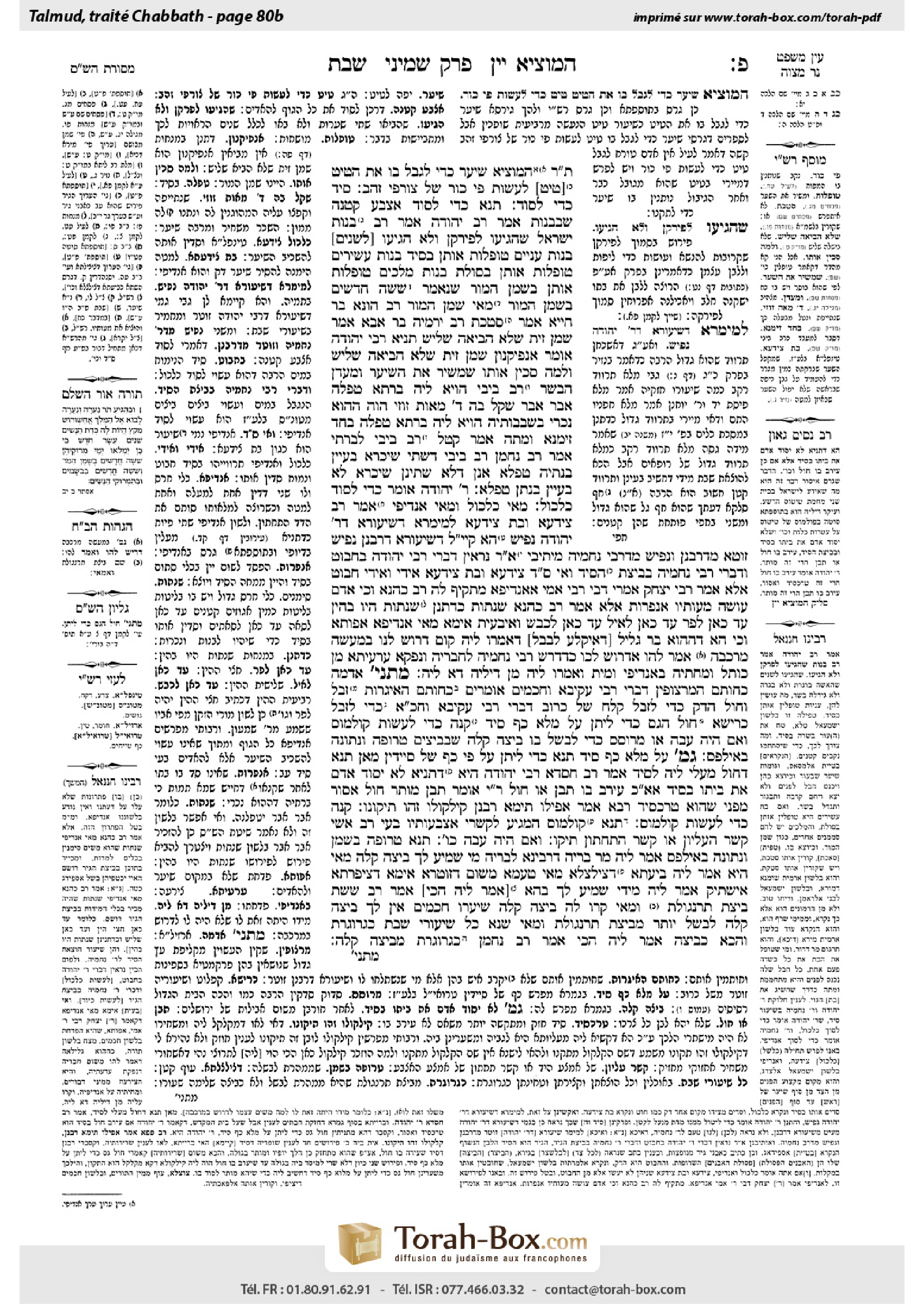
Shabbat 80b: Talmud study for Daf Yomi
Daf Yomi is the daily study of one Talmud folio. Explore 37 tractates with scans, Hebrew text, Sefaria English and AI-generated French translations where annotated.
Passage selection and English or AI-generated French translation are available where the scan has annotations. Daf Study is independent of Torah-Box and Sefaria.
Browse Shabbat · שבת · All tractatesShabbat 80b text and translations
This page of Shabbat includes the Aramaic text, an English translation and an AI-generated French translation, alongside the scan above.
שבת פ׳ ב · Aramaic and Hebrew text
תָּנוּ רַבָּנַן: הַמּוֹצִיא שֵׂיעָר כְּדֵי לְגַבֵּל בּוֹ אֶת הַטִּיט. [טִיט] לַעֲשׂוֹת פִּי כוּר שֶׁל צוֹרְפֵי זָהָב.
סִיד כְּדֵי לָסוּד. תָּנָא: כְּדֵי לָסוּד אֶצְבַּע קְטַנָּה שֶׁבַּבָּנוֹת. אָמַר רַב יְהוּדָה אָמַר רַב: בְּנוֹת יִשְׂרָאֵל שֶׁהִגִּיעוּ לְפִירְקָן וְלֹא הִגִּיעוּ [לְשָׁנִים], בְּנוֹת עֲנִיִּים — טוֹפְלוֹת אוֹתָן בְּסִיד. בְּנוֹת עֲשִׁירִים — טוֹפְלוֹת אוֹתָן בְּסוֹלֶת, בְּנוֹת מְלָכִים — טוֹפְלוֹת אוֹתָן בְּשֶׁמֶן הַמּוֹר, שֶׁנֶּאֱמַר: ״שִׁשָּׁה חֳדָשִׁים בְּשֶׁמֶן הַמּוֹר״. מַאי שֶׁמֶן הַמּוֹר? רַב הוּנָא בַּר חִיָּיא אָמַר: סְטָכַת. רַב יִרְמְיָה בַּר אַבָּא אָמַר: שֶׁמֶן זַיִת שֶׁלֹּא הֵבִיא שְׁלִישׁ. תַּנְיָא, רַבִּי יְהוּדָה אוֹמֵר: אַנְפִּיקְנוּן — שֶׁמֶן זַיִת שֶׁלֹּא הֵבִיא שְׁלִישׁ. וְלָמָּה סָכִין אוֹתוֹ — שֶׁמַּשִּׁיר אֶת הַשֵּׂיעָר וּמְעַדֵּן הַבָּשָׂר.
רַב בִּיבִי הַוְיָא לֵיהּ בְּרַתָּא, טַפְלַהּ אֵבֶר אֵבֶר, שְׁקַל בָּהּ אַרְבַּע מֵאָה זוּזֵי. הֲוָה הָהוּא גּוֹי בְּשִׁבָבוּתֵיהּ. הַוְיָא לֵיהּ בְּרַתָּא, טַפְלַהּ בְּחַד זִימְנָא וּמֵתָה. אֲמַר: קְטַל רַב בִּיבִי לִבְרַתִּי. אָמַר רַב נַחְמָן: רַב בִּיבִי דְּשָׁתֵי שִׁיכְרָא — בָּעֲיָין בְּנָתֵיהּ טִפְלָא, אֲנַן דְּלָא שָׁתֵינַן שִׁיכְרָא — לָא בָּעֲיָין בְּנָתַן טִפְלָא.
רַבִּי יְהוּדָה אוֹמֵר כְּדֵי לָסוּד כִּלְכּוּל. מַאי כִּלְכּוּל וּמַאי אַנְדִּיפֵי? אָמַר רַב: צִידְעָא וּבַת צִידְעָא. לְמֵימְרָא דְּשִׁיעוּרָא דְרַבִּי יְהוּדָה נְפִישׁ? הָא קַיְימָא לַן דְּשִׁיעוּרָא דְרַבָּנַן נְפִישׁ! זוּטָא מִדְּרַבָּנַן, וּנְפִישׁ מִדְּרַבִּי נְחֶמְיָה. מֵיתִיבִי, אָמַר רַבִּי: נִרְאִין דִּבְרֵי רַבִּי יְהוּדָה בְּחָבוּט, וְדִבְרֵי רַבִּי נְחֶמְיָה בְּבֵיצַת הַסִּיד. וְאִי סָלְקָא דַעְתָּךְ צִידְעָא וּבַת צִידְעָא, אִידֵּי וְאִידֵּי חָבוּט? אֶלָּא אָמַר רַבִּי יִצְחָק, אָמְרִי דְּבֵי רַבִּי אַמֵּי — אַאַנְדִּיפָא.
מַתְקִיף לַהּ רַב כָּהֲנָא: וְכִי אָדָם עוֹשֶׂה מְעוֹתָיו אַנְפָּרוֹת?! אֶלָּא אָמַר רַב כָּהֲנָא: שְׁנָתוֹת. כְּדִתְנַן: שְׁנָתוֹת הָיוּ בַּהִין — עַד כָּאן לַפָּר, עַד כָּאן לָאַיִל, עַד כָּאן לַכֶּבֶשׂ. וְאִיבָּעֵית אֵימָא: מַאי ״אַנְדִּיפָא״ — אַפּוּתָא. וְכִי הָא דְּהָהוּא בַּר גָּלִיל [דְּאִיקְּלַע לְבָבֶל], דַּאֲמַרוּ לֵיהּ: קוּם דְּרוֹשׁ לַנָא בְּ״מַעֲשֵׂה מֶרְכָּבָה״. אֲמַר לְהוּ: אֶדְרוֹשׁ לְכוּ כְּדִדְרַשׁ רַבִּי נְחֶמְיָה לְחַבְרֵיהּ. וּנְפַקָא עָרָעִיתָא מִן כּוּתְלָא וּמְחָתֵיהּ בְּאַנְדִּיפֵי וּמִית. וַאֲמַרוּ לֵיהּ: מִן דִּילֵיהּ דָּא לֵיהּ.
מַתְנִי׳ אֲדָמָה — כְּחוֹתַם הַמַּרְצוּפִין, דִּבְרֵי רַבִּי עֲקִיבָא. וַחֲכָמִים אוֹמְרִים: כְּחוֹתַם הָאִיגְּרוֹת. זֶבֶל וָחוֹל הַדַּק — כְּדֵי לְזַבֵּל קֶלַח שֶׁל כְּרוּב, דִּבְרֵי רַבִּי עֲקִיבָא. וַחֲכָמִים אוֹמְרִים: כְּדֵי לְזַבֵּל כְּרֵישָׁא. חוֹל הַגַּס — כְּדֵי לִיתֵּן עַל מְלֹא כַּף סִיד. קָנֶה — כְּדֵי לַעֲשׂוֹת קוּלְמוֹס. וְאִם הָיָה עָבֶה אוֹ מְרוּסָּס — כְּדֵי לְבַשֵּׁל בּוֹ בֵּיצָה קַלָּה שֶׁבַּבֵּיצִים, טְרוּפָה וּנְתוּנָה בָּאִילְפָּס.
גְּמָ׳ עַל מְלֹא כַּף סִיד. תָּנָא: כְּדֵי לִיתֵּן עַל פִּי כַּף שֶׁל סַיָּידִין. מַאן תְּנָא דְּחוֹל מְעַלֵּי לֵיהּ לְסִיד? אָמַר רַב חִסְדָּא: רַבִּי יְהוּדָה הִיא, דְּתַנְיָא: לֹא יָסוּד אָדָם אֶת בֵּיתוֹ בְּסִיד, אֶלָּא אִם כֵּן עֵירַב בּוֹ תֶּבֶן אוֹ חוֹל. רַבִּי יְהוּדָה אוֹמֵר: תֶּבֶן מוּתָּר, חוֹל אָסוּר — מִפְּנֵי שֶׁהוּא טְרַכְסִיד. רָבָא אָמַר: אֲפִילּוּ תֵּימָא רַבָּנַן — קִילְקוּלוֹ זֶהוּ תִּיקּוּנוֹ.
קָנֶה כְּדֵי לַעֲשׂוֹת קוּלְמוֹס. תָּנָא: קוּלְמוֹס הַמַּגִּיעַ לְקִשְׁרֵי אֶצְבְּעוֹתָיו. בָּעֵי רַב אָשֵׁי: קֶשֶׁר הָעֶלְיוֹן אוֹ קֶשֶׁר הַתַּחְתּוֹן? תֵּיקוּ.
וְאִם הָיָה עָבֶה כּוּ׳. תָּנָא: טְרוּפָה בְּשֶׁמֶן וּנְתוּנָה בָּאִילְפָּס. אֲמַר לֵיהּ מָר בְּרֵיהּ דְּרָבִינָא לִבְרֵיהּ: מִי שְׁמִיעַ לָךְ בֵּיצָה קַלָּה מַאי הִיא? אֲמַר לֵיהּ: בֵּיעֲתָא דְצִילְצְלָא. מַאי טַעְמָא — מִשּׁוּם דְּזוּטְרָא? אֵימָא: דְּצִיפַּרְתָּא! אִישְׁתִּיק. אֲמַר לֵיהּ: מִידֵּי שְׁמִיעַ לָךְ בְּהָא? [אֲמַר לֵיהּ: הָכִי] אָמַר רַב שֵׁשֶׁת: בֵּיצַת תַּרְנְגוֹלֶת. וּמַאי קָרוּ לַהּ ״בֵּיצָה קַלָּה״ — שִׁיעֲרוּ חֲכָמִים, אֵין לָךְ בֵּיצָה קַלָּה לְבַשֵּׁל יוֹתֵר מִבֵּיצַת תַּרְנְגוֹלֶת. וּמַאי שְׁנָא כׇּל שִׁיעוּרֵי שַׁבָּת כִּגְרוֹגֶרֶת וְהָכָא כְּבֵיצָה? אֲמַר לֵיהּ, הָכִי אָמַר רַב נַחְמָן: כִּגְרוֹגֶרֶת מִבֵּיצָה קַלָּה.
Shabbat 80b · English translation
The Sages taught: One who carries out hair is liable in a measure equivalent to that which is used to knead clay with it, as hair would be mixed with clay to reinforce it. The measure that determines liability for carrying out clay is if it is sufficient to make an opening for the bellows to be placed in a gold refiners’ crucible.
We learned in the mishna: The measure that determines liability for carrying out lime is equivalent to that which is used to spread as a depilatory on the smallest of girls. A tanna taught in a Tosefta: In a measure equivalent to that which is used to spread on the finger of the smallest of girls, who would use lime to soften and pamper the skin. Rav Yehuda said that Rav said that initially, lime was used for a different purpose. It was used for daughters of Israel who reached physical maturity, but had not yet reached the age of maturity, and women who sought to remove hair for cosmetic purposes. They would smear daughters of the poor with lime; they would smear daughters of the wealthy with fine flour; they would smear daughters of kings with shemen hamor, as it was stated: “For so were the days of their anointing filled, six months with shemen hamor” (Esther 2:12). The Gemara asks: What is shemen hamor? Rav Huna bar Ḥiyya said: Setaket. Rav Yirmeya bar Abba said: It is olive oil extracted from an olive that has not yet reached a third of its growth; the acidic oil is effective as a depilatory. It was taught in a baraita: Rabbi Yehuda says that anfiknon is olive oil from an olive that has not reached a third of its growth. And why is it spread on the body? Because it removes the hair and pampers the skin.
With regard to lime, the Gemara relates: Rav Beivai had a daughter. He smeared her with lime limb by limb and, as a result, she became so beautiful that when marrying her off, he received four hundred zuz in gifts for her beyond her dowry. There was a certain gentile in Rav Beivai’s neighborhood. He had a daughter and wanted to do the same. He smeared her entire body with lime at one time and she died. He said: Rav Beivai killed my daughter. Rav Naḥman said: Rav Beivai, who drinks beer, his daughters require that they be smeared with lime, as beer causes hair growth; we, who do not drink beer, our daughters do not require that they be smeared with lime.
We learned in the mishna: Rabbi Yehuda says: An amount equivalent to that which is used to spread on the hair that grows over the temple [kilkul] so that it will lie flat. Rabbi Neḥemya says: An amount equivalent to that which is used to spread on the temple [andifi] to remove fine hairs. The Gemara asks: What is kilkul and what is andifi? Rav said: The temple and the area beneath the temple. The Gemara asks: Is that to say that the measure of Rabbi Yehuda is greater? Don’t we maintain that the measure of the Rabbis is greater? The Gemara answers: Rabbi Yehuda’s measure is smaller than that of the Rabbis and greater than the measure of Rabbi Neḥemya. The Gemara raises an objection from a baraita where Rabbi Yehuda HaNasi said: The statement of Rabbi Yehuda and his measure appear to be correct with regard to dissolved lime, and the statement of Rabbi Neḥemya appears to be correct with regard to blocks of lime. And if it should enter your mind that these terms refer to the temple and the area beneath the temple, both that which is spread on this, kilkul, and that which is spread on that, andifi, are referring to dissolved lime. Rather, Rabbi Yitzḥak said that the school of Rabbi Ami said: When Rav Neḥemya said andifi he meant a’andifa, meaning the lime which was spread on the inside of earthenware vessels containing wine.
Rav Kahana strongly objected to this: And does a person turn his money into a loss [anparot]? In doing so, he ruins both the lime and the wine. Rather, Rav Kahana said: This lime is not placed inside the vessel, but it is used to make markings on the outside of the vessel to measure the contents of the vessel, as we learned in a mishna: In the Temple, there were markings on the hin vessel to measure wine. These would indicate that when it is filled to here, that is the measure of wine required for the libation of the sacrifice of an ox, half a hin; when it is filled to here, the measure of wine required for the libation of the sacrifice of a ram, a third of a hin; when it is filled to here, the measure of wine required for the libation of the sacrifice of a sheep, a quarter of a hin. And if you wish, say instead: What is andifa? It is the forehead upon which lime is smeared, not to remove hairs, but to pamper and soften the skin. Thick lime can be used for this purpose. And proof for that is cited from a certain Galilean who happened to come to Babylonia, to whom they said: Stand and teach us the esoteric Act of the Divine Chariot [Ma’aseh Merkava]. He said to them: I will teach it to you as Rabbi Neḥemya taught it to his colleague. And a hornet emerged from the wall and stung him on his forehead [andifi] and he died. Apparently, andifi means forehead. And with regard to the incident itself, they said about him, in a play on words: From his own, that came to him [min dilei da lei]. He was punished for his arrogance in seeking to teach Ma’aseh Merkava publicly.
MISHNA: The measure that determines liability for carrying out earth on Shabbat is equivalent to the seal of large sacks; this is the statement of Rabbi Akiva. Earth was used to seal the openings of sacks so that any tampering would be evident. And the Rabbis say: The measure for liability is much smaller, equivalent to the seal of letters. The measure that determines liability for carrying out manure and fine sand is equivalent to that which is used to fertilize one stalk of cabbage; this is the statement of Rabbi Akiva. And the Rabbis say: The measure that determines liability for carrying it out is equivalent to that which is used to fertilize a leek, which is less than that used for cabbage. The measure that determines liability for carrying out coarse sand is equivalent to that which is used to place on a full spoon of plaster. The measure that determines liability for carrying out a reed is equivalent to that which is used to make a quill. And if the reed was thick and unfit for writing, or if it was fragmented, its measure for liability is equivalent to that which is used to cook an egg most easily cooked, one that is already beaten and placed in a stew pot.
GEMARA: We learned in the mishna: The measure that determines liability for carrying out coarse sand is equivalent to that which is used to place on a full spoon of plaster. A tanna taught in a Tosefta: An amount equivalent to that which is placed on the opening of a plasterer’s trowel, and not on a spoon used for eating. The Gemara asks: Who is the tanna who holds that sand is beneficial for plaster and is, therefore, mixed with it? Rav Ḥisda said: It is Rabbi Yehuda, as it was taught in a baraita: In mourning the destruction of the Temple, one may not plaster his house with plaster, which is white, unless he mixed straw or sand in it, which will make the color off-white and less attractive. Rabbi Yehuda says: Straw is permitted, but sand is prohibited because when mixed with plaster it forms white cement [teraksid]. Apparently, Rabbi Yehuda holds that sand is typically mixed with plaster. Rava said: Even if you say that our mishna is in accordance with the opinion of the Rabbis who disagree with Rabbi Yehuda, we can say that its ruination is its improvement. Even though the Rabbis hold that mixing sand with plaster is not beneficial, since following the destruction of the Temple only partially ruined plaster may be used, adding sand to plaster enables its use.
We learned in the mishna: The measure that determines liability for carrying out a reed is equivalent to that which is used to make a quill. The size of the quill was not specified. A tanna taught in a Tosefta: This refers to a quill that reaches to the joints of one’s fingers. Rav Ashi raised a dilemma: Is this referring to the upper joint of the fingers, or the lower joint? No resolution was found to this dilemma, and therefore let it stand unresolved.
We learned in the mishna: And if the reed was thick and unfit for writing, it is considered as fuel, and its measure for liability is equivalent to that which is used to cook a beaten egg. A tanna taught in a Tosefta: Beaten means beaten in oil and placed in a stew pot. Mar, son of Ravina, said to his son: Have you heard what an egg cooked easily is? He said to him: The egg of a turtledove. He asked his father: What is the reason? Is it because it is small? If so, say the egg of a sparrow. He was silent and had no explanation. He subsequently asked his father: Have you heard anything about this? He said to him that Rav Sheshet said as follows: This refers to the egg of a chicken. And what is the reason that they call it an egg cooked easily? Because the Sages estimated that there is no egg easier to cook than the egg of a chicken. He asked his father: And what is different about this measure? All measures of prohibited labors on Shabbat involving food are a dried fig-bulk, and here the measure is like an egg cooked easily? He said to him that Rav Naḥman said as follows: He is liable for carrying out a dried fig-bulk from an egg cooked easily, not the entire egg.
Shabbat 80b · Traduction française (IA)
Les Sages ont enseigné : Celui qui transporte des cheveux est passible à partir d’une quantité équivalente à celle que l’on utilise pour pétrir de l’argile avec ces cheveux, car on mélangeait les cheveux à l’argile pour la renforcer. La quantité qui rend passible celui qui transporte de l’argile est celle qui suffit à former une ouverture destinée à recevoir le soufflet d’un creuset de raffineur d’or.
Nous avons appris dans la Michna : La quantité qui rend passible celui qui transporte de la chaux équivaut à celle que l’on utilise comme dépilatoire sur la plus petite des jeunes filles. Un tanna a enseigné dans une Tosefta : Il s’agit d’une quantité équivalente à celle que l’on applique sur le doigt de la plus petite des jeunes filles, qui utilisait de la chaux pour adoucir et embellir sa peau. Rav Yehouda a dit au nom de Rav qu’à l’origine, la chaux était utilisée à une autre fin. Elle servait aux filles d’Israël qui avaient atteint la maturité physique, mais pas encore l’âge de la maturité, ainsi qu’aux femmes qui souhaitaient s’épiler pour des raisons esthétiques. On enduisait de chaux les filles des pauvres, de farine fine celles des riches et de shemen hamor celles des rois, comme il est dit : « Car c’est ainsi que s’accomplissaient les jours de leurs soins de beauté : six mois avec du shemen hamor » (Esther 2,12). La Guemara demande : Qu’est-ce que le shemen hamor ? Rav Houna bar Ḥiyya dit : Du setaket. Rav Yirmeya bar Abba dit : C’est de l’huile d’olive extraite d’une olive qui n’a pas encore atteint le tiers de sa croissance ; cette huile acide est efficace comme dépilatoire. Il a été enseigné dans une baraïta : Rabbi Yehouda dit que l’anfiknon est de l’huile d’olive provenant d’une olive qui n’a pas atteint le tiers de sa croissance. Et pourquoi l’applique-t-on sur le corps ? Parce qu’elle enlève les poils et adoucit la peau.
À propos de la chaux, la Guemara rapporte : Rav Beivaï avait une fille. Il l’enduisit de chaux membre après membre et, par conséquent, elle devint si belle que, lorsqu’il la maria, il reçut pour elle quatre cents zuz de cadeaux, en plus de sa dot. Un certain non-Juif habitait dans le voisinage de Rav Beivaï. Il avait une fille et voulut faire de même. Il lui enduisit tout le corps de chaux d’un seul coup, et elle mourut. Il dit : « Rav Beivaï a tué ma fille. » Rav Naḥman dit : « Les filles de Rav Beivaï, qui boit de la bière, ont besoin qu’on les enduise de chaux, car la bière favorise la pousse des poils ; nos filles, nous qui ne buvons pas de bière, n’ont pas besoin qu’on les enduise de chaux. »
Nous avons appris dans la Michna : Rabbi Yehouda dit : Une quantité équivalente à celle que l’on applique sur les cheveux qui poussent sur la tempe [kilkul], afin de les aplatir. Rabbi Neḥemya dit : Une quantité équivalente à celle que l’on applique sur la tempe [andifi] pour enlever les poils fins. La Guemara demande : Que sont le kilkul et l’andifi ? Rav dit : La tempe et la région située sous la tempe. La Guemara demande : Cela signifie-t-il que la quantité de Rabbi Yehouda est plus grande ? Ne considérons-nous pas que la quantité des Sages est plus grande ? La Guemara répond : La quantité de Rabbi Yehouda est inférieure à celle des Sages et supérieure à celle de Rabbi Neḥemya. La Guemara soulève une objection à partir d’une baraïta où Rabbi Yehouda HaNassi a dit : La déclaration de Rabbi Yehouda et la quantité qu’il indique semblent justes pour la chaux dissoute, et la déclaration de Rabbi Neḥemya semble juste pour les blocs de chaux. Or, si l’on devait comprendre que ces termes désignent la tempe et la région sous la tempe, ce qui est appliqué ici, le kilkul, comme ce qui est appliqué là, l’andifi, se rapporterait à de la chaux dissoute. Rabbi Yitzḥak a plutôt dit au nom de l’école de Rabbi Ami : Lorsque Rav Neḥemya a dit andifi, il voulait dire a’andifa, c’est-à-dire la chaux appliquée à l’intérieur de récipients en terre contenant du vin.
Rav Kahana s’y opposa vivement : Est-ce qu’une personne transforme son argent en perte [anparot] ? Ce faisant, elle abîmerait à la fois la chaux et le vin. Rav Kahana dit plutôt : Cette chaux n’est pas mise à l’intérieur du récipient ; elle sert à tracer des repères sur l’extérieur du récipient afin d’en mesurer le contenu. En effet, nous avons appris dans une Michna : Dans le Temple, le hin portait des repères pour mesurer le vin. Ceux-ci indiquaient que, lorsqu’il était rempli jusqu’à tel niveau, cela correspondait à la quantité de vin requise pour la libation du sacrifice d’un taureau, un demi-hin ; lorsqu’il était rempli jusqu’à tel autre niveau, à la quantité de vin requise pour la libation du sacrifice d’un bélier, un tiers de hin ; et lorsqu’il était rempli jusqu’à tel autre niveau, à la quantité de vin requise pour la libation du sacrifice d’un mouton, un quart de hin. Et si tu le souhaites, dis plutôt : Qu’est-ce que l’andifa ? C’est le front, sur lequel on étale de la chaux non pour enlever les poils, mais pour adoucir et assouplir la peau. De la chaux épaisse peut servir à cet usage. La preuve en est rapportée à propos d’un certain Galiléen qui arriva par hasard en Babylonie. On lui dit : « Lève-toi et enseigne-nous le mystère de l’Œuvre du Char divin [Ma’aseh Merkava]. » Il leur répondit : « Je vous l’enseignerai comme Rabbi Neḥemya l’a enseignée à son collègue. » Un frelon sortit alors du mur, le piqua au front [andifi] et il mourut. Il apparaît donc que andifi signifie « front ». À propos de l’incident lui-même, on dit de lui, par un jeu de mots : « De son bien à lui, cela lui est arrivé [min dilei da lei]. » Il fut puni pour son arrogance, car il avait voulu enseigner publiquement l’Œuvre du Char divin.
MICHNA : La quantité qui rend passible celui qui transporte de la terre pendant Chabbat équivaut à celle du sceau de grands sacs ; telle est la déclaration de Rabbi Akiva. On utilisait la terre pour sceller les ouvertures des sacs, afin que toute effraction soit visible. Les Sages disent : La quantité qui rend passible est bien plus petite ; elle équivaut à celle du sceau des lettres. La quantité qui rend passible celui qui transporte du fumier et du sable fin équivaut à celle qui sert à fertiliser un seul pied de chou ; telle est la déclaration de Rabbi Akiva. Les Sages disent : La quantité qui rend passible celui qui en transporte équivaut à celle qui sert à fertiliser un poireau, ce qui est inférieur à la quantité utilisée pour le chou. La quantité qui rend passible celui qui transporte du sable grossier équivaut à celle que l’on met sur une cuillère pleine de plâtre. La quantité qui rend passible celui qui transporte un roseau équivaut à celle qui sert à fabriquer une plume à écrire. Si le roseau était épais et impropre à l’écriture, ou s’il était fragmenté, la quantité qui rend passible équivaut à celle qui sert à cuire un œuf qui cuit le plus facilement, c’est-à-dire un œuf déjà battu et placé dans une marmite.
GUEMARA : Nous avons appris dans la Michna : La quantité qui rend passible celui qui transporte du sable grossier équivaut à celle que l’on met sur une cuillère pleine de plâtre. Un tanna a enseigné dans une Tosefta : Une quantité équivalente à celle que l’on met sur l’ouverture d’une truelle de plâtrier, et non sur une cuillère servant à manger. La Guemara demande : Quel est le tanna qui estime que le sable est bénéfique au plâtre et qu’on le mélange donc à celui-ci ? Rav Ḥisda dit : C’est Rabbi Yehouda, comme il a été enseigné dans une baraïta : Pour marquer le deuil de la destruction du Temple, on ne peut pas enduire sa maison de plâtre, qui est blanc, à moins d’y mélanger de la paille ou du sable, ce qui rend la couleur blanc cassé et moins attrayante. Rabbi Yehouda dit : La paille est permise, mais le sable est interdit, car mélangé au plâtre, il forme du ciment blanc [teraksid]. Il apparaît donc que Rabbi Yehouda estime que le sable est couramment mélangé au plâtre. Rava dit : Même si l’on dit que notre Michna est conforme à l’opinion des Sages, qui ne sont pas d’accord avec Rabbi Yehouda, on peut dire que sa détérioration constitue son amélioration. Bien que les Sages estiment que mélanger du sable au plâtre n’est pas bénéfique, puisque, après la destruction du Temple, seul un plâtre partiellement détérioré peut être utilisé, ajouter du sable au plâtre permet de l’utiliser.
Nous avons appris dans la Michna : La quantité qui rend passible celui qui transporte un roseau équivaut à celle qui sert à fabriquer une plume à écrire. La taille de la plume n’était pas précisée. Un tanna a enseigné dans une Tosefta : Il s’agit d’une plume qui atteint les articulations des doigts. Rav Ashi souleva une question : S’agit-il de l’articulation supérieure des doigts ou de l’articulation inférieure ? Aucune réponse n’a été trouvée à cette question ; elle reste donc sans solution.
Nous avons appris dans la Michna : Si le roseau était épais et impropre à l’écriture, il est considéré comme du combustible, et la quantité qui rend passible équivaut à celle qui sert à cuire un œuf battu. Un tanna a enseigné dans une Tosefta : « Battu » signifie battu dans de l’huile et placé dans une marmite. Mar, fils de Ravina, dit à son fils : « As-tu entendu ce qu’est un œuf qui cuit facilement ? » Il lui répondit : « L’œuf d’une tourterelle. » Son père lui demanda : « Pourquoi ? Parce qu’il est petit ? Dans ce cas, dis plutôt l’œuf d’un moineau. » Il resta silencieux et n’avait aucune explication. Par la suite, il demanda à son père : « As-tu entendu quelque chose à ce sujet ? » Celui-ci lui répondit que Rav Sheshet avait dit ceci : Il s’agit de l’œuf d’une poule. Et pourquoi l’appelle-t-on un œuf qui cuit facilement ? Parce que les Sages ont estimé qu’il n’existe pas d’œuf qui cuise plus facilement que celui d’une poule. Il demanda à son père : « Et en quoi cette mesure diffère-t-elle ? Toutes les mesures des travaux interdits de Chabbat concernant les aliments sont du volume d’une figue sèche, et ici la mesure est celle d’un œuf qui cuit facilement ? » Il lui répondit que Rav Naḥman avait dit ceci : On est passible pour avoir transporté un volume d’une figue sèche prélevé sur un œuf qui cuit facilement, et non pour l’œuf entier.
Traduction française générée par IA à partir de l’édition anglaise de Sefaria. Vérifie toujours un passage avec le texte source.
Text from Sefaria: William Davidson Edition - Vocalized Aramaic (CC BY NC); William Davidson Edition - English (CC BY NC).