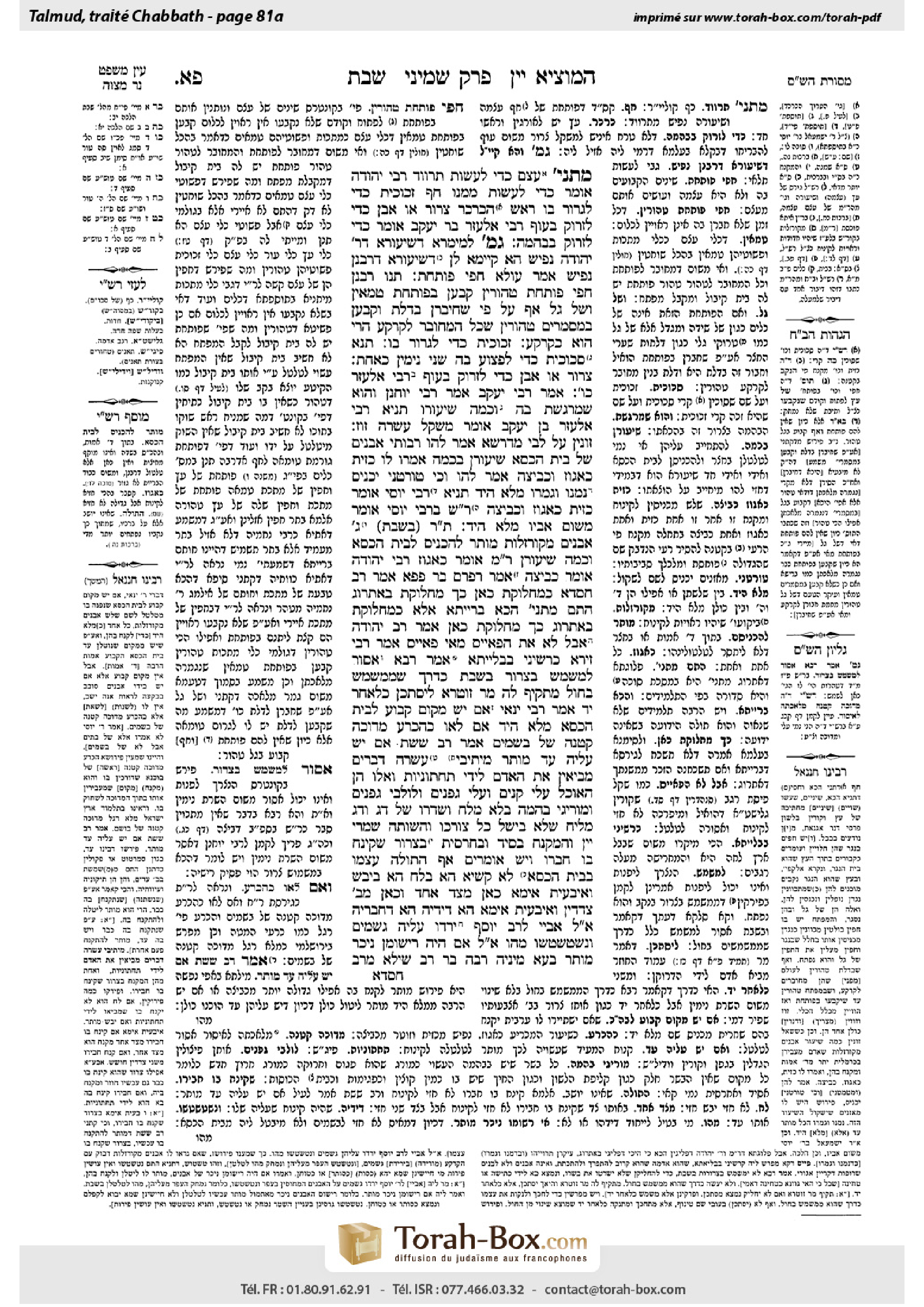
Shabbat 81a: Talmud study for Daf Yomi
Daf Yomi is the daily study of one Talmud folio. Explore 37 tractates with scans, Hebrew text, Sefaria English and AI-generated French translations where annotated.
Passage selection and English or AI-generated French translation are available where the scan has annotations. Daf Study is independent of Torah-Box and Sefaria.
Browse Shabbat · שבת · All tractatesShabbat 81a text and translations
This page of Shabbat includes the Aramaic text, an English translation and an AI-generated French translation, alongside the scan above.
שבת פ״א א · Aramaic and Hebrew text
מַתְנִי׳ עֶצֶם כְּדֵי לַעֲשׂוֹת תַּרְווֹד. רַבִּי יְהוּדָה אוֹמֵר: כְּדֵי לַעֲשׂוֹת מִמֶּנּוּ חָף. זְכוּכִית — כְּדֵי לִגְרוֹר בָּהּ רֹאשׁ הַכַּרְכֵּר. צְרוֹר אוֹ אֶבֶן — כְּדֵי לִזְרוֹק בָּעוֹף. רַבִּי אֶלְעָזָר בַּר יַעֲקֹב אוֹמֵר: כְּדֵי לִזְרוֹק בַּבְּהֵמָה.
גְּמָ׳ לְמֵימְרָא דְּשִׁיעוּרָא דְרַבִּי יְהוּדָה נְפִישׁ? הָא קַיְימָא לַן דְּשִׁיעוּרָא דְרַבָּנַן נְפִישׁ! אָמַר עוּלָּא: חֲפֵי פּוֹתַחַת. תָּנוּ רַבָּנַן: חֲפֵי פּוֹתַחַת טְהוֹרִין, קְבָעָן בַּפּוֹתַחַת טְמֵאִין. וְשֶׁל גַּל, אַף עַל פִּי שֶׁחִיבְּרָן בַּדֶּלֶת וּקְבָעָן בְּמַסְמְרִים טְהוֹרִין — שֶׁכׇּל הַמְחוּבָּר לַקַּרְקַע הֲרֵי הוּא כַּקַּרְקַע.
זְכוּכִית כְּדֵי לִגְרוֹר בָּהּ. תָּנָא: סְכוּכִית — כְּדֵי לִפְצוֹעַ בָּהּ שְׁנֵי נִימִין כְּאַחַת.
צְרוֹר אוֹ אֶבֶן כְּדֵי לִזְרוֹק בָּעוֹף. רַבִּי אֶלְעָזָר כּוּ׳. אָמַר רַבִּי יַעֲקֹב אָמַר רַבִּי יוֹחָנָן: וְהוּא שֶׁמַּרְגֶּשֶׁת בָּהּ. וְכַמָּה שִׁיעוּרוֹ? תַּנְיָא, רַבִּי אֶלְעָזָר בֶּן יַעֲקֹב אוֹמֵר: מִשְׁקַל עֲשָׂרָה זוּז.
זוּנִין עַל לְבֵי מִדְרְשָׁא, אֲמַר לְהוּ: רַבּוֹתַי, אֲבָנִים שֶׁל בֵּית הַכִּסֵּא שִׁיעוּרָן בְּכַמָּה? אָמְרוּ לוֹ: כְּזַיִת כֶּאֱגוֹז וּכְבֵיצָה. אֲמַר לְהוּ: וְכִי טוּרְטָנֵי יַכְנִיס? נִמְנוּ וְגָמְרוּ מְלֹא הַיָּד. תַּנְיָא, רַבִּי יוֹסֵי אוֹמֵר: כְּזַיִת כֶּאֱגוֹז וּכְבֵיצָה. רַבִּי שִׁמְעוֹן בְּרַבִּי יוֹסֵי אוֹמֵר מִשּׁוּם אָבִיו: מְלֹא הַיָּד.
תָּנוּ רַבָּנַן בְּשַׁבָּת: שָׁלֹשׁ אֲבָנִים מְקוּרְזָלוֹת מוּתָּר לְהַכְנִיס לְבֵית הַכִּסֵּא. וְכַמָּה שִׁיעוּרָן? רַבִּי מֵאִיר אוֹמֵר: כֶּאֱגוֹז. רַבִּי יְהוּדָה אוֹמֵר: כְּבֵיצָה. אָמַר רַפְרָם בַּר פָּפָּא אָמַר רַב חִסְדָּא: כַּמַּחֲלוֹקֶת כָּאן כָּךְ מַחֲלוֹקֶת בְּאֶתְרוֹג. הָתָם מַתְנִיתִין, הָכָא בָּרָיְיתָא! אֶלָּא: כַּמַּחֲלוֹקֶת בְּאֶתְרוֹג כָּךְ מַחֲלוֹקֶת כָּאן.
אָמַר רַב יְהוּדָה: אֲבָל לֹא אֶת הַפָּאיֵיס. מַאי ״פָּאיֵיס״? אָמַר רַבִּי זֵירָא: כַּרְשִׁינֵי בַּבְלָיָיתָא. אָמַר רָבָא: אָסוּר לְמַשְׁמֵשׁ בִּצְרוֹר בְּשַׁבָּת כְּדֶרֶךְ שֶׁמְּמַשְׁמֵשׁ בַּחוֹל. מַתְקִיף לַהּ מָר זוּטְרָא: לִיסְתַּכַּן? כִּלְאַחַר יָד. אָמַר רַבִּי יַנַּאי: אִם יֵשׁ מָקוֹם קָבוּעַ לְבֵית הַכִּסֵּא — מְלֹא הַיָּד. אִם לָאו — כַּהֶכְרֵעַ מְדוֹכָה קְטַנָּה שֶׁל בְּשָׂמִים. אָמַר רַב שֵׁשֶׁת: אִם יֵשׁ עָלֶיהָ עֵד — מוּתָּר.
מֵיתִיבִי? עֲשָׂרָה דְּבָרִים מְבִיאִין אֶת הָאָדָם לִידֵי תַחְתּוֹנִיּוֹת, וְאֵלּוּ הֵן: הָאוֹכֵל עֲלֵי קָנִים, וַעֲלֵי גְפָנִים, וְלוּלַבֵּי גְפָנִים, וּמוֹרִיגֵּי בְהֵמָה בְּלֹא מֶלַח, וְשִׁדְרוֹ שֶׁל דָּג, וְדָג מָלִיחַ שֶׁלֹּא בִּישֵּׁל כׇּל צוֹרְכּוֹ, וְהַשּׁוֹתֶה שִׁמְרֵי יַיִן, וְהַמְקַנֵּחַ בְּסִיד, וּבְחַרְסִית, וְהַמְקַנֵּחַ בִּצְרוֹר שֶׁקִּינַּח בּוֹ חֲבֵרוֹ. וְיֵשׁ אוֹמְרִים: אַף הַתּוֹלֶה עַצְמוֹ בְּבֵית הַכִּסֵּא. לָא קַשְׁיָא: הָא בְּלַח, הָא בְּיָבֵשׁ. וְאִיבָּעֵית אֵימָא: כָּאן מִצַּד אֶחָד, וְכָאן מִשְּׁנֵי צְדָדִין. וְאִיבָּעֵית אֵימָא: הָא דִּידֵיהּ, הָא דְּחַבְרֵיהּ.
אֲמַר לֵיהּ אַבָּיֵי לְרַב יוֹסֵף: יָרְדוּ עָלֶיהָ גְּשָׁמִים וְנִטַּשְׁטְשׁוּ מַהוּ? אֲמַר לֵיהּ: אִם הָיָה רִישּׁוּמָן נִיכָּר — מוּתָּר.
בְּעָא מִינֵּיהּ רַבָּהּ בַּר רַב שֵׁילָא מֵרַב
Shabbat 81a · English translation
MISHNA: The measure that determines liability for carrying out a bone is equivalent to that which is used to make a spoon. Rabbi Yehuda says: In a measure equivalent to that which is used to make from it a key. The measure that determines liability for carrying out glass is equivalent to that which is used to scrape and smooth the top of a bobbin, a sharpened stick used by weavers. The measure that determines liability for carrying out a pebble or a stone is equivalent to that which is used to throw at a bird to chase it away. Rabbi Elazar bar Ya’akov says: Equivalent to that which is used to throw at an animal, which is larger.
GEMARA: The Gemara asks: Is that to say that the measure of Rabbi Yehuda is greater? Don’t we maintain that the measure of the Rabbis is greater? Ulla said: Rabbi Yehuda did not refer to the entire key, but to the teeth of a key. With regard to the above, the Gemara cites that which the Sages taught in a baraita: The teeth of a key are ritually pure, and they cannot become impure when separate from the key, as they have no function on their own. However, if one affixed them to a key, they can become ritually impure as part of a utensil. And teeth of a lock, even though one attached them to the door and affixed them with nails, are ritually pure, as anything attached to the ground has the same legal status as the ground itself, which cannot become ritually impure.
We learned in the mishna: The measure that determines liability for carrying out glass is equivalent to that which is used to scrape and smooth the top of a bobbin. A tanna taught that halakha in a Tosefta in a different manner: The measure that determines liability for carrying out glass is equivalent to that which is used to cut two threads at once, as a glass shard can be used in place of a knife.
We learned in the mishna: The measure that determines liability for carrying out a pebble or a stone is equivalent to that which is used to throw at a bird to chase it away. Rabbi Elazar ben Ya’akov says: Equivalent to that which is used to throw at an animal. Rabbi Ya’akov said that Rabbi Yoḥanan said: And that is only if the stone is large enough that the animal feels it. And how much is the measure of that stone? It was taught in a baraita: Rabbi Elazar ben Ya’akov says: A weight of ten zuz.
The Gemara relates: Zunin entered the study hall and said to the Sages: My teachers, with regard to stones that may be moved on Shabbat for wiping in the bathroom, how much is their measure? They said to him: Stones of only three sizes may be moved for that purpose: An olive-bulk, a nut-bulk, and an egg-bulk. He said to them: And will he take scales [turtani] into the bathroom to weigh each stone? They were counted and the Sages concluded that one need not measure the stones. He simply takes a handful of stones. It was taught in a baraita: Rabbi Yosei says the measure of bathroom stones is an olive-bulk, a nut-bulk, and an egg-bulk. Rabbi Shimon, son of Rabbi Yosei, says in the name of his father: One need not measure the stones. He simply takes a handful of stones.
Our Sages taught in a baraita with regard to Shabbat: Three sharpened stones may be taken into the bathroom. And what is their measure? Rabbi Meir says: A nut-bulk; Rabbi Yehuda says: An egg-bulk. Rafram bar Pappa said that Rav Ḥisda said: Like the dispute here, so too, there is a dispute between these Sages with regard to the minimum size of a citron. The Gemara is surprised at the comparison. Why does the Gemara cite this baraita as a mnemonic to recall the dispute about the size of a citron? There, with regard to a citron, it is a mishna that is known by all; here it is a baraita, which is more obscure and more likely to require a mnemonic and a comparison to a more popular source. Rather, the phrasing is reversed: Like the dispute with regard to a citron, so too, there is a dispute here.
Rav Yehuda said: However, one may not move the payis for use in a bathroom. The Gemara asks: What is the meaning of payis? Rabbi Zeira said: It refers to clods of Babylonian earth, which is soft and flaky. Rava said: It is prohibited to manipulate the anus with a stone on Shabbat to help discharge bodily functions in the manner that one manipulates it on weekdays. Mar Zutra strongly objected to this: According to Rava, should one endanger himself by refraining from relieving himself? The Gemara explains: He meant he should do so in an unusual manner and not in the manner it is typically done. With regard to the size of stones, Rabbi Yannai said: If he has a fixed place for a bathroom, he may take a handful of stones; if he does not need them on Shabbat, he can use them on another occasion. If he does not have a fixed place he may bring in an average size stone, which is the size of a small mortar used for crushing spices. Rav Sheshet said: If the stone has an indication on it that it has already been used in the bathroom, one is permitted to move it for that purpose on Shabbat, regardless of its size.
The Gemara raises an objection: Is it permitted to wipe with a stone that was already used? Didn’t the Sages say: Ten things bring a person to suffer from hemorrhoids and they are: One who eats the leaves of bulrushes, grape leaves, tendrils of grapevines, the palate and tongue of an animal, as well as any other part of the animal which is not smooth and which has protrusions, without salt, the spine of a fish, a salty fish that is not fully cooked, and one who drinks wine dregs, and one who cleans himself with lime and clay, the materials from which earthenware is made, and one who cleans himself with a stone with which another person has cleaned himself. And some say: One who suspends himself in the bathroom as well. Apparently, using a previously used stone is dangerous to one’s health. The Gemara answers: This is not difficult. Here, where it is prohibited, is referring to a case where the stone is still moist. Here, where it is permitted, is referring to a case where the stone is dry. And if you wish, say instead that here, where it is prohibited, is referring to one side, using the side that was already used; here, where it is permitted, is referring to both sides, using the other side of the same stone. And if you wish, say instead that this, where it is permitted, is referring to one’s own stone, which he used to clean himself; this, where it is prohibited, is referring to another person’s stone, which poses a danger.
Abaye said to Rav Yosef: What is the ruling if rain fell on the stone and the indications that it had been used previously in the bathroom were obscured? The dilemma is: Is moving it permitted like a stone that is designated for use in the bathroom on Shabbat, or, is moving it prohibited since its indications were obscured and it might have the legal status of set-aside? Rav Yosef said to him: If indication on them is apparent, even though it is partially obscured, it is permitted, since the stone remains clear that it is designated for use in the bathroom.
Rabba bar Rav Sheila raised a dilemma before Rav
Shabbat 81a · Traduction française (IA)
MICHNA : La quantité qui rend passible pour le transport d’un os est celle qui sert à fabriquer une cuillère. Rabbi Yehouda dit : celle qui suffit à en fabriquer une clé. La quantité qui rend passible pour le transport de verre est celle qui sert à racler et à lisser le sommet d’une navette, un bâton pointu utilisé par les tisserands. La quantité qui rend passible pour le transport d’un caillou ou d’une pierre est celle qui sert à le lancer sur un oiseau pour le chasser. Rabbi Elazar bar Ya’akov dit : celle qui sert à le lancer sur un animal, lequel est plus gros.
GUEMARA : La Guemara demande : Cela signifie-t-il que la mesure de Rabbi Yehouda est plus grande ? Ne considérons-nous pas que la mesure des rabbins est plus grande ? Oulla dit : Rabbi Yehouda ne parlait pas de la clé entière, mais des dents d’une clé. À ce propos, la Guemara cite ce que les Sages ont enseigné dans une baraïta : Les dents d’une clé sont rituellement pures et ne peuvent pas devenir impures lorsqu’elles sont séparées de la clé, car elles n’ont aucune fonction à elles seules. Toutefois, si on les fixe à une clé, elles peuvent devenir rituellement impures en tant que partie d’un ustensile. Quant aux dents d’une serrure, même si on les a attachées à la porte et fixées avec des clous, elles sont rituellement pures, car tout ce qui est attaché au sol a le même statut juridique que le sol lui-même, qui ne peut pas devenir rituellement impur.
Nous avons appris dans la Michna : La quantité qui rend passible pour le transport de verre est celle qui sert à racler et à lisser le sommet d’une navette. Un tanna a enseigné cette halakha dans une Tossefta sous une forme différente : La quantité qui rend passible pour le transport de verre est celle qui sert à couper deux fils à la fois, puisqu’un éclat de verre peut remplacer un couteau.
Nous avons appris dans la Michna : La quantité qui rend passible pour le transport d’un caillou ou d’une pierre est celle qui sert à la lancer sur un oiseau pour le chasser. Rabbi Elazar ben Ya’akov dit : celle qui sert à la lancer sur un animal. Rabbi Ya’akov a dit au nom de Rabbi Yoḥanan : cela n’est vrai que si la pierre est assez grosse pour que l’animal la sente. Et quelle est la mesure de cette pierre ? Il a été enseigné dans une baraïta : Rabbi Elazar ben Ya’akov dit : un poids de dix zouz.
La Guemara rapporte : Zounin entra dans la maison d’étude et dit aux Sages : Mes maîtres, quelle est la mesure des pierres que l’on peut déplacer le Chabbat pour s’essuyer aux toilettes ? Ils lui répondirent : Seules des pierres de trois tailles peuvent être déplacées à cette fin : du volume d’une olive, du volume d’une noix et du volume d’un œuf. Il leur dit : Va-t-on emporter une balance [turtani] aux toilettes pour peser chaque pierre ? Les Sages en discutèrent et conclurent qu’il n’est pas nécessaire de mesurer les pierres. Il suffit de prendre une poignée de pierres. Il a été enseigné dans une baraïta : Rabbi Yossei dit que la mesure des pierres pour les toilettes est du volume d’une olive, d’une noix et d’un œuf. Rabbi Shimon, fils de Rabbi Yossei, dit au nom de son père : Il n’est pas nécessaire de mesurer les pierres. Il suffit de prendre une poignée de pierres.
Nos Sages ont enseigné dans une baraïta au sujet du Chabbat : On peut emporter aux toilettes trois pierres pointues. Et quelle est leur mesure ? Rabbi Meïr dit : du volume d’une noix ; Rabbi Yehouda dit : du volume d’un œuf. Rafram bar Pappa a dit au nom de Rav Ḥisda : De même qu’il y a ici une controverse, ces Sages sont également en désaccord sur la taille minimale d’un cédrat. La Guemara s’étonne de cette comparaison. Pourquoi la Guemara cite-t-elle cette baraïta comme moyen mnémotechnique pour se rappeler la controverse sur la taille d’un cédrat ? Là-bas, au sujet du cédrat, il s’agit d’une Michna connue de tous ; ici, il s’agit d’une baraïta, plus obscure et plus susceptible de nécessiter un moyen mnémotechnique et une comparaison avec une source plus connue. Il faut plutôt inverser la formulation : De même qu’il y a une controverse au sujet du cédrat, il y a également ici une controverse.
Rav Yehouda dit : Toutefois, on ne peut pas déplacer le payis pour s’en servir aux toilettes. La Guemara demande : Que signifie payis ? Rabbi Zeïra dit : Il s’agit de mottes de terre babylonienne, qui est molle et friable. Rava dit : Il est interdit, le Chabbat, de manipuler l’anus avec une pierre pour faciliter l’évacuation des selles, comme on le fait en semaine. Mar Zoutra s’y opposa vivement : Selon Rava, faut-il se mettre en danger en s’abstenant de se soulager ? La Guemara explique : Il voulait dire qu’on doit le faire d’une manière inhabituelle, et non de la manière habituelle. Concernant la taille des pierres, Rabbi Yannai dit : Si l’on a un endroit fixe pour aller aux toilettes, on peut prendre une poignée de pierres ; si l’on n’en a pas besoin le Chabbat, on pourra s’en servir une autre fois. Si l’on n’a pas d’endroit fixe, on peut apporter une pierre de taille moyenne, de la taille d’un petit mortier servant à broyer des épices. Rav Sheshet dit : Si la pierre porte une marque indiquant qu’elle a déjà servi aux toilettes, il est permis de la déplacer à cette fin le Chabbat, quelle que soit sa taille.
La Guemara soulève une objection : Est-il permis de s’essuyer avec une pierre qui a déjà servi ? Les Sages n’ont-ils pas dit : Dix choses conduisent une personne à souffrir d’hémorroïdes : manger des feuilles de massette, des feuilles de vigne, des vrilles de vigne, le palais et la langue d’un animal, ainsi que toute autre partie de l’animal qui n’est pas lisse et présente des aspérités, sans sel ; manger l’épine dorsale d’un poisson ; manger un poisson salé qui n’est pas complètement cuit ; boire du dépôt de vin ; se nettoyer avec de la chaux et de l’argile, les matériaux dont on fabrique la poterie ; et se nettoyer avec une pierre dont une autre personne s’est déjà servie. Et certains disent : se suspendre aux toilettes également. Il semble donc que l’usage d’une pierre déjà utilisée présente un danger pour la santé. La Guemara répond : Il n’y a pas de difficulté. Le cas où cela est interdit concerne une pierre encore humide ; le cas où cela est permis concerne une pierre sèche. Et si tu veux, dis plutôt : le cas où cela est interdit concerne l’utilisation du côté qui a déjà servi ; le cas où cela est permis concerne l’utilisation de l’autre côté de la même pierre. Et si tu veux, dis plutôt : le cas où cela est permis concerne sa propre pierre, dont il s’est servi pour se nettoyer ; le cas où cela est interdit concerne la pierre d’une autre personne, qui présente un danger.
Abayé dit à Rav Yossef : Quelle est la halakha si la pluie est tombée sur la pierre et que les signes indiquant qu’elle avait déjà servi aux toilettes ont été effacés ? La question est la suivante : peut-on la déplacer comme une pierre réservée à l’usage des toilettes le Chabbat, ou est-il interdit de la déplacer puisque ses signes ont été effacés et qu’elle pourrait avoir le statut d’objet mouktsé ? Rav Yossef lui répondit : Si un signe reste visible sur la pierre, même s’il est en partie effacé, cela est permis, car il demeure évident que la pierre est réservée à l’usage des toilettes.
Rabba bar Rav Sheila souleva une question devant Rav
Traduction française générée par IA à partir de l’édition anglaise de Sefaria. Vérifie toujours un passage avec le texte source.
Text from Sefaria: William Davidson Edition - Vocalized Aramaic (CC BY NC); William Davidson Edition - English (CC BY NC).