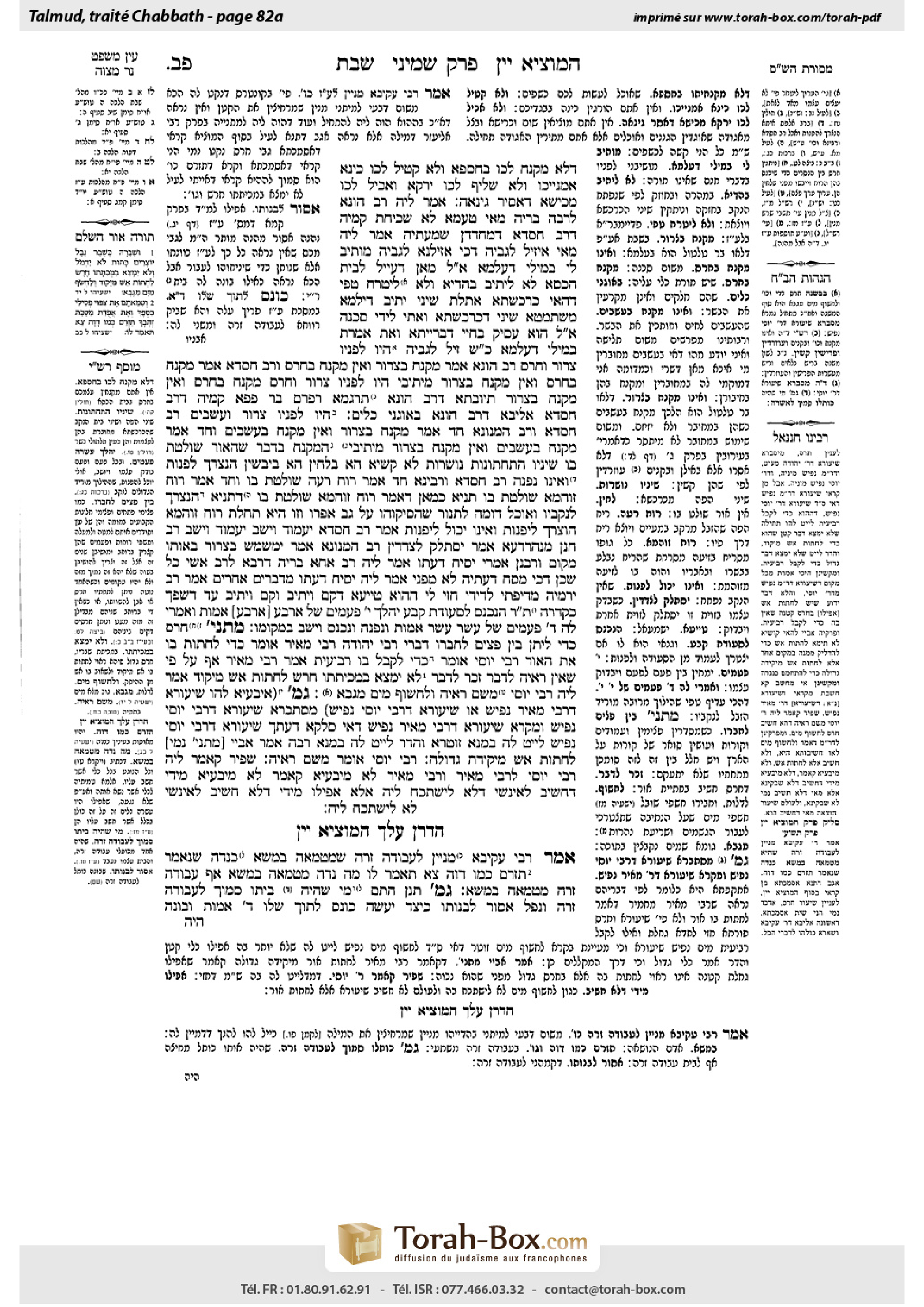
Shabbat 82a: Talmud study for Daf Yomi
Daf Yomi is the daily study of one Talmud folio. Explore 37 tractates with scans, Hebrew text, Sefaria English and AI-generated French translations where annotated.
Passage selection and English or AI-generated French translation are available where the scan has annotations. Daf Study is independent of Torah-Box and Sefaria.
Browse Shabbat · שבת · All tractatesShabbat 82a text and translations
This page of Shabbat includes the Aramaic text, an English translation and an AI-generated French translation, alongside the scan above.
שבת פ״ב א · Aramaic and Hebrew text
דְּלָא מִקַּנַּח לְכוּ בְּחַסְפָּא, וְלָא קְטִיל לְכוּ כִּינָּא אַמָּנַיְיכוּ, וְלָא שְׁלִיף לְכוּ יַרְקָא וַאֲכִיל לְכוּ מִכִּישָּׁא דְּאָסַר גִּינָּאָה.
אֲמַר לֵיהּ רַב הוּנָא לְרַבָּה בְּרֵיהּ: מַאי טַעְמָא לָא שְׁכִיחַתְּ קַמֵּיהּ דְּרַב חִסְדָּא, דִּמְחַדְּדָן שְׁמַעְתָּתֵיהּ? אֲמַר לֵיהּ: מַאי אֵיזִיל לְגַבֵּיהּ? דְּכִי אָזֵילְנָא לְגַבֵּיהּ מוֹתִיב לִי בְּמִילֵּי דְעָלְמָא. אָמַר לִי: מַאן דְּעָיֵיל לְבֵית הַכִּסֵּא לָא לִיתֵּיב בְּהֶדְיָא, וְלָא לִיטְרַח טְפֵי — דְּהַאי כַּרְכַּשְׁתָּא אַתְּלָת שִׁינֵּי יָתֵיב, דִילְמָא מִשְׁתַּמְטִי שִׁינֵּי דְכַרְכַּשְׁתָּא וְאָתֵי לִידֵי סַכָּנָה. אֲמַר לֵיהּ: הוּא עָסֵיק בְּחַיֵּי דִּבְרִיָּיתָא וְאַתְּ אָמְרַתְּ בְּמִילֵּי דְעָלְמָא?! כׇּל שֶׁכֵּן זִיל לְגַבֵּיהּ.
הָיוּ לְפָנָיו צְרוֹר וָחֶרֶס, רַב הוּנָא אָמַר: מְקַנֵּחַ בַּצְּרוֹר וְאֵין מְקַנֵּחַ בַּחֶרֶס, וְרַב חִסְדָּא אָמַר: מְקַנֵּחַ בַּחֶרֶס וְאֵין מְקַנֵּחַ בַּצְּרוֹר. מֵיתִיבִי: הָיוּ לְפָנָיו צְרוֹר וָחֶרֶס — מְקַנֵּחַ בַּחֶרֶס וְאֵין מְקַנֵּחַ בַּצְּרוֹר, תְּיוּבְתָּא דְרַב הוּנָא! תַּרְגְּמַהּ רַפְרָם בַּר פָּפָּא קַמֵּיהּ דְּרַב חִסְדָּא אַלִּיבָּא דְרַב הוּנָא: בְּאוֹגְנֵי כֵּלִים.
הָיוּ לְפָנָיו צְרוֹר וַעֲשָׂבִים, רַב חִסְדָּא וְרַב הַמְנוּנָא, חַד אָמַר: מְקַנֵּחַ בַּצְּרוֹר וְאֵין מְקַנֵּחַ בָּעֲשָׂבִים, וְחַד אָמַר: מְקַנֵּחַ בָּעֲשָׂבִים וְאֵין מְקַנֵּחַ בַּצְּרוֹר. מֵיתִיבִי: הַמְקַנֵּחַ בְּדָבָר שֶׁהָאוּר שׁוֹלֶטֶת בּוֹ שִׁינָּיו הַתַּחְתּוֹנוֹת נוֹשְׁרוֹת! לָא קַשְׁיָא: הָא בְּלַחִין, הָא בִּיבֵשִׁין.
הַנִּצְרָךְ לִפָּנוֹת וְאֵינוֹ נִפְנֶה, רַב חִסְדָּא וְרָבִינָא, חַד אָמַר: רוּחַ רָעָה שׁוֹלֶטֶת בּוֹ, וְחַד אָמַר: רוּחַ זוּהֲמָא שׁוֹלֶטֶת בּוֹ. תַּנְיָא כְּמַאן דְּאָמַר רוּחַ זוּהֲמָא שׁוֹלֶטֶת בּוֹ, דְּתַנְיָא: הַנִּצְרָךְ לִנְקָבָיו וְאוֹכֵל — דּוֹמֶה לְתַנּוּר שֶׁהִסִּיקוּהוּ עַל גַּב אֶפְרוֹ, וְזוֹ הִיא תְּחִלַּת רוּחַ זוּהֲמָא.
הוּצְרַךְ לִיפָּנוֹת וְאֵינוֹ יָכוֹל לִיפָּנוֹת, אָמַר רַב חִסְדָּא: יַעֲמוֹד וְיֵשֵׁב, יַעֲמוֹד וְיֵשֵׁב. רַב חָנָן מִנְּהַרְדְּעָא אָמַר: יִסְתַּלֵּק לִצְדָדִין. רַב הַמְנוּנָא אָמַר: יְמַשְׁמֵשׁ בִּצְרוֹר בְּאוֹתוֹ מָקוֹם. וְרַבָּנַן אָמְרִי: יַסִּיחַ דַּעְתּוֹ. אֲמַר לֵיהּ רַב אַחָא בְּרֵיהּ דְּרָבָא לְרַב אָשֵׁי: כׇּל שֶׁכֵּן דְּכִי מַסַּח דַּעְתֵּיהּ לָא מִפְּנֵי! אֲמַר לֵיהּ: יַסִּיחַ דַּעְתּוֹ מִדְּבָרִים אֲחֵרִים. אָמַר רַב יִרְמְיָה מִדִּיפְתִּי: לְדִידִי חֲזֵי לִי הַהוּא טַיָּיעָא דְּקָם וְיָתֵיב וְקָם וְיָתֵיב עַד דְּשָׁפֵךְ כְּקִדְרָה.
תָּנוּ רַבָּנַן: הַנִּכְנָס לִסְעוּדַת קֶבַע, יְהַלֵּךְ עֶשֶׂר פְּעָמִים שֶׁל אַרְבַּע [אַרְבַּע] אַמּוֹת, וְאָמְרִי לַהּ: אַרְבַּע פְּעָמִים שֶׁל עֶשֶׂר עֶשֶׂר אַמּוֹת, וְנִפְנֶה, וְנִכְנָס וְיֹשֵׁב בִּמְקוֹמוֹ.
מַתְנִי׳ חֶרֶס — כְּדֵי לִיתֵּן בֵּין פַּצִּים לַחֲבֵרוֹ, דִּבְרֵי רַבִּי יְהוּדָה. רַבִּי מֵאִיר אוֹמֵר: כְּדֵי לַחְתּוֹת בּוֹ אֶת הָאוּר. רַבִּי יוֹסֵי אוֹמֵר: כְּדֵי לְקַבֵּל בּוֹ רְבִיעִית. אָמַר רַבִּי מֵאִיר: אַף עַל פִּי שֶׁאֵין רְאָיָה לַדָּבָר, זֵכֶר לַדָּבָר: ״לֹא יִמָּצֵא בִמְכִתָּתוֹ חֶרֶשׂ לַחְתּוֹת אֵשׁ מִיָּקוּד״. אָמַר לוֹ רַבִּי יוֹסֵי: מִשָּׁם רְאָיָה? ״וְלַחְשׂוֹף מַיִם מִגֶּבֶא״.
גְּמָ׳ אִיבַּעְיָא לְהוּ: שִׁיעוּרָא דְרַבִּי מֵאִיר נְפִישׁ, אוֹ שִׁיעוּרָא דְרַבִּי יוֹסֵי נְפִישׁ? מִסְּבָרָא — שִׁיעוּרָא דְרַבִּי יוֹסֵי נְפִישׁ, וּמִקְּרָא — שִׁיעוּרָא דְרַבִּי מֵאִיר נְפִישׁ. דְּאִי סָלְקָא דַּעְתָּךְ שִׁיעוּרָא דְרַבִּי יוֹסֵי נְפִישׁ, לָיֵיט לַהּ בְּמָנָא זוּטְרָא, וַהֲדַר לָיֵיט לַהּ בְּמָנָא רַבָּה?! אָמַר אַבָּיֵי: [מַתְנִיתִין נָמֵי] לַחְתּוֹת אֵשׁ מִיקִידָה גְּדוֹלָה.
רַבִּי יוֹסֵי אוֹמֵר: מִשָּׁם רְאָיָה. שַׁפִּיר קָאָמַר לֵיהּ רַבִּי יוֹסֵי לְרַבִּי מֵאִיר! וְרַבִּי מֵאִיר ״לָא מִיבַּעְיָא״ קָאָמַר: לָא מִיבַּעְיָא מִידֵּי דַּחֲשִׁיב לְאִינָשֵׁי דְּלָא לִישְׁתְּכַח לֵיהּ, אֶלָּא אֲפִילּוּ מִידֵּי דְּלָא חֲשִׁיב לְאִינָשֵׁי לָא לִישְׁתְּכַח לֵיהּ.
הדרן עלך המוציא יין
מַתְנִי׳ אָמַר רַבִּי עֲקִיבָא: מִנַּיִין לַעֲבוֹדָה זָרָה שֶׁמְּטַמְּאָה בְּמַשָּׂא כְּנִדָּה, שֶׁנֶּאֱמַר: ״תִּזְרֵם כְּמוֹ דָוָה צֵא תֹּאמַר לוֹ״ — מָה נִדָּה מְטַמְּאָה בְּמַשָּׂא, אַף עֲבוֹדָה זָרָה מְטַמְּאָה בְּמַשָּׂא.
גְּמָ׳ תְּנַן הָתָם: מִי שֶׁהָיָה בֵּיתוֹ סָמוּךְ לַעֲבוֹדָה זָרָה וְנָפַל, אָסוּר לִבְנוֹתוֹ. כֵּיצַד יַעֲשֶׂה? כּוֹנֵס לְתוֹךְ שֶׁלּוֹ אַרְבַּע אַמּוֹת וּבוֹנֶה.
Shabbat 82a · English translation
as you do not clean yourselves with an earthenware shard, and you do not kill lice on your garments, and you do not pull out a vegetable and eat it before you untie the bundle that was tied by the gardener? This implies that all these actions carry with them the danger of witchcraft.
Rav Huna said to his son Rabba: What is the reason that you are not to be found among those who study before Rav Ḥisda, whose halakhot are incisive? Rabba said to him: For what purpose should I go to him? When I go to him, he sits me down and occupies me in mundane matters not related to Torah. For example, he said to me: One who enters a bathroom should not sit down immediately and should not exert himself excessively because the rectum rests upon three teeth, the muscles that hold it in place, and there is concern lest the teeth of the rectum dislocate through exertion and he come to danger. Rav Huna said to his son Rabba: He is dealing with matters crucial to human life, and you say that he is dealing with mundane matters? Now that I know what you meant, all the more so go before him.
The Gemara continues to discuss these halakhot. Rav Huna said: One who relieves himself and needs to wipe and has before him a stone and an earthenware shard, wipes with the stone and does not wipe with the earthenware shard, since he might injure himself. And Rav Ḥisda said: He wipes with the earthenware shard and does not wipe with the stone, which is set-aside. The Gemara raises an objection from a baraita: If one had before him a stone and an earthenware shard, he wipes with the earthenware shard and does not wipe with the stone. That is a conclusive refutation of the opinion of Rav Huna. Rafram bar Pappa explained it before Rav Ḥisda in accordance with the opinion of Rav Huna: It is not referring to earthenware shards, but to the smooth rims of vessels, which pose no danger.
There were before him a stone and grasses. With regard to the preferred method to wipe on Shabbat, what is the ruling? There is a dispute between Rav Ḥisda and Rav Hamnuna. One said: He wipes with the stone and does not wipe with the grasses; and one said: He wipes with the grasses and does not wipe with the stone. The Gemara raises an objection from a baraita: One who wipes with something flammable, his lower teeth, which hold the intestines in place, fall out. How then, may one clean himself with grasses? The Gemara answers: This is not difficult: This, where it is permitted, is referring to moist grass; that, where it is prohibited, is referring to dry grass.
The Gemara continues to discuss this topic. With regard to one who needs to defecate and does not do so, there is a dispute between Rav Ḥisda and Ravina. One said: An evil spirit dominates him; and one said: An odor of filth dominates him. It was taught in a baraita in accordance with the one who said that an odor of filth dominates him, as it was taught: One who needs to defecate and eats is comparable to an oven that was heated on top of its ashes; and that is the onset of an odor of filth.
The Gemara continues to discuss the issue: One who needed to defecate and is unable to do so, Rav Ḥisda said: He should stand and sit, stand and sit. Rav Ḥanan from Neharde’a said: He should move to the sides and attempt to relieve himself in a different spot. Rav Hamnuna said: He should manipulate with a stone in that place. And the Rabbis said: He should divert his thoughts to other matters. Rav Aḥa, son of Rava, said to Rav Ashi: All the more so that when he diverts his thoughts he will not be able to defecate. Rav Ashi said to him: He should divert his thoughts from other matters, and focus exclusively on his effort to relieve himself. Rav Yirmeya from Difti said: I saw a certain Arab who stood and sat, stood and sat, until it poured out of him like a pot. Apparently, that advice is effective.
The Sages taught in a baraita: One who wishes to enter and partake of a regular meal that will last for some time, should pace a distance of four cubits ten times, and some say, ten cubits four times, in order to expedite the movement of the bowels, and defecate, and enter, and sit in his place.
MISHNA: One who carries out a shard of earthenware on Shabbat is liable if it is in a measure equivalent to that which is used to place between one pillar and another when piled on the ground to separate them; this is the statement of Rabbi Yehuda. Rabbi Meir says: In a measure equivalent to that which is used to stoke a fire with it. Rabbi Yosei says: In a measure equivalent to that which is used to hold a quarter of a log in it. Rabbi Meir said: Although there is no proof for the matter, there is a biblical allusion to my opinion, as it is stated: “And He shall break it as a potter’s vessel is broken, smashing it without sparing; and there shall not be found among its pieces a shard to rake fire on the hearth” (Isaiah 30:14). Rabbi Yosei said to him: Is there proof from there? The verse concludes: “And to extract water from the cistern,” indicating that earthenware is significant if it is large enough to hold water.
GEMARA: A dilemma was raised before the Sages: Is the measure stated by Rabbi Meir greater, or is the measure stated by Rabbi Yosei greater? The Gemara responds: It is reasonable to say that the measure of Rabbi Yosei is greater; however, based on the verse it appears that the measure of Rabbi Meir is greater. As, if it enters your mind to say that the measure of Rabbi Yosei with regard to the shard of earthenware is greater, would the prophet first curse him by saying that a small vessel will not be found, and then curse him by saying that a larger vessel will not be found? Abaye said: The mishna is also referring to a large shard of earthenware required to stoke the fire of a large conflagration. Even in the mishna, Rabbi Meir’s measure is larger.
We learned in the mishna that Rabbi Yosei said to him: Is there proof from there? He cites proof for his opinion from the conclusion of that same verse. The Gemara comments: Rabbi Yosei spoke well to Rabbi Meir. And how does Rabbi Meir address that proof? He explains that the verse is stated employing the style of: There is no need. It should be understood as follows: There is no need to say that an item that is significant to people, e.g., a large shard of earthenware to stoke a fire, shall not be found, but even an item that is insignificant to people, i.e., a shard to extract water, shall not be found. Therefore, the conclusion of the verse does not contradict Rabbi Meir’s opinion.
MISHNA: Rabbi Akiva said: From where is it derived that idolatry, e.g., a statue of a deity, transmits impurity imparted by carrying even when the person who carries it does not come into contact with it, just as a menstruating woman does? As it is stated: “And you will defile the silver overlays of your statues, and the golden plating of your idols, you will cast them away as you would a menstruating woman [dava], you will tell it, get out” (Isaiah 30:22). Just as a menstruating woman transmits impurity imparted by carrying, so too, idolatry transmits impurity imparted by carrying.
GEMARA: Since the halakhot of idolatry and the impurity it causes are beyond the scope of tractate Shabbat, the fundamentals of this halakha are cited from tractate Avoda Zara. We learned in a mishna there: One whose house was adjacent to a house of idolatry, sharing a common wall, and the dividing wall fell, it is prohibited to rebuild it as he would thereby have built a wall for idol worship. What should one do? He moves four cubits into his own land and builds the wall there.
Shabbat 82a · Traduction française (IA)
puisque vous ne vous nettoyez pas avec un tesson de terre cuite, que vous ne tuez pas les poux sur vos vêtements et que vous ne cueillez pas un légume pour le manger avant d’avoir dénoué le fagot attaché par le jardinier ? Cela implique que toutes ces actions comportent un risque lié à la sorcellerie.
Rav Houna dit à son fils Rabba : « Pourquoi ne te trouve-t-on pas parmi ceux qui étudient auprès de Rav Ḥisda, dont les halakhot sont incisives ? » Rabba lui répondit : « À quoi bon aller chez lui ? Quand j’y vais, il me fait asseoir et m’occupe de questions profanes, sans rapport avec la Torah. Par exemple, il m’a dit : “Celui qui entre dans des toilettes ne doit pas s’asseoir immédiatement ni faire trop d’efforts, car le rectum repose sur trois dents, les muscles qui le maintiennent en place ; on craint que ces dents ne se déboîtent sous l’effort et qu’il ne se mette ainsi en danger.” » Rav Houna dit à son fils Rabba : « Il traite de questions essentielles à la vie humaine, et toi, tu dis qu’il s’occupe de choses profanes ? Maintenant que je sais ce que tu voulais dire, à plus forte raison, va étudier auprès de lui. »
La Guemara poursuit l’examen de ces halakhot. Rav Houna dit : Celui qui a déféqué et doit s’essuyer, et qui a devant lui une pierre et un tesson de terre cuite, s’essuie avec la pierre et non avec le tesson, car il pourrait se blesser. Rav Ḥisda dit, lui : Il s’essuie avec le tesson de terre cuite et non avec la pierre, qui est mouktsé. La Guemara soulève une objection tirée d’une baraïta : S’il a devant lui une pierre et un tesson de terre cuite, il s’essuie avec le tesson et non avec la pierre. Cela réfute définitivement l’opinion de Rav Houna. Rafram bar Pappa expliqua ce passage devant Rav Ḥisda conformément à l’opinion de Rav Houna : il ne s’agit pas de tessons de terre cuite, mais des bords lisses de récipients, qui ne présentent aucun danger.
Il avait devant lui une pierre et des herbes. Quelle est, le Chabbat, la méthode préférable pour s’essuyer ? Rav Ḥisda et Rav Hamnouna sont en désaccord. L’un dit : Il s’essuie avec la pierre et non avec les herbes ; l’autre dit : Il s’essuie avec les herbes et non avec la pierre. La Guemara soulève une objection tirée d’une baraïta : Celui qui s’essuie avec une matière inflammable voit tomber ses dents inférieures, qui maintiennent les intestins en place. Comment peut-il donc se nettoyer avec des herbes ? La Guemara répond : Il n’y a pas de difficulté : le cas où cela est permis concerne des herbes humides ; celui où cela est interdit concerne des herbes sèches.
La Guemara poursuit l’examen de ce sujet. Au sujet de celui qui a besoin de déféquer et ne le fait pas, Rav Ḥisda et Ravina sont en désaccord. L’un dit : Un mauvais esprit prend possession de lui ; l’autre dit : Une odeur de souillure prend possession de lui. Une baraïta a été enseignée conformément à celui qui dit qu’une odeur de souillure prend possession de lui, car il a été enseigné : Celui qui a besoin de déféquer et qui mange est comparable à un four chauffé sur ses cendres ; c’est là le début d’une odeur de souillure.
La Guemara poursuit l’examen de la question : Celui qui avait besoin de déféquer et n’y parvient pas, Rav Ḥisda dit qu’il doit se lever et s’asseoir, se lever et s’asseoir. Rav Ḥanan de Nehardea dit qu’il doit se déplacer sur le côté et essayer de se soulager à un autre endroit. Rav Hamnouna dit qu’il doit se masser à cet endroit avec une pierre. Les Sages disent qu’il doit détourner ses pensées vers d’autres sujets. Rav Aḥa, fils de Rava, dit à Rav Ashi : « À plus forte raison, en détournant ses pensées, il ne pourra pas déféquer. » Rav Ashi lui répondit : « Qu’il détourne ses pensées des autres sujets et qu’il se concentre exclusivement sur l’effort de déféquer. » Rav Yirmeya de Difti dit : « J’ai vu un certain Arabe se lever et s’asseoir, se lever et s’asseoir, jusqu’à ce que tout sorte de lui comme d’une marmite. » Cela montre que ce conseil est efficace.
Les Sages ont enseigné dans une baraïta : Celui qui souhaite entrer et prendre un repas ordinaire qui durera quelque temps doit parcourir dix fois une distance de quatre coudées — certains disent : quatre fois une distance de dix coudées — afin de stimuler le transit intestinal, puis déféquer, entrer et s’asseoir à sa place.
MICHNA : Celui qui transporte un tesson de terre cuite le Chabbat est passible si celui-ci a la mesure de celui qu’on utilise, posé sur le sol, pour placer entre un pilier et un autre lorsque ceux-ci sont empilés ; telle est l’opinion de Rabbi Yehouda. Rabbi Meïr dit : Il doit avoir la mesure de celui qu’on utilise pour attiser le feu. Rabbi Yossi dit : Il doit avoir la mesure d’un récipient pouvant contenir un quart de log. Rabbi Meïr lui dit : Bien qu’il n’y ait pas de preuve à ce sujet, mon opinion trouve une allusion dans la Torah écrite, comme il est dit : « Il le brisera comme on brise un vase de potier, le fracassant sans pitié ; et parmi ses morceaux, on ne trouvera pas de tesson pour prendre du feu sur le foyer » (Isaïe 30,14). Rabbi Yossi lui dit : « Est-ce une preuve tirée de là ? » Le verset se conclut ainsi : « et pour puiser de l’eau dans la citerne », ce qui indique que la terre cuite a de l’importance si elle est assez grande pour contenir de l’eau.
GUEMARA : Les Sages ont soulevé un dilemme : la mesure énoncée par Rabbi Meïr est-elle supérieure ou bien est-ce celle énoncée par Rabbi Yossi ? La Guemara répond : Il est raisonnable de dire que la mesure de Rabbi Yossi est supérieure ; toutefois, d’après le verset, il semble que celle de Rabbi Meïr soit supérieure. En effet, si l’on envisageait que la mesure du tesson de terre cuite selon Rabbi Yossi est supérieure, le prophète le maudirait-il d’abord en disant qu’on ne trouvera pas un petit récipient, puis en le maudissant en disant qu’on ne trouvera pas un récipient plus grand ? Abaye dit : La Michna parle aussi d’un grand tesson de terre cuite, nécessaire pour attiser le feu d’un grand brasier. Même selon la Michna, la mesure de Rabbi Meïr est plus grande.
Nous avons appris dans la Michna que Rabbi Yossi lui dit : « Est-ce une preuve tirée de là ? » Il apporte à l’appui de son opinion la conclusion de ce même verset. La Guemara remarque : Rabbi Yossi a bien répondu à Rabbi Meïr. Et comment Rabbi Meïr répond-il à cette preuve ? Il explique que le verset est formulé selon le procédé de « il n’est pas nécessaire ». Il faut le comprendre ainsi : Il n’est pas nécessaire de dire qu’un objet important aux yeux des gens, par exemple un grand tesson de terre cuite pour attiser le feu, ne se trouvera pas ; même un objet sans importance aux yeux des gens, c’est-à-dire un tesson pour puiser de l’eau, ne se trouvera pas. La conclusion du verset ne contredit donc pas l’opinion de Rabbi Meïr.
MICHNA : Rabbi Akiva dit : D’où déduit-on que l’idolâtrie, par exemple une statue de divinité, transmet l’impureté par portage même lorsque celui qui la porte n’entre pas en contact avec elle, tout comme une femme menstruée ? Comme il est dit : « Vous rendrez impurs les revêtements d’argent de vos statues et les ornements d’or de vos idoles ; vous les rejetterez comme une femme menstruée [dava], et vous leur direz : “Dehors !” » (Isaïe 30,22). De même qu’une femme menstruée transmet l’impureté par portage, l’idolâtrie transmet elle aussi l’impureté par portage.
GUEMARA : Puisque les halakhot de l’idolâtrie et l’impureté qu’elle provoque dépassent le cadre du traité Chabbat, les principes de cette halakha sont cités du traité Avoda Zara. Nous avons appris dans une Michna de ce traité : La maison de quelqu’un était contiguë à une maison d’idolâtrie, avec un mur mitoyen, et ce mur s’est écroulé ; il est interdit de le reconstruire, car il construirait ainsi un mur pour le culte idolâtre. Que doit-il faire ? Il se retire de quatre coudées sur son propre terrain et y construit le mur.
Traduction française générée par IA à partir de l’édition anglaise de Sefaria. Vérifie toujours un passage avec le texte source.
Text from Sefaria: William Davidson Edition - Vocalized Aramaic (CC BY NC); William Davidson Edition - English (CC BY NC).