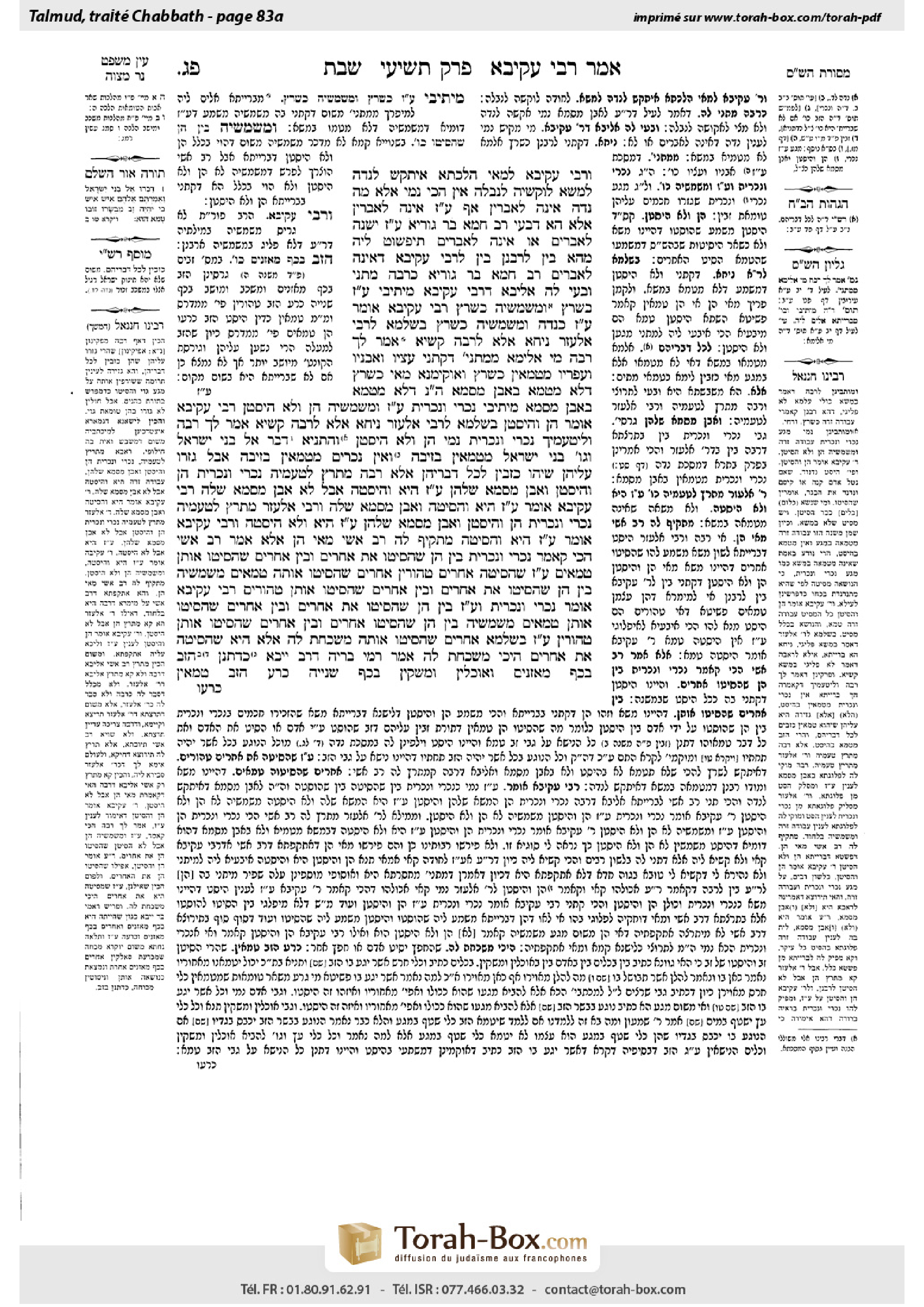
Shabbat 83a: Talmud study for Daf Yomi
Daf Yomi is the daily study of one Talmud folio. Explore 37 tractates with scans, Hebrew text, Sefaria English and AI-generated French translations where annotated.
Passage selection and English or AI-generated French translation are available where the scan has annotations. Daf Study is independent of Torah-Box and Sefaria.
Browse Shabbat · שבת · All tractatesShabbat 83a text and translations
This page of Shabbat includes the Aramaic text, an English translation and an AI-generated French translation, alongside the scan above.
שבת פ״ג א · Aramaic and Hebrew text
וְרַבִּי עֲקִיבָא לְמַאי הִלְכְתָא אִיתַּקַּשׁ לְנִדָּה? — לְמַשָּׂא, לַוקְּשֵׁיהּ לִנְבֵלָה! אִין, הָכִי נָמֵי. אֶלָּא: מָה נִדָּה אֵינָהּ לְאֵבָרִין, אַף עֲבוֹדָה זָרָה אֵינָהּ לְאֵבָרִין. אֶלָּא הָא דְּבָעֵי רַב חָמָא בַּר גּוּרְיָא: עֲבוֹדָה זָרָה יֶשְׁנָהּ לְאֵבָרִים אוֹ אֵינָהּ לְאֵבָרִים — תִּיפְשׁוֹט לֵיהּ מֵהָא בֵּין לְרַבָּנַן בֵּין לְרַבִּי עֲקִיבָא דְּאֵינָהּ לְאֵבָרִים! רַב חָמָא בַּר גּוּרְיָא כְּרַבָּה מַתְנֵי, וּבָעֵי לַהּ אַלִּיבָּא דְרַבִּי עֲקִיבָא.
מֵיתִיבִי: עֲבוֹדָה זָרָה כְּשֶׁרֶץ וּמְשַׁמְּשֶׁיהָ כְּשֶׁרֶץ. רַבִּי עֲקִיבָא אוֹמֵר: עֲבוֹדָה זָרָה כְּנִדָּה וּמְשַׁמְּשֶׁיהָ כְּשֶׁרֶץ. בִּשְׁלָמָא לְרַבִּי אֶלְעָזָר נִיחָא, אֶלָּא לְרַבָּה קַשְׁיָא! אָמַר לָךְ רַבָּה: מִי אַלִּימָא מִמַּתְנִיתִין, דְּקָתָנֵי: ״עֵצָיו וַאֲבָנָיו וַעֲפָרָיו מְטַמְּאִין כְּשֶׁרֶץ״, וְאוֹקִימְנָא, מַאי כְּשֶׁרֶץ — דְּלָא מְטַמֵּא בְּאֶבֶן מְסָמָא, הָכָא נָמֵי דְּלָא מְטַמֵּא בְּאֶבֶן מְסָמָא.
מֵיתִיבִי: נָכְרִי וְנׇכְרִית, עֲבוֹדָה זָרָה וּמְשַׁמְּשֶׁיהָ — הֵן וְלֹא הֶיסֵּטָן. רַבִּי עֲקִיבָא אוֹמֵר: הֵן וְהֶיסֵּטָן. בִּשְׁלָמָא לְרַבִּי אֶלְעָזָר נִיחָא, אֶלָּא לְרַבָּה קַשְׁיָא. אָמַר לָךְ רַבָּה: וְלִיטַעְמָיךְ נָכְרִי וְנׇכְרִית נָמֵי, הֵן וְלֹא הֶיסֵּטָן?! וְהָתַנְיָא: ״דַּבֵּר אֶל בְּנֵי יִשְׂרָאֵל וְגוֹ׳״ — בְּנֵי יִשְׂרָאֵל מְטַמְּאִין בְּזִיבָה וְאֵין גּוֹיִם מְטַמְּאִין בְּזִיבָה, אֲבָל גָּזְרוּ עֲלֵיהֶן שֶׁיְּהוּ כְּזָבִין לְכׇל דִּבְרֵיהֶן.
אֶלָּא רַבָּה מְתָרֵץ לְטַעְמֵיהּ: נָכְרִי וְנׇכְרִית — הֵן וְהֶיסֵּטָן וְאֶבֶן מְסָמָא שֶׁלָּהֶן. עֲבוֹדָה זָרָה — הִיא וְהֶיסֵּטָהּ, אֲבָל לֹא אֶבֶן מְסָמָא שֶׁלָּהּ. רַבִּי עֲקִיבָא אוֹמֵר: עֲבוֹדָה זָרָה — הִיא וְהֶסֵּיטָהּ וְאֶבֶן מְסָמָא שֶׁלָּהּ. וְרַבִּי אֶלְעָזָר מְתָרֵץ לְטַעְמֵיהּ: נָכְרִי וְנׇכְרִית — הֵן וְהֶיסֵּטָן וְאֶבֶן מְסָמָא שֶׁלָּהֶן. עֲבוֹדָה זָרָה — הִיא וְלֹא הֶיסֵּטָהּ. וְרַבִּי עֲקִיבָא אוֹמֵר: עֲבוֹדָה זָרָה — הִיא וְהֶסֵּיטָהּ.
מַתְקֵיף לַהּ רַב אָשֵׁי: מַאי ״הֵן״? אֶלָּא אָמַר רַב אָשֵׁי, הָכִי קָאָמַר: גּוֹי וְגוֹיָהּ, בֵּין הֵן שֶׁהֵסִיטוּ אֶת אֲחֵרִים וּבֵין אֲחֵרִים שֶׁהֵסִיטוּ אוֹתָן — טְמֵאִים. עֲבוֹדָה זָרָה שֶׁהֵסִיטָה אֲחֵרִים — טְהוֹרִין, אֲחֵרִים שֶׁהֵסִיטוּ אוֹתָהּ — טְמֵאִים. מְשַׁמְּשֶׁיהָ, בֵּין הֵן שֶׁהֵסִיטוּ אֶת אֲחֵרִים וּבֵין אֲחֵרִים שֶׁהֵסִיטוּ אוֹתָן — טְהוֹרִים. רַבִּי עֲקִיבָא אוֹמֵר: גּוֹי וְגוֹיָהּ וַעֲבוֹדָה זָרָה, בֵּין הֵן שֶׁהֵסִיטוּ אֶת אֲחֵרִים וּבֵין אֲחֵרִים שֶׁהֵסִיטוּ אוֹתָן — טְמֵאִים. מְשַׁמְּשֶׁיהָ, בֵּין הֵן שֶׁהֵסִיטוּ אֲחֵרִים וּבֵין אֲחֵרִים שֶׁהֵסִיטוּ אוֹתָן — טְהוֹרִין.
עֲבוֹדָה זָרָה, בִּשְׁלָמָא אֲחֵרִים שֶׁהֵסִיטוּ אוֹתָהּ — מַשְׁכַּחַתְּ לַהּ. אֶלָּא הִיא שֶׁהֵסִיטָה אֶת אֲחֵרִים הֵיכִי מַשְׁכַּחַתְּ לַהּ? אָמַר רָמֵי בְּרֵיהּ דְּרַב יֵיבָא, כְּדִתְנַן: הַזָּב בְּכַף מֹאזְנַיִם, וָאוֹכָלִין וּמַשְׁקִין בְּכַף שְׁנִיָּיה, כָּרַע הַזָּב — טְמֵאִין,
Shabbat 83a · English translation
And according to the opinion of Rabbi Akiva, with regard to what halakha was idolatry juxtaposed to a menstruating woman? If it was to teach the halakha of impurity imparted by carrying, let it be juxtaposed to an animal carcass and not to a menstruating woman and creeping animals. The Gemara answers: Yes, it is indeed so. However, the juxtaposition to a menstruating woman teaches: Just as a menstruating woman does not transmit impurity through her limbs, as a menstruating woman who leans on an object by a single limb does not transmit impurity imparted by carrying (Ra’avad), so too, an idol does not transmit impurity through its limbs, and a section of an idol does not transmit impurity. The Gemara asks: But that which Rav Ḥama bar Guria raised as a dilemma: Does idolatry have the capacity to transmit impurity through limbs or does it not have the capacity to transmit impurity through its limbs; resolve the dilemma from this, as according to both the Rabbis and Rabbi Akiva, it does not transmit impurity through limbs. According to this explanation, Rabbi Akiva agrees with the Rabbis. The Gemara rejects this: Rav Ḥama bar Guria taught in accordance with the explanation of Rabba and raised the dilemma in accordance with the opinion of Rabbi Akiva.
The Gemara now clarifies the explanations of Rabba and Rabbi Elazar in light of other sources. The Gemara raises an objection from that which was taught in a baraita: The ritual impurity of idolatry is like that of a creeping animal, and the ritual impurity of its accessories is like that of a creeping animal. Rabbi Akiva says: The ritual impurity of idolatry is like that of a menstruating woman, and the ritual impurity of its accessories is like that of a creeping animal. Granted, according to the opinion of Rabbi Elazar, it works out well. However, according to the opinion of Rabba, it is difficult. The dispute between Rabbi Akiva and the Rabbis in this baraita is whether idolatry is likened to a creeping animal and does not transmit impurity imparted by carrying or whether it is likened to a menstruating woman and it does transmit impurity imparted by carrying. According to Rabba, the Rabbis agree that it does transmit impurity imparted by carrying. Rabba could have said to you: Is the proof from this baraita stronger than the mishna in tractate Avoda Zara, which taught: Its wood and stones and dirt transmit impurity like a creeping animal? With regard to that mishna we established: What is the meaning of like a creeping animal? It means that it is like a creeping animal in the sense that it does not transmit impurity by means of a very heavy stone. Here too, the analogy to a creeping animal in the baraita is in the sense that it does not transmit impurity via a very heavy stone.
The Gemara raises an objection from what we learned: A gentile man and a gentile woman, with regard to whom the Rabbis issued a decree that they transmit impurity like a zav, idolatry and its accessories, all transmit impurity. They transmit impurity, and not their movement, i.e., they do not transmit impurity to one who moves them. Rabbi Akiva says: Both they and their movement transmit impurity. Granted, according to the explanation of Rabbi Elazar, this works out well; however, according to the explanation of Rabba, it is difficult. Rabba could have said to you: And according to your reasoning, with regard to a gentile man and a gentile woman as well, do they transmit impurity and their movement does not transmit impurity? Wasn’t it taught in a baraita with regard to the verse: “Speak to the children of Israel and say to them, when any man has an emission from his body, his emission is impure” (Leviticus 15:2), by Torah law, only the children of Israel become impure through the emission of a zav, and gentiles do not become impure through the emission of a zav? But the Sages decreed that they should be considered like a zav for all their halakhic matters. Since gentiles have the legal status of a zav, they should transmit impurity through carrying. Therefore, the baraita that states that gentiles do not transmit impurity through carrying is corrupted and must be emended.
Rather, Rabba explains and adds to the baraita in accordance with his reasoning: A gentile man and a gentile woman transmit impurity, they and their movement and their very heavy stone. And idolatry transmits impurity, it and its movement but not its very heavy stone. Rabbi Akiva says: Idolatry transmits impurity, it and its movement and its very heavy stone. And Rabbi Elazar explains and adds to the baraita in accordance with his reasoning as follows: A gentile man and a gentile woman transmit impurity, they and their movement and their very heavy stone. Idolatry transmits impurity, it and not its movement. And Rabbi Akiva says: Idolatry transmits impurity, it and its movement.
Rav Ashi strongly objects to this explanation: According to this explanation, what is the meaning of the word they in the context of this baraita? It would have been sufficient to say that their movement transmits impurity. The fact that the gentiles themselves are ritually impure is obvious. Apparently, the word they is emphasized in order to teach an additional halakha. Rather, Rav Ashi said, this is what the baraita is saying: With regard to a gentile man and a gentile woman, whether they moved others or others moved them, the others are ritually impure. The impurity of a gentile is like that of a zav, which is unique in that anything that a zav moves becomes impure even if he did not touch it directly. Idolatry that moved others, the others remain ritually pure; however, others who moved it are ritually impure. With regard to its accessories, whether they moved others or others moved them, the others remain ritually pure. Rabbi Akiva says: A gentile man and a gentile woman and idolatry, whether they moved others or others moved them, the others are ritually impure. Its accessories, whether they moved others or others moved them, the others remain ritually pure. According to this explanation, both the word they and the word movement, both of which appear in the baraita, are significant.
Rav Ashi’s explanation explains the baraita, but the Gemara questions the matter itself. With regard to idolatry, granted, a case where others moved it can be easily found. However, a case where the idolatry moved others, under what circumstances can it be found? How can an idol move another object? Rami, son of Rav Yeiva, said, a case like that is possible, as we learned in a mishna: In a case where the zav sat on one pan of a balance scale, and food and drinks were on the second pan, if the zav tipped the scales, the food and drinks on the other pan are ritually impure because the zav moved them.
Shabbat 83a · Traduction française (IA)
Et selon l’opinion de Rabbi Akiva, à propos de quelle halakha l’idolâtrie a-t-elle été rapprochée d’une femme menstruée ? Si c’était pour enseigner la halakha de l’impureté transmise par portage, qu’on la rapproche d’une carcasse animale, et non d’une femme menstruée et des animaux rampants. La Guemara répond : Oui, c’est bien le cas. Toutefois, le rapprochement avec une femme menstruée enseigne ceci : de même qu’une femme menstruée ne transmet pas l’impureté par ses membres — car une femme menstruée qui s’appuie sur un objet avec un seul membre ne transmet pas l’impureté par portage (Ra’avad) — de même, une idole ne transmet pas l’impureté par ses membres, et une partie d’idole ne transmet pas l’impureté. La Guemara demande : Mais Rav Ḥama bar Guria a soulevé cette question : l’idolâtrie peut-elle transmettre l’impureté par ses membres, ou non ? On peut trancher cette question à partir de là, puisque, selon les Rabbins comme selon Rabbi Akiva, elle ne transmet pas l’impureté par ses membres. Selon cette explication, Rabbi Akiva est d’accord avec les Rabbins. La Guemara rejette cette conclusion : Rav Ḥama bar Guria a enseigné conformément à l’explication de Rabba et a soulevé cette question selon l’opinion de Rabbi Akiva.
La Guemara précise maintenant les explications de Rabba et de Rabbi Elazar à la lumière d’autres sources. La Guemara soulève une objection à partir de ce qui a été enseigné dans une baraïta : l’impureté rituelle de l’idolâtrie est semblable à celle d’un animal rampant, et l’impureté rituelle de ses accessoires est semblable à celle d’un animal rampant. Rabbi Akiva dit : l’impureté rituelle de l’idolâtrie est semblable à celle d’une femme menstruée, et l’impureté rituelle de ses accessoires est semblable à celle d’un animal rampant. Cela s’accorde bien avec l’opinion de Rabbi Elazar. En revanche, selon l’opinion de Rabba, cela pose une difficulté. Dans cette baraïta, le désaccord entre Rabbi Akiva et les Rabbins porte sur la question de savoir si l’idolâtrie est assimilée à un animal rampant et ne transmet pas l’impureté par portage, ou si elle est assimilée à une femme menstruée et transmet l’impureté par portage. Selon Rabba, les Rabbins sont d’accord qu’elle transmet l’impureté par portage. Rabba aurait pu te répondre : Cette baraïta constitue-t-elle une preuve plus forte que la Michna du traité Avoda Zara, qui enseigne que son bois, ses pierres et sa terre transmettent l’impureté comme un animal rampant ? À propos de cette Michna, nous avons établi que l’expression « comme un animal rampant » signifie qu’elle est semblable à un animal rampant en ce sens qu’elle ne transmet pas l’impureté au moyen d’une pierre très lourde. Ici aussi, la comparaison avec un animal rampant dans la baraïta signifie qu’elle ne transmet pas l’impureté au moyen d’une pierre très lourde.
La Guemara soulève une objection à partir de ce que nous avons appris : un homme non juif et une femme non juive, au sujet desquels les Rabbins ont décrété qu’ils transmettent l’impureté comme un zav, l’idolâtrie et ses accessoires transmettent tous l’impureté. Ils transmettent l’impureté, mais pas leur mouvement, c’est-à-dire qu’ils ne transmettent pas l’impureté à celui qui les déplace. Rabbi Akiva dit : eux-mêmes et leur mouvement transmettent l’impureté. Cela s’accorde bien avec l’explication de Rabbi Elazar ; en revanche, selon l’explication de Rabba, cela pose une difficulté. Rabba aurait pu te répondre : Mais, selon ton raisonnement, un homme non juif et une femme non juive transmettent-ils l’impureté, tandis que leur mouvement ne la transmet pas ? N’a-t-on pas enseigné dans une baraïta, à propos du verset : « Parle aux enfants d’Israël et dis-leur : Tout homme qui a un écoulement de son corps, son écoulement est impur » (Lévitique 15, 2), que, selon la Torah, seuls les enfants d’Israël deviennent impurs par l’écoulement d’un zav, tandis que les non-Juifs ne deviennent pas impurs par l’écoulement d’un zav ? Mais les Sages ont décrété qu’ils seraient considérés comme des zav pour toutes les questions de halakha les concernant. Puisque les non-Juifs ont le statut juridique d’un zav, ils devraient transmettre l’impureté par portage. La baraïta qui affirme que les non-Juifs ne transmettent pas l’impureté par portage est donc corrompue et doit être corrigée.
Au contraire, Rabba explique et complète la baraïta conformément à son raisonnement : un homme non juif et une femme non juive transmettent l’impureté, eux-mêmes, leur mouvement et la pierre très lourde qu’ils portent. L’idolâtrie transmet l’impureté, elle-même et son mouvement, mais pas la pierre très lourde qu’elle porte. Rabbi Akiva dit : l’idolâtrie transmet l’impureté, elle-même, son mouvement et la pierre très lourde qu’elle porte. Rabbi Elazar explique et complète, lui aussi, la baraïta conformément à son raisonnement, comme suit : un homme non juif et une femme non juive transmettent l’impureté, eux-mêmes, leur mouvement et la pierre très lourde qu’ils portent. L’idolâtrie transmet l’impureté par elle-même, mais pas par son mouvement. Rabbi Akiva dit : l’idolâtrie transmet l’impureté par elle-même et par son mouvement.
Rav Ashi s’oppose vivement à cette explication : selon celle-ci, que signifie le mot « eux » dans le contexte de cette baraïta ? Il aurait suffi de dire que leur mouvement transmet l’impureté. Le fait que les non-Juifs eux-mêmes soient rituellement impurs est évident. Apparemment, le mot « eux » est mis en relief afin d’enseigner une halakha supplémentaire. Rav Ashi a plutôt dit que la baraïta signifie ceci : dans le cas d’un homme non juif ou d’une femme non juive, que ces derniers déplacent d’autres personnes ou que d’autres les déplacent, ces autres personnes deviennent rituellement impures. L’impureté d’un non-Juif est semblable à celle d’un zav, qui a cette particularité que tout ce qu’il déplace devient impur, même s’il ne l’a pas touché directement. Si l’idolâtrie déplace d’autres personnes, celles-ci restent rituellement pures ; en revanche, ceux qui la déplacent deviennent rituellement impurs. Quant à ses accessoires, qu’ils déplacent d’autres personnes ou que d’autres les déplacent, ces autres personnes restent rituellement pures. Rabbi Akiva dit : qu’il s’agisse d’un homme non juif, d’une femme non juive ou de l’idolâtrie, que ces derniers déplacent d’autres personnes ou que d’autres les déplacent, ces autres personnes deviennent rituellement impures. Quant aux accessoires de l’idolâtrie, qu’ils déplacent d’autres personnes ou que d’autres les déplacent, ces autres personnes restent rituellement pures. Selon cette explication, les deux termes qui figurent dans la baraïta, « eux » et « mouvement », sont significatifs.
L’explication de Rav Ashi rend compte de la baraïta, mais la Guemara remet en question la chose elle-même. S’agissant de l’idolâtrie, certes, on peut facilement trouver un cas où d’autres la déplacent. Mais dans quelles circonstances peut-on trouver un cas où l’idolâtrie déplace d’autres objets ? Comment une idole peut-elle déplacer un autre objet ? Rami, fils de Rav Yeiva, dit qu’un tel cas est possible, comme nous l’avons appris dans une Michna : si un zav s’est assis sur l’un des plateaux d’une balance et que des aliments et des boissons se trouvaient sur l’autre plateau, si le zav a fait pencher la balance, les aliments et les boissons placés sur l’autre plateau deviennent rituellement impurs, car le zav les a déplacés.
Traduction française générée par IA à partir de l’édition anglaise de Sefaria. Vérifie toujours un passage avec le texte source.
Text from Sefaria: William Davidson Edition - Vocalized Aramaic (CC BY NC); William Davidson Edition - English (CC BY NC).